John Calvin’s Gospel of Works, Fear, and NO Assurance
 “While the soteriology lends uncertainty to one’s eternal destiny, is assurance found more in having the elder’s approval? After all, if he states that you are saved, heaven will bind it.”
John Calvin was pure heretic. The present-day exaltation of him by the who’s who of evangelicals is an abomination before the Lord. For Calvin, the Christian life is lived out in a progression of justification; viz, justification is not a onetime event that is a finished work by God alone. The Christian life starts with repentance and faith, and that not only justifies us in the beginning, it must continue to justify us throughout the course of our life. “Progressive sanctification” is really progressive justification. The Christian life is not lived out as a result of our salvation; we must live in the progression of salvation and stay in its status through faith and repentance alone. We must keep ourselves saved by perpetual repentance. This is the “P” in TULIP, “perseverance of the saints.” No distinction is made between repentance unto salvation and repentance as a son of God. Calvin evokes all Scriptural calls to repentance for salvation as indicative of the Christian life. Calvin cites biblical salvation verses—as verses pertaining to the Christian life throughout the Calvin Institutes.
Furthermore, Calvin insisted that Christian repentance is motivated by fear, and repentance is active, while the results of repentance, a joyful rebirth experience, is the work of God. It is a perpetual revisiting of the gospel that saved us in order to keep ourselves saved. Our only work is repenting of sin while works imputed by God to our Christian life are only experienced, and not performed.
First, Calvin defines repentance in his Institutes. Keep in mind that he is not writing about original salvation, but the Christian life. This will be confirmed after this citation:
Certain learned men, who lived long before the present days and were desirous to speak simply and sincerely according to the rule of Scripture, held that repentance consists of two parts, mortification and quickening. By mortification they mean, grief of soul and terror, produced by a conviction of sin and a sense of the divine judgment. For when a man is brought to a true knowledge of sin, he begins truly to hate and abominate sin… By quickening they mean, the comfort which is produced by faith, as when a man prostrated by a consciousness of sin, and smitten with the fear of God, afterwards beholding his goodness, and the mercy, grace, and salvation obtained through Christ, looks up, begins to breathe, takes courage, and passes, as it were, from death unto life. I admit that these terms, when rightly interpreted, aptly enough express the power of repentance; only I cannot assent to their using the term quickening, for the joy which the soul feels after being calmed from perturbation and fear. It more properly means, that desire of pious and holy living which springs from the new birth; as if it were said, that the man dies to himself that he may begin to live unto God (CI 3.33).
We must now explain the third part of the definition, and show what is meant when we say that repentance consists of two parts—viz. the mortification of the flesh, and the quickening of the Spirit (CI 3.3.8).
And for how long do we partake in this perpetual repentance (mortification) and rebirth (vivification)?
This renewal, indeed, is not accomplished in a moment, a day, or a year, but by uninterrupted, sometimes even by slow progress God abolishes the remains of carnal corruption in his elect, cleanses them from pollution, and consecrates them as his temples, restoring all their inclinations to real purity, so that during their whole lives they may practice repentance, and know that death is the only termination to this warfare…It is not denied that there is room for improvement; but what I maintain is, that the nearer any one approaches in resemblance to God, the more does the image of God appear in him. That believers may attain to it, God assigns repentance as the goal towards which they must keep running [emphasis added] during the whole course of their lives (CI 3.3.9).
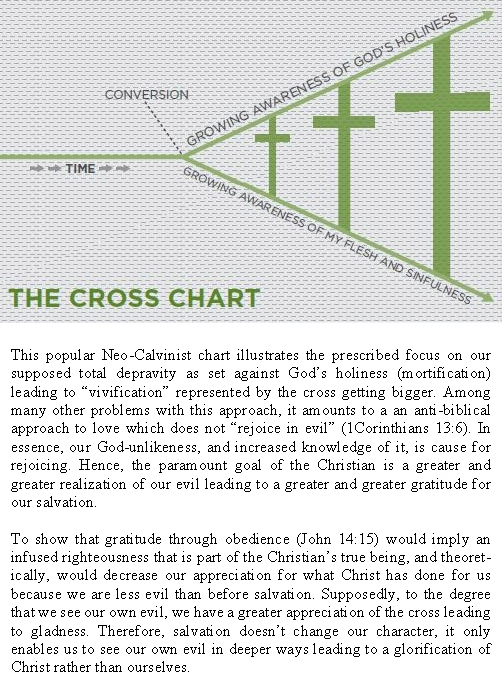
Though Calvin wrote of being transformed into the “image” of God, this is part and parcel with the passive and perpetual rebirth experience by the Christian. This does not denote a change or improvement in the Christian’s nature which would lessen the need for repentance. Obviously, if you look at the chart below, raising the trajectory of repentance makes the cross smaller, so repentance leading to real change is not in focus here. Calvin’s idea of transformation regards the birthing of realms which is experienced by the Christian through joy. Hence, the new birth is perpetual through the Christian’s life and is the result of perpetual repentance. We are to repent and dwell on our own depravity, and leave any quickenings or rebirth experiences to God:
He, however, who has emptied himself (cf. Phil. 2:7) through suffering no longer does works but knows that God works and does all things in him. For this reason, whether God does works or not, it is all the same to him. He neither boasts if he does good works, nor is he disturbed if God does not do good works through him. He knows that it is sufficient if he suffers and is brought low by the cross in order to be annihilated all the more. It is this that Christ says in John 3:7, »You must be born anew.« To be born anew, one must consequently first die and then be raised up with the Son of Man. To die, I say, means to feel death at hand (Martin Luther: Heidelberg Disputation, theses 24).
In obedience to God’s word we should fight to walk in the paths where he has promised his blessings. But when and how they come is God’s to decide, not ours. If they delay, we trust the wisdom of our Father’s timing, and we wait. In this way joy remains a gift, while we work patiently in the field of obedience and fight against the weeds and the crows and the rodents. Here is where joy will come. Here is where Christ will reveal himself (John 14:21). But that revelation and that joy will come when and how Christ chooses. It will be a gift… Heaven hangs on having the taste of joy in God. Therefore, it might not be so strange after all to think of fighting for this joy. Our eternal lives depend on it (John Piper: When I Don’t Desire God; p.43, p.34).
It is also important to note that in this construct, for the most part, repentance is something we focus on, and not something we necessarily try to do. The goal is to see our own depravity in a deeper and deeper way, and this results in a joyful rebirth experience that is totally out of our control. But yet, we must fight for this joy, or rebirth experience because “Our eternal lives depend on it.” Not only is this clearly works salvation, but it makes our eternal destiny ambiguous at best. Therefore…
Let us, therefore, embrace Christ, who is kindly offered to us, and comes forth to meet us: he will number us among his flock, and keep us within his fold. But anxiety arises as to our future state. For as Paul teaches, that those are called who were previously elected, so our Savior shows that many are called, but few chosen (Mt. 22:14). Nay, even Paul himself dissuades us from security, when he says, “Let him that thinketh he standeth take heed lest he fall,” (1 Cor. 10:12). And again, “Well, because of unbelief they were broken off, and thou standest by faith. Be not high-minded, but fear: for if God spared not the natural branches, take heed lest he also spare not thee,” (Rom. 11:20, 21). In fine, we are sufficiently taught by experience itself, that calling and faith are of little value without perseverance, which, however, is not the gift of all (CI 3.24.6).
There is danger on the way to salvation in heaven. We need ongoing protection after our conversion. Our security does not mean we are home free. There is a battle to be fought (John Piper: Bethlehem Baptist Church Minneapolis, Minnesota; The Elect Are Kept by the Power of God October 17, 1993).
According to Calvin, fear of future judgment is one of the primary motivations for repentance in the Christians life:
By mortification they mean, grief of soul and terror, produced by a conviction of sin and a sense of the divine judgment [sec.3]… it seems to me, that repentance may be not inappropriately defined thus: A real conversion of our life unto God, proceeding from sincere and serious fear of God; and consisting in the mortification of our flesh and the old man, and the quickening of the Spirit. In this sense are to be understood all those addresses in which the prophets first, and the apostles afterwards, exhorted the people of their time to repentance. The great object for which they labored was, to fill them with confusion for their sins and dread of the divine judgment, that they might fall down and humble themselves before him whom they had offended, and, with true repentance, retake themselves to the right path [sec.5]… The second part of our definition is, that repentance proceeds from a sincere fear of God. Before the mind of the sinner can be inclined to repentance, he must be aroused by the thought of divine judgment; but when once the thought that God will one day ascend his tribunal to take an account of all words and actions has taken possession of his mind, it will not allow him to rest, or have one moment’s peace, but will perpetually urge him to adopt a different plan of life, that he may be able to stand securely at that judgment-seat. Hence the Scripture, when exhorting to repentance, often introduces the subject of judgment, as in Jeremiah, “Lest my fury come forth like fire, and burn that none can quench it, because of the evil of your doings,” (Jer. 4:4)… The stern threatening which God employs are extorted from him by our depraved dispositions [sec.7] [from the CI 3.3.3-7].
Of course, this is all in egregious contradiction to the Scriptures; viz,
1John 4:18 – There is no fear in love, but perfect love casts out fear. For fear has to do with punishment, and whoever fears has not been perfected in love.
Calvin’s false gospel requires us to run a race of perpetual repentance driven by fear of judgment in order to keep ourselves saved. The new birth is not a onetime event known as regeneration, but is only an EXPERIENCE that follows the mortification of repentance. Calvin states that these quickenings that follow mortification are accompanied by joy and subjective manifestations of God’s image. Many are called, but not all have the gift of persevering in the cycle of mortification and vivification. Therefore, assurance of salvation is dubious at best.
Beside the fact that the apostle John wrote the book of 1John so that we can “know” that we are saved, Calvin’s gospel contradicts a mass of holy writ. This subjective gospel also adds a peculiar twist if you consider Calvin’s power of the keys; ie., whatever elders bind on earth will be bound in heaven. While the soteriology lends uncertainty to one’s eternal destiny, is assurance found more in having the elder’s approval? After all, if he states that you are saved, heaven will bind it.
paul

John Calvin Heresy 101: Sabbath Salvation
I often hear complaints that Reformed theology is too complicated, and therefore difficult to judge according to its truthfulness. “So, everything seems ok at the Calvinist church I attend, and they talk about the Bible.” Well, this isn’t difficult to understand: Calvin believed you keep yourself saved by living your Christian life according to the Old Testament Sabbath. In what way? Answer: by not doing any works. The Christian life must be lived out as the Sabbath Day, and in the same way that working on the Sabbath was a capital offense in the Old Testament, working in the Christian life will bring spiritual death:
Ezekiel is still more full, but the sum of what he says amounts to this: that the Sabbath is a sign by which Israel might know God is their sanctifier. If our sanctification consists in the mortification of our own will, the analogy between the external sign and the thing signified is most appropriate. We must rest entirely, in order that God may work in us; we must resign our own will, yield up our heart, and abandon all the lusts of the flesh. In short, we must desist from all the acts of our mind, that God working in us, we may rest in him, as the Apostle also teaches (Heb. 3:13; 4:3, 9). [The Calvin Institutes 2.8.29]
And how long, and to what degree should we live out the Sabbath?
Should any expect some secret meaning in the number seven, this being in Scripture the number for perfection, it may have been selected, not without cause, to denote perpetuity. In accordance with this, Moses concludes his description of the succession of day and night on the same day on which he relates that the Lord rested from his works. Another probable reason for the number may be, that the Lord intended that the Sabbath never should be completed before the arrival of the last day. We here begin our blessed rest in him, and daily make new progress in it; but because we must still wage an incessant warfare with the flesh, it should not be consummated until the fulfillment of the prophecy of Isaiah: “From one new moon to another, and from one Sabbath to another, shall all flesh come to worship before me, saith the Lord,” (Isaiah 66:23); in other words, when God shall be “all in all,” (1Cor. 15:28). It may seem, therefore, that the seventh day the Lord delineated to his people the future perfection of his sabbath on the last day, that by continual meditation on the sabbath, they might throughout their whole lives aspire to this perfection. [The Calvin Institutes 2.8.30]
In other words, we “aspire” to perfection (when we are ultimately perfected at the resurrection) “by continual meditation on the sabbath.” When I was sharing these Calvin nuggets with my wife Susan, she asked, “How do you not work in the Christian life?” My answer: ‘By meditating on your own sin and God’s grace and holiness, and thereby allowing God to work through you.’ Her next question: “But how do you know when it is God’s work or your work?” My answer: ‘Everything that you do that is a good work is done by God and only EXPERIENCED by you. All sin is your doing, and is an aid to understanding how sinful you are. All the good works experienced by you are imputed or manifested by God. And, Christians are not to live by faith alone, or in other words, live by the Sabbath for the sake of the manifestations. That would be doing something other than living by faith alone’:
He, however, who has emptied himself (cf. Phil. 2:7) through suffering no longer does works but knows that God works and does all things in him. For this reason, whether God does works or not, it is all the same to him. He neither boasts if he does good works, nor is he disturbed if God does not do good works through him. He knows that it is sufficient if he suffers and is brought low by the cross in order to be annihilated all the more…He is not righteous who does much, but he who, without work, believes much in Christ. [Martin Luther: The Heidelberg Disputation ; thesis 24,25]
Christians, according to the Reformers, are completely unable to do any good work pleasing to God:
We must strongly insist on these two things: that no believer ever performed one work which, if tested by the strict judgment of God, could escape condemnation; and, moreover, that were this granted to be possible (though it is not), yet the act being vitiated and polluted by the sins of which it is certain that the author of it is guilty, it is deprived of its merit. [The Calvin Institutes 3.14.11]
So what’s the point? What’s the payoff? Answer: JOY! The more we live by faith alone (Sabbath rest) in the Christian life by focusing on our sin and God’s Holiness, the more we experience the joy of our original salvation. Said Luther:
Now you ask: What then shall we do? Shall we go our way with indifference because we can do nothing but sin? I would reply: By no means. But, having heard this, fall down and pray for grace and place your hope in Christ in whom is our salvation, life, and resurrection. For this reason we are so instructed-for this reason the law makes us aware of sin so that, having recognized our sin, we may seek and receive grace. Thus God »gives grace to the humble« (1 Pet. 5:5), and »whoever humbles himself will be exalted« (Matt. 23:12). The law humbles, grace exalts. The law effects fear and wrath, grace effects hope and mercy. Through the law comes knowledge of sin (Rom. 3:20), through knowledge of sin, however, comes humility, and through humility grace is acquired… Nor does speaking in this manner give cause for despair, but for arousing the desire to humble oneself and seek the grace of Christ.
This is clear from what has been said, for, according to the gospel, the kingdom of heaven is given to children and the humble (Mark 10:14,16), and Christ loves them. They cannot be humble who do not recognize that they are damnable whose sin smells to high heaven. Sin is recognized only through the law. It is apparent that not despair, but rather hope, is preached when we are told that we are sinners. Such preaching concerning sin is a preparation for grace, or it is rather the recognition of sin and faith in such preaching. Yearning for grace wells up when recognition of sin has arisen. A sick person seeks the physician when he recognizes the seriousness of his illness. Therefore one does not give cause for despair or death by telling a sick person about the danger of his illness, but, in effect, one urges him to seek a medical cure. To say that we are nothing and constantly sin when we do the best we can does not mean that we cause people to despair (unless we are fools); rather, we make them concerned about the grace of our Lord Jesus Christ. [Heidelberg Disputation: thesis 16, 17]
So, the Christian life is a cycle of seeking mercy by using the Bible (the law) to reveal our wretchedness which results in being “exalted.” It is a perpetual cycle of humbling ourselves resulting in grace (exaltation). Seek mercy—get grace—seek mercy—get grace—seek mercy—get grace. The Reformers called this “mortification and vivification.” This occurs in the Sabbath rest:
Spiritual rest is the mortification of the flesh; so that the sons of God should no longer live to themselves, or indulge their own inclination. So far as the Sabbath was a figure of this rest, I say, it was but for a season; but insomuch as it was commanded to men from the beginning that they might employ themselves in the worship of God, it is right that it should continue to the end of the world. [The Complete Commentaries on the First Book of Moses Called Genesis: Jean Calvin; translated by John King, 1844-1856. Genesis 2:1-15, section 3.]
According to the Reformers, this perpetual cycle of seeking mercy and receiving the joy of grace is in fact their definition of the new birth, and this experience is a congruent deeper and deeper realization of our sinfulness coupled with more and more consistent joy. It is a perpetual reliving of our baptism and the joy thereof (Michael Horton: The Christian Faith; mortification and vivification, pp. 661-663 [Calvin Inst. 3.3.2-9], Paul Washer: The Gospel Call and True Conversion; Part 1, Chapter 1, heading – The Essential Characteristics Of Genuine Repentance, subheading – Continuing and Deepening Work of Repentance, The Heidelberg Disputation These 24, The Complete Biblical Commentary Collection of John Calvin 1844-1856: Commentaries on the Catholic Epistles, Translated by John Owen | 1Peter 4:1-5, section 2). John Piper added some contemporary philosophical pizazz to this doctrine with his Christian Hedonism doctrine. So, the pay-off is easy believism with the JOY bonus. However, many Calvinists contend that it is really the hard and narrow way because the essence of all sin is: to avoid repentance whether unregenerate or Christian. It is the hard way of Dr. Larry Crabb’s “inside look.” It is “peeling off the layers of sin ” prescribed by CJ Mahaney. Nevertheless, the affront to the Bible command to not rejoice in evil cannot be missed here (1Cor 13:6). Also, we must not miss the point that this is a prescription for keeping ourselves saved by living in the Reformed Sabbath:
And this emptying out of self must proceed so far that the Sabbath is violated even by good works, so long as we regard them as our own; for rightly does Augustine remark in the last chapter of the 22nd book, De Civitate Dei, ‘For even our good works themselves, since they are understood to be rather His than ours, are thus imputed to us for the attaining of that Sabbath, when we are still and see that He is God; for, if we attribute them to ourselves, they will be servile, whereas we are told as to the Sabbath, “Thou shalt not do any servile work in it.” [The Complete Commentaries on the First Book of Moses Called Genesis: Jean Calvin; translated by Charles William Bingham ,1844-1856. The Harmony of the Law: Commentaries on the Four Last Books of Moses | Its Repetition—Deuteronomy 5:12-15. ¶2]
In essence, this is salvation by Christ + the Reformed Sabbath Rest. It is living in a cycle of seeking knowledge of our sin in order to better appreciate the cross. Our salvation is not finished, we must “keep ourselves in the love of Christ” (CJ Mahaney). We must keep ourselves in the Reformed Sabbath for the “attaining of that Sabbath.”
paul
For the Sake of the True Gospel STOP Saying that Christ’s Righteousness is Imputed to Us
 Please stop picking up on every little jingle that sounds good and mindlessly repeating it. In Christian circles, every hour on the hour, whether on TV, radio, or a blog, we see or hear, “the imputed righteousness of Christ,” or “we have the righteousness of Christ” etc. Is this technically true? And why does it matter? The fact is, the Bible never states that the righteousness of Christ has been imputed to us, but rather states in many, many, many places that the righteousness of God the Father has been imputed to us. Is that distinction, or if you will, technicality, relevant? Yes it is; very much so.
Why the constant emphasis on the righteousness of Christ being imputed to us when the Bible emphasizes the righteousness of the Father instead? Well, this is a tradition originally promoted during the Reformation out of necessity. It is the righteousness of Christ that must be imputed to us because the Reformers taught that Christ had to keep the law perfectly during His life in order to secure our justification. Hence, righteousness had to be secured by someone fulfilling the law. So, since the righteousness had to be earned or established by Christ, it can only come from Him. If this approach creeps you out—it should.
Reformed types call this the active obedience of Christ. His death on the cross is the passive obedience of Christ. This makes Christ the primary procurer of our salvation and devalues the role of God and the Holy Spirit. God calls and declares us righteous (imputation), Christ died for our sins (the imputation of our sins to Christ), and the Holy Spirit regenerates (the new birth). Salvation is Trinitarian. If God doesn’t call and impute righteousness, no salvation. If Christ doesn’t die for our sins, no salvation. If the Holy Spirit doesn’t regenerate, no salvation.
A Trinitarian view of salvation keeps law in its proper place, a Christocentric view of salvation causes all sorts of problems with the law. It posits the idea that the law had to be fulfilled as a standard for justification—that’s a huuuuge problem.
We are justified APART from the law. This makes it possible for us to aggressively obey the law in sanctification without it affecting our justification.
Adding to the creepiness is the idea that since the law is a standard for our justification, and we can’t keep it perfectly, the perfect obedience of Christ is continually applied if we live by the same gospel that saved us. This also necessitates the death of Christ being perpetually applied to our lives as well (the Calvin Institutes 3.14.11).
When Christians speak of the imputed righteousness of Christ, they are unwittingly partaking in a distortion of the Trinity. Because the Reformers were Platonists, they believed that Christ was the true, good, and beautiful, and everything else, and everyone else, are shadows. And I do mean everyone else, including the Father and the Holy Spirit. Consider these quotes by Reformed teachers:
Christ alone means literally Christ alone, and not the believer. And for that matter, it does not even mean any other member of the Trinity!
~ Geoffrey Paxton
The pastor who makes anything or anyone other than Christ the focus of his message is actually hindering the sanctification of the flock…We don’t ‘see’ Christ literally and physically, of course (I Peter 1:8). But His glory is on full display in the Word of God, and it is every minister’s duty to make that glory known above all other subjects.
~John MacArthur Jr.
And in regard to the Holy Spirit:
But to whom are we introducing people to, Christ or to ourselves? Is the “Good News” no longer Christ’s doing and dying, but our own “Spirit-filled” life?
~Michael Horton
Calvinists, Arminians, and Discernment Bloggers: Why they Will Not Accept the Truth About John Calvin
The Christian community continues to belabor the symptoms resulting from the false gospel of Calvinism. This is a doctrine that is no different from any other works salvation and should be categorized with Adventism, Mormonism, and all of the other isms. Election isn’t the issue; the 5 points are not the issue; at issue is another gospel. A couple of articles written this week are good examples. Dr. Jay Adams wrote a good article about the pervasive lack of practical application in contemporary preaching. But that is a symptom of the problem: Calvin believed that Christian living is the New Testament expression of the Old Testament Sabbath. Hence, to do works in the Christian life is the same as violating the Old Testament Sabbath by working. According to authentic Calvinism, we are saved by faith alone, but since salvation is not a finished work in the believer, we must continue to live by faith alone to keep ourselves saved. Therefore, authentic Calvinism expressed in New Calvinism is a complicated theology that enables us to live the Christian life by faith alone. This is nothing new, James had to refute it and it is why Martin Luther rejected the book of James. That’s why there is no practical application in today’s preaching: it is deemed as works salvation. I have cited John MacArthur in previous articles who has repented of preaching practical application and has stated such plainly. He has stated that we do not apply Scripture to our lives—the Holy Spirit applies it and in most cases we do not even realize that we are obeying. Why? Because it is not us doing the work. He has plainly stated his belief on this. This is the mysticism of realm manifestation that is part and parcel with authentic Calvinism. It enables the living by faith alone in the Christian life by replacing our works with gospel manifestations of good works. In another post this week, Joel Taylor of 5Point Salt suggested that Christians should show New Calvinist Mark Driscoll more mercy because we all “make mistakes.” Mistakes? Driscoll preaches another gospel. The apostle Paul proclaimed a curse on those who preach another gospel. Why is Christianity refusing to deal with this problem? The reasons follow: 1. Calvinists are in-between a rock and a hard place because the resurgence of authentic Calvinism in the form of New Calvinism has brought to light what Calvin really believed. They don’t want to look stupid because they have been calling themselves Calvinists all of these years and didn’t know what he really believed. 2. Arminians are in-between a rock and a hard place because they have been preaching for all of these years that the issue with Calvinism is the election issue. They, too, do not want to look stupid because the real issue all along has been a fundamentally false gospel. 3. Discernment bloggers want to deal with the behavior (the symptoms) and not the gospel because they are Protestants, and by design, they are theologically dumbed down. These are the least guilty of the three. They are attempting to do something about the problem via what they can understand: behavior, but in doing so, they are focusing on symptoms and not the disease. They need to get beyond Hospice care and find the cure. Unfortunately, and perhaps wisely, they treat the New Calvinists as misguided because they don’t have the theological wherewithal to make the case for a false gospel. But again, it is kinda not their fault as they have been deliberately dumbed down by Protestant ecclesia. This has been a Reformed tradition for more than 500 years and is grounded in Augustinian Neo-Platonism. But, looking stupid shouldn’t be the issue; a love for the truth should be the issue; the eternal future of people should be the issue. What a difference it would make if notable Calvinists would admit that they missed it. What a difference it would make if Seminaries would preach the truth about New Calvinism. paul
Update on Missionary Trip to Louisville, Kentucky

The TANC missionary team has determined the process that will be used to evangelize Calvinists at the 2013 Cross Conference. We will simply obtain a hotel room and interact with the conference attenders as they enter and leave. We will videotape the exchanges as much as possible. We look forward to rich dialogue in regard to Calvin’s false gospel. TANC embraces its calling by God to evangelize Calvinists and save them from their false gospel. We have developed the primary tract that will be used and are very excited about it as it gets right to the primary point. The tract can be viewed here. If you have any suggestions for the tract, please send comments to mail@ttanc.com
Your prayers and financial support for this missionary trip would be greatly appreciated. We would like to print several hundred copies of this tract. Leftover tracts will be distributed for free. Donations can be made via Pay Pal using the same email address, or mail check /money order to TANC, PO Box 583, Xenia, Ohio 45385. If you are interested in being part of the team, email us at the same address: mail@ttanc.com.
Blessings,
The TANC evangelism team.

 Paul's Passing Thoughts
6 comments