In Regard to the Newest Neo-Calvinist Controversy: This Post is for Christians Who Don’t Want to be Confused

“Here is why these guys want to have a debate in order to keep people confused: the dirty little secret is; the Reformed false gospel is a matter of simple theological math.”
The Neo-Calvinist movement that has taken over this country has also created a hobby- like subculture via the blogosphere. This theological Entertainment Tonight subculture drifts from one controversy to the next with the WadeWatch blog leading the way.
It’s pretty obvious at this point that none of this is about truth and solutions, but rather a wallowing in confusion for the sake of drama. Neo-Calvinist leaders are all but deliberately keeping people confused, and to a great degree, that’s what Christians want. The Scriptures state plainly that in the latter days people will heap to themselves teachers with itching ears. And this is nothing new; Paul exhorted Timothy to avoid endless controversies. Come now, let’s be honest; “endless controversies” describes our church culture to a “T.”
The newest recycled “controversy” is more wrangling over the first, second, and third use of the law, or the law/gospel discussion. As a new Christian in the early 80’s I was perplexed by the fact that pastors don’t teach theology in the local churches, but of course now I understand exactly why that is and have written on the subject extensively. Knowledge empowers the individual, and Protestantism came out of the same power politics that dominated the Dark Ages.
One of the greatest misnomers of contemporary history is the idea that the Reformers wanted to make the word of God available to the masses. Personally, I believe the mass printing of Bibles was an unintended consequence of the Reformation. But regardless of where you stand on that, the Reformers rendered the Bible useless by making it a commentary on two things and two things only: the total depravity of mankind, including Christians, as set against the holiness of God.
This dualist interpretation of reality is the very foundation of Protestantism. In the same way that light defines darkness and darkness defines light, man and God are more and more defined by a deeper and deeper knowledge of each. This is the same old regurgitated metaphysics that has driven state as god from the cradle of civilization, founded all of Eastern religion, defined and given dignity by Plato, and integrated into the Bible by the big three of the Reformation; Augustine, Luther, and Calvin. Luther laid the foundation in the Heidelberg Disputation, and Calvin expanded it into a full-orbed philosophical statement in his Institutes. Therefore, ALL of the Institutes flow from 1.1.1and the first sentence thereof:
Our wisdom, insofar as it ought to be deemed true and solid wisdom, consists almost entirely of two parts: the knowledge of God and ourselves.
Of course, it is no secret how Calvin and Luther defined “ourselves.” This is not the least bit complicated, below is the most widely distributed illustration of the Reformed gospel in our day (click on to enlarge if needed):
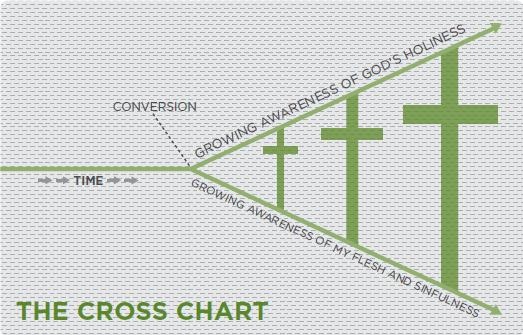
Look, as a Segway into the latest controversy, let me point out that Tullian Tchividjian did NOT create that illustration. But yet, the same people who criticize him have used this illustration themselves to teach the Reformed gospel. And well they should, it is a concise and astute depiction of Calvinism.
Sigh. This is NOT complicated.
If we have any goodness in us at all, what gets smaller? “The cross.” Very good class. If we have any goodness in us at all, is knowledge of God’s holiness increased or diminished? “Diminished.” Very good class. If we have a less and less realization of how wicked we are, is our appreciation for the cross increased or diminished? “Diminished” Is that goody-woody? “No.”
Oh my, we are on a roll!
What in the Sam Hell is complicated about this? Yet, another clueless Christian starts the newest controversy by writing the following post:
http://thegospelcoalition.org/blogs/tgc/2014/05/02/failure-is-not-a-virtue/
Tullian Tchividjian then rebuked her in a follow-up post using his usual red herrings: stuff about people believing that the power for change is in the written word; viz, law. The argument concerning power being in the paper, ink, and leather of a Bible is soooooo worn out that when I hear it, again, I just want to cry from utter disgust.
Now, the controversy plot thickens because some thirty something YRR comes riding in on a white horse of confusion to save the poor little Reformed damsel who doesn’t have a clue to begin with. Sure, it seems like she gets it to a point until you find out she sits under Matt Chandler who no whit, in principle, has any gospel disagreements with Tchividjian. He (Mark Jones) has challenged Tchividjian to a debate which will only serve to further confuse because that’s the goal. Apparently, the debate centers on the first, second, and third use of the law. This is the same old Reformed red herring that is one of the primary mainstays (other than the election debate) used to deliberately keep God’s people confused and dependent on these narcissistic Reformed hacks.
Confusion is the goal, and they know it. It’s deliberate for purposes of control. I stand behind that statement 200%.
But let me clear up the confusion on law because that is easy also. Here is why these guys want to have a debate in order to keep people confused: the dirty little secret is; the Reformed false gospel is a matter of simple theological math. Calvin believed that the law is the standard for justification as opposed to justification being APART from the law. According to RC Sproul, the third use of the law reveals the righteousness of God. That sounds completely reasonable, but is the very problem itself with Calvin’s false gospel.
“But Paul, what then is the standard for justification? ‘God’s righteousness.’” “Right, the law reveals God’s righteousness. ‘For justification or sanctification?’” “For justification. ‘No.’” “Then what is the standard for justification? ‘God’s righteousness imputed to us apart from the law.’”
See, the problem is, if the law is the standard for justification, a perfect fulfilling and maintaining of it must be sustained in order to keep God’s people saved; viz, justified. Justification is then not a finished work, a perfect keeping of the law must be maintained to keep us saved. And of course, we can’t do that, so we must live our Christian lives by faith alone so that the perfect obedience of Christ is perpetually applied to the law in our stead. The law is the standard and that not apart from justification. The apostle Paul made this point in several different ways throughout his epistles: there is NO law in justification. “Apart” means a-p-a-r-t. (Read the Brinsmead excerpt on pp. 10, 11 of It’s Not About Election http://www.7questions.org/its-not-about-election-read-here.html ).
And Tullian Tchividjian gets that. A perfect keeping of the law must be maintained in the Christian’s stead by a perpetual reapplication of the cross. Being interpreted: living by the cross via faith alone in sanctification. If we obey by “jumping from the imperative to our own effort,” we circumvent the ongoing works of the cross. Is justification finished or not finished? Read the title of chapter 14 in book 3 of the Calvin Institutes; that should answer your question.
I have a better idea. I hereby challenge Tchividjian and Jones to a debate at a place of their choosing even though I am just a dumb hillbilly from Portsmouth, Ohio. I don’t need to be smart—this is simple theological math. Calvin was fundamentally wrong on law; throw around all of your ganky Reformed phraseology all you want to—I will bring you right back to the difference between what Paul said and what the heretic John Calvin plainly said. I am sure that if one or both agree to the debate and will not come to Xenia, Ohio, PPT readers would be more than happy to donate to the cause.
Hide behind the whole idea that I am not worthy of your platform because of my lack of education if you will—that’s what James White did, and that’s all you have. And frankly, there are many Arminians strewn about who know this simple theological math is the issue, but like you, if they reveal that, they will no longer be needed as well.
Confusion and ignorance is what puts bread on your table: you are all a disgrace to the gospel of God.
paul



A Foundational Position on Election
 “Incredibly, and in broad daylight, MacArthur’s kinship to Augustine’s Platonism was eerily on display. This is not a side issue; this is the meat of the total depravity gospel which invariably leads to a Reformed view of election.”
“The idea that people can do no good work is not even true of unbelievers. But the problem for the Reformed is this: if the unbeliever can do good works, though falling far short of God’s glory in totality, one of those good works might be choosing God. That’s a huge problem for the Reformed theologian. Hence, the ability to do any good work must be eradicated; viz, total depravity.”
As anybody who visits here much at PPT knows, I have stayed clear of a specific position on election aside from discussing some inclinations about the subject. This is because I am convinced that most Christians don’t have a solid understanding of justification which is very definitive, unlike the question of election. The following makes sense to me: nail down what we can know definitively first, then perhaps the rest will fall into place.
This has worked for me; I have come to some foundational conclusions about election while knowing there is much more to learn. But the following is what I know at this time. These are difficult questions, but the very difficultly indicates an expectation by God: we are to be zealously involved in the working out of these questions. Granted, at this time, there are some things only God will know, but we are responsible for what we can know (Due 29:29, 30:11-14). Pleading ignorance because of your awareness of God’s greatness can be a cloak for wicked laziness (Matt 25:14-30).
I was inspired yesterday to put together thoughts I have had for some time after stumbling upon John MacArthur’s speech about total depravity at the 2008 T4G conference. Coming to a resolute conclusion about MacArthur’s “Christian” worldview has been a long and hard journey for me. I know Augustine, Calvin, and Luther well as I read them daily—that’s my ministry—that’s what those who support this ministry expect me to do, and MacArthur is in league with that worldview lock, stock, and barrel.
The exception would be his eschatology which doesn’t match his Reformed soteriology, and perhaps that is why there has been a parting of the ways between MacArthur and T4G. Multiple judgments and resurrections suggest a separation between justification and sanctification, and assurance of justification which is an Augustinian anomaly.
Fruit of the Poisonous Tree
In a court of law, information from a bad source or means is looked upon with much skepticism, and the fact is, the doctrine of election came from the Reformers; this makes the doctrine of election VERY suspect for concrete reasons. While stating that election didn’t come from the Reformers, but rather the Bible, all admit that the Reformers brought it to our attention that election is in the Bible, and then we went to look for ourselves based on the “biblical facts” they pointed to.
Indeed, we caution ourselves because a clock that doesn’t work is right twice a day, but in this case, the clock has no hands. The Reformers brought it to our attention that election is in the Bible, and then also brought it to our attention that we are worthy of death if we don’t agree with their assessment of election. Most Reformed confessions and counsels, including Westminster, included this clause, and Calvin stated it to Francis I in the prefatory address of his Institutes. This lacks Jesus likeness, and a tree is known by its fruit.
Secondly, Reformed soteriology is clearly at odds with biblical justification. First and foremost, the Reformers wanted to make a case for total depravity. If man is totally depraved and unable to choose God, obviously, God must elect. In his introduction at T4G, MacArthur notes that total depravity wasn’t invented by Calvin or Luther, but historically, it went all the way back to the fifth century and Saint Augustine. Apparently, older is better. 2008 was the first year that Neo-Calvinism was dubbed, “New Calvinism,” and I believe MacArthur wanted to make a case that it wasn’t “new,” a word that can make Evangelicals a little skittish. MacArthur et al deem total depravity to be the very bedrock of the Reformed gospel, and clearly, he was making a case for historical precedent. But there are two reasons why this leads to a Reformed Achilles’ heel on both feet.
Augustine was an avowed Neo-Platonist who would have considered the material, including man, as being evil and only the invisible/spiritual as being good. Furthermore, a just society was the paramount goal of Platonism which necessitates the marriage of church and state. And, “just” was defined as “united” by Plato which necessitates unquestionable allegiance to the ruling class, or philosophers. When Augustine, the undisputed father of Reformed soteriology merged Neo-Platonism with Christianity, another assertion that few dispute, Plato’s philosopher kings became the clergy. In the minds of the Platonist Reformed clergy, the state is ordained to enforce “orthodoxy.”
Incredibly, and in broad daylight, MacArthur’s kinship to Augustine’s Platonism was eerily on display. This is not a side issue; this is the meat of the total depravity gospel which invariably leads to a Reformed view of election. In addressing the pastors at T4G, he described them as the most important people in the world—more important than the rulers of nations, and because of their calling, the only ones adequate to proclaim the gospel. He referred to them as those who are “a savor of life to life and death to death.” The idea of elitism could not hold a candle to his address. Consequently, the idea that the lesser important government should enforce “life to life” for the betterment of the collective good could not be far behind, and historically, never has been.
In Augustine’s endeavor to integrate Christianity with Platonism, there was a glitch: mankind seems to perform good deeds from time to time whether saved or lost. This suggests that mankind is endowed with a general competency and ability to interpret reality. The solution? Make a perfect keeping of law the standard for justification and the maintenance thereof. If an act does not conform to the law perfectly, as if that wouldn’t be possible to begin with, it has no merit with God and is worthy of condemnation. And even if it were possible to do one truly good act, it is discredited by James 2:10 because if you break the law at one point, you are guilty of breaking all of it. This is Calvin’s cardinal point in 3.14.9-11 of the Calvin Institutes.
This is where Augustine shot Reformed soteriology in the other foot as well. A careful examination of Pauline theology contradicts this by way of extreme antithesis. God’s righteousness is imputed APART from the law (Rom 3:21). There is NO law that can give life (Gal 3:21). We are deemed sinless because there is NO law in justification. The law that judged our weakness in the flesh was ENDED by Christ (Rom 10:4) “…for righteousness.” If not for the old self and the flesh, we would obey God perfectly, but the old us that was under that law (Rom 6:14) died with Christ. Therefore, being dead, that law cannot judge us (Rom 7:1-6). You can’t bring a dead person to trial.
More Poisonous Fruit
Throughout his speech at the 2008 T4G, MacArthur referred to the “sinner’s” inability to “see the evil in their good…he does not see his sin in his goodness.” MacArthur also complained about the belief that man has a “residual good,” and an ability to “contribute to his salvation.” In true authentic Reformed style, MacArthur was deliberately ambiguous in regard to any distinction between justification and sanctification. Is a “sinner” referring to the regenerate or unregenerate or both? By “salvation,” does he mean a finished work that only pertains to the saved, or an ongoing work that encompasses the saved who are also sinners? When he used the word, “man” and “mankind,” is that mankind in general or just unbelievers?
He never said specifically, but if true to the theology of the camp where he was speaking, he meant both. He meant that believers remain totally depraved and unable to do a work that pleases God. This is indeed Calvin to a T (CI 3.14.11), and is more poisonous fruit as MacArthur, like all authentic Calvinists, talk about sanctification in a justification way. What we are really talking about is the total depravity of the saints though he never stated that outright, but that’s what it is speaking of and he knows it. This is deliberate and deceptive communication. When he spoke of “salvation,” did he mean progressive justification, or the finished work of justification? If Calvin’s title to the 14th chapter of book three (Calvin Institutes) is any indication, he meant the former (progressive justification).
That’s not only Calvin—MacArthur said something in the speech that connects all of these ideas together: salvation/ justification is progressive, total depravity also refers to the saints, and the saints can do no work pleasing to God; i.e., if the believer does not consider all of his/her works to be filthy rags, if he/she cannot see the evil in their good, they are no whit any different than the unbeliever. The only difference between a believer and an unbeliever is their ability to see how evil they are. This is revealed by his citation of a John Bunyan quote during the speech: The best prayer I ever prayed had enough sin in it to condemn the whole world. Elsewhere quoted by others: “There is enough sin in my best prayer to send the whole world to Hell.” Any questions?
That is untrue and reveals the Reformed skewing of biblical justification. The prayers of the saints contain no sin that can condemn—believers are not under the law. Where there is no law there is no sin (Rom 5:13), and the law has nothing to say to us for justification (Rom 3:19). Bunyan was talking about transgressions that can condemn according to the law, but according to James,
The effective prayer of a righteous person has great power
Moreover, when MacArthur complained in the same speech that one who thinks he can do good works also thinks he can “contribute to his salvation”—we must assume that he was speaking of believers as well. This would also be consistent with Reformed thought.
The idea that people can do no good work is not even true of unbelievers. But the problem for the Reformed is this: if the unbeliever can do good works, though falling far short of God’s glory in totality, one of those good works might be choosing God. That’s a huge problem for the Reformed theologian. Hence, the ability to do any good work must be eradicated; viz, total depravity.
As I was preparing for this post this morning, Susan overheard MacArthur’s comments on the mp3 that there is no good in man’s goodness. She immediately became indignant and ratted off several Bible references that clearly contradict that idea. That is one of the many beauties of Scripture; it presents a historic motion picture of metaphysics. It is a history that documents reality in regard to the milieu of life. Men teach certain things that you hear, and you say to yourself,
Wait a minute; I was reading in such and such book and such and such were having a conversation about this, that or the other and that makes no sense in light of what is being taught here.
You don’t need to be a theologian per se, the Bible is a metaphysical truth statement. Often, what is being taught merely doesn’t line up with reality, mathematical-like truth notwithstanding. Jesus said evil men know how to give good gifts to their children. Yes, they are evil, but they can do good works. I am not sure what is more evident. Romans 6:20 states that the unregenerate are enslaved to unrighteousness, but are free to do good. In other words, pleasing God is not the aim of their life, but they can still do good works.
You can’t have it both ways; if believers are enslaved to righteousness and free to sin, and they are (Rom 7:25), then the opposite must be true of unbelievers. Regeneration is a reversal of slavery and freedom resulting in a change of direction, not perfection, but the change of direction is counted as true righteousness. This is because the mind of the believer is a servant of the law while the sins of his/her flesh are not counted against them in regard to justification (Rom 7:17).
MacArthur claims that total depravity is the linchpin of the gospel, but in reality, it is the foundation that makes Reformed theology utterly devoid of truth. If man is unable to choose, and God must elect in that regard, it stands to reason that Christ only went to the cross for the elect, or in other words, limited atonement, the “L” in TULIP. Dying for all men implies that the ball is in their court. Aloof is the point that no one would suggest that man could supply the means of salvation, at issue is choice. Can man choose the means that God has supplied? So, what does the Bible say about limited atonement? Well, in several places it states that Christ died for all men. The Reformed are quick to assert the following in reply: “That means ‘all kinds of men,’ not ‘all’ men.” John 3:16 poses a significant problem for this view as “world” (κόσμος kosmos) would refer to all men period. Titus 3:4 states that a “love toward man” (Baker Interlinear—φιλανθρωπία philanthrōpia) appeared. Curiously, the ESV, a Neo-Calvinist translation, translates “love toward man” as simply “kindness.”
In addition, we cannot implore people to not “neglect such a great salvation” (Heb 2:3) if there is no salvation for them to neglect in the first place. If limited atonement is true, we simply have no way of knowing whether or not that is a valid appeal. Moreover, why would the Spirit of grace be “outraged” (Heb 10:29) that people turn their backs on a salvation that is not theirs in the first place? It makes more sense that He would be outraged because people turn their backs on a sacrifice that was made for them.
Even More Poisonous Fruit
While we are on the subject of TULIP, one wonders if Reformed ideologues like MacArthur have an apt understanding of what Calvin really taught; particularly, the relationship between the “I” and the “P.” Calvin taught that there are the non-elect, the called, or the general elect, which are temporary recipients of “irresistible grace,” and those who are granted the “gift” of perseverance. Ultimately, those who persevere show themselves to be the true elect. It is interesting that Calvin actually taught a temporary illumination/election (see CI 3.24.7,8). Frankly, I think this buffoonery speaks for itself. While MacArthur bemoaned those who worship a god of their own making during said speech, he worships a capricious Calvinistic god that temporarily illumines and is outraged at people who reject a salvation that was never given.
I have examined several “proof texts” that support total depravity and man’s inability/unwillingness to respond to God, or choose God. By and large, the gospel call to repentance and belief, and instances of strong exhortation to believe by God, Christ and the apostles, which assume ability to choose, far outnumber passages that seem to reflect predestination because of total depravity, and the fewer passages do not state specifically that man has no ability to choose. Moreover, one is generally uncomfortable with the idea that God commands us to do things we are incapable of doing. Augustine’s profound unction of “Lord command what you will and grant what you command!” doesn’t pass the reality smell test, and has creepy similarities to the parable of the talents.
And without a doubt, many of the proof texts presented deal with man’s will/ability to participate in the means of salvation, and have little to do with man choosing the means supplied by God alone. In other words, man can believe and choose, but it goes without saying that he cannot summon the Holy Spirit to regenerate him—that is totally out of man’s control, yet a promise for believing.
Total depravity and its Reformed take on election is fruit from the poisonous tree. MacArthur further validated this by his closing comments at the 2008 T4G conference which were very disturbing to say the least. In a show of his Augustinian kinship to Platonism, MacArthur said that the gospel was a “call to the sinner to flee from all that is natural, and run to the cross.” Really? “All” that is “natural”? This smacks of Luther’s theology of cross which asserts that ALL reality is interpreted by the gospel. Also, “Reality is not on the outside—it is on the inside.” Why would MacArthur make a point of insinuating that there is no reality in the “outside” world? Those who are familiar with Platonism will immediately recognize these concepts that are also part and parcel with Plato’s stepchildren, the Gnostics.
MacArthur also closed with two “immutable truths”: “all hearts are the same,” and “all need the same gospel—God’s work is heart work—mind work.” What does he mean by “all”? Is he saying that the heart of the unbeliever is no different than that of an unbeliever? Is he saying that both need the same gospel? Well, that would be authentic Reformed doctrine, so we must assume the answer is, “yes.”
In the final analysis, man does have a choice, but it is not that simple and this is an untapped frontier of study. For example, there is little discussion about God’s activity in our lives that aids our choices. God has promised in His word that He will not allow more in our lives than we can bear etc. As far as man being able to do works that have merit with God, it is clear that he can; for example, those who bless Israel will be blessed, and those who curse Israel will be cursed. Though a terrible reality in which to make a point, there will be degrees of eternal punishment which clearly demonstrates some kind of merit on the part of unbelievers.
The apostle Paul exhorted and implored people to be reconciled to God, and I believe he did so because he knew of man’s ability to be persuaded. Persuasion indicates choice, and let’s faces it, the belief that man has no choice does dampen evangelistic aspirations—this is unavoidable. And what is the Reformed explanation for that? Evangelism is a “savor of life to life and death to death” for God’s glory. Supposedly, both obtain glory for God.
I reject that because God, according to Him, takes no pleasure in the death of the wicked. I reject that because Christ wept over Jerusalem.
And I reject that because the doctrine of total depravity is fruit from a wicked Reformed tree. MacArthur et al refuse to acknowledge the reality of Reformation history and are driven by a logic that they refuse to repent of. It is an elitist mentality that calls for “hard preaching” that makes the parishioners “soft” (Ibid 2008 T4G). If not for the almighty Reformed elder, parishioners en masse would be left to their own hard hearts.
And here we go again, the Bible NEVER states that believers have hearts that are bent towards hardness or wickedness. In the Bible, the heart is the regenerated part of the believer that is holy and righteous. If you follow MacArthur’s message closely and draw logical conclusions from his Reformed-like nuanced statements, salvation is a beginning heart work that progresses only in the believer’s ability to “see” the works of Christ without being directly involved in them. Like he said, we can take no credit or gain any merit with God by what we do. These assertions make the Bible a metaphysical train wreck.
And perhaps that is the idea—to keep the Christian masses confused and pliable. MacArthur stated in his speech that the goal isn’t to be cool, but to be clear. This was probably a subtle statement about the YYR New Calvinist subculture, but let me be clear about what MacArthur wants to be clear: the great unwashed masses are confused, and are in desperate need of the “most important men in the world” to do the thinking for them. Preaching must be “hard” to keep parishioners softhearted pliable/controllable through fear of condemnation.
Like all of the Reformed elitists of our day, MacArthur presents himself as an angel of light, but birds of the feather flock together, and the fruit of the Reformation is undeniable, and a tree is known by its fruit.
And if you forget all else, don’t forget this: a position on election/total depravity coming from those who don’t understand the elementary principles of justification is ill-advised.
paul
The Pitiless Mean Streets of American Christianity
 “Beware of any verbiage that implies that healing comes forth by ignoring the blood that cries out from the ground. This verbiage comes from the heart of the tyrant himself, or those who carry water for him.”
“Yes, we live in a day when the American church separates justice from love, and accepts the bribe of fellowship in exchange for justice. In the same way that we offer prayer in place of supplying need, we offer condolences in place of justice. And we side with the many in our silence.”
Here in Dayton, Ohio one roams the inner-city streets at their own risk. It’s a risk that you accept if you want to go there for some reason. Likewise, people still want to go to the institutional American church for some reason, and do so at their own risk. But there is one difference: if you get mugged downtown, you might get justice, it’s a consolation prize.
Per the usual, something in my life provokes a post like this, and this post is no different. I don’t get into conspiratorial topics in my writings for two reasons: it’s hard enough getting Christians to believe the obvious and we should at least start there, and why talk about UFOs when identifiable fiendish opulence is dancing in the aisles and on the altars?
Nevertheless, if you do the research that I do, one thing becomes apparent: the New Calvinist movement that is crossing denominational lines and taking over the American church is not about the gospel, it’s about power, money, and politics. Frankly, the global aspirations of Al Mohler and many other Southern Baptist leaders are not unapparent, especially if you are well versed in Plato’s Republic. Yesterday, I was searching through information sent to me by others that a friend requested, and found myself in dark contemplation.
I keep a picture of the Jonestown aftermath in my office, the one where two adult women are embracing a toddler as they died the foretold “painless” death by spiked Kool-Aid. It’s an apt reminder for my sluggish heart that gravitates towards thinking well of those who look good and speak well. Yes, it was a protest because the US was going to take away their right to live in a socialist utopia because Jim Jones murdered a US Senator. While searching for the information, I also stumbled upon a clip about Chinese public executions that are commonplace in that culture. The story was good news that the “Peoples Supreme Court” is going to start reviewing the executions and the present rate of about ten executions a day may slow down.
Don’t you know, it’s always about the “people.” Jim Jones’ “People’s Temple” and the Chinese “People’s Supreme Court,” and by the way, your local Reformed elder “wuvs you.” Bad results are always beside the point because people are stubborn and constantly want to think for themselves. If everyone would just obey for a change, all would see that elitists know what they are talking about in regard to the “collective good.” You see, all of the slaughter is for you, you are wuved. And John Calvin wuved you. He wuved you soooo much that he wrote a weally big letter to the king of France called the Calvin Institutes calling for the execution of all who disagreed with him, because like all Platonists, he knows about the “collective good.” Yes, no wonder John Piper went to Geneva and announced his world vision for Calvin’s “Post Tenebras Lux.” Piper calls it a “wonder.” Yes indeed. You are wuved.
And in the midst of all this, I received an email from someone of my past who still wuvs me soooo much. He is concerned because I am, yawn, and here we go again, “bitter.” And why am I bitter? Well, that’s just too rich, but let me do a little prerequisite. In regard to the elitists that want to rule the world, premise is out and authority is in. Little brats that ask mommy why are the best picture: “Why?” ‘Because I said so.’” In this picture, you’re the brat and John Calvin is the mommy. It’s about the collective good; it’s about things you can’t comprehend.
The person who contacted me summarily dismissed seven years of research and informed me of my reality. He understands none of it, but this he does understand: we can’t understand, and my “glory story” is not in touch with Luther’s “cross story.” Now listen up, this is the tie that binds the American church with every murdering tyrant that ever breathed air on the earth:
“I am truly very sorry for the difficult things that have happened in your life. This is why it is difficult to offer correction. We will always be disappointed with people in the end, but thank God, if we keep our focus on Him, he is a faithful anchor of peace for our souls. What happens to us is not nearly as important as how we respond to it. I fear your response is not healing, but rather further hurtful to you and others around you. Again, I speak in gentleness, but if you place me in a position to have to speak uncomfortable truths to you, please do not assume I am answering you in a hateful tone.”
Yes, we will always be “disappointed” with the Calvinesque of the world. Calvin probably did not have to slaughter nearly as many as he did for our sake. Luther could have hated the Jews a little less, and Zwingli could have drowned fewer Anabaptists. The execution mode mocked their audacity to refute Luther and Calvin’s position on water baptism. And we are “disappointed” with Reformed elders in this country who merely improvise in their persecutions, but we must remember that it is all for us.
Beware of any verbiage that accuses Christ of not being concerned with justice in the here and now. Beware of any verbiage that implies that Christ does not hold us accountable for justice. Beware of any verbiage that implies that healing comes forth by ignoring the blood that cries out from the ground. This verbiage comes from the heart of the tyrant himself, or those who carry water for him.
And the words of a heartless tyrant ALWAYS come dressed in the garb of “love,” and in the political realm, it is always the “people’s” guillotine. The one built for them, and for their sake, adorned with the finest and sharpest blade available—only the finest for the people.
Exodus 22:15-17
You shall not fall in with the many to do evil, nor shall you bear witness in a lawsuit, siding with the many, so as to pervert justice,
Exodus 23:6
“You shall not pervert the justice due to your poor in his lawsuit.
Deuteronomy 10:18
He executes justice for the fatherless and the widow, and loves the sojourner, giving him food and clothing.
Deuteronomy 16:18
“You shall appoint judges and officers in all your towns that the Lord your God is giving you, according to your tribes, and they shall judge the people with righteous judgment.
Deuteronomy 16:19
You shall not pervert justice. You shall not show partiality, and you shall not accept a bribe, for a bribe blinds the eyes of the wise and subverts the cause of the righteous.
Deuteronomy 27:19
“‘Cursed be anyone who perverts the justice due to the sojourner, the fatherless, and the widow.’ And all the people shall say, ‘Amen.’
Yes, we live in a day when the American church separates justice from love, and accepts the bribe of fellowship in exchange for justice. In the same way that we offer prayer in place of supplying need, we offer condolences in place of justice. And we side with the many in our silence.
As I looked for the data, and perused the many pictures of beautiful Chinese damsels who had half their heads blown off with an AK-47 for some trivial offence, I wondered why God ever allowed sin to come into the world. I plunged into a dark pit of doubt and darkness. I found myself in utter despair and began to attempt to climb my way out with my thoughts. I prayed to the God I doubted to save me with reason. As I clawed desperately for hope, I reasoned that perhaps I do not even understand the basic premises of metaphysics that I assume. As I looked at those pictures, I knew that at times trust can be a bitch. And then the thought came…
For whatever reason God allowed sin to come into the world, He gave His only Son to heal it. And when He was on earth, His devotion to the Father never wavered. The Father listened as His Son cried out to Him in the passion. Christ Himself wept over Jerusalem. These thoughts brought light into my mind and the dark spirit fled—my prayers were answered. God despises sin more than I ever have or will, and has given more than anyone because of it. In allowing sin into the world, His solution was a burden that only God Himself could bear. So, I still do not know why, but the only way of hope is clear.
But this I do know: God cares just as much about what happens to us as our response. The silent lamb will return as a roaring Lion who will shake the earth. It is our duty to do all we can for justice in the here and now to obtain justice for the wronged. We are to be like Christ in the here and now. Be sure of this: justice, either now or future is a down payment for healing. Let those who separate justice from love be accursed. The repentance of our persecutors is the most efficacious to the healing process, and this is also being denied victims wholesale in the American church. The victims are offended, no one is held accountable, and justice is withheld, but the gospel has much to say about repentance and justice, and it is said to EVERYONE including those who think they speak for God.
It all comes from the same anti-Christ logic. It is the collective good over the one in 99. Today’s Reformed “shepherd” doesn’t understand that one life has already been given for the collective good, and their ignorance is predicated on the fact that they do not know Christ or anything of His justice. This is their kinship with the worst of any murdering mystic depot, and the very reason that they adore John Calvin.
To those who have joined hands with TANC, find a good picture of the Chinese damsels and put it in your wallet or purse with the pictures of your loved ones. It is a reminder that we must never stop fighting against tyranny in the church. It is a reminder that we must cry out in the wilderness if we have to. Tyranny in the church is the same logic that pulls the trigger on an AK-47.
paul

 Paul's Passing Thoughts
2 comments