The New Calvinist Takeover of Southwood Presbyterian Church, Part 21: Let’s Pretend; JL3 Believes in Obedience
 Sure he does. “Scandalous obedience” that is. Put your hand on your spiritual wallet. JL3 is not about to settle for the customary obedience of the forefathers, the New Calvinists have something better: high octane obedience because Jesus obeys for us. Throughout the message I suffered through this morning preached on January 1 at Southwood, JL3 frames obedience as something that we watch ourselves do as spectators, and “dancing with Jesus.” Why is obedience “scandalous”? Isn’t that an oxymoron in the way of John Piper’s “Christian Hedonism”? I can answer that, and don’t miss the crux of the matter: it’s “scandalous” because it is obedience apart from the law. That’s the rub. Hence, JL3 reminds us throughout the message that scandalous obedience is “BECAUSE of scandalous grace, not the BALANCE of the two.” Straw man alert. Christians don’t attempt to balance obedience with grace—that’s impossible, grace (used in context of justification) is a finished work and separate from obedience in sanctification.
The message is the same old New Calvinist manifesto throughout. Instead of following the text, JL3 set up an interpretive prism from which he exegetes the text (Romans 6:1-14). Through the use of compelling stories and spiritual sounding platitudes, the prism is either prison or Jesus, sin or Jesus, and either scandalous obedience that comes from scandalous grace or non-scandalous obedience that DOES NOT come from scandalous grace. If one listens very carefully, the prism JL3 sets up makes prison, sin, and liberty synonymous with law, and in contrast to Jesus/grace. In other words, though subtle, he sets up a distinct dichotomy between Christ and the law.
In fact, he completes the sermon with a story about a girl who turned her back on the faith because she wasn’t willing to accept radical, scandalous obedience that flows from scandalous grace which might have called her to do things she wasn’t willing to do. Instead, she wanted an obedience that she could control, ie., a list of rules that is a balance to scandalous grace. JL3’s point to this story is clear: living by “checking off the boxes” of a to-do list rather than letting scandalous obedience flow from scandalous grace in sanctification will cost you your very soul. Supposedly, when this girl realized this, for the first time in her life she understood the gospel well enough to reject it. This part of the message was definitely fear factor 101 and indicative of what I am constantly complaining about—the cultish techniques employed by New Calvinists to control people. Bottom line: you either become a New Calvinist, or you are going to hell.
In his introduction, he touts this new series on scandalous obedience as being for the purpose of seeing “what it looks like to respond to the grace of God.” His opening prayer asked that we would see more of Jesus’ holiness in the Bible (while insinuating that we have none), and more of Jesus’ holiness in ourselves and others, resulting in us being “shaped” by Jesus. In both of his introductory stories about two men who sought to be put back in prison, JL3 states that Christians are just like these two men, we “share a human nature that loves sin.” This is nothing more than the New Calvinist doctrine of the objective gospel completely outside of us. God’s grace is not internalized in the believer via the new birth (therefore, we are barley any different from the unregenerate), and all of God’s holiness remains outside of us. When we contemplate the objective gospel outside of us, it results in manifestations of sanctification that have already been secured for us in the atonement, especially obedience to the law. Moreover, JL3 used the stories in his sermon to inform the congregation of what they are asking, fearing, loving, and what they should say amen to. It’s downright creepy.
Another tenet of New Calvinism that was in this message, though very subtle, was the New Covenant Theology concept of the higher law of love which supposedly replaced the written law of God since Christ (supposedly) came to abolish it. Supposedly, since we are free from the law, we are free to love. According to my notes, at one point, JL3 asked the congregation, “Southwood, are you free to love?” Again, according to my notes, JL3 states, “A true Christian is not in bondage to his liberty, but is free to love his brother.” Liberty from what? The law. JL3 plainly states that at the end of the message and uses Romans 6:14 for a proof text. Basically, this advocates a subjective standard of love based on results of contemplating the works of Christ/gospel, which includes the fulfillment of the law for us in sanctification. Specific imperatives in the Bible are indicative of what Christ fulfilled for us as part of the atonement and should invoke thanksgiving, not a list of rules to obey. As Francis Chan said in Crazy Love, “When you are loving, it is impossible to sin.”
JL3 asked repeatedly during the message: “Is the resurrection showing up in your life?” The obvious implication was that there is only one way that resurrection power will start “showing up” in our lives, “Gospel preaching.” Throughout the message JL3 insulted the intelligence of the congregation by implying that all of what he taught in this message was proof that he is a big obedience guy. But who’s obedience? Certainly not ours. And by what standard? Certainly not the law. Like all New Calvinists, JL3 interprets Romans 6:14 in context of sanctification to make this point, but that verse is clearly referring to those who are under the dominion of sin and will be judged by the law. The New Calvinist lie that we are sanctified by justification will not stand.
Paul
The New Calvinist Takeover of Southwood Presbyterian Church: Part 20; For Southwood’s Door
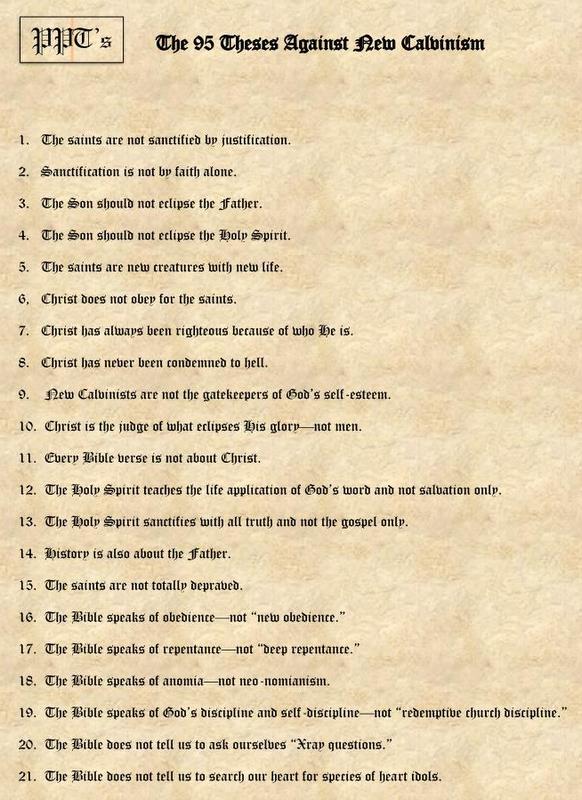
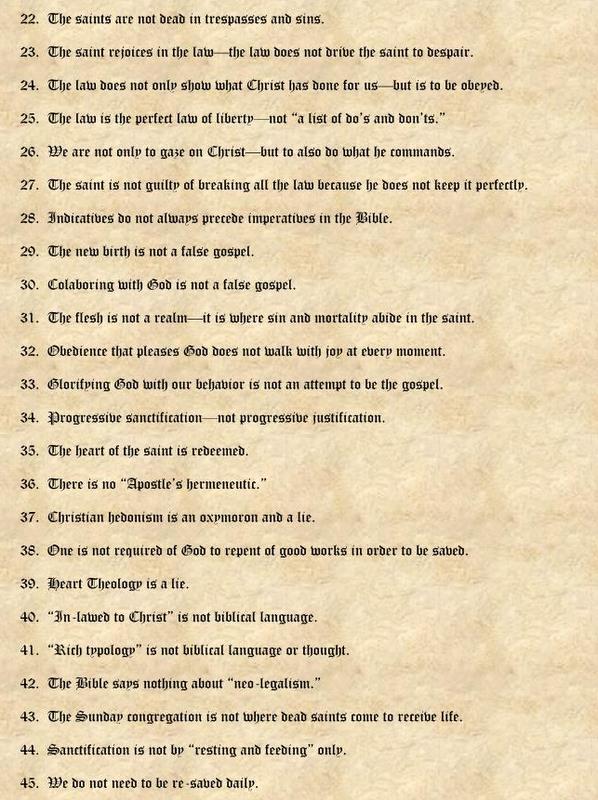
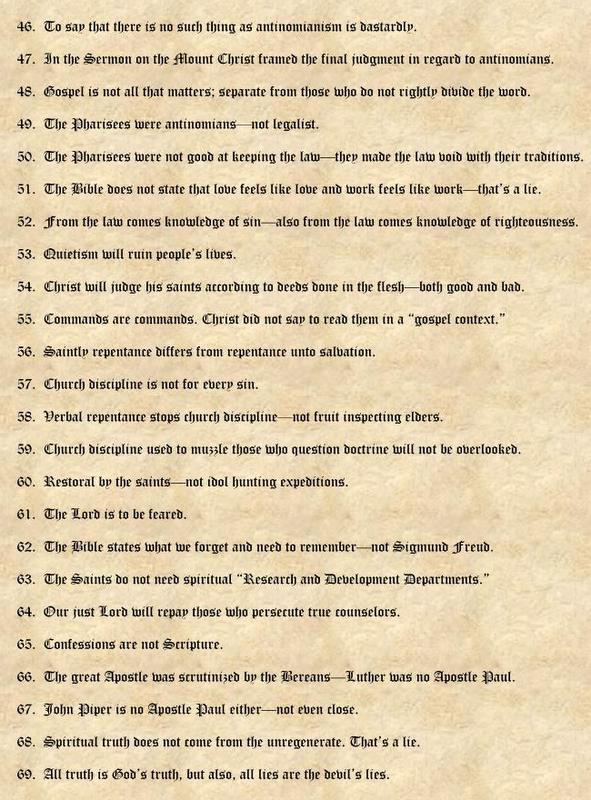
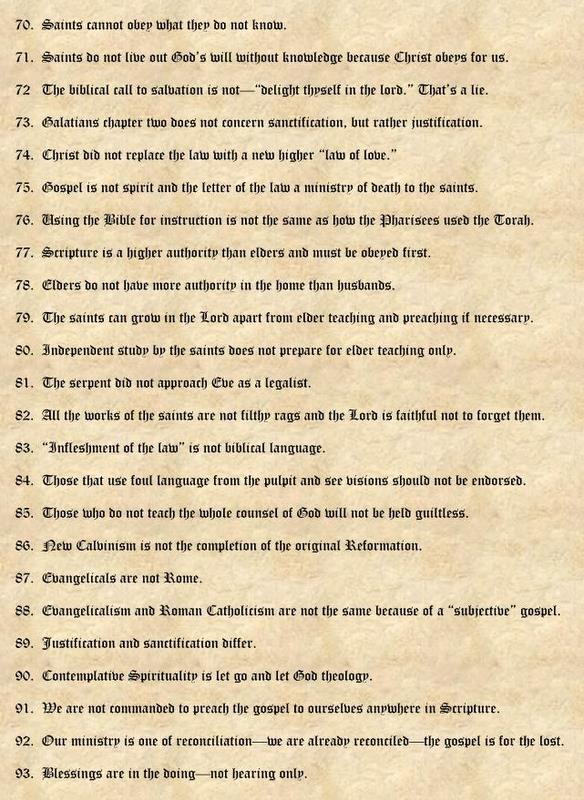
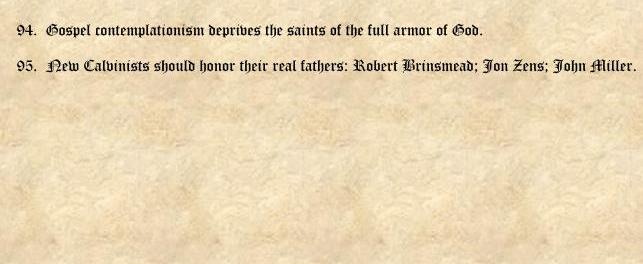
….but tape it, don’t nail it. That way you will only be brought up on church discipline and not also arrested for vandalism. PDF available here: The 95 Theses Against New Calvinism
The New Calvinist Mega-Lie: Obedience and Truth are Separate
“Therefore, Christians don’t obey for the purpose of maintaining our just standard; it is a finished work by Christ that needs no further maintenance. We obey for other reasons….”
Have you ever noticed? The Scriptures NEVER call “obedience” works salvation. We are never told that people are trying to earn their way into heaven through “obedience.” Obedience, in the Scriptures, is ALWAYS associated with the truthful application of God’s word to our lives in how we think and what we do. It is the truthful application of our role in sanctification which is putting off the old self and putting on the new creature (Ephesians 4:20-24). In the Scriptures, truth is always assumed in obedience.
This is New Calvinism’s greatest deception, the idea that one can sincerely seek to apply God’s word to their lives in a truthful way, and at the same time do so to maintain a just standing before God without realizing they are doing so. This invokes a dependance on them, a don’t try sanctification at home mentality. Though they claim that obedience is motivated by fear within the evangelical community, their sanctification formula propagates an unfounded fear that obedience is nothing more than works salvation, in and of itself. The fact of the matter is that works salvation is always based on falsehood.
Unlike the Bible, New Calvinists don’t associate obedience with truth, a love for the truth, and faith. They separate the two, specifically by separating “law” and “gospel.” Law is obedience, whether practiced in truth or not, and gospel is truth. There are many examples of this, but here is the best one I have seen of late:
This is fundamentally no different than Islam! The Gospel offers us freedom from our sin-stained hearts and our obedience-stained garments and bids us rest in the finished work of Christ which is better than us being better!!!” (Jean F. Larroux, III, Green Grass of Grace Southwood blog).
Notice: obedience is obedience whether it is Christian or Islam. Truth isn’t the issue. But the apostle Paul clearly unites the two:
They have become callous and have given themselves up to sensuality, greedy to practice every kind of impurity. But that is not the way you learned Christ!—assuming that you have heard about him and were taught in him, as the truth is in Jesus, to put off your old self, which belongs to your former manner of life and is corrupt through deceitful desires, and to be renewed in the spirit of your minds, and to put on the new self, created after the likeness of God in true righteousness and holiness (Ephesians 4:19-24).
Obviously, Paul is calling on Christians to learn truth, and put off what we learn to put off, and put on what we learn that is to be put on. The Bible calls this “obedience” when it is done as biblically prescribed. If I tell my son to take the trash out to the curb, but instead he leaves it halfway down the driveway, that’s not obedience. Unless you’re a New Calvinist. With them, truthful obedience is neither here nor there because it is impossible for Christians to accomplish anyway:
The bad news is far worse than making mistakes or failing to live up to the legalistic standards of fundamentalism. It is that the best efforts of the best Christians, on the best days, in the best frame of heart and mind, with the best motives fall short of the true righteousness and holiness that God requires [notice that there is no distinction between this sentence and the one prior (legalistic standards verses true righteousness)]. Our best efforts cannot satisfy God’s justice. Yet the good news is that God has satisfied his own justice and reconciled us to himself through the life, death, and resurrection of his Son. God’s holy law can no longer condemn us because we are in Christ (Michael Horton, Christless Christianity p. 91).
It is also extremely important here to notice the crux of New Calvinist error in this statement; specifically, the supposed need to maintain justification: “….the best motives fall short of the true righteousness and holiness that God requires…. Our best efforts cannot satisfy God’s justice.” But in sanctification, God no longer requires a just standard to maintain salvation, that has already been accomplished as a finished work. God no longer “requires” perfection that maintains our just standing. Therefore, Christians don’t obey for the purpose of maintaining our just standard/standing; it is a finished work by Christ that needs no further maintenance. We obey for other reasons—to glorify God, to experience the reality of our new birth, to show others the abundant life, and to destroy evil works, to name just a few. And also, our God-given love for the truth compels us to apply it to our lives.
Therefore, New Calvinism fuses what shouldn’t be fused and separates what shouldn’t be separated, turning orthodoxy completely upside down. They fuse justification and sanctification, and separate obedience from truth, while fictitiously calling obedience “law” (whether Christian or Islamic), and encapsulating truth in the “gospel” which is supposedly distinct from “law.” But what would we know about the gospel apart from Scripture? Christ said man lives by every word that comes from the mouth of God. Wouldn’t that include the law? Paul told Timothy that we are fully equipped for every good work by ALL Scripture. Wouldn’t that also include the law?
This fusing of what shouldn’t be fused and separating what shouldn’t be separated is the basis of their Gospel Contemplationism. Law (any effort to obey, whether according to the truth or not) is separate from gospel and impossible for us to obey perfectly in order to maintain a salvation that doesn’t need to be maintained to begin with. The formula? Contemplation on the truth that results in a “Christ formation” within totally depraved, dead jars of clay. Doubt that? reread Larroux’s quote; our hearts are sin stained as well as any obedience we may perform.
The truth: we are declared righteous and are righteous, though hindered by the flesh. Though our striving falls short of perfection, we know that can’t affect our righteous standing that has already been declared based on the finished work of Christ. And that cannot be revoked. As we strive, we also long for the day when we can obey our Lord perfectly without hindrance. So like Paul, we cry out, “who will deliver me from this body of death?”
Our striving creates that thirst, experiencing both the blessings of that truth and the failures that prevent the full experience. Peter states clearly that we are to strive for a “rich entry,“ not the beggarly entry that comes from let go and let God theology.
paul
The New Calvinist Takeover of Southwood Presbyterian Church: Part 19; Bachman – Turner Overdrive
Cruising down the highway as a young man, I was feeling pretty good listening to my rock music on the awesome new technology that replaced 8-track tapes, cassettes. One of my preferred bands was Bachman-Turner Overdrive, and one of my favorite songs was “Taking Care Of Business.” Sure, I knew a particular statement in the lyrics made no sense at all; “We love to work at nothing all day,” but I really dug the song man, and at that time of my life, trust me, the tune was way more important than the truth.
Since I have been studying New Calvinism for nearly five years now, that song has constantly been triggered in my mind. As I was perusing Southwood’s blog this morning, stopping to read “Green Grass of Grace,” by Jean (pronounced “ Jon”) F. Larroux (don’t forget: “The Third” hereafter; “JL3”), I observed the opening sentence: “Grace is difficult. It is harder than trying harder.” Then it happened in my head:
“People see you having fun
Just a-lying in the sun
Tell them that you like it this way
It’s the work that we avoid
And we’re all self-employed
We love to work at nothing all day
And we be…
Taking care of business every day
Taking care of business every way
I’ve been taking care of business, it’s all mine
Taking care of business and working overtime.”
In another post, JL3 said, “I’m not arguing for NO EFFORT or WORK I am arguing for GREATER EFFORT and MORE DIFFICULT WORK, the work of humbling ourselves, being broken, repentant, prostrate before God, looking past our ‘symptomatic sins’ to their root causes and being faced with such horror over my depravity that I am left with no other options than Jesus” (not sure, but I think the comment was pulled down).
Tullian Tchividjian, JL3’s obvious mentor stated it this way in “The Tyranny of Accountability Groups”:
The bottom line is this, Christian: because of Christ’s work on your behalf, God does not dwell on your sin the way you do. So relax and rejoice…and you’ll actually start to get better. The irony, of course, is that it’s only when we stop obsessing over our own need to be holy and focus instead on the beauty of Christ’s holiness that we actually become more holy! Not to mention, we start to become a lot easier to live with!
Oh really? I would think that people who focus on Matthew 7:24 with the result of their life being built on a rock would be the ones easier to get along with. And of course, I am constantly told by New Calvinist hacks that for me to say that these kinds of statements insinuate that Jesus obeys for is “reading into their statements.” Whatever. We see four things in Tchividjian’s statement: 1; Christ has done the work of sanctification on our behalf (ie., sanctification’s work was part of the atonement). 2; Doing less results in being “better,” productivity for the sake of the kingdom is conspicuously absent—per the usual. 3; Holiness comes by focusing on Christ’s holiness and not our own, resulting in more holiness. And I am often accused of “reading things into their statements” regarding the “Gospel Contemplationism” charge. Again, whatever. 4; The either/or communication technique, It’s either Christ’s holiness or our holiness, it can’t be both.
JL3 continues:
We are allergic to resting in the finished work of Christ and the hardest ‘trophy’ to lay down is that trophy of obedience I have been working for my whole life. To make the shift from an life driven by fear to a life motivated by love is very, very painful.
Notice that the finished work of Christ pertains to both justification and sanctification. Accuse me of reading into to this if you will, but what else can be surmised? Also, we gain see the either/or hermeneutic: we are either motivated by love or fear, it can’t be something else—it’s either/or. But the contradictions in JL3’s posts are too massive to document; for example, the Scriptures are clear that at times, God does motivate us by fear. Like all New Calvinists, JL3 validates love as something that is always (as stated by, of all people, John MacArthur) “always sweet, never bitter-sweet.” This removes the self-sacrifice aspect of love through obedience. And it brings us back to Bachman-Turner Overdrive theology as well: they only worked hard at what they loved, which was doing nothing.
Most of us have obeyed because of fear of reprisal from God. To know that we are loved apart from our obedience or disobedience is a truth that is elusive. This is why it must be pounded into our souls week after week.
This is a bunch of boloney, and notice JL3’s New Calvinist us against them mentality. “Most” obey from fear? Anybody who does counseling knows that isn’t true—fear of God is never been more lacking in recent church history.
We have purposed to drive deep into those fields ripe with the green grass of the grace of God, not into the rocky crags of fundamentalism, legalism and pietism hoping that some nourishing shoot of grace will emerge every now and again. The sheep cannot be sustained on a sparse diet of occasional grace.
Either/or: it’s either grace, or rocky crags. Nuff said, like all New Calvinists, his whole realm of speech is fraught with deceptive communication techniques.
Everything in Christendom tells them to weave for themselves garments of obedience and performance to wear before the Great White Throne of Judgment as ‘jewels in their crown.’
This hearkens back to JL3’s ancestors of the Australian Forum (the cradle of New Calvinism) who mixed Reformed teachings with SDA investigative judgment theology. Christians fear no future judgment concerning our righteousness—the righteousness of God has already been accredited to our account in full.
This is fundamentally no different than Islam! The Gospel offers us freedom from our sin-stained hearts and our obedience-stained garments and bids us rest in the finished work of Christ which is better than us being better!!!’
So, obedience in Islam is no different than obedience in Christianity? Sure it is. Christian obedience is based on T-R-U-T-H. The fundamental difference between Christianity and all other religions is our God given love for truth (2Thess. 2:10), which translates into applying it to our life. Hence, “If you love me, keep my commandments.” You can’t separate love for the truth from wanting to learn more about it, and then making it part of you. We are promised blessings if we do that (James 1:25).
JL3’s New Calvinistic teachings also has another tone shared by Bachman-Turner theology: the song demeaned people who supposedly wasted their life by doing things they didn’t like to do. New Calvinists often refer to our striving to obey as “rats on a treadmill” etc. Like MacArthur, we are told by JL3 that we should strive for a life that is “sweet, never bittersweet.” The fact is rather this: in pursuing truth, it will often collide with life, and other times it will bring joy. But when the experience is “bittersweet,” that’s not works salvation, it’s called “self-sacrifice.”
The apostle John reminded us that the Lord’s commands are not “burdensome.” We need to be reminded of this, because his commands are truth, and we love the truth. Sometimes the truth is hard, and it calls for us to reject the tune in exchange for the truth. Whatever the tune may be, whether, “resting is better than being better,” or a “love to work at nothing all day.”
paul
The New Calvinist Takeover of Southwood Presbyterian Church: Part 18; Comment From Part 17 Reflects New Calvinist Doctrine
Still working on videos. Writing is easier.

 Paul's Passing Thoughts
leave a comment