A Doctrinal Evaluation of the Anti-Lordship Salvation Movement: Part 2
The root of all controversy: the golden chain of salvation.
Before we start part 2, we have a little unfinished business from part 1. The astute observer will ask, “If Jay Adams had the right idea about sanctification while misunderstanding what Calvin really believed, what of his biblical counseling movement that moved from mere generalities to the finer points of Christian living?” Answer: it WAS a revival…probably the only real revival the church has seen since the previous focus on practical application of the Scriptures versus redemptive focus/meditation. And when was that? I have no idea.
You remember my mention of the John “Jack” Miller disciple David Powlison. He started a contra biblical counseling movement against the Jay Adams movement. This is often referred to as first generation biblical counseling versus second generation biblical counseling. The second generation effectively wiped out the first. The crux of that civil war is relevant to this study. One model sees salvation and sanctification as separate. Salvation is completely vertical, but sanctification is mostly horizontal. Jay Adams argued in his aforementioned book against Sonship theology that the source of power in the Christian life is not salvation, but regeneration. In other words, justification is a finished work and a static declaration while the Christian life flows from the “quickening” of the new birth. We don’t return to the cross for power in the Christian life, we learn and obey the Spirit’s instrument for changing us, the law of the Spirit of life. What Adams didn’t realize is that this whole idea of life coming from a perpetual revisitation of our justification is in fact authentic Reformed dogma (see the Calvin Institutes 3.14.9-11).
Every Christian controversy from the Reformation till the present finds its roots in the golden chain. Reformed pastors wax eloquent in regard to who builds the links in the chain between justification and glorification: it’s either us, or the Holy Spirit using “what Jesus has done, not anything we do.”
From the latter 40’s to 1970, the first gospel wave (Billy Graham et al) ruled the Christian scene via EB. Cogous pushed back with a vengeance from 1970 till the present with the second gospel wave. The first wave saw a commitment to obedience as synonymous with keeping yourself saved because of the golden chain idea. To say that they overemphasized the gospel would be a gargantuan understatement. Obviously, they saw a commitment to obedience as transposed upon the Christian life. The second gospel wave demanded a commitment, and recognition of Christ as Lord, but also demanded a life of faith alone to keep the law satisfied with Christ’s perfect obedience. Again, the ALS camp misunderstands the Reformed on this point. Both camps hold to sanctification by faith alone. This is the very idea that James rudely pushed back against in his epistle.
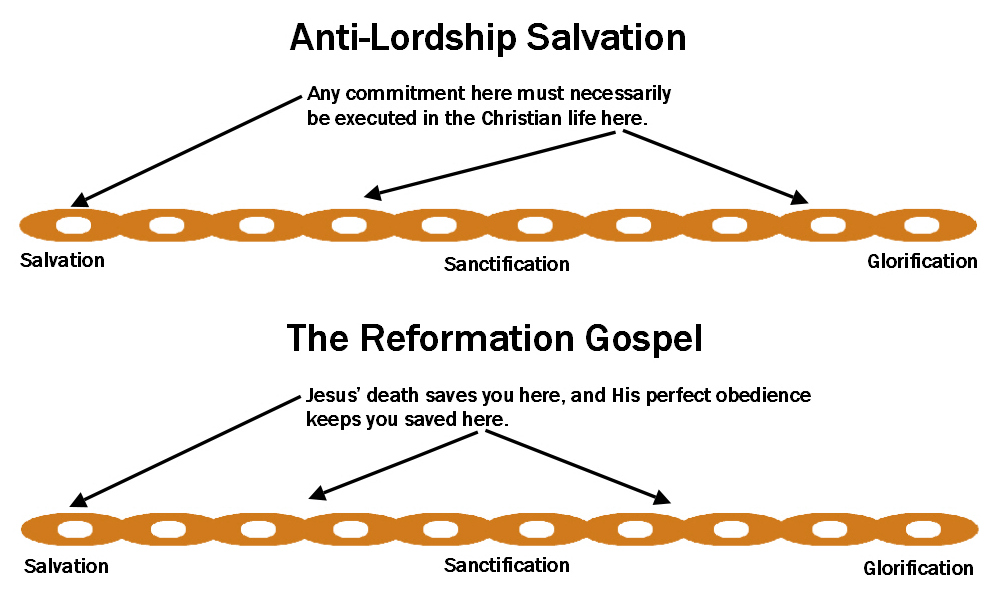
The issue made simple: Romans 8:30.
In Romans 8:30 we read the following:
And those whom he predestined he also called, and those whom he called he also justified, and those whom he justified he also glorified.
Notice that sanctification is missing from this verse even though the context spans the beginning of our salvation to our resurrection. This is the distinction between all golden chain gospels and the real gospel, the kingdom gospel. Jesus came preaching the “gospel of the kingdom.” Hereafter, KG. The golden chain gospel says that sanctification is missing from this verse because justification and sanctification are the same thing. The KG says that sanctification is missing from this verse because justification and sanctification are mutually exclusive. The context is assurance of salvation (see verses 31ff.).
Curiously, the golden chain gospel which includes both ALS and LS/Calvinism, teaches us to remind ourselves of God’s grace alone regardless of anything we do. If our behavior brings doubt, this is evidence of a fundamental misunderstanding of God’s grace and we should therefore remind ourselves of such. ALS says that concern over behavior suggests that you believe behavior finishes justification and not grace alone. With the KG, that consideration is not even on the radar screen because justification and sanctification are completely separate; finishing a finished work is impossible. You can’t have that mentality if you understand it to be an impossible reality. I might also add that simply returning to the same gospel that saved us to cure a troubled conscience instead of changing behavior sears the consequence over time. This is ill advised.
In other words, the KG says it is impossible to unwittingly attempt to please God to gain justification because that work is finished. One is free to aggressively obey God without any fear that they are unwittingly attempting to earn their justification. ALS and LS/Calvinism do not have this convenience because justification is both finished and not finished. The Reformed, already, but not yet construct that relates to predestination cannot be discussed here for lack of room and fear of confusion, but suffice to say for this study that the convenience is not there for either ALS or LS because justification is not finished. You must continue to remind yourself of free grace because you are in a continuum where unwitting works salvation can take place, and the only solution is to disavow good behavior as an evidence of conversion. Obedience must be completely optional. This used to be criticized as “Let go and let God” theology. According to the KG, such a continuum is impossible and not reality.
Consider some dialogue I have had recently with ALS proponents:
Paul, While you ponder my answer, I’d like to ask you, if you’d identify what you believe you must do, before, during and after, in order to be given eternal life. Thank you, In Him, Holly
“Before, during, and after”? to… “be given eternal life.”? The implied answer is: nothing in justification; nothing in sanctification; and nothing in glorification. But again “during” shouldn’t even be deemed possible.
LS in Cogous form already states that perpetual double imputation is needed, so bad behavior is actually a good thing because it “shows forth the gospel.” In contrast, advocates of the KG are concerned with evidence of the new birth, not the overcoming of a propensity to misunderstand the grace of God because all doing in the Christian life is attached to justification somehow. Advocates of the KG understand that nothing they do in the Christian life has anything at all to do with justification. Much assurance comes from that. However, lazy discipleship forfeits assurance because it violates the conscience, and judgment begins in the household of God regarding consequences for bad behavior in this life. The fear generated from that can get confused with fear of eternal judgment.
But don’t miss my main point here: the solution for a lack of assurance in both ALS and LS are the same: preach the gospel to yourself. Remind yourself that works done by us are completely irrelevant to our salvation which also includes sanctification (the Christian life). Both camps woefully devalue the new birth and its expectations. In effect, we have no righteousness and obedience is not really performed by us, but performed by the Holy Spirit if we are “abiding” in Christ. This is a passive sanctification of our works in sanctification in order to categorize them as living by faith alone. ANY work we do is accredited to the justification process, so it must be sanctified by the right process. In the final analysis, Christians must only EXPERIENCE an obedience imputed to us by Christ. Citations by the Reformed abound, and I can cite one from the aforementioned conversation with advocates of ALS:
We can have righteousness of our own, that is self-righteousness. I didn’t notice, did you answer any of the questions? Do you sin? How much? Or not? Are you sinless?
Park on the fact that both camps assert that the Christian has no righteousness. To have any righteousness is a “righteousness of our own.” It’s either ALL us or ALL Christ. Therefore, we can only EXPERIENCE righteousness imputed to us, but it really isn’t us performing it; hence, in relationship to the same conversation:
This passage has nothing to do with becoming saved or providing evidence through our works that we are saved. The passage is about living experientially in a manner that is consistent with our position on [sic] Christ.
Notice that the Christian lives “experientially” according to “our position [i]n Christ.” In other words, Christians only experience their position, they don’t actually perform obedience themselves. In addition, when talking to either camp, one is challenged with the question, “Did you sin today?” And in both cases, when you qualify the question with, “In justification or sanctification?”…without exception they are thrown for a loop. Why? Because they see sin in justification as no different than sin in sanctification—that’s why they ask the question in the first place. If you believe the Christian is personally righteous as well as positionally righteous, you are immediately challenged by both camps with, “Did you sin today?” Why? Because the same assumption is that righteousness and sin are mutually exclusive. For the world, this is true, but not for Christians.
Another fact of the Reformation gospel is “righteousness” is defined as a perfect keeping of the law. To remove the law’s perfect standard, and its demands for perfection from justification is the very definition of antinomianism according to the Reformers. A perfect law keeping must be maintained for each believer if they are to remain justification.
If you remember, this is a direct quote from part one. ALS and LS/Calvinism both define righteousness by perfect law keeping. Again, why the air of profundity in the terse rhetorical question designed to end the argument on the spot by coup de grace? The very essence of the question reveals a profound misunderstanding of law and grace.
Let’s get a little more full circle now with part one. Because the Christian, according to both camps, cannot be righteous if he/she sins even once (“Do you sin? How much? Or not? Are you sinless?”), the good old Reformed mainstay of double imputation is needed for both of these applications of the same golden chain gospel. From part one:
Thirdly, this requires what is known as double imputation. Christ not only died for our sins so that our sins could be imputed to Him, He lived a life of perfect obedience to the law so that His obedience could be imputed to our sanctification.
The windsock of double imputation is the idea that the righteousness of Christ is imputed to our sanctification. He died for our justification, and His perfect obedience to the law was imputed to our sanctification to keep justification rolling forward:
Model A asserts that since we cannot keep the law perfectly, we must invoke the double imputation of Christ by faith alone in order to be saved and stay saved (part 1).
Now let’s look again at the same recent conversation with ALS proponents:
Thanks Mark, I agree. We are qualified as saints, because of Christ’s righteousness imputed to us, but we still sin,..
Therefore, we only “qualify” as saints because we still sin, in order to keep our sainthood the righteousness of Christ must be imputed to us daily. Yes, that would be daily salvation. In the quote immediately prior, “Holly” was responding to this statement:
Hope you don’t mind me adding a thought, I think Paul is saying we were sinners but we are now saints (forgive me if I am wrong), it is true of course that we are saints but I believe it is also still true that we are sinners saved by grace because the Apostle Paul said, “Christ Jesus came into the world to save sinners; of whom I am chief”, present tense.
So, if Christians are still sinners, because we sin, and Christ came to save sinners, it would only make since that our need for salvation is still ongoing. Direct citations that agree with that point by John Calvin and Martin Luther is abundant low hanging fruit, but granted, such statements from the ALS camp are somewhat surprising. To further the point, I might add that “Holly” referred me to a message taught by a notable figure in the ALS movement who interpreted Romans 7:24 as a daily salvation. This is a very common rendering of that verse by the Reformed as well. The verse obviously refers to the redemption of the body and not a daily salvation.
Both are guilty of the same thing: a false double imputation construct must be applied to the Christian life by faith alone and the subjective experience thereof is optional. Like ALS—like Calvinism.
What is wrong with this gospel?
The golden chain gospel misrepresents the Trinity. The Father is removed from His role in salvation because it is His righteousness imputed to the believer before the foundation of the world. According to Romans 8:30, this guarantees glorification. The Holy Spirit is also misrepresented in regard to His role in salvation. His setting us apart before the foundation of the world is confused with His work in regeneration. Christ’s role is redefined beyond His death for our sins as a onetime act that ended sin. This is not a covering—it’s an ending. Even though the Reformed and ALS both concur that Christ died once, His death is perpetually reapplied to sins we commit as Christians when there is no such need. Neither is there a need to impute Christ’s righteousness to us perpetually. At the Bema event, it will not be God the Father looking at us and only seeing Jesus, it will be Jesus Himself judging His righteous followers. He will not be judging His own righteousness. The golden chain gospel is an egregious distortion of the Trinity.
True double imputation is our sins being imputed to Christ, and the Father’s righteousness imputed to us apart from the law. Christ came to end the law. It is because of this, and the new birth, that we are truly righteous in and of ourselves, but of course not apart from God’s power and plan of salvation. We have God’s seed in us, are no longer under any law that can judge us, and are able to please God with our lives. We are new creatures who are sinless according to justification because even if the old us that died with Christ was exhumed and brought into court, there would be no law to condemn us.
This gospel not only distorts the Trinity, rejects the new birth, and distorts double imputation, it misrepresents sonship. The sins we commit as a family member are considered to be sin against justification: “Did you sin today?” Again, if you ask them, “Sin in justification or sanctification?” all you will here is crickets, or the babblings of confused narcissists.
The golden chain gospel also strips the Christian of ability to love Christ and others by keeping Christians under the law of sin and death that Christ came to end. Said gospel makes that law the standard for righteousness. However, there is no law standard in justification, it is APART from any law—it is God’s righteousness imputed to us. Those under grace serve the law of the Spirit of life which is fulfilled by loving Christ and others:
“If you love me, keep my commandments.”
It is impossible to love Christ by keeping the law of sin and death. Besides, that law is ended when we believe. All of our sins committed before faith were against that law and in essence imputed to it. Before we were saved, we were enslaved to that law and it provoked us to sin. Consider two spouses: we were the spouse that was under the law of sin and death until we died with Christ, now we are free to serve another. Sins we now commit are against family relationship, not sins that fall short of the law of sin and death.
Said gospel prevents us from making a commitment to God’s kingdom because the commitment would have to be executed perfectly in kingdom living to maintain our citizenship. Said gospel demands that we only recognize Christ in a one-way relation while ignoring His kingdom, its law, and the king. Yea, we can only accept Him as savior in a one-way relationship. This assumes that a decision to flee the present kingdom of darkness for the kingdom of light cannot be a commitment totally separate from the kingdom citizenship. If we make a commitment, the commitment must be executed perfectly in order to remain a citizen. No, the commitment is totally separate from our citizenship in the same way justification is totally separate from sanctification.
I realize that only repentance was emphasized to the Jews, but they were already saturated with the concept of God’s kingdom. From the beginning, Abraham looked for a city built by God. As we see Gentiles coming into the church, they must be brought up to speed on their new Jewishness. We should read the Bible with this in mind and the way it affected the presentation of the gospel, and the very definition of the word “gospel” itself.
The golden chain gospel rejects the new birth by ignoring the difference in slavery between two different laws: the law of sin and death that will condemn the world, and the law of the kingdom; the law of the Spirit of life. It makes the law of the Spirit of life a fulfilment of the law of sin and death that is in fact ended. In essence we remain enslaved to a law of condemnation as “sinners.” This is a rejection of the new birth.
It also adds another seed to the covenant of promise. If the law of sin and death could impart life, it would be a second seed from which life would come to the world. It doesn’t matter who obeys it, it cannot impart life.
The golden chain gospel distorts the Trinity, distorts double imputation, misrepresents sonship, strips the Christian of ability to love Christ and others, rejects a biblical definition of the new birth, keeps Christians under the law of sin and death, distorts the atonement, perpetually reapplies the death of Christ to salvation, replaces the righteousness of God with a law standard, propagates a one-way relationship with God, makes sin as a kingdom citizen the same as condemning sin, enslaves us as a spouse still under the law of sin and death, calls for us to accept Christ as savior in a one-way relationship while ignoring His Lordship.
Do Christians have two natures? This will be examined in part 3.
paul
The Problem with Contemporary Biblical Counseling: Justification “Runs in the Background”
 “Jay Adams has often pointed out that people are clueless in regard to the fact that there are about 200 different counseling theories in Psychology. Think about that; when people go to a psychologist for help they are no doubt clueless in regard to the perspective that they will be counseled from. Nevertheless, if biblical counseling is about sanctification, and it is, there are at least as many different theories on how justification ‘runs’ with sanctification.”
The fact that our justification is a finished work is critical to the gospel. If justification is not finished, its proper maintenance by faith alone without works becomes a balancing act between works and faith in sanctification. You have an integration of two things where one calls for faith alone and the other calls for a faith that works.
Therefore, when justification and sanctification are fused together, the Christian life will be marked by confusion, fear, introspection, and a paralyzed, stagnant Christian life. Sound familiar? A radical dichotomy between justification and sanctification frees the believer to aggressively love without fear that anything they do in sanctification will affect their justification. There is no fear in our justified position.
A false gospel cannot help people. All in all, the contemporary biblical counseling movement is saturated with the idea that justification is progressive. Point in case; biblical counseling superstar Lou Priolo believes that justification, “runs in the background.” In a guest post written for Jay Adams’ Institute for Nouthetic Studies, Priolo stated the following:
To my way of thinking, the place of the doctrine of justification in the believer’s life is much like the operating system on a computer. I’m a PC guy. My personal computer operates under a Windows operating system. Windows is always up and running, but most of the time, it runs in the background. I don’t see it. I can go for days without looking at it (although I know it is functioning as long as the other programs are operating properly). Occasionally, I have to go to the control panel to troubleshoot a problem, make some minor adjustments, or defrag my hard drive, but I don’t give it another thought because I have faith that it is doing what it is supposed to do. So it is with my justification. It is always up and running. Though I am not always consciously thinking about it, everything I do flows from it.
If one carefully examines this statement by Priolo, many disturbing anti-gospel ideas could be pointed out, and oddly, Jay Adams himself has written against these very ideas. Particularly, the idea that “everything” we do is powered by, or “flows” from justification. This is no whit different from what Tullian Tchividjian, John Piper, or even Joseph Prince believes.
Justification cannot be both finished and “running.” If justification runs in sanctification, what do we have to do to keep it running properly? That’s a huge problem by virtue of the very question itself. If the race we run as Christians, the one Paul talked about, is powered by justification, and we can be disqualified from that race; well, the ramifications in this issue speak for themselves.
No wonder that confusion, chaos, controversy, and a civil war between “first generation” biblical counseling and “second generation” biblical counseling are the order of the day in those circles.
Jay Adams has often pointed out that people are clueless in regard to the fact that there are about 200 different counseling theories in Psychology. Think about that; when people go to a psychologist for help they are no doubt clueless in regard to the perspective that they will be counseled from. Nevertheless, if biblical counseling is about sanctification, and it is, there are at least as many different theories on how justification “runs” with sanctification.
Who will finally stand up and say, “Enough of this madness!”? Who will finally stand up and say one is finished and one is progressive. Come now, are we saying that one runs in a race that is finished? Indeed, I stood dumbfounded when Voddie Buacham’s answer to that question from me was, “yes.” Is this nonsense the very reason that the world does not take us seriously? We are unable to clarify the gospel we proclaim. Call the world totally depraved if you will, but they are not stupid.
paul

A Plan for Saving Calvinism with “First Generation” Biblical Counseling
 “But since I am a nice guy, I hereby propose a plan to save Calvinism with first generation biblical counseling.”
I have been getting emails that suggest the present-day Neo-Calvinist movement has peaked, is imploding, and will soon be on the decline. This would be a repeat of history. The only problem is, what is left behind of the authentic Reformation still yields weak sanctification which leaves the door open for the authentic Reformation gospel to return.
This is because the Neo-Platonist political goal of the Reformation gospel sought to keep the masses under the one law of sin and death. The practical application of the Reformation gospel wasn’t a new method for interpreting the Bible, it was a new method for interpreting reality itself through the redemptive works of Christ. Man lives in the shadows of the true forms; Jesus Christ and His works. Reality is a gospel metaphysical narrative that glorifies God through the history of sinful man, and every event is completely pre-authored by God’s pen down to the smallest detail.
This isn’t a natural way to interpret reality or literature, and as history moved further away from Calvin’s Geneva, Christians began to gravitate more and more towards a grammatical interpretation of Scripture. This made Christians more than mere characters in a prewritten metaphysical narrative, and spawned the antinomian controversies throughout church history.
Even though the European idea of living a preordained life of slavery under preordained masters was eventually rejected in America, the significance of that idea in regard to the European gospel has never been fully dealt with. There has never been a complete reevaluation of the foundations laid by the Reformation regardless of its abhorrent historical fruit.
In 1970, the American church was languishing in anemic sanctification after the first gospel wave of the 50’s and 60’s produced massive converts with very little power in the Christian life to show for it. Christianity had few answers for life’s difficult questions. Billy Graham saved you, and Oprah Winfrey counseled you. Even in our day, a disciple of Winfrey’s, Dr. Phil McGraw, helps people with real-life problems more than the institutional church would ever dream of.
And what is the church’s Neo-Calvinist answer to that? “It’s not about your life, it’s about Jesus.” “It’s not about anything you do, it’s about what Jesus did.” “Is the gospel about Jesus, or your Spirit-filled life?” “We preach the gospel, we don’t try to be the gospel.” And yes, that was the answer for concerns raised in the 70’s about powerless Christianity. You see, supposedly, what little bit of sanctification and practical application that was being practiced at the time was the problem. The first gospel wave circa 1950-1970 was strong on getting people saved and emphasized sanctification little; the Neo-Calvinist gospel wave came along and said, for all practical purposes, that sanctification is not needed at all—what we need is more Jesus—“Jesus is our sanctification.” “Sanctification isn’t you—it’s Jesus.”
In the same year that the Reformed lager once again came to save Protestant Light, 1970, a Presbyterian by the name of Jay Adams ignited the biblical counseling movement with the groundbreaking and controversial book, “Competent to Counsel.” In my opinion, being a part of the movement during its peak in the 90’s, it was one of the true revivals in church history that was strictly a church affair minus European political intrigue, if not the only one.
The reason for this is simple: Adams focused on walking in the Spirit. This wasn’t a walking in the Spirit that prescribed working hard at gospel contemplationism, this was a walking in the Spirit that prescribed learning and hard work on the part of God’s people with the Holy Spirit as counselor and helper. Adams separated justification and sanctification, and claimed that the power for Christian living came from the new birth, not justification. The cross saves you, but it doesn’t sanctify you. The resurrection sanctifies you.
There is only one reason for being sanctified by justification: Christians remain under the law of sin and death. Hence, the cross must continue to save us from that law—more cross. Adams prescribed walking in the law of the Spirit of life, and rejected the idea that the law of the Spirit operated in the power of the cross; Adams insisted that obedience to the law of the Spirit of life was a colaboring between us and the Spirit who raised Christ from the grave.
And the Neo-Calvinist resurgence went to war against Adams and won. Adams’ primary nemesis was the propagators of Sonship theology who are alive and well in the present-day Neo-Calvinist movement and own 95% of all biblical counseling. Adams’ Institute for Nouthetic Studies is the last vestige of the revival standing, and is unfortunately staffed with some who want to be friends with both camps even though at issue is the very gospel of Jesus Christ—because the crux is, are we still under law, OR under grace and the law of the Spirit of life?
Though the “second generation” counseling movement has managed to stay clear of the ongoing implosion, they are in the Neo-Calvinist camp and if history repeats itself, and that is what seems to be happening, they will likewise die the same social death that monergistic substitutionary sanctification always dies. That is, unless it can get in bed with the government and compel its orthodoxy by force, but historically, that only buys it some additional time prior to its inevitable demise.
But since I am a nice guy, I hereby propose a plan to save Calvinism with first generation biblical counseling. It is said of Adams’ first generation biblical counseling that it is to be commended for paving the way and laying a foundation, but now the “second generation” of biblical counseling is the real solution. Oh really? They have been running the show completely for twenty years now in the American church, and are we better off? Hardly! They have created mediating organizations that keep churches out of court, or at least try to, as a solution for cleaning up the bad fruit that their false gospel has created. When in American history have we ever needed mediating organizations to keep Christians from suing the institutional church? 2009 brought a nuclear explosion of discernment blogs, not against the familiar isms of church history, but against the same old spiritual tyranny that this doctrine has produced for over 500 years leading to its own periodic social deaths.
The key to saving Calvinism in all of this is the general ignorance and doctrinal illiteracy that has always been part of Calvin’s tyranny. As the framers of our constitution stated, an informed people is a free people. Calvinists can now use this ignorance to save the movement, and take credit for the future fruits born by instructing people to walk in the Spirit of life through obedience to everything Christ has commanded.
Because we Christians are generally stupid, the same ploy used by David Powlison (one of the forefathers of second generation biblical counseling) against Jay Adams can now be employed to save Calvinism. On the one hand, Powlison et al call Adams a Pharisee, but on the other, they commend him for laying the foundation of biblical counseling, by far the most formidable catalyst for Neo-Calvinism in our day. In the same way, since God’s people have apparently bought into this oxymoron of helpful flawed foundations and false premises that bear good fruit, the same could be said of Calvin.
Yes, even though Calvin kept God’s people under the law of sin and death, it could be said of him, “Well, Calvinists don’t believe everything Calvin believed.” I know, it’s stupid, but hey, it works. In our day, it enables folks to call Jay Adams a Pharisee while at the same time commending him. And David Powlison is so nuanced in what he says, if he slithers back into first generation counseling, no one will know the difference.
Hence, a return to the real revival of the 90’s, while giving Calvin all the credit. Hey, people also buy into all of this Old Calvinist/New Calvinist stuff; Tullian Tchividjian could be labeled the father of New Calvinism and all of the blame for misunderstanding Calvin could be placed on him. There is already a head start on that play. I am telling you, this plan is coming together in my mind and is examplitory of my compassion for Calvinists. After all, we are all just sinners saved by grace.
Now, what would this new plan, “look like.” Well, it would look like Calvinists standing around a bonfire holding hands on a clear summer night, actually, a book burning, while singing… “trust and obey, for there is no other way to be happy in Jesus…trust and obey.”
paul
A Contemporary History of Sanctification
…. It finally occurred to me after trying to fight this problem of new Calvinism with doctrine that, for almost six years now, it’s apparent it’s not going any place real quick. So first of all, I’d like to take a look at the fact that everybody functions by philosophy. This is reality. The definition of Philosophy is the study of general and fundamental problems such as those connected with reality, existence, knowledge, values, reason, mind, and language. Philosophy is distinguished from other ways of addressing such problems by its critical, generally systematic approach, and its reliance on rational argument.
Now everybody functions on philosophy. And in fact, if you don’t want to function on a philosophy, you need a philosophy to not function on philosophy. The philosophy of I believe the pronunciation is nihilism or nihilism is the philosophy, and this was very prevalent, prevalent, a very prevalent philosophy just prior to Socrates, which would be sixth, seventh century B.C. Nihilism is the belief that values are baseless and that nothing can be known or communicated. And by the way, this philosophy is making a comeback on our culture right now. So it’s the philosophy that you can’t know anything. There’s no objective truth. But that’s a philosophy. So if you don’t wanna live by a philosophy, it takes a philosophy to not live by a philosophy.
Our philosophy of life would determine our life. I want to make this clear: Philosophy determines life. How we think determines what we do. Now the events that Susan will be sharing throughout this conference today are things that happened in her Christian experience directly related and are driven by a philosophy that determines thinking. And thinking leads to things that happen. I’m very happy that Susan is sharing her experiences and putting with John will be talking about what I’m talking about. Susan will actually – could fit on how that way of thinking and philosophy plays out in real life and her experiences and her Christian experience, okay? So that’s critical. So we’re gonna be able to look at the thinking and how people actually experience these things in real life.
How we think controls us. Our philosophy controls our thinking. And our thinking determines what we do. Nobody but nobody robs a bank because they think they’re gonna get caught, all right? So the predominant philosophy affecting the church today is undoubtedly New Calvinism. That’s the 2009 issue of Time Magazine, and the theme of that issue is Ten Ideas Changing the World Right Now. And one of the ten is New Calvinism. In fact, I think it’s rated like third out of all the other ideas changing the world today, and that’s a secular magazine. So even the secular world is taking note of Neo Calvinism and the effect it’s having on our culture.
Like most movements, the catalyst for New Calvinism was and is due to the failure of the prior movement that came before it. That’s a catalyst for New Calvinism. The philosophy of movements, like all philosophies, eventually renders results to say that prior things start happening. And again, Susan will be sharing how that fleshes out in real life.
So what was the prior movement and its failures? What movement preceded New Calvinism and what were the failures that contribute greatly on this New Calvinist, the tsunami that we’re experiencing? And Susan and I have talked to pastors, even pastors who are in very important positions, you know, a month having lunch with a certain guy who is a over a lot of youth camps in the country. This is exactly what he said. He was drawn in to the New Calvinist philosophy because of the failures of the prior movement that was prevalent in the Christian Church.
Before I come back to that, I’m going to take a quick interlude before I move on. Here’s a quick interlude I’d like to take. New Calvinism is a false gospel. I’m going to get into that a little bit more later. And it doesn’t matter, like I said, I had a transition of thinking on this. That’s been me lately. Is the philosophy stupid? It really is. And let me explain this. Let me explain this.
Another gospel was a book that I decided not to publish. And one of the reasons that I decided not to publish it, and here it is, well over two hundred pages. A lot of pastors said this, “This is a real strong doctrinal argument against the New Calvinism.” But in my interaction on my blog and with other people, the doctrinal arguments in here just weren’t going anywhere. In our day and age, the problem that we’re having is that there’s an underlying philosophy that bypasses the doctrinal argument. For years now as a Christian, who has been heavily focused on doctrines especially regarding my contention against New Calvinism, I have seen firsthand attempting and persuading Christians with doctrinal arguments is useless. That book is published online now for free.
Why is this? Why is it? And that’s what where we come to understanding the philosophy of what I call the two gospel waves, the two gospel waves. And this is critical in understanding why this underlying philosophical belief and mentality has to be taken care of before we can start dealing with these problems doctrinally. The two gospel waves are critical in understanding this. The two gospel waves cover the last 62 years of Christianity in America. The first wave covers 1915 to 1970.
And here are the elements of the first gospel wave. One, it emphasized salvation with a much lesser emphasis on discipleship and personal holiness. Two, because of the lack of emphasis on in-depth discipleship, biblical generalities filled the gap. When there’s lack of in-depth discipleship, people were going, “Life still happens irregardless.” So people are going to start putting the bandage on things. Right? Three, the Bible was primarily good for the gospel but was not sufficient for solving the deeper problems of life. That’s three. Four, one of their favorite mottos was, still is, think about this. “I’ve said it myself. We are sinners saved by grace,” which concedes that Christians still sin as a lifestyle. If you look up sinner in the dictionary, it’s somebody who sins as a lifestyle. Huge difference between being born again Christians who sin versus a sinner saved by grace. Big difference.
MAN: Can you go back over number three again, gospel?
The Bible was primarily good for the gospel but was not sufficient for solving the deeper problems of life.
MAN: Okay. Good.
All right? The Bible was preached out of generalities and lived out by generalities. Henceforth, we think this is funny in our day, the Hillbilly Ten Commandments. Commandment one, ain’t but One God. Two, honor yer ma and yer pa. Three, no telling tales or gossips. And so on and so forth. Ha ha, very funny. This is guy right here ought to be the poster child for death and despair in the Christian Church. And again, Susan’s going to share with us why that is in her experiences and what she experienced.
So things like this are favorite truisms in the first gospel wave. And there’s an overlapping between the first gospel wave and the second gospel wave. But sixth, theology nor doctrine is taught in the local churches. Theology nor doctrine is taught in the local churches. And going back to the Hillbilly Ten Commandments, counseling looks something like this. So you have problems in your marriage? Well, we have next [SOUNDS LIKE] 00:14:45 commandment number five, ain’t nothing come before the Lord. Now you remember that and get up on out of here. You’ll be fine. And we’ll pray for you.
Now seven, traditionally, though parishioners desire educated pastors, it is a sin that the pastors will not teach what they’ve learned in seminary to the congregations. And I’ve seen this all my Christian life. Pastors don’t teach what they learned in seminary to their congregants. But yet, congregants rarely dream of accepting a pastor into their – leading their church without being educated.
Eight, in contradiction to Matthew 28:19, a strong emphasis on bringing people to the church to hear the gospel rather than going out to preach the gospel. This tradition illustrates the assumed incompetence of parishioners to present the gospel. And my point of the first gospel wave is this. Underlying what happened and what the first gospel wave looks like is this underlying philosophy that of incompetence, that man is incompetent, that Christians are incompetent.
MAN: Can we go back to number five? I totally missed that.
Oh, five is favorite truisms are things such as the Hillbilly Ten Commandments. All right?
What is more representative of living by biblical generalities? We don’t need any in-depth study into the deeper meanings of how the Ten Commandments apply to life and how we learn from that, and as Jesus said, “Put it into practice,” thus forth changing our lives and the world saying that and glorifying God the Father, we don’t need to get into all that deep stuff. You just remember, honor yer ma and yer pa. Okay?
Number eight, quit your foul-mouthing. Generalities, all right? Living by biblical generalities.
Nine, by the latter ’60s, the philosophy of the first gospel wave was causing bad things to happen, and people started looking for something else. Again, Susan is going to have a lot to say how she experienced these things.
The second gospel wave was born in 1970 and continues to present day as the embodiment of New Calvinism. So New Calvinism is the embodiment of the second gospel wave, and that began in 1970. But don’t forget my major point about the first gospel wave. If you look at those elements, underlining these elements is an assumed incompetence on the part of parishioners.
Please don’t miss this. It’s probably the major point of the first gospel wave. Right now, on this day, the reason we cannot persuade Christians by doctrine is because Christians en masse have conceded the fact that they can’t understand doctrine. Underlying the first gospel wave was an assumption of incompetence on the part of parishioners in general.
So one, under second gospel wave, which is what I’m gonna go over now, it not only emphasizes salvation over discipleship like the first gospel wave does, it goes much further than that. It teaches justification and sanctification are the same thing. So the first gospel wave said what’s important is getting people saved because sinners are going to be sinners. There’s only so much you can do with their lives. Yeah, there’s a select few that come to this higher evolution of obeying God, and they actually called that disciple – there was a big movement in this first gospel wave where there two classes of Christians, the saved and the disciples, right?
So the second gospel wave involving the New Calvinism it says, “Ah, not only is discipleship not important, there isn’t any such thing. Everything is about the gospel.” Though they deny this, though they deny this, listen to their very own mottos. Listen carefully. “The same gospel that saved us also sanctifies us.” Right? How about this one? “We must preach the gospel to ourselves every day.” These are their words, not mine.
Secondly, the Bible is presented as a gospel narrative that only serves to give believers a deeper and deeper knowledge of the same gospel that saved them. Like the first wave, using the Bible for instruction and righteousness is horrendously devalued. But the second wave goes beyond that and denies the Bible to be used for discipleship at all. Now they wouldn’t come right out admit this. But if you pay close attention, it’s what comes out in the watch. And in private conversations with New Calvinist pastors, they’ve told me that pointblank. They’ve told me that pointblank. You study the Bible for purposes of learning what it says and applying it to our life. They even have a name for it: biblicism.
The transition between the two gospel waves. Living by biblical generalities was presented to the victims of the first gospel wave as legalism by proponents of the second gospel wave, and offered an alternative to supposedly living by dos and don’ts and living by lists. Guilty as charged, all right? But again biblical generalities replaced in-depth discipleship and in-depth study of the Word of God for purposes of applying it to life’s deepest problems. Because of the lack of doctrinal education and the dumbing down of parishioners en masse during the first gospel wave, Christians were absolutely helpless in seeing through the deceptions of the second wave.
Now nobody denies that Christians in our day are dumbed down. Susan and I have talked to hundreds of people in regard to studying New Calvinism. And Susan, how many people have we met, Christians that know the difference between justification and sanctification?
SUSAN: Very few.
I don’t remember any. Pastors have called us in regard to this conference. At least one pastor I talked to didn’t even know the difference. A pastor! Look, if you don’t know the fundamental doctrinal difference between justification and sanctification, you can’t understand the book of Galatians.
So Christianity was perfectly primed for the second wave, helpless against it because of the gross overemphasis on gospel that was indicative of the first wave. These two movements share that in common. The core philosophy that drives both of these movements is a philosophy, doctrine if you will, of humanity’s incompetence. This is the philosophy that resides deep in the psyche of western culture. This philosophy varies in scope and from secular to the spiritual but certainly in American culture. Though this philosophy is passively accepted in the secular realm, it is most definitely the idea that rules the day in American churches. Again, you can’t contend against false doctrine with doctrine because American parishioners have conceded that they don’t understand doctrine and can’t understand doctrine, and they aren’t the least bit shamed of it. And in fact, it’s a badge of honor. And I’m sure anybody would agree that if you read the Apostle Paul in the New Testament where he emphasizes “the apostle’s doctrine” and holding his exhortations to Timothy about holding a sound doctrine, if the average American parishioner has conceded to the fact and happily said that they don’t understand doctrine, are we not in big trouble?
Blatant examples display themselves in the politics of communism and socialism with things like Rush Limbaugh fight. Ironically, like the secular academic example, most American Christians will not accept this philosophy in the political arena. A dichotomy is made between the secular and spiritual. This is indicative of the dualism that comes from the ancient philosophies that spun this doctrine. Evil matter is fair game for the spiritually incompetent while understanding deep spiritual matters is a dangerous stunt that shouldn’t be tried at home.
Furthermore, many embrace this concept eagerly thinking that natural incompetence, and I think this is one of the motives, that natural incompetence in spiritual matters supersedes responsibility before God. Right? If I can’t understand spiritual things and I can’t understand doctrine, when I stand before the Lord, I can blame it on the pastor. I think that goes a long way.
MAN: Say that sentence again, “Natural incompetence with the responsibility…”
Furthermore, many embrace this concept eagerly, thinking that natural incompetence in spiritual matters supersedes responsibility before God. There’s no doubt in my own mind that’s a big part of this. I’ve had congregants tell me in no uncertain words that, “Hey, I’m following the elders. I’m doing my duty by following. I don’t understand the deep theological stuff. I don’t understand half of what that pastor says. But you know what? I’m following and obeying them per Hebrews 13:17. And you know what? When I stand before the Lord, if they’ve done anything wrong, that’s going to be on them. I’m not culpable.” I have them say that to me. Anybody here buy that?
Let me wrap up my first session. I don’t think I did too bad on time. This is not God’s view of parishioners. It’s not even God’s view of lost people. Let me illustrate. First of all, listen to the Apostle Paul on Romans 15:14. Paul says, “I myself am satisfied about you, my brothers, that you yourselves are full of goodness and filled with all knowledge and able to instruct one another. Let me read that again. The Apostle Paul speaking to the Romans, “I myself am satisfied about you, my brothers,” speaking generally to the Christians in Rome, “that you yourselves are A, full of goodness, filled with all knowledge and able to instruct one another.”
MAN: Now where is that? Romans…?
Romans 15:14. Filled with all what? What? Knowledge. Okay? Acts 17:11, do you know it? Now these Jews were more noble. The Holy Spirit calls them noble. Why does he call them noble? Because they shine to the light of their own ability to interpret Scriptures with what an apostle was teaching. And the Holy Spirit called them noble for this. And this is okay because this will be repeated in the introduction to my next session. So that’s Acts 17.
Now let me close with this last verse in Genesis. They chose God’s attitude towards the competence of lost people in my book. Genesis 11:6-7. This is the story of the Tower of Babel, Genesis 11. “And the Lord said, ‘Behold they are one people, and they have all one language. And this is only the beginning of what they will do and nothing that they proposed to do will now be impossible for them.'” It doesn’t sound like an attitude of incompetence to me. Even the Lord God said of these vile, wicked sinners that if we don’t go down there and mess up their language, they’re not limited to anything. This underlying view of the incompetence of man is not shared by God for the lost or the saved.
And I’m not going to make a big theological issue of anything or make a lot hang on this. But you know, when the serpent came to Eve in the Garden, there’s this underlying approach that she was incapable of knowing what God really said, right? The serpent said, “Hey, I’m the expert on what God says here. You’re just Eve. Come on. ‘Cause God really said – in fact, I’ve got this higher knowledge that God’s trying to keep from you. And I’m the expert on that. So listen to me.” Wow, that is so indicative of what I think are ancient philosophies. That’s the underlying crux of where we are today in all this.
With that, I’m going to wrap up my first session. And Susan can come up next and present her part of this. And thanks for your attention.
[END OF TRANSCRIPT]
… 1952 the same year the infamous evangelist, Billy Graham, concentrated full time on preaching. He helped to bind together a vulnerable nation through religious revival. Many believe that his success was directly related to the cultural climate of post World War II. He spoke out against communism. In 1954 Graham stated that either Communism must die or Christianity must die because it is actually a battle between Christ and the anti-Christ.
With the advent of nuclear weapons and the demonstrated fragility of life, people turned to spirituality for comfort. And Graham illuminated their path. He helped to bind together a vulnerable nation through religious revival. By glazing over the finer points of Christianity and focusing on more moderate doctrines, he made evangelism enticing, non-threatening, and easy to swallow, and in a lot of ways gave definition to easy believism. His mission to present the gospel and get people say they’re on their way to heaven permeated the focus of many fundamental churches, particularly the Southern Baptist denomination with which Billy Graham was associated.
As a result of the success of Billy Graham, many other evangelists and pastors adopted and adopted his mode of operation in order to bring in the sheep. This is often referred to as the first gospel wave that swept over America in the ’50s and continued on into the early ’70s. People, please, do not misunderstand my remarks. The biographical remarks were taken from an article written of Billy Graham. We all believed that people were genuinely saved as a result of the ministry of Billy Graham. But I want to also say that many thought they were saved as a result of his ministry as well.
Here’s the dilemma his type of evangelism created: A, genuine salvation experiences occurred, and B, professions of salvation made but no outward change in living their lifestyle, and C, lack of assurance of salvation as a result of poor follow up in discipleship. In my neck of the woods, the at least he is saved mentality, which the Billy Graham Association innocently created, helped people rationalize sinful lifestyles, making valid emotional experiences and equate them with regeneration, and issued fire insurance policies, the fire insurance policy mentality amongst churchgoing people. Just say the sinner’s prayer, and you’re guaranteed a home in heaven.
I was born and reared at the mouth of a holler called Owl’s Branch [SOUNDS LIKE] 00:03:06 in Dorton, Kentucky. After World War II, my father attended Berea College, majoring in Science, and returning to the high school from which he graduated to teach Chemistry, Biology, Physics, and coach basketball. Living in Appalachia, we were surrounded by a culture much like the one you would find in a foreign country. We were isolated from big city influences and big city opportunities. Full of traditions, superstitions, and a different way of thinking permeated the area.
It is easy to see how this culture and way of thinking and living evolved into what my dad called the hillbilly mentality. My dad’s definition of hillbilly mentality was this: A, you follow the loudest and most intimidating leader, whether right or wrong. B, education is not important; ridicule those who want to pursue higher learning. C, make the most money you can by honest or dishonest means, whichever may work for you. And D, entitlement. If you have money, you are entitled to special consideration. If you did not have money, you were entitled to special consideration.
Religion was and still is important in that area. The old regular Baptist was the primary established church. An occasional Methodist could be seen. And hark, in the big towns of Jenkins and Pikeville, there were Catholic churches. But my parents and paternal grandparents broke away from the mold and supported a mission established by the Christian and Missionary Alliance called the Beefhide Gospel Mission. My dad told our family that we were not going to be a part of the shenanigans that went on in the regular Baptist churches. My understanding of Baptist church shenanigans was singing every song to the tune of Amazing Grace, exuberant yelling, walking the aisle to get saved, long hair on women, baptismal regeneration, snake handling, the laying on of hands, and preachers who foamed at the mouth.
So I agreed with my dad and thought it was a good idea to stay away from those shenanigans, especially the snake part. The Christian and Missionary Alliance commissioned Margaret Wearley as well as other men and women missionaries to come to Eastern Kentucky and present the gospel to the hill folk and establish bible-teaching churches. Besides the chapel they organized, they ran a camp called Camp Begomi, B-E for Beefhide, G-O for gospel, and M-I for mission. It was every child and young person’s delight from all over Eastern Kentucky to spend a week there. Good food, games, swimming, crafts, bible-teaching, and tabernacle evangelistic services every evening to present the gospel and to get children saved and on the way to heaven.
The difference from other evangelical endeavors in the manner of the established regular Baptist churches was that these men and women attempted to educate their children in the Bible after we returned home from camp. Sunday school with the glorious flannelgraph stories, vacation bible school with the bible lesson and missionary story, arts and crafts, and my very favorite, pioneer girls. The year I remember so distinctly was the year my dear friend, Sandy, this is hard because Sandy passed away at the camp. She was eight. Because I was seven, I had to wait an entire year. She walked forward during one of those evangelistic meetings, got saved, and came home and told me about it. I told her that I wanted to get saved too. And her answer, “You can’t. You have to go to camp to get saved.” Well, that didn’t sit too well with me. And I got upset and I went home, knelt by my bed and prayed my version of the sinner’s Prayer. I don’t know how to get saved, but I wanna be saved. So save me. I went back to my friend, Sandy, told her what I’ve done, and she matter of factly told me that I wasn’t really saved yet.
What a long year it was until the next June. I was ready and waiting for the Camp Begomi bus at seven a.m. and was the first person down the aisle to get saved the first night of evangelistic meetings. When the counselor talked to me about why I came forward, I told her that I wanted to make sure I had done it right. Well, praise the Lord. There is a new name written down in glory, and it’s mine.
Well, I drove my brothers crazy. During the summer, our coal house was empty so I converted it into a tabernacle. I made a podium with benches for my dolls. I preached salvation to them in a variety of ways. I covered my dad’s tools with signs. Sow god into your heart. Hammer Satan out of your life. And the creek was real handy for baptismal services. My parents were concerned that I would end up in Africa as a missionary.
I attended camp for ten straight years. For six of those ten years, I went forward with tears, sincerely wanting to make sure I was doing the salvation thing right. Those blessed missionaries failed in a basic point of discipling me, the teaching of doctrine. First of all, the doctrine of justification, the doctrine of soteriology, which is the doctrine of salvation, which includes assurance of salvation, the doctrine of sanctification, and the how to live not just a saved life but a sanctified one.
When I was 14 we moved to the ends of the earth. Actually, to the other end of the state, Louisville, where my father took a teaching position at Seneca High School, the largest school in the state. My graduating class was 588. I attended a series of revival meetings with a friend. And the first night, the evangelist said, “If you can’t remember the date you got saved and have it written down in the front cover of your Bible, you are not really saved. Because salvation is such a memorial event, you will remember the time, date, month, and year.” Well, it was as if I’ve been hit by a bolt of lightning, and I began to cry. My friend asked me what was wrong. And I told her I thought I don’t think I’m saved. I remember kneeling by my bed, but Lord, what was the date? Was it in June? Was it July? Sandy came back from camp on a Saturday. Was it a Saturday that I knelt by my bed? All this time Lord, if I would have died, I would have gone to hell. So guess what I did again? Walked the aisle, knelt, and prayed the sinner’s prayer just to make sure. Thank you, Lord, for saving my soul. Again. I wrote the date of that salvation event now.
What’s wrong with this picture? The first evangelical wave, evangelistic wave, preached the gospel. Go forward. Fill out a response card. Walk the Romans Road. Pray the sinner’s prayer like a tsunami. And I was part of that spiritual damage left on the shore. How many other people were feeling the same as I? Getting people saved and on the gospel express to heaven, repeating the sinner’s prayer, walking the aisle, writing down the date on the cover of your Bible, read your Bible, pray every day, and you’ll grow, grow, grow. Now what? Where was I supposed to go from here? This was a form of spiritual insanity.
I returned to camp as a counselor that summer after this new birth experience, and was asked by Ms. Wearley to give my testimony. Well, I stood up in the tabernacle and gave my testimony of how I was saved at the age of 14 on such and such date. After the service was over, Ms. Wearley asked to speak with me in her cabin. I was scared to death. That woman was to be feared. It was there in her cabin that she asked me where I had gotten the notion that I had just recently been converted. Well, the story came out. And it was then she explained to me about justification and assurance of salvation. On my walk back to my cabin, I remember saying, “Lord, why wasn’t I taught that seven years ago? Then all of the grief and heartache I had experienced over the years would never have occurred.” I had kept returning to the cross, preaching the gospel to myself, reliving the salvation experience frequently, and had missed the peace and joy of assurance of salvation, kingdom living, and abundant life in Christ. I was one of those caught in that first evangelical wave and floundering because I lacked biblical education and doctrine.
A family who lived next door to us back in the hills was the Wright family. They were the wrong family to be friends with. We children always thought that Mrs. Wright was possessed because of how she acted when we came on their property uninvited. Her seven children were meaner than junkyard dogs. Henry pushed my brother, David, off a culvert and almost broke his back. Henry stole my father’s entire paycheck. And the twins, Debbie [SOUNDS LIKE] and Tiny [SOUNDS LIKE], pushed me off a cliff. But the oldest son, Lovell, was the one everyone gave space. He was the purest definition of hillbilly mentality. He was loud, intimidating, he quit school at sixteen, ridiculed those who pursued education, and he had a definite attitude of entitlement. Oh, he had walked forward at the old regular Baptist church his parents were members of. He was baptized, and he was on his way to heaven.
Well, Lovell moved to Detroit, and it wasn’t long before the news got back to the family that Lovell will be coming home. In a casket. He was caught stealing a car, drove down a dead end alley, ran from the police, and was shot when he didn’t stop when asked. Back then funerals were held in homes. The living room of the Wright’s house was turned into a funeral parlor. Red velvet curtains were mounted behind the casket. And then the casket rested on a black and gold stand, and electric candle lobbers stood at the head of [UNINTELLIGIBLE] 00:14:39 and it give the room this eerie red glow. All of the smell of flowers mixed with cigarette smoke and it created a sicky sweet smell. It made it almost impossible to stay in the room for very long. Well, the old regular Baptist preacher stood by the casket and he preached his heart out. He foamed at the mouth. He spit into his handkerchief. He mopped the sweat off of his brow as he continued for over an hour expounding upon the goodness of Brother Lovell, how he was resting in the bosom of Abraham. In the background, Mrs. Wright was wailing and trying to climb into the casket to be buried with her son.
Lovell stayed in the living room of the Wright’s home for three days before he was laid to rest in the family cemetery at the head of Belcher Holler. The older women of the church sat together in the amen corner, amening the pastor, waving their fans that have been provided by the funeral home as briskly [SOUNDS LIKE] 00:15:36 as they could. And I heard one elder woman turn to another and say, “Well, Mrs. Coleman, [SOUNDS LIKE] at least, he was saved.”
The next day my dad and I went on an errand. And I asked daddy why the preacher lied. “Lied? Lied about what, honey?” he asked. “Well, he lied when talked about Lovell. He said Lovell was a good boy and that he loved his parents and did good things for people. Well, Lovell hurt us, and he cussed his parents out all the time. He stole from people. And the preacher said he would be waiting for his mother in the bosom of Abraham.” I know that my dad tried hard not to laugh because it took him a while before an answer. “Well, Susan, a preacher sometimes have to say things to comfort the family. Wouldn’t it have been comforting to tell the parents that Lovell was burning in hell because he was a sinful, rebellious son?” “He still shouldn’t have lied, Daddy.” That was my final answer.
“Mrs. Coleman said, At least, he was saved. Can a person be a little bit saved and still go to heaven?” I asked. “Honey, there are all kinds of opinions on whether Lovell was saved. And God has final say in the matter, not the preacher.” I have heard that phrase many times at funerals or when speaking of someone who died. “Well, at least he was saved.” So Lovell lived like the devil, but at least he had his fire insurance policy, made effective because he walked the aisle, said the sinner’s prayer, and was baptized in the Big Sandy River. But I will have to agree with my dad. Only God really knows if Lovell was genuinely saved or not and resting in the bosom of Abraham. At my funeral, I hope more will be said about me than “at least, she was saved.”
The problem of the ’50s and the ’70s, that first evangelical wave, was an overemphasis on evangelism and little or no emphasis on discipleship, doctrine, and kingdom living. The damage left behind as a result of this séance [SOUNDS LIKE] 00:17:58 decade, in doing research for this conference, I ran across many comments and answer to the question why people no longer go to church or associate with an established church. Overwhelmingly, the answer was the church has no answers other than, “Go home and pray about it.” The exodus of young people from the church when they leave home for college was and still is astounding. People leaving the church because there are no answers there. We are not teaching how to discern man’s ideas from God’s truth. We’re not counseling from God’s word to give answers to life’s problems. Church is no longer relevant in this contemporary age. Church is for children. These are reasons given by people who don’t want to give Christianity a nod of their head. When I was a child, I spoke as a child and thought as a child. And when I became a man, I put away childish things–the Elmer Gantry answer when asked why he fell from grace as a tent evangelist.
What I want you to take from my first talk, when leading a person to Christ, whether we use the Romans Road, the ABC’s of salvation or other effective plans, please take the time to explain what happens in the salvation experience. We get so eager to get the decision that helping the person understand his decision is put on the backburner. Salvation is more than one asking Jesus to come into his heart. It’s agreeing to the facts of the gospel. It is repentance. It is trusting Christ and his atoning work. These facts are what the gospel says about the spiritual need of mankind. God’s gracious provision of salvation in Christ and what the sinner must do to be saved. It is to acknowledge the truthfulness of these facts rather than just being an emotional leap into some undefined experience. Salvational faith embraces what God says in his word about Jesus and his atoning work. The presentation of these facts should be accompanied with explanation so that they may be more meaningful to the unsaved heart.
Repentance. Repentance is a change of mind and attitude toward God and the things of which the gospel seeks. This change in mind and attitude is brought about by God. Without repentance, there is no salvation.
Trusting in Christ and his atoning work is more than a general faith in God or Jesus. The devils believe and they tremble. This is to place one’s complete trust in Jesus and his atoning work for the specific purpose of being delivered from sin and receiving God’s gift to spiritual life. It is here that many miss salvation, thinking that they are saved by some physical action like the raising of a hand or walking an aisle. Depending upon an emotional experience, they fail to trust Jesus’ substitutionary work for their salvation. They place their trust in something or someone other than him. But one’s trust must be wholly in Jesus and his atoning work, for he alone is the sinner’s substitute and savior. If any of these are missing, then one does not experience salvation.
Teach assurance of salvation. Upon receiving Christ as our savior, we are making preachers in him, possessing a new kind of life and experiencing the renewal of our inner human nature. It is impossible to have new life and to experience this change in nature without manifesting this in daily life. This manifestation of new life may vary and can be eclipsed by sin. Nevertheless, the signs of this new life will be expressed in them who have it.
There is a logical order to our salvation experience. First, we understand justification, then the new birth, regeneration, new preacherhood, sanctification, a co-laboring with God as we experience kingdom living, and ultimately, glorification.
I encourage you pastors, teachers, and parents to obey Scripture and teach the dreaded D word: doctrine. Deuteronomy 6:6-9, “The Lord spoke to Moses and to us, and you must commit yourself wholeheartedly to these commands that I am giving you today. Repeat them again and again to your children. Talk about them when you are at home and when you are away on a journey, when you are lying down, and when you are getting up again. Tie them to your hands as a reminder. Wear them on your forehead. Write them on the doorpost of your house and on your gates. It is vital to know and to teach doctrine as we all follow the great commission. Go and make disciples.
[END OF TRANSCRIPT]
The Jay Adams Doing Reformation: A Study in Contrast pdf link: TANC ch 9
The Law of Sin and the Law of Faith; Romans 2:12-29 : http://wp.me/pmd7S-1O1

 Paul's Passing Thoughts
leave a comment