Reposted from Nouthetic.org: “Love by Life”
 Posted on June 29, 2015 by Jay Adams on nouthetic.org
In 1 Kings 3:3 we read,
Solomon loved the Lord by walking in the statutes of his father David (HCSB).
What a clear and explicit statement of how one goes about loving God! These days, there is much confusion about this very point. There are those who would tell us, in near monkish terms, that one loves God by all sorts of personal disciplines and denials. Yet, we find no such things in the life of David—a life, in general, that is mentioned here as exemplary enough to hold up as an example. Of course, David had his faults—which are set forth in the Bible, but for the most part, he was willing to follow God’s commands, and repent when he failed to do so (there are no greater repentance psalms in the Bible than those written by him).
Don’t let anyone tell you that by following man-made restrictions and regulations one best loves God. Col. 2: 23 says it all:
Of course, they have a reputation for wisdom because of their self-imposed worship and supposed humility, and ascetic treatment of the body, but those things are of no value in keeping the flesh from satisfying itself.
God Himself has set forth the terms by which He is served in love. These, here, are termed “the statutes of David.” That does not mean that he set up his own statutes, but that he faithfully followed God’s (for the most part, that is—note the qualification about the high places in this verse).
If you want to love God, you will do as the Lord Jesus (Who never failed to do so) did—you will keep His commandments. Fundamentally, love is not a feeling. Love is giving: “God so loved the world that He gave”; “He loved us and gave Himself for us,” etc. The great commission is explicit: “teaching them to observe whatsoever I have commanded you.” These statements all reflect the same activity, namely, giving.
In the passage from 1 Kings, the word “walking” is the usual Hebrew expression for speaking of one’s lifestyle (or, as we also put it, how one conducts himself). So, John says in his two short epistles that he is delighted to hear how the reader’s children “walk in the truth.” That is, they live lives characterized by God’s truth. And, tying all of this together, he speaks in those letters of “love in the truth.”
A Clarification on my Anti-Reformation, Anti-Protestant Stance
It is true, I have totally written off every Calvinist that has ever lived in regard to having any value for sanctification or justification except for two, one being Dr. Jay Adams. After all, I don’t want to be extreme.
So, what’s my excuse for excusing Adams? He brings something to the table that isn’t Reformed. Sure, he may argue that it is Reformed, but nevertheless the results are the same: people find a measure of real help in a contemporary church where there isn’t any help. In fact, the consensus is in: people are better off after they leave church. This ministry has witnessed several marriages on their way to divorce court until the couple simply stopped going to church. In fact, I dare say their marriages are getting better.
We are in a Protestant Dark Age. A movement is needed where the wisdom of God found in the Scriptures is rediscovered in Western culture. What needs to be rediscovered specifically? It starts with the knowledge that the Bible is written for the able individual. That’s first.
Secondly, the issue of how we interpret reality must be addressed. The Reformers did not interpret reality literally, and that tradition was passed down to all that followed them. In the church today, by and large, the pastorate does not interpret state of being in the same way that congregants do. The Reformers reinterpreted every word and term according to their own worldview. For example, “God’s glory” really means “God’s self-love.” Stated simply, John 3:16 in reverse.
The Reformers devised an ingenious indoctrination system of sliding metaphysics. They redefined every word and term, and allowed the listeners to assume what they meant by each word and term. In the process of using these words and terms in a certain way, listeners are slowly indoctrinated in accordance with the primary goal of the Reformers: a desired functionality albeit foggy understanding.
Let me give some specific examples. Total depravity. From the beginning in Reformed thought, this included believers. So, while assuming total depravity pertains to the unregenerate only, many are eventually indoctrinated into the original Reformed idea that this also includes believers.
Sola scriptura. The assumption is Scripture alone, but the Reformers knew that few would ask the following question: “What exactly did the Reformers believe about the Scriptures?” Sure, Scripture alone, but for what purpose?
Election. The assumption is that this argument focuses on man’s ability to choose God for salvation, but it goes much, much deeper than that and is directly relevant to what the Reformers believed about reality itself. Few know that Calvin believed in three classes of elect: non-elect, temporarily elect, and the final elect, or those who persevere.
The Reformers believed that reality is a narrative written by God in which mankind is written into the script. Reformers such as Jonathan Edwards believed that man has no will per se, but God preordains every thought that precedes every act of man which makes it seem as if man has a will. My wife Susan will be doing three sessions on Jonathan Edwards at this year’s TANC conference. Many will find her research fairly shocking.
Sola fide. The assumption is faith alone for salvation/justification. By far, this is the one that the Reformers get the most mileage out of. Using this assumption, they continually talk about sanctification in a justification way. Eventually, sanctification becomes justification. Eventually, the Christian life becomes perpetual re-justification which is the Reformation gospel in a nutshell.
Protestantism is truly the super-cult of the ages.
And the institutional church finds itself in a huge dilemma. Traditional institutional worship beginning with the Reformation was tailored for perpetual re-justification down to the alter call routine. The Lord’s Table is a solemn ceremony where additional grace is imparted through repentance. In reality, the first century assemblies met for dinner, and the fellowship meal was supposed to remind them of their fellowship with God and His Son. It was all very informal and not for the purpose of imparting additional grace.
The gatherings were an extension of worshipful living specifically designed for private homes and nothing more. The institutional version is an extension of two pillars of Reformed theology: the doctrine of progressive justification, and the politics of church-state. Hence, traditional institutional worship necessarily circumvents the original intent of Christ’s mandate for His assemblies.
With all of that said, Adams supplies a little help that can be found right now in the institutional church, and at least for the time being, we need to seize upon everything we can get. I am not talking about those who think they are helped by adopting a Reformed worldview of zero-sum-life (viz, “second generation” biblical counseling). I am not talking about those who seem to stand strong in the face of adversity because they see all of life as nothing but a divine prewritten narrative for the sole benefit of a divine self-love. No, here is my reasoning in regard to Adams per a comment I posted yesterday:
God used Jay Adams to save my life. How? Jay emphasized the need for biblical counseling using a grammatical approach to the Scriptures. This approach proffered the idea that seizing upon the literal promises of God in the Bible is curative. Of course, this would seem evident. That gives hope; if I follow God’s instruction on this, God will do that.
In the midst of the hell I found myself in, I could begin to please God. Nothing could keep me from doing so except myself, and in God’s timing, and in God’s way, it would be curative as well.
As someone who prided himself as a knowledgeable, objective evangelical, Jay’s teachings exposed the fact that I was really a functioning mystic that used all of the orthodox verbiage. While I disagree with Jay on many things, this is the powerful approach that he brings to the table.
“Christians” have a choice to make in regard to how they will interpret the Scriptures and reality itself: grammatically, or according to Christocentric Gnosticism. I am not talking about pseudo grammatical interpretation used for a purely redemptive outcome, I am talking about authentic exegetical interpretation, not cross-centered eisegesis leading to the antinomianism of “second generation” biblical counseling.
And, Jay is an example to all of us in practicing our gifts faithfully to the end. There is no retiring from a love for the ministry that you are called to whatever it is.
May the Lord give God’s people many more years of his living sacrifice.
Am I willing to give a Calvinists credit where credit is due? Yes, if he brings something to the table that can give life. If we were in a time when the laity has retaken its rightful place in Christ’s mandate supplying ample sanctification wisdom, would I recommend Adams in any regard? I am not sure, my due to him in this particular age notwithstanding. But for the time being, we must scrape up everything we can get until the laity obeys its calling, as long as it is truly worth scraping up.
The Reformation has failed. A resurgence of it commenced in 1970. By 2008, it dominated American evangelicalism and continues to do so today. But, the chickens are coming home to roost. Its leaders are dropping like flies. The damage control is now unmanageable. The institutional church is a train wreck while the Nones and the Dones are laying about everywhere on the landscape. The latest trail blazer of the neo-resurgence to fall at the hands of his own gospel sanctification Reformed doctrine is Tullian Tchividjian. He is one of seven of the most visible leaders of the movement to resign for misconduct in less than two years. Others have been the focus of controversial bully-like conduct in the same time frame, along with numerous Neo-Calvinist mega church pastors who have resigned for sexual misconduct, three in the Orlando, Florida area alone.
The answer is NOT Reformation—the answer is a laity revolution. The laity has been conned into investing huge sacrifice in Reformed academia, and to what end? Who will deny that the laity understands less about Christian living than we ever have? Rather than seeking God’s face on our own, we run to orthodox sand boxes like The Warburg Watch and play with the same regurgitated Reformed talking points. This only serves to help the failed Reformation with its damage control. It only serves to send the message that being confused is acceptable.
But we do not serve a God of confusion. It’s time for the laity to stop worshiping Reformed academia and give honor to the one who sanctifies us with truth—not the traditions of mere men.
paul
The Problem with Contemporary Biblical Counseling: Justification “Runs in the Background”
 Originally published June 13, 2014
“Jay Adams has often pointed out that people are clueless in regard to the fact that there are about 200 different counseling theories in Psychology. Think about that. When people go to a psychologist for help they are no doubt clueless in regard to the perspective that they will be counseled from. Nevertheless, if biblical counseling is about sanctification, and it is, there are at least as many different theories on how justification ‘runs’ with sanctification.”
The fact that our justification is a finished work is critical to the gospel. If justification is not finished, its proper maintenance by faith alone without works becomes a balancing act between works and faith in sanctification. You have an integration of two things where one calls for faith alone and the other calls for a faith that works.
Therefore, when justification and sanctification are fused together, the Christian life will be marked by confusion, fear, introspection, and a paralyzed, stagnant Christian life. Sound familiar? A radical dichotomy between justification and sanctification frees the believer to aggressively love without fear that anything they do in sanctification will affect their justification. There is no fear in our justified position.
A false gospel cannot help people. All in all, the contemporary biblical counseling movement is saturated with the idea that justification is progressive. Point in case; biblical counseling superstar Lou Priolo believes that justification, “runs in the background.” In a guest post written for Jay Adams’ Institute for Nouthetic Studies, Priolo stated the following:
To my way of thinking, the place of the doctrine of justification in the believer’s life is much like the operating system on a computer. I’m a PC guy. My personal computer operates under a Windows operating system. Windows is always up and running, but most of the time, it runs in the background. I don’t see it. I can go for days without looking at it (although I know it is functioning as long as the other programs are operating properly). Occasionally, I have to go to the control panel to troubleshoot a problem, make some minor adjustments, or defrag my hard drive, but I don’t give it another thought because I have faith that it is doing what it is supposed to do. So it is with my justification. It is always up and running. Though I am not always consciously thinking about it, everything I do flows from it.
If one carefully examines this statement by Priolo, many disturbing anti-gospel ideas could be pointed out, and oddly, Jay Adams himself has written against these very ideas. Particularly, the idea that “everything” we do is powered by, or “flows” from justification. This is no whit different from what Tullian Tchividjian, John Piper, or even Joseph Prince believes.
Justification cannot be both finished and “running.” If justification runs in sanctification, what do we have to do to keep it running properly? That’s a huge problem by virtue of the very question itself. If the race we run as Christians, the one Paul talked about, is powered by justification, and we can be disqualified from that race; well, the ramifications in this issue speak for themselves.
No wonder that confusion, chaos, controversy, and a civil war between “first generation” biblical counseling and “second generation” biblical counseling are the order of the day in those circles.
Jay Adams has often pointed out that people are clueless in regard to the fact that there are about 200 different counseling theories in Psychology. Think about that. When people go to a psychologist for help they are no doubt clueless in regard to the perspective that they will be counseled from. Nevertheless, if biblical counseling is about sanctification, and it is, there are at least as many different theories on how justification “runs” with sanctification.
Who will finally stand up and say, “Enough of this madness!”? Who will finally stand up and say one is finished and one is progressive. Come now, are we saying that one runs in a race that is finished? Indeed, I stood dumbfounded when Voddie Buacham’s answer to that question from me was, “yes.” Is this nonsense the very reason that the world does not take us seriously? We are unable to clarify the gospel we proclaim. Call the world totally depraved if you will, but they are not stupid.
paul
Forgiveness After Forgiveness?
By Jay Adams at Institute for Nouthetic Studies blog:
The Lord’s Prayer is confusing. I have understood that once forgiven by Christ, you don’t need to be forgiven again. But in that prayer, we are to pray for forgiveness of our trespasses. And in the footnote to it, we are told that if we don’t forgive, we won’t be forgiven. How come?
That the prayer is for believers—once-for-all-forgiven people—is clear: they are to pray to God their Father. They are His children.
What’s with this asking for forgiveness, then? Read more
A Doctrinal Evaluation of the Anti-Lordship Salvation Movement: Part 2
Originally published August 14, 2014
The root of all controversy: the golden chain of salvation.
Before we start part 2, we have a little unfinished business from part 1. The astute observer will ask, “If Jay Adams had the right idea about sanctification while misunderstanding what Calvin really believed, what of his biblical counseling movement that moved from mere generalities to the finer points of Christian living?” Answer: it WAS a revival…probably the only real revival the church has seen since the previous focus on practical application of the Scriptures versus redemptive focus/meditation. And when was that? I have no idea.
You remember my mention of the John “Jack” Miller disciple David Powlison. He started a contra biblical counseling movement against the Jay Adams movement. This is often referred to as first generation biblical counseling versus second generation biblical counseling. The second generation effectively wiped out the first. The crux of that civil war is relevant to this study. One model sees salvation and sanctification as separate. Salvation is completely vertical, but sanctification is mostly horizontal. Jay Adams argued in his aforementioned book against Sonship theology that the source of power in the Christian life is not salvation, but regeneration. In other words, justification is a finished work and a static declaration while the Christian life flows from the “quickening” of the new birth. We don’t return to the cross for power in the Christian life, we learn and obey the Spirit’s instrument for changing us, the law of the Spirit of life. What Adams didn’t realize is that this whole idea of life coming from a perpetual revisitation of our justification is in fact authentic Reformed dogma (see the Calvin Institutes 3.14.9-11).
Every Christian controversy from the Reformation till the present finds its roots in the golden chain. Reformed pastors wax eloquent in regard to who builds the links in the chain between justification and glorification: it’s either us, or the Holy Spirit using “what Jesus has done, not anything we do.”
From the latter 40’s to 1970, the first gospel wave (Billy Graham et al) ruled the Christian scene via EB. Cogous pushed back with a vengeance from 1970 till the present with the second gospel wave. The first wave saw a commitment to obedience as synonymous with keeping yourself saved because of the golden chain idea. To say that they overemphasized the gospel would be a gargantuan understatement. Obviously, they saw a commitment to obedience as transposed upon the Christian life. The second gospel wave demanded a commitment, and recognition of Christ as Lord, but also demanded a life of faith alone to keep the law satisfied with Christ’s perfect obedience. Again, the ALS camp misunderstands the Reformed on this point. Both camps hold to sanctification by faith alone. This is the very idea that James rudely pushed back against in his epistle.
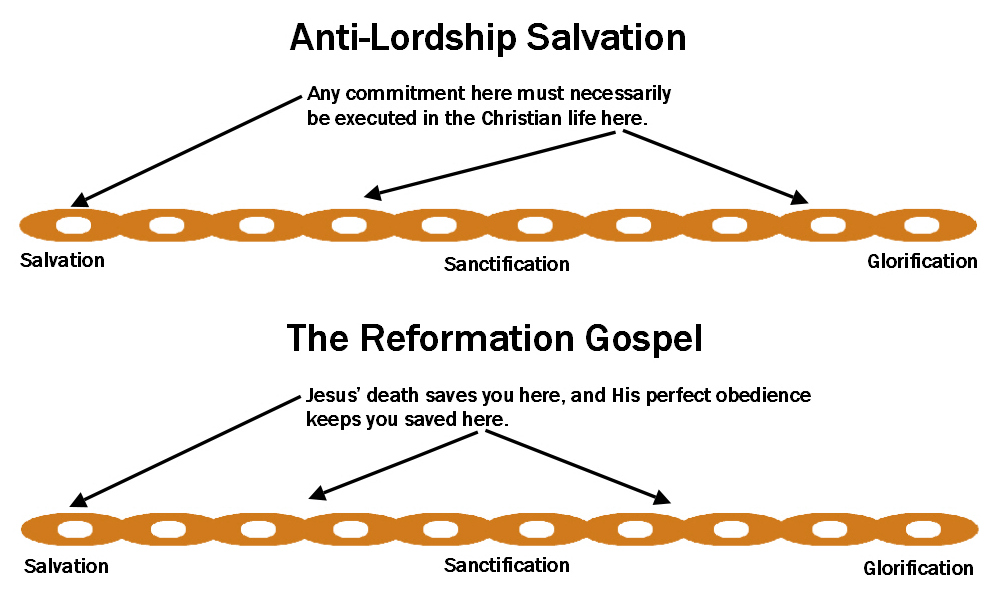
The issue made simple: Romans 8:30.
In Romans 8:30 we read the following:
And those whom he predestined he also called, and those whom he called he also justified, and those whom he justified he also glorified.
Notice that sanctification is missing from this verse even though the context spans the beginning of our salvation to our resurrection. This is the distinction between all golden chain gospels and the real gospel, the kingdom gospel. Jesus came preaching the “gospel of the kingdom.” Hereafter, KG. The golden chain gospel says that sanctification is missing from this verse because justification and sanctification are the same thing. The KG says that sanctification is missing from this verse because justification and sanctification are mutually exclusive. The context is assurance of salvation (see verses 31ff.).
Curiously, the golden chain gospel which includes both ALS and LS/Calvinism, teaches us to remind ourselves of God’s grace alone regardless of anything we do. If our behavior brings doubt, this is evidence of a fundamental misunderstanding of God’s grace and we should therefore remind ourselves of such. ALS says that concern over behavior suggests that you believe behavior finishes justification and not grace alone. With the KG, that consideration is not even on the radar screen because justification and sanctification are completely separate; finishing a finished work is impossible. You can’t have that mentality if you understand it to be an impossible reality. I might also add that simply returning to the same gospel that saved us to cure a troubled conscience instead of changing behavior sears the consequence over time. This is ill advised.
In other words, the KG says it is impossible to unwittingly attempt to please God to gain justification because that work is finished. One is free to aggressively obey God without any fear that they are unwittingly attempting to earn their justification. ALS and LS/Calvinism do not have this convenience because justification is both finished and not finished. The Reformed, already, but not yet construct that relates to predestination cannot be discussed here for lack of room and fear of confusion, but suffice to say for this study that the convenience is not there for either ALS or LS because justification is not finished. You must continue to remind yourself of free grace because you are in a continuum where unwitting works salvation can take place, and the only solution is to disavow good behavior as an evidence of conversion. Obedience must be completely optional. This used to be criticized as “Let go and let God” theology. According to the KG, such a continuum is impossible and not reality.
Consider some dialogue I have had recently with ALS proponents:
Paul, While you ponder my answer, I’d like to ask you, if you’d identify what you believe you must do, before, during and after, in order to be given eternal life. Thank you, In Him, Holly
“Before, during, and after”? to… “be given eternal life.”? The implied answer is: nothing in justification; nothing in sanctification; and nothing in glorification. But again “during” shouldn’t even be deemed possible.
LS in Cogous form already states that perpetual double imputation is needed, so bad behavior is actually a good thing because it “shows forth the gospel.” In contrast, advocates of the KG are concerned with evidence of the new birth, not the overcoming of a propensity to misunderstand the grace of God because all doing in the Christian life is attached to justification somehow. Advocates of the KG understand that nothing they do in the Christian life has anything at all to do with justification. Much assurance comes from that. However, lazy discipleship forfeits assurance because it violates the conscience, and judgment begins in the household of God regarding consequences for bad behavior in this life. The fear generated from that can get confused with fear of eternal judgment.
But don’t miss my main point here: the solution for a lack of assurance in both ALS and LS are the same: preach the gospel to yourself. Remind yourself that works done by us are completely irrelevant to our salvation which also includes sanctification (the Christian life). Both camps woefully devalue the new birth and its expectations. In effect, we have no righteousness and obedience is not really performed by us, but performed by the Holy Spirit if we are “abiding” in Christ. This is a passive sanctification of our works in sanctification in order to categorize them as living by faith alone. ANY work we do is accredited to the justification process, so it must be sanctified by the right process. In the final analysis, Christians must only EXPERIENCE an obedience imputed to us by Christ. Citations by the Reformed abound, and I can cite one from the aforementioned conversation with advocates of ALS:
We can have righteousness of our own, that is self-righteousness. I didn’t notice, did you answer any of the questions? Do you sin? How much? Or not? Are you sinless?
Park on the fact that both camps assert that the Christian has no righteousness. To have any righteousness is a “righteousness of our own.” It’s either ALL us or ALL Christ. Therefore, we can only EXPERIENCE righteousness imputed to us, but it really isn’t us performing it; hence, in relationship to the same conversation:
This passage has nothing to do with becoming saved or providing evidence through our works that we are saved. The passage is about living experientially in a manner that is consistent with our position on [sic] Christ.
Notice that the Christian lives “experientially” according to “our position [i]n Christ.” In other words, Christians only experience their position, they don’t actually perform obedience themselves. In addition, when talking to either camp, one is challenged with the question, “Did you sin today?” And in both cases, when you qualify the question with, “In justification or sanctification?”…without exception they are thrown for a loop. Why? Because they see sin in justification as no different than sin in sanctification—that’s why they ask the question in the first place. If you believe the Christian is personally righteous as well as positionally righteous, you are immediately challenged by both camps with, “Did you sin today?” Why? Because the same assumption is that righteousness and sin are mutually exclusive. For the world, this is true, but not for Christians.
Another fact of the Reformation gospel is “righteousness” is defined as a perfect keeping of the law. To remove the law’s perfect standard, and its demands for perfection from justification is the very definition of antinomianism according to the Reformers. A perfect law keeping must be maintained for each believer if they are to remain justification.
If you remember, this is a direct quote from part one. ALS and LS/Calvinism both define righteousness by perfect law keeping. Again, why the air of profundity in the terse rhetorical question designed to end the argument on the spot by coup de grace? The very essence of the question reveals a profound misunderstanding of law and grace.
Let’s get a little more full circle now with part one. Because the Christian, according to both camps, cannot be righteous if he/she sins even once (“Do you sin? How much? Or not? Are you sinless?”), the good old Reformed mainstay of double imputation is needed for both of these applications of the same golden chain gospel. From part one:
Thirdly, this requires what is known as double imputation. Christ not only died for our sins so that our sins could be imputed to Him, He lived a life of perfect obedience to the law so that His obedience could be imputed to our sanctification.
The windsock of double imputation is the idea that the righteousness of Christ is imputed to our sanctification. He died for our justification, and His perfect obedience to the law was imputed to our sanctification to keep justification rolling forward:
Model A asserts that since we cannot keep the law perfectly, we must invoke the double imputation of Christ by faith alone in order to be saved and stay saved (part 1).
Now let’s look again at the same recent conversation with ALS proponents:
Thanks Mark, I agree. We are qualified as saints, because of Christ’s righteousness imputed to us, but we still sin,..
Therefore, we only “qualify” as saints because we still sin, in order to keep our sainthood the righteousness of Christ must be imputed to us daily. Yes, that would be daily salvation. In the quote immediately prior, “Holly” was responding to this statement:
Hope you don’t mind me adding a thought, I think Paul is saying we were sinners but we are now saints (forgive me if I am wrong), it is true of course that we are saints but I believe it is also still true that we are sinners saved by grace because the Apostle Paul said, “Christ Jesus came into the world to save sinners; of whom I am chief”, present tense.
So, if Christians are still sinners, because we sin, and Christ came to save sinners, it would only make since that our need for salvation is still ongoing. Direct citations that agree with that point by John Calvin and Martin Luther is abundant low hanging fruit, but granted, such statements from the ALS camp are somewhat surprising. To further the point, I might add that “Holly” referred me to a message taught by a notable figure in the ALS movement who interpreted Romans 7:24 as a daily salvation. This is a very common rendering of that verse by the Reformed as well. The verse obviously refers to the redemption of the body and not a daily salvation.
Both are guilty of the same thing: a false double imputation construct must be applied to the Christian life by faith alone and the subjective experience thereof is optional. Like ALS—like Calvinism.
What is wrong with this gospel?
The golden chain gospel misrepresents the Trinity. The Father is removed from His role in salvation because it is His righteousness imputed to the believer before the foundation of the world. According to Romans 8:30, this guarantees glorification. The Holy Spirit is also misrepresented in regard to His role in salvation. His setting us apart before the foundation of the world is confused with His work in regeneration. Christ’s role is redefined beyond His death for our sins as a onetime act that ended sin. This is not a covering—it’s an ending. Even though the Reformed and ALS both concur that Christ died once, His death is perpetually reapplied to sins we commit as Christians when there is no such need. Neither is there a need to impute Christ’s righteousness to us perpetually. At the Bema event, it will not be God the Father looking at us and only seeing Jesus, it will be Jesus Himself judging His righteous followers. He will not be judging His own righteousness. The golden chain gospel is an egregious distortion of the Trinity.
True double imputation is our sins being imputed to Christ, and the Father’s righteousness imputed to us apart from the law. Christ came to end the law. It is because of this, and the new birth, that we are truly righteous in and of ourselves, but of course not apart from God’s power and plan of salvation. We have God’s seed in us, are no longer under any law that can judge us, and are able to please God with our lives. We are new creatures who are sinless according to justification because even if the old us that died with Christ was exhumed and brought into court, there would be no law to condemn us.
This gospel not only distorts the Trinity, rejects the new birth, and distorts double imputation, it misrepresents sonship. The sins we commit as a family member are considered to be sin against justification: “Did you sin today?” Again, if you ask them, “Sin in justification or sanctification?” all you will here is crickets, or the babblings of confused narcissists.
The golden chain gospel also strips the Christian of ability to love Christ and others by keeping Christians under the law of sin and death that Christ came to end. Said gospel makes that law the standard for righteousness. However, there is no law standard in justification, it is APART from any law—it is God’s righteousness imputed to us. Those under grace serve the law of the Spirit of life which is fulfilled by loving Christ and others:
“If you love me, keep my commandments.”
It is impossible to love Christ by keeping the law of sin and death. Besides, that law is ended when we believe. All of our sins committed before faith were against that law and in essence imputed to it. Before we were saved, we were enslaved to that law and it provoked us to sin. Consider two spouses: we were the spouse that was under the law of sin and death until we died with Christ, now we are free to serve another. Sins we now commit are against family relationship, not sins that fall short of the law of sin and death.
Said gospel prevents us from making a commitment to God’s kingdom because the commitment would have to be executed perfectly in kingdom living to maintain our citizenship. Said gospel demands that we only recognize Christ in a one-way relation while ignoring His kingdom, its law, and the king. Yea, we can only accept Him as savior in a one-way relationship. This assumes that a decision to flee the present kingdom of darkness for the kingdom of light cannot be a commitment totally separate from the kingdom citizenship. If we make a commitment, the commitment must be executed perfectly in order to remain a citizen. No, the commitment is totally separate from our citizenship in the same way justification is totally separate from sanctification.
I realize that only repentance was emphasized to the Jews, but they were already saturated with the concept of God’s kingdom. From the beginning, Abraham looked for a city built by God. As we see Gentiles coming into the church, they must be brought up to speed on their new Jewishness. We should read the Bible with this in mind and the way it affected the presentation of the gospel, and the very definition of the word “gospel” itself.
The golden chain gospel rejects the new birth by ignoring the difference in slavery between two different laws: the law of sin and death that will condemn the world, and the law of the kingdom; the law of the Spirit of life. It makes the law of the Spirit of life a fulfilment of the law of sin and death that is in fact ended. In essence we remain enslaved to a law of condemnation as “sinners.” This is a rejection of the new birth.
It also adds another seed to the covenant of promise. If the law of sin and death could impart life, it would be a second seed from which life would come to the world. It doesn’t matter who obeys it, it cannot impart life.
The golden chain gospel distorts the Trinity, distorts double imputation, misrepresents sonship, strips the Christian of ability to love Christ and others, rejects a biblical definition of the new birth, keeps Christians under the law of sin and death, distorts the atonement, perpetually reapplies the death of Christ to salvation, replaces the righteousness of God with a law standard, propagates a one-way relationship with God, makes sin as a kingdom citizen the same as condemning sin, enslaves us as a spouse still under the law of sin and death, calls for us to accept Christ as savior in a one-way relationship while ignoring His Lordship.
Do Christians have two natures? This will be examined in part 3.
paul

 Paul's Passing Thoughts
leave a comment