New Calvinism Further Exposed With Help From Aaron O’Kelly: Part One
This is a shocking statement that unwittingly reveals O’Kelly’s ignorance in regard to the short history of the doctrine he embraces. Dr. John Miller is the father of Sonship theology and coined the mantra that is a hallmark of New Calvinism: “We must preach the gospel to ourselves everyday.” Luther didn’t coin that phrase—Miller did.
A New Calvinist blogger by the name of Aaron O’Kelly has responded to my open letter to Peter Lumpkin. Among many other accomplishments, Aaron obtained a doctorate degree from Southern seminary which is of particular interest to me as a Southern Baptist.
I will address the title of Aaron’s post first. It exemplifies the New Calvinist motif: us against them; evangelical Catholicism against the children of Luther; the scandalous doctrine of freedom; and partaking with Paul the apostle in being called an antinomian, etc. Though I could cite a gazillion examples, one from New Calvinist guru Tullian Tchividjian should suffice:
“As I’ve said before, I once assumed (along with the vast majority of professing Christians) that the gospel was simply what non-Christians must believe in order to be saved, while afterward we advance to deeper theological waters.”
That’s the mentality—they are set apart from the “vast majority” of professing Christians. Let that sink in. Towards the end of his post, Aaron eludes to their kinship with the great apostle in being called antinomian because they have discovered the long lost gospel:
“Dohse’s open letter is one more indication of how scandalous the gospel really is. When we receive the unfathomable good news that God receives us into his favor on account of Christ alone, and not because of anything in us, we instinctively recoil in an attempt to protect this glorious message from the charge of antinomianism. The pure gospel is too strong for us, and we think we need to mix it with a good bit of law to keep it from becoming too dangerous.”
And:
“But the gospel of the New Testament is the good news of freedom from the law through union with the crucified and risen Christ (Romans 7:1-7). It is a message that Paul was slandered for proclaiming, as though he encouraged sin (Romans 3:8). And those who have proclaimed it faithfully have been slandered ever since.”
O’Kelly also mentions that he considers himself a “Luthero-Calvinistic Baptist, but that hasn’t caught on yet.” Give it time Aaron, I’m sure it will eventually. After all, like Luther, New Calvinists are set apart from the “vast majority” of professing Christians.
I might also mention that the we are like the apostle Paul because he was accused of antinomianism also was tried on Jason Hood when New Calvinist Dane Ortlund responded to his calling out of Tchividjian. I comment on the exchange in another post:
“Moreover, a new one that I hadn’t heard before was mentioned by Hood regarding Ortlund’s original challenge—the whole idea that today’s New Calvinists are being ‘falsely’ accused of antinomianism like the apostle Paul was during his ministry (Rom 3:8). Therefore, if they are being accused of antinomianism, they must be preaching just like Paul was. Oh brother!”
Hood’s theological trouncing of Ortland’s position can be observed here: http://goo.gl/wYTrV .
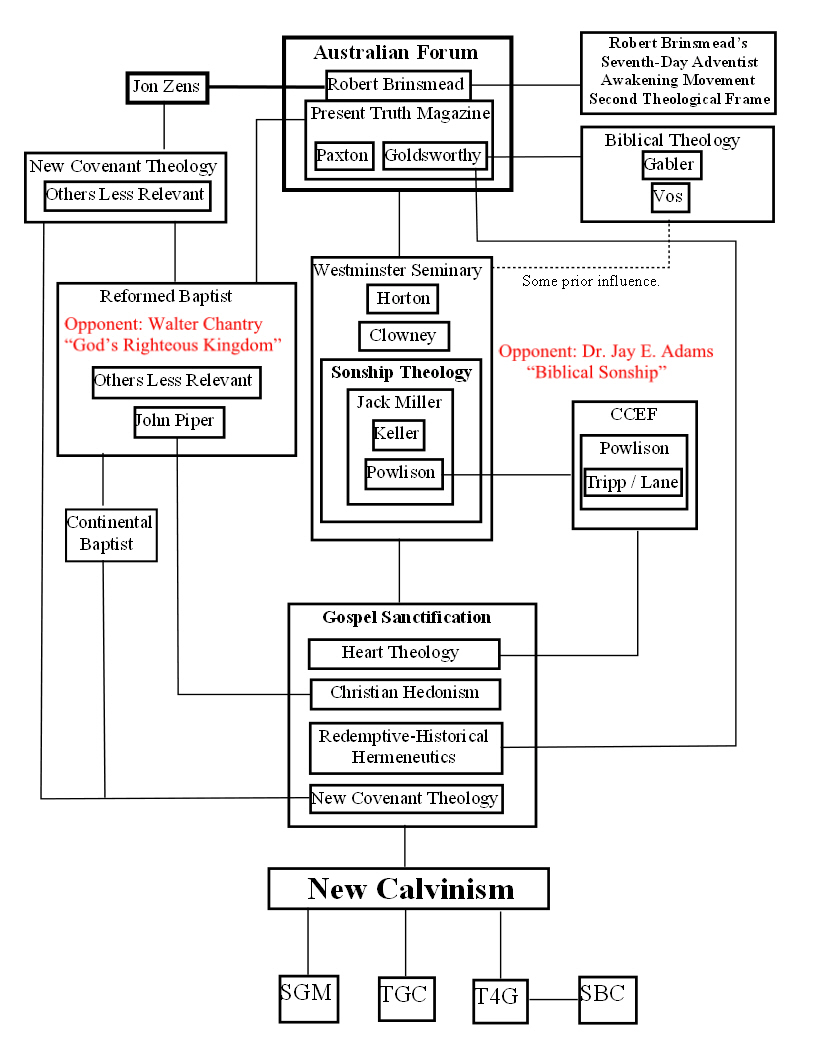
Much of Aaron O’Kelly’s (hereafter: “A-OK”) post addresses the genealogy chart. Perfect. After likening me to a government worker, he says the following:
“All kidding aside, charts like these have the effect of distorting the character of broad movements by implying that the adherents of the movement are members of a tightly knit group (cult?) who have conspired together to defend the novel teachings of their founder(s), to whom they are staunchly loyal.”
“Genealogy charts” and “family trees” (terms I use often to refer to the chart) in no way infer what A-OK is saying. Theological frameworks often leave behind a long history of people who never knew each other. Besides, the theological journal of the Australian Forum (hereafter: “AF”), Present Truth (hereafter “PT”), had a huge readership in Reformed Baptist circles and places like Westminster Seminary. In fact, Jon Zens was introduced to Brinsmead and the Forum through PT while he was a student at Westminster. To make my point, A-OK states the following concerning the top of the chart:
“I myself have never heard of the majority of names at the top of the list. I have heard of Graeme Goldsworthy, and I think he is an excellent Bible teacher. He is one influence among many (including some other names on the chart, but also including a large number of names that are not) who has played a role in my understanding of the Bible. Does that make me a card-carrying member of the group represented by this chart? If so, I must have missed the meeting where we learned the password and the secret handshake.”
So, A-OK seems to say that he has never heard of Zens or Brinsmead (he implies that Goldsworthy is the only one he knows of at the top of the chart), but it is well documented that Zens is the father of New Covenant Theology with considerable contributions by Brinsmead. Certainly, A-OK has heard of New Covenant Theology. He may even ascribe to it, but that doesn’t mean he’s a loyal follower of Jon Zens; or for that matter, even knew him or heard of him which seems to be the case.
Another indication that one does not need to know of the conceivers of a doctrine (or that my chart would imply a conspiracy) to embrace its elements passed on by various means, is the fact that A-OK parrots the AF’s position on the supposed subjective aspect of the gospel—even using their terminology. Here is what he writes:
“I am not sure why Dohse would consider it controversial to say ‘the gospel is something completely outside of us.’ To say otherwise would be to imply that salvation comes, at least in part, by gazing at our navels.”
Now consider what one of the AF3 wrote (Geoffrey Paxton, who I doubt he has heard of either) on the same wise:
“Such evangelical naval watching does nothing to commend Christianity….” (The False Gospel of the New Birth PT vol.37 article 4). The AF3 continually referred to “naval watching” when discussing the supposed subjective aspects of the gospel verses the objective gospel.
Another example would be Michael Horton who said this: “But to whom are we introducing people to, Christ or to ourselves? Is the ‘Good News’ no longer Christ’s doing and dying, but our own ‘Spirit-filled’ life?” Compared to G. Paxton who said this: “It robs Christ of His glory by putting the Spirit’s work in the believer above and therefore against what Christ has done for the believer in His doing and dying.”
Furthermore, A-OK prefaces the following statement in regard to the chart:
“By the way, I am speaking the language of Luther here; I am in no way indebted to the ‘Sonship theology’ that Dohse criticizes, nor have I ever heard of it prior to reading his letter.”
This is a shocking statement that unwittingly reveals O’Kelly’s ignorance in regard to the short history of the doctrine he embraces. Dr. John Miller is the father of Sonship theology and coined the mantra that is a hallmark of New Calvinism: “We must preach the gospel to ourselves everyday.” Luther didn’t coin that phrase—Miller did. Moreover, the present-day New Calvinist movement is replete with Miller’s spiritual children; namely, Tim Keller, David Powlison, Jerry Bridges, Darren Patrick, Mark Driscoll, and many others.
But now the most important points about the chart: First, it raises questions of integrity. Why does Keller and Powlison avoid the Sonship nomenclature among New Calvinist? You say, “They don’t” Then why do New Calvinist constantly espouse the phrase Miller invented, but yet they have never even heard of Sonship theology? O’Kelley said himself as one who is apparently qualified to write a response to the chart: “….nor have I ever heard of it prior to reading his letter.” I think this also adds to my aforementioned point as well—my chart hardly implies an accusation concerning a conspiracy.
Secondly, New Calvinists can no longer pretend that notable evangelicals have never had a problem with this doctrine. And to a more significant point, notable Calvinist themselves! And I don’t mean secondary disagreements, I mean, “This movement must be exposed and stopped.”
Thirdly, New Calvinist hacks can no longer go to conferences and pretend that all of the keynote speakers are parachuted in from Luther’s compound. Those days are over, and rightfully so.
Well, we have much more work to do on O’Kelly’s post. Lord willing, I will write part two tomorrow.
paul
Great Link
 Peter Lumpkins posted a great find on his blog. It is a link to fourteen copies of Jay Adams’ book on Sonship Theology. The cost of the books reflect the fact that it is unfortunately out of print. Here is the link: http://goo.gl/SPlS6
But Peter, They’re Not Really Calvinist! An Open Letter To Peter Lumpkins
 Dear Peter,
I write to you as a fellow Southern Baptist.
I think real Calvinism has brought good things to Southern Baptists, but I just wanted to write you and mention that your present contention is not with real Calvinism.
They call themselves Calvinists, but that’s a lie. In fact, real Calvinists contend against them. Let me explain. The present movement you see in the SBC has a Calvinism label, but was really hatched by Jon Zens and a Seventh-day Adventist named Robert Brinsmead. Brinsmead created a project called the Australian Forum to promote the doctrine, and the two other primary contributors were Geoffrey Paxton and Graeme Goldsworthy. Their family tree, a work of mine with the help of others, can be seen in the following chart:

The basic frame of the doctrine they created is known as the centrality of the objective gospel (COG), and is what drives the present movement you see in the SBC. Apparently, the movement is now known as “New Calvinism,” and entails the T4G, The Gospel Coalition, and many, many other organizations that promote the movement.
Basically, it teaches that the gospel is something completely outside of us (objective), and that we are transformed by contemplating the depths of the gospel (or as John Piper states it: “Beholding as a way of becoming”). This outside, objective focus supposedly aids us in not being distracted by things that are subjective; for instance, even the belief that we are born again. In fact, the movement denies the significance of the new birth and teaches that Christians are still totally depraved. This can be illustrated by the video circulating on the Web called “John Piper is Bad” which doesn’t mean Piper is a cool guy, but rather that he is still a “T” in TULIP—totally depraved. Unlike real Calvinism, it projects TULIP onto sanctification as well. Piper acknowledged in an interview that he understood the video to mean exactly that and also agreed with it. Certainly, traditional Calvinism does not believe that Christians are still totally depraved.
In other words, the movement only recognizes justification (objective) and not the vital union or the new birth (subjective). We are supposedly transformed by focusing on the historical Christ event alone. This is why CJ Mahaney, one of the “core four” with Al Mohler in the T4G, always presents the gospel in the five-word epigram “Christ died for our sins.” In like manner, Piper presents a justification only gospel in “The gospel in 6 Minutes: “In a sentence….That’s the gospel.”
In 2008, one of the Australian 3, Graeme Goldsworthy, spoke at Southern Seminary (in the Australian Forum’s theological journal “Present Truth,” both Paxton and Goldsworthy declared the new birth a “false gospel”). John Piper reviewed Goldsworthy’s visit/lecture in an article posted on his Desiring God website (Piper is one of the keynote speakers at the 2012 T4G). In that article, Piper affirmed COG, and wrote the following:
“When the ground of justification moves from Christ outside of us to the work of Christ inside of us, the gospel (and the human soul) is imperiled. It is an upside down gospel [emphasis his, not mine].”
This is an interesting statement considering that Southern Baptists certainly change emphasis to our role as new creatures after we are saved. Piper is saying to do so is to put one’s soul in peril, and this is also exactly what the AF3 propagated. Furthermore, Piper seems to be saying that any emphasis on the work of Christ inside of us is a false gospel—also what the AF3 advocated. Peter, trust me, this problem is way bigger than Calvinism.
In addition, real Calvinist have fought this problem tooth and nail. As you can see from their family tree, the doctrine was repackaged by Dr. John Miller in the form of Sonship Theology while he was at Westminster Seminary. Pastors in the PCA (Calvin’s denomination) have been fighting the doctrine for years, especially Dr. Jay Adams who wrote a book against it in 1999. Tim Keller, a major figure in the New Calvinist movement, as well as David Powlison, were followers of John Miller. During a lecture at John Piper’s church, Powlison called Miller his mentor and chastised Adams for being critical of Dr. Miller for coining the phrase, “We must preach the gospel [justification] to ourselves everyday.” However, the fact that the criticism was in book form seemed to have slipped Powlison’s mind. Moreover, readers of my blog, one of which is taking the Sonship course presently, assure me that Sonship clearly teaches the total depravity of the saints, rejects the new birth, and holds to a New Covenant Theology view of the law. It is also common knowledge that Keller has taught Sonship Theology extensively.
It’s all the same doctrine. If the doctrine hadn’t found new life at Westminster, it wouldn’t have survived the brutal pushback by Reformed Baptist (more real Calvinist) such as Walter Chantry. Chantry and others adamantly called it out for what it is: “neo-antinomianism.” In the same way that COG plagued the Reformed Baptist by splitting churches and families, this doctrine continues to wreak havoc on God’s people.
Peter, worry about the real Calvinist later—these guys must go!
paul

Big Mac Contradictions: From “Saved Without A Doubt” to “Uneclipsing The Son”
 “Like the Emergent Church postmodernism that Dr. MacArthur rebukes in ‘The Truth War’ with all fervor, he has become comfortable with contradictions. Like the postmoderns he ridicules, the Bible is not a superintended document concerning what Jesus SAYS, it is a story / narrative about what Jesus looks like. These are indeed confusing days for the American church, and she has lost one that was once a voice of clarification amidst the crosstalk.”
As one who has had profound respect for John MacArthur over the years, his courtship with New Calvinism and their Gospel Sanctification doctrine has been a major disappointment for me. That aside, by far, the most powerful book Mac has ever written is Saved Without A Doubt. It’s probably why the book has been recently reprinted.
But one can only conclude that there is a really big contradiction by Mac regarding what he wrote in SWD and what he penned in the forward to the atrocious Uneclipsing The Son by Rick Holland ; specifically, what gives you assurance of salvation doesn’t also sanctify you.
I have always said that the first chapter of 2Peter presents huge problems for the New Calvinist movement. First, Peter makes it clear that he wrote the epistle during a time when he knew his departure into glory was at hand (verses 12-15). This was the message that Peter thought to be the most important truth for the saints to remember after his departure so that they could “be able at any time to recall these things.” What things? Peter calls those things “qualities” (verse 12) that are to be ADDED to our FAITH (because obviously, faith is the foundation that we build on in contrast to the New Calvinist proposition to continually rebuild the foundation). If Michael Horton’s “revisiting the gospel afresh” is paramount to sanctification, it is unthinkable that this would not be what Peter would want them to be in constant remembrance of.
Secondly, Peter wrote that he and others saw the very majesty of Christ firsthand, but then refers to the Scriptures as a better testimony that was to be used for direction (a light in a dark place [verse 19] or as Psalm 119;105 says, “a light to my path”).
This same chapter also has assurance as a major theme, so I thought it would be very interesting to go back and revisit what MacArthur wrote about the first chapter of 2Peter in SWD. Throughout chapter 7 where he expounds on 2Peter and its relationship to assurance, the contradictions to what he wrote in UTS are numerous, but I will highlight the most glaring contradictions.
1. In his introduction to chapter 7, Mac writes that he took a sabbatical in 1980 (when New Calvinism was still in its infancy and being nurtured by Robert Brinsmead and Jon Zens) to reevaluate his future at Grace Community Church where he had ministered for eleven years. Mac states on page 127: “I remember feeling I had taught my congregation everything I knew. I feared boring them by going over the same old things.” Here, Mac is clearly talking about a variety of biblical truth and disciplines. Surely, he wasn’t referring to deeper knowledge of Christ (and his personhood) as “the same old things” (and additionally, “things” in the plural). He then states that God called him to a ministry of remembrance that reinvigorated him: “What happened? The Lord taught me the importance of being used to remind believers of truth they already know. I sensed a new commitment and perspective in ministry based on my reading of 2Peter 1.” He then states: “I’ve been at my church for more than forty years now. If I have my way, I’ll be around a lot longer than that, reinforcing the truth just as Peter did.”
But in UTS he writes: “After more than four decades of pastoral ministry, I am still constantly amazed at the power of Christ-centered preaching”[as opposed to “truth”]. And, “The pastor who makes anything or anyone other than Christ the focus of his message is actually hindering the sanctification of the flock.” So much for a ministry of “remembrance.” If the remembering is anything other than Christ—it hinders sanctification, and one would have to assume assurance as well.
2. On page 128 of SWD, MacArthur was in good company with those who propose that the Lord’s table is what Christ recommended for remembering Him and his sacrifice for us. In his contention against a form of New Calvinism called Sonship Theology, Jay Adams wrote the following: “Certainly, all of us may frequently look back to the time when we became sons and rejoice in the fact, but there is no directive to do so for growth, or even an example of this practice, in the New Testament….The true reminder of the good news about Jesus’ death for our sins is the one that he left for us to observe-the Lord’s supper (‘Do this in remembrance of Me’).” Likewise, MacArthur recognizes this same reality on page 128: “Remembrance is a vital aspect of Christian ministry. Celebrating Communion at the Lord’s Table is a prime example—its point is that we might forever remember Jesus Christ and His sacrifice on our behalf. It challenges us to overcome the indifference bred by familiarity.” And, “God has endowed the brain with the capacity to reinforce spiritual truth. When you continually feed on the Word of God [verses Christ only?], you will respond in a spiritual manner almost voluntarily.”
In SWD, Mac clearly has a variety of biblical truth in mind, but in UTS, Mac says, “Second Corinthians 3:18 describes in simple terms how God conforms us to the image of His Son: ‘And we all, with unveiled face, beholding the glory of the Lord, are being transformed into the same image from one degree of glory to another’ (emphasis added). We don’t ‘see’ Christ literally and physically, of course (I Peter 1:8). But His glory is on full display [“full display” ?] in the Word of God, and it is every minister’s duty to make that glory known above all other subjects.”
3. By far, the most glaring contradiction is the most important, and is paramount to sanctification that turns out well. In the forward to UTS, Mac makes it clear that spiritual growth comes by gazing on the “face” of Jesus (but what exactly does that mean?! And how do you do that “one verse at a time” which is the motto of his ministry?). But he would then have to say that sanctification that is going well isn’t experienced by assurance because of what he writes in SWD. On page 123 of the new addition and 106 of the first addition, he writes the following: “Perhaps the most obvious reason for lacking assurance is disobedience, because assurance is the reward for obedience.” Not only that, but Mac makes it clear that it is us exerting and striving in the process: “Peter said to expend maximum effort to equip or supply ourselves (GK., epichoregein) with a series of virtues” (p.132 new / p.114 first edition).
However, in UTS, he says the following: “This is the ever-increasing reality of progressive sanctification; it happens not because believers wish it or want it or work for it in their own energy, but because the glory of Christ captures their hearts and minds.” That concept of contemplative spirituality is nowhere to be found in SWD, and is a direct contradiction to “….expend maximum effort to equip or supply OURSELVES with a series of virtues” (emphasis mine).
4. Furthermore, in SWD, Mac clearly contradicts the New Calvinist concept of the imperative command is grounded in the indicative event. When he is talking about the necessity of exerting our own energy or efforts in obedience for assurance, and presumably spiritual growth as well, he rejects the notion that Peter’s imperatives in 2Peter 1 flow from the indicates in some kind of effortless experience: “Now that may come as a surprise after hearing in verses 3-4 about all the good things God has already done for us. You might expect the next statement to be, ‘So let go and let God. Relax and wait for Him to do it all.’ Hardly. Peter said to EXPEND MAXIMUM EFFORT to equip or supply OURSELVES….”(emphasis mine). So, Dr. MacArthur, which is it? NOT by our own efforts, or expending maximum effort to supply ourselves? Regardless, Mac is clearly rejecting a cause and effect relationship between contemplating what God has done in verses 3,4 and what Peter commands in the verses following.
5. Mac further contradicts the theme of Holland’s book (which he enthusiastically endorses) by emphasizing in SWD that salvation is a foundation that we build on. UTS rejects that idea and replaces it with the idea that the gospel is not merely the “ABC’s of Christianity, but the A-Z” as many New Calvinists like to state it. Holland states this on almost every page of UTS, but particularly on page 15. On that page, he also states that being familiar with the gospel is what hinders spiritual growth, and the key is to look deeper into the gospel for the purpose of feeling the same way we did when we were first saved (“Do these words move you as they once did?”). Again, in SWD, Mac agrees with Adams in regard to a primary remedy for that—the Lord’s Table, but also writes: “In your faith, your initial believing in Christ, you need to come lavishly, zealously, diligently alongside what Christ has done and do everything you [amazingly, the emphasis here on “you” is MacArthur’s] can possibly do. That’s what will continue to yield the fruit of assurance in your life.” A close friend of MacArthur’s, RC Sproul, who also for some reason enthusiastically endorses New Calvinism, would agree:
““Sanctification is cooperative. There are two partners involved in the work. I must work and God will work. If ever the extra-biblical maxim, ‘God helps those who help themselves,’ had any truth, it is at this point. We are not called to sit back and let God do all the work. We are called to work, and to work hard. To work something out with fear and trembling is to work with devout and conscientious rigor. It is to work with care, with a profound concern with the end result” (Pleasing God p. 227).
6. As opposed to gazing on the glory of Christ (or his “face” which obviously is not seen in Scripture, nor John Piper’s “pictures of Jesus” that we are supposed to look for) as the primary gateway to spiritual growth as propagated by Mac in UTC, he rather promotes the primary idea in SWD that the gateway of assurance (and one assumes accompanying growth) is obedience and right choices (p.129 first / p.150 new). Again, on those pages, he reiterates that vigorously appropriating what God has supplied is the “balancing” approach, not some kind of effort that flows from the work of God that is not our “own efforts.” In UTS, MacArthur falls into the New Calvinist either/or hermeneutic; it’s either all of us, or all of the Spirit. Jay Adams notes well that such a hermeneutic strips us of a way to genuinely love the Lord according to a biblical prescription.
Additionally, in stark contrast, he describes love and praise of God, joy, contentment, service, gratitude, and fearlessness as flowing from assurance which he says first flows from obedience! (129,130 / 150-152). This completely blows-up the New Calvinist paradigm propagated by Michael Horton: 1. Contemplation on the gospel 2.Gratitude 3. Doxology 4. obedience (#4 flowing from something that is “not in our own efforts” which is what exactly?). Mac makes this absolutely clear on page 147 of the new addition, saying that God knows who he has elected; and, “God is not the issue here; you are.” On page 146 of the new addition and replicated in the first, Mac writes: “Be warned: A failure to diligently pursue spiritual virtue will produce spiritual amnesia. It will dim your vision of your spiritual condition. You may associate some external activity or experience with the moment of you salvation, but you will not feel assured.” This is obviously a gargantuan contrast to what Mac is advocating in UTS.
Like the Emergent Church postmodernism that Dr. MacArthur rebukes in The Truth War with all fervor, he has become comfortable with contradictions. Like the postmoderns he ridicules, the Bible is not a superintended document concerning what Jesus SAYS, it is a story / narrative about what Jesus looks like. These are indeed confusing days for the American church, and she has lost one that was once a voice of clarification amidst the crosstalk.
paul

 Paul's Passing Thoughts

4 comments