Jay Adams: “People have gotten so used to others with no answers that they don’t expect them.”
February 17, 2012 by Jay Adams
http://www.nouthetic.org/blog/?p=3190Most people who ask the question—whether in distress or out of simple puzzlement—don’t really want an answer. They turn their attention to something else as you open your mouth to answer.
WHAT THEY ARE DOING INSTEAD OF REALLY ASKING A LEGITIMATE QUESTION IN SEARCH OF AN ANSWER IS COMPLAINING. AND THAT’S NOT GOOD!
Have you ever stopped such a person in the middle of his next comment or question to say, “Did you really want to know the answer to your question?” Try it sometime. It’s not impolite—just startling to him. People have gotten so used to others with no answers that they don’t expect them.
The answer you give may be something like this: “You asked why? I’d like to tell you.”
If your startled companion encourages you—even slightly—“Uh . . .yeah, sure,” then tell him something like this:
“What happened, about which you were wondering “why” was an act of God’s providence. You know He’s actively at work in this world. And what He does for His children is always for their good (quote Romans 8:28). Even though we don’t know what He’s up to in the problem, nevertheless, we can be sure of several things since you are a Christian:
God is in the problem
God is up to something in the problem
God is up to something good.
You may or may not find out what that is soon, later, or in the life to come.
But, since you asked, that’s “why” it happened.
Now, you can look for some good to come from the outset. But you must look!
If you do, you may discover that this is the beginning of something exciting.
Sure hope so. And I certainly hope you don’t miss out on it.
Now, of course, you may want to say it your own way—eliminate the list (as such), or leave out a line or so. But one thing must be certain—you need to make it clear that GOD IS INVOLVED IN WHAT IS HAPPENING, BRINGING ABOUT GOOD IN ONE WAY OR ANOTHER, IN HIS TIME.
Give it a try and see what happens—it may open up a conversation that will be a blessing for both of you. But if you say the wrong things, in the wrong ways to the wrong person—well, don’t blame me!
The Only Real Difference Between First and Second Generation Biblical Counseling is Romans 8:30
“Are two different gospels operating under the same nomenclature of ‘help can be found here’ acceptable or not? Both are not the truth, and one or the other will help, or add further hurt.”
Heath Lambert recently published the book, The Biblical Counseling Movement After Adams. The contemporary motif of our day is the idea that Dr. Jay E. Adams started the biblical counseling movement (first generation), and then others such as David Powlison of Westminster’s CCEF built on the foundation laid by Adams. The ever-morphing result is called “second generation” biblical counseling. Lambert’s book is a lengthy treatise that supposedly informs us of the differences between the two generations.
I am going to bypass all of those issues and focus on the one difference that matters—how each generation interprets the gospel. As the president of the annexed NANC used to say, “Fasten your seatbelts and put on your crash helmets,” because my thesis is that one of these generations is founded on, and operates by a false gospel.
As many know, especially my wife, I have spent almost five years researching the present-day New Calvinism movement. The movement has its roots in the Progressive Adventist movement fathered by Robert Brinsmead. The magnum opus of that movement was their interpretation of Romans 8:30. I will pause now and quote an individual who witnessed that remarkable movement firsthand:
In 1971, Brinsmead scheduled a flurry of summer institutes to bring us his latest emphasis. There was more excitement than usual; the latest round of tapes had prepared us for something big. Bob had been studying the Reformation doctrine of justification by faith, comparing it to Roman Catholic doctrines. Reading Luther, he saw that justification is not just a means to the end of perfect sanctification. When we are justified by faith, not only does God impute Christ’s righteousness to us but we also possess Christ Himself—all His righteousness and all His perfection. Eternity flows from that fact.
And those whom he predestined he also called, and those whom he called he also justified, and those whom he justified he also glorified’ (Rom. 8:30).
The same ones he justified he also glorified. We began to realize we had inserted extra steps into Paul’s chain of salvation: sanctification and a final atonement brought about by blotting out sins. Those added steps, in fact, were the heart of the Awakening message—but we had ignored the heart of the real gospel: being justified by faith, we ‘rejoice in hope of the glory of God.’ Our righteousness is in heaven, said Brinsmead:
“The righteousness by which we become just in God’s sight, remain just in His sight and will one day be sealed as forever just in His sight, is an outside righteousness. It is not on earth, but only in heaven…only in Jesus Christ” (Martin L. Carey: Judged by the Gospel: The Progression of Brinsmead’s Awakening )
Brinsmead further articulated this magnum opus in the theological journal, Present Truth:
Then in the golden chain of salvation, Romans 8:30, justification spans our Christian life all the way from calling or conversion to glorification: “Whom He called, them He justified; whom He justified, them He also glorified.” Here justification, our standing before God, is coterminous with sanctification, our being conformed to the image of God’s Son, in Romans 8:29. In 1 Corinthians 1:30 the apostle mentions Christ as our righteousness or justification before he names Him as our sanctification. But in 1 Corinthians 6:11 the order is reversed: “You are washed, you are sanctified, you are justified in the name of the Lord Jesus, and by the Spirit of our God.”
Accordingly, Luther taught that to accept justification by faith in Christ is our whole work for the whole Christian life. We never learn this too well. For the forgiveness of sins is a continuous divine work until we die. Christ saves us perpetually (Luther’s Works, American ed. (Philadelphia: Muhlenberg Press; St. Louis: Concordia, 1955- ), Vol.34, pp.164, 167, 190) [Present Truth: volume 25, pages 11,12].
Now, the term, “golden chain of salvation” did not originate with Brinsmead, but when that term was used by theologians of old, it doesn’t seem to be in reference to Romans 8:30. The term seems to have a contemporary meaning when associated with Romans 8:30, and that is how it will be used in this post. Furthermore, Brinsmead attributes the magnum opus of Progressive Adventism to Martin Luther, and Carey attributes it to Brinsmead who again, states that he learned it from the writings of Luther.
But the need for further research aside, this post will focus on the what. And the what is the following:
[1] Brinsmead’s interpretation of Romans 8:30 combines justification and sanctification, and perpetuates the need for a just standing before God until glorification.
[2] And the need for a progressive justification until glorification, ie.,“Christ saves us perpetually.”
[3] And sanctification is missing from Romans 8:30 because it is “coterminous” with Justification. “Conterminous” means, 1. having the same border or covering the same Area 2. being the same in extent; coextensive in range or scope.
[4] This Romans 8:30 golden chain can be definitively traced throughout the New Calvinism community as a single mainframe that holds the doctrine together and determines its modus operandi.
[5] The Romans 8:30 golden chain manifests itself as, Gospel Sanctification, Sonship Theology, New Covenant Theology, and Christian Hedonism which all dwell in the community of New Calvinism.
Hence, New Calvinists can run, but they can’t hide—their interpretation of Romans 8:30 identifies them. And it also identifies what they will teach, and how they will counsel.
The Two Romans 8:30 and Their Gospels
Therefore, one version of Romans 8:30 suggests that sanctification is missing from the verse because justification and sanctification are the same, and justification is perpetual till glorification. The second interpretation of Romans 8:30 suggests that sanctification is missing from the verse because justification and sanctification are completely separate; and justification is a finished work that makes sanctification possible, but does not directly power it. This position would hold that sanctification is powered by regeneration, and not justification. Hence, Romans 8:30 is missing sanctification because justification is a finished work that guarantees glorification.
These are two completely different gospels. One is monergistic substitutionary sanctification, and the other is monergistic justification and synergistic sanctification. How the gospel is presented from each of these different viewpoints must necessarily be radically different. Moreover, counseling is necessarily, and radically different as well.
And these two views of Romans 8:30 define the difference between the two generations of biblical counseling. David Powlison says so. In a seminar presented by David Powlison at John Piper’s church while Piper was on sabbatical, Powlison stated the following:
This might be quite a controversy, but I think it’s worth putting in. Adams had a tendency to make the cross be for conversion. And the Holy Spirit was for sanctification. And actually even came out and attacked my mentor, Jack Miller, my pastor that I’ve been speaking of through the day, for saying that Christians should preach the gospel to themselves. I think Jay was wrong on that. I – it’s one of those places where I read Ephesians. I read Galatians. I read Romans. I read the gospels themselves. I read the Psalms. And the grace of God is just at every turn, and these are written for Christians (David Powlison: What is Biblical Counseling May 8, 2010. Online source for MP3s ; http://goo.gl/Dumep).
David Powlison’s mentor, Dr. John Miller, whom he mentions in the above citation, was the father of Sonship Theology. Jay Adams wrote a book in contention against the doctrine in 1999. By way of reiterating Powlison’s articulation, Adam’s made the following statement on page 34 of Biblical Sonship:
The problem with Sonship is that it misidentifies the source of sanctification (or the fruitful life of the children of God) as justification. Justification, though a wonderful fact, a ground of assurance, and something never to forget, cannot produce a holy life through a strong motive for it….On the other hand, regeneration, (quickening, or making alive; Ephesians 2:25) is the true source of sanctification.
The major difference between the first and second generations of biblical counseling is their gospel models. One model will attempt to help people with the reductionist gospel of sanctification by justification. The other will attempt to help people with the full armor of regeneration.
Though CCEF is a lost cause and was wicked from its conception, the realty of how counselors interpret Romans 8:30 is a gut-check for the president and board members of the critically ill NANC. Are two different gospels operating under the same nomenclature of “help can be found here” acceptable or not? Both are not the truth, and one or the other will help, or add further hurt.
Let’s be honest, how important is truth to those who claim to be in the truth business?
paul
Two Important Posts by Donn Arms

Special thanks to Donn Arms for these clear and concise articles:
Gospel Indicatives/Gospel Imperatives
Book Review: The Biblical Counseling Movement After Adams
Some Passing Thoughts About Jay Adams
As I work out my own salvation with fear and trembling, I find that Jay is right: strengthening one area of your life contributes to the other areas in strengthening them as well. So, be encouraged, one area isn’t isolated among a long list of others—it all works together.
Jay has done some significant heavy lifting in regard to sanctification principles, and for our day, his materials are a vital help to God’s people. Any pastor or church that does not tap into his studies is passing on a vital gift to the church.
In the past thirty years, if there has been any kind of a reformation at all, it was born from the book, “Competent to Counsel.” Let go and let God, or meditate harder and longer and hope God will do something because it would be better if nothing happened rather than God not getting all the glory—is a message of hopelessness. I could also argue that keeping our own salvation intact by doing nothing other than meditation is a form of works salvation and a false gospel. Jay’s teachings accentuate the precious promises of the Bible that we are NOT helpless in our situations if we will do things God’s way. We can do something! And God will help us!
Jay is a master encourager. There is one of his books that I think defines him as a person. The title is, “The Case of the Hopeless Marriage” Jay delights in the opportunity to show what God will do if we obey him. The bigger the problem, the more glory for God.
I am now well past what I was originally going to write, but another thing that is indicative of Jay’s ministry is his desire that the saints have their questions answered. Yes, I know, it’s blaspheme in our day—to not believe that “what should I do?” is the wrong question. Supposedly, the right question is always, “what has Jesus done?” That’s why his recent book, “Fifty Difficult Passages Explained” is so Jay-like (and I have a hunch that they are not all about the gospel).
In my own life, my divorce situation was an over-the-top bizarre situation. Pastors flippantly told me that I could remarry, but couldn’t back it up with definitive biblical wisdom. I read Adams’ “Marriage, Divorce, And Remarriage In The Bible” without any hope that the 100-page book would address my situation specifically. Wrong! I was amazed that such a definitive answer could be obtained in my situation.
Frankly, any pastor or church that is not utilizing the INS program in totality is missing the boat in a big way, and passing on a powerful resource for helping God’s people.
paul
What Exactly is New Calvinism? Its Five Major Tenets and Their Sources
The Core Four of the Australian Forum
 In1970, a think tank was initiated to systematize the “lost Reformation doctrine of justification.” The project was the brainchild of Robert Brinsmead, a Seventh-day Adventist theologian. Their theological journal was “Present Truth Magazine.” Brinsmead came from a family of respected Adventist theologians, and was active in the “justification debate” within Adventism.
He was joined by two Anglican theologians, Geoffrey Paxton and Graeme Goldsworthy. Clearly, Paxton was enamored by an Adventist motif that presented Adventism as the gatekeepers of Reformation doctrine. This is a major theme of his book, “The Shaking of Adventism.” Goldsworthy was a proponent of “Biblical Theology,” or “Redemptive Historical Hermeneutics” which has deep roots in neo-orthodoxy and modernist theology. Neo-orthodoxy and Modernism are the products of liberal, philosophical theology that was born among European philosophers and theologians (primarily in Germany). Biblical Theology was invented by the liberal theologian Johann Philipp Gabler (1753-1826), and was later remodeled by philosopher/theologian Geerhardus Vos (1862-1949). Many consider Graeme Goldsworthy as the one who has taken the torch forward from Vos.
The clear, stated goal of the Forum was to systematize Reformation doctrine to prevent it from being lost again (ref. p. 34 The Truth About New Calvinism). The Forum was later joined by Jon Zens who discovered the Forum through Present Truth which was widely distributed at Westminster Seminary where Zens was a student. Zens was deeply concerned with the relationship between law and gospel and how the two related to covenants.
The Unifying Central Crux
And all agreed on one thing: the Reformation doctrine of justification by faith alone had been lost because of subjectivism, ie., the Bible being interpreted through personal experience. They all agreed that Soren Kierkegaard’s existentialist theology was indicative, and at the very crux of what caused Reformation doctrine to be lost. Existentialism teaches that truth becomes truth for an individual when he accepts it as such according to his/her own experience (very subjective, iffy, fuzzy). The Forum believed that Rome/Protestantism set a tsunami of subjectivism into motion through emphasizing the new birth which supposedly encouraged existentialism-like doctrines. The Forum believed that ALL doctrine can be divided into two categories: Reformation or Romanism, and most of Protestantism ended up following Rome’s subjective gospel based on personal experience. Volume 25 of Present Truth Magazine dealt with the Forum’s view on this and included an article written by Zens on Existentialism.
The Cure: Tenet One; COGOUS
Brinsmead’s first theological frame that launched Progressive Adventism (the “Awakening” movement) taught that Christ stands in the judgment for us as opposed to the traditional Adventist view that Christians are enabled by God to obtain perfection in order to stand in the judgment. For lack of a better way of stating it; subconsciously, many Adventist weren’t buying it. The whole idea that Christ stands in our place and presents His righteousness for us in the judgment was exceedingly good news.
Brinsmead was afforded credibility across denominational lines because he supposedly came to this conclusion by studying Reformation doctrine, and the results seemed to speak for themselves. Everybody, especially Reformed folks, wanted to jump on the Brinsmead bandwagon. Present Truth was the most publicized theological journal of that time, and at least one edition printed one million copies.
Of course, the basic defect in comparison to orthodoxy is the view that there will be a future judgment for Christians in regard to maintaining our justification, which is already a settled matter. As an aside, one wonders if this defect is by design—if our justification is already a settled matter, what do we need pricy theologians for? A judgment to determine our rewards lowers the bar considerably.
But Brinsmead’s second theological frame (a tweaking of the first in regard to some eschatological issues, ie., when does the judgment occur in redemptive history?) settled the subjectivism issue as well as being found truly righteous at the judgment: the centrality of the objective gospel outside of us (COGOUS). This taught that we have NO righteousness in, and of ourselves for purposes of justification, and that all truth must be based on the gospel that is outside of us without regard to personal experience. But remember, just like the Romanism it despised (and the Adventism that it was enamored by), the Forum saw sanctification as a process that maintains and completes justification, or a road that links justification and glorification. So, COGOUS applied to both justification and sanctification. The doctrine was illustrated by the Forum using the following visual aid in volume 21 of Present Truth:
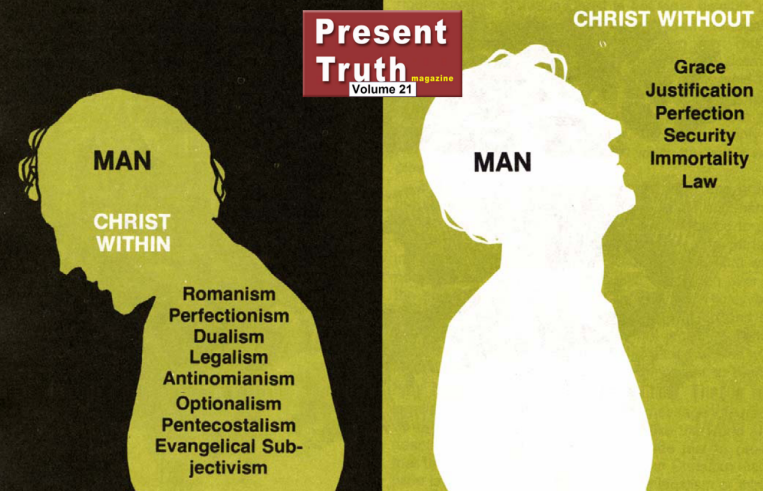
Therefore, the gospel was the measure of all truth, and all objective truth had to come from outside of us. All change had to come from outside of us as well. Christ does NOT do His work INSIDE of us. All New Calvinist thought begins with this premise. If Christ works within us, this makes us colaborers in justification so that we can be found righteous at the judgment. It is also seen as “emptying ourselves” and “dying to self.” It is anti-existentialism on steroids. But not really; as we will see, this objective puritanism leads to a hyper-subjectivism that characterizes New Calvinism.
Element One of COGOUS: Gospel Sanctification
The term “Gospel Sanctification,” was coined by this ministry in 2004 and picked up by others. COGOUS split into two notable theologies in the 80’s: New Covenant Theology and Sonship Theology. Both endured a violent push back among Baptists and Presbyterians to the point of going underground. “Sonship Theology” became “Gospel Transformation.” The movement functioned for ten years without a name; and in fact, experienced astronomical growth during that time. Based on the slogans, “The same gospel that saved you also sanctifies you,” and “We must preach the gospel to ourselves every day,” slogans that show its undisputable kinship to COGOUS, “Gospel Sanctification” became a useful tool for identifying the doctrine. Gospel Sanctification is the subject of “Another Gospel” which was never published. The movement was dubbed, “New Calvinism” in 2008.
Element Two of COGOUS: Gospel Contemplationism
Spiritual contemplationism is certainly nothing new. Spiritual growth via contemplating the works of Christ, and using the Bible to do so can be found among the earliest Adventist theologians, especially Ellen White (according to citations noted by Paxton in The Shaking of Adventism). White was always in the thick of trying to reconcile Adventist perfectionism with grace and law. Sanctification by Gospel Contemplationism has always been an apt companion for doctrines that want to reduce the role of the Christian to the lowest common denominator. Most of these ideas came from European philosophers posing as theologians. Gospel Contemplationism, like Gospel Sanctification, puts feet on the doctrine.
Tenet Two: Redemptive Historical Hermeneutics
Starting with Gabler, this hermeneutic (method of interpretation) makes the Bible a historical narrative about the gospel. Through deeper and deeper knowledge of the gospel, we are “wowed” and “motivated by gratitude.” This makes the Bible a perfect tool for contemplationism rather than instruction and propositional truth. Redemptive Historical hermeneutics, or “Biblical Theology” has its origin in Modernism and neo-orthodox theology. This may seem contradictory to New Calvinism’s supposed stance against existentialism, but this method actually leads to all kinds of subjectivism because a gospel interpretation is forced upon the whole Bible.
Tenet Three: New Covenant Theology
Jon Zens coined the phrase “New Covenant Theology” in 1981. Brinsmead and Zens worked together closely on how law and covenants relate to COGOUS. New Calvinists usually stay aloof from any association to NCT because of its direct link to Zens and the Forum. Though New Calvinists are not shy about playing the “all truth is God’s truth” card, they would rather not have to explain how their doctrine was contrived by a Seventh-day Adventist who is now purported to be an atheist. DA Carson is a good example of a New Calvinists that gives hefty support to NCT while pretending to be merely sympathetic to some of its tenets. Founders Ministries, a SBC organization founded in the early 80’s for the sole purpose of taking over the convention via COGOUS (and falsely associating the doctrine with a well-known Southern Baptist theologian), even claims to be anti-NCT. Founders Ministries has also been challenged to explain their claim that they published “In Defense of the Decalogue” which is a treatise against NCT.
Tenet Four: Heart Theology
This theology was developed through David Powlison’s Dynamics of Biblical Change which forms the basis of counseling curriculum at Westminster Seminary. The doctrine is based on Sonship Theology—Powlison specifically stated that as fact while giving a presentation at John Piper’s church. Powlison also stated that Gospel Sanctification (not the exact terminology he used) was the primary difference between his counseling philosophy and that of Jay Adams. In other words—a fundamental difference in how they interpret the gospel. See chapter 9 of “The Truth About New Calvinism.” How People Change, written by Paul David Tripp (an understudy of Powlison), is a treatise on Powlison’s Dynamics of Biblical Change, and practically a word for word recital of COGOUS.
In the tradition of New Calvinism’s takeover mentality, CCEF now controls almost all of the major counseling organizations, and the Biblical Counseling Coalition was recently organized to aid in that purpose.
Tenet Five: Christian Hedonism
This was concocted by John Piper in the 80’s as an important addition to COGOUS. Though Piper avoids any connections to the Forum like the Bubonic Plague, he showed his hand and specific allegiance to COGOUS when he wrote an article on a series of lectures that Graeme Goldsworthy did at Southern Seminary. See chapter 4 of The Truth About New Calvinism.
Before Piper attended Fuller Seminary, which advocated neo-orthodoxy during the time he attended there (they even hosted appearances by Karl Barth, the contemporary father of neo-orthodoxy), he majored in philosophical literature. Immediately upon graduating from Fuller in 1971, he went to Germany to study under modernist/neo-orthodox theologians. Piper’s theological upbringing is extremely suspect and warrants surprise in regard to his present popularity in Christian circles.
After jumping on the Brinsmead bandwagon, he saw a deficiency in COGOUS. It is best explained by somebody who witnessed the unfolding of the Awakening movement firsthand:
Our righteousness is in heaven, said Brinsmead:
The righteousness by which we become just in God’s sight, remain just in His sight and will one day be sealed as forever just in His sight, is an outside righteousness. It is not on earth, but only in heaven…only in Jesus Christ.”
True sanctification looks away from self and flows from the finished, objective work of Christ…. For many Christians, the glory of the crucified Christ is not their focus; instead they seek internal experiences that eclipse the cross. The Awakening rightly opposed the subjective, human-centered emphasis found among some groups within Christianity. Wrongly, they reacted with a cerebral, spiritless gospel. Brinsmead strongly opposed the Charismatic movement’s emphasis on experiences as a return to the theology of Rome.
However, going to another extreme, Present Truth magazine decried “the false gospel of the new birth,” and offered a new birth that was merely a corporate, objective blessing, not an individual experience.
John Piper to the Rescue
COGOUS was in danger of instigating the same kind of response that prompted existentialism: a pushback regarding indifference to the human experience. COGOUS supplied a theological frame that supposedly demolished the root of all false doctrine, but still didn’t deal with the human experience angle. This would explain why Piper is such a hero in this movement—he probably saved it. Christian Hedonism strongly emphasizes how COGOUS is experience (joy) while staying true to its strong emphasis on monergism. And, joy is a result of what we contemplate, not anything we do.
Conclusion
COGOUS is the doctrine/backbone of New Calvinism; Biblical Theology (RHH) is its hermeneutic; New Covenant Theology articulates COGOUS’s relationship to law and gospel; Heart Theology is its practical application (as far as that goes); and Christian Hedonism is how COGOUS is experienced. It’s the complete package. It is the first complete theological system for let go and let God theology ever devised in church history. It is powerful, and is a latter-day antinomian blitzkrieg of biblical proportions.
But the gigs up. Few Christians will buy into the idea that God used Robert Brinsmead to rediscover the lost Reformation doctrine. Trust me, it was never lost to begin with. I will conclude with a statement by John H. Armstrong that describes the New Calvinist motif, and a Piper video that contains subtle illusions to what they believe:
The sixteenth-century rediscovery of Paul’s objective message of justification by faith [and sanctification also because justification is supposedly progressive] came upon the religious scene of that time with a force and passion that totally altered the course of human history. It ignited the greatest reformation and revival known since Pentecost.
Now, if the Fathers of the early church, so nearly removed in time from Paul, lost touch with the Pauline message, how much more is this true in succeeding generations? The powerful truth of righteousness by faith needs to be restated plainly, and understood clearly, by every new generation.
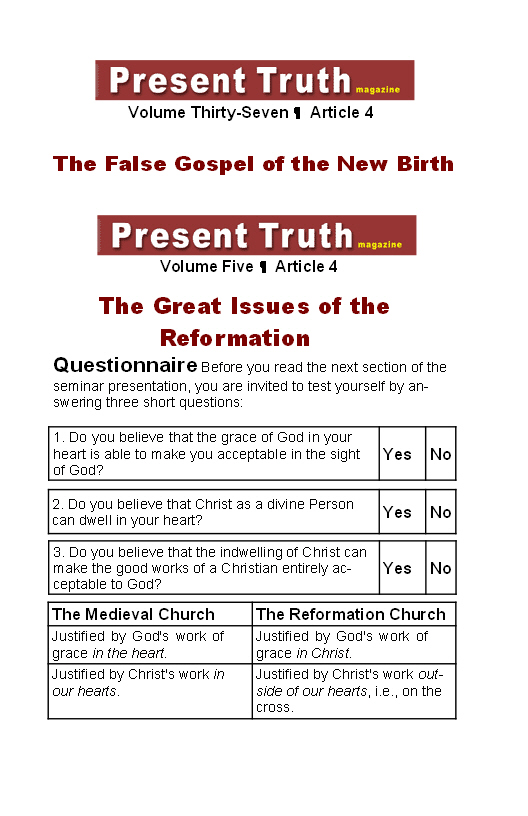
In our time we are awash in a “Sea of Subjectivism,” as one magazine put it over twenty years ago. Let me explain. In 1972 a publication known as Present Truth published the results of a survey with a five-point questionnaire which dealt with the most basic issues between the medieval church and the Reformation. Polling showed 95 per cent of the “Jesus People” were decidedly medieval and anti-Reformation in their doctrinal thinking about the gospel. Among church-going Protestants they found ratings nearly as high.
A visual illustration of the issue Armstrong is talking about follows:
And here is the Piper video:

 Paul's Passing Thoughts
leave a comment