FOUL!!! Doug Phillips: Repentance a Local Church Matter
Spiritual Sounding Board .com has a pretty decent piece that breaks down the literary absurdity of Doug Phillips’… “resignation update”? I am compelled to comment on this part of it which is a customary New Calvinist mantra:
The local church, not the Internet, is the proper forum for overseeing the details of a man’s repentance,
Oh really? Tell me if I am missing something here. If you get placed under church discipline in a local Reformed church, do they not state that they will inform any church of such that you try to attend? Also, in regard to New Calvinist mega church campus networks, is it not true that several instances of church discipline have been addressed via the internet? For example, the infamous James MacDonald video. Furthermore, most New Calvinist churches announce church discipline issues in the Sunday morning service with VISITORS PRESENT.
Moreover, does not the Bible state clearly that pastors who sin are to be rebuked PUBLICLY so the others will fear?
These guys are spiritual morons and a total waste of time. Is not the number of discernment blogs indicative of Christians trying to save something? Yes, the institutional church. The brick and mortar church. Why? We need a movement of home fellowships that will enable us to ignore these counterfeits. Trust me, the institutional church is not worth saving.
paul
The James MacDonald White Paper: James MacDonald is Just a Symptom; Post 17 of 20

James MacDonald is a symptom of his false gospel; namely, Calvinism. The Reformed think tank that resurrected authentic Calvinism in 1970 defined it in a way that could be understood, and systematized it in a way better suited for our postmodern age. Their publication, Present Truth Magazine, was the most publicized theological journal in the English speaking world during the 1970’s. The following excerpts from their journal perfectly captures the essence of Calvin’s false gospel. Anyone familiar with biblical justification should be able to pinpoint the grievous error of this gospel:
After a man hears the conditions of acceptance with God and eternal life, and is made sensible of his inability to meet those conditions, the Word of God comes to him in the gospel. He hears that Christ stood in his place and kept the law of God for him. By dying on the cross, Christ satisfied all the law’s demands. The Holy Spirit gives the sinner faith to accept the righteousness of Jesus. Standing now before the law which says, “I demand a life of perfect conformity to the commandments,” the believing sinner cries in triumph, “Mine are Christ’s living, doing, and speaking, His suffering and dying; mine as much as if I had lived, done, spoken, and suffered, and died as He did . . . ” (Luther). The law is well pleased with Jesus’ doing and dying, which the sinner brings in the hand of faith. Justice is fully satisfied, and God can truly say: “This man has fulfilled the law. He is justified.”
We say again, only those are justified who bring to God a life of perfect obedience to the law of God. This is what faith does—it brings to God the obedience of Jesus Christ. By faith the law is fulfilled and the sinner is justified.
On the other hand, the law is dishonored by the man who presumes to bring to it his own life of obedience. The fact that he thinks the law will be satisfied with his “rotten stubble and straw” (Luther) shows what a low estimate he has of the holiness of God and what a high estimate he has of his own righteousness. Only in Jesus Christ is there an obedience with which the law is well pleased. Because faith brings only what Jesus has done, it is the highest honor that can be paid to the law (Rom. 3:31).
~ Present Truth: Law and Gospel ; volume 7, article 2, part 2.
The flesh, or sinful nature of the believer is no different from that of the unbeliever. “The regenerate man is no whit different in substance from what He was before his regeneration.” — Bavinck. The whole church must join the confession, “Have mercy upon us miserable sinners.” The witness of both Testaments is unmistakably clear on this point.
No work or deed of the saints in this life can meet the severity of God’s law. Apart from God’s merciful judgment, the good works of the saints would be “mortal sin” (Luther), and nothing is acceptable to God unless mediated through the covering cloud of Christ’s merits. Because of “indwelling sin,” we need mercy at the end as much as at the beginning, for the old nature is as evil then as ever. Growth in grace, therefore, does not mean becoming less and less sinful, but on the contrary, it means becoming more and more sinful in our own estimation.
It is this conviction of the wretchedness of even our sanctified state—which conviction comes by the law—that keeps sanctification from the rocks of self-righteousness. It keeps the Christian’s little bark constantly pointed toward his only star of hope—justification by faith in a righteousness that stands for him in heaven. The refuge of the sinner must ever also be the refuge of the saint.
~ Present Truth: Sanctification-Its Mainspring ; volume 16, Article 13.
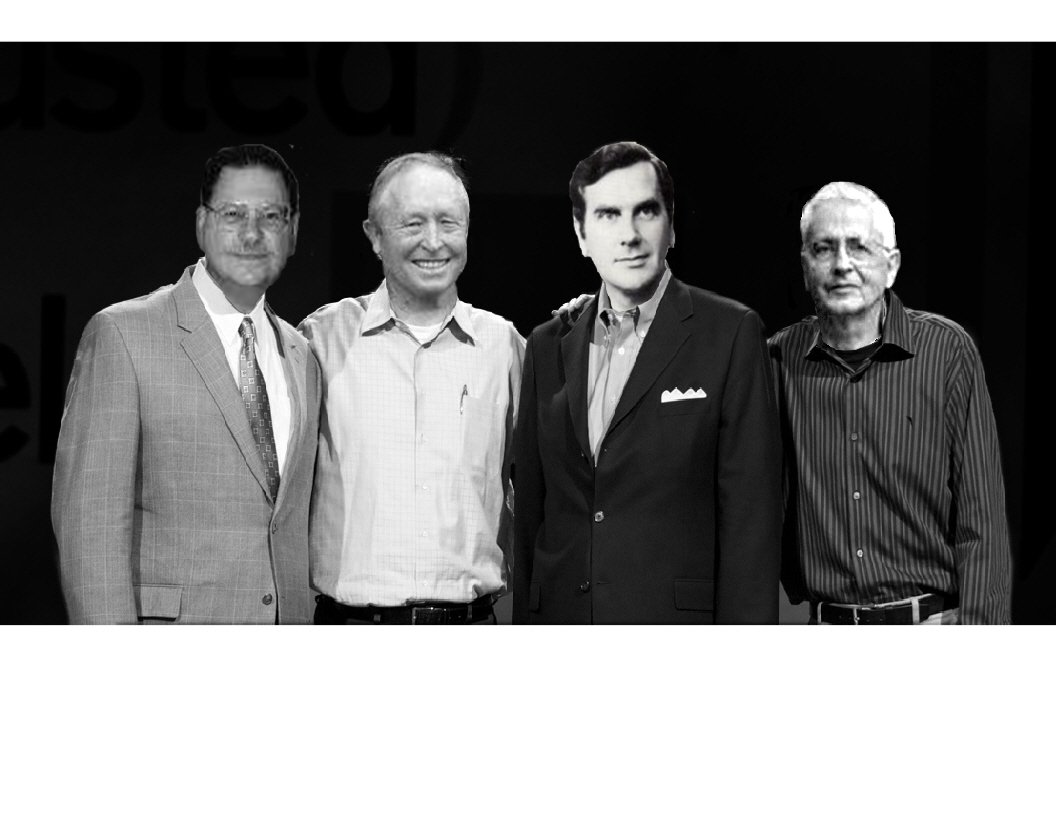
THE ORIGINAL CORE FOUR OF THE AUSTRALIAN FORUM THINK TANK CIRCA 1970

THE REAL DREAM TEAM
The James MacDonald White Paper: The New Calvinist Big Fat Lie; Post 16 of 20
 “How long will Christians continue to fall for this ruse? These guys have been running the show in an increased continuum for 43 years!”
New Calvinism is the Christian version of “Blame it on Bush.” People like new things, and New Calvinism is still being sold as something new. Fact is, they have been selling this “resurgence” pitch for forty-three years now. New Calvinism was hatched in 1970 and is a return to authentic Calvinism. The New Calvinism movement and its ideology have completely dominated the American church since 2008. In a 2009 Time Magazine article, New Calvinism was said to be one of the top ten ideas changing the world in our day. This ministry is constantly informed by people throughout the U.S. that the only churches in their general geographical area are New Calvinist without exception.
Nevertheless, The Neo-Calvinists continue to draw what’s left of American Christianity into their megacult by claiming that their “rediscovery” of the Reformed gospel is the answer to the carnage that they have in fact created. The New Calvinist movement is directly responsible for the mass exodus from the formal church presently taking place.
The hybrid form of this rabid mysticism (evangelicalism) that has survived its (authentic Calvinism) social deaths in church history have always been crippled with vestiges of the same ideology: primarily, weak sanctification. This has always primed future “resurgences” of the despotic original. New Calvinism is weeding out the competition and dominating the Christian landscape for the following reasons:
1. Protestantism has always disarmed its congregants theologically with its Romish-like spiritual caste system. American Christians do not have the theological wherewithal to fight this movement.
2. The mentality, again, created by Protestantism, that the laity are not responsible for the overall landscape of the church because they are the Sudra at best, and the Untouchables at least.
3. Because of number 2, alternatives are not being created and many are merely checking out of the church scene.
New Calvinism will continue to dominate Christianity unless alternatives are created along with necessary education. New Calvinism will continue to create carnage and then offer itself as the solution, leaving itself as the only alternative embodied with mindless followers. What is left of the formal church must repent of Protestantism; embrace the priesthood of believers, and the plain sense of Holy Writ. The Reformation gospel teaches that the law can give life because Christ fulfilled it for us. The result is the antinomianism that the Bible clearly states will dominate the last days. Pastors of the formal church must humble themselves and admit they didn’t know that Reformed total depravity also pertains to the saints, and sola fide also pertains to sanctification. They must also admit they didn’t know sola Christus really means Christ alone in regard to the other Trinity members, not just the way to the Father.
This is the backdrop for the “resurgence” motif constantly propagated by James MacDonald and associate Mark Driscoll. The latter is actually, and this is totally unbelievable to me, writing a book entitled, A Call to Resurgence: Will Christianity Have a Funeral Or a Future? The following is stated about the book in a promo:
It’s tempting to believe that the Christian faith is alive and well in our country today. Our politicians talk about God. Our mega-churches are filled. Christian schools dot our landscape. Brace yourself. It’s an illusion. Believe it or not, only 8 percent of Americans profess and practice true evangelical Christian faith. There are more left-handed people than evangelical Christians in America.
In this book, Mark Driscoll delivers a wake-up call for every believer: We are living in a post-Christian culture—a culture fundamentally at odds with faith in Jesus. This is good and bad news. The good news is that God is still working, redeeming people from this spiritual wasteland and inspiring a resurgence of faithful believers. The bad news is that many believers just don’t get it. They continue to gather exclusively into insular tribes, lobbing e-bombs at each other in cyberspace.
Mark’s book is a clarion call for Christians. It’s time to get to work. We can only do this if we unite around Jesus and the essentials found in his Word, while at the same time, appreciating the distinctives within each Christian tribe. Mark shows us how to do just that. This isn’t the time to wait or debate. Join the resurgence.
How long will Christians continue to fall for this ruse? These guys have been running the show in an increased continuum for 43 years! They have absolutely dominated the Christian landscape since 2008. I agree that the American church is in a dark age, but it is a New Calvinist dark age. They have mocked the intelligence of Christianity by calling for Reformed resurgence in the very midst of one since 1970.
Likewise, in James MacDonald’s Vertical Church, he devotes all of chapter four to this very idea, calling the contemporary church an “epic failure.” Under said heading in that chapter, he states a list of those failures:
1. 6,000 churches close their doors every year.
2. 3,500 Americans leave the church every day.
3. Only one pastor in ten retires while still in ministry.
4. Less than 20% of Americans attend church regularly.
5. Only 15% of churches in the U.S. are growing numerically.
6. Only 2% percent of growing churches are effectively winning converts to Christ.
7. Only 9% of evangelicals tithe to their churches.
8. 800 new church plants survive each year.
9. 10,000 new churches would be needed annually to keep up with the population growth.
These are New Calvinist statistics. These are New Calvinist failures. This is their economy. And many pastors would do well to get a backbone and speak up about it.
paul
The James MacDonald White Paper: The “Vertical Church ‘Experience'”; Post 15 of 20
The New Calvinism movement is a return to the viral Gnosticism that wreaked havoc on the first century church. Gnosticism permeated Judaism as well as Gentile mystery religions. Some evidence of this can be seen in the seven letters of Revelation. The Nicolaitans were Gnostics, and the church at Laodicea at the time of those letters is a good picture of what a Gnostic church would look like. “Nicolaitan” means, power over the laity. A root of the word can also be seen in THE teacher of Israel, Nicodemus. Part and parcel with Gnosticism is antinomianism and the idea that man is part of evil matter and not changeable for the better. Hence, the reason Christ emphasized the new birth and obedience to Nicodemus. This is also why the motif that the Pharisees were “legalists” (a word that does not appear in the Bible), is a sham. Christ plainly stated that they had replaced the law of God with their traditions. The New Testament was written against the backdrop of a Gnostic tsunami. It is the doctrine that dared to confront the apostolic church; therefore, its present-day resurgence should be no surprise.
Gnosticism has the blue chip ability to deceive Biblicists because it posits a plenary justification in its pseudo Christian version. The pseudo Christian Gnostic needs to only speak of sanctification in a justification way. Of course, like Gnostics of old, they are also masters of terminology. New Calvinists sometimes refer to their doctrine as, Objective Justification, Subjective Justification, and Final Justification. Ever heard of Ronald Reagan’s trickle-down economics? This is trickle-down justification, and you get the trickle-down from focusing vertically on justification. You can preach wonderful sermons on justification all year long, but the big question is: “What’s missing?”
And, since matter can’t change for the better, and to attempt change in sanctification is synonymous with denying the person and salvific works of Christ, “manifesting” the glory of Christ replaces works in the Christian life. We “experience” the works of Christ, but we do not participate in the works. How this is actually said to operate in the Christian life varies among the New Gnostics. Some say that we are merely experiencing a manifestation of Christ in our realm. Others say that we are actually incited to participate bodily because Christ has filled our hearts with a desire to do said task; so, it is us doing it, but only because Christ has filled our hearts with Himself for that particular manifestation. These manifestations are a result of gospel/justification contemplationism.
Like most Eastern concepts of sanctification, EXPERIENCE is the key. The goal is spiritual wellbeing and glorifying the gods. The goal is to experience rebirth, or the true objective forms that trickle down into progressive subjectivism. It’s experiencing the pure unchanging true, good, and beautiful to the fullest extent possible in the subjective realm that we live in. We are, as the New Calvinist Justin Taylor states, “between two worlds.” As New Calvinist Chad Bresson states it, “between two spheres, gazing at Christ—our heavenly destiny.” But primarily for the New Gnostics, it enables us to eliminate our works in sanctification, and thereby maintaining our just state before God. Its goal is to manifest the objective gospel in our subjective realm. The payoff is a perpetual experience of rebirth—the same baptism that we experienced when we were saved, it is John Piper’s “treasure chest of joy.” They blatantly call it the same thing that it is called in Eastern Sufism, “vivification.” The likes of Michael Horton and Paul Washer call it a “living out of our original baptism.” It results from focusing on our miserable existence in the subjective realm (and especially our sin) as set against the glories of the objective. Therefore, suffering is good because it reminds us of the difference between the two. Suffering brings a death that will result in vivification. Those who put any stock in this life are disdained as ignorant and blind.
So, key is gospel contemplationism leading to manifestations, and resulting in experience. Vertical only =’s the baptism experience and accompanied joy. It frees the “Christian” from the experience of this horizontal life, and seeks to experience the objective. Those who “live in the shadows” are naysayers worthy of death. And that is the essence of James MacDonald’s Vertical Church. In the 320 pages of the book, MacDonald uses the word “experience” 128 times. He uses the word “manifest/manifestation” 111 times.
My advice to the congregants at Harvest is to cut your losses sooner than later. Not just because this movement is destined to crash and burn, but because it is a mystic lie and a vile affront to the gospel.
paul
NOTE FILE SHARING WIDGET FOR THIS SERIES ON BOTTOM RIGHT SIDE PANEL
The James MacDonald White Paper: To HBC Parishioners, “Does This Sound Familiar?”; Post 14 of 20
 “I paid good money for my children to be brainwashed and for my marriage to be ruined”
~Michelle Freeman
Let’s take a test: Mormonism, cult or denomination? Cult. Correct. Methodist, cult or denomination? Denomination. Correct. Jehovah’s Witnesses, cult or denomination? Cult. Correct. Pentecostalism, cult or denomination? Denomination. Correct, but like the other denominations listed here, not always. Enter Calvary Temple of Sterling, Va. Clearly a cult by anybody’s standards. You can read the newspaper article here: Doctrine of Divisiveness: Authoritarian pastor’s church builds legacy of broken families.
The reality of the matter is this, any denominational church can become a cult. The following is a dictionary definition of a cult: “A religion or religious sect generally considered to be extremist or false, with its followers often living in an unconventional manner under the guidance of an authoritarian, charismatic leader.” The article link above is a fascinating study in regard to recognizing cults who don’t identify themselves by commonly known names such as “latter Day Saints.”
1. Most of these ministries start out as solid churches that honor God: “They had joined eagerly, drawn to Scott’s energy as a new religious broadcaster and his commitment to living by the literal word of the Bible. ‘What started out as a Christian organization has turned into a cult where people are controlled,’ said Jonathan Ernst, a Calvary pastor until he was blacklisted by Scott in 1994.”‘
2. The church may have the appearance of vitality complete with building programs and growing numbers: “Under the leadership of longtime pastor Star R. Scott, Calvary opened a school, television and radio ministries, and satellite churches around the globe. The local congregation at one point numbered 2,000.”
3. Watch out for niche doctrines that seem to indicate that the church leaders want to stand out as unique among other Churches: “In his sermons, Scott teaches that his church is scripturally superior to others and views keeping people in the fold as a matter of their salvation.”
4. Watch out for a movement by the leaders to disassociate themselves with church organizations within the denomination that offer accountability. This is a big one: “Scott’s decision to dissociate Calvary Temple from the Assemblies of God organization removed a level of financial oversight, and he eliminated boards and public votes, former members said.”
5. Look for movements by the leaders toward control issues in two areas: administration (such as self perpetuating elder bodies) and the personal lives of members: “Former members contend that much about their lives, from how they spent their money to how they raised their children, was dictated by Scott and other church leaders. Scott is Calvary’s ‘apostle’ and presiding elder, and in 1996, he named himself the sole trustee, putting him in charge of virtually all of the church’s operations, its theology and finances”
6. Look for the use of fear to control people, especially in the area of church discipline and excommunication. If you sense fear of the leaders among the congregation, grab your family and run for the exit doors: “Scott describes those who decide to leave the church as ‘depraved,’ and Calvary’s practice is to cut them off.”
7. Watch for aloofness among the leaders when you try to nail them down on doctrinal issues. If their answers are nebulous and have disclaimers attached, hit the road running: “Calvary leaders are careful never to explicitly tell people what to do, she said. We just say: ‘This is what the Bible says. You make a decision.’” Ya, right.
8. Watch for the division of families, especially over doctrinal issues. This is one of the major hallmarks of a cult: “When parents have left the church, some young children have been urged to stay; a few have been taken in by pastors. Scott’s family has been divided, too: Scott is estranged from his 36-year-old son, Star Scott Jr. After 12 years at Calvary, Freeman is furious. ‘I paid good money for my children to be brainwashed and for my marriage to be ruined,’ said Freeman, a U.S. Postal Service secretary.”
9. Watch for exaggerated or extreme confidence on the part of the leaders. Their unwavering pre-canned answers to your tuff questions does not make what they are teaching true: “Most current members declined to talk to the Washington Post, although Scott and three other leaders spoke at length. ‘I’m at perfect peace with them being gone,’ he said. ‘We’re happy with what we believe, so why aren’t they happy?”’
10. Never judge your interpretation based on the congregational following. People in today’s churches are all but completely mindless: “In 2002, three weeks after the death of his wife, Scott, who was then 55, stood before the congregation and announced that the Bible instructed him as a high priest to take a virgin bride from the faithful. A week later, he did – a pretty 20-year-old who a couple of years earlier had been a star basketball player on the church high school team.” This incident did not lead to a mass exodus in this church. Unbelievable. Remember, this is an affluent church in America full of business professionals.
11. Watch for an over emphasis on love and community at the expense of truth. This is the major mode of operation for the cults: “Kim Heglund, Scott’s daughter and the wife of a Calvary pastor, said members feel strongly loyal to Calvary because they believe they are living out the Bible. ‘This is Christianity, people being a family. Bitter feelings and divided families are the exception and caused by people who ‘pretended to be Christians.”’
12. Watch out for counsel that undermines self confidence and encourages over dependence on the leaders or the church in all areas of life, especially discernment. This is another mark of a cult: “Former members contend that much about their lives, from how they spent their money to how they raised their children, was dictated by Scott and other church leaders.”
13. Watch out for a we are the only sound church within a hundred square miles of here mentality. This way of thinking lays a dangerous foundation: “Scott’s followers see him as an inspiring interpreter of God’s word. Members pack the church most nights, united in their desire to live as the Bible intended and reject what they view as society’s moral ambivalence. ‘Church isn’t for everyone who wants to just show up,’ Scott said in an interview. ‘It’s not a community club. We’re not looking to build moral, successful children. We’re looking to build Christians.”’ Sounds good, doesn’t it?
14. Watch for what looks like difficulty in leaving the church. Have persons leaving membership been put under undue stress? Do the leaders seem defensive about people leaving? This one is big. Are persons who have left the church been maligned?: “But for hundreds of members who have left the church during the past decade, Calvary is a place of spiritual warfare, where ministers urged them to divorce spouses and shun children who resisted the teachings. ‘Scott is twisting the Bible’s message,’ they say, and members who challenged the theology were accused of hating God.”‘
Pay attention. The longer your family is in a church that ends up like this, the more trauma there will be for your family when you leave . The most telling sign is a developing pattern among the leaders that shuns outside accountability. Another major question is this: does the teaching divide families or bring them closer together? Teach your family that this could happen to any church and agree together in regard to discerning these signs; that way, a smooth exit strategy can be planned. Your departure must not be a protracted event. Leaders of “churches” like this will use this time to drive a wedge between you and your family. Keep this in mind; more than likely, other Christians or ministries are not going to take a stand. Per the usual, it is a secular newspaper that sounds the alarm, as in this case. Try to avoid a war because you will probably fight it by yourself, so practice preventative medicine.
Always lay the burden of scriptural correctness on the leaders regardless of the troubled people they are dealing with. As the pastor of this church said himself: “When asked about the divided families, Scott answered, ‘That happens. They accepted Calvary’s theology until it affected them,’ he said.’They were ready to see it apply to others lives for years and served many times in the orchestration of it.’”
Remember also, we live in a time when independent autonomous churches loosely associated with fellowship (fellowship, not accountability) groups are very popular. These churches are especially susceptible to becoming cults. Truth from scripture is the bottom line, that must guide you:
“Then you will know the truth, and the truth will set you free.” John 8;32
Be a good berean: “Now these were more noble-minded than those in Thessalonica, for they received the word with great eagerness, examining the Scriptures daily {to see} whether these things were so” (Acts 17:11).

 Paul's Passing Thoughts
3 comments