Christianity and Islam: The Pot Calling the Kettle Black?
Originally posted March 10, 2014
Many relate to my personal testimony; despite my best efforts, I have been for the most part at odds with church. Julia Duin noted in her book Quitting Church that she has always sensed that something is fundamentally wrong with the Evangelical church.
I wonder if that mysterious fundamental reason has come to light. Note this statement by Al Mohler, arguably the most influential Evangelical of our day:
Niebuhr’s fifth model is where he seems to be pointing us, that is, to Christ the transformer of culture. These are the conversionists, and they are far more hopeful than the dualists. They understand the distinction between Christ and the culture, but they also understand that it is the mission of the church to transform the culture with the claims of Christ. We continually hear this kind of language: “Let’s go out and redeem the culture. Let’s go out and conquer the culture in the name of Christ. Let’s transform every dimension of the culture, whether the media and the arts, or business and finance, and let’s subdue them to the claims of Christ. Let’s have a more Christian military and a more Christian realm of arts.” This leads to a very progressive impulse, one which looks to a better world and a better condition if we will only do this. It promises transformation, hopes for cultural redemption, and leads to Christian activism. (Preaching the Cross: chapter 3, subheading; Niebuhr’s Treatment of Christ and Cutler, Niebuhr’s fifth model).
What a minute. Is this not the exact same vision as Islam? Moreover, do Muslims understand this better than most Christians? When Christian missionaries travel abroad, are they perceived this way whether they know it or not? When we hear of Christian missionaries being murdered or detained for “conspiracy to overthrow the state,” we immediately assume that’s a crock. Well, maybe not when you consider what the Crusades were all about coupled with this contemporary dominion mentality among leading Evangelicals.
Furthermore, Al Mohler is far from being the only one propagating these ideas. This same idea is the theses of Paul David Tripp’s book Broken-Down House. Many examples could be given, but I will not belabor the point past the following notation by blogger Joel Taylor:
While filming a promo in Dubai (UAE) for the new student missions conference, CROSS, John Piper (standing in front of the Burj Khalifa tower) makes this statement:
“And that tower and this city are coming down!”
Was that a wise thing to say while standing on United Arab Emirates soil? I wonder how the Arab people would understand his remark if they saw this?
It probably wouldn’t surprise them. The American church was founded on the Reformation, and many of its European stalwarts had their own standing armies. And ok, we have much spiritual tyranny and a divine right of kings mentality in the church today; ya think? If they muse about bringing down the Burj Khalifa tower what do you think they will do to you if you ask too many questions?
So this explains everything. It’s really not about the gospel. It’s not about making disciples, it’s about globalism. Making “disciples” is not the primary goal, it’s only a small part of a much larger vision. The whole idea that people can only find salvation in the “local church” is the ploy that funds the global vision while Christians believe it’s about the gospel. We are encouraged to bring people to church to get them saved for that very reason. It also brings to mind all of the hoopla about “lone rangers” who are not “under the authority” of a local church.
Do I think this clarifies the mission of home fellowships? Absolutely. Do you want to make disciples? Or do you want to fund world dominion? Christ’s mandate to the assemblies was to make as many disciples as possible before Christ returns. Why? Because He is not calling on Christians to renovate the earth—He is going to come back and blow up the whole thing and start over.
This is a short post, but one that opens up a very wide avenue of considerations. “There is no perfect church”: that’s not the issue; the issue is the fundamental mandate. That’s not merely a question of perfection, but the difference between eternal investment or a complete waste of time and money.
paul
New Calvinism’s Silent and Dramatic Reshaping of American Politics
 Pundits of American politics are likely missing a major philosophical shift among the voting public. Traditionally, it has been safe to assume that the evangelical vote tends towards American values. After all, the Pilgrims first settled in America seeking religious freedom and much of American heritage is rooted in that narrative. The ultra-conservative talk show host Rush Limbaugh has even written a children’s book about the Pilgrims (Puritans) presumably to preserve this rich heritage that underpins American values.
Hence, evangelicalism is assumed to be one in heart with freedom and liberty for all. Furthermore, they are responsible folks with deep convictions, viz, a large percentage of them vote, and vote conservative. The who’s who of American conservatism openly proclaim their love for God and country. When election time is near, this paradigm is a given for the political prognosticators.
But it shouldn’t be. The silent equation that everyone seems to be missing is the New Calvinist movement. This movement has all but completely taken over American evangelicalism, and will result in two things regarding the evangelical vote: low turnout and a shift towards socialist leaning candidates.
Consider: who are the New Calvinists? One is Dr. Albert Mohler, the president of Southern Theological Seminary which is the flagship seminary of the largest evangelical denomination in the world, the Southern Baptists. Consider, in 2009, Time Magazine named New Calvinism as one of the top ten ideas changing the world in our time. That was almost six years ago, and the movement’s tsunami-like growth has not relented in the least.
And consider, there is an ever increasing theme emerging in their massive publication machine of blogs, radio, pulpit, conferences, and books: anti-American sentiment with the primary whipping post being “the American Dream.” Why?
New Calvinism is a return to the Reformation basics—they are Reformation purists, and few really understand Martin Luther’s worldview that founded Protestantism in its authentic form. Luther, like his Reformation compatriot John Calvin, were rabid followers of Saint Augustine who was an avowed Neo-Platonist. Luther was a friar in the Augustinian Order, and Calvin quoted Augustine over 400 times in The Institutes of the Christian Religion. Let’s skip the specific worldview shared by Plato, Augustine, Luther, and Calvin, and instead point out the inevitable social prescription that it demanded as articulated in Plato’s Republic.
Plato denied that the common people could perceive reality, or what Reformation purists refer to as “total depravity.” Therefore, this idea called for elitist philosopher kings to rule over the masses with a standing army just in case citizens get the idea that they can actually know something. The sole purpose and sum value of a citizen is determined by ability to contribute to the “common good” and society at large. A comment regarding a blog post on New Calvinism stated it well:
In fact Calvinism strikes me as being antithetical to American cultural norms; such as, the notion of the American Dream and all men being created equal…I can see how Calvinism would have been bred in a European society with its history of class [caste system], but it would be a hard fit for America.
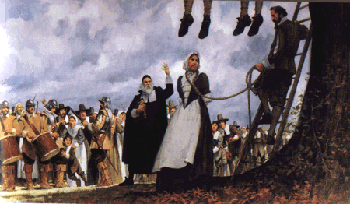
The reader rightly assessed with that comment. When the Puritans (who were Calvinists) came across the pond, they brought a European caste mentality with them. The primary goal was to start their own theocracy, what they called “New Zion.” This is why the first Bible to land on the eastern shore of America was the Geneva Bible. Geneva is the place where John Calvin earned the nickname “Pope of Geneva.” Nearly every detail of life was regulated there, including mandatory church attendance where Calvin’s elders tortured people with linguistic drones that lasted for hours. In addition, people were jailed for talking or sleeping during sermons, and Geneva law enforcement patrolled the streets searching for those not in attendance. Penalties for bad behavior were harsh as demonstrated by the fact that a public execution occurred at least once per week.
Please take note that the “elder statesman” of New Calvinism, Dr. John Piper, recently went to Geneva to produce a video announcing the newest phase of his ministry; i.e., to spread Calvin’s Post Tenebras Lux (after darkness light) throughout the whole world. Like the socialism of the ages, there is always an excuse why the light has never worked—this time it will be different and mankind will finally be saved!
Much could be written on this wise and there is not sufficient room here to do so, but for purposes of this post, we should focus on the question of individualism. The American Dream is a construct that limits government to the task of freeing the individual to pursue all that they can be or want to be. Materialism is a mere result, the American Dream is not materialism—it’s an idea. Another natural result is the collective wellbeing of society. Happy and free individuals make a happy and free society.
This all boils down to the question of individual competence. We know how socialism answers that question while aggressively foisting a nanny state upon the American people more and more. They want to control how we travel, what we eat, and even how we wipe ourselves after using the bathroom. This is more than an annoyance; the horrifying and real question becomes, “Who owns man?” Does man own man, or does the state own man? If man cannot self-govern, and needs government to rule over his being via elitist philosophers or religionists, man becomes property of the state by default.
Is this not the crux of the conflict that we see in American politics? Regardless of the obvious, “you didn’t build that” because “you” are not competent. It only looks like you built it because the government made it possible. And even more horrifying is the idea that all wars would end if the masses would just finally agree to be owned. Yes, then all of Plato’s children could come together and agree on the best way to manage people. Terrorists are really not bad people; actually, they know something very important that Ronald Reagan never figured out: people cannot self-govern.
But yet, there is something even more horrifying: the masses who have bought into the idea of their own incompetence and the incompetence of mankind in general. This is fear of chaos. This is looking to the elitists to protect us from ourselves. Though the recent riots incited by socialists in America over whatever excuse was stumbled upon at the time seem to be pointless, really they are not pointless. The riots serve the following purpose:
See! See! See what happens when people own themselves? Chaos! Oh my! The streets are aflame! What will become of us?
Riots are designed to incite fear and send people scrambling for hasty answers—terrorism likewise. This is all an epic battle for the ownership of mankind. And where evangelicalism stands in that fight is now abundantly clear; they stand with the religious version of socialism: Post Tenebras Lux.
This is a huge reality lurking behind the curtain of America’s political stage. The New Calvinist movement (circa 1970) has created a massive religious subculture with significant sway over millions of evangelicals and has crossed all denominational lines to some degree. Presently, the movement is producing a mass of anti-American propaganda depicting the American Dream as steroidal selfism that is destroying the fabric of our society. Many notable New Calvinists, not excluding the aforementioned Al Mohler, are even writing articles defending terrorism and stating, one man’s terrorist is another man’s patriot. In one article, Mohler equates Nelson Mandella with George Washington. Other articles posted by notable New Calvinists object to the “exaggeration” of atrocities committed by ISIS. If you think this eerily similar to Hillary Clinton’s latest call to better understand terrorists, you rightly assess.
And this article cannot be concluded without mentioning New Calvinism’s latest wave of socialist propaganda: the virtues of slavery. That’s right. In fact, mega evangelical and New Calvinist Dr. John MacArthur Jr. wrote a book in 2010 titled Slave: The Hidden Truth About Your Identity in Christ. The theme, also posited by numerous articles flowing from the gargantuan New Calvinist propaganda machine, is that man is metaphysically enslaved and the concept of freedom is a misnomer. In the reality of being, there is no real freedom. Hence, according to the general theses, Christ didn’t see slavery as a bad thing per se because men are enslaved anyway, but probably took exception to naughty slave owners. Trust me, Hillary Clinton would go to church to hear that sermon and would be in the amen row to boot while promising to be one of those good slave owners that Christ thought well of.
So, what is the new mentality of the evangelical in the voting booth? First things first: vote for who gets it—vote for the candidate that understands man is enslaved by his own incompetence whether he knows it or not. The New Calvinist philosopher kings can go to the negotiating table later with their sphere of influence as a bargaining chip. Remember, the people always outnumber the philosopher kings and the warriors by significant margins. The New Calvinists bring a significant sphere of influence to the table. With any nation, it’s ALL about what people believe, and people can believe particular things that render government force powerless. Ultimately, ideas win wars.
The New Calvinists deem Capitalism little different from that of Islamic terrorists. Job one for them is to get rid of the American Dream by any candidate possible who understands the total depravity of man and the incompetence of the masses.
And political pundits of the patriot stripe would do well to adjust their evangelical equation accordingly.
paul
Thanksgiving Day: Democrats, Pilgrims, Islam, and Republicans, the Gospel of Freedom, and Why That Gospel is Important to Every Soul
 Originally published November 28, 2013
Thanksgiving Day is upon us, and of course, this is the day we remember those brave Pilgrims who came to America for religious freedom. And of course, there were struggles in the new land and the Pilgrims got some advice from the Indians on how to plant corn and such. So, at harvest time, the good Pilgrims invited the Indians for a feast of “thanksgiving.” Hence, Thanksgiving is adorned with images of Pilgrims, Indians, and tables of food with a big fat turkey as the centerpiece.
In all of history, no propaganda proffered by the worst of despots could hold a candle to this story. In historical context, who were the Pilgrims, and what should Americans really be thankful for?
The idea that the Pilgrims came here for religious freedom is not exactly true and should incite a qualifying question: “What kind of religious freedom”?
First, let’s start with the right mental framework: “Pilgrim” is a soft term for, “Puritan.” The Pilgrims were European Puritans. They came from Europe. This is a short post, so let me compare Puritanism to something you may be more familiar with: Islam. Puritanism WAS predicated on the same basics of Islam; namely, a spiritual elite must rule over the unenlightened masses for their own good and the overall good of humanity. Secondly, the spiritual status of all people is predetermined; you are of the gnosis class, or you aren’t. Mobility between these classes is/was strictly forbidden. I emphasize “was” in regard to the Puritans and “is” in regard to Islam because the Puritans no longer exist.
Why do the Puritans no longer exist? You can thank Benjamin Franklin and company for that and add it to your list of things to be thankful for on Thanksgiving Day. The “religious freedom” that the Puritans sought in the new land was that of the church state. The Puritans were political refugees that dreamed of creating the ideal church state In America. In their mind, the church state was the way to go; it had just never been done correctly. That’s why they left Europe; supposedly, Europe was doing the right thing the wrong way.
We are all familiar with the story of Jesus exorcising demons from a man, and their request to be allowed to enter a heard of pigs. Some surmise from this that demons have to operate in a living entity of some sort. That’s speculation, but the fact that Puritan religion, like Islam, must have a body of political government to live in is not speculation, it’s a fact. That’s why Puritanism doesn’t exist today; the American founding fathers took their body away. Nothing has changed. Islam is in America seeking to find life in our political body. If they are kept out, they will die. Puritanism, like Islam, can only live when the spirit of faith is united with the body of governmental force.
Puritanism, like Islam, is a bad idea that must survive on the blood of the people. It is an idea that is not self-sustaining. The idea must enslave the masses and feed off of them. This is the reality, in every case, of the third world country: an elite that won the cosmic lottery, ruling over the totally depraved masses. They will tell you what you are capable of doing for the state. They will tell you what to eat. They will tell you how many children you can have. You are incompetent by virtue of the class you were born into.
The American colonies were originally ruled by the Puritans. The traditions they brought with them from Europe included the sport of witch hunting that had to be vacated in Europe because it threatened to wipe out an important element of humanity: the female. In some German cities, only a handful of women survived the European witch wars. The sport had to be vacated because the brilliant Puritans started doing the societal math: women minus producer class equals no church state. Brilliant. And did they learn their lesson? Answer: ever heard of the Salem Witch Trials?
The Puritans also created the first public school system in the colonies. In many cases, these were boarding schools where children were removed from their homes by law because the Puritans didn’t trust the commoners to raise their own children. Many Puritan laws concerning the American Indians were also the inspiration for the genocide that later occurred in American history. The Puritans were also primarily responsible for bringing slaves to America. Slavery was one of the European traditions they brought with them. Among the first slaves brought to America arrived at Jamestown. Remember that the Puritans were also second wave Calvinists embodied in the Presbyterian church which later became the primary champions of slavery in the South. The fruit never falls far from the tree.
This is the tyrannical environment that the founding fathers grew up in. Tradition holds that Benjamin Franklin attended the first Puritan public school in Boston. The European tyranny they grew up in inspired the American idea. This idea was predicated on the competence of the individual. This idea was predicated on the belief that all men were created equal and free. The founding fathers said that this truth was intuitive. They stated specifically that it was “self-evident.” As a result, the Puritans were ever a thorn in their side; for example, the Puritans claimed that Benjamin Franklin, a prolific inventor, did so by demonic powers.
“Gospel” means “good news.” The true American gospel is not far from the biblical gospel. Christ preached the good news of God’s forgiveness and a future kingdom. But He also preached the freedom of man to be responsible for the sum and substance of his own life—a responsibility to maximize the gifts God has given. A responsibility to “the life that bears your own name.” It is both freedom and responsibly: “to whom much is given, much is expected.” The founding fathers emphasized the part of the gospel that was paramount at that time: the freedom of man. This gospel inspired slave and commoner alike. It was the true gospel of the Great Awakening.
To associate American evangelicalism with the Republican Party is surely a mistake. American evangelicals confuse the American gospel with the biblical gospel. Both are good, and one is very good, but Christ never converted anybody with the sword. Man is created free, competent, responsible, and free to choose.
Anyone who thinks they are above the fray of American politics and religion is a fool. Anyone who doesn’t concern themselves with these questions is a fool. You cannot separate your freedom from religion or politics. A man once said, “You may not be interested in war, but war is interested in you.” Let me borrow that wisdom and say, “You may not be interested in religion or politics, but they are interested in you.” These will eventually own you one way or the other.
Certainly, those who are not free have nothing to be thankful for other than the predestined crumbs of life handed to them by sin or the tyrant that rules over them. This is now their abysmal plight due to their ignorance.
And it’s a pity, for the tyrant is always unworthy to rule over the free. The big fat turkey in the middle of the table wasn’t obtained by the Pilgrims because turkeys are hard to hunt. Surely the same Indians who had to plant their corn brought it to the feast. Pilgrim-like religionists are always pathetic beasts who must be fed by those ignorant enough to allow their oppression. Those ignorant of the gospel of freedom.
paul
The Heavenly B-52s Can Save American Christianity From Its Present Dark Age
Originally posted February 11, 2013
We must remember that the Dark Ages were a European thing. And we must remember that Greco-Roman philosophy was the source and then it was turbocharged with the integration of European style religiosity. European religion has always been grounded in Plato’s disdain for humanity. Hence, one philosopher stated well that faith and force together are the destroyers of the modern world. One of the most notable historians of our time, K.R. Popper, fingered Plato specifically in regard to the logic that has wreaked havoc on Western culture through Communism, Islam, Catholicism, and Reformed theology. Augustine, one of the fathers of the Reformation, called Plato a pre-Christian Christian, and the juggernaut of faith and force was thus born.
And primarily, American religion was imported from Europe via the Puritans who were a European style religious political sect. They wanted to create a theocracy of their own in the new world. That’s the “religious freedom” they sought in America—a political one. Ironically, this importation of a European pandemic is romanticized by the Thanksgiving holiday. Somehow, deep in our evangelical American psyche, we think the Puritans could have led us to the religious utopia that we all lust for. And in fact, deep in our evangelical psyches, we think the war still rages between our Puritan foundations and the evils of Enlightenment philosophy. And if Enlightenment philosophy would surrender, all would be well and the heavenly Jerusalem would finally come down to Earth.
Nothing could be further from the truth. Enlightenment thought, even with its many abhorrent shortcomings, launched America to unprecedented greatness as a nation because of three basic principles that God agrees with: man is free; man is capable; and man is responsible for the sum and substance of his own life before God. Men “small and great” will all stand before God. Plato’s philosopher kings do not stand before God in our stead regardless of the priestly garb that the Reformers have adorned them with.
In the movie Moneyball, based on a true story, the General Manager of the Oakland A’s baseball team set all time league records with a meager budget and has-been players by breaking tradition with the ways big league teams have always been built. The player’s manager of the team was against the plan, and was a constant hindrance to its implementation. But when the Oakland A’s became the talk of the sports world because of the plan, the player’s manager got all of the credit. In the same way, the manager of American Christianity, the one of 95 Theses fame, Martin Luther, is given credit for America’s greatness. God has blessed America because of the Puritan missionary children that he spawned. Their roots are the lifeblood of America. We were “founded on their Christian principles.” This is a significant departure from reality.
Luther despised reason. He believed that reasoning was a dangerous stunt that the unenlightened masses shouldn’t try at home. And because they are not capable, they have to be protected from themselves; hence, neither are they free. To the degree that we are free the world is in a spree. Man must be saved from himself; by force if necessary, and for the good of the world. Martin Luther to the rescue. Stalin to the rescue. Muhammad to the rescue. The Moral Majority to the rescue. And on every Thanksgiving Day, deep, deep in our American psyche, a small still voice cries out: “Oh but for the Puritans! What could we be?” It’s all the same logic. You can dress it up in different doctrines, but it’s all the same. Logic comes in many doctrinal forms—both secular and religious.
The founding fathers of this country were children of the Enlightenment era. Until America popped up on the history radar screen, force and faith was the big league tradition. Our founding fathers proposed something different: government as the protector of man’s right to be free, capable, and responsible. And a government that served at the pleasure of the people to do so. It is a testimony to the power that is displayed when merely three ideas from God are implemented in our realty. Three ideas from God made America the envy of all world history. In the end, the motif that any child can perceive in the book of Revelation will fill the world with blood up to the horse’s bridles: force and faith. To what is said here, the proffers of force and faith, the Reformed of our day, answer in all of their Puritan glory, “I beg your pardon! Jesus Christ should be the envy of the world!” But which Jesus Christ? The Puritan Jesus Christ? And enlightened minds want to know: “Are we free to decide that for ourselves?” And: “Are we capable of even knowing that?” We fear that the answer to both of these questions is, “No.” And that is why giving you power in our lives at any level is a really bad idea.
Hence, To the degree that the Reformed Dark Age feigns, darkness in the American church does rein. And we are in that Dark Age. It came in essence as logic stowed away in the Mayflower’s diseased European rats bringing the same plague with it. I could drag out all of the apocalyptic data and its many faceted manifestations, but a recent televised top of the hour newscast introduction will suffice:
Here we go again, another sex scandal in the Evangelical church.
You notice they said, “Evangelical” and not “Catholic.” Anybody that knows the facts knows that sexual abuse and the subsequent cover-ups are just as prevalent in the Protestant Evangelical Church as it is in the Catholic Church. The scandals are the same, and the silence among clergy is the same, along with the same disregard for victims. Different doctrines—same logic—same results. Logic always has an endgame; there are many different doctrines that can get you there.
But the American Dark Age takes on a different appearance than the open fires of European religious wars and unspeakable terrors for it is tempered with freedom, capability, and responsibility. In the same way that God’s spies found refuge with a harlot, the American church has been saved from itself by Enlightenment thought. The result has been Reformed Light, and the carnage has been greatly limited. The European Reformers believed that children should be seen and not heard; American Reformed Light allows their children to play in a sandbox. Children are happier when they have a sandbox to play in, and they can form all kinds of ideas in what they make in the sand. But when it is time for dinner, it’s also time to put our little buckets and shovels away, run to the dinner bell, and obey mommy and daddy. They protect us from truth that can cause division because we are unable to handle truth, and they make truth a storybook that we can understand. They read it to us at night, and we are much comforted. We can pretend in the backyard, and we feel safe because mommy is watching from the kitchen window.
But the children of Reformed Light do not grow up. For certain, the American church is every bit like grown adults playing in a sandbox. The real Reformers now come forward and scoff at the pathetic sight, and say they are the answer. Yes, not playing with ideas at all must be the answer. Adults in a sandbox is not the problem, the sandbox is the problem. Sandboxes tempt people to play with truth. The Reformers to the rescue—those half breed Semi-Pelagian parents be damned.
Children in adult bodies will always rape, hate, pillage and steal. It is what it is: spiritually, they were born slaves, born incapable, and born irresponsible. Reformed theology is a bus of misfits, but all believe that it is the only bus going to heaven—the bus of faith alone in Puritan sanctification. All kinds are on the bus, but the tie that binds is womb to the tomb total depravity.
Some do not persevere in accepting their total depravity and the total depravity of others. Some do not trust God’s anointed to get the bus of misfits to heaven, so an Inquisition is needed. The European Reformers used the gallows and the burning stake (if the victim was lucky), brainwashing, and orthodoxy. The American Reformers can use brainwashing and orthodoxy, but because of the founding fathers, the American Reformers must replace the gallows and burning stake with character assassination, authority to condemn eternally, and false criminality. And all of the aforementioned paints the portrait of the present-day American Dark Age in the church. There is a little metal plate on the bottom of the spectacular painting hanging in the gallery of human history, and it reads:
Here we go again.
The Bible is written for mass consumption. All Bible books, save a few, were written to assemblies and not leadership. God has also written his word on the hearts of every person ever born into the world (Romans 2:14). We are all responsible before God, free to obey Him or not Obey Him, and obviously, must exercise our minds for understanding. We also live in the information age; so, if man was without excuse in the days of the apostolic church (Romans 2:1) we are certainly without excuse today.
Nations, particularly the USA, have used heavy bombers to drop propaganda leaflets on cities before an invasion or in an attempt to turn the population at large against the enemy leadership. Each bomb usually weighs about 250 lbs. and rains about 60,000 leaflets on a given area. During the Iraq/US war, leaflet bombings resulted in the mass surrender of Iraqi soldiers. In the same way, regardless of what’s going on in the world, God has a message of truth for every person. Invariably, it is man’s responsibility to do what God wants him to do in any given situation.
God has given the truth to all men, and only the truth will set us free. We need to pick up and read the leaflet and surrender to the Chief Shepherd. The Reformation is responsible for this present Dark Age in the American church. It is a doctrine that must be rejected with prejudice, and we must disdain anything that has touched its filthy garments.
A little leaven leavens the whole lump.
paul
The Greatest Threat to Civilization in the 21st Century: Protestantism’s Doctrine of Death
In researching the Reformation, one finds the “terror” of ISIS (Islamic State of Iraq and Syria) wanting in regard to its overall threat to civilization. Islam has always been inept in the politics of logic that despises life. Even many who agree with them will not buy into their means or politics. Per the usual since the 6th century, the likes of them only succeed in stirring up what little wrath there may be in the most passive among us.
A far greater threat, if not the threat, is Protestantism. While it is thought of by and large as a force for good in the world, if not the force for good in the world, its core logic is no whit different from Islam. Both are rooted in zero sum life value (not to be confused with life as zero sum game). The fallen creation is not merely weak by God’s metaphysical standards, it is utterly evil. If you can see it, feel it, smell it, taste it, or hear it—it is evil. The definition of faith is to believe that and nothing else, and a man’s highest calling is to set the masses free from placing value in this life. Protestant leaders are selfless souls in their own estimation, enduring the horrors of life for the sake of those who are in bondage to finding happiness here.
What people think they believe and how they function are two different things. This is where the intelligence of Martin Luther and John Calvin were far superior to their Islamic kinsmen. The latter think it important for people to know why they function the way they do; that wasn’t important to Luther or Calvin at all. In fact, they didn’t think the average person has the ability to know that anyway. Islam is considered fringe because they openly proclaim zero sum life. In contrast, Protestants claim to uphold the “sanctity of life,” but the core value is Luther’s doctrine of death. Islam is always too hasty—Protestantism is patient in its endeavor to plunge the whole world into its identity of darkness and death.
This fact is undeniable: while Protestants proclaim life, their father was a purveyor of zero sum life. Protestants have an appearance of loving life, and many actually think they do, but the core value of their hero and founder is death—this is an unavoidable metaphysical fact. We will first examine what Luther believed about life and reality, how that functions in life, and finally, why it is the greatest threat to the wellbeing of civilization in the 21st century.
The doctrine of zero sum life ALWAYS has three primary elements: material is evil and invisible is good; preordained mediators between the material world and the invisible world, and the goal of utopia. Though the varied assessments in each category are vast, the three fundamentals remain fixed with the SAME results: death and darkness. The only difference is the quality and experience in getting to the predictable end. These are ancient principles found in the cradle of civilization that play themselves out in myriad cyclic progressions of history. The Protestant Reformation was nothing new; it was a biblical version of the same worn-out caste system that has wreaked havoc on the earth since the Garden of Eden, and continues to do so in various and sundry expressions.
Obviously, the Protestant Reformation was not founded on Luther’s 95 Theses. That was a “Remember the Alamo” sort of thing. The doctrinal foundation of the Reformation came about six months later in Luther’s Heidelberg Disputation of 1518 to the Augustinian Order. In it, we find the three basic elements of ancient spiritual caste defined by zero sum life. Luther equated ALL human works with the natural and material:
Much less can human works, which are done over and over again with the aid of natural precepts, so to speak, lead to that end (Theses 2).
The manifest and visible things of God are placed in opposition to the invisible, namely, his human nature, weakness, foolishness (Theses 20).
That wisdom which sees the invisible things of God in works as perceived by man is completely puffed up, blinded, and hardened (Theses 22).
In other words, nothing that man does in this life can be based on wisdom from the invisible because he can’t comprehend it. He is enslaved to “natural precepts.” ALL visible things are defined by “human nature, weakness, foolishness.”
Because the material is supposedly evil, Luther believed that the deprecation of everything human and natural was the only way to experience wellbeing. Man cannot do anything good, but can experience wellbeing that comes from the invisible realm through suffering. Luther believed that Christ came to suffer in order to establish suffering and the annihilation of the natural as an epistemological gateway to the wellbeing of the invisible realm:
The manifest and visible things of God are placed in opposition to the invisible, namely, his human nature, weakness, foolishness. The Apostle in 1 Cor. 1:25 calls them the weakness and folly of God. Because men misused the knowledge of God through works, God wished again to be recognized in suffering, and to condemn »wisdom concerning invisible things« by means of »wisdom concerning visible things«, so that those who did not honor God as manifested in his works should honor him as he is hidden in his suffering (absconditum in passionibus). (Theses 20).
Viz, ALL knowledge of God is hidden in suffering. This is suffering as a plenary epistemology. Stated simply, spiritual wisdom cannot be known, but only experienced through suffering. The material cannot produce anything good which of course includes mankind. By the grace of God, mankind can experience the glory of heaven, but he cannot perform any work that has merit in the material realm.
This brings us to Luther’s preordained mediators for the great unwashed masses between the visible and invisible. He called them, Theologians of the Cross, or in other words, theologians of suffering:
That person does not deserve to be called a theologian who looks upon the »invisible« things of God as though they were clearly »perceptible in those things which have actually happened« (Rom. 1:20; cf. 1 Cor 1:21-25).
This is apparent in the example of those who were »theologians« and still were called »fools« by the Apostle in Rom. 1:22. Furthermore, the invisible things of God are virtue, godliness, wisdom, justice, goodness, and so forth. The recognition of all these things does not make one worthy or wise (Theses 19).
He deserves to be called a theologian, however, who comprehends the visible and manifest things of God seen through suffering and the cross (Theses 20).
These are men specially gifted, if that’s your perspective, in interpreting ALL reality, or at least reality that means anything significant, through redemption or the suffering of the cross. This was Luther’s version of Plato’s philosopher kings. While Plato’s epistemology was based on immutable elements in the shadow world such as geometry and math, for Luther it was the cross of suffering. The gateway to freedom from the bondage of “natural precepts” is the study and meditation of suffering, and better yet, the experience of it.
This is where Luther prescribed law and Scripture as a tool to pursue suffering as an epistemology and way of life. The Bible’s purpose, according to Luther, is to show us the depths of our depravity and worthlessness:
The law wills that man despair of his own ability, for it »leads him into hell« and »makes him a poor man« and shows him that he is a sinner in all his works, as the Apostle does in Rom. 2 and 3:9, where he says, »I have already charged that all men are under the power of sin.« However, he who acts simply in accordance with his ability and believes that he is thereby doing something good does not seem worthless to himself, nor does he despair of his own strength (Theses 18).
Luther’s focus was on the wellbeing of the individual and not necessarily that of society, but obviously, individual wellbeing defines the collective wellbeing of community. The use of the law for self-depravation and the embrace of suffering are key to experiencing wellbeing. Humble, broken individuals lead to a humble society.
The payoff for this way of life is a well-known Reformed doctrine till this very day: Vivification. Luther saw the Christian life as a perpetual cycle of death and rebirth. As man strives to see his depravity in the Scriptures and is driven to despair, the result is a recurring and deepening experience of future glory. This is the formal Reformed doctrine of Mortification and Vivification supposedly pictured in baptism. Hence, baptism doesn’t picture a onetime transformational event—the old self dying with Christ and then resurrected to new life, it is supposedly a picture of Christian life defined by perpetual death and rebirth:
He, however, who has emptied himself (cf. Phil. 2:7) through suffering no longer does works but knows that God works and does all things in him. For this reason, whether God does works or not, it is all the same to him. He neither boasts if he does good works, nor is he disturbed if God does not do good works through him. He knows that it is sufficient if he suffers and is brought low by the cross in order to be annihilated all the more. It is this that Christ says in John 3:7, »You must be born anew.« To be born anew, one must consequently first die and then be raised up with the Son of Man. To die, I say, means to feel death at hand (Theses 24).
Protestants of our day are in no wise confused about the doctrine Mortification and Vivification:
Progressive sanctification has two parts: mortification and vivification, ‘both of which happen to us by participation in Christ,’ as Calvin notes….Subjectively experiencing this definitive reality signified and sealed to us in our baptism requires a daily dying and rising. That is what the Reformers meant by sanctification as a living out of our baptism….and this conversion yields lifelong mortification and vivification ‘again and again.’ Yet it is critical to remind ourselves that in this daily human act of turning, we are always turning not only from sin but toward Christ rather than toward our own experience or piety” (Michael Horton: The Christian Faith; mortification and vivification, pp. 661-663 [Calvin Inst. 3.3.2-9]).
At conversion, a person begins to see God and himself as never before. This greater revelation of God’s holiness and righteousness leads to a greater revelation of self, which, in return, results in a repentance or brokenness over sin. Nevertheless, the believer is not left in despair, for he is also afforded a greater revelation of the grace of God in the face of Christ, which leads to joy unspeakable. This cycle simply repeats itself throughout the Christian life. As the years pass, the Christian sees more of God and more of self, resulting in a greater and deeper brokenness. Yet, all the while, the Christian’s joy grows in equal measure because he is privy to greater and greater revelations of the love, grace, and mercy of God in the person and work of Christ. Not only this, but a greater interchange occurs in that the Christian learns to rest less and less in his own performance and more and more in the perfect work of Christ. Thus, his joy is not only increased, but it also becomes more consistent and stable. He has left off putting confidence in the flesh, which is idolatry, and is resting in the virtue and merits of Christ, which is true Christian piety” (Paul Washer: The Gospel Call and True Conversion; Part 1, Chapter 1, heading – The Essential Characteristics Of Genuine Repentance, subheading – Continuing and Deepening Work of Repentance).
This is Luther’s utopian ideal: perpetual death and rebirth towards ultimate freedom from the natural.
What is the appeal of such a belief? It is the same as it has always been: this life that we are in bondage to does not have to be taken seriously; don’t worry, be happy. Life is worthless, and we are therefore not obligated to invest in it. This life is not what really matters, so don’t sweat it. Sure, if you want to excel in the shadow world, that’s fine, but it’s not really relevant. You can experience life in a completely relaxed mode because it is all just an illusion anyway. As with all trifold spiritual caste systems, EVERYTHING is predetermined, therefore, you are really not responsible for anything that happens. Neither is this point missed among Protestants as well:
What is the appeal of such a doctrine? I think it was stated best by the popular Reformed Mockingbird blog. They wrote an article entitled, The Subjective Power of an Objective Gospel. The following is an excerpt:
What, then, is the subjective power of this message? Firstly, we find that there is real, objective freedom, the kind that, yes, can be experienced subjectively. We are freed from having to worry about the legitimacy of experiences; our claims of self-improvement are no longer seen as a basis of our witness or faith. In other words, we are freed from ourselves, from the tumultuous ebb and flow of our inner lives and the outward circumstances; anyone in Christ will be saved despite those things. We can observe our own turmoil without identifying with it. We might even find that we have compassion for others who function similarly. These fluctuations, violent as they might be, do not ultimately define us. If anything, they tell us about our need for a savior (David Zahl and Jacob Smith: Mockingbird blog). (Paul M. Dohse Sr.: Pictures of Calvinism; TANC Publishing 2013, p. 34).
When it gets right down to the crux of it, this is the appeal in a nutshell. And what are the consequences for our 21st century culture? Dire. A return to the original articles of the Reformation and a proper understanding of it has been growing since 1970. In our day, “New Calvinism” which is a return to Reformation fundamentals has all but completely taken over the evangelical churches worldwide. The political consequences, especially in the United States, could be catastrophic.
 Why? For the first time in world history, the American idea adopted a government for the people and by the people. It was the first government in history to reject the ancient threefold caste system of man’s inability, oligarchy, and utopia. The common three-fold caste system has never produced anything other than suffering and tyranny. Protestantism is merely one of many different versions of three-fold spiritual caste. American Protestants of the past have been a strength for freedom because of their integration with capitalism, but with Protestantism returning to its original European roots, that has already changed dramatically. New Calvinists are markedly anti-American, and this should not surprise us in the least.
Compounding the problem is the aforementioned issue of beliefs versus function. American Protestants profess to believe in individual responsibly and capability, but they function as those totally dependent on experts to understand reality. While they would verbally reject the three-fold caste system based on beliefs, they clearly function by all three elements.
This is confirmed by what evangelicals profess as set against blatant contradictions. The most glaring contradiction is the idea that America is a “Christian nation.” Worse yet, we must be a Christian nation because if we weren’t, that only leaves “secular,” and secular equals evil because, well, it’s not Christian. This is a mentality spawned from element one of spiritual caste: material is evil—invisible is good, and Christianity represents the invisible. My wife Susan, after being a Christian for more than 50 years, is beginning to recognize this. Though she would have always rejected the idea of spiritual caste as a lifelong professional educator, there was a time when she thought the only good teacher was a Christian teacher. In her mind, only Christian teachers had a proper grasp of reality. Where did she get such ideas?
In regard to groups that threaten American liberty, patriots would do well to add Protestants to the list. And unwitting Protestants who think they are patriots should wise up and do their own research. To the New Calvinists, anybody being in control is better than “We the people.” American exceptionalism is based on individual ability, not total depravity. For the most part, New Calvinists do not vote, and if they do, they vote socialist. Why? Because there is only one thing worse than communist rule in their minds: the collective will of totally depraved individuals. This ministry researches in the realm of New Calvinism, and anti-American rhetoric is a constant theme among them.
First, New Calvinism is a huge movement, and growing; second, if America goes south, so goes the world. Right now, America has, at the very least, a 45% leaning towards socialism, and the ever-growing New Calvinist movement will continue to chip away at the remaining 55%. What needs to be done?
Those who get it must stop arguing with New Calvinists on their own terms. They must be confronted in regard to their interpretation of reality and what their mentors really believed. In light of their massive and blatant contradictions to the plain sense of Scripture, why does this movement continue to grow by leaps and bounds? Answer: most Christians would say that we must interpret Scripture for ourselves, but we don’t function that way. If a leader states something that seems like a blatant contradiction to us, we chalk it up to our own inability and assume them to be the experts.
We must come to grips with the fact that these “experts” are no different from the chanting Buddhist monks sitting on the ground dressed in orange bath towels and shaved heads. Such do not benefit American freedom—you have never seen any of them in line at a voting location. New Calvinist numbers are growing at an alarming rate among what is left of evangelicalism, and that could very well tip the balance of influence and America’s future political landscape, and where America goes, so goes the world.
That’s why Protestantism is now the greatest threat to civilization in the 21st century.
paul

 Paul's Passing Thoughts
leave a comment