The James MacDonald White Paper: Why JMac, Like All Authentic Calvinists, is a Liar; Post 18 of 20
 “Why do you think these movements are so flush with cash and mindless followers? What would you pay for your eternal salvation?”
By all appearances to the average parishioner walking into one of James MacDonald’s Harvest Bible Chapel campuses, there is a vibrant ministry going on. While one marvels at the ability of false teachers like JMac to create such illusions that draw people in, it shouldn’t surprise us because the apostle Paul likened the false teacher’s ability to do so to that of Satan’s ability to present himself as an angel of light.
Many of the lies that create this illusion at Harvest Bible Chapel could be discussed, but let’s discuss one of the fundamentals of the Christian faith: baptism. In the HBC statement of faith, we read the following in regard to baptism:
Baptism and communion are the two ordinances required in the church. We believe that Christian baptism by immersion in water is a public identification with Jesus Christ in His death, burial, and resurrection. Although baptism is not required for salvation, it is commanded of all believers and is for believers only (Matthew 28:19-20; Acts 2:38, 41; Acts 18:8). Scripture shows that a person was baptized after personally receiving forgiveness of sin through accepting Jesus Christ. The waters of baptism are a symbol of our death, burial, and resurrection to newness of life that happens when we become new creations in Christ (Colossians 2:12; 2 Corinthians 5:17; Romans 6:1-4).
The problem is with the following:
The waters of baptism are a symbol of our death, burial, and resurrection to newness of life that happens when we become new creations in Christ (Colossians 2:12; 2 Corinthians 5:17; Romans 6:1-4).
This is a lie and James MacDonald knows grade-A-well it’s a lie. Like all authentic Calvinists, he does not believe that the “born again” Christian changes. Like all cultists, he redefines the language for the sake of those who need him (in his mind), but are not ready for the hard truth of the “scandalous” gospel (pronounced like “gaaawwwwwssssffful “among New Calvinists).
The statement will invoke a nod of approval from those vetting the doctrinal statement, but if they fall for it, the Reformed mainstay of the total depravity of the saints will be slowly assimilated into their mindset. For a long time, every time JMac speaks of their depravity, they will assume he is talking about the former unregenerate state. Finally, after months of being taught salvation minus Christian walk, or Christian walk in a salvation context, all that is left is salvation.
The goal is now achieved: the parishioners function according to the Reformed manifesto; the same gospel that saved us must be continually revisited in order to keep ourselves saved. Calvin wanted to invent an easy way to work for your salvation.
So, how do we revisit that gospel? Well, how were you saved? Answer: by repenting of my sinfulness and believing in what Jesus did on the cross, not anything we do. “Jesus’ doing and dying.” Right. Now you keep doing that to keep yourself saved. If you “go beyond the gospel,” ie., your doing versus Jesus’ doing and dying; ie., doing anything as a Christian other than revisiting the gospel circumvents Jesus’ dying, you lose your lifeline.
Now, if you are no longer a sinner, if you are no longer just declared righteous, but actually are righteous, that’s a problem, because there is no longer a need for a gospel salvific repentance. Now there is a family repentance that regards intimacy, and the repentance unto salvation is no longer needed.
That’s a huge problem for cultic Calvinism, because Calvin believed that the necessary perpetual salvific repentance needed to keep ourselves saved can only be found in the institutional church, and administered by anointed elders. The JMac gospel is a resalvation that can only be found in the institutional church (the “vertical” church) via the elders. Eventually, many function according to this doctrine though they would deny it intellectually. Why do you think these movements are so flush with cash and mindless followers? What would you pay for your eternal salvation?
“But Paul, isn’t it true that we still sin?” This question is indicative of Calvin’s brilliance and his ability to formulate a doctrine that executed his desired outcome: a theologically dumbed-down mass of humanity that could be easily controlled by the clergy. The very fact that Christians fall for this rhetorical question en mass is evidence that the goal of the Reformers was achieved: theological illiteracy. Lack of knowledge is key to controlling the masses.
The biblical answer to this “rhetorical” question follows:
1. The law is eliminated in regard to judging our righteousness. Yes, we still sin, but it is not sin that can be judged by the law’s relationship to salvation. We are no longer under judgment. The law now informs our Christian living. It is our guide for living a wise Christian life. It is not a guide for showing us that we “never outgrow our need for the gospel.” We simply no longer need forgiveness for sin that does not meet the law’s demand for perfection in regard to salvation—in that regard, the law has been abolished. In Calvinism, the law is still the standard for our salvation, so we must be newly forgiven daily via the same gospel that saved us. Calvin was clear on this: sin in the Christian life separates us from grace. That’s why we need the gospel every day. And that gospel forgiveness can only be found in the institutional church. He called this, “the power of the keys.”
2. We now love the law and the truth. That is evidence that we are in fact new creatures practically, and not just positionally. The Reformed redefinition of loving God’s law entails loving it because it shows our deeper and deeper need for the same gospel that saved us because we are still unchanged sinners.
3. In contrast to JMac’s infamous blog post about quitting in regard to “fixing people,” the Bible teaches that we can be progressively fixed through the wisdom and instruction of God’s word. As new creatures, we can live the very definition of biblical sanctification which is, “learning to control your own bodies.”
Why would JMac boldly, and publically resign from “fixing people”?
That’s a rhetorical question.
paul
The James MacDonald White Paper: James MacDonald is Just a Symptom; Post 17 of 20

James MacDonald is a symptom of his false gospel; namely, Calvinism. The Reformed think tank that resurrected authentic Calvinism in 1970 defined it in a way that could be understood, and systematized it in a way better suited for our postmodern age. Their publication, Present Truth Magazine, was the most publicized theological journal in the English speaking world during the 1970’s. The following excerpts from their journal perfectly captures the essence of Calvin’s false gospel. Anyone familiar with biblical justification should be able to pinpoint the grievous error of this gospel:
After a man hears the conditions of acceptance with God and eternal life, and is made sensible of his inability to meet those conditions, the Word of God comes to him in the gospel. He hears that Christ stood in his place and kept the law of God for him. By dying on the cross, Christ satisfied all the law’s demands. The Holy Spirit gives the sinner faith to accept the righteousness of Jesus. Standing now before the law which says, “I demand a life of perfect conformity to the commandments,” the believing sinner cries in triumph, “Mine are Christ’s living, doing, and speaking, His suffering and dying; mine as much as if I had lived, done, spoken, and suffered, and died as He did . . . ” (Luther). The law is well pleased with Jesus’ doing and dying, which the sinner brings in the hand of faith. Justice is fully satisfied, and God can truly say: “This man has fulfilled the law. He is justified.”
We say again, only those are justified who bring to God a life of perfect obedience to the law of God. This is what faith does—it brings to God the obedience of Jesus Christ. By faith the law is fulfilled and the sinner is justified.
On the other hand, the law is dishonored by the man who presumes to bring to it his own life of obedience. The fact that he thinks the law will be satisfied with his “rotten stubble and straw” (Luther) shows what a low estimate he has of the holiness of God and what a high estimate he has of his own righteousness. Only in Jesus Christ is there an obedience with which the law is well pleased. Because faith brings only what Jesus has done, it is the highest honor that can be paid to the law (Rom. 3:31).
~ Present Truth: Law and Gospel ; volume 7, article 2, part 2.
The flesh, or sinful nature of the believer is no different from that of the unbeliever. “The regenerate man is no whit different in substance from what He was before his regeneration.” — Bavinck. The whole church must join the confession, “Have mercy upon us miserable sinners.” The witness of both Testaments is unmistakably clear on this point.
No work or deed of the saints in this life can meet the severity of God’s law. Apart from God’s merciful judgment, the good works of the saints would be “mortal sin” (Luther), and nothing is acceptable to God unless mediated through the covering cloud of Christ’s merits. Because of “indwelling sin,” we need mercy at the end as much as at the beginning, for the old nature is as evil then as ever. Growth in grace, therefore, does not mean becoming less and less sinful, but on the contrary, it means becoming more and more sinful in our own estimation.
It is this conviction of the wretchedness of even our sanctified state—which conviction comes by the law—that keeps sanctification from the rocks of self-righteousness. It keeps the Christian’s little bark constantly pointed toward his only star of hope—justification by faith in a righteousness that stands for him in heaven. The refuge of the sinner must ever also be the refuge of the saint.
~ Present Truth: Sanctification-Its Mainspring ; volume 16, Article 13.
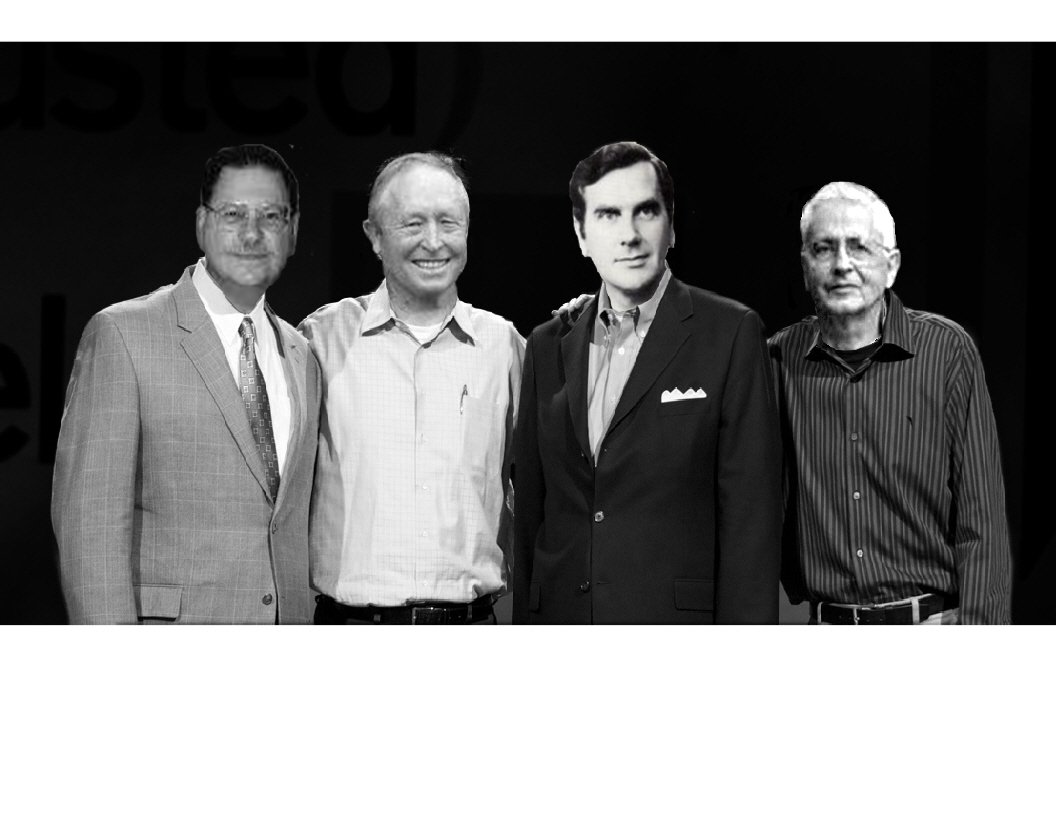
THE ORIGINAL CORE FOUR OF THE AUSTRALIAN FORUM THINK TANK CIRCA 1970

THE REAL DREAM TEAM
The James MacDonald White Paper: The New Calvinist Big Fat Lie; Post 16 of 20
 “How long will Christians continue to fall for this ruse? These guys have been running the show in an increased continuum for 43 years!”
New Calvinism is the Christian version of “Blame it on Bush.” People like new things, and New Calvinism is still being sold as something new. Fact is, they have been selling this “resurgence” pitch for forty-three years now. New Calvinism was hatched in 1970 and is a return to authentic Calvinism. The New Calvinism movement and its ideology have completely dominated the American church since 2008. In a 2009 Time Magazine article, New Calvinism was said to be one of the top ten ideas changing the world in our day. This ministry is constantly informed by people throughout the U.S. that the only churches in their general geographical area are New Calvinist without exception.
Nevertheless, The Neo-Calvinists continue to draw what’s left of American Christianity into their megacult by claiming that their “rediscovery” of the Reformed gospel is the answer to the carnage that they have in fact created. The New Calvinist movement is directly responsible for the mass exodus from the formal church presently taking place.
The hybrid form of this rabid mysticism (evangelicalism) that has survived its (authentic Calvinism) social deaths in church history have always been crippled with vestiges of the same ideology: primarily, weak sanctification. This has always primed future “resurgences” of the despotic original. New Calvinism is weeding out the competition and dominating the Christian landscape for the following reasons:
1. Protestantism has always disarmed its congregants theologically with its Romish-like spiritual caste system. American Christians do not have the theological wherewithal to fight this movement.
2. The mentality, again, created by Protestantism, that the laity are not responsible for the overall landscape of the church because they are the Sudra at best, and the Untouchables at least.
3. Because of number 2, alternatives are not being created and many are merely checking out of the church scene.
New Calvinism will continue to dominate Christianity unless alternatives are created along with necessary education. New Calvinism will continue to create carnage and then offer itself as the solution, leaving itself as the only alternative embodied with mindless followers. What is left of the formal church must repent of Protestantism; embrace the priesthood of believers, and the plain sense of Holy Writ. The Reformation gospel teaches that the law can give life because Christ fulfilled it for us. The result is the antinomianism that the Bible clearly states will dominate the last days. Pastors of the formal church must humble themselves and admit they didn’t know that Reformed total depravity also pertains to the saints, and sola fide also pertains to sanctification. They must also admit they didn’t know sola Christus really means Christ alone in regard to the other Trinity members, not just the way to the Father.
This is the backdrop for the “resurgence” motif constantly propagated by James MacDonald and associate Mark Driscoll. The latter is actually, and this is totally unbelievable to me, writing a book entitled, A Call to Resurgence: Will Christianity Have a Funeral Or a Future? The following is stated about the book in a promo:
It’s tempting to believe that the Christian faith is alive and well in our country today. Our politicians talk about God. Our mega-churches are filled. Christian schools dot our landscape. Brace yourself. It’s an illusion. Believe it or not, only 8 percent of Americans profess and practice true evangelical Christian faith. There are more left-handed people than evangelical Christians in America.
In this book, Mark Driscoll delivers a wake-up call for every believer: We are living in a post-Christian culture—a culture fundamentally at odds with faith in Jesus. This is good and bad news. The good news is that God is still working, redeeming people from this spiritual wasteland and inspiring a resurgence of faithful believers. The bad news is that many believers just don’t get it. They continue to gather exclusively into insular tribes, lobbing e-bombs at each other in cyberspace.
Mark’s book is a clarion call for Christians. It’s time to get to work. We can only do this if we unite around Jesus and the essentials found in his Word, while at the same time, appreciating the distinctives within each Christian tribe. Mark shows us how to do just that. This isn’t the time to wait or debate. Join the resurgence.
How long will Christians continue to fall for this ruse? These guys have been running the show in an increased continuum for 43 years! They have absolutely dominated the Christian landscape since 2008. I agree that the American church is in a dark age, but it is a New Calvinist dark age. They have mocked the intelligence of Christianity by calling for Reformed resurgence in the very midst of one since 1970.
Likewise, in James MacDonald’s Vertical Church, he devotes all of chapter four to this very idea, calling the contemporary church an “epic failure.” Under said heading in that chapter, he states a list of those failures:
1. 6,000 churches close their doors every year.
2. 3,500 Americans leave the church every day.
3. Only one pastor in ten retires while still in ministry.
4. Less than 20% of Americans attend church regularly.
5. Only 15% of churches in the U.S. are growing numerically.
6. Only 2% percent of growing churches are effectively winning converts to Christ.
7. Only 9% of evangelicals tithe to their churches.
8. 800 new church plants survive each year.
9. 10,000 new churches would be needed annually to keep up with the population growth.
These are New Calvinist statistics. These are New Calvinist failures. This is their economy. And many pastors would do well to get a backbone and speak up about it.
paul
The James MacDonald White Paper: The “Vertical Church ‘Experience'”; Post 15 of 20
The New Calvinism movement is a return to the viral Gnosticism that wreaked havoc on the first century church. Gnosticism permeated Judaism as well as Gentile mystery religions. Some evidence of this can be seen in the seven letters of Revelation. The Nicolaitans were Gnostics, and the church at Laodicea at the time of those letters is a good picture of what a Gnostic church would look like. “Nicolaitan” means, power over the laity. A root of the word can also be seen in THE teacher of Israel, Nicodemus. Part and parcel with Gnosticism is antinomianism and the idea that man is part of evil matter and not changeable for the better. Hence, the reason Christ emphasized the new birth and obedience to Nicodemus. This is also why the motif that the Pharisees were “legalists” (a word that does not appear in the Bible), is a sham. Christ plainly stated that they had replaced the law of God with their traditions. The New Testament was written against the backdrop of a Gnostic tsunami. It is the doctrine that dared to confront the apostolic church; therefore, its present-day resurgence should be no surprise.
Gnosticism has the blue chip ability to deceive Biblicists because it posits a plenary justification in its pseudo Christian version. The pseudo Christian Gnostic needs to only speak of sanctification in a justification way. Of course, like Gnostics of old, they are also masters of terminology. New Calvinists sometimes refer to their doctrine as, Objective Justification, Subjective Justification, and Final Justification. Ever heard of Ronald Reagan’s trickle-down economics? This is trickle-down justification, and you get the trickle-down from focusing vertically on justification. You can preach wonderful sermons on justification all year long, but the big question is: “What’s missing?”
And, since matter can’t change for the better, and to attempt change in sanctification is synonymous with denying the person and salvific works of Christ, “manifesting” the glory of Christ replaces works in the Christian life. We “experience” the works of Christ, but we do not participate in the works. How this is actually said to operate in the Christian life varies among the New Gnostics. Some say that we are merely experiencing a manifestation of Christ in our realm. Others say that we are actually incited to participate bodily because Christ has filled our hearts with a desire to do said task; so, it is us doing it, but only because Christ has filled our hearts with Himself for that particular manifestation. These manifestations are a result of gospel/justification contemplationism.
Like most Eastern concepts of sanctification, EXPERIENCE is the key. The goal is spiritual wellbeing and glorifying the gods. The goal is to experience rebirth, or the true objective forms that trickle down into progressive subjectivism. It’s experiencing the pure unchanging true, good, and beautiful to the fullest extent possible in the subjective realm that we live in. We are, as the New Calvinist Justin Taylor states, “between two worlds.” As New Calvinist Chad Bresson states it, “between two spheres, gazing at Christ—our heavenly destiny.” But primarily for the New Gnostics, it enables us to eliminate our works in sanctification, and thereby maintaining our just state before God. Its goal is to manifest the objective gospel in our subjective realm. The payoff is a perpetual experience of rebirth—the same baptism that we experienced when we were saved, it is John Piper’s “treasure chest of joy.” They blatantly call it the same thing that it is called in Eastern Sufism, “vivification.” The likes of Michael Horton and Paul Washer call it a “living out of our original baptism.” It results from focusing on our miserable existence in the subjective realm (and especially our sin) as set against the glories of the objective. Therefore, suffering is good because it reminds us of the difference between the two. Suffering brings a death that will result in vivification. Those who put any stock in this life are disdained as ignorant and blind.
So, key is gospel contemplationism leading to manifestations, and resulting in experience. Vertical only =’s the baptism experience and accompanied joy. It frees the “Christian” from the experience of this horizontal life, and seeks to experience the objective. Those who “live in the shadows” are naysayers worthy of death. And that is the essence of James MacDonald’s Vertical Church. In the 320 pages of the book, MacDonald uses the word “experience” 128 times. He uses the word “manifest/manifestation” 111 times.
My advice to the congregants at Harvest is to cut your losses sooner than later. Not just because this movement is destined to crash and burn, but because it is a mystic lie and a vile affront to the gospel.
paul
NOTE FILE SHARING WIDGET FOR THIS SERIES ON BOTTOM RIGHT SIDE PANEL

 Paul's Passing Thoughts
1 comment