Religious Tyranny: A Case Study; Introduction and Chapter One
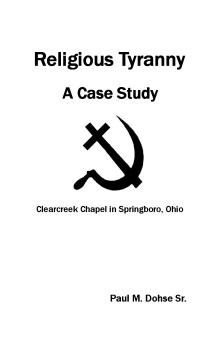
Cover: Religious Tyranny; A Case Study
Preamble
I need another project right now like I need a hole in the head; nevertheless, recent events have impressed upon me the immediate need for this work. As I accomplish each part I will be posting it here on PPT and making all readers part of an editing committee. So, comment here, email me here mail@ttanc.com, and pass judgment on content, grammar, style or whatever else editors do. The compilation will be available in a free ebook or hardcopy book form that can be purchased.
Thank you for your input.
paul
Introduction
“…I have sworn upon the altar of god eternal hostility against every form of tyranny over the mind of man.” – Thomas Jefferson to Dr. Benjamin Rush, September 23, 1801
This book flows not from the winepress of sour grapes, but rather from thankfulness. Whether secular or religious tyranny, these endeavors always yield freedom. Tyranny was a usurper into God’s creation and challenges man’s innate need to be free. Therefore, sin finds itself in a quandary; it is utterly driven by a lust to enslave, but this will eventually drive men to a fight or flight. Tyranny is affliction, but it will always awaken man to his freedom duty. For this, we can be thankful.
This book is an in-depth look into religious tyranny using Clearcreek Chapel in Springboro, Ohio as a case study. However, this case study is a story that reads like most church experiences in our day, and the personal testimonies read the same as well. The information written within will come from the author’s firsthand experience and the testimonies of others, but there is no need to focus on a few people when this is the like testimony of many. Hence, the study will focus on common experiences and not particular individuals.
Most people are saved according to the experience described by the apostle Paul in 1Thessalonians 1:5,
For our gospel came not to you in word only, but also in power, and in the Holy Ghost, and in much assurance; as you know what manner of men we were among you for your sake (KJV).
Yet, most professing Christians doubt their salvation, and furthermore, most professing Christians know there is something fundamentally missing in church; something isn’t right, but they can’t put their finger on it. The present mass exodus from the institutional church is well documented while most people leaving the church don’t know specifically why they are leaving. They are leaving because something is missing, but they are not sure what that something is. The salvation that came with much power and assurance has faded into doubt and indifference.
On the other hand, the church, whether Catholic or Protestant, seems to be supported by many others who are unwavering despite tyranny, illogical contradictions, hypocrisy, and evils not even spoken of in the secular world. How can this be? How can a church like Clearcreek Chapel now embrace beliefs that would have been rejected out of hand with extreme prejudice by the same Chapel parishioners twenty years prior? How can the present leadership behave in a way that would not have been tolerated for a moment twenty years prior by the same people who now embrace it wholeheartedly?
This study proposes to answer all of these questions in no uncertain way, but one final question needs to be answered to complete the study; once the indictment is clarified, what should our response be? What is the solution?
So then, how can we have full assurance of salvation? What is wrong with church? Why is tyranny acceptable? And what should we do about it?
Because only truth sanctifies (John 17:17),
Paul M. Dohse Sr.
Chapter One: The Chapel’s Unique Place in Church History
Clearcreek Chapel in Springboro, Ohio played an important and telling role in contemporary church history. Founded by a young Dr. John D. Street in the latter 1980’s, it sought to be relevant in contemporary culture. Dr. Street often described the church at that time as “ministering to the present culture while wearing bellbottom pants.” Street also patterned the Chapel ministry after his mentor, Pastor John MacArthur Jr.
Dr. Street also made an emerging movement at that time a hallmark of the Chapel ministry; the biblical counseling movement founded by Dr. Jay Adams. The advent of said movement began with Adams’ controversial book, “Competent to Counsel” (1970). The Chapel became a training center for the biblical counseling movement founded by Adams, and in large part a face of the biblical counseling movement.
Adams, a Presbyterian minister, was provoked by his own confession that he was unable to help people with serious problems, and indicted the church as a whole in the same way. What made this indictment painfully obvious was the integration of secular Psychology into religious thought during the 1980s. This integration was a movement that peaked in the 80’s. Help could not be found in the church so people looked for help outside of the church. The biblical counseling movement peaked in the 1990’s and this is when it experienced a true biblical revival, and Clearcreek Chapel was one of the epicenters of that spiritual awakening.
It is now very important to explain what that revival looked like because the implications are profound. This is the first point in beginning to answer the questions presented in the introduction: what’s wrong with church? Why do so many Christians doubt their salvation? Why do so many embrace churches that practice open tyranny? And lastly, what should we do about it?
If most Christians are honest, they see very little progressive change in the people they attend church with. If most Christians are honest, they admit people who are saved from the outside secular world into an enduring life testimony are very few and far in-between. Yet, this was not what was going on at the Chapel during the 90s. In one year (1995) as a result of the biblical counseling focus, twelve people were saved in 1Thessalonians 1:5 fashion and stayed the course. During this time other churches influenced by the Chapel shared the same testimony.
But let’s back up for a moment; Jay Adams’ testimony is startling. As one who came from the elitist hallowed halls of Protestant brain trust, he openly admitted himself that he was clueless in regard to helping people with real life problems. Furthermore, this was his indictment against the church at large as well. We must pause and ponder this fact soberly; after more than 500 years and oceans of Protestant scholarly ink, it was commonly accepted that most ministers were unable to take the word of God and help people with serious problems. There is a very simple answer in regard to why that was the reality and still is, and we will arrive there in due process. But before we move on, it is interesting to note that while the Protestant brain trust openly confessed its inability to help people with deep personal problems, it wailed and screamed in sackcloth and ashes that the void was filled with secular Psychology.
The brainchild of Adams’ biblical counseling construct is even more startling. In beginning his quest for helping people with real problems, he sought out none other than O. Hobart Mowrer, a notable secular Psychiatrist who fathered a kind of responsibility therapy movement championed by the likes of Dr. Phil McGraw and Dr. Laura Schlessinger. Adams wrote in the introduction of Competent To Counsel,
Reading Mowrer’s book The Crisis in Psychiatry and Religion, as I said, was an earth-shaking experience. In this book Mowrer, a noted research psychologist who had been honored with the Presidency of the American Psychological Association for his breakthrough in learning theory, challenged the entire field of psychiatry, declaring it a failure, and sought to refute its fundamental Freudian presuppositions. Boldly he threw down the gauntlet to conservative Christians as well. He asked: “Has Evangelical religion sold its birthright for a mess of psychological pottage?”
In Crisis, Mowrer particularly opposed the Medical Model from which the concept of mental illness was derived. He showed how this model removed responsibility from the counselee. Since one is not considered blameworthy for catching Asian Flu, his family treats him with sympathetic understanding, and others make allowances for him. This is because they know he can’t help his sickness. He was invaded from without. Moreover, he must helplessly rely on experts to help him get well. Mowrer rightly maintained that the Medical Model took away the sense of personal responsibility. As a result, psychotherapy became a search into the past to find others (parents, the church, society, grandmother) on whom to place the blame. Therapy consists of siding against the too-strict Super-ego (conscience) which these culprits have socialized into the poor sick victim.
In contrast, Mowrer antithetically proposed a Moral Model of responsibility. He said that the “patient’s” problems are moral, not medical. He suffers from real guilt, not guilt feelings (false guilt). The basic irregularity is not emotional, but behavioral. He is not a victim of his conscience, but a violator of it. He must stop blaming others and accept responsibility for his own poor behavior. Problems may be solved, not by ventilation of feelings, but rather by confession of sin.
From my protracted involvement with the inmates of the mental institutions at Kankakee and Galesburg, I was convinced that most of them were there, as I said, not because they were sick, but because they were sinful. In counseling sessions, we discovered with astonishing consistency that the main problems people were having were of their own making. Others (grandmother, et al.) were not their problem; they themselves were their own worst enemies. Some had written bad checks, some had become entangled in the consequences of immorality, others had cheated on income tax, and so on. Many had fled to the institution to escape the consequences of their wrongdoing. A number had sought to avoid the responsibility of difficult decisions. We also saw evidence of dramatic recovery when people straightened out these matters. Humanistic as his methods were, Mowrer clearly demonstrated that even his approach could achieve in a few weeks what in many cases psychotherapy had been unable to do in years.
I came home deeply indebted to Mowrer for indirectly driving me to a conclusion that I as a Christian minister should have known all along, namely, that many of the “mentally ill” are people who can be helped by the ministry of God’s Word. I have been trying to do so ever since.
This experience was the breakthrough that launched the biblical counseling movement and its subsequent success. Without Mowrer’s observations, the biblical counseling movement never happens. Nevertheless, Adams then states the following in the same introduction:
Let me append one final word about Mowrer. I want to say clearly, once and for all, that I am not a disciple of Mowrer or William Glasser (a writer in the Mowrer tradition who has become popular recently through the publication of Reality Therapy,a book that has confirmed Mowrer’s contentions in a different context). I stand far off from them. Their systems begin and end with man. Mowrer and Glasser fail to take into consideration man’s basic relationship to God through Christ, neglect God’s law, and know nothing of the power of the Holy Spirit in regeneration and sanctification. Their presuppositional stance must be rejected totally. Christians may thank God that in his providence he has used Mowrer and others to awaken us to the fact that the “mentally ill” can be helped. But Christians must turn to the Scriptures to discover how God (not Mowrer) says to do it.
All concepts, terms and methods used in counseling need to be re-examined biblically. Not one thing can be accepted from the past (or the present) without biblical warrant. Biblical counseling cannot be an imposition of Mowrer’s or Glasser’s views (or mine) upon Scripture. Mowrer and Glasser have shown us that many of the old views were wrong. They have exposed Freud’s opposition to responsibility and have challenged us (if we read their message with Christian eyes) to return to the Bible for our answers. But neither Mowrer nor Glasser has solved the problem of responsibility. The responsibility they advocate is a relative, changing human responsibility; it is a non-Christian responsibility which must be rejected as fully as the irresponsibility of Freud and Rogers. At best, Mowrer’s idea of responsibility is doing what is best for the most. But social mores change; and when pressed as to who is to say what is best, Mowrer falls into a subjectivism which in the end amounts to saying that each individual is his own standard. In other words, there is no standard apart from God’s divinely imposed objective Standard, the Bible. Tweedie is correct, therefore, when he rejects Mowrer’s “projected solution” to the problem of sin as an “acute” disappointment.
During the years that followed, I have been engrossed in the project of developing biblical counseling and have uncovered what I consider to be a number of important scriptural principles. It is amazing to discover how much the Bible has to say about counseling, and how fresh the biblical approach is. The complete trustworthiness of Scripture in dealing with people has been demonstrated. There have been dramatic results, results far more dramatic than those I saw in Illinois.
In light of the entire context stated here, Adams’ paradoxical twist on Mowrer is both stunning and perplexing, but don’t miss the much larger point; Adams’ perspective as documented here is profoundly indicative of what is fundamentally wrong with church. Yes, it is the something that is wrong that few are able to put their finger on. However, we are still in the history stage of our study. In regard to why Clearcreek Chapel is a paramount case study for religious tyranny, we are still laying the historical groundwork.
Chapter Two: The Insurgency
PPT Will Pen an In-Depth Exposé on Clearcreek Chapel
 In the near future, PPT will publish an in-depth exposé on Clearcreek Chapel in Springboro, Ohio. This will include its history and an in-depth profile of past and present elders. Also, its litany of unresolved conflict with many Christian families will be documented in painstaking detail.
This is in response to the constant flow of longstanding emotional suffering flowing out of this “ministry” that refuses to cease or even slow down. Particular attention will be paid to the rabid lust for controlling others practiced by the Clearcreek elders.
And lastly, evangelical organizations, churches, individuals, and pastors who enable their behavior will also be profiled.
This project will surpass any level of in-depth research performed by TANC Ministries since 2009, and will be accompanied by aggressive widespread publication.
The goal is to temper the suffering foisted upon unsuspecting people by Clearcreek Chapel that is constantly brought to our attention by those seeking counsel.
How should such organizations be responded to? That question will be explored as well.
Paul Dohse
TANC Ministries
Clearcreek Chapel Gone Wild: Jesus Keeps the Clearcreek Covenant for You
 Originally posted November 18, 2013
My, my, how different Clearcreek Chapel of Springboro, Ohio is since a pack of New Calvinist wolves took it over shortly after the departure of the founding pastor. The victorious pack, led by Chad Bresson (who for some reason recently left the KoolAid paradise that he built at his former chapel with a creepy adoration for his supposed theological prowess) began infiltrating the flock a couple of weeks before Dr. John Street’s departure.
The undomesticated canine delegation he brought with him from a Baptist church in Dayton, Ohio seemed to be frustrated with their inability to devour at that location. Really old sheep produce a mutton that is tough to chew, and invariably leaves a bad aftertaste.
As far as the “friends” I knew back in that day and their susceptibility to believe Bresson’s outrageous mythology, I never saw it coming.
Apparently, just about any place a thinking person pokes the Chapel these days produces something utterly bizarre. I say this because of what I accidently stumbled onto today. In a recent sermon by Chapel elder Devon Berry, who is a mental healthcare professional (yikes!), he stated that Jesus keeps the Chapel covenant for the “beloved” members. Let me share an excerpt:
Is the Chapel covenant a call to a certain kind of living in the Church? Yes, it is. But beloved, it is a call to much, much, much more than that and it can never be only that. It is a call to the living Christ, our righteousness, our sin-bearer, our life. When you read the Chapel Covenant, reflect on Christ first for it is meant to point us to him – not to ourselves and our own efforts. Then rejoice. He has obeyed for us. He has suffered and died for us. And, he has also enabled us by grace – something we’ve talked around this morning but not mentioned directly.
Let me close by contradicting myself. Earlier I said that you could not keep the Chapel Covenant. I will end by saying that you can keep the Chapel Covenant. Grace, the enabling power given by God because we are at peace with him through the work of the cross, provides all that we need to obey and overcome sin. Hence, the Chapel Covenant is a call to live in the reality of who we are as believers. There is no better place you could live, no more joyful place you could abide, no more beautiful place you could dwell than in the life-transforming reality of the gospel. Believer, be who you are for Christ has given you all that you need.
Clearly, Berry is putting the Chapel covenant on par with the Scriptures. He states that it is more than a standard, it is a “call to the living Christ.” And, the ability to keep the covenant requires the enabling grace of Christ? This is beyond creepy. Moreover, if 2+2=4, Berry makes living by the Chapel covenant via the grace of Christ synonymous with dwelling in the “life-transforming reality of the gospel.” And according to Berry, there is not a place in the world where they could have more joy.
Sorry I am missing all the fun.
paul
Book Review: Russ Kennedy’s “Perplexity,” All you Need is the Cover
 Really? Christians need yet another book on gospel contemplationism? In Perplexity: Bringing My Questions to God, the theses is a very familiar one in our day. As I was reading through the Kindle version while riding in the family car with my wife Susan, intermittently reading aloud, she commented, “It sounds like the same ole’ stuff.” Indeed, the institutional church will continue to relentlessly pound this one simple message into the heads of Christians in different ways, and anyone who comes up with a different version will be lauded accordingly.
It’s ironic, Russ Kennedy, the “pastor” of Clearcreek Chapel in Springboro, Ohio was at the center of one of the most perplexing seasons of my life. Had this book been published at that time, perhaps I would still be there, and living according to its age-old theses. But I wanted answers, and according to the theses of this religion, a very ancient one, that’s arrogance. Yes, perplexity is a good thing because it humbles us, it reminds us that we can’t know anything except that we are perplexed, and living in the dark cave of life. Hence, see the cover of the book. This is not perplexing at all; you are in the dark cave looking up, and the light seen at the mouth of the cave is the gospel. If you know what Russ Kennedy et al believe, all you need is the cover—it says it all in a visual bumper sticker.
Let me interject something here: that perplexing time of my life was only perplexing at the time. That’s one of the real truths of biblical perplexity; time often reveals exactly how God uses the evil of the world for His divine purposes. In the midst of severe, dark trials, we continue in well-dong and wait for God’s answers (1Pet 4:19). That’s difficult, we will need the love and truthful encouragement of other Christians. Yes, in rare instances, we will have to wait for glory to know the answers, but we can be sure that God is working all things for His divine purposes, and for the believer, that isn’t for the express purpose of showing us how worthless and depraved we are. Conspicuously absent in Kennedy’s book is the following concept:
Deuteronomy 29:29 – The secret things belong to the Lord our God, but the things that are revealed belong to us and to our children forever, that we may do all the words of this law.
According to Kennedy and the long history of those who supply thoughts for him, the only thing that Christians can DO is the same gospel that saved them. We are in the dark cave, and all we can do is contemplate the light outside of the tunnel. Our reality is a subjective dark cave, and according to a former elder that supplied the overall philosophy for the Chapel, “New Covenant Theology presumes a Christocentricity to the understanding and meaning of all reality.” Said elder, Chad Bresson, departed from the Chapel, also dubbed “Cloudy Creek Chapel” by many former members, at approximately the same time of a controversy concerning an accusation that the Chapel elders were teaching, “some kind of Christian mysticism.” Go figure.*
So, if Christians can’t really know anything objectively except the suffering of the cross, what’s the point? Well, that answer isn’t perplexing at all: joy. As you look up from the dark cave of life and humanity to the only thing you can know, the light of the glorious cross shining outside of the cave, the result is the stripping away of everything treasured at all other than Christ resulting in joy while in the cave. Joy, regardless of circumstances, is the payoff. Joy in the cave is the payoff. Like Hinduism, the cause and effect of knowledge and the application thereof are toys that we discard as we mature spiritually, IF we come to realize that life is a completely preordained god-narrative that points us to a light that transcends empirical knowledge. As Kennedy states in the book, answers to life’s problems are “shadows.” Right and wrong answers are not the issue; the arrogant assumption that you can know anything except the suffering of the cross is the issue.
Listen, I was perplexed, and paid a price for wanting answers, but I see now that God used those dark circumstances to incite me to seek godly knowledge. I would only change one thing: I shouldn’t have been ignorant in regard to authentic church history and its progression of various soteriologies. My own ignorance and lack of knowledge led me to that darkness. Instead of letting me suffer the full brunt of my lazy Christianity, viz, letting others think for me, God restricted the circumstances to awakening me out of my pathetic slumber. That’s grace in sanctification my friends. When it gets right down to it, I can’t blame Russ Kennedy mysticism for what happened; we live in an information age, I was a know-it-all according to everyone else’s “knowledge.” Christ died to save me from the law, and gave me a “helper” to sincerely love Him with God-given talents. Instead of utilizing that, I did not study to show myself approved—it’s on me. For certain, I do not deserve what God has done to rebuild my life, but be sure of this, I have learned from it.
What have I learned? I have learned that the present-day chaos in the church is not perplexing at all. It is as simple as the cover on Russ Kennedy’s book. Frankly, the audacity of Plato’s cave adorning the cover of this book shouldn’t surprise us. The framers of the American Constitution readily observed that the colonial Calvinist Puritans of that day were followers of Plato. That, coupled with the tyranny that they experienced growing up under the colonial Puritan theocracy of that day inspired them to create one of the greatest experiments of all time—the American ideal, which God has used to wreak more good on the earth since the good news of the gospel. For one example, the Puritans, like the one Kennedy cites in his book, called Benjamin Franklin a devil for inventing the lightening rod. The only thing that saved Franklin from the fate of others who tried to improve the human condition through knowledge was the fact that his lightening rod saved churches from burning down via lightning strikes.
Platonism eventually became Gnosticism which was nemesis #1 for the New Testament church. The Neo-Calvinist resurgence of our day is a return to that Gnosticism in every respect, and the teaching method is no different than that used by Kennedy in his book:
1. Focus on being rightly descriptive about how trials and the rigors of life are experienced. This makes the listener think that you understand where they are at.
2. Exploit the fact trying to do the right thing the wrong way is very prevalent in the human experience. Then interpret those failures as a misconception regarding the very interpretation of reality. Interpret those failures as part of the overall failures of reason itself: i.e., Plato’s shadows in the cave. Our existence is experienced subjectively via the shadows of the true forms. The Puritans merely changed Plato’s true forms into the gospel/Christ, and our human existence is the cave.
3. Offer the alternative of gospel contemplationism, using proof-texting with verses that only tell half of the story: mysteries that belong to the Lord—which can only be experienced by joy and not known. This is the crux of Gnosticism. All reason and human knowledge are only shadows of the mysteries of Plato’s trinity: the true, good, and beautiful. They merely make Plato’s trinity “the gospel.” Any member at Clearcreek Chapel who is honest with themselves will see this concept woven within all of Russ Kennedy’s teachings sometimes plagiarized from John Piper’s Christian Hedonism which led to his dismissal from a church in Illinois.
Church history tells us that Gnosticism has always had mass appeal and has always been the greatest challenge to true Christianity. This is because it feeds our propensity towards lazy thinking, and enables us to step back from the rigors of life and observe them from afar. It also enables us to escape responsibility, and change by glorying in our ignorance while appearing spiritual. Yes, we are the humble totally depraved who “know nothing but Christ and Him crucified.” Change is hard, and many will exchange it in a heartbeat for the easy way while having the added bonus of looking humble and spiritual to boot. This is the mass appeal that has always been Gnosticism, a kissing cousin to Stoicism.
Wow! Look at his faith in the face of this immense tragedy! If only I had faith like that!
Faith? Or a Gnostic indifference towards reality? Was it faith that led a son to stand up at the funeral of a godly pastor and proudly proclaim that his father was a “wicked sinner”? What of the disdain shared by a Clearcreek elder in regard to his mother-in-law’s grieving because she was terminally ill and would not see her grandchildren grow up? The disdain evolved around her treasuring of her grandchildren more than Christ. Grandchildren are mere shadows.
There is only one false religion: antinomian sanctification. A rejection of knowledge in sanctification under the guise of “knowing nothing but Christ and him Crucified” portrays a certain mindset about justification. It exchanges love in sanctification for fear in justification. If we must keep ourselves justified by a humbleness defined by knowing nothing, we indeed need the Russ Kennedys of the world which is why he wrote the book. But one best ponder the very words of Christ: “Because of anomia, the love of many will become cold.”
Strange, once again I am inadvertently ministered to by tyranny. Susan and I have been considering a change of direction as this ministry is a very lonely ministry that fights the uphill battle against completely unnecessary perplexity in the American church. A recent sermon by Andy Stanley has Christians “troubled” and “perplexed.” In the sermon, Stanley proffered the idea that Christ put people before “his religion” which he made synonymous with the law. Supposedly, the Pharisees did the opposite by putting the law before people. Stanley then defiantly dared anyone to ask for a practical application to the sermon. Stanley then concluded the “sermon” by stating that he didn’t know where the theses would lead, that of course, would be decided by the Lord. As one blogger noted:
With all due respect, I submit that if Andy Stanley did not know the answers to the questions posed above, he should have never delivered the sermon.
With all due respect, Christians need to stop being perplexed in regard to where these antinomian teachers are coming from. We find the same exact concept in this book published by Kennedy. In the difficult questions of life and times of darkness, you don’t look for answers; you only meditate on the gospel and not shadowy reason. In death, you seek more death, so that the joy of the cross may abound in your heart. This is what you do while waiting for the Lord to change your circumstances at a time of his choosing. Of course, this is a counselor’s dream; one size fits all. Every counselee walking in has the same problem: they value life. Don’t be fooled by multiple layers of nuance and careful choice of synonyms, this is the crux of the matter; you either treasure Christ alone, or you treasure all else but Him alone. It’s either the dark cave or the light, period.
Their god is the god of confusion, not ours. And perplexity is not a glory; it is the disdain of lady wisdom and a lamp-less dark path to destruction.
paul
*Incredibly, the Chapel still benefits from the biblical counseling movement started by Dr. Jay Adams in 1970. The movement was a true revival because it called the church back to practical application in sanctification. As a former pastor at the Chapel, I witnessed this doing reformation (at its peak in the early 90s) firsthand because the Chapel was a NANC training center at the time. The movement was neutralized by a Gnostic form of biblical counseling followed by Russ Kennedy and his elders. Nevertheless, they represent themselves as advocates of the original movement and its tenets. As they deceptively allow people to come into membership under this false pretense, controversy arises later due to the contradictions involved. Much of the energies expended by the Clearcreek Chapel elders involve damage control.
Clearcreek Chapel Gone Wild: Jesus Keeps the Clearcreek Covenant for You
 My, my, how different Clearcreek Chapel of Springboro, Ohio is since a pack of New Calvinist wolves took it over shortly after the departure of the founding pastor. The victorious pack, led by Chad Bresson (who for some reason recently left the KoolAid paradise that he built at his former chapel with a creepy adoration for his supposed theological prowess), began infiltrating the flock a couple of weeks before Dr. John Street’s departure.
The undomesticated canine delegation he brought with him from a Baptist church in Dayton, Ohio seemed to be frustrated with their inability to devour at that location. Really old sheep produce a mutton that is tough to chew, and invariably leaves a bad aftertaste.
As far as the “friends” I knew back in that day, and their susceptibility to believe Bresson’s outrageous mythology, I never saw it coming.
Apparently, just about any place a thinking person pokes the Chapel these days produces something utterly bizarre. I say this because of what I accidently stumbled onto today. In a recent sermon by Chapel elder Devon Berry, who is a mental healthcare professional (yikes!), he stated that Jesus keeps the Chapel covenant for the “beloved” members. Let me share an excerpt:
Is the Chapel covenant a call to a certain kind of living in the Church? Yes, it is. But beloved, it is a call to much, much, much more than that and it can never be only that. It is a call to the living Christ, our righteousness, our sin-bearer, our life. When you read the Chapel Covenant, reflect on Christ first for it is meant to point us to him – not to ourselves and our own efforts. Then rejoice. He has obeyed for us. He has suffered and died for us. And, he has also enabled us by grace – something we’ve talked around this morning but not mentioned directly.
Let me close by contradicting myself. Earlier I said that you could not keep the Chapel Covenant. I will end by saying that you can keep the Chapel Covenant. Grace, the enabling power given by God because we are at peace with him through the work of the cross, provides all that we need to obey and overcome sin. Hence, the Chapel Covenant is a call to live in the reality of who we are as believers. There is no better place you could live, no more joyful place you could abide, no more beautiful place you could dwell than in the life-transforming reality of the gospel. Believer, be who you are for Christ has given you all that you need.
Clearly, Berry is putting the Chapel covenant on par with the Scriptures. He states that it is more than a standard; it is a “call to the living Christ.” And, the ability to keep the covenant requires the enabling grace of Christ? This is beyond creepy. Moreover, if 2+2=4, Berry makes living by the Chapel covenant via the grace of Christ synonymous with dwelling in the “life-transforming reality of the gospel.” And according to Berry, there is not a place in the world where they could have more joy.
Sorry I am missing all the fun.
paul

 Paul's Passing Thoughts
leave a comment