Our Justification Crisis, Perseverance, and Assurance: Part 2
Live Streamed every Sunday @ 7pm from freebereans.blogspot.com
CLICK ON TO ENLARGE

CLICK ON TO ENLARGE

CLICK ON TO ENLARGE

CLICK ON TO ENLARGE
Last week we looked at the nature of the present-day justification crises. Tonight we will look at the relationship between justification, perseverance, and assurance of salvation. This is another topical subject related to the book of Romans that we are adding to our verse by verse study. I have interjected this study because of the rampant confusion related to perseverance and the Christian. Granted, there are verses in the Bible that seem to indicate that Christians have to persevere in their faith to obtain a “final justification.”
If there is anything about election that would endear detractors at all, it is the idea that our justification was determined before the creation of the world, and therefore, there is nothing we or anyone else can do in sanctification to mess that up. Once saved, always saved. Traditionally, Calvinists have been primarily associated with this election idea. The idea makes people uneasy, but at least you get assurance of salvation in the deal. Or do you?
In our endeavor to understand the paramount subject of justification, Calvinism and Reformed doctrine in general must be dealt with. Why? Because as the lazy-thinking church slumbered, Calvinists have established a doctrinal foundation. They own the history. They own the seminaries. They own the publishing companies. They own the debate. They are accepted out of hand as the ones who know. This is what they do—they attempt to create a reality that yields the results that they want. And in our day, they have nearly succeeded. If not for the internet, this would be a done deal.
Many assumptions prevail: total depravity only pertains to the unregenerate. Faith alone (sola fide) only pertains to justification. Christ alone (solus Christus) doesn’t literally mean “Christ alone” to the exclusion of the other Trinity members. Scripture alone (Sola scriptura): instruction for life and godliness, or a meta-narrative for gospel contemplationism? And now we find that election doesn’t really mean “election” per se. Now we find that election justifies you, if you are chosen, but you have to persevere in order to obtain “final justification.”
And this idea is split up into two authentic Calvinism camps. In one camp, the Christian must persevere in sanctification by faith alone with his/her primary nemesis being the temptation to “obey in our own efforts.” “Effort” is the essence of works salvation. Augustine and Calvin both taught that the Sabbath rest was sanctification specifically. Because salvation is a “golden chain” where justification starts, and progresses in the middle towards final justification, we must maintain our justification in the same way that it began at the beginning of the chain. By faith alone. This is the double imputation crowd. Christ’s passive obedience to the cross secured our justification, His active obedience to the law while He lived on earth is imputed to our sanctification as long as we live by faith alone in sanctification. To the contrary, biblical double imputation is the imputation of God the Father’s righteousness to us apart from the law by faith in Christ alone, and the imputation of our sin to Christ. The imputation of Christ’s perfect obedience to the law being imputed to our sanctification to finish justification is NOT righteousness apart from the law.
Now the other camp. They reject Reformed double imputation, but their view of election is also an initial justification that must be maintained by our perseverance. In this case, a general faithfulness to the New Covenant. Note the following comments I received on my blog from a knowledgeable Reformed teacher from this camp:
I think it is clear from Scripture that salvation (election, calling, justification, glorification) cannot be lost. But justification can be initially entered into via faith alone, but we must then remain faithful. This was the error of the Jews, they thought that because they had entered a right standing (justification) with God, they were good to go…. All who have been elected unto mercy will persevere unto salvation, but Scripture makes it clear that there will be some who enter into or begin a relationship with God (justification, a right standing), but who fall away, commit apostasy, are severed from Christ, do not bear fruit, soil their garments, are excommunicated, etc. Another way to say this is that they lose their justification.
Justification is necessary for salvation, but the initial possession of justification does not mean that one will be saved in the end. He must endure….Sure there is – the New Covenant. And our faithfulness to this law will certainly be judged. This is why Paul teaches a gospel of righteousness, self-control and judgment in Acts 25 (or 24?)…. Back to your first statement – there is a standard: it is called the New Covenant. We now have cleansing (forgiveness, justification) through faith in Christ, but just like the Jews, we must also maintain that righteousness by virtue of faithfulness to the moral law – which, by the way, has been the same since Adam and Eve. Furthermore, under the new covenant, it is the Church (the Body of Christ) that is the focus of this covenant. We are enslaved to God, we are bound to the law of the Spirit, the law of Christ, etc. We have all kinds of instruction in Scripture about how to keep the law of God and what to do when we break it.
The key is the covenant community, however. There is no justification outside of the visible, local church…. All who have been elected unto mercy will persevere unto salvation, but Scripture makes it clear that there will be some who enter into or begin a relationship with God (justification, a right standing), but who fall away, commit apostasy, are severed from Christ, do not bear fruit, soil their garments, are excommunicated, etc. Another way to say this is that they lose their justification.
Justification is necessary for salvation, but the initial possession of justification does not mean that one will be saved in the end. He must endure.
Here was one of my responses that I think is the crux of my contention:
The problem is a standard for faithfulness maintaining justification. Those who are justified are no longer under any standard/law that judges whether or not they are justified. The justified live BY the law as a pattern of life, but not FOR justification. We are justified “apart from the law” and it is impossible for us to sin in the eyes of justification because apart from the law, “sin lies dead.”
That’s the problem. There is no standard or way to judge faithfulness in regard to justification because we are no longer “under the law.”
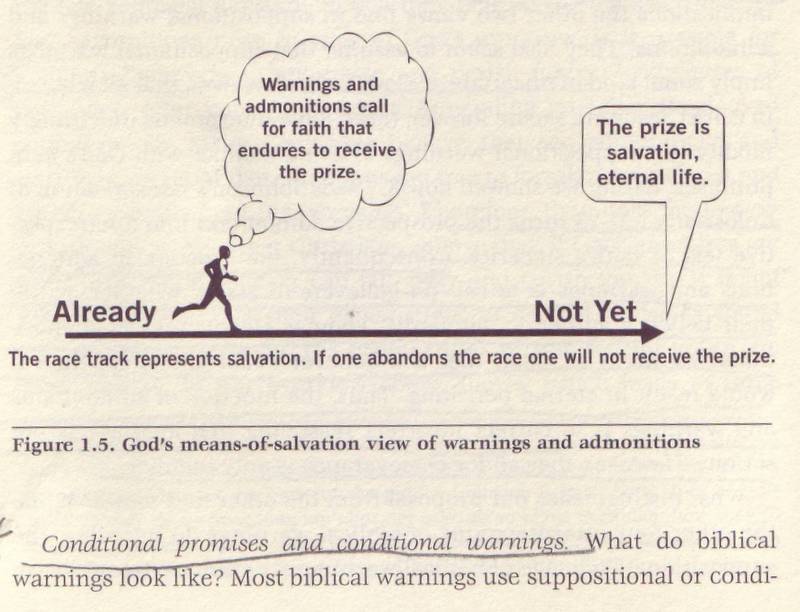
This view by camp B is specifically called, mutable justification. So, these are the two authentic Calvinist camps: Reformed double imputation and mutable justification. Both of these ideas are referred to the reformed motto, already-but not yet. Here is yet another assumption, that this is a Reformed paradox. Not so, “already” is initial justification; “not yet” is perseverance. This is why Calvinism is predicated on lack of assurance. The following is an illustration from the Reformed book, The Race Set Before Us p. 40:
CLICK ON TO ENLARGE
Now, let me begin by saying that election must be completely reevaluated because most of the thinking in regard to it has come from Reformed orthodoxy. That makes election according to the Reformers extremely suspect, especially since it is not really election to begin with. And trust me, for six years, I have been dealing with the justification issue and its relationship to the law and have not had time to reevaluate the metaphysics of election, and I know, much to the consternation of many of PPT’s (blog) readers. But I want to begin our evaluation of justification’s relationship to perseverance and assurance by beginning with what we do know about election. We have addressed the reality of the present-day foundation that dominates the church; now let’s look at this biblically.
What do we know today, here at the Potter’s House, about election? First, we know its purpose. Its purpose is to completely remove works from justification:
Romans 9:11 – though they were not yet born and had done nothing either good or bad—in order that God’s purpose of election might continue, not because of works but because of him who calls— 12 she was told, “The older will serve the younger.” 13 As it is written, “Jacob I loved, but Esau I hated.”
This couldn’t be clearer: God’s purpose in election is to remove all of our works from justification and make it dependent on the “call.” By the way, though I haven’t revisited the metaphysical questions of election yet, I do reject, on the basis of Scripture, that the call equals fatalistic determinism. Now, I don’t know how that fact is going to play out when I revisit this, but to date, I know that much. This brings us to the second thing that we know about election. In the following text, election is referred to as the call:
Romans 8:30 – And those whom he predestined he also called, and those whom he called he also justified, and those whom he justified he also glorified.
Stop right there. Here is where we drive a stake. If we can’t take this at face value, neither can we take John 3:16 at face value. The two things we know about election is that it has two purposes: one, to eliminate all works in justification; therefore, perseverance must be excluded from justification because perseverance has to be judged by a standard. To meet that standard is a work. Perseverance must be severed from justification completely. Secondly, election is for assurance of salvation. Election is the bedrock of our assurance. Paul makes this clear in the next verses immediately following:
31 What then shall we say to these things? If God is for us, who can be against us? 32 He who did not spare his own Son but gave him up for us all, how will he not also with him graciously give us all things? 33 Who shall bring any charge against God’s elect? It is God who justifies. 34 Who is to condemn? Christ Jesus is the one who died—more than that, who was raised—who is at the right hand of God, who indeed is interceding for us. 35 Who shall separate us from the love of Christ? Shall tribulation, or distress, or persecution, or famine, or nakedness, or danger, or sword? 36 As it is written,
“For your sake we are being killed all the day long; we are regarded as sheep to be slaughtered.”
37 No, in all these things we are more than conquerors through him who loved us. 38 For I am sure that neither death nor life, nor angels nor rulers, nor things present nor things to come, nor powers, 39 nor height nor depth, nor anything else in all creation, will be able to separate us from the love of God in Christ Jesus our Lord.
Now, how can glorification be spoken of in the past tense? Because it is a finished issue. It is guaranteed. In addition, the philosophers among us can probably be a help here, but I assume there is no beginning and end in eternity. This calling took place before creation. So does this mean there was never a time when we weren’t elected? That would be an interesting discussion for the philosophers among us. But sanctification is not in Romans 8:30 because sanctification has no connection to justification. Justification results in glorification. The two are inseparable because the calling guarantees glorification.
Romans 11: 29 – For the gifts and the calling of God are irrevocable.
John 6:35 – Jesus said to them, “I am the bread of life; whoever comes to me shall not hunger, and whoever believes in me shall never thirst. 36 But I said to you that you have seen me and yet do not believe. 37 All that the Father gives me will come to me, and whoever comes to me I will never cast out. 38 For I have come down from heaven, not to do my own will but the will of him who sent me. 39 And this is the will of him who sent me, that I should lose nothing of all that he has given me, but raise it up on the last day. 40 For this is the will of my Father, that everyone who looks on the Son and believes in him should have eternal life, and I will raise him up on the last day.”
Verses that seem to indicate a necessary perseverance by the believer to the obvious hindrance of assurance must be interpreted in light of Romans 8:30 and 9:11-13. These verses are definitive. Furthermore, 1John 5:13 states unequivocally that we can presently know that we have eternal life. If final justification awaits a confirmation in the future as a result of our perseverance, this is ambiguous at best. Though we are born again, our ultimate confidence, our sure confidence, is in God. Moreover, the New Covenant is a one-way covenant that does not depend on anything we do. We enjoy the benefits of the covenant as heirs, but all the riches of the inheritance are because of the testator, not our contribution to that covenant. The Old Covenant was the will; the New Covenant is the inheritance upon the death of the testator, Jesus Christ. The fullness of the inheritance will be realized at the new heavens and new earth.
There are many, many, conditional promises in the Bible, for example, EPH 6:1-3, but The Promise, the Abrahamic Covenant that is built by all the other covenants, is UNCONDITIONAL. God put Abraham in a deep sleep and consummated the covenant himself. The thief on the cross contributed nothing to his election. He only believed, and was assured by God Himself that he would be in heaven that day. Not because of anything he did, there was no perseverance to be had by him—he could only hang there with the hope he had been given by God’s promise.
So what is going on with all of the verses in the Bible that seem to indicate a requirement on our part to persevere in order to obtain a supposed “final justification”? You can consider Romans 8:30 and 9:11-13 point one, and the following point 2: perseverance is stated throughout Scripture as a characteristic of salvation, but not a condition. We are engaged in warfare, and the friends of God and the enemies of God are evident. During the tribulation period as now, the side you are on is manifest. We are not justified by anything we do, but we can be called justified by what we do. Our actions justify our justification. We have a good example of this in the book of James:
James 2:14 – What good is it, my brothers, if someone says he has faith but does not have works? Can that faith save him? 15 If a brother or sister is poorly clothed and lacking in daily food, 16 and one of you says to them, “Go in peace, be warmed and filled,” without giving them the things needed for the body, what good is that? 17 So also faith by itself, if it does not have works, is dead.
18 But someone will say, “You have faith and I have works.” Show me your faith apart from your works, and I will show you my faith by my works. 19 You believe that God is one; you do well. Even the demons believe—and shudder! 20 Do you want to be shown, you foolish person, that faith apart from works is useless? 21 Was not Abraham our father justified by works when he offered up his son Isaac on the altar? 22 You see that faith was active along with his works, and faith was completed by his works; 23 and the Scripture was fulfilled that says, “Abraham believed God, and it was counted to him as righteousness”—and he was called a friend of God. 24 You see that a person is justified by works and not by faith alone. 25 And in the same way was not also Rahab the prostitute justified by works when she received the messengers and sent them out by another way? 26 For as the body apart from the spirit is dead, so also faith apart from works is dead.
This isn’t that complicated. Saving faith justifies us, and is alive: therefore, works result that per se, justify us, or show that we are justified. Rahab wasn’t justified by what she did, her actions revealed the fact that she was justified. This is also the Bible’s way of making a strong statement about Christians acting like Christians. Stating that we are justified by what we do is using an obvious contradiction to get our attention: behavior is so intrinsically connected to the new birth that for all practical purposes you can say one is justified by what they do. This is the point James is making. And I think that point is made throughout Scripture:
Romans 2:13 – For the hearers of the law be not just with God, but the doers of the law shall be made just (Wycliffe Bible).
You can’t read the book of Romans and think for a second that Paul is talking about being justified by the law. The point is made here: obedience justifies the claim that we are justified. Likewise, those who are justified persevere as a characteristic of the justified; the perseverance does not make them justified. It’s our character resulting in practice, not our position. All such verses can be read in that way.
This is the third point concerning assurance: practice gives assurance. No text gives this more clarity than 2Peter 1:5-11:
3 According as his divine power hath given unto us all things that pertain unto life and godliness, through the knowledge of him that hath called us to glory and virtue: 4 Whereby are given unto us exceeding great and precious promises: that by these ye might be partakers of the divine nature, having escaped the corruption that is in the world through lust. 5 And beside this, giving all diligence, add to your faith virtue; and to virtue knowledge; 6 And to knowledge temperance; and to temperance patience; and to patience godliness; 7 And to godliness brotherly kindness; and to brotherly kindness charity. 8 For if these things be in you, and abound, they make you that ye shall neither be barren nor unfruitful in the knowledge of our Lord Jesus Christ. 9 But he that lacketh these things is blind, and cannot see afar off, and hath forgotten that he was purged from his old sins.
10 Wherefore the rather, brethren, give diligence to make your calling and election sure: for if ye do these things, ye shall never fall: 11 For so an entrance shall be ministered unto you abundantly into the everlasting kingdom of our Lord and Saviour Jesus Christ (KJV).
Obviously, Peter isn’t talking about solidifying our election through works; he is talking about making our election sure to ourselves through obedience. This is also the major theme of 1John. Verse ten strikes a contrast between it and verses eight and nine. We can forget that we have been purged from our sins and heaven can become a distant reality. Also note that there is a quality of entry into heaven (v.11). Some translations refer to a “rich” entry into heaven. Verse ten refers to falling into deep sin. This is a picture of someone who is unsure of their standing with God. We can’t work for our justification, but we can certainly work for our assurance. Peter calls for “diligence” in this regard. One of the elements he mentions that needs to be added to our faith is “patience.” This has the idea of “endurance” and “perseverance.” The three words are used interchangeably throughout Scripture. The reward for our perseverance is assurance—not salvation.
I would like to close with some charts. The following two are from last week and illustrate what we have discussed in general.
CLICK ON TO ENLARGE
CLICK ON TO ENLARGE
The next one is from page 24 of False Reformation:

Justification is a one-time declaration. Salvation is a little different. At salvation we receive all of the blessings and power of heaven. As we appropriate that power through obedience in sanctification the reality and power of our salvation is experienced. This gives assurance, and shows others that we are justified. In that regard we are justified by our works.
Addendum:
We have discussed many reasons why we believe that Christians will not stand in a final judgment to determine final justification. We reject the idea that justification has a beginning, process, and end (aka, justification, “progressive sanctification” and final justification confirmed at a final judgment). We find that at the final judgment, books are opened and the “dead” are judged from the books according to what they have done (REV 20:11-14). Being “under the law,” we assume that they are judged according to the law. Everyone at this judgment has died. This is NOT so with the OTHER judgment that seems to be primarily a judgment for rewards.
We believe that Christians will not be judged by the law in a final judgment. It is very possible that our sins were once recorded in those books, but were blotted out when we gave our lives to Christ:
Isaiah 43:25 – I, I am he who blots out your transgressions for my own sake, and I will not remember your sins.
Many texts document the fact that God will not remember the sins of the redeemed (a few: HEB 8:12, 10:17, JER 31:34, Micah 7: 19 ISA 44:22, Acts 3:19, PS 103:12) . As the apostle Paul said, “love does not keep a record of wrong.” At one judgment, Christ states, “depart from me….I never knew you.” “Knew” probably refers to the fact that He never loved them as a kingdom heir. At the final judgment, there is obviously a record of sin. But of particular interest is the blotting out statements. Again, this probably refers to the idea that our sins were once recorded in those books, but were blotted out when we were saved. Similar language is used to refer to those who are blotted out from the book of life:
Psalm 69:28 – Let them be blotted out of the book of the living; let them not be enrolled among the righteous.
A Scriptural study of the books is critical to understanding justification and the grace of God. How many of us have been taught this subject in-depth? Let me give you some framework as a result of some residual study I have done. There appears to be books where all of the sins of mankind are recorded, and the book of life in which all who are born into the world are recorded. A cursory observation seems to point to the idea that the saved are blotted out of the books that record sin, and not blotted out of the book of life. It is also possible that some are never recorded in the book of life even though they walk the earth at some point. The Lamb’s book of life may also be a separate book. Christ promised the saved would never be blotted out of the book of life (one among many: REV 3:5).
The Potter’s House: Calvinism’s View of the Law Driven by Platonist Metaphysics

We Are Declared Righteous, and We Are Righteous
I had planned to continue in Romans 10 and 11 tonight as we are looking at those two chapters as one unit beginning in 10:1 and ending at 11:26 with a doxology following. But a combination of events has prompted me to share something very important tonight. Lord willing, we will finish our study on justification from the book of Romans within the next two weeks and begin studying more in the area of sanctification, or Christian living.
Last week, I wrote an article announcing that the Potter’s House is now an organized church. I have also been very busy because of the upcoming conference—so busy that I almost didn’t recognize the craziness that was going on. Paul’s Passing Thoughts blog is not a blog that usually evokes a lot of comments, but out of nowhere, it seemed that Calvinist crackpots where converging on the blog from every direction. I finally stopped to take a look at what was going on. That post in particular drew more than 60 comments (with an additional 30 related comments posted on other articles) in a couple of days with no end in sight—I finally closed the comments down.
But with the research Susan has been doing for the conference in the back of my mind, a particular comment on the blog hit me right between the eyes—truly a light bulb moment. It just made it all come together for me and supplied a clear vision moving forward for the Potter’s House. First, let me display the Reformed illustration that will be the thesis of all three of my sessions at the conference:
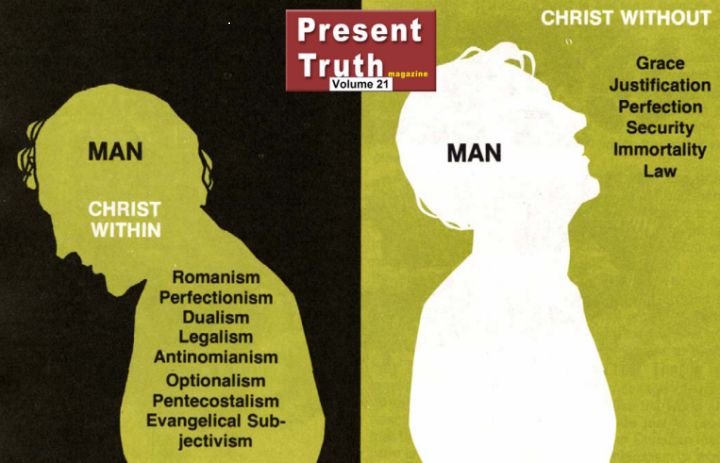
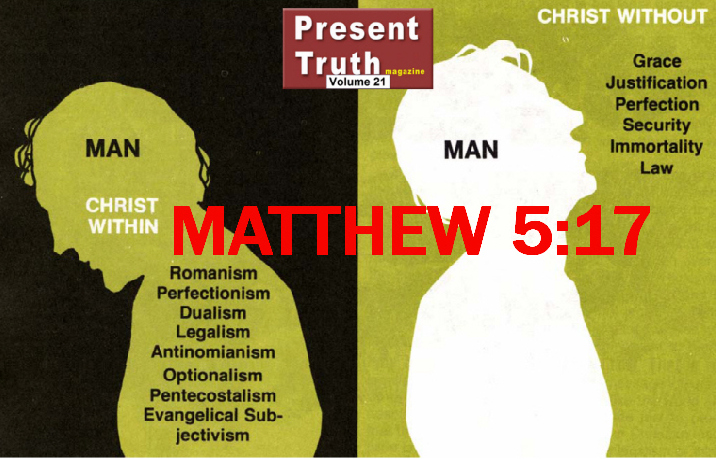
This is a Reformed illustration of the official Reformation gospel, the centrality of the objective gospel outside of us. Here is what Susan’s research has made clear to me: this is nothing more or less than a Platonist construct; period. This is predicated on the idea that matter is inherently evil and only spirit is the true, good, and the beautiful which is Plato’s trinity. That’s what this is. Man, being part of the material world, cannot have grace or goodness within him. And I quote:
When the ground of justification moves from Christ outside of us to the work of Christ inside of us, the gospel (and the human soul) is imperiled. It is an upside down gospel.
~ John Piper
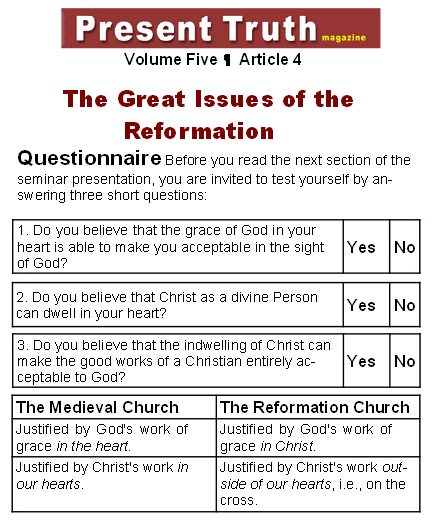
In our time we are awash in a “Sea of Subjectivism,” as one magazine put it over twenty years ago [see left man in illustration]. Let me explain. In 1972 a publication known as Present Truth published the results of a survey with a five-point questionnaire which dealt with the most basic issues between the medieval church and the Reformation. Polling showed 95 per cent of the “Jesus People” were decidedly medieval and anti-Reformation in their doctrinal thinking about the gospel. Among church-going Protestants they found ratings nearly as high.
~ John H. Armstrong
And here is an excerpt from the exact article Armstrong spoke of:
Whether the Medieval church believed the new birth aided us in finishing our justification is not the point. The point is that sanctification does not finish justification and the two or totally separate, but more on that later. I now want to address the aforementioned comment on Paul’s Passing Thoughts blog:
Perhaps you could give me an example of a Calvinist teaching that matter is evil in and of itself. What you say about law is true regarding Calvinists and Paul’s teaching except that Calvinists do believe that Jesus satisfied the Law’s righteous requirements so that the believer stands justified before the Law.
And this was my answer to the comment:
You just stated it yourself. Calvinists believe Jesus had to fulfill the law for us and not in us because we are of matter and not Spirit. Paul taught that the new birth enabled the righteous requirements of the law to be fulfilled in us in sanctification–and the law is abolished in regard to justification.
Of course, this is a direct reference to Matthew 5:17;
“Do not think that I have come to abolish the Law or the Prophets; I have not come to abolish them but to fulfill them.
THIS IS IT RIGHT HERE. The Calvinist interpretation of this passage equals the same as the two-man illustration. This has to be interpreted as Christ fulfilling the law for us while not abolishing it for justification. Abolishment pertains to justification; i.e., Christ didn’t come to abolish the law in regard to justification, and fulfillment is completely of Christ for that purpose. Because of the fundamental idea that the true, the good, and the beautiful cannot be united with evil and create good, this MUST be their view of law. It is of necessity within that construct.
But this is where interpreting the Bible in context of justification and sanctification is absolutely critical. Is Matthew 5:17 regarding justification or sanctification? Unless this distinction is made, the Bible contradicts itself. How so? Because in fact, the apostle Paul stated that Christ came to “end” the law:
Romans 10:4 – For Christ is the end of the law for righteousness to everyone who believes.
When one believes, they are no longer “under the law” ….for justification. In regard to justification, the law is abolished—it is no longer a standard for our justification:
Romans 3:19 – Now we know that whatever the law says it speaks to those who are under the law, so that every mouth may be stopped, and the whole world may be held accountable to God. 20 For by works of the law no human being will be justified in his sight, since through the law comes knowledge of sin. 21 But now the righteousness of God has been manifested apart from the law, although the Law and the Prophets bear witness to it— 22 the righteousness of God through faith in Jesus Christ for all who believe.
Romans 5:13 – for sin indeed was in the world before the law was given, but sin is not counted where there is no law.
So what was Christ saying when He said He didn’t come to abolish the law, but rather to fulfill it? He was talking about sanctification which by the way is the subject of the Sermon on the Mount. Justification by faith alone is nowhere to found in that sermon. The sermon is about how the Christian builds their life on a rock. So, in what way did Christ say He was going to fulfill the law? Let’s see:
Romans 8:3 – For God has done what the law, weakened by the flesh, could not do. By sending his own Son in the likeness of sinful flesh and for sin, he condemned sin in the flesh, 4 in order that the righteous requirement of the law might be fulfilled in us, who walk not according to the flesh but according to the Spirit. 5 For those who live according to the flesh set their minds on the things of the flesh, but those who live according to the Spirit set their minds on the things of the Spirit. 6 For to set the mind on the flesh is death, but to set the mind on the Spirit is life and peace. 7 For the mind that is set on the flesh is hostile to God, for it does not submit to God’s law; indeed, it cannot. 8 Those who are in the flesh cannot please God.
Christ came and died on the cross to release us from the law so that the law could be fulfilled in us….for sanctification. Another way of looking at this is that he came and died on the cross to destroy the works of the devil in us:
1John 3:8 – Whoever makes a practice of sinning is of the devil, for the devil has been sinning from the beginning. The reason the Son of God appeared was to destroy the works of the devil. 9 No one born of God makes a practice of sinning, for God’s seed abides in him, and he cannot keep on sinning because he has been born of God. 10 By this it is evident who are the children of God, and who are the children of the devil: whoever does not practice righteousness is not of God, nor is the one who does not love his brother.
Living a life of sin denies the very reason Christ went the cross. Ephesians gives us a good example of how this is applied:
Ephesians 4:19 – They have become callous and have given themselves up to sensuality, greedy to practice every kind of impurity. 20 But that is not the way you learned Christ!— 21 assuming that you have heard about him and were taught in him, as the truth is in Jesus, 22 to put off your old self, which belongs to your former manner of life and is corrupt through deceitful desires, 23 and to be renewed in the spirit of your minds, 24 and to put on the new self, created after the likeness of God in true righteousness and holiness.
By practicing righteousness (put on) we please God, love Christ, and fulfill the righteousness of the law in His service. By putting off the old us we serve Christ by destroying the works of the devil. But if obeying the law perfectly to maintain our just standing is the case, we are obviously out of the loop. Moreover, it combines the good with mortality which is anathema in the Platonist construct. Hence, in Calvinism, the law must remain as a standard to maintain a just standing. That makes righteousness within mortality impossible. This is the crux of the issue. True righteousness operating in imperfection is a metaphysical impossibility to the Platonist. But God has accomplished it by putting to death the mortal body we dwell in, abolishing the law for our justification, imputing our sin to Christ, and imputing His righteousness to us apart from the law. The old us died with Christ and cannot be judged, and the righteous seed of God dwells within us.
Let’s examine some of the answers to this that I received by Calvinists on the blog:
No, I was asking for an example of a Calvinist teaching that matter is evil in and of itself. Where does any Calvinist teach that Jesus had to fulfill the law for us because we are matter and not spirit? Now I even have questions about your statement that Paul taught that law is abolished in regard to justification. Where does he ever say the law is abolished in regard to justification?
In regard to the latter, we have answered that question. Paul stated plainly that we are justified APART from the law in many places. In regard to the former, it is like a wife-beater demanding to be shown in the Bible where it states specifically that he cannot beat his wife. It’s ludicrous. The principle can be seen in Calvinism’s “T” in T.U.L.I.P: total depravity. Look, I could once again cite the Calvin Institutes to make this point, but I think the following tweet from Tullian Tchividjian should suffice:
This mentality mimics Calvin precisely. Hence, my answer:
Calvin rejected the idea that any saint has ever done one righteous deed that pleased God (CI 3.14.9-11). Was he speaking of flesh or spirit? And if both are depraved, why would it make a difference?
I got this in reply:
Even those who believe in total depravity (whether in a regenerate or unregenerate state—most Calvinists would not subscribe to the idea that believers continue to be totally depraved in the same sense as are the unregenerate) do not believe the body is evil in and of itself.
And my reply:
In regard to you: we are all totally depraved, but not in the same way, and it doesn’t mean our bodies are inherently evil. Right. Typical Calvinist double speaking nonsense–you will not be wasting any more of my time. Post if you will, and get your jollies doing it–but they will not see the light of day here.
No matter what verbiage Calvinists use and what they seem to say, they must be brought back to the two-man illustration to give an account. In our day, the New Calvinist problem is a return of the exact same Gnosticism (which came from Platonism) that wreaked havoc on the first century church. This can be seen throughout the New Testament. New Calvinists like Paul David Tripp and CJ Mahaney call Christians, “enemies of God,” “God ignoring,” “we hate God,” etc., while the apostles stated the exact opposite:
Romans 15:14 – I myself am satisfied about you, my brothers, that you yourselves are full of goodness, filled with all knowledge and able to instruct one another.
The book of 1John is peppered with rebuttals that reflect a contention against the exact same things that the New Calvinists teach in our day. That is because John was contending against Gnosticism and that’s what the New Calvinists are. This will be clearly demonstrated at this year’s conference historically, doctrinally, and practically.
Therefore, the clear vision for the Potter’s House moving forward is a strong assertion that we are not only declared righteous, we are righteous. Our primary goals are aggressive sanctification in all areas of life, emphasis on doctrinal and theological training, and making disciples by teaching them all that the Lord commanded.
Because only truth sanctifies.
The Potter’s House 12/30/2012: Law and Grace; Romans Chapter 4

We now come to chapter four in our study of Romans. Thus far, Paul has emphasized that all men, whether Jew or Gentile, are saved by faith alone. This salvation is a revelation of God’s righteousness, and is imputed to us when we believe in Jesus Christ. We have learned that the gospel is the full counsel of God which of course includes the death burial, and resurrection of Christ. We have learned that Paul was very concerned with a spiritual caste system that would render the Gentiles as second-class citizens in the church. Though the church is uniquely Jewish, God shows no partiality in regard to race and gives the various gifts of salvation to all men freely.
What we have in the book of Romans is a radical dichotomy between justification and sanctification; or said another way, salvation and its imputed righteousness set against the Christian life as kingdom citizens living on earth as aliens and ambassadors. However, there is NO dichotomy between law and gospel. Why? Because both are the full counsel of God. In the Bible, “law,” “truth,” “gospel,” “Scriptures,” “holy writ,” “the law and the prophets,” and other terms are used interchangeably to speak of the closed canon of God’s full counsel for life and godliness. Christ as well as Paul made it absolutely clear: man lives by every word that proceeds from God and ALL Scripture is profitable to make the servant of God complete in every good work.
Now listen: though the life application of some Scripture changes with time and circumstances, it still remains that all Scripture informs us in regard to our walk with God in the way we pray, think, and act. We do not stone rebellious children in our day. Nay, when we have a rebellious teen in the church, we do not gather the congregation together and stone him/her to death. With that said, does the fact that God at one time instructed the Jews to do so inform us in regard to many applications for teen rebellion in our day? Absolutely. Oh my, the contemporary applications in our day are almost endless. Not only that, Old Testament ritual and symbolism offers a built-in protective hermeneutic for the Scriptures as a whole. What do I mean by that? Well, you can mess with words, but symbolism is very difficult to mess with. If it’s a lampstand, it’s hard to change that to a Honda Civic. Right?
Paul delves into a paramount truth for Christians in the book of Romans: The relationship of the law to the unsaved verses the saved. And here it is: the lost are UNDER the law, and the saved are UNDER grace, but informed by the law. Let me repeat that: the lost are UNDER the law, and the saved are UNDER grace, but informed by the law. And we can see this right in the same neighborhood of the text that we are in.
Romans 3:21—But now the righteousness of God has been manifested apart from the law, although the Law and the Prophets bear witness to it—
That verse pretty much says it all. We are justified apart from the law, and as we will see, Paul means totally apart from the law. But we are informed by it. Paul states in Romans 3:28:
For we hold that one is justified by faith apart from works of the law.
Now note what he states after a few verses following in Romans 4:3,
For what does the Scripture say?
Paul strives to make the point in this letter that law is not even on the radar screen in regard to justification. And this is extremely important to know in our day for many teach that law is on the justification radar screen and therefore Christ must keep the law for us in order to maintain our justification. Not so, there is no law to keep in regard to justification—a righteousness APART from the law, the very righteousness of God has been imputed to our account in full. Paul even writes (and this is very radical) that Christians are sinless in regard to justification because there is no law in justification to judge us:
Romans 7:1—Or do you not know, brothers—for I am speaking to those who know the law—that the law is binding on a person only as long as he lives?
Romans 7:6—But now we are released from the law, having died to that which held us captive….(v.8) Apart from the law, sin lies dead.
Now, the law can judge our sin in our Christian life, but that can’t touch the fact that we are “washed.” Therefore, in sanctification, we only need to wash our feet to maintain a healthy family relationship with our Father God and Brother, the Lord Jesus Christ. Turn with me and let’s look at this in John 13:1-11:
Now before the Feast of the Passover, when Jesus knew that his hour had come to depart out of this world to the Father, having loved his own who were in the world, he loved them to the end. 2 During supper, when the devil had already put it into the heart of Judas Iscariot, Simon’s son, to betray him, 3 Jesus, knowing that the Father had given all things into his hands, and that he had come from God and was going back to God, 4 rose from supper. He laid aside his outer garments, and taking a towel, tied it around his waist. 5 Then he poured water into a basin and began to wash the disciples’ feet and to wipe them with the towel that was wrapped around him. 6 He came to Simon Peter, who said to him, “Lord, do you wash my feet?” 7 Jesus answered him, “What I am doing you do not understand now, but afterward you will understand.” 8 Peter said to him, “You shall never wash my feet.” Jesus answered him, “If I do not wash you, you have no share with me.” 9 Simon Peter said to him, “Lord, not my feet only but also my hands and my head!” 10 Jesus said to him, “The one who has bathed does not need to wash, except for his feet, but is completely clean. And you are clean, but not every one of you.” 11 For he knew who was to betray him; that was why he said, “Not all of you are clean.”
Clearly, “washing” refers to salvation, and differs from needing the lesser washing of the feet. The example is set against the unregenerate betrayer among them. Note that Jesus said that even though we needed to wash our feet, we are still “completely clean.” My, my, what a strong contrast to much of the teachings in our day; i.e., the idea of “deep repentance” that is the same repentance that saved us and keeps us saved—as long as we are in a Reformed church where such forgiveness is available.
Secondly, this passage shows that the gratuitous pardon of sins is given us not only once, but that it is a benefit perpetually residing in the Church, and daily offered to the faithful. For the Apostle here addresses the faithful; as doubtless no man has ever been, nor ever will be, who can otherwise please God, since all are guilty before him; for however strong a desire there may be in us of acting rightly, we always go haltingly to God. Yet what is half done obtains no approval with God. In the meantime, by new sins we continually separate ourselves, as far as we can, from the grace of God. Thus it is, that all the saints have need of the daily forgiveness of sins; for this alone keeps us in the family of God (Calvin’s Commentaries, Vol. 45: Catholic Epistles).
So, Paul in chapter four, in his endeavor to get this into the heads of Christians, approaches it from another angle: the life of Abraham, the father of faith. This is so powerful. Again, you can fiddle with words in translation, but rearranging the order of Abraham’s biography would be a difficult endeavor and the order of his life from the Old Testament account solidifies what Paul is teaching here about justification:
Romans 4:1-8—What then shall we say was gained by Abraham, our forefather according to the flesh? 2 For if Abraham was justified by works, he has something to boast about, but not before God. 3 For what does the Scripture say? “Abraham believed God, and it was counted to him as righteousness.” 4 Now to the one who works, his wages are not counted as a gift but as his due. 5 And to the one who does not work but believes in him who justifies the ungodly, his faith is counted as righteousness, 6 just as David also speaks of the blessing of the one to whom God counts righteousness apart from works: 7 “Blessed are those whose lawless deeds are forgiven, and whose sins are covered; 8 blessed is the man against whom the Lord will not count his sin.
We had a fellowship last night and a brother pointed out a common problem among Christians; they often don’t know when something should be simply applied and not figured out. And this is one—faith declares us completely righteous and no sin will be counted against us. Justification is a gift. Righteousness is a gift. If the gift is righteousness and God says so, that is the end of the discussion. Unlike a gift, any kind of work in justification equals a wage that is due. Paul then deals with the issue of justification through circumcision (something we do):
9 Is this blessing then only for the circumcised, or also for the uncircumcised? For we say that faith was counted to Abraham as righteousness. 10 How then was it counted to him? Was it before or after he had been circumcised? It was not after, but before he was circumcised. 11 He received the sign of circumcision as a seal of the righteousness that he had by faith while he was still uncircumcised. The purpose was to make him the father of all who believe without being circumcised, so that righteousness would be counted to them as well, 12 and to make him the father of the circumcised who are not merely circumcised but who also walk in the footsteps of the faith that our father Abraham had before he was circumcised.
What Paul is saying is that God deliberately waited to have Abraham circumcised so that he would be the father of the uncircumcised as well as the circumcised. Also, to make the point that no ritual saves us whether circumcision or baptism, and followed by an attitude that we are justified accordingly by the ritual alone, and can hence live anyway we want to. As we have discussed previously in this study, an attitude of obedience is part and parcel with saving faith. Obedience and saving faith are two sides of the same coin. This is NOT so-called “lordship salvation,” but a statement regarding the fact that saving faith is not accompanied by a libertine attitude towards God’s full counsel, but rather a love for the truth. No obedience saves anybody, but saving faith is also endowed with a love for the truth with natural results following. However, as we will see later in this same book, the flesh is weak and faith alone does not carry the day in sanctification like it does in justification; so, many other factors come to bear in sanctification. This is where the sanctification by justification rave of our day is most unfortunate.
This is not the only place in Scripture where Paul uses the chronology of Abraham’s life to argue for righteousness completely separate from the law:
Galatians 3:15—To give a human example, brothers: even with a man-made covenant, no one annuls it or adds to it once it has been ratified. 16 Now the promises were made to Abraham and to his offspring. It does not say, “And to offsprings,” referring to many, but referring to one, “And to your offspring,” who is Christ. 17 This is what I mean: the law, which came 430 years afterward, does not annul a covenant previously ratified by God, so as to make the promise void. 18 For if the inheritance comes by the law, it no longer comes by promise; but God gave it to Abraham by a promise.
This is the foolishness of any idea that the law is still a standard for our justification and the law must be maintained by Christ in our sanctification, or that Christ’s life was for the purpose of imputing his obedience to our sanctification. The promise of justification by faith alone was ratified before the law ever came through Moses—430 years before. Why would Christ have to maintain a perfect keeping of a law that had nothing to do with the promise whatsoever? Hence, look at the perfect fit we have in Romans 4:13-15:
13 For the promise to Abraham and his offspring that he would be heir of the world did not come through the law but through the righteousness of faith. 14 For if it is the adherents of the law who are to be the heirs, faith is null and the promise is void. 15 For the law brings wrath, but where there is no law there is no transgression.
Again, no law, no transgression. Transgression is not absent in justification because Christ maintains the law for us in sanctification—there is no transgression to be counted against our justification because there is no law in justification period. It’s based on promise—not law. Christ came to die in order to fulfill the promise that was given 430 years before the law. And this brings us to a previous point. As some know, because of the focus of the particular ministry I am in, I use the ESV translation of the Bible. The ESV is a contemporary translation by New Calvinists and is their Bible of choice. Now note how Romans 4:16 is translated in the ESV:
That is why it depends on faith, in order that the promise may rest on grace and be guaranteed to all his offspring—….
“Depends” is a very interesting choice of words here. Actually, there is no merit at all for the use of that word in Romans 4:16. The word, or even that idea doesn’t appear in any interlinear, expanded translation, or manuscript such as the Received text, Majority text, or Critical text. But it does have merit in regard to the Reformed view of justification; i.e., maintaining our just standing requires a continuance of faith alone in sanctification. Our justification “depends” on that. “Depends” also hints of an ongoing or continual dependence.
Paul then concludes with a definition of this saving faith:
16 That is why it depends on faith, in order that the promise may rest on grace and be guaranteed to all his offspring—not only to the adherent of the law but also to the one who shares the faith of Abraham, who is the father of us all, 17 as it is written, “I have made you the father of many nations”—in the presence of the God in whom he believed, who gives life to the dead and calls into existence the things that do not exist. 18 In hope he believed against hope, that he should become the father of many nations, as he had been told, “So shall your offspring be.” 19 He did not weaken in faith when he considered his own body, which was as good as dead (since he was about a hundred years old), or when he considered the barrenness of Sarah’s womb. 20 No unbelief made him waver concerning the promise of God, but he grew strong in his faith as he gave glory to God, 21 fully convinced that God was able to do what he had promised. 22 That is why his faith was “counted to him as righteousness.” 23 But the words “it was counted to him” were not written for his sake alone, 24 but for ours also. It will be counted to us who believe in him who raised from the dead Jesus our Lord, 25 who was delivered up for our trespasses and raised for our justification.
Herein we have a definition of saving faith: it has a stubborn trust in the promises of God regardless of life circumstances. It hopes in God regardless of the hopeless motif continually posited by the world. And, Abraham grew in faith as he gave glory to God. What’s that mean? We have a clue from Matthew 5:14-16;
14 “You are the light of the world. A city set on a hill cannot be hidden. 15 Nor do people light a lamp and put it under a basket, but on a stand, and it gives light to all in the house. 16 In the same way, let your light shine before others, so that they may see your good works and give glory to your Father who is in heaven.
We are all saved and justified with an initial faith that varies according to the grace of God (Romans 12:3), but certainly, our faith in sanctification grows as we exercise it through obedience while giving glory to God. Obedience demonstrates trust. Applying God’s truth to our life demonstrates that we believe that He knows best and blessings will result. Peter said that we should be diligent to “add to our faith” (2Peter 1:5-11). Faith is a gift that justifies us once, and for all time with the very righteousness of God. But we participate in the growth of our faith through application of the full counsel of God. This is what the book of James is about (see James 1:25), and only one example among many in holy writ.
Of course, the life of Christ was very awesome for many reasons, but His life was not for the purpose of obeying the law perfectly so that His obedience to the law could be imputed to us in sanctification for the purpose of maintaining our just standing. The law is not the standard for maintaining justification; it is finished. Christ was the only Man ever born into the world under the law who could be the perfect sacrifice required by God. All others born under law are under its curse and provoked to sin by it. But note the last verse here in chapter four:
23 But the words “it was counted to him” were not written for his sake alone, 24 but for ours also. It will be counted to us who believe in him who raised from the dead Jesus our Lord, 25 who was delivered up for our trespasses and raised for our justification.
Paul states that our justification came through Christ’s resurrection, not His life. The Reformed construct of Christ living for our sanctification and dying for our justification is simply nowhere to be found in Scripture, and if it is, as with a myriad of other textual examples, Paul fails to mention such a crucial fact in these last verses.

The Potter’s House 12/16/2012: “False Reformation” Published; Romans Study Resumes Next Sunday
I am sooooo glad “False Reformation” is now published. We will resume our study in Romans this Sunday. We will be breaking into chapter 3, and the major theme of this chapter is the law/gospel issue that is addressed in detail throughout False Reformation.
Much of the book was inspired by what I have learned in Romans which has shown me why Calvinism is fundamentally a blatant false gospel. Election/freewill isn’t even the issue at all—a gospel that teaches us to live out our sanctification in an antinomian way in order to keep our salvation is the issue. If you have to do anything to keep your salvation—it’s works—you have to do something to keep it. That includes “resting and feeding.” Even if your “resting” is supposedly not a work—it most certainly is if it’s a condition to keep your salvation.
I look forward to resuming Romans next week, starting in 3:1.
Click on this link for preview of False Reformation: False Reformation PREVIEW
paul
Today’s Christian Husband and Father: Killing His Family with Awesome Preaching
 Bob is on his way to Jerry’s house for dinner. Bob is the chairman of their church’s elder board. Jerry is being considered for eldership and Bob will be dining at his house for a pre-interview en lieu of further discussion. Pizza is the cuisine. And apparently, not just on this night—Bob notes that every trashcan in the house is stuffed with pizza boxes. Dishes full of M & Ms also adorn many of the table tops. Bob is taken to the kitchen by Jerry to meet his wife, and Bob perceives no less than twenty-five bags of potato chips staked about in various places. One corner of the kitchen is occupied with a tall stack of Coca-Cola 12packs. Big on taste—small in nutrition. Precious few will disagree that Bob’s family is headed for serious health problems if they do not change their ways. Yet, Bob is a picture of how the vast majority of Christian husbands oversee the spiritual diets of their families. However, the “Bob” motif falls woefully short of making the point; at least Bob knows what his family is eating for better or worse. Christian husbands of our day don’t even know the difference between Redemptive Historical hermeneutics and Grammatical Historical hermeneutics. In fact, when the subject comes up, a rolling of the eyes follows. That’s because the preaching/teaching is awesome where they go to church. Uncompromising, and God glorifying. As one pastor exhorted me when inquiring about what hermeneutic he used in his preaching: “Come and see if it tastes good, and if you still want to, we will talk about theology.” But I never doubt it will taste good. Who doesn’t love pizza for dinner, potato chips as a side, Coke to drink, and M&Ms for desert? Fact is, nearly 90% of preaching/teaching in today’s American church is fundamentally based on Luther’s Heidelberg Disputation. This document is the very heart of the Reformation and the engine that drives the present-day New Calvinist movement. Its premise was based on the idea that all spiritual reality, wisdom, and truth comes from the combination of two perspectives, and only these two: the holiness of God, and the wretchedness of all men whether they are Christians or not. Luther called this perspective the “theology of the cross.” It has come to be known as Gospel-Centered preaching/teaching. It is also the foundation of the Calvin Institutes. Everything in the Calvin Institutes, in some way, points to the glory of God “as set against our sinfulness.” This has become job one: as described in the Heidelberg Disputation; this way of teaching is the “cross story,” and all other spiritual wisdom is the “glory story.” Hence, the contemporary clarion call of the Reformation derived from Luther’s Disputation is, the centrality of the objective gospel outside of us. Anything at all that has anything to do with us is “subjective,” and part of the “glory story.” Unless it concerns our wretchedness. Therefore, the Disputation ridiculed a negative attitude towards suffering as well for this serves to further reveal our woeful state in life which magnifies the redemptive work of Christ and our utter worthlessness. The whole motif can be visualized by the following Reformed chart:
  Yes, you can preach wonderful sermons on those two dimensions. They are both abundantly true. Charles Spurgeon is known as the “prince of preachers.” All of his sermons are based on the “cross story.” All, I repeat “all” of John Piper’s sermons and the (seems like) 600 books he has written are based on nothing but, I repeat, nothing but the “cross story.” Amen, pass the potato chips. In circa 1994, John MacArthur abandoned the “glory story” aspects of his preaching and now focuses on the “cross story.” Amen, pass the M&Ms. And those babies slide down nice with a big swig of Coca-Cola. “But Paul, what’s so sweet about focusing on our own wickedness?” My dear friend, haven’t you seen any Staples commercials? It’s easy. You totally stink. Nothing is expected of you: “Hey honey! Good news! We don’t change! Our marriage isn’t about a bunch of do’s and don’ts! Our failures make us wiser!” That was easy. In fact, teachers like Michael Horton and John Piper continually espouse the idea that expectations are just, “more bad news.” And regarding leaders? “Alright, time to prepare my message for tomorrow, and all I have to do is look for two things, and two things only in the text: how great God is, and how bad we are.” That was easy. In fact, we find the following on a well-known Reformed blog regarding instruction on how to prepare a Bible lesson:
At this time, resist the temptation to utilize subsequent passages to validate the meaning or to move out from the immediate context. Remembering that all exegesis must finally be a Christocentric exegesis. Look for Christ even if He isn’t there directly. It is better to see Christ in a text even if He isn’t, than to miss Him where He is.
But as the apostle asked rhetorically, “What saith the Scriptures?” Is there another story other than the “cross story”? Anybody interested in the House on a Rock story?
Matthew 7:24 -“Everyone then who hears these words of mine and does them will be like a wise man who built his house on the rock. 25 And the rain fell, and the floods came, and the winds blew and beat on that house, but it did not fall, because it had been founded on the rock. 26 And everyone who hears these words of mine and does not do them will be like a foolish man who built his house on the sand. 27 And the rain fell, and the floods came, and the winds blew and beat against that house, and it fell, and great was the fall of it.”
Learn and do. That’s how we have a life built on a rock. It is the very definition of a disciple:
Matthew 19 – Go therefore and make disciples of all nations, baptizing them in the name of the Father and of the Son and of the Holy Spirit, 20 teaching them to observe all that I have commanded you. And behold, I am with you always, to the end of the age.”
So, here is my suggestion. When you go to church this Sunday, and other days following that involve sitting under the teachings of your leaders, take a legal pad with you. Draw a line at a downward angle on the bottom labeled, “our sin.” Draw a line at the top with an upward angle, and label it “Christ.” Then draw a line in the middle and label it, “What? Why? And How?” Or, “Not only what Jesus did, but what did He SAY?” Or simply, “Life built on a rock.” If there isn’t a three-dimensional balance—get out of there. You either love your family or you don’t. You will be judged by Christ accordingly. I was approached by my wife Susan this morning. My son by marriage had approached her asking questions about demonology. Apparently, he had questions concerning some things he had heard about the subject in the secular realm. I was astonished; though both of them have been in church for a combined total of 72 years, they didn’t even know the basics regarding this subject. My wife wanted to know the answers to his questions—other than the usual answers: “Jesus” and “gospel.” And if we don’t know, the world will gladly inform our children accordingly. Knowledge equals authority. Men, wake up. paul

 Paul's Passing Thoughts
4 comments