Prophesy and the Gospel

Scripture References: Matthew 5:9, 10:23, 24:11-14, Luke 21:10, 1Thessalonians 5:3.
Calvinism and the Problem with Perfection
 Originally published November 7, 2013
Augustine, Luther, and Calvin were first and foremost Platonists. They integrated the Bible with Platonism. Plato’s theory of forms posits the idea of two worlds; the mutable material world of illusion where reality can only be partially known, and another world where the immutable objective true forms exist. This material world is a shadow world; everything is shadows of the true forms. Therefore, man can only interpret and experience this world subjectively. The tendency is to interpret reality by observing the shadows. To the degree that mankind thinks the material world is reality according to the five senses, subjectivity and chaos will abound.
Therefore, Plato’s ethic was to improve the subjective experience of this life by accessing the true forms through ideas and mathematics—things that transcend the five senses (he believed math was an unchangeable rule and therefore not part of the shadow world). He believed that those who have the capability and willingness to bring more understanding of the objective into the subjective to be an elite minority. These were Plato’s philosopher kings whom he thought should rule society in order to decrease chaos as much as possible. Without philosopher kings, the world would be awash in a sea of subjectivity, everyone living by their own subjective presuppositions based on the shadows of this world. Hence, the arch enemy of the Platonic ideal is individualism.
Plato’s world of true objective forms was his trinity of the true, good, and beautiful. Experiencing the pure form of goodness in this world is impossible—only a shadow of good can be experienced subjectively. Plato’s social engineering has a doctrine, and to the degree that doctrine is applied, a higher quality of subjective existence occurs.
The Reformers put a slightly different twist on this construct. There is no doctrine to apply, only an orthodoxy that focuses on seeing and experiencing. Their version of Plato’s philosopher kings are pastors who possess the power of the keys. Orthodoxy is mediated truth determined by “Divines,” and passed down to the masses for the purpose of experiencing the objective power of the gospel subjectively. The Reformers made the true forms “the gospel,” and reality itself the gospel; ie., the work and personhood of Jesus Christ in particular.
Therefore, in the same way Plato envisioned a society that experiences the power of the true forms subjectively through ideas and immutable disciplines like mathematics; the Reformers sought a heightened subjective experience through a deeper and deeper knowledge of their own true, good, and beautiful—the gospel. And more specifically, instead of the gateway of understanding being reason, ideas, and immutable disciplines, they made the gospel itself the interpretive prism. So: life, history, the Bible; ie., everything, is a tool for experiencing true reality (the gospel) in a higher quality subjectivity. The Bible and all life events are a gospel hermeneutic. Salvation itself is the interpretive prism. All of reality is about redemption. Salvation itself is the universal hermeneutic.
But both constructs have this in common: pure goodness and perfection cannot exist objectively in the material world. This is where Calvinism and Platonism kiss. The Bible only agrees with this if it is a “gospel narrative.” But if it is God’s full orbed philosophical statement to all men to be interpreted grammatically and exegetically, contradictions abound. To wit, if man possesses goodness and the ability to interpret reality objectively, Platonism and its Reformed children are found wanting. If Reformation orthodoxy is not evaluated biblically with the very theses of its own orthodoxy as a hermeneutic, even more wantonness is found.
The Apostles rejected Platonism because they believed goodness and perfection could indeed be found in this material world. There is no question of the quality of goodness inside of man that enables mankind to interpret reality objectively, the quantity of goodness notwithstanding. In contrast, a dominate theme in the Calvin Institutes is the idea that no person lost or saved can perform a good work. Like Plato’s geometric hermeneutics, the Reformers believed the Law lends understanding to man’s inability to do good because eternal perfection is the standard. The best of man’s works are tainted with sin to some degree, and therefore imperfect. Even if man could perform one perfect work, one sin makes mankind a violator of the whole law. The Reformers were adamant that no person could do any good work whether saved or lost.
Why all the fuss over this point? Why was Calvin dogmatic about this idea to the point of annoyance? Because he was first and foremost a Platonist. The idea that a pure form of good could be found within mankind was metaphysical heresy. Because such contradicts every page of the Bible, the Reformers’ Platonist theology was made the hermeneutic as well. Instead of the interpretation method producing the theology, they made the theology the method of interpretation. If all of reality is redemptive, it must be interpreted the same way.
For the Platonist, the coming of Jesus Christ in the flesh poses a huge problem. He is the truth. He came to the material world in a material body. Platonism became Gnosticism and wreaked havoc on the 1st century church. Notice how the first sentences of 1John are a direct pushback against the Gnosticism of that day:
1John 1:1 – That which was from the beginning, which we have heard, which we have seen with our eyes, which we looked upon and have touched with our hands, concerning the word of life— 2 the life was made manifest, and we have seen it, and testify to it and proclaim to you the eternal life, which was with the Father and was made manifest to us— 3 that which we have seen and heard we proclaim also to you, so that you too may have fellowship with us; and indeed our fellowship is with the Father and with his Son Jesus Christ. 4 And we are writing these things so that our joy may be complete.
Christ is the true, good, and beautiful, and He was touched, felt, seen, heard, and understood. Game over. This is the paramount melding of Plato’s two worlds resulting in a plenary decimation of his philosophy. Nevertheless, Calvin et al got around that by keeping mankind in a subjective realm while making the material world a gospel hermeneutic. Reality still cannot be understood unless it is interpreted by the gospel—everything else is shadows.
Martin Luther took Plato’s two worlds and made them two stories; our own subjective story, a self “glory story” that leads to a labyrinth of subjectivism, or the “cross story” which is the objective gospel. Luther made Plato’s two worlds two stories, but still, they are two realms; one objective and one subjective. In the final analysis mankind is still incompetent, and void of any good whether saved or lost.
Whether the Reformed gospel or Platonism, the infusion of objective goodness is the heresy. Man cannot have any righteousness in and of himself, whether lost or saved. The pushback against this idea can be seen throughout the New Testament. A few examples follow:
1John 2:4 – Whoever says “I know him” but does not keep his commandments is a liar, and the truth is not in him, 5 but whoever keeps his word, in him truly the love of God is perfected.
1John 2:20 – But you have been anointed by the Holy One, and you all have knowledge.21 I write to you, not because you do not know the truth, but because you know it, and because no lie is of the truth.
1John 2:26 – I write these things to you about those who are trying to deceive you. 27 But the anointing that you received from him abides in you, and you have no need that anyone should teach you. But as his anointing teaches you about everything, and is true, and is no lie—just as it has taught you, abide in him.
1John 2:29 – If you know that he is righteous, you may be sure that everyone who practices righteousness has been born of him.
1John 3:2 – Beloved, we are God’s children now, and what we will be has not yet appeared; but we know that when he appears[a] we shall be like him, because we shall see him as he is. 3 And everyone who thus hopes in him purifies himself as he is pure. 4 Everyone who makes a practice of sinning also practices lawlessness; sin is lawlessness. 5 You know that he appeared in order to take away sins, and in him there is no sin. 6 No one who abides in him keeps on sinning; no one who keeps on sinning has either seen him or known him. 7 Little children, let no one deceive you. Whoever practices righteousness is righteous, as he is righteous.
Romans 15:14 – I myself am satisfied about you, my brothers, that you yourselves are full of goodness, filled with all knowledge and able to instruct one another.
Christians can know goodness, and perform righteousness objectively. This speaks to the quality of the righteousness when it is performed—it is perfect and acceptable to God. We are not limited to a mere subjective experience in regard to righteousness. When we are resurrected, the quantity thereafter will be 100%, but our present righteousness is acceptable to God when it is performed by us. If it is accepted by God, it is perfect.
Even the unregenerate know good, and can perform it. The works of the law are written on their hearts, and their consciences either accuse or excuse them (Romans 2:12-15). Though enslaved to unrighteousness, they are free to perform righteousness (Romans 6:20). The very goodness of God can be understood from observing creation as well (Romans 1:20).
The only way the Reformers can make all goodness outside of man is to make the Bible a salvation hermeneutic. It is the only way they could integrate the Bible with their Platonist philosophy.
Romans 13:11 | What’s in the Word, “Saved” Part 1: A Salvation Paradigm
Originally published March 19, 2014

“You were purchased and the sale is final. Christ did not purchase you on a Reformed installment plan. We wait for redemption when Christ comes to claim what He purchased.”
“Moreover, if justification and sanctification are not separate, and are the same thing the Bible must be interpreted through the prism of justification only and in fact that is the very interpretive craze of our day; i.e., every verse in the Bible is about Jesus. Unfortunately, this would not explain the interpretive dichotomies of the Bible and would instead make them contradictions. There are many, many examples of this throughout the Bible, but the primary one is works. On the one hand, the Bible continually calls for faith alone without works, but on the other hand, it also calls for vigorous labor and obedience to the law. How can these be reconciled? Answer: some verses are talking about justification while others are talking about sanctification. If justification and sanctification are not separate, the Bible is nothing more than a book of confusion.”
Click to enlarge illustrations if needed.
I am very happy that we have arrived at Romans 13:11 because what Paul states here is the source of much misunderstanding in our day. As a pastor, I have said it: “We were saved, are being saved, and will be completely saved.” What was I thinking when I used to say things like that? I really don’t know. But isn’t that what Paul is saying here in Romans 13:11?
Besides this you know the time, that the hour has come for you to wake from sleep. For salvation is nearer to us now than when we first believed.
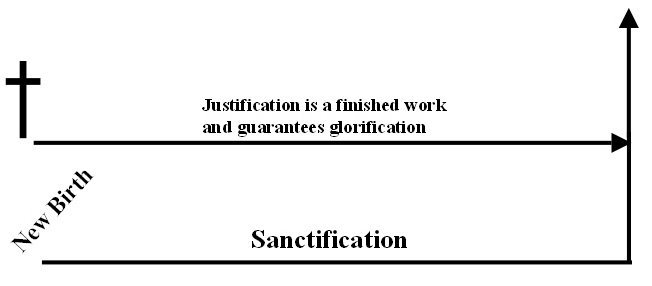
Paul seems to be saying what I used to say: our original salvation culminates into a final salvation. At TANC LLC, our research institute, we call that the “linear gospel.” In Reformed circles it is called the “golden chain of salvation.” Now listen, this is a really big deal. One must choose between the linear gospel and the parallel gospel. Let’s look at the illustrations below:
Illustration A

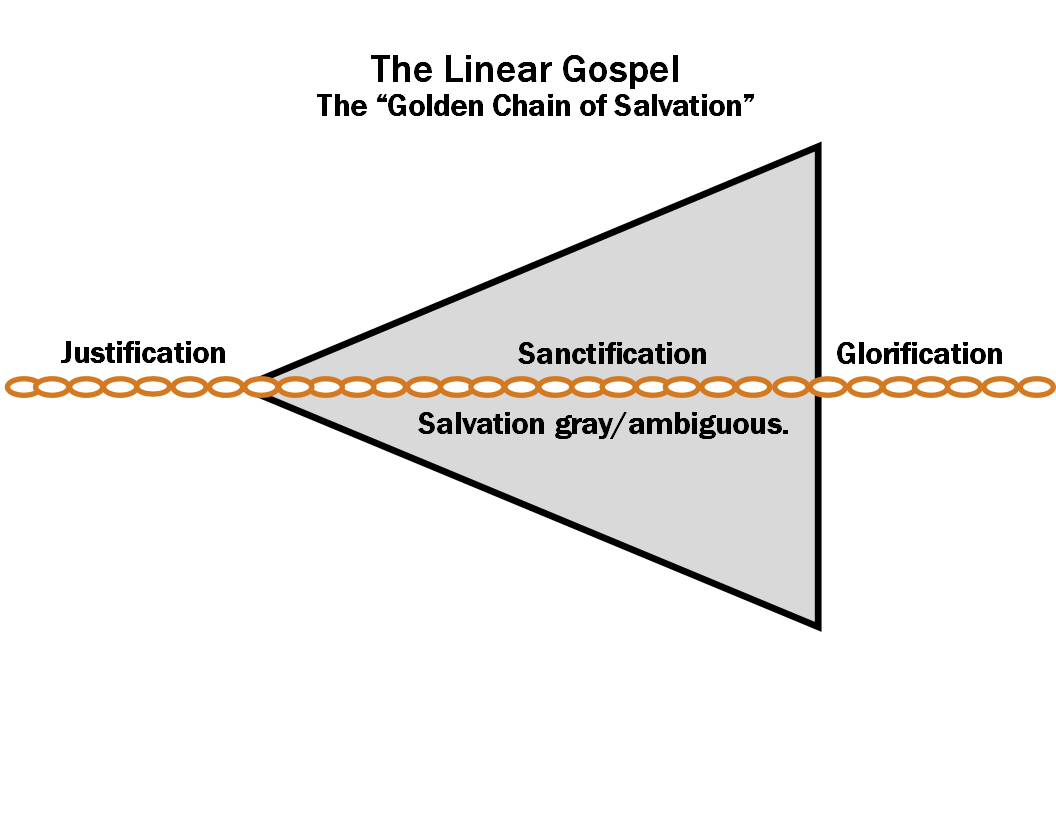
Illustration B
I have been making these illustrations for some time, and was surprised to find the following like-illustrations in the archives of the Australian Forum, the reformed think tank that spawned the present-day neo Calvinist movement:
Illustration C
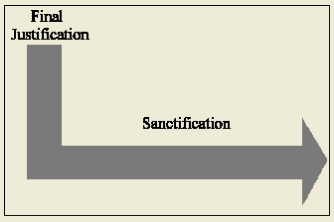
Illustration D

Illustration E
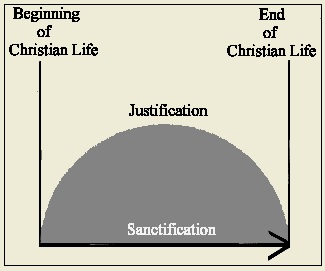
The Australian forum used these illustrations to convince the church that the true gospel of the Reformation had been lost. These illustrations were key in clarifying what the Reformers really believed. And, though the recent Neo-Calvinist movement parrots much of the Forum’s dialect and other illustrations to teach authentic Reformed doctrine, they avoid these illustrations like a plague. Why? Because these concepts are the most clarifying, and what was used to clarify can also be used to refute the same doctrine.
I agree with the Forum, my illustration B and their Illustration C was the model that the church, for the most part, was teaching when the Australian Forum showed up in 1970 (Hereafter: AF). Don’t get me wrong, I don’t think the church was applying the model, but it is what they held to. They were actually functioning like model A and E.
Model A combines salvation with the Christian life. That may sound like a statement in regard to the obvious, but it really isn’t. When someone asks us if we are saved, we say yes, but the answer is in regard to models B and C. We were saved, so we are now saved. It was a onetime permanent act. Valerie, the family dog was born in the past, but her dogness is permanent. Valerie is not in the process of becoming a complete dog, she is a dog, she is perfect dogness. The AF would agree with my assessment here. Note in model C that justification is “finished.” When Valerie was born, her doghood was finished. Valerie will now start acting like a dog because that is her nature.

Not so with the Reformed models A and E. If someone asks a Reformed person if they are saved, they most say, “already—not yet” which is the nomenclature of an official Reformed doctrine. It means that one is in the process of BEING saved—their complete salvation is future. Again, the AF would have agreed with this assessment. Note the following illustration published by them:
Illustration F
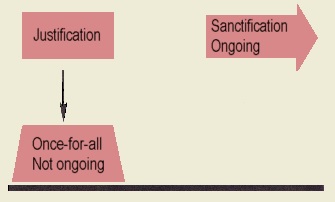
I would also like to use their illustration to make a point. They, in representing the Reformed view take issue with justification being finished. They believe it is ongoing, but look what they call it: “sanctification.” Why wouldn’t they call it “ongoing justification”? Normally, the term for the Christian life is progressive sanctification, but Reformed theologians stay well clear of the term progressive justification. The only exception is in the Calvin Institutes (3.14.title). At issue is what they illustrate with model E—justification and sanctification are combined. Salvation is a progression and worse yet, we are in the midst of the progression. That means we can mess up the progression, this is an unavoidable inference, and is indeed an element of Reformed thinking.
This is where I want to make a point about illustration D. The AF, like all of the Reformed, refutes this model as Christ plus something. Salvation only covers past sins, but we have to do something in our sanctification to maintain our righteous standing. In both models justification (salvation) is not finished, but the Reformers say that is ok for their model because justification is finished by justification.
But yet, this is the problem with all linear gospels like model A: we are in the middle of the process, so the question must be answered; “what is our role?” And that very question is a huge problem because mankind has NO role in being justified. No man other than Christ could pay the penalty for our sins. However, the Reformed answer is, “The Vital Union.” Basically, it is ok for us to be in the midst of the unfinished justification process because we participate in the same way that we were saved; viz, by faith alone. So models A, D, and E are the same thing, but the Reformed say that is ok for their model because it is Christ plus faith alone in Christ. In order to keep justification moving along properly, we must live our lives by faith alone.
Personally, I contend that if we have ANY role in our salvation other than the decision that brought the death of the old us and the birth of a new us, that’s works salvation by doing nothing with intentionality. In fact, it’s called abstaining and that’s a verb. Salvation by Christ plus doing nothing is still model D. Calvinist Tullian Tchividjian wrote a book titled Jesus plus nothing equals everything, but in a linear gospel where justification and sanctification are fused together, IT’S IMPOSSIBLE TO DO NOTHING because doing nothing is something. The only way that we can do nothing is if …
1. The work itself is finished. You can’t do anything to finish a finished work.
2. You are not present to do anything. The work is not located in your realm of operation.
This requires a discussion regarding the separation of justification and sanctification which is anathema to the Reformed thinker. They say, “Justification and sanctification are never separate, but distinct.” However, because of the terms used by Scripture, the Reformers are forced to do something with sanctification, especially in light of 1Thess 4:3,4, so the progression of justification falls under the auspices of progressive sanctification. This brings us back to illustration F. If Valerie, a dog, specifically a beagle, is justification, why would we call her something different because she gets up and starts walking? Is that cause to call her a duck? Indeed, a Valerie sitting is “distinct” from Valerie walking, but does that make her something other than a dog? If Calvin himself spoke of justification as being progressive in the title of chapter 14 | book 3, and that in fact is what you deem it to be, why not call it progressive justification and be done with it?
We hold that justification is a finished work and completely separate from the Christian life. Model B is the ONLY “plus nothing” model because you cannot add to a finished work nor can you work on something that is otherworldly. Christ came to finish a work that we cannot touch. Justification declares that the law that would judge us has no jurisdiction over us. Our sanctification comes from the regeneration of the new birth, not the finished work of justification. This was the rhetorical question that Paul asked of the Galatians:
3:2 – this only do I wish to learn from you—by works of law the Spirit did ye receive, or by the hearing of faith?
3 so thoughtless are ye! having begun in the Spirit, now in the flesh do ye end?
(YLT).
In other words, after receiving the Spirit, do you finish a finished work by circumcision? Note the previous verse:
3:1 – O thoughtless Galatians, who did bewitch you, not to obey the truth—before whose eyes Jesus Christ was described before among you crucified? (YLT).
Christ’s death on the cross finished the work of justification.
But doesn’t Paul say that our salvation is future? The question is salvation from what? We know it is not salvation from sin that would condemn us for sin is not counted where there is no law (Rom 4:15, 5:13) and Christ put an end to the law (Rom 10:4). However, it is clear that the world will be judged by the law (Rom 3:19, 20). It is not salvation from sin that would condemn us.
While the believer is born again and truly righteous, we must carry around the old us that was crucified with Christ. The things Christ died for are still with us (2Cor 4:7-18). As Christians, we await a deliverance from this body of death. (Rom 7:25). Clearly, salvation from condemnation is finished (Rom 8:34), salvation from the sin that condemns is past and complete, but there is left a salvation from sin that harasses us daily. If the gospel is linear, and justification is not finished, Paul is speaking of a future salvation from condemnation—we reject that idea with prejudice, Paul is talking about the other salvation from the sin of our mortality.
The Bible also refers to that as redemption. Remember last week and our discussion of the exchange of slavery? We were purchased from the other slave owner by the blood of Christ (1Cor 6:19,20, 7:22,23), and Christ will one day return to redeem His purchase (Gal 3:13, Luke 21:28). In the linear model, there can be no exchange of slavery because we are not finally free till the end. Neither is there an exchange of law because faith only is required to maintain the “vital union” that keeps our original justification moving forward.
Moreover, if justification and sanctification are not separate, and are the same thing the Bible must be interpreted through the prism of justification only and in fact that is the very interpretive craze of our day; i.e., every verse in the Bible is about Jesus. Unfortunately, this would not explain the interpretive dichotomies of the Bible and would instead make them contradictions. There are many, many examples of this throughout the Bible, but the primary one is works. On the one hand, the Bible continually calls for faith alone without works, but on the other hand, it also calls for vigorous labor and obedience to the law. How can these be reconciled? Answer: some verses are talking about justification while others are talking about sanctification. If justification and sanctification are not separate, the Bible is nothing more than a book of confusion.
The linear gospel also leads to all sorts of confusing doctrines that make doing nothing in our Christian life feasible. One is double imputation. This is the belief that Christ died for our justification and lived a perfect life of obedience for our sanctification. That way, Christ’s perfect obedience to the law is imputed to our Christian life as we live by faith alone.
Illustration G
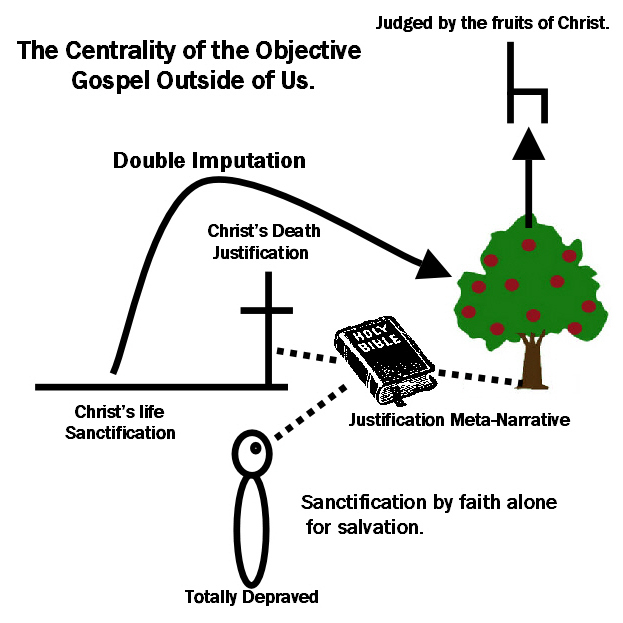
This Reformed doctrine also makes law the standard for justification in regard to Christians. Since perfect adherence to law remains the standard, but Christ fulfilled and keeps it for us, neither is an exchange of law needed in salvation as we discussed last week—the relationship to the law doesn’t change.
This results in an attempt to reduce sanctification to a mere “awareness” or “experience” with all kinds of mystic doctrines following of which there is no shortage in Reformed circles. An excellent example is the following excerpt from a sermon I heard recently:
Years ago, there was a pastor named Ichabod Spencer, and he was talking to a young student who was convicted of a sin and wasn’t a believer but wanted to come to Christ. And he wrote of the conversation, and it’s in a book called Pastoral Sketches, and Ichabod Spencer’s section in there has this conversation. And it’s fascinating because it’s called “I Can’t Feel.” Listen to this interchange. Ichabod Spencer said,
“I don’t know, my dear sir, what more can be said to you. I’ve told you all that I know. Your state as a sinner, lost, exposed to the righteous penalty of God’s law and having a heart alienated from God and the free offer of redemption by Christ, I’ve told you those things, and your instant duty to repent of sin and give up the world and give God your heart and the source of your help through the power of the Holy Spirit assured to you if you will receive Christ.” In other words, self-empty, and believe it, all these things have become as familiar to you as household words. What more can I say? I know not more what there is to be said.” He said, “I cannot read your heart. God can. And you can by his aid. Some things you’ve said almost made me think you a Christian, and other things again have destroyed that hope. I now put it to your own heart. If you’re not a Christian, what hinders you?”
And he thought for a moment, and he said, “I can’t feel.” “Well, why didn’t you tell me this before?” He said, “I never thought of it before, sir.” “Well, how do you know this hinders you?” “I can’t think of nothing else. I’m sure I shall never be converted to God if I have no more feeling than I have now. That is my own fault. I know you can’t help me.” And he said, “No, sir, I cannot, nor can you help yourself. Your heart will not feel at your bidding.” “What then can I do?” said he with much anxiety. “Come to Christ now. Trust him. Give up your darling world. Repent so inequity shall not be your ruin.” Well, he seemed perplexed, annoyed, vexed. And with an accent of impatience such as I had never witnessed in him before, he replied, “That is impossible. I want the feeling to bring me to that, and I can’t feel.”
And Spencer said, “Hear me, sir, and heed well what I say. I have several points. Number one, the Bible never tells you you must feel, but you must repent and believe. Number two, your complaint that you cannot feel,” listen to this, “is just an excuse by which your wicked heart will justify you for not coming to Christ now.”
First of all, this idea that we cannot command our feelings is something that I hear often and is not biblical. The apostle Paul instructed us to keep a clear conscience before God. Elsewhere, we find that our consciences either accuse us or excuse us. We all know how bad we feel when our consciences accuse us; therefore, we may assume that the opposite is true when we do right. We are also instructed by Paul as well to make it our goal to please God; certainly, a feeling of accomplishment can be expected here as well.
Clearly, we can command our feelings by doing what is right. In contrast, the above dialogue is the result of the linear gospel where an act of grace must precede all feelings. Again, if we are in the middle of a process that saves us, and we are good Reformed thinkers with faith alone always in the forefront, we must only believe and merely be a witness to “grace.” Can you see this in the above dialogue? Only believe is the exhortation of the pastor, and we cannot command our feelings anyway.
In contrast, this young man isn’t going feel any different UNTIL he makes a decision to follow Christ. Why? Because he is under judgment! When you are under law, all that awaits you is a fearful judgment under the law. Why would he feel any different until he is no longer under threat of judgment? This would have been my counsel to this young man. At the very least, the vacancy of fear and the knowledge that you are going to spend eternity in heaven will produce good feelings on some level.
Yes, this leads into all kinds of Reformed wackiness that I believe shuts up the door of heaven to many. I myself know of a young man that wouldn’t make a commitment to Christ because he was yet to see Christ as a “treasure chest of joy.” This all speaks to the Reformed concern that man is able to make an intellectual decision that is part of the salvation process. Yea, we must have some kind of sign that we were enlightened first before we make the decision. But why would it be delight? What of a fear of judgment that we know we deserve?
The fact that the aforementioned young man was vexed and in turmoil is a sure sign from heaven that he understand that he is under the law. Good grief! Lord come quickly and deliver us from this ignorance dressed in academic garb! Remember what we have learned previously in this Romans study? Our service to God is a what? Right, “reasonable service.” Remember what that word means? It means “rational.” My father was an intellectual who always had an interest in God throughout his whole life, but in the end, he assured me that he had made a personal commitment to Christ. But be sure of this, my dad would not have made a commitment to mystic nonsense coming from the Reformed crowd. The decision to be saved is a rational decision, and our service to Christ is rational.
“Just believe” is no answer, we must tell people WHY they mustn’t wait on a feeling. It is because feelings follow thinking and doing. For the most part, feelings are a choice. What do you do if you feel unsafe? You make a decision to change your circumstance to something safer, and then you feel safer. My friends, this is hardly rocket science.
But this can now bring us to another consideration of linear versus parallel—that of end times. The linear gospel can only speak of one final judgment where the children of God are “manifested.” If you look at the parallel gospel, it supplies the possibility of two judgments. Note the illustration below:
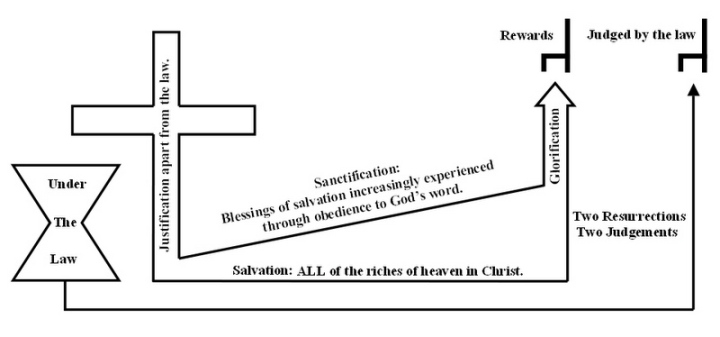
What comfort is there in thinking that our “final justification” will be confirmed at some plenary judgment at the end of the age? We should take comfort in the fact that we will not stand in that judgment at all! And again, this points to the need for interpretation according to the following interpretive question: Is it a justification verse, or a sanctification verse? In the linear construct, it must always be a justification verse; either a sitting still dog or a walking dog that is apparently a duck because he is now walking. But in the parallel construct, I can point to numerous biblical dichotomies that are defined by parallelism. Let’s look at a couple.
In 1John, John tells us there is no fear in love and fear has to do with “judgment.” But then Paul tells us to work out our own salvation with trembling and fear. This is not the same salvation being spoken of. John is writing of the difference between the law of sin and death that will judge us, and the law of love which is the difference between being under law and under grace. Paul is writing of having a sober stance towards our sanctification. The Christian life isn’t a birthday party; it’s a many-faceted intellectual warfare. “Salvation” in the Bible doesn’t always speak of salvation from eternal judgment, there is yet a salvation for God’s people—the salvation from carrying about in our bodies all of the things that Christ died for. Let’s close by looking at an example of how the linear perspective gets us into difficulty. In the Reformed scholarly work “The Race Set Before Us,” the authors cite Matthew 24:13 as proof that salvation is future and that Christians must persevere till the end of their life:
But the one who endures to the end will be saved.
Again, the assumption is that “saved” always means eternal salvation. But let’s qualify that with Matthew 10:
21 Brother will deliver brother over to death, and the father his child, and children will rise against parents and have them put to death, 22 and you will be hated by all for my name’s sake. But the one who endures to the end will be saved. 23 When they persecute you in one town, flee to the next, for truly, I say to you, you will not have gone through all the towns of Israel before the Son of Man comes.
What is Christ saying? He is saying that when you see certain things happen during the tribulation period, you will be able to save yourself from physical death by fleeing from town to town because the Lord’s return is near. He is talking about saving yourself from physical death, not eternal salvation.
“Saved” has more than one meaning. In verse 11, Paul is talking about salvation from this present warfare against evil within and evil without. In the same way Christ stated that those who see certain things in the tribulation period draw near to their “redemption.” That word refers to a ransom that has already been paid on the cross.
You were purchased and the sale if final. Christ did not purchase you on a Reformed installment plan. We wait for redemption when Christ comes to claim what He purchased.
Romans 13:14B; Part 1, “Overcoming Sin and Living Righteously, a Righteous Life of Real and Lasting Change”

“I only have ONE comment concerning all of the drama that is part and parcel with the institutional church: ‘under law.’ That’s it. To be under law is to be cut off from bearing fruit for God. To be under law is to be cut off from its life and love.”
“This whole idea dominating the institutional church that Jesus keeps the law for us or, ‘Christ 100% for us,’ cuts off ‘life and peace’ from God’s people…The idea that we are still sinners and need to return to the cross daily to keep our sins covered is the blue chip of satanic gospels.”
“We are NOT sinners, we are saints. If we do not know this, sin will rein in our lives—it will be empowered by condemnation. The first step to living a life of change is to know that we are no longer condemned.”
As I reviewed Romans 13:14 in preparation to move on in our Romans study via 14:1, I noticed that the primary focus of our last study was the first part of 13:14 and we emphasized putting off sin and putting on Christ. In this study, I want to pause and focus on the second part of 13:14: Paul’s command to not “gratify” the “desires” of the “flesh.”
Let’s be clear and concise: what distinguishes the home fellowship movement from the institutional church follows: we believe that Christians are not only declared righteous, we are in fact personally righteous. We are perfect because there is no law to condemn us, and we possess the same desires of the Holy Spirit. The sin we commit in our Christian lives is sin against the fellowship of our heavenly family, and cannot remove us from our sonship. We only sin because we remain in these mortal bodies that tempt us with contrary desires which we sometimes “gratify.”
The institutional church, by and large does not believe this. Because Christians supposedly remain unrighteous, their sins need to be covered until the return of Christ, and the institutional church supplies that covering. Of course, there are varied doctrinal opinions regarding the “correct” process for keeping our sins covered, but it is usually referred to as “absolution.” The vast majority of institutional churches came from either Catholicism or Protestantism, and though most professing Christians assume that Protestantism is not predicated on absolution, this is NOT true at all. Both are clearly salvation by an institution given authority on earth by God to forgive sins. John Calvin and Martin Luther, the undisputed co-fathers of Protestantism state this fact throughout their writings in no uncertain terms.
Home fellowships believe our sins are ended, not merely covered. The institutional church believes that we need a continued covering because we are still sinners because we sin. This keeps Christians under [the] law which is the biblical definition of a lost person. Protestants think that is ok because Christ fulfilled/fulfills the law for us, but Christ didn’t come to uphold justification by law-keeping, He came to end the law and all of the sin that is imputed to it—justification is apart from the law.
This fact also clears up a lot of confusion about the Old Covenant versus the New Covenant. The Old Covenant, though passing away (Hebrews 8:13), still has a function: all sin that condemns is imputed to it. When someone believes in the death, burial, and resurrection of Christ; the law, its condemnation, and all of the sin imputed to it are ended for that individual. They are no longer under law, but under grace (Romans 6:14).
Another very important thing to know about being under law follows: it is where sin gets its power over people. Of course, if we believe Christians can overcome sin and live righteously, the belief that we are no longer under law is vital. The law’s ability to condemn is what gives sin its power:
1Corinthians 15:56 – The sting of death is sin, and the power of sin is the law. 57 But thanks be to God, who gives us the victory through our Lord Jesus Christ. 58 Therefore, my beloved brothers, be steadfast, immovable, always abounding in the work of the Lord, knowing that in the Lord your labor is not in vain.
Romans 7:4 – Likewise, my brothers, you also have died to the law through the body of Christ, so that you may belong to another, to him who has been raised from the dead, in order that we may bear fruit for God. 5 For while we were living in the flesh, our sinful passions, aroused by the law, were at work in our members to bear fruit for death. 6 But now we are released from the law, having died to that which held us captive, so that we serve in the new way of the Spirit and not in the old way of the written code.
7 What then shall we say? That the law is sin? By no means! Yet if it had not been for the law, I would not have known sin. For I would not have known what it is to covet if the law had not said, “You shall not covet.” 8 But sin, seizing an opportunity through the commandment, produced in me all kinds of covetousness. For apart from the law, sin lies dead. 9 I was once alive apart from the law, but when the commandment came, sin came alive and I died. 10 The very commandment that promised life proved to be death to me. 11 For sin, seizing an opportunity through the commandment, deceived me and through it killed me. 12 So the law is holy, and the commandment is holy and righteous and good.
What does it mean that the law “held us captive” before we were saved? That is answered from the book of Galatians:
Galatians 3:21 – Is the law then contrary to the promises of God? Certainly not! For if a law had been given that could give life, then righteousness would indeed be by the law. 22 But the Scripture imprisoned everything under sin, so that the promise by faith in Jesus Christ might be given to those who believe.
23 Now before faith came, we were held captive under the law, imprisoned until the coming faith would be revealed. 24 So then, the law was our guardian until Christ came, in order that we might be justified by faith. 25 But now that faith has come, we are no longer under a guardian, 26 for in Christ Jesus you are all sons of God, through faith. 27 For as many of you as were baptized into Christ have put on Christ.
So, the idea of being enslaved to the law is to be under its condemnation. Sin feeds on the ability to condemn. It is interesting to note that regardless of the fact that there is “now no condemnation” (Rom 8:1) for Christians, Satan is the “accuser of the brethren.”
Look, the issue of condemnation is a big deal. This is where sin gets its power. Watch out for condemnation. Gospels that keep people under the law will often be predicated by lots of condemnation. Do you now understand why, as a Protestant, primarily of the Baptist variety, that you go to church week after week and hear about what a bad person you are even as a Christian? That’s because you are still under the law.
Listen, it doesn’t matter if Jesus supposedly keeps the law for you, if you can’t keep it, you are still under it (See Romans 8, nothing is clearer). Any doctrine that indicates that all bets are off if you can’t keep the law perfectly, or that you can’t please God on any wise save obedience to the one idea that the former is true, is an under law/under condemnation very bad news gospel. In fact, many in the Reformed camp are often heard saying the following: the idea that you can please God by keeping the law is just, “more bad news,” “pretending,” and “trying to gain merit with God” etc.
But another bad angle on being under law and its condemnation is the fact that Christians are cut off from the life of the law. I only have ONE comment concerning all of the drama that is part and parcel with the institutional church: “under law.” That’s it. To be under law is to be cut off from bearing fruit for God. To be under law is to be cut off from its life and love. Please note the following:
Romans 7:7 – What then shall we say? That the law is sin? By no means! Yet if it had not been for the law, I would not have known sin. For I would not have known what it is to covet if the law had not said, “You shall not covet.” 8 But sin, seizing an opportunity through the commandment, produced in me all kinds of covetousness. For apart from the law, sin lies dead. 9 I was once alive apart from the law, but when the commandment came, sin came alive and I died. 10 The very commandment that promised life proved to be death to me. 11 For sin, seizing an opportunity through the commandment, deceived me and through it killed me. 12 So the law is holy, and the commandment is holy and righteous and good.
When Paul states, “The very commandment that promised life proved to be death to me,” that isn’t a hypothetical or the law promising a pipe dream, it is a statement of fact: the law does promise life, and in fact gives life to those who are not under it. When you are under grace, the law gives life, when are under law, the law only bears fruits of death. What is more obvious in the Scriptures?
Romans 7:4 – Likewise, my brothers, you also have died to the law through the body of Christ, so that you may belong to another, to him who has been raised from the dead, in order that we may bear fruit for God.
Romans 8:1 -There is therefore now no condemnation for those who are in Christ Jesus. 2 For the law of the Spirit of life has set you free in Christ Jesus from the law of sin and death. 3 For God has done what the law, weakened by the flesh, could not do. By sending his own Son in the likeness of sinful flesh and for sin, he condemned sin in the flesh, 4 in order that the righteous requirement of the law might be fulfilled in us, who walk not according to the flesh but according to the Spirit. 5 For those who live according to the flesh set their minds on the things of the flesh, but those who live according to the Spirit set their minds on the things of the Spirit. 6 For to set the mind on the flesh is death, but to set the mind on the Spirit is life and peace. 7 For the mind that is set on the flesh is hostile to God, for it does not submit to God’s law; indeed, it cannot. 8 Those who are in the flesh cannot please God.
This whole idea dominating the institutional church that Jesus keeps the law for us or, “Christ 100% for us,” cuts off “life and peace” from God’s people. This is why church is at worst boring, repressive, and depressing, and at best repetitious. You can dress it up with contemporary décor, programs, and praise music all you want to, but it will eventually go the way of Mark Driscoll’s Mars Hill dynasty. Why is it like this? Because you are under law and cut off from the law’s life and peace that comes from being under grace. Your sin is not ENDED, it is only covered by allegiance to the institutional church and its bogus authority.
Be sure of this: all of the rage about Joel Osteen is a pushback against 500 years of incessant condemnation. For the first time since anybody can remember, you can actually go to church without getting your weekly dose of deserved condemnation. Sure, he offers a cheap substitute for discipleship, and only time will tell where that will end up, but for now, this is what you are seeing. Susan and I went to an institutional church yesterday for a school project she is working on and we received our weekly dose of condemnation through the whole worn-out “forgive others as Christ forgave you” motif. It’s blank check forgiveness written on funds from the bank of moral equivalency. Basically, it teaches that all of humanity is equally evil; i.e., here we go again, “under law.” That’s where all of these ideas come from fundamentally. A transfer from death to life only regards a position in Christ and not a practical application in Christ other than the one obedience to the idea that we can’t keep the law perfectly so all bets are off.
There has been a lot of conversations recently on PPT regarding T-shirts, a lot of it is just pun, but seriously, let me recommend a T-shirt that will give you massive opportunities to present the gospel—especially to the Reformed. In big letters, “Yes, as a matter of fact, I AM PERFECT,” or simply, “I’m Perfect.” This will invoke comments from the Reformed like vultures are attracted to road kill. The conversations will go something like this:
Them: “That’s an interesting T-shirt you are wearing, what exactly do you mean by it?”
You: “Pretty much what it says, ‘I’m perfect.’”
Them: “Oh, you mean to say that you are ‘perfect in Christ.’”
You: “No, I am not only perfect in Christ, I am in fact perfect.”
Them: “Oh, so you didn’t sin today?”
You: “See, that statement right there tells me that you believe a false gospel.”
Them: “How so?”
You: “Because obviously, you believe perfection to the law is what justifies us when in reality we are justified apart from the law, and where there is no law there is no sin.”
Them: “No, I agree with you, there is no law in Christ.”
You: “No, you do not agree with me, you are saying that there is no law for us to keep because Jesus keeps it for us, but we are still under it; yet, it doesn’t matter who keeps it, we are either under law or under grace. Your very statement about sin indicates that you see sin against justification and sin against God’s family (or grieving the Holy Spirit; Eph 4:30) as the same thing—we are still under law in your mind. Sin for us is not ended, it is only covered by Christ’s obedience and not ours which also separates us from the life, peace, and fruits of the Spirit received as those under grace.
If Satan cannot hoodwink us into remaining under law, he will at least try to empower sin within us through condemnation. Be careful my friends, a critical spirit towards others is often the spirit of condemnation seeking to inflame sin within others. In the Old Testament, we have a very vivid picture of this:
Zechariah 3:1 – Then he showed me Joshua the high priest standing before the angel of the Lord, and Satan standing at his right hand to accuse him. 2 And the Lord said to Satan, “The Lord rebuke you, O Satan! The Lord who has chosen Jerusalem rebuke you! Is not this a brand plucked from the fire?” 3 Now Joshua was standing before the angel, clothed with filthy garments. 4 And the angel said to those who were standing before him, “Remove the filthy garments from him.” And to him he said, “Behold, I have taken your iniquity away from you, and I will clothe you with pure vestments.” 5 And I said, “Let them put a clean turban on his head.” So they put a clean turban on his head and clothed him with garments. And the angel of the Lord was standing by.
Presently, Satan is allowed access to heaven and he uses the privilege to condemn us. He is called the “accuser of the brethren.” The Bible states that Christ intercedes for us in regard to these accusations. Not only do we see this type of activity by Satan clearly in the book of Job, but we see Christ interceding for Peter while he was among the disciples (Luke 22:31,32). This is a ministry of intercession that Christ presently performs for us in heaven and is often confused with intercession concerning justification which is a finished work.
There is NOW no condemnation for us, and beware of spiritual bumper stickers that condemn us: “We are all just sinners saved by grace.” These are satanic ploys meant to condemn us and empower sin within us. Sin is empowered by the law’s condemnation.
We are NOT sinners, we are saints. If we do not know this, sin will reign in our lives—it will be empowered by condemnation. The first step to living a life of change is to know that we are no longer condemned. The idea that we are still sinners and need to return to the cross daily to keep our sins covered is the blue chip of satanic gospels.
Next week, we will look at the other concrete elements critical to the subject at hand. We have looked at “condemnation,” “perfection,” “life,” “love,” “peace,” and “law” this morning, we will also, Lord willing, look at “sin,” “flesh,” “weakness,’ “love,” and the primary crux, “desire.”
Politics and Religion Have the Same Soul
Originally posted September 27, 2012
When I didn’t know any better as a Christian, I was indifferent to politics because it made no sense to me. My problem was the following: I was always focused on outcomes. It never made any sense to me that regardless of outcomes, people would vote the same ideologues into office time and time again. In my frustration I would think, “Politics is a waste of time because people are stupid. Regardless of outcomes, they vote these same people into office time and time again.” This made absolutely no sense to me.
Until recently, church never made any sense to me either. Consider this picture: vast institutions pregnant with ultra-educated people coming up with ideas that plainly contrast Scripture. Again, regardless of the poor outcomes, the SYSTEM remains intact. The system seems to offer a devil that we know, and have become comfortable with, as opposed to a devil that we don’t know.
If you think about it, what is the difference between contemporary Christianity and the slave caste system of the Civil War era? To stand up against injustice is really the same thing as challenging the system. Action is stalled because people hope that the system will change (good luck with that)—that’s easy, changing the system is hard. However, we will fight harder to not change the system, as opposed to changing the system because it’s what we know. Hence, the system takes precedent over God’s justice and is protected by political spin dressed in biblical garb.
But people aren’t stupid, they just prefer whatever the normal is for the day—especially if they aren’t the ones being tied between two horses running in opposite directions. Pathetic, but it is what it is. And both politics and religion are kept alive by the same heart in this regard; the epic question of, “Who owns man?” Ownership is the soul of politics and religion.
Since the day that the framers of the American Constitution posed this question and answered it with the resolve of “Give me liberty or give me death,” be sure of this: the question of who owns man is the soul of American politics and always will be. Whether the American public realizes it or not, those who vote for Obama think government owns man. People who vote for Romney (albeit not their preferred choice) believe that we own ourselves, and are responsible to no other than God for the sum and substance of our life.
That’s the crux, until the day that the former wins the day—then politics will not be necessary because everything is decided in regard to the arena of ideas—there won’t be any arena—the government decides what a good idea is, and what it isn’t.
And religion is no different. That’s because the American framers of the Constitution were home wreckers. They caused the divorce between the European marriage of church and state. In Europe prior to the Enlightenment era that gave birth to the framers; as it was in the government, so it was in the church. There was no arena of ideas save the think tanks that devised efficient machines to eliminate free thinkers with as much pain as possible. Never before in human history has more science been poured into the technology of death machines than in Medieval Europe. And as part of the totally depraved masses, suggesting ideas privately or otherwise was extremely hazardous to one’s health.
It was a very efficient marriage. The church came up with the ideas and controlled them, and the government enforced the churches’ ideas. But there was a problem. The problem can be seen in one Bible verse among God’s full philosophical statement to man regarding truth: “Come, let us reason together saith the Lord.”
Reason. Even God presents His truth in an arena for man’s hearing. In the book of Job, we even find God challenging Satan in that arena. Like no other creatures, we are the ones called to reason—it is how we are wired by God. The results of shutting down man’s ability to think are abundantly evident from European history. Man is created to think. A man who is not allowed to think is exactly like a fish out of water. Eventually, he will start flopping around.
The framers understood this. They knew that any attempt by government to control ideas would only result in a repeat of European history. They also knew that religion is the fundamental gene pool in that regard. But systems die hard. Regardless of the eight-hundred-year European raging fire that could not be extinguished with blood, European religious tyrants who came to setup shop in America could only propagate their system in the government protected American-made arena of ideas.
The divorced couple must play by American rules thus far. In the American political system, it’s communism/socialism. In the religious realm, it’s European Reformed theology. The fight between the Europeans and the yanks continues in the arena of ideas instead of the battlefield. But be also certain of this: every drop of blood spilled in human history has been over ideas. The American framers of the Constitution, for the first time in history, invented a caste system that could implement ethics through politics without blood. Preferable in my book. And I am allowed to say so.
The soul of politics and religion is therefore the same. Who owns man? What could be more obvious? Does government own man? Or does man own man? It could be rightfully argued that God owns man, but even he says, “Come, let us reason together” while the European Reformer Martin Luther called reason a “whore” who should have “dung rubbed in her face to make her ugly.” The separated spouse, government, thinks they know best as well. Thinking, ideas, and reason, in the hands of the masses are supposedly the same as handing an eight-year-old a loaded gun as a play toy. And in the American arena of ideas, many are convinced that this is true.
 Now you know the heart of the election that is now upon us. Obama has clearly stated that it is common sense that man exists for the government, and doesn’t build anything: “I hear business owners say, ‘I built this or that.’ You didn’t build that.” And obviously, the idea that led to the building project had nothing to do with it as well. The contrast can be pointed out in a recent speech by Romney at the Dayton, Ohio International airport in which he said that FREEDOM of IDEAS are critical to the overall American economy and wellbeing. It is also reflected in his recent bemoaning that 47% of Americans are dependent on the government and will not vote for him. Right. Exactly. That’s the crux: who owns man? And is he created to reason and think? And is it ok with God when man’s ideas produce positive outcomes?
What is at stake in this election? You only need to look at the government’s estranged spouse—the church. For the most part, European Reformed theology has won out in the arena of ideas. The caste system formed by the Westminster Confession and rabid Puritans has been embraced willingly by those convinced that the church owns them. Sure, there is rape. Sure, there is the denial of ideas. Sure, there is injustice. Sure, there are no other answers but “the gospel.” Sure, we are still totally depraved and helpless. Sure, church is boring. Sure, the church is full of mindless followers. But what else is there? If not for the system, then what? If not for the system of Reformed “orthodoxy” enforced by church “polity” and executed by various and sundry unpleasantries that replaced the burning stake forbidden by our American forefathers, then what?
Ownership by government always leads to the same thing. Always. There are no exceptions. Regardless of outcomes, many American voters who like to be owned by their religion will also vote to be owned by the state. I also wonder how much this might be connected to the whole issue of culpability before God. After all, if we are unable to think for ourselves, and our ideas are dangerous to our own wellbeing, how can God hold us responsible? This provokes one to think of Nazi Germany and that people’s refrain, “The government made us do it.”
“One thing we don’t discuss in mixed company is politics and religion.” Right, because there is no doubt; that divorced couple is a volatile subject, especially when the two are poligion. We do know the devil of poligion, but change is hard and inconvenient. Luther suggested that reason be consigned to the “closets of the house” and we have obeyed. And whatever you do, don’t look in the closet—the monster of history is in there.
Nevertheless, when you pull the lever in November, the question isn’t, “Romney or Obama?” The real question is the soul of politics and religion: “Who owns you?”

 Paul's Passing Thoughts
leave a comment