Gospel Sanctification and Sonship’s Gospel-Driven Genealogy, Part 4: Spiritually Dead Christians
 As I sort through the history of Seventh-Day Adventism, Robert Brinsmead’s biography, and the teachings of the Australian Forum (AF), my mind is overwhelmed with the theological elements and characteristics that liken to present-day New Calvinism / Gospel Sanctification / Sonship Theology (NCGSS). However, there are two places in our endeavor where we can drive stakes thus far, and with certainty: the centrality and premise of everything gospel (ie., justification), and everything seen, understood, and interpreted through the gospel (justification) prism. In other words, two elements that make up the foundation of these two movements are exactly the same: a dogmatic refusal to let any truth eclipse justification, and a gospel-centered hermeneutic.
In the first, we also see the kinship between the two movements in the either / or interpretive schema. It’s what I call GB theology—you’re either with us—or you’re with the terrorist. In BOTH movements, you are either for justification only in sanctification (of course, that’s not how they would frame it)—or you are totally against justification by faith alone for salvation as well.
In the latter, the echo between the AF and the likes of Paul David Tripp regarding “all things must be seen in its gospel context” is utterly uncanny. I contend that the aforementioned facts show a historical uniqueness between the two groups that hardly persuade me that one didn’t come from the other.
This post is about NCGSS’s total depravity of the saints—and AF’s denial of the new birth. Obviously, spiritually dead saints (as Paul Tripp teaches), and born again Christianity is a contradiction. In Present Truth Magazine (the official journal of AF doctrine), archives volume 37, article 4, Paxton (one of the AF three) penned the article entitled “The False Gospel of the New Birth.” Present Truth (PT) had a large readership among Reformed Baptist in the seventies, and many voiced their displeasure at the article. More research is needed, but I have a working hypothesis that the AF, and movements within Reformed Baptist circles that facilitated New Covenant Theology (NCT) played a part in John Piper’s injection into NCGSS.
Take note: Goldsworthy, one of the AF three and the golden boy of NCGSS hermeneutics, affirmed his agreement with Paxton by footnoting the article in “Obituary for the Old Testament.”:
“Bultmann’s existential gospel led him inevitably to a negative view of the Old Testament. And the new-birth oriented “Jesus-in-my-heart” gospel of evangelicals has destroyed the Old Testament just as effectively as has nineteenth-century liberalism.1”
The footnote as in the same article is the following:
1 See Geoffrey J. Paxton, “The False Gospel of the New Birth,” Present Truth Magazine 7, no.3 (June 1978): 17-22.
Let me save a bunch of ink here. The premise of Paxton’s article is that since the new birth isn’t as important as focusing on Christ’s works in the gospel—the new birth is therefore not relevant. Again, it’s either / or, which characterizes and saturates NCGSS teachings. While Paxton writes, “We [“we” being the AF three] are not saying that the typical evangelical approach to the new birth is an outright denial of the truth,” he then continues to write, “Rather, it is the corruption of the ultimate truth. It confuses a good effect with the best cause. It puts a good fruit in place of the best root. Many who do this are good people whose Christian status and integrity we do not question. But that is the alarming thing about the newbirth craze.”
Stop right there. Let me now introduce another example (characteristic) of how the student looks like the teacher. Like NCGSS, AF writings are saturated with a bias against Evangelicals. Here, Paxton refers to the “typical evangelical approach.” As can be seen in this article, you can even accidentally get two examples of this if you refer back to the aforementioned Goldsworthy quote: “And the new-birth oriented ‘Jesus-in-my-heart’ gospel of evangelicals has destroyed the Old Testament just as effectively as has nineteenth-century liberalism.”
And stop right there again. I am going to introduce another related characteristic that the two groups share: the whole inside verses outside focus thing. What is that? Well, it dominates NCGSS teaching, especially that of Michael Horton. It is the idea that to focus on something like the new birth is to focus on us, or what is inside of us, rather than what is outside of us, namely, the gospel. This is a major theme of late in Horton’s writings. Paxton writes in the article that is the subject of this post:
“This approach to the new birth is incredibly introspective and self-preoccupied. Such evangelical ‘navel watching’ does nothing to commend robust Christianity to non-evangelicals or to those outside the church. It assaults the tender consciences of believers. It robs Christ of His glory by putting the Spirit’s work in the believer above and therefore against what Christ has done for the believer in His doing and dying. It is, in fact, anti-Christ.”
Sigh. Ok, I am really busy today and I can’t remember where I filed some Horton quotes that ape the AF example exactly, so let me take a minute and google “Michael Horton outside of us.” Be right back. Ok—it’s been about 30 seconds, and here is what I have, though not the best examples:
“Each of these themes serves to remind the believer that his or her righteousness is found not within, but outside.”
“It is essential, therefore, to point unbelievers and believers alike to Christ outside of their own subjective experiences and actions.”
I could now get into yet another apeian characteristic of how the two camps interpret anything to do with us as being “subjective,” while the gospel outside of us is “objective.” Of course, as I have written before: using the objective gospel prism to interpret everything in the Bible leads to gargantuan subjectivity, but I digress. The more one peers into the data, the more it’s like grabbing two handfuls of Jell-O out of the same bowl and comparing them. In fact, I asked my readers to pray about a project I have been working on, but the way the prayers were answered was totally unexpected. The recent discovery of the AF firebombed the project. The project was a workbook that analyzed the writings of John Fonville because the way he writes makes an articulation of NCGSS easy to understand. Not only that—Fonville is a very contemporary up and comer in the movement, which should make my comparison to AF writings very interesting. Fonville wrote in one article:
“Throughout much of my Christian life I was a professing Evangelical but in practice a functioning Roman Catholic…. What do I mean by that? I would habitually turn inward to conduct personal ‘fruit inspection’ and then wallow and mope around for long periods of time in despair, guilt and a troubled conscience. I would beat myself up with self-focused thoughts.”
Interestingly, Paxton says this in the article that we are considering: “The false gospel of the new birth imagines that the new birth refers primarily to what happens in the believer and that this is the greatest news in the world. This is classical Roman Catholicism.”
Even more characteristics could be discussed; such as, both camps relying heavily on the writings of Walter Marshal. More to my point, before I even knew of the AF, I wrote this in the now defunct Fonville project: : “In addition to ill definitions and antithetical exaggerations, Fonville, like other GS teachers, employs an either/or paradigm in interpreting Scripture. There will be many examples of this in his writings, and we observe the first here as he insinuates that the law can only have a plenary role in spiritual growth, or none at all. Fonwell will also deny a colaboring in spiritual growth (1Corinthians 3:9 and 1Thessalonians 3:2) by default—insinuating that both saint and Spirit cannot work in the process—it’s either/or.”
Besides the undeniable, twofold, primary foundation of both camps, everything justification dogma, and the gospel prism of interpretation, the list of identical characteristics and elements continues to get longer with each hour of study: either/or, us against Evangelicals, and outside focus verses inside focus, etc.
paul
Gospel Sanctification and Sonship’s Gospel-Driven Genealogy, Part 3: New Calvinism’s Bad Seed
In one of the more contemporary blogs dedicated to Christocentric hermeneutics, it happened—Robert Brinsmead appeared, and started a lot of trouble. The blog is Vossed World, authored by Chad Bresson, an elder at Clearcreek Chapel in Springboro, Ohio. According to a message preached there recently by another Clearcreek elder, the leadership considers Clearcreek to be a “New Covenant Theology” church. They are also very strong on Christian Hedonism (John Piper), Heart Theology (CCEF), and Redemptive-Historical hermeneutics which is the theme of Bresson’s blog. Bresson is also a member of the Earth Stove Society (dedicated to NCT).
Bresson posted an excerpt from the writings of Brinsmead that represented the beliefs of the Australian Forum (see chart in part 2) concerning the use and interpretation of the Scriptures. The Australian Forum (hereafter “AF”) included Brinsmead, Geoffrey Paxton, and Graeme Goldsworthy. The post was brought to my attention by a reader. Though one person who commented on the post was totally unaware of it—Bresson responded to him by launching a defense regarding the relevance of Brinsmead’s apostasy:
“There are two reasons your analogy doesn’t wash: 1. Brinsmead wrote this ditty during a time of his life (as SDA, no less) when he affirmed reformed theology. That this guy is now an atheist is irrelevant. 2. What Brinsmead says here isn’t anything different than what has been posted on this blog for the past three years. In fact, given the recent articles written by the guys at Southern [see bottom of chart in part 2], what Brinsmead writes here could have just as easily have been written by one of them.”
The reader responded this way:
“I didn’t toss an ad hominem attack. I am criticizing the doctrine you are pursuing; I am not attacking you personally at all. I didn’t know this guy is now an atheist. I don’t know anything about him.”
The post and all the comments can be viewed here:
http://breusswane.blogspot.com/2008_07_17_archive.html
July of 2008 is a long way from what the AF wrote in the 1970’s. Bresson and the Chapel are respected as being on the cutting edge of New Calvinism (hereafter “NC”), and notice that he said, “What Brinsmead says here isn’t anything different than what has been posted on this blog for the past three years.” When I read the Brinsmead excerpt, I immediately recognized the fact that NC, ie., Gospel Sanctification and Sonship Theology (hereafter “NCGSS) needs such a hermeneutic to appear (consistent) and function consistently. My point by point rebuttal of the Brinsmead excerpt posted by Bresson can be read here: http://wp.me/pmd7S-lq
Or here: Brinsmead
This post is the first that demonstrates that the top of the proposed genealogy chart looks the same as the bottom. Bresson and the Chapel are an excellent specimen representing the NCGSS movement—yet, Bresson states that what Brinsmead wrote some thirty years ago is representative of what has been written on his blog for the past three years. Furthermore, Bresson’s blog is also replete with Graeme Goldsworthy writings, who was one of the original three that made up the AF.
So what? Well, the original doctrine of the AF was a mixture of sanctification by faith alone, Seventh-Day Adventist doctrine, and “Redemptive” Historicism. Also, all facts so far strongly indicate that Brinsmead was the primary visionary and inventor of the doctrine—and he is now an apostate—not good. Most Christians don’t buy into the idea that God used an unsaved person to reveal something “new” to God’s people, especially someone who became apostate after leaving a cult! Moreover, nobody can deny that Goldsworthy is the darling of present-day NCGSS hermeneutics, and that he was also one of the original three that made up the AF.
paul
Submitted to the Committee on Resolutions for the 2011 Southern Baptist Convention
Resolution On Distinctions Between Justification And Sanctification
June 2011
WHEREAS, A major contribution to the spiritual weakness of many Protestant denominations has been erroneous teachings in regard to sanctification; and
WHEREAS, Some teach that Christians are sanctified by the exact same means of justification only; and
WHEREAS, Some teach that Christians should preach the Gospel of justification to themselves everyday for sanctification purposes; and
WHEREAS, Some teach that contemplation on the Gospel of justification alone is the primary duty for the Christian, and from that one duty, all other duties find life; and
WHEREAS, Some teach that a worshipful doxology resulting from a contemplation on justification always precedes obedience acceptable to God; and
WHEREAS, Some teach that Christians need to be justified continually until glorification, and enablement to participate in sanctification has not been granted by God in any portion more than those who need to be justified; and
WHEREAS, Some teach that personal exertion by Christians in response to all that Christ has commanded in Scripture is works salvation.
BE IT THEREFORE RESOLVED, That the Southern Baptist Convention affirm Scriptural distinctions between justification and sanctification; and
BE IT FURTHER RESOLVED, That we affirm these distinctions according to Scripture and those that are clearly evident in Article IV of the 2000 Baptist Faith and Message Statement. Concerning enablement in sanctification, Article IV (C) contains this statement as follows: “Sanctification is the experience, beginning in regeneration, by which the believer is set apart to God’s purposes, and is enabled to progress toward moral and spiritual maturity through the presence and power of the Holy Spirit dwelling in him.”
Concerning justification as a one-time legal declaration by God, Article IV (B) contains the following statement: “Justification is God’s gracious and full acquittal upon principles of His righteousness of all sinners who repent and believe in Christ”; and
BE IT FURTHER RESOLVED, That we believe that the Scriptures are not for the sole purpose of contemplating justification only, but rather according to Article I of the 2000 Baptist Faith and Message Statement which contains the following in regard to the Scriptures: “It is a perfect treasure of divine instruction. It has God for its author, salvation for its end, and truth, without any mixture of error, for its matter. It reveals the principles by which God judges us; and therefore is, and will remain to the end of the world, the true center of Christian union, and the supreme standard by which all human conduct, creeds, and religious opinions should be tried”; and
BE IT FURTHER RESOLVED, That we affirm our belief in the biblical truth that Christians are new creatures in Jesus Christ, and therefore, we also agree with Article XV of the 1925 confession which contains this statement: “There is a radical and essential difference between the righteous and wicked”; and
BE IT FURTHER RESOLVED, That we affirm as true and biblical, any endeavor or teaching concerning sanctification that likens to these words written by JC Ryle: “In justification the word to address to man is believe–only believe; in sanctification the word must be ‘watch, pray, and fight.’ What God has divided let us not mingle and confuse”; and
BE IT THEREFORE FINALLY RESOLVED, That because of the aforementioned convictions commonly believed by Southern Baptists as described in these resolutions, that those who persist in confounding two things that differ–that is, justification and sanctification, be deemed unfit as ministers or teachers of the Gospel.
The Heart / Flesh Debate
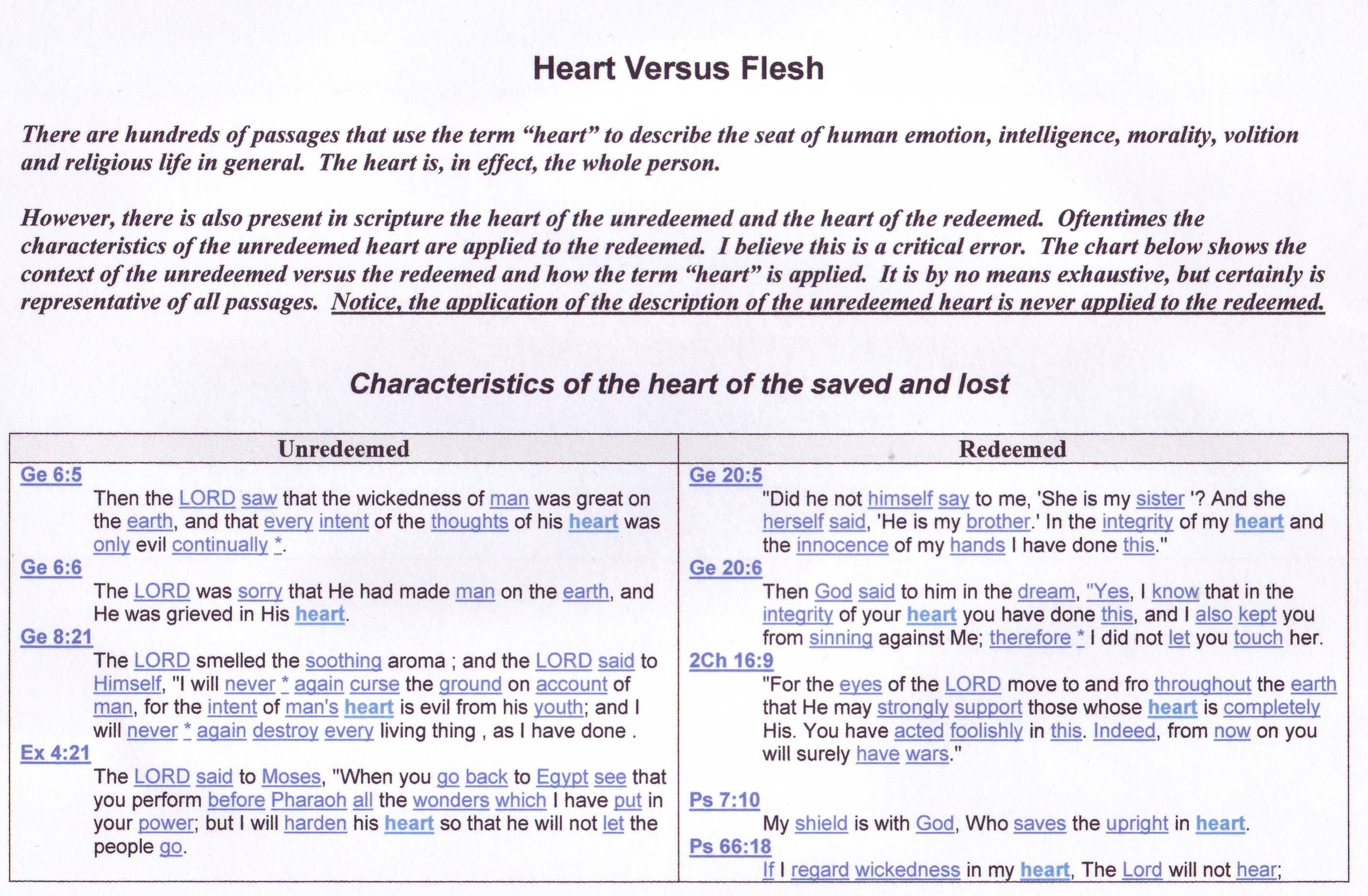
Heart Versus Flesh
There are hundreds of passages that use the term “heart” to describe the seat of human emotion, intelligence, morality, volition and religious life in general. However, most often, “heart” is used in Scripture as an idiom for the mind.
There is also present in scripture the heart of the unredeemed and the heart of the redeemed. Oftentimes the characteristics of the unredeemed heart are applied to the redeemed. I believe this is a critical error. The chart below shows the context of the unredeemed versus the redeemed and how the term “heart” is applied. It is by no means exhaustive, but certainly is representative of all passages. Notice, the application of the description of the unredeemed heart is never applied to the redeemed.
Characteristics of the heart of the saved and lost
|
Unredeemed |
Redeemed |
| Ge 6:5Then the LORD saw that the wickedness of man was great on the earth, and that every intent of the thoughts of his heart was only evil continually *.
Ge 6:6The LORD was sorry that He had made man on the earth, and He was grieved in His heart.Ge 8:21 The LORD smelled the soothing aroma ; and the LORD said to Himself, “I will never * again curse the ground on account of man, for the intent of man’s heart is evil from his youth; and I will never * again destroy every living thing , as I have done . Ex 4:21 The LORD said to Moses, “When you go back to Egypt see that you perform before Pharaoh all the wonders which I have put in your power; but I will harden his heart so that he will not let the people go. De 5:29 ‘Oh * that they had such a heart in them, that they would fear Me and keep all My commandments always *, that it may be well with them and with their sons forever ! De 8:14 then your heart will become proud and you will forget the LORD your God who brought you out from the land of Egypt, out of the house of slavery. 1Sa 7:3 Then Samuel spoke to all the house of Israel, saying, “If you return to the LORD with all your heart, remove the foreign gods and the Ashtaroth from among you and direct your hearts to the LORD and serve Him alone; and He will deliver you from the hand of the Philistines.” 2Ch 12:14 He did evil because he did not set his heart to seek the LORD. 2Ch 25:2 He did right in the sight of the LORD, yet not with a whole heart. 2Ch 26:16 But when he became strong, his heart was so proud that he acted corruptly, and he was unfaithful to the LORD his God, for he entered the temple of the LORD to burn incense on the altar of incense. Ps 73:1 Surely God is good to Israel, To those who are pure in heart ! Ps 78:8 And not be like their fathers, A stubborn and rebellious generation, A generation that did not prepare its heart And whose spirit was not faithful to God. Jer 5:23 ‘But this people has a stubborn and rebellious heart; They have turned aside and departed. Jer 17:9 “The heart is more deceitful than all else And is desperately sick; Who can understand it? Eze 14:4 “Therefore speak to them and tell them, ‘Thus says the Lord GOD, “Any man of the house of Israel who sets up his idols in his heart, puts right before his face the stumbling block of his iniquity, and then comes to the prophet, I the LORD will be brought to give him an answer in the matter in view of the multitude of his idols, Eze 20:16 because they rejected My ordinances, and as for My statutes, they did not walk in them; they even profaned My sabbaths, for their heart continually went after their idols. Mr 7:21 “For from within, out of the heart of men, proceed the evil thoughts, fornications, thefts, murders, adulteries, Lu 6:45 “The good man out of the good treasure of his heart brings forth what is good; and the evil man out of the evil treasure brings forth what is evil; for his mouth speaks from that which fills his heart. Ac 8:21 “You have no part or portion in this matter, for your heart is not right before God. Ro 1:21 For even though they knew God, they did not honor Him as God or give thanks, but they became futile in their speculations, and their foolish heart was darkened. Ro 2:5 But because of your stubbornness and unrepentant heart you are storing up wrath for yourself in the day of wrath and revelation of the righteous judgment of God, Eph 4:18 being darkened in their understanding, excluded from the life of God because of the ignorance that is in them, because of the hardness of their heart;
|
Ge 20:5“Did he not himself say to me, ‘She is my sister ‘? And she herself said, ‘He is my brother.’ In the integrity of my heart and the innocence of my hands I have done this.”Ge 20:6Then God said to him in the dream, “Yes, I know that in the integrity of your heart you have done this, and I also kept you from sinning against Me; therefore * I did not let you touch her.
2Ch 16:9 “For the eyes of the LORD move to and fro throughout the earth that He may strongly support those whose heart is completely His. You have acted foolishly in this. Indeed, from now on you will surely have wars.” Ps 7:10 My shield is with God, Who saves the upright in heart. Ps 66:18 If I regard wickedness in my heart, The Lord will not hear; Ps 73:1 Surely God is good to Israel, To those who are pure in heart ! Ps 86:12 I will give thanks to You, O Lord my God, with all my heart, And will glorify Your name forever. Jer 24:7 ‘I will give them a heart to know Me, for I am the LORD; and they will be My people , and I will be their God, for they will return to Me with their whole heart. Jer 31:33 “But this is the covenant which I will make with the house of Israel after those days,” declares the LORD, “I will put My law within them and on their heart I will write it; and I will be their God, and they shall be My people . Jer 32:39 and I will give them one heart and one way, that they may fear Me always *, for their own good and for the good of their children after them. Eze 11:19 “And I will give them one heart, and put a new spirit within them. And I will take the heart of stone out of their flesh and give them a heart of flesh, Eze 36:26 “Moreover, I will give you a new heart and put a new spirit within you; and I will remove the heart of stone from your flesh and give you a heart of flesh. Mt 5:8 “Blessed are the pure in heart, for they shall see God. Mt 12:34 “You brood of vipers, how can you, being evil, speak what is good ? For the mouth speaks out of that which fills the heart. Mt 15:18 “But the things that proceed out of the mouth come from the heart, and those defile the man. Lu 6:45 “The good man out of the good treasure of his heart brings forth what is good; and the evil man out of the evil treasure brings forth what is evil; for his mouth speaks from that which fills his heart. Ro 2:29 But he is a Jew who is one inwardly; and circumcision is that which is of the heart, by the Spirit, not by the letter; and his praise is not from men, but from God. Ro 6:17 But thanks be to God that though you were slaves of sin, you became obedient from the heart to that form of teaching to which you were committed, Heb 10:22 let us draw near with a sincere heart in full assurance of faith, having our hearts sprinkled clean from an evil conscience and our bodies washed with pure water. 1Pe 1:22 Since you have in obedience to the truth purified your souls for a sincere love of the brethren, fervently love one another from the heart, 1Jo 3:21 Beloved, if our heart does not condemn us, we have confidence before God; Addendum: Romans 6:17 – But thanks be to God, that you who were once slaves of sin have become obedient from the heart to the standard of teaching to which you were committed, Romans 7:25 – Thanks be to God through Jesus Christ our Lord! So then, I myself serve the law of God with my mind, but with my flesh I serve the law of sin. Hebrews 10:22 – let us draw near to God with a sincere heart and with the full assurance that faith brings, having our hearts sprinkled to cleanse us from a guilty conscience and having our bodies washed with pure water. |
As you look at the references above, you’ll easily see that the Bible never applies the ugly characteristics of an unregenerate heart to a redeemed person. Why then, should we? God has renewed the heart of a believer and it is unbiblical to accuse the Body of Christ of having hearts that are unregenerated.
Where then, is the battle? The Bible teaches that the battle against sin is in the flesh, NOT the heart. Notice, please:
Mt 26:41
“Keep watching and praying that you may not enter into temptation; the spirit is willing, but the flesh is weak.”
Jesus is speaking to a redeemed person. He shows them that the danger is in the flesh, not the heart (perhaps synonymous with spirit in this passage).
Ro 7:5
For while we were in the flesh, the sinful passions, which were aroused by the Law, were at work in the members of our body to bear fruit for death.
Paul teaches here that our sinful passions are from the flesh.
Ro 7:18
For I know that nothing good dwells in me, that is, in my flesh; for the willing is present in me, but the doing of the good is not.
A critical passage! We know the Bible teaches that our flesh was not redeemed at salvation and, in fact, awaits the glorification described so clearly in 1 Corinthians 15. Therefore, we have a “redeemed heart” incarcerated in “unredeemed flesh.” This is exactly why we struggle. Notice:
Ro 7:14
For we know that the Law is spiritual, but I am of flesh, sold into bondage to sin.
Ro 7:25
Thanks be to God through Jesus Christ our Lord ! So then, on the one hand I myself with my mind am serving the law of God, but on the other, with my flesh the law of sin.
Ro 8:3
For what the Law could not do, weak as it was through the flesh, God did: sending His own Son in the likeness of sinful flesh and as an offering for sin, He condemned sin in the flesh,
Ro 8:4
so that the requirement of the Law might be fulfilled in us, who do not walk according to the flesh but according to the Spirit.
Ro 8:5
For those who are according to the flesh set their minds on the things of the flesh, but those who are according to the Spirit, the things of the Spirit.
Ro 8:6
For the mind set on the flesh is death, but the mind set on the Spirit is life and peace,
Ro 8:7
because the mind set on the flesh is hostile toward God; for it does not subject itself to the law of God, for it is not even able to do so,
Ro 8:8
and those who are in the flesh cannot * please God.
Ro 8:9
However, you are not in the flesh but in the Spirit, if indeed the Spirit of God dwells in you. But if anyone does not have the Spirit of Christ, he does not belong to Him.
Ro 8:12
So then, brethren, we are under obligation, not to the flesh, to live according to the flesh —
Ro 8:13
for if you are living according to the flesh, you must die; but if by the Spirit you are putting to death the deeds of the body, you will live.
The heart is not mentioned anywhere in this key teaching. Romans 6 through 8 contain the key teaching on our struggle against sin. And, it is clear; the struggle is centered on the flesh, not the heart.
Further evidence of this:
Ro 13:14
But put on the Lord Jesus Christ, and make no provision for the flesh in regard to its lusts.
1Co 3:1
And I, brethren, could not speak to you as to spiritual men, but as to men of flesh, as to infants in Christ.
How do we cleanse ourselves and appear holy before the Lord?
2Co 7:1
Therefore, having these promises, beloved, let us cleanse ourselves from all defilement of flesh and spirit, perfecting holiness in the fear of God.
Ga 5:13
For you were called to freedom, brethren; only do not turn your freedom into an opportunity for the flesh, but through love serve one another.
Ga 5:16
But I say, walk by the Spirit, and you will not carry out the desire of the flesh.
Ga 5:17
For the flesh sets its desire against the Spirit, and the Spirit against the flesh; for these are in opposition to one another, so that you may not do the things that you please.
Ga 5:19
Now the deeds of the flesh are evident, which are: immorality, impurity, sensuality,
Ga 5:24
Now those who belong to Christ Jesus have crucified the flesh with its passions and desires.
Ga 6:8
For the one who sows to his own flesh will from the flesh reap corruption, but the one who sows to the Spirit will from the Spirit reap eternal life.
~ Penned and researched by Brian Jonson, West Chester, Ohio
By Request, But….
A reader viewed the Old Calvinism / New Calvinism chart ( http://wp.me/pmd7S-Bc ) and the GS / Sonship heart model chart ( http://wp.me/pmd7S-BD ), and found them both “helpful.” She then asked if I had an Old Calvinism / New Calvinism heart model comparison chart. Uh, well, ya, I do, but it was really just something I was playing around with. However, since the individual has impressive theological credentials–maybe the charts aren’t as, well, non-helpful as I thought they were. So, here they are, BUT remember: these are just tools to hang our thoughts on.
But I will say this, I think the charts bring up some interesting points:
1. As I was developing the OC chart, I was struck by how several Scriptures came to mind on each element. To the contrary–that was not the case with the NC chart. HOWEVER, it would be awesome to have a NC proponent tag the different elements of the NC with Scripture. For sure, that would be an interesting challenge.
2. Keep in mind, the charts are in regard to sanctification and the “heart” which is being used to refer to the inner man. With that said–interesting observations can be made; such as, a two-fold limited model verses a many faceted model, and what is inner verses outer.
3. The NC chart needs explanation which follows before the charts.
4. I hope somebody takes this concept and develops something awesome. I really see myself as a get the ball rolling guy.
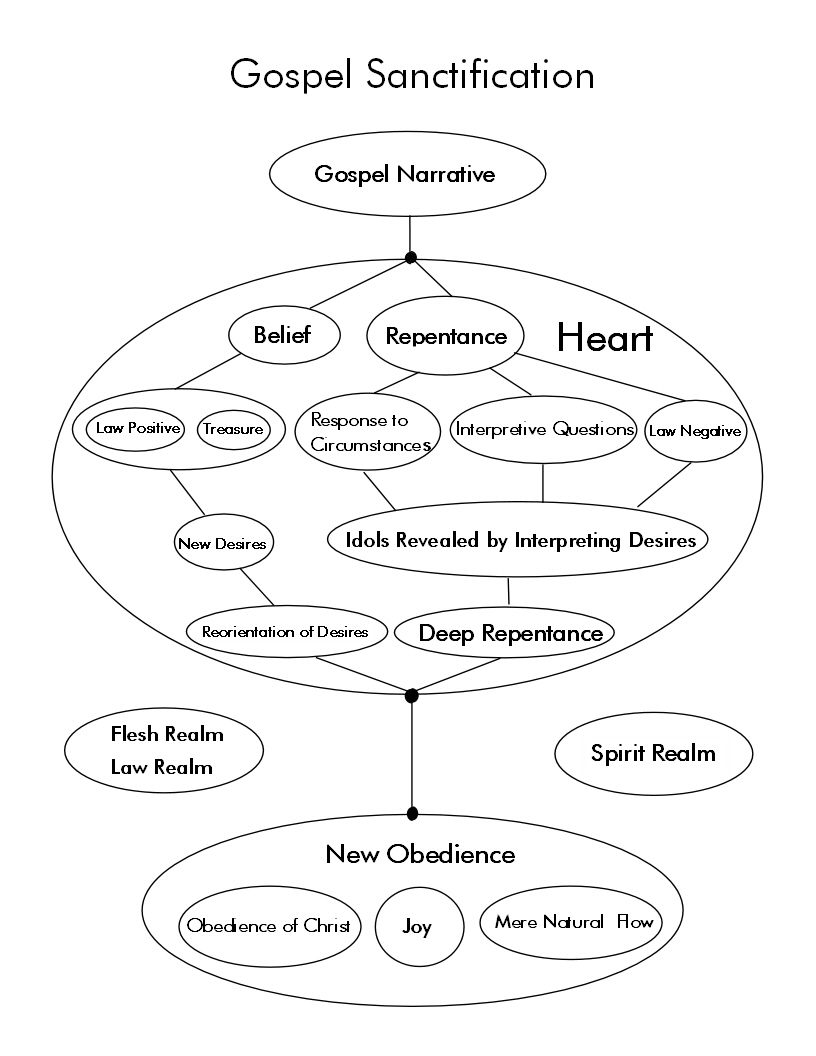
Gospel Narrative:
It all starts with the Bible being a gospel narrative only. The belief is that the Spirit only sanctifies through the contemplation of the personhood of Christ (whatever that means exactly), or who He is as a person and His works. For instance, to read the Bible with the goal of ascertaining instruction, even by Christ, and applying it to ones life, is an improper use of Scripture (according to GS), and an endeavor that the Spirit will not honor because it focuses on our efforts, and not who Christ is, and what He has done and accomplished for us. To do the prior is to use the Bible as a “instruction book” and not to gain a deeper understanding of the finished works of Christ. Therefore, proponents of GS do not believe that spiritual growth is really taking place in Christian circles where the Scriptures are used for any other purpose than the Chrstocentric approach.
Belief:
Now we come to one of two elements of justification moving forward via the gospel narrative. GS believes that the same gospel leading to justification that saved us, also sanctifies us. Hence, like justification (salvation), their is only two things we can do to grow spiritually, believe and repent. The GS doctrine holds that gazing upon the gospel narrative will lead to more belief, and belief will always produce proper behavior on its own, being earmarked by the right desires. We will follow belief to the bottom of the chart, and then start back at the top with the second, or other half of the sanctification process according to GS, repentance.
Law Positive:
Proper use of the Scripture (according to GS) sees the Law as a description of what Christ has already done for us, fulfilling the law with His life because we are unable to, even as Christians.Therefore, seeing all of the laws Christ has fulfilled for us gives us a deeper appreciation of who He is and what his works accomplished for us.
Treasure:
Seeing who Christ is, and all of His works in Scripture, and all that he has done for us, causes us to treasure Him above all else. Therefore, it becomes our desire to be whatever He is. GS believes that we are primarily driven by desire; and in fact, enslaved by it. Therefore, change the desires, and you change behavior. Assumes our appreciation of Christ’s greatness and mercy is all the motivation we need to change our desires.
Repentance:
This is the second part of our limited role in the sanctification process according to GS. All other activities are a mere natural flow from the Christ in us. It is not we who live, but Christ who lives in us (Galations 2:20). Again, like salvation, the same gospel that saved us, also sanctifies us, and is limited to belief and repentance, with everything else flowing from Christ who lives in us.
Response to Circumstances:
God’s purpose in all circumstances (according to GS) is to reveal idols of the heart so that we can repent of them. How we respond to circumstances reveals what we desire more than Christ. The particular idol that caused us to respond in a Christless manner can be identified by asking ourselves interpretive questions (what did you want? [more than Christ?]). Scripture, which is (according to GS) a grand gospel story (gospel meta narrative), can also reveal to us what the heart idol might be by how other saints responded to the same circumstances in redemptive (gospel) history. So, another limited purpose of Scripture is to help us determine idols of the heart so that we can repent of them.
This is done by showing us what other saints in redemptive history wanted (desired) more than Christ. As you might imagine therefore, how GS effects biblical counseling is profound. The focus will be on identifying heart idols and their attached desires, and changing desires of the heart, rather than behavior through biblical prescriptions born of other approaches to biblical interpretation. Some would argue: objective (behavior) verses subjective (heart issues).
Interpretive Questions:
These are merely “desire” questions that can help us determine what we love more than Christ. The most common one is “What did you want more than Christ?” Or simply, “What did you want?” However, the Christian Counseling and Education Foundation has a list of about one-hundred that they call “X-Ray questions.”
Law Negative:
This is the use of the Law (in Scripture) to drive us to despair by suggesting that we attempt to uphold the Law by application, and thereby driving us back to the cross (being impossible to accomplish). According to GS, the Law is still a schoolmaster that drives us to Christ in sanctification, and in the same way that it does in justification as well; unless, It is seen as being the works of Christ fulfilled for us (Law Positive). Law Negative has a purpose in revealing heart idols to us as well; such as, the desire to be self-dependant (heart idol of pride). Besides, the law has no use to us anyway (Christians) because it has been fulfilled by Christ and replaced by the one Law of love (I will not address this here for lack of room). According to GS advocates, Christians are only obligated to uphold the singular law of love. However, both Law Positive and Law Negative have their respective antithetical purposes for being present in the gospel narrative.
Idols Revealed by Interpreting Desires:
When the methods under “Repentance” are employed to determine idols, we can then repent of them, resulting in “Deep Repentance.”
Deep Repentance:
Also known as “intelligent repentance.” We can eliminate the idol by repenting of the thing we desired more than Christ, and replace it with a truth about Christ that we should desire or treasure more than anything or anyone. This is also known as the “reorientation of desires.” This leads to “New Obedience”
Flesh Realm:
Most GS advocates do not believe that the fight between us and sin takes place on the battle ground of the “flesh.” They believe the battle ground is the “heart.” Though they often speak of the “flesh,” they don’t think it is an inner turf where the real war takes place. This Theory makes our own efforts a point of contention in favor of a more passive viewpoint.Most GS advocates believe it is a realm that puts pressure on us, and at any given time, we either yield to the Spirit or yield to the flesh (a sinful, or worldly realm).
Law Realm:
Since the Law is sometimes said to aggravate sin, some GS proponents also attribute the Law to being part of the Flesh Realm.
Spirit Realm:
The other realm that exerts pressure on us. We simply yield to one or the other.
New Obedience:
New obedience is the natural result of “Belief” and “Deep Repentance.” Since belief is the result of seeing the glory of Christ in the gospel narrative, and causing us to desire and treasure Him more than other things, new obedience will naturally be accompanied by joy and experienced as a “mere natural flow.” Some GS proponents teach that it is actually Christ obeying for us. This is called the “imputed active obedience of Christ.” However, more GS advocates believe this than are willing to admit it.
Addendum: New Desires and Reorientation of Desires:
This is merely what happens automatically when Christ fills the void of eradicated idols through the only two disciplines of sanctification according to GS: belief, and deep repentance.
 If anybody would like these charts in some kind of file: pmd@inbox.com
paul

 Paul's Passing Thoughts
5 comments