

The Uninformed Reformed
 Most people in our day that call themselves Calvinists or Reformed are really New Calvinists. And most of them are young, uninformed, and misinformed when they are informed by New Calvinists calling themselves Calvinists. John Piper is an example of this. Is he a Calvinist? Hardly.
Furthermore, the word needs to get out that New Calvinism, New Covenant Theology, Gospel Sanctification, and Sonship Theology are the SAME thing and came from the EXACT same source—a Seventh-Day Adventist turned atheist named Robert Brinsmead. No wonder they constantly proclaim, “All truth is God’s truth.” I would also.
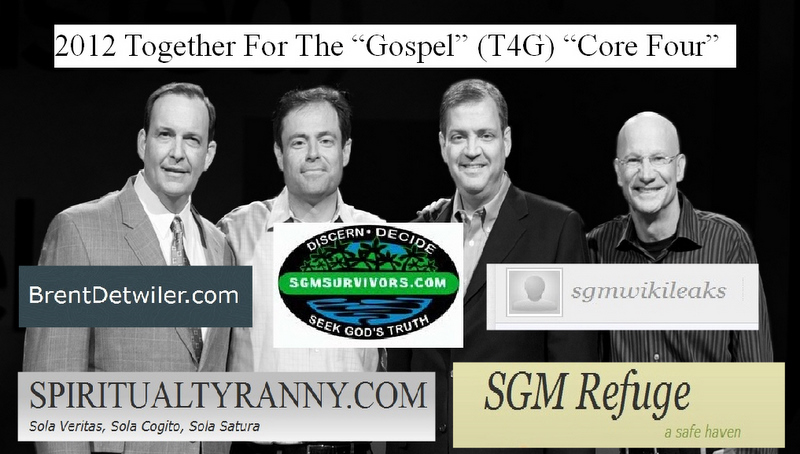
Neo-Calvinism is 41 years old, period. And the whole T4G, TGC bunch is the same bunch of antinomians who show-up and harass the church every 50-100 years. It’s the same bunch Ryle had to contend with and Baxter /Rutherford before him. Different doctrine, same goal: anti-law.
I was referred to the same old, worn out song and dance at the Facebook “Reformed Baptist Page,” where a member of the PPT peanut gallery asked a question about the connection between NCT and New Calvinism:
Is New Calvinism and Reformed theology the same Thing? The ones I was talking to think this doctrine is a combination of New Calvinism, Reformed theology and New Covenant theology all in one.
Well, she almost got the question right—NCT and New Calvinism are definitely based on the same doctrine. The uninformed Reformed Page then misinformed “Cindy”:
Hi Cindy,
Typically when folks speak of “New Calvinism” they are referring to the “young, restless and reformed” kind of Calvinism, the hip and cool Calvinists. Though the theology, when it comes to the five points is the same, their philosophy of worship, separation from the world, and other practical issues are not in line with historical Reformed theology and practice. As for New Covenant Theology, as was posted a few days ago is a modern hybrid between classical dispensational theology and biblical covenant theology. I think anyone who holds to New Covenant theology is simply confused, but certainly not heretical.
This is the typical take on NCT; supposedly, a mere attempt to find a middle road between dispensationalism and covenant theology. Not so. Jon Zens worked together with Robert Brinsmead to develop a view of the law that would fit with Brinsmead’s “centrality of the objective gospel.” Cindy then sought the following verdict from this source on Facebook:
Ok, is New Calvinism heretical then? Sorry for asking so many questions, I just want to be informed.
Notice that Cindy is confident that this source on Facebook will “inform” her. Hmmmmm. Makes one wonder how many professing Calvinists have read the Calvin Institutes? Or a Bible for that matter.
Regardless of the fact that many real Calvinists have condemned New Calvinism, the uninformed Reformed Page misinformed Cindy that it is not a heretical movement so now the misinformed Cindy thinks she’s informed. And that’s why she went to that page, because, “I just want to be Reformed informed.” We understand Cindy.
She then asked about Gospel Sanctification and Sonship theology and got the following answer:
The New Calvinists I know are solid on the Gospel Sanctification. Sonship theology seems to be a new name for antinomianism.
This reveals how shallow research is among this bunch. They call Sonship theology antinomianism, but the forefathers of Sonship theology, Tim Keller and David Powlison, are major figures in the New Calvinist movement. The whole “We must preach the gospel to ourselves everyday” was coined by the father of Sonship theology, Dr. John “Jack” Miller, who was Keller and Powlison’s mentor. Powlison based CCEF counseling on Miller’s theology.
I responded by posting a short history of the movement which was answered with the typical response: Nothing can be ascertained because everybody in the movement doesn’t agree on every jot and tittle. And the usual ratcheting back from any information that enables people to connect the dots, followed by personal attacks.
The informed Reformed Page didn’t challenge my post, they pulled it down, I guess because such information isn’t possible because that’s where the Reformed go to get informed. So, if they didn’t know about it, well, it couldn’t be informative. Right?
paul

The New Calvinist Mega-Lie: Obedience and Truth are Separate
 “Therefore, Christians don’t obey for the purpose of maintaining our just standard; it is a finished work by Christ that needs no further maintenance. We obey for other reasons….”
Have you ever noticed? The Scriptures NEVER call “obedience” works salvation. We are never told that people are trying to earn their way into heaven through “obedience.” Obedience, in the Scriptures, is ALWAYS associated with the truthful application of God’s word to our lives in how we think and what we do. It is the truthful application of our role in sanctification which is putting off the old self and putting on the new creature (Ephesians 4:20-24). In the Scriptures, truth is always assumed in obedience.
This is New Calvinism’s greatest deception, the idea that one can sincerely seek to apply God’s word to their lives in a truthful way, and at the same time do so to maintain a just standing before God without realizing they are doing so. This invokes a dependance on them, a don’t try sanctification at home mentality. Though they claim that obedience is motivated by fear within the evangelical community, their sanctification formula propagates an unfounded fear that obedience is nothing more than works salvation, in and of itself. The fact of the matter is that works salvation is always based on falsehood.
Unlike the Bible, New Calvinists don’t associate obedience with truth, a love for the truth, and faith. They separate the two, specifically by separating “law” and “gospel.” Law is obedience, whether practiced in truth or not, and gospel is truth. There are many examples of this, but here is the best one I have seen of late:
This is fundamentally no different than Islam! The Gospel offers us freedom from our sin-stained hearts and our obedience-stained garments and bids us rest in the finished work of Christ which is better than us being better!!!” (Jean F. Larroux, III, Green Grass of Grace Southwood blog).
Notice: obedience is obedience whether it is Christian or Islam. Truth isn’t the issue. But the apostle Paul clearly unites the two:
They have become callous and have given themselves up to sensuality, greedy to practice every kind of impurity. But that is not the way you learned Christ!—assuming that you have heard about him and were taught in him, as the truth is in Jesus, to put off your old self, which belongs to your former manner of life and is corrupt through deceitful desires, and to be renewed in the spirit of your minds, and to put on the new self, created after the likeness of God in true righteousness and holiness (Ephesians 4:19-24).
Obviously, Paul is calling on Christians to learn truth, and put off what we learn to put off, and put on what we learn that is to be put on. The Bible calls this “obedience” when it is done as biblically prescribed. If I tell my son to take the trash out to the curb, but instead he leaves it halfway down the driveway, that’s not obedience. Unless you’re a New Calvinist. With them, truthful obedience is neither here nor there because it is impossible for Christians to accomplish anyway:
The bad news is far worse than making mistakes or failing to live up to the legalistic standards of fundamentalism. It is that the best efforts of the best Christians, on the best days, in the best frame of heart and mind, with the best motives fall short of the true righteousness and holiness that God requires [notice that there is no distinction between this sentence and the one prior (legalistic standards verses true righteousness)]. Our best efforts cannot satisfy God’s justice. Yet the good news is that God has satisfied his own justice and reconciled us to himself through the life, death, and resurrection of his Son. God’s holy law can no longer condemn us because we are in Christ (Michael Horton, Christless Christianity p. 91).
It is also extremely important here to notice the crux of New Calvinist error in this statement; specifically, the supposed need to maintain justification: “….the best motives fall short of the true righteousness and holiness that God requires…. Our best efforts cannot satisfy God’s justice.” But in sanctification, God no longer requires a just standard to maintain salvation, that has already been accomplished as a finished work. God no longer “requires” perfection that maintains our just standing. Therefore, Christians don’t obey for the purpose of maintaining our just standard/standing; it is a finished work by Christ that needs no further maintenance. We obey for other reasons—to glorify God, to experience the reality of our new birth, to show others the abundant life, and to destroy evil works, to name just a few. And also, our God-given love for the truth compels us to apply it to our lives.
Therefore, New Calvinism fuses what shouldn’t be fused and separates what shouldn’t be separated, turning orthodoxy completely upside down. They fuse justification and sanctification, and separate obedience from truth, while fictitiously calling obedience “law” (whether Christian or Islamic), and encapsulating truth in the “gospel” which is supposedly distinct from “law.” But what would we know about the gospel apart from Scripture? Christ said man lives by every word that comes from the mouth of God. Wouldn’t that include the law? Paul told Timothy that we are fully equipped for every good work by ALL Scripture. Wouldn’t that also include the law?
This fusing of what shouldn’t be fused and separating what shouldn’t be separated is the basis of their Gospel Contemplationism. Law (any effort to obey, whether according to the truth or not) is separate from gospel and impossible for us to obey perfectly in order to maintain a salvation that doesn’t need to be maintained to begin with. The formula? Contemplation on the truth that results in a “Christ formation” within totally depraved, dead jars of clay. Doubt that? reread Larroux’s quote; our hearts are sin stained as well as any obedience we may perform.
The truth: we are declared righteous and are righteous, though hindered by the flesh. Though our striving falls short of perfection, we know that can’t affect our righteous standing that has already been declared based on the finished work of Christ. And that cannot be revoked. As we strive, we also long for the day when we can obey our Lord perfectly without hindrance. So like Paul, we cry out, “who will deliver me from this body of death?”
Our striving creates that thirst, experiencing both the blessings of that truth and the failures that prevent the full experience. Peter states clearly that we are to strive for a “rich entry,“ not the beggarly entry that comes from let go and let God theology.
paul

 Paul's Passing Thoughts

2 comments