Why Mark Dever Hates America and Old People
 Originally published July 3, 2013
“But yet, his ministry confronted me for using a logo similar to his T4G logo. Actually, legal action was implied. He will fight for what his logo represents, but anybody who wants an American flag in the sanctuary is a pathetic person stupid enough to think Christians need a flag to worship. And yet, many are miffed by my utter disgust for these people.”
Well, tomorrow is the Fourth of July and the Calvinist bloggers, per the usual, are typing away about the evils of eclipsing the Son by celebrating America. I was sent one such article by a reader of PPT entitled, “Removing Old Glory for God’s Glory.” Apparently, the all-sovereign God dropped the ball when He made America great and created competition for himself. The metaphysical insanity of Calvinism truly staggers the imagination. The article highlighted heretic Mark Dever who rules his Southern Baptist church in D.C. with an iron fist. Dever, who represents the Neo-Calvinist mentality on this, stated the following:
When I was coming to the church in Washington DC, I requested the flag be left out of the sanctuary. Over a year later, an older member of the church asked me where the flag was. I said, “What flag?” She was asking where the American and Christian flags were because Memorial Day was coming up, and we needed a flag. When we gather in the church we’re more fundamentally Christian than American. We have much more in common with the Nigerian who is in Christ than the non-Christian across the street. She was not happy and it was taken to the church leadership. I told the deacons we could leave the flag but it’s a fairly new custom and in this age things are so politicized that the flag looks like a right wing political statement. We want to reach democrats too with the Gospel. After tearful discussion, we decided to keep them out of the sanctuary.
This statement reflects why I have so much disdain for Calvinists. Aside from their hideous false gospel, they are cold-blooded Stoic control freaks. However, my deepest resentment of them, aside from their false gospel of progressive justification, comes from my experience as a fire inspector. My work involved nursing homes, and the abuse that I saw has really left me with a penchant for despising those who disrespect the elderly and their honorable legacies. For one, never talk to an elderly person like you are talking to a young child due to their declining mental capabilities. This is a real pet peeve of mine. If I see you do it, I will not slap you on your silly face, but only because it would be against the law. Focus on what they do understand and address them as a peer. If you could read their minds, what they think of your stupidity and disrespect might be surprising.
These are people with a story. These are people who have paid the dues of life. God has them here for a reason. In our country, anybody in their 70’s or 80’s could be someone who lost half of their family (or all of it) to WWII so that you can have the freedom to eat what you want, read want you want, work where you want, drive what you want, and think what you want. Show some respect. You can quote me on this: one reason I despise Mark Dever is his pattern of disrespecting the elderly. Frankly, this pattern is also indicative of the Neo-Calvinist movement in general. Notice that he is compelled to refer to one of his victims as, “an older member.” Why is that relevant to the issue in his mind?
The American flag means a lot to our contemporary elder population because of what it represents. It represents a people who saved the world from tyranny. It represents a people who refused to give in to their fears in the face of formidable evil beasts never before encountered; an evil that seemed to be otherworldly. They knew for such an evil to prevail would leave an earth unfit for habitation. Courage told them that death or liberty were the only two options. They hold their hand over their heart with streaming tears on their face because that flag waving in the wind represents the termination of killing fields throughout contemporary history. Killing fields that showed no pity for the baby, the child, the fair damsel or the elderly. They paid the price so that Mark Dever has the freedom to look in the mirror and admire his in-vogue unshaven GQ Magazine look; the freedom to stand before thousands of naive youth with hearts muttering, “It’s the voice of a god, and not man.”
And what was his answer to the “older” member?
What flag?
Indeed Mr. Mark Dever.
He then couches his indifference to this parishioner’s perspective by implementing the “tearful” resolution. What is more despicable than the cold indifference of a Calvinist? Perhaps the disingenuous sympathy that insults the intelligence of a child. Dever, while calling himself a pastor, has no ability to possess empathy for those who disagree with him. His social instincts are those of a predatory animal. Notice his further demeaning of the “older” person by suggesting that said person posited the idea that Christians “needed” the flag. Dever makes no distinction between the parishioner’s concern for what the flag represents and a supposed “need.” But yet, his ministry confronted me for using a logo similar to his T4G logo. Actually, legal action was implied. He will fight for what his logo represents, but anybody who wants an American flag in the sanctuary is a pathetic person stupid enough to think Christians need a flag to worship. His minion that contacted me complained about what it costed them to design the logo, but what of the price paid in order for the American flag to stand? And yet, many are miffed by my utter disgust for these people. Much more could be discussed here in regard to Dever’s reality disconnect and incompetence; for example, his suggestion that the American flag is only loved by conservative Republicans.
But where does this mentality come from? It comes from Dever’s Calvinistic philosophy. Augustine, Luther, and Calvin predicated their theology on Platonism. Susan Dohse presented the irrefutable evidence for this at TANC 2013 using the words from Augustine’s own mouth. It’s an ideology that despises life in general. It’s an ideology that seeks to separate itself from life as much as possible and only regard an ambiguous eternity in the Spirit realm. Good works of men are completely irrelevant because they are of this life. The story of the Boy Scout who throws himself in front of a car to save the elderly pedestrian is a gospel of death unless mixed with fear that one would believe that this is a good deed, for only God is good and to believe the deed is good is a mortal sin. To shrink back in terror that the deed is perceived as good is only a venial sin.
This philosophy is the foundation of the Reformation as represented in Luther’s Heidelberg Disputation to the Augustinian Order. Calvin then took Luther’s dualist construct and applied it to a full-orbed worldview via the Calvin Institutes. The construct ONLY sees reality from TWO perspectives: the glory story (any perspective of human existence good or bad) or the cross story. America is the glory story. There are only two realities in the Calvinist worldview. It’s either the glory story or the cross story. And each focus yields a certain result. Dever wanted the flag out because it hinders the cross story. That’s it in a nutshell. His other stated reasons are lies. There is a method to his mystic despotism.
Plato disdained those who insisted on interpreting reality through the five senses. He perceived them as ignorant morons who didn’t know the difference between the true forms and the shadows of the forms. He believed the true forms were accessed through ideas and thinking. Those who are born as philosophers should therefore rule over the unenlightened who insist on being enslaved to the material world. The Reformers merely made Christ and His works the true forms. The glory story is the material; the cross story is Spirit. Likewise, Dever has no patience for stupid old fogies who insist on living in the shadows. No patience for those who take away from the cross story for some other glory. Hence, the title of said post:
Removing Old Glory for God’s Glory.
In the world of the Reformers, there is no room for both. And each focus yields a certain result. Actually, this philosophy has ruled the Western world for centuries in either Platonic secular mode (communism etc.) or integrated religions. The purveyors of each have a common bind: the enlightened must rule the world for this is humanities only hope. In the minds of the Reformed, the only thing worse than a Marxist is one who interprets life by the shadows. Therefore, the Reformer sees the Marxist as a cut above the common man which does not bode well for anything Americana.
The framers of our constitution were the first in history to say “no” to European determinism whether secular or religious. As John Immel pointed out in this year’s conference, their minds were endowed with knowledge concerning the results of “truth” by force or utopia by force. I think the reader who sent me the link added apt thoughts to the reality of that pushback:
The apostle Paul was probably the biggest patriot in the NT. He was very proud of his nationality and grieved for his people, the Jews! You can easily make a case for that.
Oh yeah, it’s easy to see that their same disdain for the freedom represented by the flag is the same disdain for freedom of the laity.
It represents freedom of the individual, which is the last thing a tyrant wants, spiritual or otherwise, free-thinking individuals.
Luther and Calvin disdained free thought. Read Luther’s Heidelberg Disputation for yourself. And that’s Dever’s problem with the flag; what it represents. The T4G logo is not a problem because it represents the control he thinks he should have over those who live in the shadows exemplified by unbiblicaly excommunicating 256 church members for non-attendance. Think about this: couple that with Calvin’s power of the keys which his elders have often written about; the idea that elders have the power to bind and loose salvation on earth. He thought he was condemning 256 people to hell that day.
And that is the difference between Mark Dever and every bloodthirsty tyrant that ever walked the earth, the representation of the flag, but a difference in character as razor thin as a playing card. His associates dream of launching people into the air with catapults and running them over with gospel buses, they even plainly say so in public. The flag represents a restraint that deprives them of their psychotic visions of grandeur.
So tomorrow, on July 4th, eat lots of hotdogs, and say a prayer for freedom. And pray that God would continue to save America from Calvin’s legacy of bloodshed in the name of Christianity.
paul
The Heavenly B-52s Can Save American Christianity From Its Present Dark Age
 Originally published February 11, 2013
We must remember that the Dark Ages were a European thing. And we must remember that Greco-Roman philosophy was the source and then it was turbo charged with the integration of European style religiosity. European religion has always been grounded in Plato’s disdain for humanity. Hence, one philosopher stated well that faith and force together are the destroyers of the modern world. One of the most notable historians of our time, K.R. Popper, fingered Plato specifically in regard to the logic that has wreaked havoc on Western culture through Communism, Islam, Catholicism, and Reformed theology. Augustine, one of the fathers of the Reformation, called Plato a pre-Christian Christian, and the juggernaut of faith and force was thus born.
And primarily, American religion was imported from Europe via the Puritans who were a European style religious political sect. They wanted to create a theocracy of their own in the new world. That’s the “religious freedom” they sought in America—a political one. Ironically, this importation of a European pandemic is romanticized by the Thanksgiving holiday. Somehow, deep in our evangelical American psyche, we think the Puritans could have led us to the religious utopia that we all lust for. And in-fact, deep in our evangelical psyches, we think the war still rages between our Puritan foundations and the evils of Enlightenment philosophy. And if Enlightenment philosophy would surrender, all would be well and the heavenly Jerusalem would finally come down to Earth.
Nothing could be further from the truth. Enlightenment thought, even with its many abhorrent shortcomings, launched America to unprecedented greatness as a nation because of three basic principles that God agrees with: man is free; man is capable; and man is responsible for the sum and substance of his own life before God. Men “small and great” will all stand before God. Plato’s philosopher kings do not stand before God in our stead regardless of the priestly garb that the Reformers have adorned them with.
In the movie, Moneyball, based on a true story, the General Manager of the Oakland A’s baseball team set all time league records with a meager budget and has-been players by breaking tradition with the ways big league teams have always been built. The player’s manager of the team was against the plan, and was a constant hindrance to its implementation. But when the Oakland A’s became the talk of the sports world because of the plan, the player’s manager got all of the credit. In the same way, the manager of American Christianity, the one of 95 Theses fame, Martin Luther, is given credit for America’s greatness. God has blessed America because of the Puritan missionary children that he spawned. Their roots are the lifeblood of America. We were “founded on their Christian principles.” This is a significant departure from reality.
Luther despised reason. He believed that reasoning was a dangerous stunt that the unenlightened masses shouldn’t try at home. And because they are not capable, they have to be protected from themselves; hence, neither are they free. To the degree that we are free the world is in a spree. Man must be saved from himself; by force if necessary, and for the good of the world. Martin Luther to the rescue. Stalin to the rescue. Muhammad to the rescue. The Moral Majority to the rescue. And on every Thanksgiving Day, deep, deep in our American psyche, a small still voice cries out: “Oh but for the Puritans! What could we be?” It’s all the same logic. You can dress it up in different doctrines, but it’s all the same. Logic comes in many doctrinal forms—both secular and religious.
The founding fathers of this country were children of the Enlightenment era. Until America popped up on the history radar screen, force and faith was the big league tradition. Our founding fathers proposed something different: government as the protector of man’s right to be free, capable, and responsible. And a government that served at the pleasure of the people to do so. It is a testimony to the power that is displayed when merely three ideas from God are implemented in our realty. Three ideas from God made America the envy of all world history. In the end, the motif that any child can perceive in the book of Revelation will fill the world with blood up to the horse’s bridles: force and faith. To what is said here, the proffers of force and faith, the Reformed of our day, answer in all of their Puritan glory, “I beg your pardon! Jesus Christ should be the envy of the world!” But which Jesus Christ? The Puritan Jesus Christ? And enlightened minds want to know: “Are we free to decide that for ourselves?” And: “Are we capable of even knowing that?” We fear that the answer to both of these questions is, “No.” And that is why giving you power in our lives at any level is a really bad idea.
Hence, To the degree that the Reformed Dark Age feigns, darkness in the American church does rein. And we are in that Dark Age. It came in essence as logic stowed away in the Mayflower’s diseased European rats bringing the same plague with it. I could drag out all of the apocalyptic data and its many faceted manifestations, but a recent televised top of the hour newscast introduction will suffice:
Here we go again, another sex scandal in the Evangelical church.
You notice they said, “Evangelical” and not “Catholic.” Anybody that knows the facts knows that sexual abuse and the subsequent cover-ups are just as prevalent in the Protestant Evangelical Church as it is in the Catholic Church. The scandals are the same, and the silence among clergy is the same, along with the same disregard for victims. Different doctrines—same logic—same results. Logic always has an endgame; there are many different doctrines that can get you there.
But the American Dark Age takes on a different appearance than the open fires of European religious wars and unspeakable terrors for it is tempered with freedom, capability, and responsibility. In the same way that God’s spies found refuge with a harlot, the American church has been saved from itself by Enlightenment thought. The result has been Reformed Light, and the carnage has been greatly limited. The European Reformers believed that children should be seen and not heard; American Reformed Light allows their children to play in a sandbox. Children are happier when they have a sandbox to play in, and they can form all kinds of ideas in what they make in the sand. But when it is time for dinner, it’s also time to put our little buckets and shovels away, run to the dinner bell, and obey mommy and daddy. They protect us from truth that can cause division because we are unable to handle truth, and they make truth a storybook that we can understand. They read it to us at night, and we are much comforted. We can pretend in the backyard, and we feel safe because mommy is watching from the kitchen window.
But the children of Reformed Light do not grow up. For certain, the American church is every bit like grown adults playing in a sandbox. The real Reformers now come forward and scoff at the pathetic sight, and say they are the answer. Yes, not playing with ideas at all must be the answer. Adults in a sandbox is not the problem, the sandbox is the problem. Sandboxes tempt people to play with truth. The Reformers to the rescue—those half breed Semi-Pelagian parents be damned.
Children in adult bodies will always rape, hate, pillage and steal. It is what it is: spiritually, they were born slaves, born incapable, and born irresponsible. Reformed theology is a bus of misfits, but all believe that it is the only bus going to heaven—the bus of faith alone in Puritan sanctification. All kinds are on the bus, but the tie that binds is womb to the tomb total depravity.
Some do not persevere in accepting their total depravity and the total depravity of others. Some do not trust God’s anointed to get the bus of misfits to heaven, so an Inquisition is needed. The European Reformers used the gallows and the burning stake (if the victim was lucky), brainwashing, and orthodoxy. The American Reformers can use brainwashing and orthodoxy, but because of the founding fathers, the American Reformers must replace the gallows and burning stake with character assassination, authority to condemn eternally, and false criminality. And all of the aforementioned paints the portrait of the present-day American Dark Age in the church. There is a little metal plate on the bottom of the spectacular painting hanging in the gallery of human history, and it reads:
Here we go again.
The Bible is written for mass consumption. All Bible books, save a few, were written to assemblies and not leadership. God has also written his word on the hearts of every person ever born into the world (Romans 2:14). We are all responsible before God, free to obey Him or not obey Him, and obviously, must exercise our minds for understanding. We also live in the information age; so, if man was without excuse in the days of the apostolic church (Romans 2:1) we are certainly without excuse today.
Nations, particularly the USA, have used heavy bombers to drop propaganda leaflets on cities before an invasion or in an attempt to turn the population at large against the enemy leadership. Each bomb usually weighs about 250 lbs. and rains about 60,000 leaflets on a given area. During the Iraq/US war, leaflet bombings resulted in the mass surrender of Iraqi soldiers. In the same way, regardless of what’s going on in the world, God has a message of truth for every person. Invariably, it is man’s responsibility to do what God wants him to do in any given situation.
God has given the truth to all men, and only the truth will set us free. We need to pick up and read the leaflet and surrender to the Chief Shepherd. The Reformation is responsible for this present Dark Age in the American church. It is a doctrine that must be rejected with prejudice, and we must disdain anything that has touched its filthy garments.
A little leaven leavens the whole lump.
paul
The Calvinist’s Greatest Fear: The Spiritual Peasantry Will Understand Law and Grace
 Originally published January 2, 2013
“The two are completely separate; the law is left behind in the former and loved in the latter.”
Susan and I perceive constantly that most Christians don’t understand the difference between justification and sanctification. Said another way, they don’t understand the difference between law and grace. This is by design. Instead of outlawing the Bible like the Popes, the Reformers merely posited the Bible as a catechism that aped their orthodoxy derived from counsels and creeds. I won’t mention names, but prominent evangelical leaders have shared with me personally that they know the general populous of American Christians are theologically illiterate. And again, this is by design. And, most Christians in our day openly admit it, and in some cases are proud of it. The remainder admits they believe that the pastorate is an intermediary between them and what God wants us to understand.
There are a number of problems with this, but primarily, God thinks it’s a bad idea. The Bible is clearly written to Christians in general. And His word cannot be properly understood unless it is read in the context of justification/sanctification. Whatever your opinion of the American church, it is a product of parishioner illiteracy in regard to doctrine; that is certain and indisputable.
Though it takes a lot of study to see some things in simple form, the simple fact of Calvinism (and we are all Calvinists if we are Protestant) is that it makes “under” a verb and not what it is: a preposition. They could get away with this in medieval times because most people didn’t know the difference. In our day, we know the difference, but assume the pastorate has a set of metaphysical eyes given to them by God before the foundation of the world that we don’t have—so our eyes don’t even blink when their interpretations contradict the plain sense of Scripture.
As we have seen in our previous observations from the book of Romans, Christians are UNDER grace and were previously UNDER law. All people born into the world are born into it UNDER the law, and will be judged by it at the end of their lives if they don’t escape it. Christ was the only man ever born under the law that could live by it without sin and was therefore the only man ever born who could die for our sins. We escape the condemnation of the law by believing in what He did to make a way of escape for us. Calling on Christ to save us acknowledges that we all fall short of God’s glory and are therefore in danger of eternal separation from Him.
We are “under” grace, NOT “under” law:
Romans 6:14—For sin will have no dominion over you, since you are not under law but under grace.
The word for “under” here is hupo which is a primary preposition. Calvinism teaches that we are still under the law. This is the main reason that it is a false gospel. Now, they would vehemently deny this in the following way with red faces and veins popping out of their necks:
NONSENSE! We emphatically state constantly that no man is justified by the law unless he can keep it perfectly and we all know that no man can keep the law perfectly. We constantly cite James 2:10 which states that if we break the law at one point—we are guilty of breaking the whole law. HOW DARE YOU SLANDER US IN THIS WAY!!!
This argues the point by making “under” a verb (something we do or don’t do) rather than a position. Therefore, they are not arguing jurisdiction, they are arguing practice in regard to how we are justified. Position is the issue, not what we do; i.e., keeping the law or not keeping the law, or doing this/that in this way or the other way etc. Calvinists believe our position stays the same; therefore, what we do becomes critical. In fact, what we don’t do keeps us saved; e.g., “You don’t keep the law by keeping the law.”
There are four versions of “Christians” still being “under” the law, or under its jurisdiction. First, antinomianism which teaches that we are still under the law, but God cancelled our obligation to keep it because it promotes grace. Secondly, that we are still under the law, but the Holy Spirit helps us keep it so that we will pass the final judgment. Thirdly, that we are still under the law, but if we perform certain rituals within the church, by authority of the church, our sins are continually forgiven (perpetual pardon in the face of the law). Fourthly, we are still under the law, but Jesus keeps it for us while we continually contemplate His saving works in the Scriptures. This is the Reformed view. And of course—it’s no less a false gospel than the former three.
This is verified by their interpretation of Galatians 2:20—this exposes their heresy:
I have been crucified with Christ. It is no longer I who live, but Christ who lives in me. And the life I now live in the flesh I live by faith in the Son of God, who loved me and gave himself for me.
We supposedly remain spiritually dead, which as they know is clearly synonymous with being under the law in Scripture. So, Galatians 2:20 is interpreted as being applicable to our Christian life. We don’t live in our Christian life, we are still spiritually dead, but the living Christ within us keeps the law for us so that the “ground of our justification will be Christ in the final judgment.” Calvinists believe that we are not under the law in regard to the idea that we don’t keep it in our Christian life to be justified, Christ keeps it for us. Hence, “under” is a verb issue rather than a position issue. What we do becomes critical, not where we are positionally. Therefore, Calvinism makes our Christian life (sanctification) by faith alone as a way to maintain our just standing for the final judgment. Only problem is, we are still fulfilling a requirement of the law in cooperation with Christ—this is the problem of salvation being a verb issue rather than a preposition issue. If the law no longer has jurisdiction over us FOR JUSTIFICATION, who keeps it or doesn’t keep it is irrelevant FOR JUSTIFICATION.
Then what is Paul talking about in Galatians 2:20? He is talking about justification; not sanctification, this should be evident. Consider the context:
Galatians 2:16—yet we know that a person is not justified by works of the law but through faith in Jesus Christ, so we also have believed in Christ Jesus, in order to be justified by faith in Christ and not by works of the law, because by works of the law no one will be justified.
Galatians 2:17—But if, in our endeavor to be justified in Christ, we too were found to be sinners, is Christ then a servant of sin? Certainly not!
Galatians 3:11—Now it is evident that no one is justified before God by the law, for “The righteous shall live by faith.”
Consider verse 21 which immediately follows 2:20:
I do not nullify the grace of God, for if righteousness were through the law, then Christ died for no purpose.
Why do Calvinists apply Galatians 2:20 to sanctification? Because what we do is the issue, not our position, so Christ must obey the law for us. To the contrary, we are justified because the old self that lived in the flesh died with Christ. And when it did, we also died to the law. So, in regard to justification, we can only be justified if the life we lived in the flesh is dead and no longer under the law. Being alive in the flesh equals: being under the law. Now, obviously, our mortal bodies are still alive in one sense in that we are walking around, but in reality the old self is dead and the power of sin and the law are broken. In that sense, we are dead, and justified via the fact that Christ was resurrected for our justification (Romans 4:25). Notice that Paul states that he is dead in regard to his life “in the flesh.” This doesn’t mean that we are also spiritually dead in sanctification. The context of Galatians 2:20 is justification. Hopefully, Romans 6:5-14 will clarify this for you:
5 For if we have been united with him in a death like his, we shall certainly be united with him in a resurrection like his. 6 We know that our old self was crucified with him in order that the body of sin might be brought to nothing, so that we would no longer be enslaved to sin. 7 For one who has died has been set free from sin. 8 Now if we have died with Christ, we believe that we will also live with him. 9 We know that Christ, being raised from the dead, will never die again; death no longer has dominion over him. 10 For the death he died he died to sin, once for all, but the life he lives he lives to God. 11 So you also must consider yourselves dead to sin and alive to God in Christ Jesus.
12 Let not sin therefore reign in your mortal body, to make you obey its passions. 13 Do not present your members to sin as instruments for unrighteousness, but present yourselves to God as those who have been brought from death to life, and your members to God as instruments for righteousness. 14 For sin will have no dominion over you, since you are not under law but under grace.
As we have noted before in our Romans study, being under the law comes part and parcel with being lost and under the power of sin which is provoked by the law. The flesh under the law is like throwing gasoline on a fire (Romans 7:8-11). But notice in Romans 6:5-14 that there is both death and life. This passage in Romans also adds “death” to being under the law and the bondage of sin. Galatians 2:20 only speaks of our death to the law and sin (“Apart from the law, sin lies dead”), not the life we have in sanctification. Romans 5-14 speaks to both because the context includes both sanctification and justification:
13 Do not present your members to sin as instruments for unrighteousness, but present yourselves to God as those who have been brought from death to life, and your members to God as instruments for righteousness. 14 For sin will have no dominion over you, since you are not under law but under grace.
We have been brought from death to life. The life we live in the flesh has had the power and dominion of sin under the law broken because we died with Christ. We are dead and Christ lives for our justification:
Romans 4:23—But the words “it was counted to him” were not written for his sake alone, 24 but for ours also. It will be counted to us who believe in him who raised from the dead Jesus our Lord, 25 who was delivered up for our trespasses and raised for our justification.
In regard to justification and this life we live in the flesh, we are dead, and more importantly, also dead to the law as well, and only Christ is alive, but that doesn’t pertain to sanctification as well. In sanctification, we are alive, and UNDER GRACE. In justification, the old self is dead and no longer under the law. Calvinists believe we remain under the law in sanctification, and being under the law is synonymous with still being spiritually dead. Therefore, we remain dead in sanctification and under the judgment of the law, so the law must be fulfilled for us.
Being under grace is synonymous with being born again, new creatures, informed by the law, not under it (see Galatians 2:19), and lovers of the truth. Obedience to the law is now our means of loving the Lord and showing the world that we love Him. The law is the full counsel of God in regard to family harmony and kingdom living. It informs us on how to be separate from the world. In a word: sanctification. The law in regard to judging our justification has NO jurisdiction over us. We are no longer under it.
The very fact that Calvinists propagate a total depravity of the saints in which bondage to sin is not broken clearly illustrates that the law is still a standard for our justification; we are still under its jurisdiction for our just standing. A cursory perusal of Reformed writings can produce a motherload of citations to establish this fact, but one from Reformed icon G. C. Berkouwer should suffice:
Bavinck too, wrote in connection with the regenerating work of the Spirit: “The regenerate man is no whit different in substance from what He was before his regeneration” (Faith and Sanctification p. 87).
Clearly, this can only mean one thing: the one that is “no whit different” must also remain under the law. His position hasn’t changed, so lest one attempt to be justified by the law, what is done in sanctification becomes paramount in eternal issues as opposed to it being a Divine family matter. The Reformed camp uses the book of Galatians to argue for this when the book actually addresses their specific error. They use the book of Galatians, as mentioned, particularly 2:20, to argue a supposed Pauline position that the Galatians were doing things in their sanctification that was affecting the status of their just standing. Again, the Reformed crowd makes what we do in sanctification the issue, not our position which biblically proposes that nothing done in sanctification can affect justification. The Reformed use of Galatians to argue this propagates a fusion of justification and sanctification which makes the law the standard for justification from salvation to glorification.
However, the book of Galatians is the antithesis of such as it shows a clear dichotomy between justification/sanctification and the application of the law in each. In justification: NO application. In sanctification: obedience. In regard to no law in justification, but the law informing our sanctification, consider Galatians 2:19:
For through the law I died to the law, so that I might live to God.
We have also noted in our Romans study:
But now the righteousness of God has been manifested apart from the law, although the Law and the Prophets bear witness to it—
We are justified apart from the law, but we would not know anything about these issues if not informed by the “Law and the prophets.” Furthermore, after belaboring the point about their being no law in justification, in both Romans and Galatians Paul makes his point by asking “What saith the Scriptures?” (Romans 4:3 and Galatians 4:30). And the absolute classic point on this is Galatians 4:21:
Tell me, you who desire to be under the law, do you not listen to the law?
There is no law in justification, but the law informs our obedience in Sanctification. Scriptural examples are myriad, but consider Galatians 5:2-7:
2 Look: I, Paul, say to you that if you accept circumcision, Christ will be of no advantage to you. 3 I testify again to every man who accepts circumcision that he is obligated to keep the whole law. 4 You are severed from Christ, you who would be justified by the law; you have fallen away from grace. 5 For through the Spirit, by faith, we ourselves eagerly wait for the hope of righteousness. 6 For in Christ Jesus neither circumcision nor uncircumcision counts for anything, but only faith working through love.
7 You were running well. Who hindered you from obeying the truth?
Verses 2 through 6 are about justification by faith alone apart from the law. Verse 7 concerns sanctification—running and obeying which we are free to do aggressively without fear of it affecting our justification. The two are completely separate; the law is left behind in the former and loved in the latter. I once heard a Reformed pastor fuming from the pulpit over a statement that he heard at a conference: “He said that the law leads us to Christ, and then Christ leads us back to Moses. THAT’S BLASPHEME!!!”
No it isn’t. When the law was increased through Moses, it had a dual purpose: to increase sin in order to show those under the law their need for salvation, and as can be ascertained by many other texts, for the saved to better glorify God:
Romans 5:20—The law was brought in so that the trespass might increase. But where sin increased, grace increased all the more,
Galatians 3:19—Why then the law? It was because of transgressions….
paul
How Calvinism Turns Brave Hearts into Cold Hearts
 Originally posted April 29, 2013
I will post a video at the end of this article that elicited the following response from those who posted it on the social network where I watched it:
“Not sure what one could add to or take away from what we have just seen. I am reminded of Matt. 24 when Jesus says that because of lawlessness the hearts of many will grow cold. “Just do it” and laughter throughout the time is just beyond me. Heather was in tears. I wanted to throw up. Beyond disgusting.”
The key to understanding the cold-bloodedness that they observed is in their mention of Matthew 24:12, and the two key words are BECAUSE and LAWLESSNESS. Christ said that “because” of “lawlessness,” love would “grow cold.” The source of this lawlessness is described by Jesus in the previous verse: “many false prophets.”
Now we would do well to examine what Christ meant by the word often translated “lawlessness” and “wickedness” in our English Bibles. These words posit the idea of bad behavior, but that’s not what the actual word that is used by Christ means at all. The word is “anomia.” The “a” is a negative article prefix that means “anti” and “nomia” or nomos, refers to God’s law specifically. The idea of sinful behavior is an entirely different word altogether. Among many used is “hamartia,” or “sin” and these two words are specifically contrasted in 1John 3:4. Sin is defined by any aberration of God’s standard.
In Matthew 24:12, as well as many other passages, an anti-Bible agenda is in view propagated by false prophets.
The world in general becomes cold-hearted by rejecting the law of God written on their hearts and administered by the conscience—either excusing or accusing their actions (ROM 2:15,16). The conscience can eventually be seared if continually violated and ignored (1TIM 4:2). Christians are to keep a clear conscience before God (Acts 24,16 1Peter 3:16, 1TIM 1:5, 3:9, 2TIM 1:3). Keeping a clear conscience before God is obviously behavior focused as judged by the Bible.
One of the monumental misnomers of all time is the idea of “legalism.” This term was formulated by false prophets who really want to steer us away from nomos. Misguided obedience has never been the church’s primary nemesis; it has always been anti-word of God. When the apostle Paul warned those who wanted to be justified by the law, “law,” is in a manner of speaking; Paul was referring to what false teachers purport to be the law, not an actual sincere love for truth and a desire to live by it. This is why James stated that anyone who wanted to be justified by the law had to keep all of it, not a standard of their own choosing (James 2:10). Supposed law-keeping is also often connected to salvation by mere ritual as well. This point cannot be better made than to cite what Paul wrote to the Galatians:
5:2 Look: I, Paul, say to you that if you accept circumcision, Christ will be of no advantage to you. 3 I testify again to every man who accepts circumcision that he is obligated to keep the whole law. 4 You are severed from Christ, you who would be justified by the law; you have fallen away from grace. 5 For through the Spirit, by faith, we ourselves eagerly wait for the hope of righteousness. 6 For in Christ Jesus neither circumcision nor uncircumcision counts for anything, but only faith working through love. 7 You were running well. Who hindered you from obeying the truth? 8 This persuasion is not from him who calls you.
We see here, clearly, that Paul was confronting a belief that being circumcised according to law excused them from a truthful obedience to the law. In other words, justification by law-keeping is ALWAYS a dumbed-down version of the law to make adherence for salvation feasible. Paul contrasts this with true obedience to the law in sanctification:
You were running well. Who hindered you from obeying the truth?
Justification by law-keeping is NEVER an endeavor to obey the truth; it is ALWAYS the replacement of God’s law with the traditions of men—making the law of God “void.” The Pharisees, the supposed poster children for “legalism,” or “living by the law,” were not guilty of trying to obtain salvation by a sincere obedience to the truth, but rather replaced the law of God with their traditions and made that the standard for salvation (which has no law standard to begin with):
Matthew15:1 – Then Pharisees and scribes came to Jesus from Jerusalem and said, 2 “Why do your disciples break the tradition of the elders? For they do not wash their hands when they eat.” 3 He answered them, “And why do you break the commandment of God for the sake of your tradition? 4 For God commanded, ‘Honor your father and your mother,’ and, ‘Whoever reviles father or mother must surely die.’ 5 But you say, ‘If anyone tells his father or his mother, “What you would have gained from me is given to God,” 6 he need not honor his father.’ So for the sake of your tradition you have made void the word of God.
Matthew 23:16 – “Woe to you, blind guides, who say, ‘If anyone swears by the temple, it is nothing, but if anyone swears by the gold of the temple, he is bound by his oath.’ 17 You blind fools! For which is greater, the gold or the temple that has made the gold sacred? 18 And you say, ‘If anyone swears by the altar, it is nothing, but if anyone swears by the gift that is on the altar, he is bound by his oath.’ 19 You blind men! For which is greater, the gift or the altar that makes the gift sacred? 20 So whoever swears by the altar swears by it and by everything on it. 21 And whoever swears by the temple swears by it and by him who dwells in it. 22 And whoever swears by heaven swears by the throne of God and by him who sits upon it. 23 “Woe to you, scribes and Pharisees, hypocrites! For you tithe mint and dill and cumin, and have neglected the weightier matters of the law: justice and mercy and faithfulness. These you ought to have done, without neglecting the others. 24 You blind guides, straining out a gnat and swallowing a camel!
25 “Woe to you, scribes and Pharisees, hypocrites! For you clean the outside of the cup and the plate, but inside they are full of greed and self-indulgence. 26 You blind Pharisee! First clean the inside of the cup and the plate, that the outside also may be clean. 27 “Woe to you, scribes and Pharisees, hypocrites! For you are like whitewashed tombs, which outwardly appear beautiful, but within are full of dead people’s bones and all uncleanness. 28 So you also outwardly appear righteous to others, but within you are full of hypocrisy and lawlessness.
And what were the Pharisees full of “within”? “[L]awlessness” which is the word “anomia.” The English translation is “anti-law” or “antinomianism.” That’s what the Pharisees were full of within—not “legalism” which is a concept not found in the Bible anywhere by idea or word. There is obedience to truth or anti-truth—no in-between.
“Legalism” fosters the idea that Christians can unwittingly try to please God by obeying the truth as a way to earn their justification. The idea was hatched by the Reformers and is a Neo-Calvinist doctrinal mainstay in our day. The favorite illustration is the Pharisees who supposedly were really, really good at keeping the law and obeying the Bible in an attempt to earn their justification. This is a ploy to create confusion in regard to the law’s relationship to justification and sanctification. The Reformers created immense fear among Christians by making the law’s relationship to justification the same as sanctification. In justification, law has no jurisdiction in regard to the Christian. The Christian is transformed from a status where the law is the standard to be justified (and impossible) to a status where the law informs our sanctification totally separate from justification. So, the law is a standard for sanctification, but in regard to the Christian, the law no longer has jurisdiction over his/her salvation. In Calvinism, the law remains a standard for justification IN salvation that must be maintained until the final judgment.
Because man is created to do works, this makes sanctification very tricky with our eternal destiny hanging in the balance. Calvinists therefore assure Christians that if they live their Christian lives by faith alone—they are playing it safe. As one New Calvinist told me: “If I let Jesus do all the work, He can’t fault me for anything when I stand before Him.” Of course, living in a way that imputes the works of Christ to our Christian walk is very complicated, but be assured: New Calvinists will teach us how to “practice obedient faith” so we can arrive at the final judgment covered by “what Jesus has done, not anything we do”….in our Christian walk. This confounding of the law’s relationship to justification and sanctification makes the Christian walk a minefield with constant danger of “making sanctification the ground of our justification.” We must therefore seek out the Reformed for their secret formula for living the Christian life by faith alone. “Sola Fide” is for justification and sanctification both—that’s the dirty little secret. The Reformed couch the language in terms like “obedient faith.” The Reformers saw faith as a neutral conduit that God uses to impute the perpetual works of Christ to the believer. In other words, Christ’s atoning work is not yet finished for salvation: though accomplished in one period of time, it must be continually appropriated to maintain our just standing. The maintenance of our salvation is in view. Hence, we must “preach the gospel to ourselves every day.”
But this brings us from fearful hearts to cold hearts. Reformed theology will heap its share of cold-hearted mentality on humanity “because of anomia.” It’s just more anomia dressed in religious garb. This brings my point back to the video that was posted. It is cold-heartedness on steroids regarding the abortion issue. Therefore, the following should make perfect sense to us:
According to the National Right to Life, the total number of abortions in the US is down-33% from its peak in 1980/81- and the greatest decrease is among adolescent girls and young women. Good News!
But if we look further into these statistics, we find disconcerting news for the Church: The abortion rates among professing Christians are commensurate with the rest of the population!
Approx. 560,000 for Protestants (43%)
Approx. 350,000 per year for Catholics (27%)
13% of abortions (approx. 170,000 per year) are performed on self-described “Born Again” or Evangelical Christians (Alan Guttmacher Institute and Physicians for Reproductive Choice, “An Overview of Abortion in the United States,” 2003 and 2008)
Even more disturbing is the fact that these percentages have NOT dropped, even though the number of abortions have in recent years!
These statistics reveal that actually MORE women who profess Christianity are having abortions.
This is what Reformed theology has always done to society. Despite the traditions of men that claim otherwise, the Reformation did not bring light to darkness, it brought more darkness. Post Reformation brought little more than chaos and turmoil to Europe—more than it had ever seen before. It brought tyranny to America in the form of the Salem witch trials, and its contemporary resurgence has resulted in an unprecedented level of abuses in the American church.
It is the epitome of a primary concern of Christ during His ministry: the replacement of the law by the traditions of men resulting in anomia. While waxing eloquent about the Pharisees, Neo-Calvinism is in fact a return to what plagued the apostolic church. To say that Calvinists vaunt the opinions of a litany of past Reformers as authority is an understatement of the most dramatic sort. Even Charles Spurgeon, “the prince of preachers” did little more than regurgitate Reformed tradition. Recently, one Reformed conference was based on the writings of twenty-five Reformed icons. The popular Resolved conferences hosted by John MacArthur highlighted the traditional teachings and legacies of Reformed men of years gone by.
With all of the harping about the Pharisees by Calvinists—they are the Pharisees, and they propagate the same kind of cold-heartedness with it.
Their heart is unfeeling like fat, but I delight in your law.
~Psalm 119:70
paul
Reformed Questions in Response to “False Reformation”
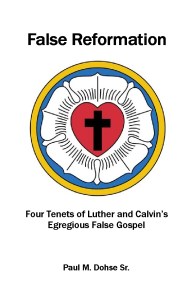
Originally published December 11, 2012
Paul,
Just a few questions:
1. If you accept the idea that “flesh” and “spirit” refer to parts of regenerate believers rather than to spheres in which people live and by which we are controlled, where does sanctification take place, in the flesh or in the spirit? The same question applies in terms of “old man”/ “new man.” Which of those grows in sanctification?
Answer: This question reflects the fact that the Reformed crowd doesn’t openly discuss what they really believe about this issue, and I commend you accordingly. Authentic Reformed doctrine holds to the idea that the active obedience of Christ is manifested in the “Spirit realm” as a result of what we see in the Bible being imputed to us by faith alone in sanctification (see Luther’s Heidelberg Disputation, theses 27). We don’t change. The “Spirit realm” and the “flesh realm” are two forces that put pressure on us, and at any given time, we “yield” to one or the other. This is the position of the elders who are over the NANC training center in Springboro, Ohio according to an email I received from them when they thought I was on board with their doctrine.
Of course, the take on this varies among those in the Reformed tradition. Another example would be the idea that we are still dead spiritually, and the living Christ within us is the one obeying. What is consistent is the idea that this obedience is experienced in a certain way: joy and a willing spirit (see LHD, theses 27); that’s how we know Jesus is doing it and not us. At any rate, the crux of Reformed theology is that all good works take place outside of the believer; i.e., Luther’s “alien righteousness” for not only justification, but for sanctification as well. Your question is at the very core of debates that took place between heretic Dr. Ed Welch of CCEF and the commendable Dr. Jay Adams.
Jay Adams oversees INS as he was pretty much run out of NANC and CCEF—largely due to the fact that NANC and CCEF are both bastions of evil. I find it utterly intolerable that thousands are sent to these organizations daily with the hope of change when these Reformed organizations in fact don’t believe that God changes them. There are no words for my loathing of such hideous deception while these organizations also take people’s hard-earned money to boot. And some don’t go along with these ideas, but they stand silent and therefore are just as guilty. And my “whole life” is contending against this? Perhaps, but better that than one’s whole life buying acceptance with silence. Moreover, people praise CJ Mahaney and co. for their tireless night and day service to the “gospel” which is really the work of the kingdom of darkness against the kingdom of light. A pity that I would counter that with my own life.
Unfortunately, Adams, who is much more advanced in patience than I am—associates with them, and in my estimation thereby causes confusion regarding the kind of counseling that will change people. Also, the possibility that the only biblical counseling organization left on the face of the earth that is not infected with Trippism and Powlisonism is also a major concern. Nevertheless, Adams and his associate, Donn Arms, are the only ones who have taken a stand against the heretical onslaught taking place in biblical counseling circles which is fraught with mindless followers, lackeys, lovers of filthy lucre, shameless cowards, and lying integrationists. The idea that these people care about any marriage or the well being of any saint is laughable.
But to answer your question completely, I believe the Scriptures are clear that the old self was put to death and no longer has the ability to enslave us to sin. The old self was “under the law” which means that the law provoked him to sin and a final judgment according to the law. As long as we are alive, our mortality has influence over us in regard to the old ways of being under the law, but the enslavement is broken. We are in fact born again, and have a regenerated “law of our mind.” Hence, “the spirit is willing, but the flesh is weak.” The warfare takes place inside of the believer between the law of his mind and the “law of sin.” The apostle makes it absolutely clear: this warfare takes place between my “inner being” and “in my members.” What is clearer? Unless the Bible is a Reformed gospel narrative that isn’t meant to inform our co-laboring with God in sanctification. But it is, because we are no longer “under” it for justification, but are informed by it for sanctification. Because the Reformers believe we are still under it, we must continue to live by the gospel that saved us from the law. We are still under it, but Jesus keeps it for us. How this is applied to the Christian life by the Reformers is outright Gnosticism to the core.
Furthermore, the “law of my mind” part of the believer that “delights in the law” in our “inner being” is what grows. Something in us is in fact growing: a host of passages that include 1Peter 2:1-3 make this certain. Really? Jesus isn’t really talking to us when he states, “Well done faithful servant”?
2. Do you believe sanctification occurs completely apart from faith? Do we have everything we need at the point of regeneration, so that further dependence on the Holy Spirit is no longer necessary? It sounds as if that is what you are saying.
Answer: Your question is framed within the confines of the Reformed either/or hermeneutic. Reality is either interpreted through the “glory story” or the “cross story.” This is the interpretive foundation of Reformed theology as stated in Luther’s HD. Because sanctification includes us, it must be by faith alone like salvation or it includes our glory as well. Therefore, where faith is, it must be by faith alone because faith is of God who will not share His glory with another. Therefore, if our doing is involved with sanctification, it must occur completely apart from faith. It must be the glory story, or the cross story. Reformed proponent Gerhard Forde states this in no uncertain terms.
Biblicists reject that metaphysical presupposition with prejudice. We stand with our beloved brother James, whom Luther rejected for obvious reasons, in saying that faith and works are together in sanctification while faith is alone in justification. Luther and his Reformed minions believe that grace is fused with works apart from our faith when it is faith in the works of Christ alone in sanctification (LHD theses 25).
Also, “Do we have everything we need at the point of regeneration, so that further dependence on the Holy Spirit is no longer necessary?” Again, we see Reformed metaphysics. If any part of our story is in the narrative, it’s semi-Pelagianism and not the cross story. This is a rather simple concept. All of the power that raised Christ from the dead is credited to our account in salvation. The Holy Spirit, our “HELPER” (ESV) “helps” us (that’s what a “helper” does, they “help”) in appropriating the blessings of salvation. He aids us (that’s what a “helper” does, he “aids”). And those blessings are appropriated “IN” (that’s a preposition) the DOING (James 1:25).
3. Do you believe Jesus’ actions are ever to be considered not only as instructional as a pattern for our obedience, but as motivation to imitate him?
Answer: As many have forcefully argued in several articles, especially Presbyterian Pastor Terry Johnson, God uses many different incentives to motivate us other than gratitude and meditating on the salvific works of Christ. This was also Adams’ primary contention against Sonship Theology.
4. Do you see any difference between God’s work in a believer that replaces his need to obey and God’s work in believers motivating them to obey?
Answer: The very question suggests a “need” to “replace (s)” the “need” of a believer to “obey” in sanctification? Of course, a clear distinction is not made regarding….in sanctification or justification? But, NO SUCH NEED EXISTS for sanctification. Our work in sanctification has NO bearing on our justification. The premise of the question is based on faulty Reformed presuppositions.
5. How do you see the Reformed doctrine as teaching that sanctification completes justification?
Answer: They call it a “CHAIN” (The golden chain of salvation-Romans 8:29,30). What’s a “chain”? What happens if you remove the middle links of a “chain” ? It’s not completed—this would seem apparent.
paul

 Paul's Passing Thoughts
2 comments