Heresy in Heels: The Queens of Progressive Justification
 “As one respected Reformed pastor noted: it is the same Catholic salvation that those of Reformed thought claim to refute.”
He is supposedly the Master who does all the work for us lest He be robbed of any glory. Somehow, if we actually do any of the work as born again slaves, that doesn’t honor the Master, but yet, he insists on being known as a master. It seems like God would want to be known by something else other than, “Lord.”
Using language that referred to the slave culture of that day, the apostle Paul said we were “bought with a price.” We were purchased as slaves with the blood of Christ, but the gospel that is all the rage of our day denies this very purchase and the lordship of Christ; it’s replaced with a supposed purchase of parasites.
As the heretic Paul David Tripp states it: we “rest and feed” on Christ. Got that? We are the slaves, He is the Lord, but we “rest and feed.” Really? And how valid is any profession of faith that doesn’t understand this relationship? How valid is a profession that accepts Christ as Savior only and denies the purchase?
Contemporary Reformed leaders of our day are now cashing in on this false gospel two-fold. The judgement they are heaping upon themselves for present-day cash is not enough—they are getting their wives in on the action. The organization True Woman .com is only one of many massive organizations saturating Christian culture with New Calvinism’s fusion of justification and sanctification.
The organization is led by several wives of the who’s who of neo-Calvinism—following their husbands in heresy. And I am not the only one saying so. Even those of the “Reformed tradition” label the neo-Calvinist active obedience of Christ (Christ obeys for us) as, “heresy,” “works salvation” by not working in sanctification, “easy believism,” and antinomianism.
When justification and sanctification are fused together, justification is not a finished work. The doctrine makes two justifications: one finished and one progressive. They deceptively refer to this as “progressive sanctification.” Hence, “progressive sanctification” is really finishing justification. That’s a huge problem because we are in the sanctification process and what we do can therefore effect our “just standing with God.” It requires a maintaining of antinomianism to keep our just standing before God; ie., sanctification by faith alone. But living by faith alone in sanctification becomes a way to maintain our just standing before God—for all practical purposes, works salvation by antinomianism.
It’s not an oxymoron; when justification and sanctification are fused together, everything we do in sanctification points back to, or effects our justification because at least one aspect of it is not finished. As one respected Reformed pastor noted: it is the same Catholic salvation that those of Reformed thought claim to refute.
Furthermore, the primary catalyst for the doctrine’s present success was its Sonship theology package hatched at Westminster Seminary by Dr. John “Jack” Miller. A self-proclaimed understudy of Miller’s, David Powlison, then made the doctrine the foundation of Westminster’s biblical counseling curriculum via CCEF. In a book written by Dr. Jay E. Adams, he clearly states that the doctrine promotes a view that sanctification is powered by justification. Clearly, even in the Reformed community, there is a dispute in regard to the very reason we are supposed to be here: the gospel.
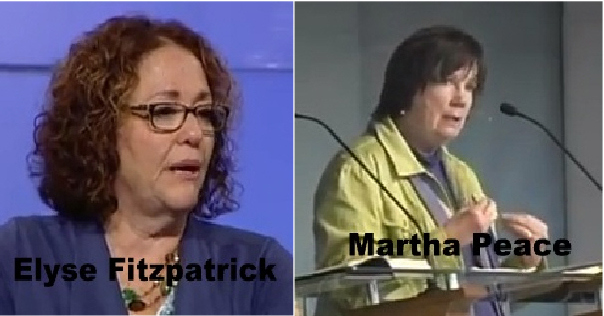
But does the Reformed tradition trump gospel truth? The answer is a resounding, “yes,” especially in the biblical counseling community. The two primary queens of that movement are Elyse Fitzpatrick and Martha Peace. Fitzpatrick has openly denied that there is any such thing as an antinomian because man is helplessly legalistic. Like all good neo-Calvinists, the poo-pooing of specific biblical truth is done without a blinking of the eye. In this case, the biblical word “anomia” is completely dismissed. And apparently, Satan came to Eve in the garden as a legalist.
Peace is a hardcore New Calvinist proponent of the active obedience of Christ and sanctification by faith alone. But yet, these two women are the toast of the biblical counseling community—even by those who refute the neo-Calvinist take on double imputation (the active and passive obedience of Christ imputed to our sanctification).
Why? Because it’s really not about the gospel. That’s why. And as far as counseling, people can’t be helped with a false gospel. No way.
paul
Comment Post: The Difference Between Old Calvinism and New Calvinism
With addendum:
Lydia,
Authentic Calvinism eventually dies a social death. It looks like the following pattern: It dies, then there is a resurgence that lasts 30-50 years. The death usually lasts about 100 years before another “rediscovery.” Remnants of the resurgence live on with more biblically grounded soteriology, but retains the name, “Calvinism.” Moreover, this is why contemporary Calvinism (the remnant) has a soteriology that is inconsistent with their eschatology. Hence, many “Calvinists” of our day contend against “New Calvinism.”
The historical rediscoveries die out as a result of:
1. The novelty wears off and the “gospel” repetition becomes boring and lifeless.
2. The saints eventually discover that it is a false gospel.
3. It is always accompanied by escalating tyranny.
4. The lack of sound doctrine regarding sanctification begins to have ill results in the lives of many people.
New Calvinism is a resurgence of authentic Calvinism with a new twist: for the first time in church history, it was systematized and packaged for the present church culture via the Australian Forum (1970). This time, it may not go away and become part of the last day antinomian blitzkrieg that will precede Christ’s return. However, Susan and I have been visiting churches that were on the cutting edge of the most recent resurgence. They were the ones who embraced this Reformed model early on as the movement was picking up steam (early 80′s). And what we are seeing is almost surreal. The best way we can explain it is: the outward expression of praise and worship with no life. Almost like skeletons raising their hands in praise to Jesus. Lots of praise and worship, but in both cases, large crowds of people move past each other like ships in the night. While the message is love, love, love, joy, joy, joy; we were not greeted by anybody. Never in my life have I seen so many unfriendly people with smiling faces.
paul
John MacArthur’s Showing Without Telling: The Reformed Way of Preaching Progressive Justification
 “Moreover, this paradigm, according to many Calvinists in our day including John MacArthur, asserts that Christians often obey and experience biblical truth that they are unaware of intellectually.”
“MacArthur had a choice: the authority of Scripture or Reformed orthodoxy; he chose the latter.”
“And, what exactly are the ‘implications’ that John MacArthur ‘explains’ from the text? If you assume a many-faceted full counsel of God, your assumptions would be dead wrong.”
Progressive justification is the gospel of John Calvin and present-day neo-Calvinists of all stripes. Forget the freewill/election debate; forget all of the haranguing over the residual issues; progressive justification is simply a false gospel.
It teaches that the power for our Christian living comes from our salvation or justification. At first, you may object to my objection on the bases that salivation makes Christian living possible, and I agree, but making Christian living possible and being directly powered by it are two opposing ideas with a crucial difference.
If Christian living is powered by our salvation (justification), and if our salvation does more than change our standing, position, or status, Christian living (sanctification) remains connected to our justification. This makes sanctification a spiritual minefield with endless and sobering implications.
Of which the least is not: preaching. When justification and sanctification are fused together, we are interacting with our justification throughout life; this would seem evident and terrifying to those who understand the implications because we can supposedly do things in our sanctification that can affect our standing before God.
Hence, in this fusion of the Reformed “golden chain of salvation” (what’s a chain?) we must be careful in how we (according to John Piper) participate in the links because we are not home free and there is a danger in sanctification. No kidding. There would be when justification and sanctification are fused together.
Furthermore, because this makes sanctification very tricky, the children of God (according to Doug Wilson) will be manifested at the last judgment. I sometimes receive complaints here at PPT that John Piper et al seem to state that we cannot know for certain whether we are saved or not until the last judgment. I am not surprised by these questions; they would be consistent with the logical conclusions one must draw from the theology.
This now brings us to our discussion about preaching. Obviously, Reformed pastors are going to be very careful not to preach in a way that will lead us in making our sanctification the ground of our justification. Or, leaping from the imperative to obedience. If we do not pre-bathe all obedience in our salvation, it is “making our sanctification the ground of our justification.” In Reformed circles, they call this, “The biblical command is grounded in the indicative event.” The indicative “event” is the crucifixion of Christ—all obedience flows from that event directly as the empowerment thereof—not a possibility that we participate in.
Therefore, all true obedience in the life of a believer is a mere natural flow experienced by joy and a willing spirit IF it is powered by our salvation. This is obtained through using our Bible to meditate on our salvation, and the works of Christ, and then just letting the Spirit take things from there. If the Spirit then instigates the obedience, it’s the Spirit applying justification to our sanctification and not us. Hence, we are safe from “making our own sanctification the ground of our justification.” Again, this is supposedly manifested and verified by joy (which Piper makes absolutely synonymous with saving faith and the struggle thereof dependent on our salvation [When I Don’t Desire God p.35]). Likewise, John MacArthur mimics the same nonsense as documented in the following PPT post:
Hence, creepy similarities to Piper’s theology appear in “Slave,” especially Pipers belief that true Christian obedience is always experienced as an unhesitating, natural response accompanied by joy. Throughout the book, MacArthur describes Christian obedience as “pure delight” and “joy-filled.” On page 208, he describes our experience as slaves to Christ as “not partially sweet and partially sour, but totally sweet.” This, despite what the apostle John clearly experienced as recorded in Revelation. But regardless of the fact that there is nothing sweeter than being a slave of Christ, to suggest that our experience is never mixed with bitterness (taste, not attitude) is just plain nonsense. A believer who has lost an unbelieving relative or close friend would be an example. Also, even though I realize the importance of joy in the Christian life, I make this observation in “Another Gospel” (page 78):
“Only problem is, among many, is the eleventh chapter of Hebrews contradicts everything in Piper’s statement above. Hebrews 11 is one of the more extensive statements on saving faith in Holy writ. The Hebrew writer defines the faith of at least twenty believers in regard to the decisions they made and obedience. Joy or pleasure, even pleasure in God, is not named once as being an attribute of their faith. The only semblance of feelings or emotions mentioned is that of strife and fear of God more than man. The truth of Hebrews 11, as well as many other Scriptures, makes a mockery of Piper’s theory of Christian hedonism.”
According to John Piper, if we find ourselves in a situation where we find no joy in the obedience—go ahead and obey, but be sure to ask God for forgiveness because of your sinful obedience (John Piper: Treating Delight as Duty is Controversial; pdf booklet available on Desiring God .org). Moreover, this paradigm, according to many Calvinists in our day including John MacArthur, asserts that Christians often obey and experience biblical truth that they are unaware of intellectually. A prime example of this would be the following excerpt from an article written by New Calvinist Bill Baldwin:
Give me a man who preaches the law with its terror and Christ with his sweetness and forgets to preach the law as a pattern of the fruit of sanctification and what will result? In two months his parishioners will be breaking down his door begging to be told what behavior their renewed, bursting with joy, hearts may best produce. And when he tells them, they will be surprised (and he will not) to discover that by and large they have produced exactly that. And where they haven’t, take them back to Christ again that they may contemplate him in all his glorious perfection so that they may better understand what sort of God and man he was and is (Bill Baldwin: Sanctification, Counseling, and the Gospel 08/02/1996).
My best information is that MacArthur bought into this nonsense circa 1994. He was persuaded by, among others, John Piper and Michael Horton that the Reformers in fact held to a progressive justification. MacArthur had a choice: the authority of Scripture or Reformed orthodoxy; he chose the latter. Therefore, MacArthur’s preaching will ape that of most Reformed teachers: heavy on the glory of God and very light on practical application or specific instruction. As Baldwin states it: “….the law as a pattern of the fruit of sanctification.”
And even though MacArthur is far more subtle in his anti-instruction/application than most Calvinists (probably due to the habits of his prior preaching which was heavy on sanctification elements), Christians have nevertheless noticed his lack of application (most likely due to the contrast) and questioned him on it. His defense reveals his dastardly selling out of the truth.
In, “Why doesn’t John MacArthur add much application to his sermons?” (Online source: http://goo.gl/P0eR9), MacArthur defends his Reformed Application Light sermons. But for you skeptics, let me get your attention. In regard to my accusation that this paradigm doesn’t require intellectual knowledge for experience or application, MacArthur concludes his defense by stating the following:
So now you know. You’ve been experiencing this. You had no idea what you were experiencing, right? (Applause) Okay.
The “applause” part of the transcript is the barf factor when one ponders the mindless following of philosopher kings such as “Pastor” John MacArthur Jr. Nevertheless, MacArthur continues:
Now let me tell you what happens when you preach effectively. You do explanation. In other words, you explain the meaning of Scripture, okay? The explanation carries with it implication. In other words, there are implications built into this truth that impact us. You add to that exhortation. And I’ve said things tonight to exhort you to follow what is implied by the text. Now when you deal with the text and the armor of God, like tonight, all I can do is explain it. That’s all it does. There aren’t any applications in that text. It doesn’t say, “And here’s how to do this if you’re 32 years old, and you live in North Hollywood.” “Here’s how to do this the next time you go to a Mall.” “Here’s how to do this when you go in your car and you’re driving in a traffic jam.” It doesn’t tell you that. And if I made my message mostly a whole lot of those little illustrations, I would be missing 90 percent of you who don’t live in that experience.
Unfortunately, MacArthur has gone the way of New Calvinist ungodly communication. He makes application of Scriptures the same thing as applying it to petty life concerns; such as, going to the mall. It’s the classic New Calvinist demeaning of biblical application and obedience. What is really behind it is an antinomian spirit. Let me point out MacArthur’s error in regard to the above quote concerning the idea that there is no application in Ephesians 6:16-20, only “explanation.” That text is full of imperatives and applications in regard to the full armor of God: “Put on…., stand against…, take up…, that you may be able…., having done all…., having put on…., Stand therefore…., having fastened…., and having put on…., in all circumstances [what circumstances? It would be wrong to draw examples from our life?]…., with which you can…., to that end…., [etc., etc., etc].” To imply that Ephesians 6:16-20 doesn’t contain instruction for practical application is ludicrous.
Also, adding to the absurdity of MacArthur’s statement is the fact that “putting on” is a major theme of that passage. This refers back to Ephesians 4:20-24, and the Apostle Paul’s discussion of putting off the old nature and putting on the new. So, MacArthur is not only denying application from our life experience, but specific life application specified in Scripture. Dr. Jay E. Adams notes 45 life applications to the putting off/putting on concept that he didn’t deduct from life observation, but are specifically mentioned in Scripture regarding life application (INS Training in Biblical Counseling by Extension: Introduction Principles and Practices; pp.22-24).
Surely, other than what good preachers should be able to draw from life for biblical application, specific biblical applications regarding life are too numerous to list. For example, Paul states in I Corinthians 7:41 that Christians should only marry “in the Lord.” The life application is what Nehemiah stated about Solomon when he didn’t follow that mandate; ie., even a man of his spiritual wherewithal fell into grievous sin by violating said spiritual principle.
Nehemiah 13:26
Was it not because of marriages like these that Solomon king of Israel sinned? Among the many nations there was no king like him. He was loved by his God, and God made him king over all Israel, but even he was led into sin by foreign women.
No life application in that? Really?
MacArthur continues:
It’s not for me to do that. Application belongs to the Spirit of God. All I’m interested in is explanation and its implications [What about 2Timothy 3:16,17 and the issue of “instruction” ?]. And the power comes in the implication and the Spirit of God takes the implications of what I’ve said tonight, all these things I’ve said, I don’t need to say all kinds of little scenarios to you and paint all kinds of little individual circumstances. All I need you to know is this is what the Word of God says and the implications are powerfully brought to bear with authority on your life and I exhort you to respond to those implications, it is the Spirit’s work to drive those implications into direct and personal application. That’s why you’re not going to, like so many preachers, you’re not going to hear me create all kinds of practical scenarios about how this all fleshes out in everybody’s world because you may hit somebody, you may hit a person here or there, that’s kind of a rifle-shot approach, the shot-gun approach that sprays everybody is the implicational essence of Scripture. That’s the power. And that’s when everybody walks out and says, “Wow, that hit me!” because you already have a commitment to the authority and the power of Scripture.
So, Reformed preaching merely explains Scripture, and the Holy Spirit applies it. So what do we need “instruction” for? (2Timothy 3:16,17). As we have clearly seen, this is an iffy proposition. If this is the case, why does the Bible command specific life application? Does the Spirit need to inform Christians as to what He may or may not do in their lives? I contend that this is MacArthur’s nuanced way of propagating the whole Reformed idea that the Holy Spirit obeys for us, so that our sanctification will not be the “ground of our justification.”
MacArthur further explains:
You already have a commitment to the truthfulness of Scripture. All I want you to understand is what it means. And in the meaning expanded beyond the given text to other texts so that you build all the theological implications, I leave you with the implications and an exhortation to be obedient and I leave the application to the Spirit.
Obedient to what? Obviously, there can be no specific instruction from the pulpit, only “explaining.” Instruction would imply specific application of the text. So, not only does the Holy Spirit apply the text, does he also teach the Christian how to apply it specifically? Or does that just come as a mere natural flow? Well, since, “So now you know. You’ve been experiencing this. You had no idea what you were experiencing, right?” Answer: like Baldwin, and for that matter, all New Calvinists, the “obedience” is “experienced” (not personally applied) without necessary intellectual understanding or knowledge. Let me reiterate MacArthur’s exact words:
So now [present tense] you know. You’ve been [past tense] experiencing this [experiencing what? Answer: obedience]. You had no idea [this should speak for itself….] what you were experiencing, right?
Right John. Whatever you say.
And, what exactly are the “implications” that John MacArthur “explains” from the text? If you assume a many faceted full counsel of God, your assumptions would be dead wrong. MacArthur makes it clear what should be primarily mined from the Scriptures in his Forward to Rick Holland’s Gnostic masterpiece, Uneclipsing The Son:
As believers gaze at the glory of their Lord—looking clearly, enduringly, and deeply into the majesty of His person and work—true sanctification takes place as the Holy Spirit takes that believer whose heart is fixed on Christ and elevates him from one level of glory to the next. This is the ever-increasing reality of progressive sanctification; it happens not because believers wish it or want it or work for it in their own energy, but because the glory of Christ captures their hearts and minds. We are transformed by that glory and we begin to reflect it more and more brightly the more clearly we see it. That’s why the true heart and soul of every pastor’s duty is pointing the flock to Christ, the Great Shepherd….The pastor who makes anything or anyone other than Christ the focus of his message is actually hindering the sanctification of the flock.
What MacArthur endeavors to “explain” in every verse of Scripture is Jesus and His works (as stated by many New Calvinists), “not anything we would do.” As can be seen in the above MacArthur quote, he also follows the Reformed tradition of making God the Father and the Holy Spirit of lesser significance than Christ. Sadly, throughout church history, those of Reformed tradition has burned many at the stake for misrepresenting the Trinity while they are in fact guilty of the same thing.
There is certainly no reason to believe that MacArthur has not completely embraced this doctrine which also suggests that the saints can only get an adequate explanation of the Scriptures from Reformed elders. Saints dare not even fill up half of their plate with anything but Reformed elder preaching:
You think, perhaps, that [you] can fill up the other half of the plate with personal study, devotions, or quiet times, or a radio program. Beloved, you cannot. Scripture is relatively quiet on such practices. But on preaching, the case is clear and strong. Neglect preaching and neglect your soul (Elder Dr. Devon Berry: How to Listen to a Sermon; Clearcreek Chapel .org).
MacArthur’s defense of his preaching being discussed here implies the same idea:
But I want you to understand, if you don’t already understand, what I think should happen in effective biblical preaching. You heard a testimony tonight in the waters of Baptism from Juan about how he kept coming to Grace Church. And in spite of the fact that he wanted to be a hypocrite, the power of the Scripture began to overwhelm him.
Notice that the “power of the Scripture,” which should be understood in context of what we are discussing here, is not the primary crux of the point, but rather, “….he kept coming to Grace Church.” The “power of the Scripture” coming from the pulpit at Grace Church seems to be the point, and would also fit with the Reformed view of anointed elder preaching. MacArthur’s Bible Commentary is now published in the official New Calvinist translation of the Bible, The English Standard Version. It is published by Crossway, which is totally in the tank for New Calvinism. In the following promotional video clip, MacArthur hails the translation as the best ever: http://youtu.be/L1VxhQqsGXU. Again, MacArthur is now a dyed in the wool New Calvinist in the same order of the ones he supposedly despises like Mark Driscoll. While whining about their view of alcohol use among Christians and other residual issues, he is a believer in the same gospel (progressive justification).
The fact that John MacArthur is one of the most popular preachers in church history should be a chilling realization for those Christians who still love the truth.
He is also an excellent acid test for those who really want to know if they are followers of men or followers of the truth.
paul
The PPT Francis Chan Archives
There have been a lot of requests for information on Francis Chan of late. Not sure why, but nevertheless, hope this helps. Click on title links below:
Can Anybody Say Nothing Better Than Francis Chan?
Francis Chan Not Sure That Hell Is Eternal Suffering
Chan, Carson, Piper, Tchividjian Verses the Holy Spirit On “Rules”
Ok, Let’s Go Over This Again: Crazy Truth
Francis Chan’s “Crazy Love” is Really Antinomian Puppy-Love

 Paul's Passing Thoughts
17 comments