Question Concerning Last Sunday’s Potter’s House Message is Key
 “The answer to this question identifies a definitive difference between the two primary gospels of our day. The major difference is how we participate in sanctification, and what that states in regard to what we believe about justification.”
I received the following question concerning Sunday’s message at the Potter’s House: “Regarding your statement, ‘It [the gospel] solves the paramount problem of mankind being unreconciled to God, and then continues to solve the myriad of problems associated with the fall, or the fallout thereof. The gospel is the truth that resolves the fall, and the fallout in our lives. The gospel not only solves the fall, but the fallout as well.’ My question is, how does that differ from saying the same gospel that justifies us [dealing with the fall] also sanctifies us [the fallout as well]? I believe you are right; the gospel deals with both.”
The answer to this question identifies a definitive difference between the two primary gospels of our day. The major difference is how we participate in sanctification, and what that states in regard to what we believe about justification. In the Potter’s House series on the book of Romans we identify the gospel as a call unto all mankind to commit one’s life to the full body of God’s truth for life and godliness. This includes believing that Christ made a way for us to be reconciled to God through His death for our sins, and His resurrection on the third day. It also includes a commitment to “obey the gospel” and “accept the word.” Obeying the gospel, accepting the word, and obeying/loving the truth are terms used synonymously with “the gospel” throughout the book of Acts and the New Testament in general. Saving faithis not a mereacclamation and mental ascent to the death, burial, and resurrection even if it is accompanied by a “treasure chest of joy” as John Piper teaches.
To only believe in the death, burial, and resurrection, and make no commitment to “obey all that I have commanded” is to join the world in suppressing the truth, putting our light under a basket, being salt that has no saltiness, and building our house upon the sand. The commitment to the full gospel saves us, not the doing of it. Jesus is “Lord and Savior”—not just savior. The commitment justifies us and seals us till the day of redemption. Therefore, to think that any of our doing in kingdom living maintains our justification is foolish because we are trying to contribute to a work that is already finished. This is Paul’s point in the letter to the Galatians which many New Calvinists twist to their own destruction. However, our learning and practice of the whole gospel (God’s revealed [and many-faceted] truth for life and godliness) does result in assurance of salvation (see 2Peter chapter 1, especially verses 5-11).
So, this gospel teaches a dependent colaboring with God in the sanctification process. OUR efforts may be aggressive in this because our part in the work does not, and cannot effect the work that is already finished by Chrsit: justification. Our work in this process is imperfect because we still dwell in mortal bodies, but there is a redeemed part of us that is US, or it wouldn’t war against our mortality that possesses a remnant of sin (Romans 7:21-23). As we will see as we progress in our study of Romans, Paul explains in painstaking detail why the redeemed still sin. However, he also explains why sin no longer characterizes the life of a believer.
So, to now answer the question, what is the difference between being sanctified by this gospel and the other gospel? The answer is simple: one gospel is a full body of truth that includes the death, burial, and resurrection WITH instruction for us to learn and apply while the other gospel is confined to the death, burial, and resurrection of Christ and is strictly information in regard to the works of Christ alone. This becomes a prism in which all reality and manifestations flow. Hence, the focus is meditation on the “gospel narrative,” and then reality flows from that. Not only is our Christian life powered by contemplating the works of Christ only, but reality itself flows from it. The premise of its hermeneutic is that all human history is redemptive (gospel) and is a predetermined gospel narrative. By searching the Scriptures for everything Jesus, and seeing our own responses to life in the lives of the biblical characters, we place ourselves into the gospel narrative and live in redemptive reality. History, from the big picture to the little picture of our lives, is a grand gospel narrative, and we enter the plot by seeing our own sinfulness in the Scriptures as set against Christ’s redemptive works (see page 94 of Paul David Tripp’s “How People Change”).
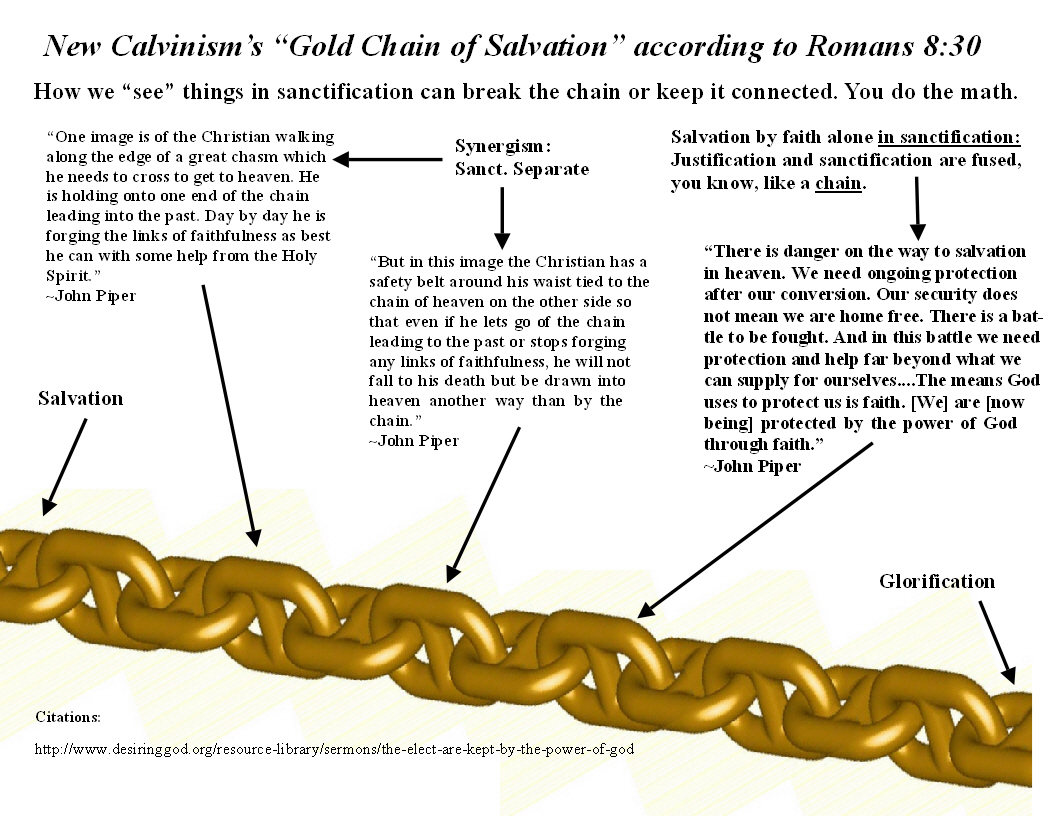
Therefore, instead of a full orbed knowledge of truth that includes the works of Christ that we learn and apply to our lives with intentionality, we rather meditate on the gospel narrative and await “new and surprising fruit” (How People Change pp. 207-221). To not do this is to “jump from the imperative to obedience.” Biblical commands are to show us what Christ did for us and what we are unable to do—that’s the purpose of the Scriptures—not the former purpose. Anything that does not flow naturally from the proper Reformed procedure for gospel contemplationism is works salvation because their way is “offering the works of Christ to God the Father by faith alone and not our own works.” This is critical because the Reformed gospel sees salvation as a “golden chain” in which sanctification connects justification to glorification. Therefore, we must be sanctified the same way we were justified in the links that connect justification to glory: by faith alone. Justification is not a finished work, it is a “golden chain” leading to glorification. However, Romans 8:30 speaks of glorification as being finished as well—no “golden chain” is needed. I believe Scripture speaks of glorification as a finished work as a way of stating that it is guaranteed because justification is finished. Therefore, Romans 8:30 speaks specifically to the separation of sanctification and justification.
This is why aggressive obedience is not a reason for concern in the prior gospel; there is no “link” between justification and sanctification. OUR works in sanctification are therefore the mode, and is intentionally mixed with our faith for the purpose of pleasing God. Though the will to do so is a gift from God, that doesn’t exclude our responsibility to make use of the gift!
So, one gospel is a full body of truth that we learn and practice in the sanctification process without fear of it being works salvation while the other gospel sanctifies us through faith alone—utilizing meditation to manifest the works of Christ and not our own.
That’s the difference.
paul
My Reply to a Reformed Pest
["pastor"],

Yawn, yawn, and more yawn. I am not moved in the least by your baseless ramblings. You
constantly go back to the same old Reformed elitist playbook. It won't work with me. It's
all the same worn out manipulation to throw thinking people off the scent leading them to
the truth. And the truth is: the Reformation is the biggest hoax ever perpetrated on
mankind. Never has something so vile ever been masterfully dressed to look so good. It is
nothing more than Communism in biblical garb.

The Reformation fruit can be seen in European church history where it incited war, after
war, after war. In this culture where law prohibits its collusion with government, it
propagates its tyranny through subtle manipulation and mind control. It is the exact same
metaphysical philosophy that drives all cults, but evades the accusation via its own
establishment of "orthodoxy." Its creeds, confessions, and counsels speak to the arrogant
idea that the totally depraved saints need to be told what their own copies of the word of
God state. There is a reason why Reformed churches behave no differently than the Catholic
Church though they prefer a different doctrine designed to control people; they have the
same father.

The Popes, and the Westminster Divines; what's the difference? Nothing. The Popes stating
that the saints need them to interpret the Bible, and the Westminster Divines saying they
need to explain to the saints how each and every verse is about Jesus and nothing else,
what's the difference? Nothing. Pedophile Priests, excommunication and slander used to
silence critics, and other various acts of tyranny and injustice while clergy stands
silent; what's the difference between the two? Nothing. The difference between all of that
and the latest SGM scandal: absolutely nothing.

I measure my success in communicating the truth by the persecution. Reformed folks can't
help themselves; challenges to their ideas are intolerable to their humble theological
egos. Their thoughts lust after the desire to have a theocracy like Calvin had where
people who ask too many questions are burned at the stake. For now, they can only try to
comfort their souls with the tools of excommunication, slander, dividing families, and
mind control.

paul
Reformed Response to PPT Helps Me Make My Point About Their Heresy
A Response to some of my recent posts is just too juicy to pass up because it helps me make my point. The article was written by one of the early advocates of New Covenant Theology which was a spin on Luther’s law/gospel concept that came out of the Australian Forum via Jon Zens. Zens was one of the core four of the Australian Forum along with Robert Brinsmead, Graeme Goldsworthy, and Geoffrey Paxton. They are the true, and original core four, not those other dorks.
I owe them a debt of gratitude for articulating so well what the Reformers really believed which is going to make the second volume of “The Truth About New Calvinism” much easier to write. I have actually corresponded with Brinsmead who owns a rockin’ fruit farm in Australia. I wanted to go over there and hang with him but Susan said we couldn’t afford it. Oh well. Some say he is an atheist now, but that isn’t true. Actually, what he now believes is much healthier than Reformed Theology.
The title of the post is, “Straw Man Arguments About Justification and Sanctification.” A Reformed definition of a “straw man” is: a man that burns really, really fast on a stake and doesn’t scream at all. That’s why “straw man” has such negative cogitations in Reformed circles.
I will skip the usual Reformed crybaby stuff that prefaces the introductions to Reformed writings about “unity,” “secondary issues” etc, and get to the meat of the issue.
The name of the blog is “Truth Unchanging” which has Platonist cogitations. Plato, the daddy of Reformed theology (as will be documented in “The Reformation Myth”), believed that anything that changes form cannot be truth. That would exclude the material world, and explains the crux of why Reformed hacks are so opposed to dispensationalism, albeit a lot of them don’t realize it. Basically, most of them don’t like dispensationalism because John Piper says it’s naughty.
The author’s first point follows:
In matters that concern the purity of the gospel, it is clear there are mis-statements that are so grave that the very gospel itself is in danger of being lost. For example, if a person denies the concept of imputation, he has denied the heart of God’s good news. If the sinner’s justification depends to any degree on his faithfulness to God’s covenant, the so-called “good news” would become bad news. Not only do the unconverted sinner’s best works of “righteousness” fall short of meeting God’s standard for justification, but the believer’s best obedience also fails to meet that standard. God requires perfect, continual, and internal obedience to his Law. What one of us can claim that we have loved God, perfectly, continually and from the heart? I would like to believe I love God, yet I would never profess that, even as a believer, I love him with all my heart, soul, mind and strength.
This is a shocking admission, but very indicative of Reformed theology. A perfect obedience to the law must be maintained during the believers sanctification. The apostle Paul went out of his way in his gospel letter to the Romans to refute this very tenet, but it is in fact the crux of the Reformation gospel. A change of standard is counter-intuitive to the Greek philosophy that Reformed theology was founded on. But Paul makes it clear: God imputed a righteousness that is “apart from the law.” This is also why the Reformers were against the dispensationalist idea of two judgments and two resurrections. Two different judgments suggest that one judgment can’t be based on the law because believers are no longer “under the law, but under grace” ….for justification. The Reformed view of imputation then becomes a progressive imputation of Christ’s perfect obedience to uphold the standard of the law during our sanctification. This is called “Christ’s active obedience.”
The author continues:
The reality is that God doesn’t declare righteous those who are righteous in and of themselves. Nor, does he justify sinners because through the infusion of grace, i.e., enablement, these sinners have attained a level of faithfulness to God’s covenant that God is now able to declare them righteous, despite their failure to attain the level of perfection the Scriptures teach us he requires.
Though the goal of perfection is required in sanctification, this is another clear-cut statement showing that a perfect keeping of the law is required to maintain the just standing of the believer. The usual argument is that since Christians sin, they have no righteousness in, and of themselves that can maintain the standard. But this is the exact idea Paul was refuting when he wrote, “….because the law brings wrath. And where there is no law there is no transgression.”
Notice that in true Reformed tradition, the author denies “the infusion of Grace”; ie, the new birth, of which Christ said we must have for salvation. The key here is the fact that we are considered Holy because there is no law that can judge us for justification, the penalty thereof has also been paid by Christ, we have the seed of God within us, and the old us has been crucified and is dead. And therefore, “….is no longer I who do it, but it is sin living in me that does it.” As Christians, we can therefore obey the law in a way that pleases God as opposed to the way we were before we were crucified with Christ.
The author then states a lot of things about justification that no one would disagree with, but then pulls the Reformed missing transition between justification and sanctification communication technique:
What, then, is God’s standard? Paul’s answer is clear. It is perfect, continual and inward obedience to God’s Law. He wrote, “For it is not the hearers of the Law who are righteous before, but the doers of the law who will be justified [declared righteous]” ( Romans 2:13).
The author cites Romans 2:13 as a standard for justification regarding believers, but it is not. That verse speaks of the direction of the saved, and not the perfection in comparison to those who are unsaved. This is clear if you observe the preceding text in 2:6-11:
He will render to each one according to his works: 7 to those who by patience in well-doing seek for glory and honor and immortality, he will give eternal life; 8 but for those who are self-seeking and do not obey the truth, but obey unrighteousness, there will be wrath and fury. 9 There will be tribulation and distress for every human being who does evil, the Jew first and also the Greek, 10 but glory and honor and peace for everyone who does good, the Jew first and also the Greek. 11 For God shows no partiality.
Why would those who keep the law perfectly need “patience” in well-doing? It speaks of the desire of the saved who are hindered by sinful mortality. This is a sanctification verse.
The author continues:
Now, we must ask two questions: 1. What sinner is there among us who has met that standard? Paul’s answer is, “not one!” 2. Who has been subjected to that standard who has met the standard perfectly? The answer is, only one! Paul argues that “since by man came death, by man came also the resurrection of the dead.” It is not a divine righteousness our case demands. It is a perfect human righteousness, defined by God’s perfect standard. Our case demands a righteousness defined as unbridled, wholehearted love for God that is manifested in an unswerving commitment to God’s revealed will.
The good news is that believers are given credit for that kind of love for God and obedience to his will that even in our best moments we do not possess personally.
Here is another shocking admission, but again, uniquely Reformed: God’s declaration of His imputed righteousness to the believer, based on their belief in Christ is not enough, it must be a perfect human righteousness! This is exactly why the preponderance of Scripture states that it is God the Father’s righteousness that was imputed to us, and with the exception of one or two verses where it is inferred, not the righteousness of Christ.
Romans 8:30 states specifically that God’s righteousness was imputed to us and our glorification guaranteed before creation. The significance of Christ’s perfect obedience is the fact that He was the only man “born under the law” (Galatians 4:4) that could go on to die on the cross for the world’s sins without being tempted by the law or condemned by it. All other men are provoked to sin by the law, will be judged by the law, and condemned by the law unless they believe on Christ. They are under law, not grace, and enslaved to sin. Christ’s perfect life on earth was not part of the atonement, but was necessary in order not to be condemned as one born under the law like all other people born into the world. He was the only man who ever lived on Earth that could have come in order to pay the penalty of sin for all of mankind because He was able to keep the law perfectly. But His obedience was not then imputed to our sanctification.
The rest of the article is just a bunch of doublespeak with intent to fog the issue. It can be summed up this way: we supposedly work, but our work is not in combination with God for a result in sanctification. We work because God works first, and oh, by the way, Christ’s obedience must be added to it as well. They make it sound like a colaboring, but in the end, remember that they reject a separate resurrection and judgment concerning rewards.
They instead believe in one resurrection and one judgment to determine who is justified….
….by maintaining our justification by faith alone in sanctification.
paul
Are Calvinists Saved?
The begging of the question has a sound Scriptural argument.
This ministry has made much of the critical importance of separating justification (salvation) and sanctification (growth in holiness, or kingdom living). The Reformed (Calvin/Luther Reformation doctrine/gospel) “never separate, but distinct” doublespeak doesn’t cut it in the arena of truth, and we will see why. “Never separate” =’s false gospel. If you get a little lost in the first part of my argument which gives the lay of the land, don’t worry, when I get into the specific Scriptural argument, it will clear things up and make it all come together for you.
It must delight the ghosts of the Reformation that the argument has always been in the arena of freewill verses predestination. It’s the primary thrust of this ministry to change that argument. This isn’t a quibbling about semantics in the mainstream—this is about the truth of the gospel. As New Calvinist Russ Kennedy once thundered from the pulpit in his mousy voice: “Any separation of justification and sanctification is an abomination!”
I have often argued from the standpoint of this issue. If sanctification is the middle of the Reformed “golden chain of salvation” then sanctification is part of finishing justification. This means that what happens in sanctification determines whether or not justification is properly finished. What’s a chain? John Piper even preached a message about the eternal importance of our contribution to the “links” in just the right way. In essence, sanctification becomes a spiritual minefield.
This is exactly the same thing that the Reformed crowd has always accused Rome of: the fusing together of justification and sanctification. However, as we shall see, they are both guilty of the exact same heresy/false gospel. As we shall see, both teach that sanctification finishes justification.
This is a linear gospel (one unified chain from salvation to resurrection (glorification) versus a parallel gospel with salvation on one plane as a finished work before the foundation of the world, and kingdom living that runs parallel with the finished work and reflects the reality of our salvation until glorification. Typical in the linear gospel is the idea that Christ died for all of our past sins, but we must now finish the work (with the Holy Spirit’s help [sanctified works salvation]) until glorification when we are completely transformed into complete holiness. This is the often-heard bemoaning of “Christ PLUS something.”
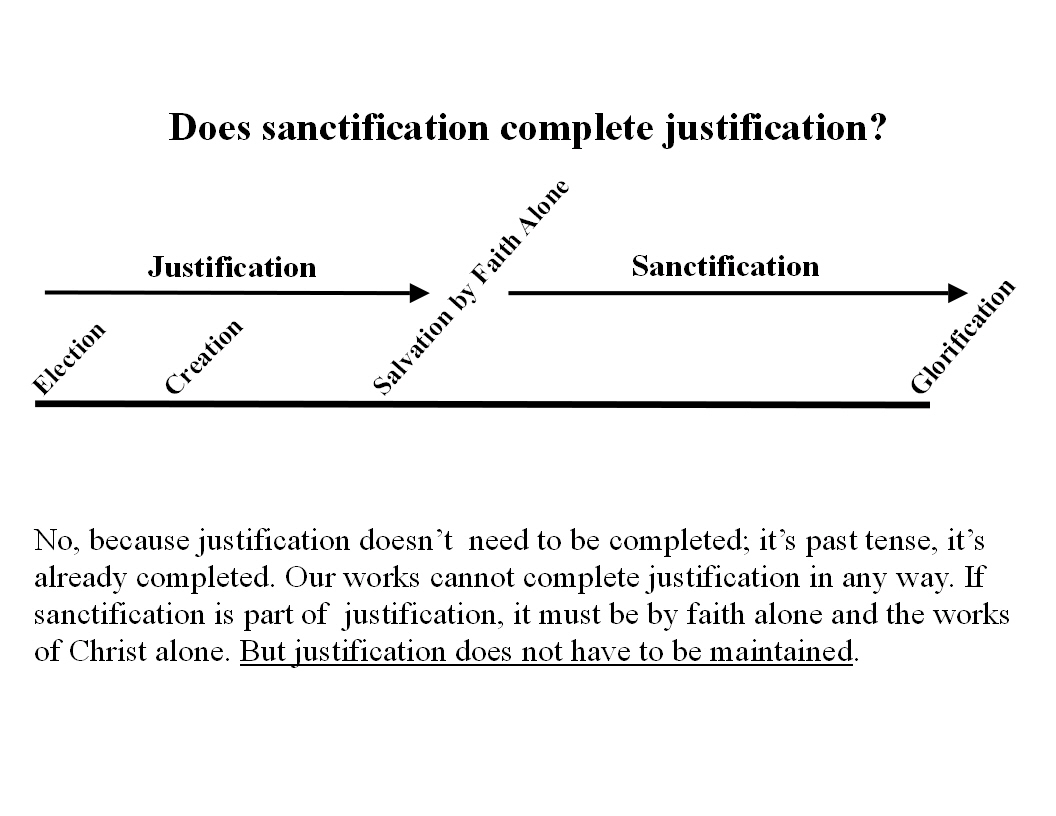
An excellent example is some strains of Freewill Baptists who teach that Christ died for all of our past sins, but with the help of the Holy Spirit, we must confess and repent of every sin we commit until the resurrection; e.g., Christ plus salvation by repentant prayer for sins committed after we are “saved.” My grandparents were saved out of this tradition. When my grandfather asked my grandmother if she thought that God could ever forgive him of all the sins he committed, she answered: “Yes, but you are going to have to pray awful hard!” Praise God that through the ministry of several individuals my grandparents eventually abandoned that gospel for the true one of salvation by faith alone as a finished work.
Likewise, Rome teaches that you must let the Catholic Church finish your justification through ritual; e.g., Christ plus Catholic ritual. The Reformation gospel is also Christ plus something else, but the something else is ever-so-subtle. In both cases, sin must be dealt with in sanctification in order for the saint to remain justified until the final judgment. In other words, the righteous standard of justification must be maintained on our behalf. Like all other proponents of a linear gospel, the Reformed crowd contends that anything less than the perfection demanded of the law (“all sin is transgression of the law”) is “legal fiction.” So both Rome and the Reformers agree: justification must be maintained by sanctification, and in the case of the Reformers specifically, they believe that the perfect standard of the law must be maintained until glorification; otherwise, our justification is “legal fiction.”
Here is where Reformed subtlety is uncanny: Christ keeps the law for us in sanctification. He maintains the perfect standard. All the fruit of sanctification (obedience/good works) flows from the life He lived on Earth and His death on the cross. Christ plus the works of Christ to finish salvation. “But Paul, what in the world is wrong with that!” Here is what is wrong with it: works are still required to maintain justification. That is a huge problem, even if it is Christ doing the work. What did the Hebrew writer say about Christ’s work for justification not being complete?
And even more subtle is the following Reformed idea: believing that the law is no longer a standard for maintaining justification is antinomianism. Antinomianism =’s legal fiction. Their definition of antinomianism is the removal of the law from justification as the standard for maintaining it. Traditionally, among Biblicist, antinomianism is the removal of the law from sanctification, and herein lays even further steroidal subtlety: the Reformed theologians would refute a removal of the law from sanctification as well, not only because they think justification and sanctification are the same thing, but because its perfect keeping is required to maintain a true declaration of the just that is not “legal fiction.”

However, the Biblicist believes that the law is a standard for kingdom living and is no longer a standard for justification. Therefore, if we attempt to obey it with the Holy Spirit’s help, and to please/serve the Lord, it can have no bearing on our just state. While the Biblicists think they are therefore joint contenders with the Reformers against antinomianism, such is far from the truth. The Reformed mind believes the Biblicist is either a legalist or an antinomian, or both. The Biblicist is supposedly an antinomian because he/she has removed the law from justification as a just standard, or is a legalist because they think they should strive to keep the law in sanctification. Since sanctification finishes justification’s perfect standard of law keeping, our “own” attempts to keep the law in sanctification is an attempt to finish justification. Hence, what the Biblicist fails to understand is the Reformers belief that Christ must maintain the law for us in sanctification because justification and sanctification are not separate. Anything more or less is supposedly works salvation.
On the other hand, because it is vital that Christ obeys the law for us in sanctification, the likes of John Piper and Tullian Tchividjian contend that those who are really preaching the Reformed gospel will indeed be accused of antinomianism. All in all, their position is easy to see if you pay attention. John Piper and many other Calvinists often state that, “Good works are the fruit of justification.” And, “Justification is the root, and sanctification is the fruit.”
Well, the average Biblicist then thinks, “Yes, but of course, our salvation makes good works in sanctification possible.” But that’s not what they are saying. If you pay closer attention, they are saying that justification is a tree that produces its own fruit. Justification is the root, and whatever happens in true sanctification is the fruit of the root of the justification tree. Problem is, justification doesn’t grow. Justification is a finished work. What Calvinists refer to as “progressive sanctification” is really the fruit of the root: progressive justification. Another name for this that they throw around is “definitive sanctification.” The word “definitive” refers back to the definite completion of justification.

Revision: this ministry now rejects the idea that orthodoxy is truth; orthodoxy is the traditions of men. Never in Scripture do we find premise for a body of teaching that explains the teaching. The above illustration is valuable for demonstrating that the fruit of justification is glorification, NOT sanctification.
This brings us to the Scriptural argument which begins with a question I asked myself just this morning: “Paul, you are always harping about the crucial importance of the separation of justification and sanctification—a parallel gospel versus a linear one. But where does the Bible say specifically that this is critical?”
First, the very definition of a lost person in the Bible is one who is “under the law”:
Romans 3:19
Now we know that whatever the law says it speaks to those who are under the law, so that every mouth may be stopped, and the whole world may be held accountable to God.
Romans 6:14
For sin will have no dominion over you, since you are not under law but under grace.
Romans 6:15
What then? Are we to sin because we are not under law but under grace? By no means!
1 Corinthians 9:20
To the Jews I became as a Jew, in order to win Jews. To those under the law I became as one under the law (though not being myself under the law) that I might win those under the law.
Romans 7:1
Or do you not know, brothers —for I am speaking to those who know the law—that the law is binding on a person only as long as he lives?
Romans 7:2
For a married woman is bound by law to her husband while he lives, but if her husband dies she is released from the law of marriage.
Romans 7:3
Accordingly, she will be called an adulteress if she lives with another man while her husband is alive. But if her husband dies, she is free from that law, and if she marries another man she is not an adulteress.
The unsaved are “under the law” and will be judged by it in the end. This is the very definition of the unsaved. Calvinists define Christians the same way—we are supposedly still under the law and will be judged by it in the end. That’s why Christ must keep the law for us—because we are still under it.
If not this position, why do many in the Reformed tradition hold to the idea that Christ’s perfect obedience is imputed to our sanctification? His death justifies us, and His perfect life sanctifies us. Hence, His death pays the penalty for past sins, and then His perfect life imputed to our sanctification keeps us justified. Why would an imputation to our sanctification be necessary if we are no longer under the law? This is known as the Reformed view of “double imputation” and has been called out as heresy by many respected theologians for this very reason: it implies that Christians are still under the law.
In regard to sustaining the law in our stead, why? It has been totally abolished in regard to our just standing:
Romans 3:20
For by works of the law no human being will be justified in his sight, since through the law comes knowledge of sin.
Romans 3:21
But now the righteousness of God has been manifested apart from the law, although the Law and the Prophets bear witness to it—
Romans 4:15
For the law brings wrath, but where there is no law there is no transgression.
The keeping of the law by anybody DOES NOT do anything to justify mankind:
Romans 3:28
For we hold that one is justified by faith apart from works of the law.
Here is where the separation of justification and sanctification is vital on this first point: we ARE NOT under the law for justification, but rather UPHOLD THE LAW in sanctification. The two must be separate because of the differing relationships to the law:
Romans 3:31
Do we then overthrow the law by this faith? By no means! On the contrary, we uphold the law.
Romans 6:15
What then? Are we to sin because we are not under law but under grace? By no means!
Furthermore, if we are still under the law (whether or not Christ obeys it for us to keep us in a just standing), this means we are still under the power of sin. Being under the law and also under its spell to provoke sin in the unregenerate is spoken of as being synonymous in the Bible. Those who are “under the law” are also under the power of sin and enslaved to it:
Romans 7:4
Likewise, my brothers, you also have died to the law through the body of Christ, so that you may belong to another, to him who has been raised from the dead, in order that we may bear fruit for God.
Romans 7:5
For while we were living in the flesh, our sinful passions, aroused by the law, were at work in our members to bear fruit for death.
Romans 7:6
But now we are released from the law, having died to that which held us captive, so that we serve in the new way of the Spirit and not in the old way of the written code.
Romans 7:8
But sin, seizing an opportunity through the commandment, produced in me all kinds of covetousness. For apart from the law, sin lies dead.
If we are still under the law, and will be judged by it, whether or not Christ stands in the judgment for us with His own works, we are still enslaved to sin by virtue of being under the law…. for justification. And Calvinists know this to be true, that’s why they say we are still…. what? Right, even as Christians, “totally depraved.” And, “enemies of God.” Of course, throughout the Bible, Christians are spoken of as being friends of God and no longer His enemies. Our status as enemies of God is stated in the past tense. But the Reformed crew continually state that Christians are vile enemies of God and are enslaved to sin. They realize that this goes hand in hand with being under the law.
To the contrary, dying to the law in the death of Christ….for justification—sets us free to be enslaved to the righteousness that is defined by the law. We are dead to the law for justification and alive to obey truth….for sanctification:
Romans 8:2
For the law of the Spirit of life has set you free in Christ Jesus from the law of sin and death.
Romans 8:3,4 [emphasis by author]
For God has done what the law, weakened by the flesh, could not do. By sending his own Son in the likeness of sinful flesh and for sin, he condemned sin in the flesh,….in order that the righteous requirement of the law might be fulfilled in us, who walk not according to the flesh but according to the Spirit.
Romans 8:7
For the mind that is set on the flesh is hostile to God, for it does not submit to God’s law; indeed, it cannot.
Romans 9:31
but that Israel who pursued a law that would lead to righteousness did not succeed in reaching that law.
John 17:17
Sanctify them in the truth; your word is truth.
James 1:25
But the one who looks into the perfect law, the law of liberty, and perseveres, being no hearer who forgets but a doer who acts, he will be blessed in his doing.
So, that is the separation that must be for the true Christian: Justification has no law for which we are judged, and we live by the law of blessings in sanctification.
This brings us to another important separation in the two: the judgments. Those under the law and sin will stand in a final judgment which will be according to the law. Again, because Calvinists believe that we are still under the law, albeit that Christ obeyed/obeys it for us, Christians will supposedly stand in the same judgment as the damned who are under the law and enslaved to it. At that time, the children of God, according to Calvinists, will be “made manifest.”
But because Christians are not under the law and cannot be judged by it, they will stand in a judgment for rewards and not a judgment that determines a perfect keeping of the law by Christ in our stead. Hence, there will be two different resurrections: one for those under the law and another for those under grace, and two different judgments for the same two groups. One for rewards, and one to determine if those under the law kept it perfectly. That judgment doesn’t go well for any standing in it.
Luke 14:12-14
He said also to the man who had invited him, “When you give a dinner or a banquet, do not invite your friends or your brothers or your relatives or rich neighbors, lest they also invite you in return and you be repaid. 13 But when you give a feast, invite the poor, the crippled, the lame, the blind, 14 and you will be blessed, because they cannot repay you. For you will be repaid at the resurrection of the just.” [Notice that this is a resurrection for the “just.” They are already determined to be just before they are resurrected].
2Corinthians 5:9,10
So whether we are at home or away, we make it our aim to please him. 10 For we must all appear before the judgment seat of Christ, so that each one may receive what is due for what he has done in the body, whether good or evil.
1Corintians 3:11-15
For no one can lay a foundation other than that which is laid, which is Jesus Christ. 12 Now if anyone builds on the foundation with gold, silver, precious stones, wood, hay, straw— 13 each one’s work will become manifest, for the Day will disclose it, because it will be revealed by fire, and the fire will test what sort of work each one has done. 14 If the work that anyone has built on the foundation survives, he will receive a reward. 15 If anyone’s work is burned up, he will suffer loss, though he himself will be saved, but only as through fire.
Hebrews 6:10
For God is not unjust so as to overlook your work and the love that you have shown for his name in serving the saints, as you still do.
Revelation 20:6
Blessed and holy is the one who shares in the first resurrection! Over such the second death has no power, but they will be priests of God and of Christ, and they will reign with him for a thousand years.
Revelation 20:11-15
Then I saw a great white throne and him who was seated on it. From his presence earth and sky fled away, and no place was found for them. 12 And I saw the dead, great and small, standing before the throne, and books were opened. Then another book was opened, which is the book of life. And the dead were judged by what was written in the books, according to what they had done. 13 And the sea gave up the dead who were in it, Death and Hades gave up the dead who were in them, and they were judged, each one of them, according to what they had done. 14 Then Death and Hades were thrown into the lake of fire. This is the second death, the lake of fire. 15 And if anyone’s name was not found written in the book of life, he was thrown into the lake of fire.
Don’t let anyone tell you that eschatology is a “secondary” or “nonessential” consideration. Your eschatology is your gospel. It will state your position regarding whether or not you fuse justification and sanctification together; ie, likening Christians to those under the law.
Yet another vital difference in sanctification and justification is repentance. Repentance for salvation (when you are justified) is different from our repentance in sanctification. Among many in the Reformed tradition where the “same gospel that saved you also sanctifies you,” the repentance is the same. Repentance unto salvation is not a onetime “washing,” but rather a means to continue “in the gospel” through what they call, “deep repentance.” Biblicism holds to repentance in sanctification that restores his/her fellowship and communion with God as His children. They would see repentance unto salvation as differing, and only necessary for salvation—a onetime decision to take one’s life in a new direction by following Christ, and believing in his death, burial, and resurrection.
Reformed repentance, according to the likes of Paul David Tripp and others is a “daily rescue.” Our original repentance was for rescue, and we need rescue today as much as we needed rescue when we were saved. Again, this indicates their belief that we are still under the curse of the law and need to be continually rescued from it while remaining under the bondage of sin.
However, Christ made it clear to Peter (John 13:6-11) that those who have been washed (1Corinthians 6:11, Romans 8:30) do not need another washing. Those who drink of the living water do not thirst again (John 4:13,14).
Lastly, though many other separations could be discussed, why saints can be considered just while they still sin at times is of paramount importance. There is no sin in our justification because there is no law, and where there is no law, there is no sin. Though unfortunate, there can be sin in our sanctification because it is totally separate from justification and can’t affect our just standing with God.
Basically, all of the aforementioned makes it of necessity to deny the new birth. If we have God’s seed in us, and we do (1John 3:9), that dispels total depravity, and without total depravity, justification and sanctification cannot be fused together. The new birth is a huge problem for Reformed theology. If the old man that was under the law is dead (Romans 7:1ff), and the seed of God is in the saved person, and the sin due our weakness in the flesh cannot be laid to our account for justification, then our justification is not “legal fiction” because we do not exhibit perfect obedience to the law. This is another grave consideration because Christ said, “You must be born again.” Obviously, despite their denials that they deny the new birth—you can’t be both totally depraved and born again.
Reformation doctrine is clearly a false gospel. Its version of justification does not void the law, and denies the new birth while distorting everything in-between. Freewill verses predestination is hardly the issue, the very gospel itself is the issue.
paul
Martin Luther: Justification/Salvation is Perpetual
From the archives of the Australian Forum:
The present continuous nature of justification was the genius of Luther’s emphasis. In “The Disputation Concerning Justification” (1536). He says:
. . . forgiveness of sins is not a matter of a passing work or action, but comes from baptism which is of perpetual duration, until we arise from the dead. — Luther’s Works(American ed.; Philadelphia: Muhlenberg Press; St. Louis: concordia, 1955), vol. 34, p. 163.
. . . Forgiveness of sins is not a matter of a passing work or action, but of perpetual duration. For the forgiveness of sins begins in baptism and remains with us all the way to death, until we arise from the dead, and leads us into life eternal. So we live continually under the remission of sins. Christ. is truly and constantly the liberator from our sins, is called our Savior, and saves us by taking away our sins. If, however, he saves us always and continually, then we are constantly sinners. — Ibid., p.164.
On no condition is sin a passing phase, but we are justified daily by the unmerited forgiveness of sins and by the justification of God’s mercy. Sin remains, then, perpetually in this life, until the hour of the last judgment comes and then at last we shall be made perfectly righteous. — Ibid., p.167.
For the forgiveness of sins is a continuing divine work, until we die. Sin does not cease. Accordingly,Christ saves us perpetually. —Ibid., p.190.
Daily we sin, daily we are continually justified, just as a doctor is forced to heal sickness day by day until it is cured. — Ibid., p.191.

 Paul's Passing Thoughts
10 comments