Stop Saying That Jesus’ Righteousness Is Imputed to US Because it’s NOT True
 Christians ought to speak the truth and not throw around spiritual bumper stickers that are not true. Jesus’ righteousness is not imputed to us. Actually, the statement is a false gospel.
First, it’s Calvinism. Are you a Calvinist? If not, just stop saying that Jesus’ righteousness is imputed to us. It was God the Father’s righteousness that is imputed to us, not Christ’s. Does it really make that much difference? Yes, it makes a huge difference.
For the very much most part, the Bible attributes our righteousness to God the Father, a few verses could be cited to imply Jesus’ righteousness is imputed to us, but the arguments are weak. Nevertheless, why are we not emphasizing what the Bible clearly emphasizes and instead emphasizing the righteousness of Christ being imputed to us?
The reason is because the contrary emphasis is tied to the false gospel of Protestantism which hinges its gospel on the idea that Christ came to fulfill the law rather than end it. Fulfillment verses ending is the difference between a true gospel and a false gospel.
So, fulfillment posits the idea that Christ not only came to die for our sins, but also had to live a perfect life so His perfect obedience to the law could be imputed to us as well. This turns the true gospel completely upside down and rejects the new birth. The power of sin is death and condemnation, and any violation of the law is sin—that’s why Christ came to end that law, not fulfill it. There is no life in that law even if Christ did fulfill it, and if He did fulfill it for our justification, there is not one seed, but two. Christ came to end that law, there is therefore no condemnation for us and the power of death is broken.
I say “that” law, and not “the” law because there are two laws. John Calvin and his heretic buddies only recognized one law, and that is a huge problem. Yes, it is one law as far as the same words, but with two different relationships to life and death. For the unbeliever, it is “the law of sin and death,” for the believer, it is “the law of the Spirit of life.” When the Bible talks about fulfillment of the law, it is talking about the fulfillment of the law of the Spirit of life “through us” (Rom 8:4).
Also keep in mind that the law couldn’t be completely fulfilled to begin with because of future unfulfilled prophecy. Not only that, when Christ said He came to fulfill the law, the New Testament had not even been written, and most of it, actually all of it, was written after His ascension. Keep in mind that there is unfulfilled Bible prophecy in the Old Testament as well.
Here is where we get into a huge problem: the idea that there is one law and the atonement is two-fold; His death for sin, and obedience to the law by Christ because the one law of sin and death is the standard for righteousness. Think about this, if there is one law, the law of sin and death, and it is the standard of righteousness, then the perfect demands of that law must continue to be satisfied in order to keep us saved. That’s the crux of Protestant heresy—a one law that must be perpetually satisfied in order to keep us saved.
But when we believe, we are no longer under that law because it is ended for us. We are no longer “under law,” but “under grace.” That means that we are now under the law of the Spirit of life. When we sin, we cannot be condemned, but unfortunately, we grieve the Holy Spirt who has sealed us until the day that our bodies are redeemed.
This is where it is necessary for the Reformed heretics to say that Jesus’ righteousness (obedience) is perpetually applied to the law of sin and death in our stead. That law is not ended, it must be perpetually satisfied for us. This is what those heretics are talking about when they verbalize the truism, “Jesus 100% for us.” This keeps “Christians” under law and not under grace in regard to justification. Sanctification fulfills the law of the Spirit of life and is completely separate from Justification. This is why Protestantism calls for a sanctification by faith alone; if we live by faith alone in sanctification, the same way we were justified (“We must preach the gospel to ourselves every day”), the perfect obedience of Jesus will continue to satisfy the law of sin and death in our stead.
 The contra Reformation gospel frees the Christian to aggressively obey God in sanctification because the only possible motivation is love because the other law is ended and has nothing to do with our justification. That is a finished work that has nothing to do with our Christian life. We are free to aggressively love without fear instead of being afraid that we are not properly living by faith alone which supposedly circumvents the satisfaction of the law via Jesus.
Learn to interpret your Bible accordingly: “Is this a justification verse, or a sanctification verse, and which law is being addressed?”
paul
Horton’s Systematic Theology Adds To The Sonship/Gospel Sanctification Massive Subculture: Revised
[NOTE: This was written before I discovered that New Calvinism is in fact the same gospel that the Reformers taught. The resurgence movement began as COG in 1970, became Sonship circa 1986, Gospel Transformation in 2000, dubbed Gospel Sanctification by detractors in 2007, and finally New Calvinism in 2008. This was also written before I understood that orthodoxy is a part of spiritual caste in general].
“Gospel Sanctification, as Sonship is now called, will begin to totally rewrite orthodox Christianity” [Note also that I no longer equate “orthodoxy ” with truth per se].
[Further revision: much has been learned since this post, but the general idea is very accurate: the Neo-Calvinist movement is seeking to develop a subculture within American culture that will eventually, if all goes as planned, devour American culture as we know it. This is part and parcel with Calvinism’s dominion theology. This post submits a sketchy framework of useful categories under the general idea. For instance, one college that focuses strictly on the Neo-Calvinist vision is a far cry from the fact that this movement owns (in an intellectual capacity) most of the seminaries in America. Other categories could be added as well, e.g., Christian publishing ].
The Fix is now in. The false doctrine of the centrality of the objective gospel (COG) which found new life in Sonship Theology about thirty years ago—now has its own theology, hermeneutic, practical application, defined experience, ecumenical (inclusiveness) movement, history, college, counseling organization, missionary organization, Bible—and now, its own systematic theology. Gospel Sanctification (GS), as Sonship is now called, will begin to totally rewrite orthodox Christianity. It won’t be long; those who we minister to will have to be deprogrammed before we can help them, starting with convincing them that the Bible is to be taken as literal instruction from God as our authority for ministry and life. Not understanding GS beforehand will make any attempt to help people with the word of God—dead on arrival.
GS Theology
The movement started with a very powerful concept in the minds of its perpetrators. Supposedly, we grow spiritually by revisiting the gospel that saved us every day. Proponents were convinced (and still are) that this thesis stands alone as truth; therefore, all other propositions must bow to it.
The GS Hermeneutic
A literal interpretation of Scripture will continually contradict GS. So, the proponents have changed how we read/ interpret the Bible accordingly. The GS hermeneutic is an interpretive prism that will always yield results that make GS plausible. Unlike the rest of the elements (which are very contemporary), the hermeneutic (known as Biblical Theology or Redemptive-Historical hermeneutics) was borrowed from times past. It originated in Germany under the liberal teaching and writings of Johann Philipp Gabler (1753-1826), who emphasized the historical nature of the Bible over against a “dogmatic” interpretation thereof. Nearly a century later, Geerhardus Vos (1862-1949) was instrumental in taking the discipline of biblical theology in a, supposedly, more conservative direction. Graeme Goldsworthy tweaked the doctrine to facilitate COG, and today, Goldsworthy’s “Trilogy” is the pillar of interpretation within the movement.
Practical Application
The GS narrow approach to sanctification must be embellished and applicable to life in some way in order to be sold. This is Heart Theology, and was developed through David Powlison’s Dynamics of Biblical Change at Westminster Seminary. In 1996, two former students of Powlison articulated Heart Theology in a book entitled, “How People Change.”
Defined Experience
John Piper seeks to articulate how Sonship is experienced via Christian Hedonism. Because GS makes our works and the work of the Spirit an either/or issue, someone needed to develop a thesis that explained how the difference can be ascertained. John Piper answered the call with the development of Christian Hedonism.
Ecumenical Bent
GS now encompasses any group that agrees with its primary view of plenary monergism and the synthesis of justification and sanctification. All other disciplines are seen as secondary and irrelevant to fellowship and joint ventures. The Gospel Coalition (holding national conferences on odd years, 2011, etc.), and T4G (Together For The Gospel, holding national conferences on even years) work together to promote GS/S while promoting inclusiveness among denominations and religions.
History
GS proponents claim a historical precedent dating back to Creation, and also claim to be the second part of the first Reformation. Of course, this is laughable. Sonship, the Antioch school, TGC, T4G, NCT, CH, and HT have no historical precedent prior to 1970. Many of the notable proponents of GS are associated in some way with the father of Sonship Theology, Dr. John “Jack” Miller. Tim Keller and David Powlison were followers of Miller. Paul Tripp and Timothy Lane are followers of David Powlison. Jerry Bridges attributes his view of the gospel to Miller as well.
College
The Antioch School of leadership training has GS as its foundation and basis for training. It is located in Ames, Iowa.
Counseling Organization
The upstart Biblical Counseling Coalition, which seeks to network other counseling organizations as well, is intimately associated with T4G and The Gospel Coalition. The who’s who of Gospel Sanctification sit on its governing board including David Powlison and Paul David Tripp.
Missionary Organization
It’s primary missionary organization was founded by the father of Gospel Sanctification / Sonship—Dr. John “Jack” Miller. Banner of Truth states the following in The Movement Called Sonship: “Miller encouraged New Life Presbyterian Church into originating the ‘World Harvest Mission’, a non-denominational missionary organization. Sonship became its main teaching vehicle.”
Bible
The English Standard Version (ESV) was first published by Crossway in 2001. Its vice president of editorial is Justin Taylor who also authors The Gospel Coalition Blog, the multimedia propaganda machine for GS doctrine. One of the translators was Wayne Grudem, also well known as a major proponent of GS doctrine. The ESV’s GS connection has made it the most purchased English Bible in the past ten years. The latest promotion of the ESV by Crossway, “Trusted: Trusted Legacy [a whopping ten years]; trusted By Leaders; Trusted For Life,” features an endorsement by the who’s who of GS doctrine.
The Complete Fix
With Michael Horton’s recent publication of “The Christian Faith: A Systematic Theology for Pilgrims On the Way” (2011), the total fix is in place. The GS machine will now begin to move forward—rewriting and re-forming orthodox Christianity. I confidently predict that Horton’s book will be widely used in seminaries nationwide. Seminary students will be pumped into the local churches with a skewered view of truth—but using all of the same terminology that was formally orthodox.
What Can Be Done?
This doctrine thrives on the fact that Christians are theologically dumbed-down. If most Christians do not know the difference between justification and sanctification (and they don’t), they are helpless against this false doctrine. If most Christians don’t realize the importance of understanding hermeneutics (and they don’t), they are even more helpless. Local churches need to start in-doctrine–ating their people.
paul
Romans 13:11 | What’s in the Word, “Saved” Part 1: A Salvation Paradigm
 “You were purchased and the sale if final. Christ did not purchase you on a Reformed installment plan. We wait for redemption when Christ comes to claim what He purchased.”
“Moreover, if justification and sanctification are not separate, and are the same thing the Bible must be interpreted through the prism of justification only and in fact that is the very interpretive craze of our day; i.e., every verse in the Bible is about Jesus. Unfortunately, this would not explain the interpretive dichotomies of the Bible and would instead make them contradictions. There are many, many examples of this throughout the Bible, but the primary one is works. On the one hand, the Bible continually calls for faith alone without works, but on the other hand, it also calls for vigorous labor and obedience to the law. How can these be reconciled? Answer: some verses are talking about justification while others are talking about sanctification. If justification and sanctification are not separate, the Bible is nothing more than a book of confusion.”
Click to enlarge illustrations if needed.
I am very happy that we have arrived at Romans 13:11 because what Paul states here is the source of much misunderstanding in our day. As a pastor, I have said it: “We were saved, are being saved, and will be completely saved.” What was I thinking when I used to say things like that? I really don’t know. But isn’t that what Paul is saying here in Romans 13:11?
Besides this you know the time, that the hour has come for you to wake from sleep. For salvation is nearer to us now than when we first believed.
Paul seems to be saying what I used to say: our original salvation culminates into a final salvation. At TANC LLC, our research institute, we call that the “linear gospel.” In Reformed circles it is called the “golden chain of salvation.” Now listen, this is a really big deal. One must choose between the linear gospel and the parallel gospel. Let’s look at the illustrations below:
Illustration A

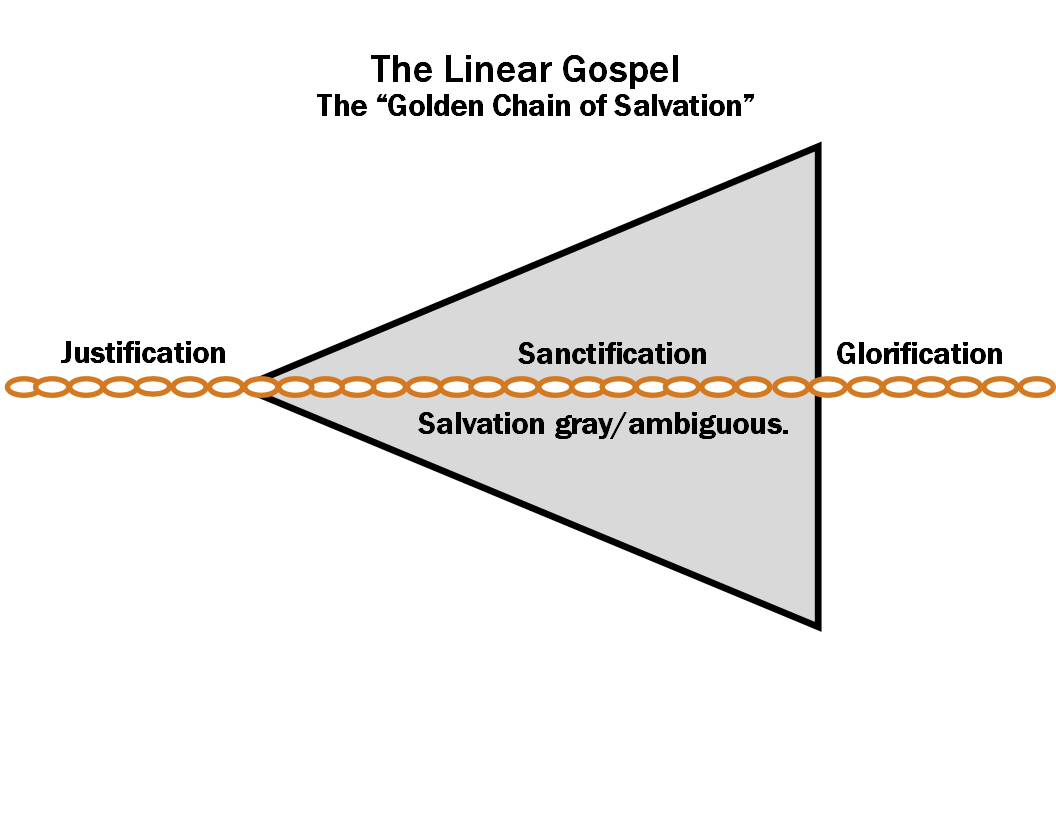
Illustration B
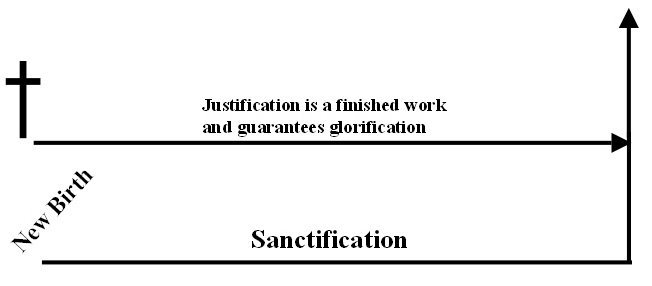
I have been making these illustrations for some time, and was surprised to find the following like-illustrations in the archives of the Australian Forum, the reformed think tank that spawned the present-day neo Calvinist movement:
Illustration C
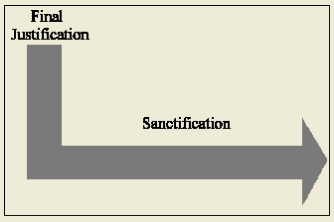
Illustration D

Illustration E
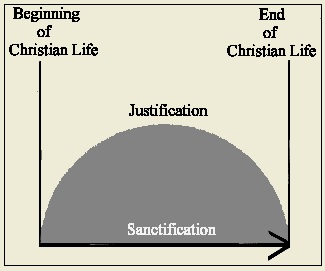
The Australian forum used these illustrations to convince the church that the true gospel of the Reformation had been lost. These illustrations were key in clarifying what the Reformers really believed. And, though the recent Neo-Calvinist movement parrots much of the Forum’s dialect and other illustrations to teach authentic Reformed doctrine, they avoid these illustrations like a plague. Why? Because these concepts are the most clarifying, and what was used to clarify can also be used to refute the same doctrine.
I agree with the Forum, my illustration B and their Illustration C was the model that the church, for the most part, was teaching when the Australian Forum showed up in 1970 (Hereafter: AF). Don’t get me wrong, I don’t think the church was applying the model, but it is what they held to. They were actually functioning like model A and E.
Model A combines salvation with the Christian life. That may sound like a statement in regard to the obvious, but it really isn’t. When someone asks us if we are saved, we say yes, but the answer is in regard to models B and C. We were saved, so we are now saved. It was a onetime permanent act. Valerie, the family dog was born in the past, but her dogness is permanent. Valerie is not in the process of becoming a complete dog, she is a dog, she is perfect dogness. The AF would agree with my assessment here. Note in model C that justification is “finished.” When Valerie was born, her doghood was finished. Valerie will now start acting like a dog because that is her nature.

Not so with the Reformed models A and E. If someone asks a Reformed person if they are saved, they most say, “already—not yet” which is the nomenclature of an official Reformed doctrine. It means that one is in the process of BEING saved—their complete salvation is future. Again, the AF would have agreed with this assessment. Note the following illustration published by them:
Illustration F
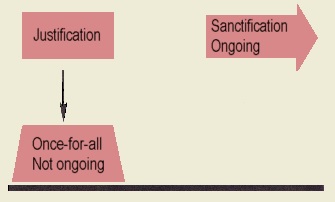
I would also like to use their illustration to make a point. They, in representing the Reformed view take issue with justification being finished. They believe it is ongoing, but look what they call it: “sanctification.” Why wouldn’t they call it “ongoing justification”? Normally, the term for the Christian life is progressive sanctification, but Reformed theologians stay well clear of the term progressive justification. The only exception is in the Calvin Institutes (3.14.title). At issue is what they illustrate with model E—justification and sanctification are combined. Salvation is a progression and worse yet, we are in the midst of the progression. That means we can mess up the progression, this is an unavoidable inference, and is indeed an element of Reformed thinking.
This is where I want to make a point about illustration D. The AF, like all of the Reformed, refutes this model as Christ plus something. Salvation only covers past sins, but we have to do something in our sanctification to maintain our righteous standing. In both models justification (salvation) is not finished, but the Reformers say that is ok for their model because justification is finished by justification.
But yet, this is the problem with all linear gospels like model A: we are in the middle of the process, so the question must be answered; “what is our role?” And that very question is a huge problem because mankind has NO role in being justified. No man other than Christ could pay the penalty for our sins. However, the Reformed answer is, “The Vital Union.” Basically, it is ok for us to be in the midst of the unfinished justification process because we participate in the same way that we were saved; viz, by faith alone. So models A, D, and E are the same thing, but the Reformed say that is ok for their model because it is Christ plus faith alone in Christ. In order to keep justification moving along properly, we must live our lives by faith alone.
Personally, I contend that if we have ANY role in our salvation other than the decision that brought the death of the old us and the birth of a new us, that’s works salvation by doing nothing with intentionality. In fact, it’s called abstaining and that’s a verb. Salvation by Christ plus doing nothing is still model D. Calvinist Tullian Tchividjian wrote a book titled Jesus plus nothing equals everything, but in a linear gospel where justification and sanctification are fused together, IT’S IMPOSSIBLE TO DO NOTHING because doing nothing is something. The only way that we can do nothing is if …
1. The work itself is finished. You can’t do anything to finish a finished work.
2. You are not present to do anything. The work is not located in your realm of operation.
This requires a discussion regarding the separation of justification and sanctification which is anathema to the Reformed thinker. They say, “Justification and sanctification are never separate, but distinct.” However, because of the terms used by Scripture, the Reformers are forced to do something with sanctification, especially in light of 1Thess 4:3,4, so the progression of justification falls under the auspices of progressive sanctification. This brings us back to illustration F. If Valerie, a dog, specifically a beagle, is justification, why would we call her something different because she gets up and starts walking? Is that cause to call her a duck? Indeed, a Valerie sitting is “distinct” from Valerie walking, but does that make her something other than a dog? If Calvin himself spoke of justification as being progressive in the title of chapter 14 | book 3, and that in fact is what you deem it to be, why not call it progressive justification and be done with it?
We hold that justification is a finished work and completely separate from the Christian life. Model B is the ONLY “plus nothing” model because you cannot add to a finished work nor can you work on something that is otherworldly. Christ came to finish a work that we cannot touch. Justification declares that the law that would judge us has no jurisdiction over us. Our sanctification comes from the regeneration of the new birth, not the finished work of justification. This was the rhetorical question that Paul asked of the Galatians:
3:2 – this only do I wish to learn from you—by works of law the Spirit did ye receive, or by the hearing of faith?
3 so thoughtless are ye! having begun in the Spirit, now in the flesh do ye end?
(YLT).
In other words, after receiving the Spirit, do you finish a finished work by circumcision? Note the previous verse:
3:1 – O thoughtless Galatians, who did bewitch you, not to obey the truth—before whose eyes Jesus Christ was described before among you crucified? (YLT).
Christ’s death on the cross finished the work of justification.
But doesn’t Paul say that our salvation is future? The question is salvation from what? We know it is not salvation from sin that would condemn us for sin is not counted where there is no law (Rom 4:15, 5:13) and Christ put an end to the law (Rom 10:4). However, it is clear that the world will be judged by the law (Rom 3:19, 20). It is not salvation from sin that would condemn us.
While the believer is born again and truly righteous, we must carry around the old us that was crucified with Christ. The things Christ died for are still with us (2Cor 4:7-18). As Christians, we await a deliverance from this body of death. (Rom 7:25). Clearly, salvation from condemnation is finished (Rom 8:34), salvation from the sin that condemns is past and complete, but there is left a salvation from sin that harasses us daily. If the gospel is linear, and justification is not finished, Paul is speaking of a future salvation from condemnation—we reject that idea with prejudice, Paul is talking about the other salvation from the sin of our mortality.
The Bible also refers to that as redemption. Remember last week and our discussion of the exchange of slavery? We were purchased from the other slave owner by the blood of Christ (1Cor 6:19,20, 7:22,23), and Christ will one day return to redeem His purchase (Gal 3:13, Luke 21:28). In the linear model, there can be no exchange of slavery because we are not finally free till the end. Neither is there an exchange of law because faith only is required to maintain the “vital union” that keeps our original justification moving forward.
Moreover, if justification and sanctification are not separate, and are the same thing the Bible must be interpreted through the prism of justification only and in fact that is the very interpretive craze of our day; i.e., every verse in the Bible is about Jesus. Unfortunately, this would not explain the interpretive dichotomies of the Bible and would instead make them contradictions. There are many, many examples of this throughout the Bible, but the primary one is works. On the one hand, the Bible continually calls for faith alone without works, but on the other hand, it also calls for vigorous labor and obedience to the law. How can these be reconciled? Answer: some verses are talking about justification while others are talking about sanctification. If justification and sanctification are not separate, the Bible is nothing more than a book of confusion.
The linear gospel also leads to all sorts of confusing doctrines that make doing nothing in our Christian life feasible. One is double imputation. This is the belief that Christ died for our justification and lived a perfect life of obedience for our sanctification. That way, Christ’s perfect obedience to the law is imputed to our Christian life as we live by faith alone.
Illustration G
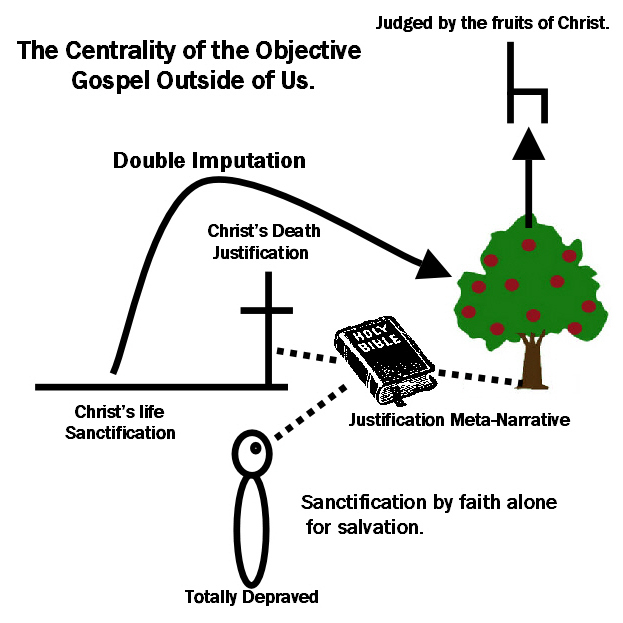
This Reformed doctrine also makes law the standard for justification in regard to Christians. Since perfect adherence to law remains the standard, but Christ fulfilled and keeps it for us, neither is an exchange of law needed in salvation as we discussed last week—the relationship to the law doesn’t change.
This results in an attempt to reduce sanctification to a mere “awareness” or “experience” with all kinds of mystic doctrines following of which there is no shortage in Reformed circles. An excellent example is the following excerpt from a sermon I heard recently:
Years ago, there was a pastor named Ichabod Spencer, and he was talking to a young student who was convicted of a sin and wasn’t a believer but wanted to come to Christ. And he wrote of the conversation, and it’s in a book called Pastoral Sketches, and Ichabod Spencer’s section in there has this conversation. And it’s fascinating because it’s called “I Can’t Feel.” Listen to this interchange. Ichabod Spencer said,
“I don’t know, my dear sir, what more can be said to you. I’ve told you all that I know. Your state as a sinner, lost, exposed to the righteous penalty of God’s law and having a heart alienated from God and the free offer of redemption by Christ, I’ve told you those things, and your instant duty to repent of sin and give up the world and give God your heart and the source of your help through the power of the Holy Spirit assured to you if you will receive Christ.” In other words, self-empty, and believe it, all these things have become as familiar to you as household words. What more can I say? I know not more what there is to be said.” He said, “I cannot read your heart. God can. And you can by his aid. Some things you’ve said almost made me think you a Christian, and other things again have destroyed that hope. I now put it to your own heart. If you’re not a Christian, what hinders you?”
And he thought for a moment, and he said, “I can’t feel.” “Well, why didn’t you tell me this before?” He said, “I never thought of it before, sir.” “Well, how do you know this hinders you?” “I can’t think of nothing else. I’m sure I shall never be converted to God if I have no more feeling than I have now. That is my own fault. I know you can’t help me.” And he said, “No, sir, I cannot, nor can you help yourself. Your heart will not feel at your bidding.” “What then can I do?” said he with much anxiety. “Come to Christ now. Trust him. Give up your darling world. Repent so inequity shall not be your ruin.” Well, he seemed perplexed, annoyed, vexed. And with an accent of impatience such as I had never witnessed in him before, he replied, “That is impossible. I want the feeling to bring me to that, and I can’t feel.”
And Spencer said, “Hear me, sir, and heed well what I say. I have several points. Number one, the Bible never tells you you must feel, but you must repent and believe. Number two, your complaint that you cannot feel,” listen to this, “is just an excuse by which your wicked heart will justify you for not coming to Christ now.”
First of all, this idea that we cannot command our feelings is something that I hear often and is not biblical. The apostle Paul instructed us to keep a clear conscience before God. Elsewhere, we find that our consciences either accuse us or excuse us. We all know how bad we feel when our consciences accuse us; therefore, we may assume that the opposite is true when we do right. We are also instructed by Paul as well to make it our goal to please God; certainly, a feeling of accomplishment can be expected here as well.
Clearly, we can command our feelings by doing what is right. In contrast, the above dialogue is the result of the linear gospel where an act of grace must precede all feelings. Again, if we are in the middle of a process that saves us, and we are good Reformed thinkers with faith alone always in the forefront, we must only believe and merely be a witness to “grace.” Can you see this in the above dialogue? Only believe is the exhortation of the pastor, and we cannot command our feelings anyway.
In contrast, this young man isn’t going feel any different UNTIL he makes a decision to follow Christ. Why? Because he is under judgment! When you are under law, all that awaits you is a fearful judgment under the law. Why would he feel any different until he is no longer under threat of judgment? This would have been my counsel to this young man. At the very least, the vacancy of fear and the knowledge that you are going to spend eternity in heaven will produce good feelings on some level.
Yes, this leads into all kinds of Reformed wackiness that I believe shuts up the door of heaven to many. I myself know of a young man that wouldn’t make a commitment to Christ because he was yet to see Christ as a “treasure chest of joy.” This all speaks to the Reformed concern that man is able to make an intellectual decision that is part of the salvation process. Yea, we must have some kind of sign that we were enlightened first before we make the decision. But why would it be delight? What of a fear of judgment that we know we deserve?
The fact that the aforementioned young man was vexed and in turmoil is a sure sign from heaven that he understand that he is under the law. Good grief! Lord come quickly and deliver us from this ignorance dressed in academic garb! Remember what we have learned previously in this Romans study? Our service to God is a what? Right, “reasonable service.” Remember what that word means? It means “rational.” My father was an intellectual who always had an interest in God throughout his whole life, but in the end, he assured me that he had made a personal commitment to Christ. But be sure of this, my dad would not have made a commitment to mystic nonsense coming from the Reformed crowd. The decision to be saved is a rational decision, and our service to Christ is rational.
“Just believe” is no answer, we must tell people WHY they mustn’t wait on a feeling. It is because feelings follow thinking and doing. For the most part, feelings are a choice. What do you do if you feel unsafe? You make a decision to change your circumstance to something safer, and then you feel safer. My friends, this is hardly rocket science.
But this can now bring us to another consideration of linear versus parallel—that of end times. The linear gospel can only speak of one final judgment where the children of God are “manifested.” If you look at the parallel gospel, it supplies the possibility of two judgments. Note the illustration below:
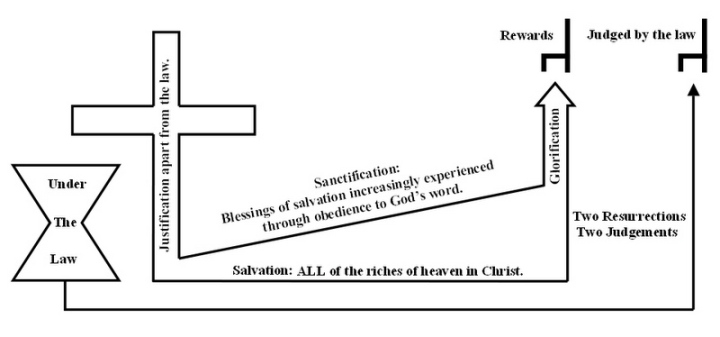
What comfort is there in thinking that our “final justification” will be confirmed at some plenary judgment at the end of the age? We should take comfort in the fact that we will not stand in that judgment at all! And again, this points to the need for interpretation according to the following interpretive question: Is it a justification verse, or a sanctification verse? In the linear construct, it must always be a justification verse; either a sitting still dog or a walking dog that is apparently a duck because he is now walking. But in the parallel construct, I can point to numerous biblical dichotomies that are defined by parallelism. Let’s look at a couple.
In 1John, John tells us there is no fear in love and fear has to do with “judgment.” But then Paul tells us to work out our own salvation with trembling and fear. This is not the same salvation being spoken of. John is writing of the difference between the law of sin and death that will judge us, and the law of love which is the difference between being under law and under grace. Paul is writing of having a sober stance towards our sanctification. The Christian life isn’t a birthday party; it’s a many-faceted intellectual warfare. “Salvation” in the Bible doesn’t always speak of salvation from eternal judgment, there is yet a salvation for God’s people—the salvation from carrying about in our bodies all of the things that Christ died for. Let’s close by looking at an example of how the linear perspective gets us into difficulty. In the Reformed scholarly work “The Race Set Before Us,” the authors cite Matthew 24:13 as proof that salvation is future and that Christians must persevere till the end of their life:
But the one who endures to the end will be saved.
Again, the assumption is that “saved” always means eternal salvation. But let’s qualify that with Matthew 10:
21 Brother will deliver brother over to death, and the father his child, and children will rise against parents and have them put to death, 22 and you will be hated by all for my name’s sake. But the one who endures to the end will be saved. 23 When they persecute you in one town, flee to the next, for truly, I say to you, you will not have gone through all the towns of Israel before the Son of Man comes.
What is Christ saying? He is saying that when you see certain things happen during the tribulation period, you will be able to save yourself from physical death by fleeing from town to town because the Lord’s return is near. He is talking about saving yourself from physical death, not eternal salvation.
“Saved” has more than one meaning. In verse 11, Paul is talking about salvation from this present warfare against evil within and evil without. In the same way Christ stated that those who see certain things in the tribulation period draw near to their “redemption.” That word refers to a ransom that has already been paid on the cross.
You were purchased and the sale if final. Christ did not purchase you on a Reformed installment plan. We wait for redemption when Christ comes to claim what He purchased.
Charles Haddon Spurgeon: The Prince of Preachers?
 “The problem is the fusing of law and grace, not election. People on both sides of that argument can fuse law and grace together and often do….Notice that who does the work is not the issue. Work period is the issue.”
Protestantism is the foundation of the American church. Our heroes of the faith are those who protested Rome but never left Rome. Augustine, Luther, and Calvin merely believed they could do Rome better. Luther and Calvin in particular were fed-up with the popes and gave birth to a resurgence of Plato’s moral tyranny. The popes were in the tyranny business for money and the fulfillment of sinful desires; the Reformers were in the tyranny business for the glory of God. Their mentor, Augustine, boldly proclaimed that the Bible was useless without Plato’s insight and proclaimed Plato a pre-Christian Christian.
Plato’s philosophical principles and anthropomorphic presuppositions laid the foundation for every political and religious caste system in Western culture. Plato’s DNA is in every tyrant ever born in the West whether political or religious. His philosophy lives in both anemic form and viral, fleshing itself out in either philosophical capitulation or the zealot’s bloody axe. Only God knows the number buried in that landfill named, “The Traditions of Men.”
During the first advent, Christ spoke often of two concerns: the traditions of men and antinomianism. Anti-law of God is made possible to the degree that the authority of men usurp the authority of God’s word. Tradition is powerful and often relegates truth to a metaphysical anomaly. Such is the case with American religious heroes. Their stardom defies logic and truth. While Americans shake their heads in disbelief at documentary films that show Hitler pontificating to swooning masses, we celebrate the Pilgrim Puritans who hung Quakers and baptized women in waters of death. Tradition knows no limits in regard to hypocrisy and ignorance. Better to skim the Cliff Notes of tradition than to suffer a possible stroke by the exercise of thinking.
Calling Charles Haddon Spurgeon the “Prince of Preachers” is perhaps the grandiose example of illogical tradition. Spurgeon was a shameless Calvinistic hack. He once said,
There is no such thing as preaching Christ and Him crucified, unless we preach what nowadays is called Calvinism. It is a nickname to call it Calvinism; Calvinism is the gospel, and nothing else.
The most inconvenient thing ever for admirers of Spurgeon is the truth. He constantly disregarded the plain sense of Scripture, though eloquently. While comparing Augustine and Calvin to the apostle Paul in the same sermon (A Defense of Calvinism), any concern for Paul’s warning of being a proponent of a doctrine named after a man was totally disregarded by Surgeon in open defiance to the truth (1COR 3:1-9).
But the fundamental problem is the fact that Calvin taught a blatant false gospel. He believed that grace was not possible unless Christ fulfilled the law for us (CI 3.14.9-11). He believed that Christians are still “under law” which is the very definition of a lost person in the book of Romans and the premise for Calvin’s total depravity.
Hence, Christians remain under the law for justification and must live their Christian lives by faith alone in order to keep their salvation. If Christians live by faith alone in sanctification, the perfect obedience of Christ is perpetually imputed to us and we remain saved. Of course, this requires a complex doctrinal judgment in regard to what is works in sanctification and what is not a work in sanctification in order to live our Christian lives by faith alone resulting in the maintaining of our salvation. This is the very reason for the anemic sanctification that has plagued Protestantism for centuries. We either throw Law out the window completely, or live in fear regarding what is a work and what isn’t a work in our Christian lives lest we find ourselves in “works salvation.”
The problem is the fusing of law and grace. Not election. People on both sides of that argument can fuse law and grace together and often do. Unbelievers are “under law” while believers are “under grace.” We are justified APART from the law (ROM 3:21). Christ didn’t come to fulfill the law FOR OUR JUSTIFICATION; He came to die for our sins so that a righteousness APART from the law could be credited to our account. If Christ had to fulfill the law…. for our justification, law is still the BASIS for our justification and justification is then NOT OF GRACE. The basis of our justification is not law, we are rather UNDER GRACE. This is what the apostle Paul wrote:
Romans 11:6 – But if it is by grace, it is no longer on the basis of works; otherwise grace would no longer be grace.
Notice that who does the work is not the issue. Work period is the issue. The BASIS of grace is the issue here, and if the basis of grace is works it is no longer grace. If Christ had to keep the law for us to make grace possible, according to Paul, grace is no longer of grace. To the contrary, Paul states that Christ came so that he could fulfill the law through us in sanctification completely separate from justification:
Romans 8:1 – There is therefore now no condemnation for those who are in Christ Jesus. 2 For the law of the Spirit of life has set you free in Christ Jesus from the law of sin and death. 3 For God has done what the law, weakened by the flesh, could not do. By sending his own Son in the likeness of sinful flesh and for sin, he condemned sin in the flesh, 4 in order that the righteous requirement of the law might be fulfilled in us, who walk not according to the flesh but according to the Spirit. 5 For those who live according to the flesh set their minds on the things of the flesh, but those who live according to the Spirit set their minds on the things of the Spirit. 6 For to set the mind on the flesh is death, but to set the mind on the Spirit is life and peace. 7 For the mind that is set on the flesh is hostile to God, for it does not submit to God’s law; indeed, it cannot. 8 Those who are in the flesh cannot please God.
Notice that a perfect keeping of the law is not required for us in sanctification to please God for justification. Why? Because the two are separate and there is no law in justification for the believer. The two are separate. We are saved apart from the law for justification and the law informs our sanctification (ROM 3:21, GAL 4:21). Calvinism propagates a grace based on works. Its consummation is an antinomianism where Christ must keep the law for us because we are unable to please God through the perfect fulfillment of it in our Christian lives—perfection as a goal not withstanding in sanctification, but not for justification. According to Calvinism, we have no faith that is alive; we are still dead in our trespasses and sins. It is of the variety that separates us from the fulfillment of the law in sanctification as well. Only Calvin was genius enough to devise a doctrine that combined the best of works salvation and antinomianism.
Only truth sanctifies (John 17:17). The idea that Spurgeon ever helped anyone with his preaching is an illusion grounded in the traditions of men.
paul
Calvinist T4G Orthodoxy: Library Size Matters
What do you think of the T4G gang and their “Study Tour”? This is where the key speakers associated with T4G conferences past and present show off their vast libraries. I have posted the video links at the end of this article.
Think about what this is saying. It clearly emanates the idea that vast para-biblical knowledge is needed to understand God’s word. It is also saying that unless you have the money to purchase such a library, you aren’t qualified. These guys are to be revered, respected, and obeyed because they have the knowledge. It’s spiritual caste on steroids.
This is clearly a power play to control people through intimidation—if you’re not a thinker. Basically, if you have a Bible and the internet, your access to information and the efficiency thereof makes their libraries look like an outhouse. But again, the most egregious idea that stems from this is that the Bible doesn’t contain adequate information in and of itself for life and godliness. In order to really grasp the Bible, you need all of that information from guys who lived in medieval times and had the compassion of alligators.
Can you imagine the Apostles putting on such a display? What are these guys thinking? Do they really want a pastor from Harlem seeing this video? What should he make of it? Good grief! These videos speak for themselves as these men flaunt their resources before the world in arrogance that staggers the imagination.
Al Mohler: http://vimeo.com/groups/27420/videos/8693850
Ligon Duncan: http://vimeo.com/groups/27420/videos/9237570
Mark Dever (This video is particularly disturbing):
CJ Mahaney:
John I used to teach the truth MacArthur:

 Paul's Passing Thoughts
10 comments