Romans 13:11 | What’s in the Word, “Saved” Part 1: A Salvation Paradigm
Originally published March 19, 2014

“You were purchased and the sale is final. Christ did not purchase you on a Reformed installment plan. We wait for redemption when Christ comes to claim what He purchased.”
“Moreover, if justification and sanctification are not separate, and are the same thing the Bible must be interpreted through the prism of justification only and in fact that is the very interpretive craze of our day; i.e., every verse in the Bible is about Jesus. Unfortunately, this would not explain the interpretive dichotomies of the Bible and would instead make them contradictions. There are many, many examples of this throughout the Bible, but the primary one is works. On the one hand, the Bible continually calls for faith alone without works, but on the other hand, it also calls for vigorous labor and obedience to the law. How can these be reconciled? Answer: some verses are talking about justification while others are talking about sanctification. If justification and sanctification are not separate, the Bible is nothing more than a book of confusion.”
Click to enlarge illustrations if needed.
I am very happy that we have arrived at Romans 13:11 because what Paul states here is the source of much misunderstanding in our day. As a pastor, I have said it: “We were saved, are being saved, and will be completely saved.” What was I thinking when I used to say things like that? I really don’t know. But isn’t that what Paul is saying here in Romans 13:11?
Besides this you know the time, that the hour has come for you to wake from sleep. For salvation is nearer to us now than when we first believed.
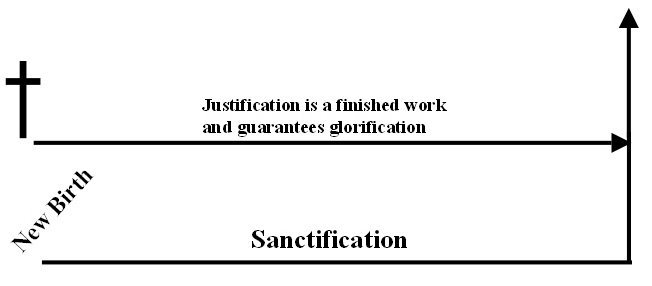
Paul seems to be saying what I used to say: our original salvation culminates into a final salvation. At TANC LLC, our research institute, we call that the “linear gospel.” In Reformed circles it is called the “golden chain of salvation.” Now listen, this is a really big deal. One must choose between the linear gospel and the parallel gospel. Let’s look at the illustrations below:
Illustration A

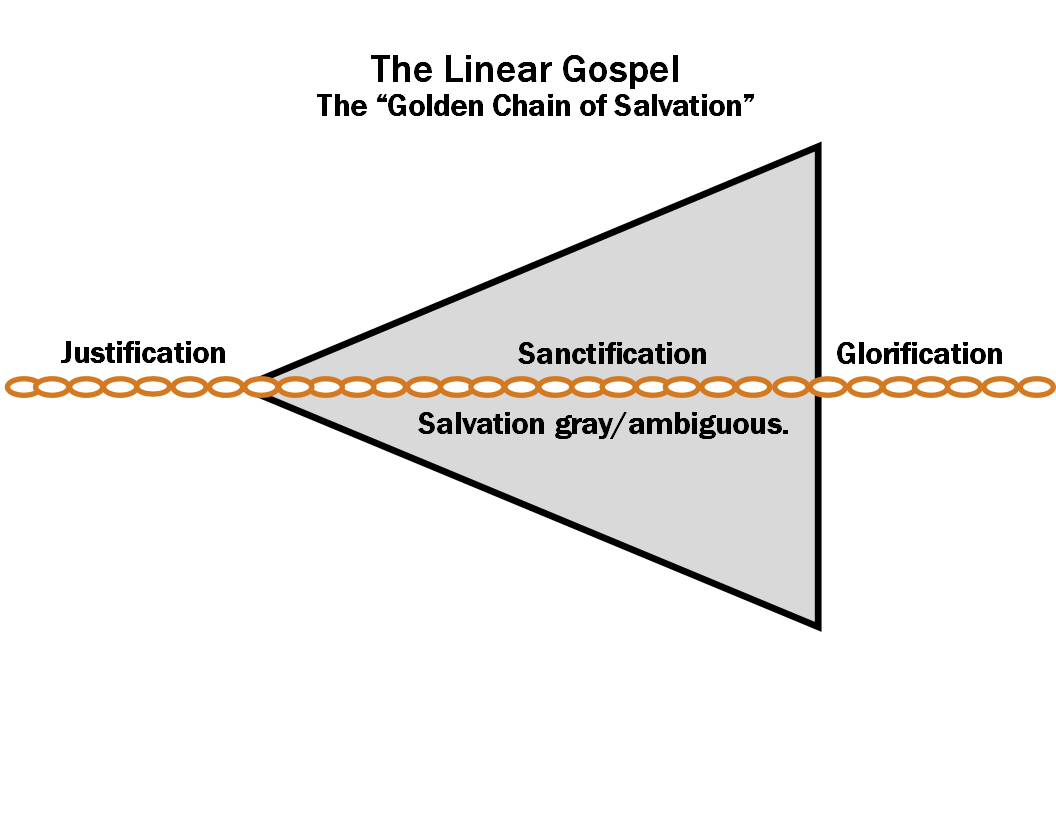
Illustration B
I have been making these illustrations for some time, and was surprised to find the following like-illustrations in the archives of the Australian Forum, the reformed think tank that spawned the present-day neo Calvinist movement:
Illustration C
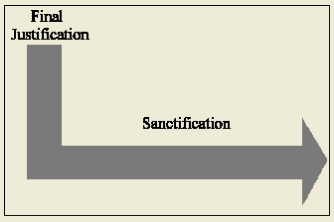
Illustration D

Illustration E
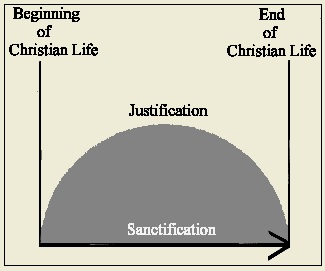
The Australian forum used these illustrations to convince the church that the true gospel of the Reformation had been lost. These illustrations were key in clarifying what the Reformers really believed. And, though the recent Neo-Calvinist movement parrots much of the Forum’s dialect and other illustrations to teach authentic Reformed doctrine, they avoid these illustrations like a plague. Why? Because these concepts are the most clarifying, and what was used to clarify can also be used to refute the same doctrine.
I agree with the Forum, my illustration B and their Illustration C was the model that the church, for the most part, was teaching when the Australian Forum showed up in 1970 (Hereafter: AF). Don’t get me wrong, I don’t think the church was applying the model, but it is what they held to. They were actually functioning like model A and E.
Model A combines salvation with the Christian life. That may sound like a statement in regard to the obvious, but it really isn’t. When someone asks us if we are saved, we say yes, but the answer is in regard to models B and C. We were saved, so we are now saved. It was a onetime permanent act. Valerie, the family dog was born in the past, but her dogness is permanent. Valerie is not in the process of becoming a complete dog, she is a dog, she is perfect dogness. The AF would agree with my assessment here. Note in model C that justification is “finished.” When Valerie was born, her doghood was finished. Valerie will now start acting like a dog because that is her nature.

Not so with the Reformed models A and E. If someone asks a Reformed person if they are saved, they most say, “already—not yet” which is the nomenclature of an official Reformed doctrine. It means that one is in the process of BEING saved—their complete salvation is future. Again, the AF would have agreed with this assessment. Note the following illustration published by them:
Illustration F
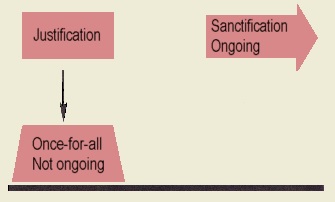
I would also like to use their illustration to make a point. They, in representing the Reformed view take issue with justification being finished. They believe it is ongoing, but look what they call it: “sanctification.” Why wouldn’t they call it “ongoing justification”? Normally, the term for the Christian life is progressive sanctification, but Reformed theologians stay well clear of the term progressive justification. The only exception is in the Calvin Institutes (3.14.title). At issue is what they illustrate with model E—justification and sanctification are combined. Salvation is a progression and worse yet, we are in the midst of the progression. That means we can mess up the progression, this is an unavoidable inference, and is indeed an element of Reformed thinking.
This is where I want to make a point about illustration D. The AF, like all of the Reformed, refutes this model as Christ plus something. Salvation only covers past sins, but we have to do something in our sanctification to maintain our righteous standing. In both models justification (salvation) is not finished, but the Reformers say that is ok for their model because justification is finished by justification.
But yet, this is the problem with all linear gospels like model A: we are in the middle of the process, so the question must be answered; “what is our role?” And that very question is a huge problem because mankind has NO role in being justified. No man other than Christ could pay the penalty for our sins. However, the Reformed answer is, “The Vital Union.” Basically, it is ok for us to be in the midst of the unfinished justification process because we participate in the same way that we were saved; viz, by faith alone. So models A, D, and E are the same thing, but the Reformed say that is ok for their model because it is Christ plus faith alone in Christ. In order to keep justification moving along properly, we must live our lives by faith alone.
Personally, I contend that if we have ANY role in our salvation other than the decision that brought the death of the old us and the birth of a new us, that’s works salvation by doing nothing with intentionality. In fact, it’s called abstaining and that’s a verb. Salvation by Christ plus doing nothing is still model D. Calvinist Tullian Tchividjian wrote a book titled Jesus plus nothing equals everything, but in a linear gospel where justification and sanctification are fused together, IT’S IMPOSSIBLE TO DO NOTHING because doing nothing is something. The only way that we can do nothing is if …
1. The work itself is finished. You can’t do anything to finish a finished work.
2. You are not present to do anything. The work is not located in your realm of operation.
This requires a discussion regarding the separation of justification and sanctification which is anathema to the Reformed thinker. They say, “Justification and sanctification are never separate, but distinct.” However, because of the terms used by Scripture, the Reformers are forced to do something with sanctification, especially in light of 1Thess 4:3,4, so the progression of justification falls under the auspices of progressive sanctification. This brings us back to illustration F. If Valerie, a dog, specifically a beagle, is justification, why would we call her something different because she gets up and starts walking? Is that cause to call her a duck? Indeed, a Valerie sitting is “distinct” from Valerie walking, but does that make her something other than a dog? If Calvin himself spoke of justification as being progressive in the title of chapter 14 | book 3, and that in fact is what you deem it to be, why not call it progressive justification and be done with it?
We hold that justification is a finished work and completely separate from the Christian life. Model B is the ONLY “plus nothing” model because you cannot add to a finished work nor can you work on something that is otherworldly. Christ came to finish a work that we cannot touch. Justification declares that the law that would judge us has no jurisdiction over us. Our sanctification comes from the regeneration of the new birth, not the finished work of justification. This was the rhetorical question that Paul asked of the Galatians:
3:2 – this only do I wish to learn from you—by works of law the Spirit did ye receive, or by the hearing of faith?
3 so thoughtless are ye! having begun in the Spirit, now in the flesh do ye end?
(YLT).
In other words, after receiving the Spirit, do you finish a finished work by circumcision? Note the previous verse:
3:1 – O thoughtless Galatians, who did bewitch you, not to obey the truth—before whose eyes Jesus Christ was described before among you crucified? (YLT).
Christ’s death on the cross finished the work of justification.
But doesn’t Paul say that our salvation is future? The question is salvation from what? We know it is not salvation from sin that would condemn us for sin is not counted where there is no law (Rom 4:15, 5:13) and Christ put an end to the law (Rom 10:4). However, it is clear that the world will be judged by the law (Rom 3:19, 20). It is not salvation from sin that would condemn us.
While the believer is born again and truly righteous, we must carry around the old us that was crucified with Christ. The things Christ died for are still with us (2Cor 4:7-18). As Christians, we await a deliverance from this body of death. (Rom 7:25). Clearly, salvation from condemnation is finished (Rom 8:34), salvation from the sin that condemns is past and complete, but there is left a salvation from sin that harasses us daily. If the gospel is linear, and justification is not finished, Paul is speaking of a future salvation from condemnation—we reject that idea with prejudice, Paul is talking about the other salvation from the sin of our mortality.
The Bible also refers to that as redemption. Remember last week and our discussion of the exchange of slavery? We were purchased from the other slave owner by the blood of Christ (1Cor 6:19,20, 7:22,23), and Christ will one day return to redeem His purchase (Gal 3:13, Luke 21:28). In the linear model, there can be no exchange of slavery because we are not finally free till the end. Neither is there an exchange of law because faith only is required to maintain the “vital union” that keeps our original justification moving forward.
Moreover, if justification and sanctification are not separate, and are the same thing the Bible must be interpreted through the prism of justification only and in fact that is the very interpretive craze of our day; i.e., every verse in the Bible is about Jesus. Unfortunately, this would not explain the interpretive dichotomies of the Bible and would instead make them contradictions. There are many, many examples of this throughout the Bible, but the primary one is works. On the one hand, the Bible continually calls for faith alone without works, but on the other hand, it also calls for vigorous labor and obedience to the law. How can these be reconciled? Answer: some verses are talking about justification while others are talking about sanctification. If justification and sanctification are not separate, the Bible is nothing more than a book of confusion.
The linear gospel also leads to all sorts of confusing doctrines that make doing nothing in our Christian life feasible. One is double imputation. This is the belief that Christ died for our justification and lived a perfect life of obedience for our sanctification. That way, Christ’s perfect obedience to the law is imputed to our Christian life as we live by faith alone.
Illustration G
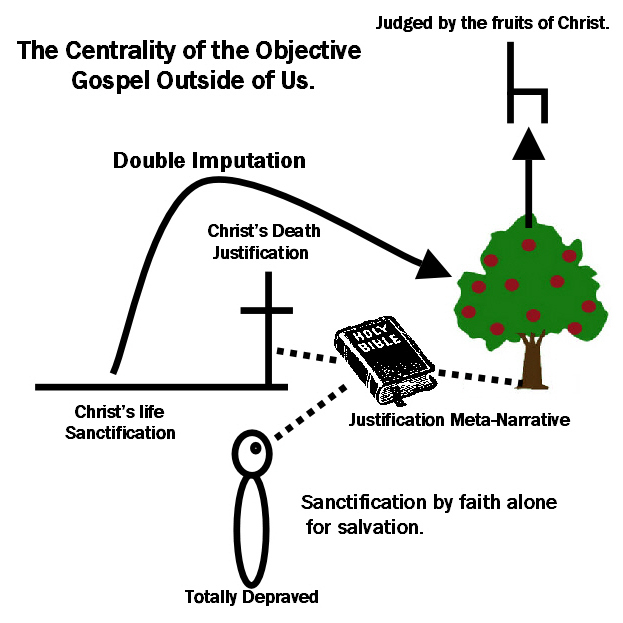
This Reformed doctrine also makes law the standard for justification in regard to Christians. Since perfect adherence to law remains the standard, but Christ fulfilled and keeps it for us, neither is an exchange of law needed in salvation as we discussed last week—the relationship to the law doesn’t change.
This results in an attempt to reduce sanctification to a mere “awareness” or “experience” with all kinds of mystic doctrines following of which there is no shortage in Reformed circles. An excellent example is the following excerpt from a sermon I heard recently:
Years ago, there was a pastor named Ichabod Spencer, and he was talking to a young student who was convicted of a sin and wasn’t a believer but wanted to come to Christ. And he wrote of the conversation, and it’s in a book called Pastoral Sketches, and Ichabod Spencer’s section in there has this conversation. And it’s fascinating because it’s called “I Can’t Feel.” Listen to this interchange. Ichabod Spencer said,
“I don’t know, my dear sir, what more can be said to you. I’ve told you all that I know. Your state as a sinner, lost, exposed to the righteous penalty of God’s law and having a heart alienated from God and the free offer of redemption by Christ, I’ve told you those things, and your instant duty to repent of sin and give up the world and give God your heart and the source of your help through the power of the Holy Spirit assured to you if you will receive Christ.” In other words, self-empty, and believe it, all these things have become as familiar to you as household words. What more can I say? I know not more what there is to be said.” He said, “I cannot read your heart. God can. And you can by his aid. Some things you’ve said almost made me think you a Christian, and other things again have destroyed that hope. I now put it to your own heart. If you’re not a Christian, what hinders you?”
And he thought for a moment, and he said, “I can’t feel.” “Well, why didn’t you tell me this before?” He said, “I never thought of it before, sir.” “Well, how do you know this hinders you?” “I can’t think of nothing else. I’m sure I shall never be converted to God if I have no more feeling than I have now. That is my own fault. I know you can’t help me.” And he said, “No, sir, I cannot, nor can you help yourself. Your heart will not feel at your bidding.” “What then can I do?” said he with much anxiety. “Come to Christ now. Trust him. Give up your darling world. Repent so inequity shall not be your ruin.” Well, he seemed perplexed, annoyed, vexed. And with an accent of impatience such as I had never witnessed in him before, he replied, “That is impossible. I want the feeling to bring me to that, and I can’t feel.”
And Spencer said, “Hear me, sir, and heed well what I say. I have several points. Number one, the Bible never tells you you must feel, but you must repent and believe. Number two, your complaint that you cannot feel,” listen to this, “is just an excuse by which your wicked heart will justify you for not coming to Christ now.”
First of all, this idea that we cannot command our feelings is something that I hear often and is not biblical. The apostle Paul instructed us to keep a clear conscience before God. Elsewhere, we find that our consciences either accuse us or excuse us. We all know how bad we feel when our consciences accuse us; therefore, we may assume that the opposite is true when we do right. We are also instructed by Paul as well to make it our goal to please God; certainly, a feeling of accomplishment can be expected here as well.
Clearly, we can command our feelings by doing what is right. In contrast, the above dialogue is the result of the linear gospel where an act of grace must precede all feelings. Again, if we are in the middle of a process that saves us, and we are good Reformed thinkers with faith alone always in the forefront, we must only believe and merely be a witness to “grace.” Can you see this in the above dialogue? Only believe is the exhortation of the pastor, and we cannot command our feelings anyway.
In contrast, this young man isn’t going feel any different UNTIL he makes a decision to follow Christ. Why? Because he is under judgment! When you are under law, all that awaits you is a fearful judgment under the law. Why would he feel any different until he is no longer under threat of judgment? This would have been my counsel to this young man. At the very least, the vacancy of fear and the knowledge that you are going to spend eternity in heaven will produce good feelings on some level.
Yes, this leads into all kinds of Reformed wackiness that I believe shuts up the door of heaven to many. I myself know of a young man that wouldn’t make a commitment to Christ because he was yet to see Christ as a “treasure chest of joy.” This all speaks to the Reformed concern that man is able to make an intellectual decision that is part of the salvation process. Yea, we must have some kind of sign that we were enlightened first before we make the decision. But why would it be delight? What of a fear of judgment that we know we deserve?
The fact that the aforementioned young man was vexed and in turmoil is a sure sign from heaven that he understand that he is under the law. Good grief! Lord come quickly and deliver us from this ignorance dressed in academic garb! Remember what we have learned previously in this Romans study? Our service to God is a what? Right, “reasonable service.” Remember what that word means? It means “rational.” My father was an intellectual who always had an interest in God throughout his whole life, but in the end, he assured me that he had made a personal commitment to Christ. But be sure of this, my dad would not have made a commitment to mystic nonsense coming from the Reformed crowd. The decision to be saved is a rational decision, and our service to Christ is rational.
“Just believe” is no answer, we must tell people WHY they mustn’t wait on a feeling. It is because feelings follow thinking and doing. For the most part, feelings are a choice. What do you do if you feel unsafe? You make a decision to change your circumstance to something safer, and then you feel safer. My friends, this is hardly rocket science.
But this can now bring us to another consideration of linear versus parallel—that of end times. The linear gospel can only speak of one final judgment where the children of God are “manifested.” If you look at the parallel gospel, it supplies the possibility of two judgments. Note the illustration below:
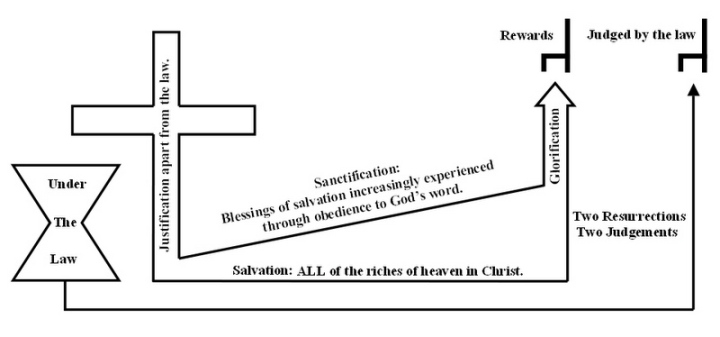
What comfort is there in thinking that our “final justification” will be confirmed at some plenary judgment at the end of the age? We should take comfort in the fact that we will not stand in that judgment at all! And again, this points to the need for interpretation according to the following interpretive question: Is it a justification verse, or a sanctification verse? In the linear construct, it must always be a justification verse; either a sitting still dog or a walking dog that is apparently a duck because he is now walking. But in the parallel construct, I can point to numerous biblical dichotomies that are defined by parallelism. Let’s look at a couple.
In 1John, John tells us there is no fear in love and fear has to do with “judgment.” But then Paul tells us to work out our own salvation with trembling and fear. This is not the same salvation being spoken of. John is writing of the difference between the law of sin and death that will judge us, and the law of love which is the difference between being under law and under grace. Paul is writing of having a sober stance towards our sanctification. The Christian life isn’t a birthday party; it’s a many-faceted intellectual warfare. “Salvation” in the Bible doesn’t always speak of salvation from eternal judgment, there is yet a salvation for God’s people—the salvation from carrying about in our bodies all of the things that Christ died for. Let’s close by looking at an example of how the linear perspective gets us into difficulty. In the Reformed scholarly work “The Race Set Before Us,” the authors cite Matthew 24:13 as proof that salvation is future and that Christians must persevere till the end of their life:
But the one who endures to the end will be saved.
Again, the assumption is that “saved” always means eternal salvation. But let’s qualify that with Matthew 10:
21 Brother will deliver brother over to death, and the father his child, and children will rise against parents and have them put to death, 22 and you will be hated by all for my name’s sake. But the one who endures to the end will be saved. 23 When they persecute you in one town, flee to the next, for truly, I say to you, you will not have gone through all the towns of Israel before the Son of Man comes.
What is Christ saying? He is saying that when you see certain things happen during the tribulation period, you will be able to save yourself from physical death by fleeing from town to town because the Lord’s return is near. He is talking about saving yourself from physical death, not eternal salvation.
“Saved” has more than one meaning. In verse 11, Paul is talking about salvation from this present warfare against evil within and evil without. In the same way Christ stated that those who see certain things in the tribulation period draw near to their “redemption.” That word refers to a ransom that has already been paid on the cross.
You were purchased and the sale if final. Christ did not purchase you on a Reformed installment plan. We wait for redemption when Christ comes to claim what He purchased.
The Only Real Difference Between First and Second Generation Biblical Counseling is Romans 8:30
 Originally published February 3, 2012
“Are two different gospels operating under the same nomenclature of ‘help can be found here’ acceptable or not? Both are not the truth, and one or the other will help, or add further hurt.”
Heath Lambert recently published the book The Biblical Counseling Movement After Adams. The contemporary motif of our day is the idea that Dr. Jay E. Adams started the biblical counseling movement (first generation), and then others such as David Powlison of Westminster’s CCEF built on the foundation laid by Adams. The ever-morphing result is called “second generation” biblical counseling. Lambert’s book is a lengthy treatise that supposedly informs us of the differences between the two generations.
I am going to bypass all of those issues and focus on the one difference that matters—how each generation interprets the gospel. As the president of the annexed NANC used to say, “Fasten your seatbelts and put on your crash helmets,” because my thesis is that one of these generations is founded on, and operates by a false gospel.
As many know, especially my wife, I have spent almost five years researching the present-day New Calvinism movement. The movement has its roots in the Progressive Adventist movement fathered by Robert Brinsmead. The magnum opus of that movement was their interpretation of Romans 8:30. I will pause now and quote an individual who witnessed that remarkable movement firsthand:
In 1971, Brinsmead scheduled a flurry of summer institutes to bring us his latest emphasis. There was more excitement than usual; the latest round of tapes had prepared us for something big. Bob had been studying the Reformation doctrine of justification by faith, comparing it to Roman Catholic doctrines. Reading Luther, he saw that justification is not just a means to the end of perfect sanctification. When we are justified by faith, not only does God impute Christ’s righteousness to us but we also possess Christ Himself—all His righteousness and all His perfection. Eternity flows from that fact.
And those whom he predestined he also called, and those whom he called he also justified, and those whom he justified he also glorified’ (Rom. 8:30).
The same ones he justified he also glorified. We began to realize we had inserted extra steps into Paul’s chain of salvation: sanctification and a final atonement brought about by blotting out sins. Those added steps, in fact, were the heart of the Awakening message—but we had ignored the heart of the real gospel: being justified by faith, we ‘rejoice in hope of the glory of God.’ Our righteousness is in heaven, said Brinsmead:
“The righteousness by which we become just in God’s sight, remain just in His sight and will one day be sealed as forever just in His sight, is an outside righteousness. It is not on earth, but only in heaven…only in Jesus Christ” (Martin L. Carey: Judged by the Gospel: The Progression of Brinsmead’s Awakening )
Brinsmead further articulated this magnum opus in the theological journal, Present Truth:
Then in the golden chain of salvation, Romans 8:30, justification spans our Christian life all the way from calling or conversion to glorification: “Whom He called, them He justified; whom He justified, them He also glorified.” Here justification, our standing before God, is coterminous with sanctification, our being conformed to the image of God’s Son, in Romans 8:29. In 1 Corinthians 1:30 the apostle mentions Christ as our righteousness or justification before he names Him as our sanctification. But in 1 Corinthians 6:11 the order is reversed: “You are washed, you are sanctified, you are justified in the name of the Lord Jesus, and by the Spirit of our God.”
Accordingly, Luther taught that to accept justification by faith in Christ is our whole work for the whole Christian life. We never learn this too well. For the forgiveness of sins is a continuous divine work until we die. Christ saves us perpetually (Luther’s Works, American ed. (Philadelphia: Muhlenberg Press; St. Louis: Concordia, 1955- ), Vol.34, pp.164, 167, 190) [Present Truth: volume 25, pages 11,12].
Now, the term “golden chain of salvation” did not originate with Brinsmead, but when that term was used by theologians of old, it doesn’t seem to be in reference to Romans 8:30. The term seems to have a contemporary meaning when associated with Romans 8:30, and that is how it will be used in this post. Furthermore, Brinsmead attributes the magnum opus of Progressive Adventism to Martin Luther, and Carey attributes it to Brinsmead who again, states that he learned it from the writings of Luther.
But the need for further research aside, this post will focus on the what. And the what is the following:
[1] Brinsmead’s interpretation of Romans 8:30 combines justification and sanctification, and perpetuates the need for a just standing before God until glorification.
[2] And the need for a progressive justification until glorification, ie.,“Christ saves us perpetually.”
[3] And sanctification is missing from Romans 8:30 because it is “coterminous” with Justification. “Conterminous” means, 1. having the same border or covering the same area 2. being the same in extent; coextensive in range or scope.
[4] This Romans 8:30 golden chain can be definitively traced throughout the New Calvinism community as a single mainframe that holds the doctrine together and determines its modus operandi.
[5] The Romans 8:30 golden chain manifests itself as Gospel Sanctification, Sonship Theology, New Covenant Theology, and Christian Hedonism which all dwell in the community of New Calvinism.
Hence, New Calvinists can run, but they can’t hide—their interpretation of Romans 8:30 identifies them. And it also identifies what they will teach, and how they will counsel.
The Two Romans 8:30 and Their Gospels
Therefore, one version of Romans 8:30 suggests that sanctification is missing from the verse because justification and sanctification are the same, and justification is perpetual till glorification. The second interpretation of Romans 8:30 suggests that sanctification is missing from the verse because justification and sanctification are completely separate; and justification is a finished work that makes sanctification possible, but does not directly power it. This position would hold that sanctification is powered by regeneration, and not justification. Hence, Romans 8:30 is missing sanctification because justification is a finished work that guarantees glorification.
These are two completely different gospels. One is monergistic substitutionary sanctification, and the other is monergistic justification and synergistic sanctification. How the gospel is presented from each of these different viewpoints must necessarily be radically different. Moreover, counseling is necessarily and radically different as well.
And these two views of Romans 8:30 define the difference between the two generations of biblical counseling. David Powlison says so. In a seminar presented by David Powlison at John Piper’s church while Piper was on sabbatical, Powlison stated the following:
This might be quite a controversy, but I think it’s worth putting in. Adams had a tendency to make the cross be for conversion. And the Holy Spirit was for sanctification. And actually even came out and attacked my mentor, Jack Miller, my pastor that I’ve been speaking of through the day, for saying that Christians should preach the gospel to themselves. I think Jay was wrong on that. I – it’s one of those places where I read Ephesians. I read Galatians. I read Romans. I read the gospels themselves. I read the Psalms. And the grace of God is just at every turn, and these are written for Christians (David Powlison: What is Biblical Counseling, Session 4, May 8, 2010. Online source for MP3s; http://www.hopeingod.org/resources/seminars/topic/313).
David Powlison’s mentor, Dr. John Miller, whom he mentions in the above citation, was the father of Sonship Theology. Jay Adams wrote a book in contention against the doctrine in 1999. By way of reiterating Powlison’s articulation, Adam’s made the following statement on page 34 of Biblical Sonship:
The problem with Sonship is that it misidentifies the source of sanctification (or the fruitful life of the children of God) as justification. Justification, though a wonderful fact, a ground of assurance, and something never to forget, cannot produce a holy life through a strong motive for it….On the other hand, regeneration, (quickening, or making alive; Ephesians 2:25) is the true source of sanctification.
The major difference between the first and second generations of biblical counseling is their gospel models. One model will attempt to help people with the reductionist gospel of sanctification by justification. The other will attempt to help people with the full armor of regeneration.
Though CCEF is a lost cause and was wicked from its conception, the realty of how counselors interpret Romans 8:30 is a gut-check for the president and board members of the critically ill NANC. Are two different gospels operating under the same nomenclature of “help can be found here” acceptable or not? Both are not the truth, and one or the other will help, or add further hurt.
Let’s be honest, how important is truth to those who claim to be in the truth business?
paul
New Calvinism’s Replacement of the New Birth with Pagan Philosophy
Originally posted March 8, 2012
We can rest assured that our Father doesn’t want us to be confused. He gave us a brain and is honored when we use it, but know this: He doesn’t want us to use it to vet every theory running amuck in the world regarding the meaning of life. His word to us is clear: we have His Spirit; we are not to be deceived; test every spirit; and we have all that is needed to be fully equipped for every good work. But according to New Calvinist David Powlison, the church forgets stuff. Therefore, it needs a research and development purpose to rediscover lost truth and apply it. Buyers beware; you only need to follow the money.
As stated in The Truth About new Calvinism, it all boils down to the enemy’s agenda: 1) keep people out of the kingdom 2) deceive kingdom citizens into living spiritually anemic lives 3) which leads to a lack of testimony and thereby facilitates purpose number one. If the kingdom of darkness couldn’t keep you out, it can at least use you to keep others out. And we only need to examine that in context of what worked so well: “Did God really say….” The apostle Paul warned us many times in regard to being led away from the truth by vain philosophies.
New Calvinism is a reductionist theology. Reductionism is two-fold. First, in an attempt to make much of God’s grace and little of man’s efforts, the role of man is reduced as much as possible in theological systems. Secondly, this entails diminishing the primary instrument for man’s participation in God’s work—the law. Therefore, something needs to be done about the new birth because it implies the ability to participate in upholding God’s law in sanctification. New Calvinists have several different ways of denying the new birth; this post is about what they replace it with.
The primary tenet of New Calvinism is the centrality of the objective gospel outside of us as developed by the Australian Forum, a think tank for the Progressive Adventist Movement. One reader commented in regard to part 5 of the New Calvinism for Dummies video series:
One of the things that popped into my mind when you were talking about “objective” and it occurring outside ourselves. It also seems like the NC is inviting the person to stepoutside themselves to be an observer of themselves. Like they are being invited to emotionally remove themselves from who they are, becoming the unemotional observer, which would also lead to some coldheartedness. With the emotions corralled, as such, it just sort of reminds me of Spock on Star Trek.
That’s a good assessment, and speaks to the fact that New Calvinists are very coldhearted and indifferent, also lacking in having a sense of justice about them. That’s one of the bad results of partaking in anti-word philosophies:
….and many false prophets will appear and deceive many people. Because of the increase of anomia, the love of most will grow cold (Matthew 24:11,12).
Their hearts are callous and unfeeling, but I delight in your law (Psalm 119:70).
The centrality of the objective gospel outside of us (COGOUS) is the mainframe that holds all of the various movements within New Calvinism together and gives it a hyper-ecumenical flare. The various groups within New Calvinism all have their own way of making this doctrine work with real life, but the overall goal of the doctrine is the same: gospel contemplationism leading to a passive manifestation of a realm. This is merely a device of the only primary goal of the kingdom of darkness from the beginning of redemptive history; specifically, “Has God really said.” It is meant to divert God’s people from Christ’s simple counsel:
Everyone then who hears these words of mine and does them will be like a wise man who built his house on the rock (Matthew 7:24).
If every verse in the Bible is about what Christ has done and not what he SAYS; ie, “these words of mine,” biblical wisdom for kingdom living is circumvented. Secondly, if our only “do[ing]es” is a passive yielding to a realm, the kind of intentional application of God’s word necessary for a life built on a rock is also circumvented. This will lead to the circumvention of Christ’s goal stated in Matthew chapter five:
14 You are the light of the world. A city set on a hill cannot be hidden. 15 Nor do people light a lamp and put it under a basket, but on a stand, and it gives light to all in the house. 16 In the same way, let your light shine before others, so that they may see your good works and give glory to your Father who is in heaven.
Therefore, the simple biblical approach of learn/hear>>>obey>>>God glorified, must be replaced with a more passive formula. Opponents of the biblical model would say they only want to exclude man’s efforts so God will get all of the glory, resulting in contemplation/meditation>>>_________>>>God’s works manifested, not ours. The blank is filled in by various and sundry techniques which New Calvinists point to. This often confuses the real issue. But getting back to the main point, the new birth must be refuted because it makes the contra formula possible. And because the latter formula is reductionist and narrow, it must be embellished. Hence, Christian Hedonism, Heart Theology, unbiblical forms of prayer, Neuro-Linguistic-Programming, reorientation of desires, etc, etc. This is vital in selling the product because we were created for work (you know, feet, hands, stuff like that), and passive theologies therefore contradict the conscience. So the blank between meditation and work must be filled in with some plausible stuff that sounds good. Please note: I am stating all of this in context of sanctification. COGOUS>>>life application>>>manifestation of works verses new birth>>>learn and apply>>>obedience.
Furthermore, the application must not only supply a feasible life application, but must also appeal to human desire. This brings us back to the astute comment by the aforementioned reader. This whole idea of COGOUS giving one the ability to step outside of themselves and be an observer of their own life. Some would call this Nature/Freedom philosophy; this is the freedom from the laws of nature, and in the case of New Calvinism, God’s written law as well. There is no better way to demonstrate this than by a quote from one of the most popular New Calvinist articles ever written:
What, then, is the subjective power of this message? Firstly, we find that there is real, objective freedom, the kind that, yes, can be experienced subjectively. We are freed from having to worry about the legitimacy of experiences; our claims of self-improvement are no longer seen as a basis of our witness or faith. In other words, we are freed from ourselves, from the tumultuous ebb and flow of our inner lives and the outward circumstances; anyone in Christ will be saved despite those things. We can observe our own turmoil without identifying with it. We might even find that we have compassion for others who function similarly. These fluctuations, violent as they might be, do not ultimately define us. If anything, they tell us about our need for a savior.
Secondly, this freedom gives us permission to confront and confess our pain. We can look our self-defeating and regressive tendencies in the eye for once. We no longer have to pretend to be anything other than what the Gospel tells us we are: hopeless sinners in need of mercy. Honesty and repentance go hand in hand – freedom puts us on our knees, where we belong. A subjective Gospel turns repentance into a frightening affair, evidence that God is far away from us. An objective Gospel provides the assurance that actually produces repentance, forging the pathway to the place where we find forgiveness and redemption. We can finally grasp hold of the truth that it is always better to be sorry than to be safe. The pastoral implications for marriage alone are staggering.
(David Zahl and Jacob Smith: Mockingbird blog, “The Subjective Power Of An Objective Gospel”).
I think this quotation says it all. It is a freedom from obedience to the law (because we are totally depraved sinners that can’t keep it anyway), freedom from consequences, and supplies a mentality that we can use to detach ourselves from the burdens of life. It is Nature Freedom philosophy to the max and could be accompanied by the song, “Don’t Worry Be Happy” by Bobby McFerrin:
Here is a little song I wrote
You might want to sing it note for note
Don’t worry be happy
In every life we have some trouble
When you worry you make it double
Don’t worry, be happy……
Ain’t got no place to lay your head
Somebody came and took your bed
Don’t worry, be happy
The land lord say your rent is late
He may have to litigate
Don’t worry, be happy
Look at me I am happy
Don’t worry, be happy
Here I give you my phone number
When you worry call me
I make you happy
Don’t worry, be happy
Ain’t got no cash, ain’t got no style
Ain’t got not girl to make you smile
But don’t worry be happy
Cause when you worry
Your face will frown
And that will bring everybody down
So don’t worry, be happy (now)…..
There is this little song I wrote
I hope you learn it note for note
Like good little children
Don’t worry, be happy
Listen to what I say
In your life expect some trouble
But when you worry
You make it double
Don’t worry, be happy……
Don’t worry don’t do it, be happy
Put a smile on your face
Don’t bring everybody down like this
Don’t worry, it will soon past
Whatever it is
Don’t worry, be happy
….because everything that matters is outside of you—the cross. Just sit back and let life make the cross bigger; stop trying to be the gospel instead of living the gospel by faith alone. That’s one of the many allurements of New Calvinism, but primarily, it’s a theological framework that allows us to fill in the practical application line in any way we would like to. And we like that.
paul
Charles Haddon Spurgeon: The Prince of Preachers?
Originally published July 29, 2013
“The problem is the fusing of law and grace, not election. People on both sides of that argument can fuse law and grace together and often do….Notice that who does the work is not the issue. Work period is the issue.”
Protestantism is the foundation of the American church. Our heroes of the faith are those who protested Rome but never left Rome. Augustine, Luther, and Calvin merely believed they could do Rome better. Luther and Calvin in particular were fed-up with the popes and gave birth to a resurgence of Plato’s moral tyranny. The popes were in the tyranny business for money and the fulfillment of sinful desires; the Reformers were in the tyranny business for the glory of God. Their mentor, Augustine, boldly proclaimed that the Bible was useless without Plato’s insight and proclaimed Plato a pre-Christian Christian.
Plato’s philosophical principles and anthropomorphic presuppositions laid the foundation for every political and religious caste system in Western culture. Plato’s DNA is in every tyrant ever born in the West whether political or religious. His philosophy lives in both anemic form and viral, fleshing itself out in either philosophical capitulation or the zealot’s bloody axe. Only God knows the number buried in that landfill named, “The Traditions of Men.”
During the first advent, Christ spoke often of two concerns: the traditions of men and antinomianism. Anti-law of God is made possible to the degree that the authority of men usurp the authority of God’s word. Tradition is powerful and often relegates truth to a metaphysical anomaly. Such is the case with American religious heroes. Their stardom defies logic and truth. While Americans shake their heads in disbelief at documentary films that show Hitler pontificating to swooning masses, we celebrate the Pilgrim Puritans who hung Quakers and baptized women in waters of death. Tradition knows no limits in regard to hypocrisy and ignorance. Better to skim the Cliff Notes of tradition than to suffer a possible stroke by the exercise of thinking.
Calling Charles Haddon Spurgeon the “Prince of Preachers” is perhaps the grandiose example of illogical tradition. Spurgeon was a shameless Calvinistic hack. He once said,
There is no such thing as preaching Christ and Him crucified, unless we preach what nowadays is called Calvinism. It is a nickname to call it Calvinism; Calvinism is the gospel, and nothing else.
The most inconvenient thing ever for admirers of Spurgeon is the truth. He constantly disregarded the plain sense of Scripture, though eloquently. While comparing Augustine and Calvin to the apostle Paul in the same sermon (A Defense of Calvinism), any concern for Paul’s warning of being a proponent of a doctrine named after a man was totally disregarded by Surgeon in open defiance to the truth (1COR 3:1-9).
But the fundamental problem is the fact that Calvin taught a blatant false gospel. He believed that grace was not possible unless Christ fulfilled the law for us (CI 3.14.9-11). He believed that Christians are still “under law” which is the very definition of a lost person in the book of Romans and the premise for Calvin’s total depravity.
Hence, Christians remain under the law for justification and must live their Christian lives by faith alone in order to keep their salvation. If Christians live by faith alone in sanctification, the perfect obedience of Christ is perpetually imputed to us and we remain saved. Of course, this requires a complex doctrinal judgment in regard to what is works in sanctification and what is not a work in sanctification in order to live our Christian lives by faith alone resulting in the maintaining of our salvation. This is the very reason for the anemic sanctification that has plagued Protestantism for centuries. We either throw Law out the window completely, or live in fear regarding what is a work and what isn’t a work in our Christian lives lest we find ourselves in “works salvation.”
The problem is the fusing of law and grace. Not election. People on both sides of that argument can fuse law and grace together and often do. Unbelievers are “under law” while believers are “under grace.” We are justified APART from the law (ROM 3:21). Christ didn’t come to fulfill the law FOR OUR JUSTIFICATION; He came to die for our sins so that a righteousness APART from the law could be credited to our account. If Christ had to fulfill the law…. for our justification, law is still the BASIS for our justification and justification is then NOT OF GRACE. The basis of our justification is not law, we are rather UNDER GRACE. This is what the apostle Paul wrote:
Romans 11:6 – But if it is by grace, it is no longer on the basis of works; otherwise grace would no longer be grace.
Notice that who does the work is not the issue. Work period is the issue. The BASIS of grace is the issue here, and if the basis of grace is works it is no longer grace. If Christ had to keep the law for us to make grace possible, according to Paul, grace is no longer of grace. To the contrary, Paul states that Christ came so that he could fulfill the law through us in sanctification completely separate from justification:
Romans 8:1 – There is therefore now no condemnation for those who are in Christ Jesus. 2 For the law of the Spirit of life has set you free in Christ Jesus from the law of sin and death. 3 For God has done what the law, weakened by the flesh, could not do. By sending his own Son in the likeness of sinful flesh and for sin, he condemned sin in the flesh, 4 in order that the righteous requirement of the law might be fulfilled in us, who walk not according to the flesh but according to the Spirit. 5 For those who live according to the flesh set their minds on the things of the flesh, but those who live according to the Spirit set their minds on the things of the Spirit. 6 For to set the mind on the flesh is death, but to set the mind on the Spirit is life and peace. 7 For the mind that is set on the flesh is hostile to God, for it does not submit to God’s law; indeed, it cannot. 8 Those who are in the flesh cannot please God.
Notice that a perfect keeping of the law is not required for us in sanctification to please God for justification. Why? Because the two are separate and there is no law in justification for the believer. The two are separate. We are saved apart from the law for justification and the law informs our sanctification (ROM 3:21, GAL 4:21). Calvinism propagates a grace based on works. Its consummation is an antinomianism where Christ must keep the law for us because we are unable to please God through the perfect fulfillment of it in our Christian lives—perfection as a goal not withstanding in sanctification, but not for justification. According to Calvinism, we have no faith that is alive; we are still dead in our trespasses and sins. It is of the variety that separates us from the fulfillment of the law in sanctification as well. Only Calvin was genius enough to devise a doctrine that combined the best of works salvation and antinomianism.
Only truth sanctifies (John 17:17). The idea that Spurgeon ever helped anyone with his preaching is an illusion grounded in the traditions of men.
paul
Often Asked By Those Looking For a Church: How Do I Know If It Is New Calvinist Or Not? Important Addendum
Originally published February 7, 2012
There has been an important development for the answering of this question. Specifically, how a pastor interprets Romans 8:30 will determine whether he is New Calvinist, or not New Calvinist. This is best explained by using an excerpt from another recent post, and then I will repost the original article afterward.
As many know, especially my wife, I have spent almost five years researching the present-day New Calvinism movement. The movement has its roots in the Progressive Adventist movement fathered by Robert Brinsmead. The magnum opus of that movement was their interpretation of Romans 8:30. I will pause now and quote an individual who witnessed that remarkable movement firsthand:
In 1971, Brinsmead scheduled a flurry of summer institutes to bring us his latest emphasis. There was more excitement than usual; the latest round of tapes had prepared us for something big. Bob had been studying the Reformation doctrine of justification by faith, comparing it to Roman Catholic doctrines. Reading Luther, he saw that justification is not just a means to the end of perfect sanctification. When we are justified by faith, not only does God impute Christ’s righteousness to us but we also possess Christ Himself—all His righteousness and all His perfection. Eternity flows from that fact.
And those whom he predestined he also called, and those whom he called he also justified, and those whom he justified he also glorified’ (Rom. 8:30).
The same ones he justified he also glorified. We began to realize we had inserted extra steps into Paul’s chain of salvation: sanctification and a final atonement brought about by blotting out sins. Those added steps, in fact, were the heart of the Awakening message—but we had ignored the heart of the real gospel: being justified by faith, we ‘rejoice in hope of the glory of God.’ Our righteousness is in heaven, said Brinsmead:
“The righteousness by which we become just in God’s sight, remain just in His sight and will one day be sealed as forever just in His sight, is an outside righteousness. It is not on earth, but only in heaven…only in Jesus Christ” (Martin L. Carey: Judged by the Gospel: The Progression of Brinsmead’s Awakening )
Brinsmead further articulated this magnum opus in the theological journal, Present Truth:
Then in the golden chain of salvation, Romans 8:30, justification spans our Christian life all the way from calling or conversion to glorification: “Whom He called, them He justified; whom He justified, them He also glorified.” Here justification, our standing before God, is coterminous with sanctification, our being conformed to the image of God’s Son, in Romans 8:29. In 1 Corinthians 1:30 the apostle mentions Christ as our righteousness or justification before he names Him as our sanctification. But in 1 Corinthians 6:11 the order is reversed: “You are washed, you are sanctified, you are justified in the name of the Lord Jesus, and by the Spirit of our God.”
Accordingly, Luther taught that to accept justification by faith in Christ is our whole work for the whole Christian life. We never learn this too well. For the forgiveness of sins is a continuous divine work until we die. Christ saves us perpetually (Luther’s Works, American ed. (Philadelphia: Muhlenberg Press; St. Louis: Concordia, 1955- ), Vol.34, pp.164, 167, 190) [Present Truth: volume 25, pages 11,12].
Now, the term, “golden chain of salvation” did not originate with Brinsmead, but when that term was used by theologians of old, it doesn’t seem to be in reference to Romans 8:30. The term seems to have a contemporary meaning when associated with Romans 8:30, and that is how it will be used in this post. Furthermore, Brinsmead attributes the magnum opus of Progressive Adventism to Martin Luther, and Carey attributes it to Brinsmead who again, states that he learned it from the writings of Luther.
But the need for further research aside, this post will focus on the what. And the what is the following:
[1] Brinsmead’s interpretation of Romans 8:30 combines justification and sanctification, and perpetuates the need for a just standing before God until glorification.
[2] And the need for a progressive justification until glorification, ie.,“Christ saves us perpetually.”
[3] And sanctification is missing from Romans 8:30 because it is “coterminous” with Justification. “Conterminous” means, 1. having the same border or covering the same Area 2. being the same in extent; coextensive in range or scope.
[4] This Romans 8:30 golden chain can be definitively traced throughout the New Calvinism community as a single mainframe that holds the doctrine together and determines its modus operandi.
[5] The Romans 8:30 golden chain manifests itself as, Gospel Sanctification, Sonship Theology, New Covenant Theology, and Christian Hedonism which all dwell in the community of New Calvinism.
Hence, New Calvinists can run, but they can’t hide—their interpretation of Romans 8:30 identifies them. And it also identifies what they will teach, and how they will counsel.
The Two Romans 8:30 and Their Gospels
Therefore, one version of Romans 8:30 suggests that sanctification is missing from the verse because justification and sanctification are the same, and justification is perpetual till glorification. The second interpretation of Romans 8:30 suggests that sanctification is missing from the verse because justification and sanctification are completely separate; and justification is a finished work that makes sanctification possible, but does not directly power it. This position would hold that sanctification is powered by regeneration, and not justification. Hence, Romans 8:30 is missing sanctification because justification is a finished work that guarantees glorification.
These are two completely different gospels. One is monergistic substitutionary sanctification, and the other is monergistic justification and synergistic sanctification. How the gospel is presented from each of these different viewpoints must necessarily be radically different. Moreover, counseling is necessarily, and radically different as well.
New Calvinism is not only dangerous to one’s soul, it is very subtle, and its proponents are deliberately covert. A post on what to look for is overdue, and my thanks to the reader who wrote and reminded me of this need. First, know this: in our day, New Calvinist churches will be the rule and not the exception. When you visit a church, assume that it is in the process of being taken over by New Calvinists, or has been in that camp completely for a period of time. Churches that have been solidly New Calvinist for a number of years will have cult-like characteristics.
Now, let me first begin my list by specifically answering the readers question and then I will expand from there: “….and would like to have a few questions to ask a Pastor to be able to know for sure if he is or is not in the NC camp by how the questions are answered. At the top of your head what questions would you recommend be asked that would be very telling?”
1) The biggie: “What hermeneutic do you use when you are preaching? Do you use the grammatical historical hermeneutic, or the redemptive historical hermeneutic?” Whether the pastor is NC or not, a deer in the headlight look will follow because most parishioners of our day do not know any theology. Think about it for a moment. These are two very different ways of approaching the Bible with the results being radically different; but yet, 99% of the parishioners out there have no idea which one their pastor uses.
GHH seeks to be exegetic; all ideas about everything are drawn from the text. RHH has an eisegetic approach; the sole purpose of the Bible is to gain a deeper understanding of Christ. It is sometimes called the “Chrstocentric” hermeneutic.
If the pastor admits that he is RHH, he is a NC. If he becomes aloof, for example; “Well, why don’t you come and see what we are about at one of our services, and then if you still want to talk about theology, we can do that” (by the way, that’s an actual quote from a pastor in response to my question concerning his hermeneutics), he is suspect. If he claims to be both, he is also suspect. If he is NC, he will know the very second you asked that question that he does not want you in his church.
2) Ask him who his favorite teachers are (you may want to word the question in a different way). If aloofness follows, he is suspect. If his favorite teachers are the likes of John Piper et al, he is either undiscerning or NC. In other words, he’s suspect.
3) You can ask him about his view on obedience, but you have to ask it this way in order not to be roper-doped: “Does all legitimate obedience and duty come out of a deeper understanding of our salvation? And when it does, is it a ‘mere natural flow?’”
4) “Do you believe that we are sanctified (set apart) by contemplating the gospel that saved us, or colaboring with the Holy Spirit in applying the word to our life.”
Bottom line: a skilled NC pastor can get around all of these questions except question number one. Even then, he can claim that he uses both hermeneutics.
Things to Look For
5) Is everything going on in the church about the gospel and Jesus? Is all of the music about redemption? Are all the messages about salvation, even though it’s a Christian setting? Is God the Father and the Holy Spirit rarely mentioned?
6) Another biggie: The missing transition communication technique in teaching and conversation. Like number one, this is huge. A message will begin with the subject of our Christian walk, but then will move into the subject of salvation without a transition in subject, as if the two are the same thing. Really, number one and number six are the most significant answers to the reader’s question.
7) The either/or communication technique, or the missing option C communication technique. The classic example is this prayer I heard spoken by a New Calvinist elder: “Lord, forgive us for obeying you in our own efforts.” The prayer insinuates that it’s either all of our effort, or all of something else that we don’t need forgiveness for. New Calvinists use this communication technique over a wide spectrum of teachings.
The Danger Zone
8.) Don’t forget, New Calvinist elders believe they have authority over you if you are a professing Christian and you are in their neck of the woods. Never, never, never, never meet with an elder or a group of elders ALONE. Never. And document everything. If you find yourself trying to ascertain where a church is doctrinally, and things are getting uncomfortable—that’s a New Calvinist church, or a cult, one or the other. Also, in this type of situation in a NC church, they consider these meetings to be steps of Matthew 18. They also consider any type of formal or informal counseling to be part of the discipline process. Regardless of whether you are a member or not, they will formally excommunicate you from the church universal in a Sunday morning service. And by the way, you have no legal grounds for a lawsuit in any state. Please, please, avoid these situations.
9) Watch for signs of exclusiveness; such as, “We preach the scandalous gospel,” ect. Or, “We teach this, as opposed to the ‘vast majority’ of other Christian churches.” “This is what makes us unique.” If you hear verbiage like this, gather your family and run for the nearest exit door. And don’t look back.
10) Watch out for love bombing. An overemphasis on love usually replaces things that are missing—like TRUTH! True loving relationships, even among Christians, are developed over time.
Also, in a NC church, if you are thought to be discerning, you may be approached by an elder with an unsolicited offer to “disciple” you on a weekly basis. This is more than likely for the purpose of neutralizing you as a threat. In many NC churches, this is considered counseling/discipline whether you are aware of it or not. It is known as “redemptive church discipline.” The goal is to bring you to a “redemptive” view of sanctification.
paul

 Paul's Passing Thoughts
leave a comment