Horton’s Systematic Theology Adds To The Sonship/Gospel Sanctification Massive Subculter
[NOTE: This was written before I discovered that New Calvinism is in fact the same gospel that the Reformers taught. The resurgence movement began as COG in 1970, became Sonship circa 1986, Gospel Transformation in 2000, dubbed Gospel Sanctification by detractors in 2007, and finally New Calvinism in 2008. This was also written before I understood that orthodoxy is a part of spiritual caste in general].
“Gospel Sanctification, as Sonship is now called, will begin to totally rewrite orthodox Christianity” [Note also that I no longer equate “orthodoxy ” with truth per se].
[Further revision: much has been learned since this post, but the general idea is very accurate: the Neo-Calvinist movement is seeking to develop a subculture within American culture that will eventually, if all goes as planned, devour American culture as we know it. This is part and parcel with Calvinism’s dominion theology. This post submits a sketchy framework of useful categories under the general idea. For instance, one college that focuses strictly on the Neo-Calvinist vision is a far cry from the fact that this movement owns (in an intellectual capacity) most of the seminaries in America. Other categories could also be added.
The Fix is now in. The false doctrine of the centrality of the objective gospel (COG) which found new life in Sonship Theology about thirty years ago—now has its own theology, hermeneutic, practical application, defined experience, ecumenical (inclusiveness) movement, history, college, counseling organization, missionary organization, Bible—and now, its own systematic theology. Gospel Sanctification (GS), as Sonship is now called, will begin to totally rewrite orthodox Christianity. It won’t be long; those who we minister to will have to be deprogrammed before we can help them, starting with convincing them that the Bible is to be taken as literal instruction from God as our authority for ministry and life. Not understanding GS beforehand will make any attempt to help people with the word of God—dead on arrival. GS
Theology
The movement started with a very powerful concept in the minds of its perpetrators. Supposedly, we grow spiritually by revisiting the gospel that saved us every day. Proponents were convinced (and still are) that this thesis stands alone as truth; therefore, all other propositions must bow to it.
The GS Hermeneutic
A literal interpretation of Scripture will continually contradict GS. So, the proponents have changed how we read/ interpret the Bible accordingly. The GS hermeneutic is an interpretive prism that will always yield results that make GS plausible. Unlike the rest of the elements (which are very contemporary), the hermeneutic (known as Biblical Theology or Redemptive-Historical hermeneutics) was borrowed from times past. It originated in Germany under the liberal teaching and writings of Johann Philipp Gabler (1753-1826), who emphasized the historical nature of the Bible over against a “dogmatic” interpretation thereof. Nearly a century later, Geerhardus Vos (1862-1949) was instrumental in taking the discipline of biblical theology in a, supposedly, more conservative direction. Graeme Goldsworthy tweaked the doctrine to facilitate COG, and today, Goldsworthy’s “Trilogy” is the pillar of interpretation within the movement.
Practical Application
The GS narrow approach to sanctification must be embellished and applicable to life in some way in order to be sold. This is Heart Theology, and was developed through David Powlison’s Dynamics of Biblical Change at Westminster Seminary. In 1996, two former students of Powlison articulated Heart Theology in a book entitled, “How People Change.”
Defined Experience
John Piper seeks to articulate how Sonship is experienced via Christian Hedonism. Because GS makes our works and the work of the Spirit an either/or issue, someone needed to develop a thesis that explained how the difference can be ascertained. John Piper answered the call with the development of Christian Hedonism.
Ecumenical Bent
GS now encompasses any group that agrees with its primary view of plenary monergism and the synthesis of justification and sanctification. All other disciplines are seen as secondary and irrelevant to fellowship and joint ventures. The Gospel Coalition (holding national conferences on odd years, 2011, etc.), and T4G (Together For The Gospel, holding national conferences on even years) work together to promote GS/S while promoting inclusiveness among denominations and religions.
History
GS proponents claim a historical precedent dating back to Creation, and also claim to be the second part of the first Reformation. Of course, this is laughable. Sonship, the Antioch school, TGC, T4G, NCT, CH, and HT have no historical precedent prior to 1970. Many of the notable proponents of GS are associated in some way with the father of Sonship Theology, Dr. John “Jack” Miller. Tim Keller and David Powlison were followers of Miller. Paul Tripp and Timothy Lane are followers of David Powlison. Jerry Bridges attributes his view of the gospel to Miller as well.
College
The Antioch School of leadership training has GS as its foundation and basis for training. It is located in Ames, Iowa.
Counseling Organization
The upstart Biblical Counseling Coalition, which seeks to network other counseling organizations as well, is intimately associated with T4G and The Gospel Coalition. The who’s who of Gospel Sanctification sit on its governing board including David Powlison and Paul David Tripp.
Missionary Organization
It’s primary missionary organization was founded by the father of Gospel Sanctification / Sonship—Dr. John “Jack” Miller. Banner of Truth states the following in The Movement Called Sonship: “Miller encouraged New Life Presbyterian Church into originating the ‘World Harvest Mission’, a non-denominational missionary organization. Sonship became its main teaching vehicle.”
Bible
The English Standard Version (ESV) was first published by Crossway in 2001. Its vice president of editorial is Justin Taylor who also authors The Gospel Coalition Blog, the multimedia propaganda machine for GS doctrine. One of the translators was Wayne Grudem, also well known as a major proponent of GS doctrine. The ESV’s GS connection has made it the most purchased English Bible in the past ten years. The latest promotion of the ESV by Crossway, “Trusted: Trusted Legacy [a whopping ten years]; trusted By Leaders; Trusted For Life,” features an endorsement by the who’s who of GS doctrine.
The Complete Fix
With Michael Horton’s recent publication of “The Christian Faith: A Systematic Theology for Pilgrims On the Way” (2011), the total fix is in place. The GS machine will now begin to move forward—rewriting and re-forming orthodox Christianity. I confidently predict that Horton’s book will be widely used in seminaries nationwide. Seminary students will be pumped into the local churches with a skewered view of truth—but using all of the same terminology that was formally orthodox.
What Can Be Done?
This doctrine thrives on the fact that Christians are theologically dumbed-down. If most Christians do not know the difference between justification and sanctification (and they don’t), they are helpless against this false doctrine. If most Christians don’t realize the importance of understanding hermeneutics (and they don’t), they are even more helpless. Local churches need to start in-doctrine–ating their people.
paul
Horton’s Systematic Theology Completes The Fix
 Revised:
The Fix is now in. What started out as Sonship Theology about thirty years ago—now has its own theology, hermeneutic, practical application, defined experience, ecumenical (inclusiveness) movement, history, college, counseling organization—and now, its own systematic theology. Gospel Sanctification, as Sonship is now called, will begin to totally rewrite orthodox Christianity. It won’t be long; those who we minister to will have to be deprogrammed before we can help them, starting with convincing them that the Bible is to be taken as literal instruction from God as our authority for ministry. Not understanding GS beforehand will make any attempt to help people with the word of God—dead on arrival.
GS Theology
The movement started with a very powerful concept in the minds of its perpetrators. Supposedly, we grow spiritually by revisiting the gospel that saved us every day. Proponents were convinced (and still are) that this thesis stands alone as truth; therefore, all other propositions must bow to it. Though Covenant Theology will work with GS, New Covenant Theology was developed to bolster the Sonship thesis. NCT was developed where Sonship was also born: Westminster Seminary.
The GS Hermeneutic
A literal interpretation of Scripture will continually contradict GS. So, the proponents have changed how we read / interpret the Bible accordingly. The GS hermeneutic is an interpretive prism that will always yield results that make GS plausible. Unlike the rest of the elements (which are very contemporary), the hermeneutic (known as Biblical Theology or Redemptive-Historical hermeneutics) was borrowed from times past. It originated in Germany under the liberal teaching and writings of Johann Philipp Gabler (1753-1826), who emphasized the historical nature of the Bible over against a “dogmatic” interpretation thereof. Nearly a century later, Geerhardus Vos (1862-1949) was instrumental in taking the discipline of biblical theology in a, supposedly, more conservative direction.
Practical Application
The GS narrow approach to sanctification must be embellished and applicable to life in some way in order to be sold. This is Heart Theology, and was developed through David Powlison’s Dynamics of Biblical Change at Westminster Seminary. In 1996, two former students of Powlison articulated Heart Theology in a book entitled, “How People Change.”
Defined Experience
John Piper seeks to articulate how Sonship is experienced via Christian Hedonism. Because GS makes our works and the work of the Spirit an either / or issue, someone needed to develop a thesis that explained how the difference can be ascertained. John Piper answered the call with the development of Christian Hedonism.
Ecumenical Bent
GS now encompasses any group that agrees with its primary view of plenary monergism and the synthesis of justification and sanctification. All other disciplines are seen as secondary and irrelevant to fellowship and joint ventures. The Gospel Coalition (holding national conferences on odd years, 2011, etc.), and T4G (Together For The Gospel, holding national conferences on even years) work together to promote GS/S while promoting inclusiveness among denominations and religions.
College
The Antioch School of leadership training has GS as its foundation and basis for training. It is located in Ames, Iowa.
History
GS proponents claim a historical precedent dating back to Creation. Of course, this is laughable. Sonship, the Antioch school, TGC, T4G, NCT, CH, and HT have no historical precedent prior to 1970. Most of the notable proponents of GS are associated in some way with those who created Sonship Theology: Edmund Clowney, and primarily, Dr. John “Jack” Miller. Tim Keller and David Powlison were followers of Miller. Paul Tripp and Timothy Lane are followers of David Powlison. Jerry Bridges attributes his view of the gospel to Miller as well.
Counseling Organization
The upstart Biblical Counseling Coalition, which seeks to network other counseling organizations as well, is intimately associated with T4G and The Gospel Coalition. The who’s who of Gospel Sanctification sit on its governing board including David Powlison and Paul David Tripp.
The Complete Fix
With Michael Horton’s recent publication of “The Christian Faith: A Systematic Theology for Pilgrims On the Way” (2011), the total fix is in place. The GS machine will now begin to move forward—rewriting and re-forming orthodox Christianity. I confidently predict that Horton’s book will be widely used in seminaries nationwide. Seminary students will be pumped into the local churches with a skewered view of truth—but using all of the same terminology that was formally orthodox.
What Can Be Done?
This doctrine thrives on the fact that Christians are theologically dumbed-down. If most Christians do not know the difference between justification and sanctification (and they don’t), they are helpless against this false doctrine. If most Christians don’t realize the importance of understanding hermeneutics (and they don’t), they are even more helpless. Local churches need to start in-doctrine-ating their people.
paul
“The ‘Gospel’ Coalition” Series, Part 15: How Does GS / Sonship Work?
Once you bring people to the point where they can wrap their brain around GS, inevitably, this question follows with an incredulous expression on their faces: “How does this supposedly work in real life?” I have developed a visible chart following this post that will hopefully aid in understanding
Remember, GS / Sonship is sanctification by salvation / justification, so, like salvation, you can only implement belief and repentance to effect sanctification. Therefore, under “Gospel Narrative,” you have the “Belief” and “Repentance” circles. If sanctification is by salvation, then the Bible only addresses justification. Hence, at the top of the chart we have the “Gospel Narrative” circle. The Bible, or gospel narrative, helps us with all of the other circles. In fact, in their view, the Bible could actually be organized according to these circles. Paul Tripp has a similar chart in “How People Change.” It’s just a different way to explain the same thing, except I go beyond his primary “change” thesis and implement some of the theology as well. In chapter 6, Tripp explains this GS “big picture” hermeneutic. He specifically states in chapter six that the whole Bible can be organized according to his chart, and more than once cautions his readers that the information is not “a set of directions, but an aerial view of daily life….” Many GS counselors now use such visual tools to avoid instructing counselees with “do’s and dont’s” and “lists.” The goal is to show the counselee where they are in the gospel narrative, and thereby illuminating the gospel to a brighter level in the mind of the counselee. Tripp claims that his model (a redemptive-historical model) is derived from the book of Jeremiah; but of course, that’s ridiculous.
We will examine the belief leg first and then move to the repentance leg in explaining how these two effect change. Supposedly. Reading the gospel narrative with, as John Piper says, “an eye toward the cross,” we begin to “treasure” (see Treasure circle) Christ and the gospel more and more which contributes to the endgame (the New Obedience circle). Note the Law Positive circle: all of the commands in the Bible are to be seen as what Christ fulfilled for us—a bunch of laws that we could never keep anyway; so instead of seeing them as laws to be obeyed, or instruction, we are to see them as a way to cultivate thankfulness for the works of Christ, “not anything we do.” Therefore, one of the pillars of faith concerning the gospel narrative is its documentation of all of the laws that Christ obeyed for us.
Repentance is the major component of GS. Almost everything is geared towards removing idols from the heart (anything we love more than Christ). As we remove idols from our heart through confession, the void is filled by Christ which results in New Obedience (HPC p.28). Therefore, all of life is geared toward a warfare with idols of the heart. All circumstances are seen as an opportunity to reveal heart idols through our responses (see Response to Circumstances circle). In “How people Change,” it’s the “Heat” circle on Tripp’s chart. Idols of the heart produce evil desires, i.e., anything we love more than Christ; so, an examination of the desires can reveal what the idol is that is causing the sin. This is done through asking ourselves questions that help determine what we loved / wanted / desired more than Christ (see Interpretive Questions circle). David Powlison and Paul Tripp refer to these as “X-ray questions” (HPC p. 163).
“Law Negative” has to do with using Scripture as law, and not gospel / Spirit. The Bible is used for the purpose of (as Michael Horton states it speaking of biblical imperatives): “….drive[ing] us to despair of self righteousness.” GS counselors will often do this, especially during redemptive church discipline. Supposedly, it reveals the folly of trying to obey the law / Scriptural imperatives. Paul Tripp calls such an effort on the part of the believer, “Christless activism.” So it also serves in revealing idols of self righteousness as well. The goal of Law Negative is to bring the counselee to the point where, as Bill Baldwin conveys it—the counselee says, “’I cannot keep it! Someone must do it for me!’”
Once idols are identified and the desires that they produce (by the way, Scripture says sinful desires come from the flesh, not the heart), they can be repented of and replaced with a contrary desire produced by the gospel narrative. This whole process is called “deep repentance,” and replacing the sinful desire with a desire spawned by the gospel narrative is called the “reorientation of desires / heart.” By contemplating the gospel and partaking in deep repentance, we are strengthened to make two primary facilitators of change possible: new desires, and in some veins of GS, “yielding.” Many in the GS movement, like John Piper, believe that we are completely driven by desire. So, by changing the desires—you change the behavior. Of course, this is eerily similar to Freudian Depth Psychology. Others believe that the flesh and the Spirit are figurative realms, and at any moment we yield to one or the other. They also make a distinction between the Spirit and the law—the law brings death like the flesh realm, and the Spirit brings life. Of course, this is eerily similar to Gnosticism.
This all results in the filling of Christ, which results in “New Obedience,” which is always earmarked by experiencing obedience as a “mere natural flow” accompanied by joy.
paul

“The ‘Gospel’ Coalition” Series, Part 10: How Can Something Be “New” if it’s Not Different?
Advocates of GS/Sonship that protest my writings must ask themselves the following: what is it, exactly, that the propagators of GS/Sonship say is so different? On the one hand, people write me and deny my representations. On the other hand, what then are the differences that the proponents themselves describe as “A radical departure” (Russ Kennedy, director of a NANC training center in Dayton OH), a “Modern ‘Reformation’” (the name of Horton’s magazine publication), different from the “vast majority” of “professing” Christians (Tullian T.), different from “hordes” of other Christians (Paul David Tripp), a “New” Calvinism? What’s “new” about it? If my proposed differences are incorrect–then what are they exactly? The former director of the aforementioned NANC counseling center in Dayton OH said that the GS (of course, he didn’t use that label) hermeneutic was “a whole new way of reading the Bible.”
Let me ask: how can someone choose a church to attend when they don’t even know how the pastor of that church “reads his Bible”? Sure, who is going to object to constantly hearing about who Christ is and what he did throughout the Old and New Testaments? Nobody, unless they stop and think about it. Christ was constantly annoyed by people who wanted to focus on other things besides his commands and instruction (Luke 11:27,28). There are two distinct ways of interpreting our Bibles in this day that will yield different results—the GS proponents themselves say they have a different way of interpreting the Bible. Is this not a major issue? How many Christians know the difference between the Redemptive-Historical hermeneutic and the Grammatical-Historical hermeneutic?—No Christian that I have ever asked; and moreover, how many attending this year’s TGC conference even know? However, have no fear; apparently, both sides are going to be presented. Ya, right.
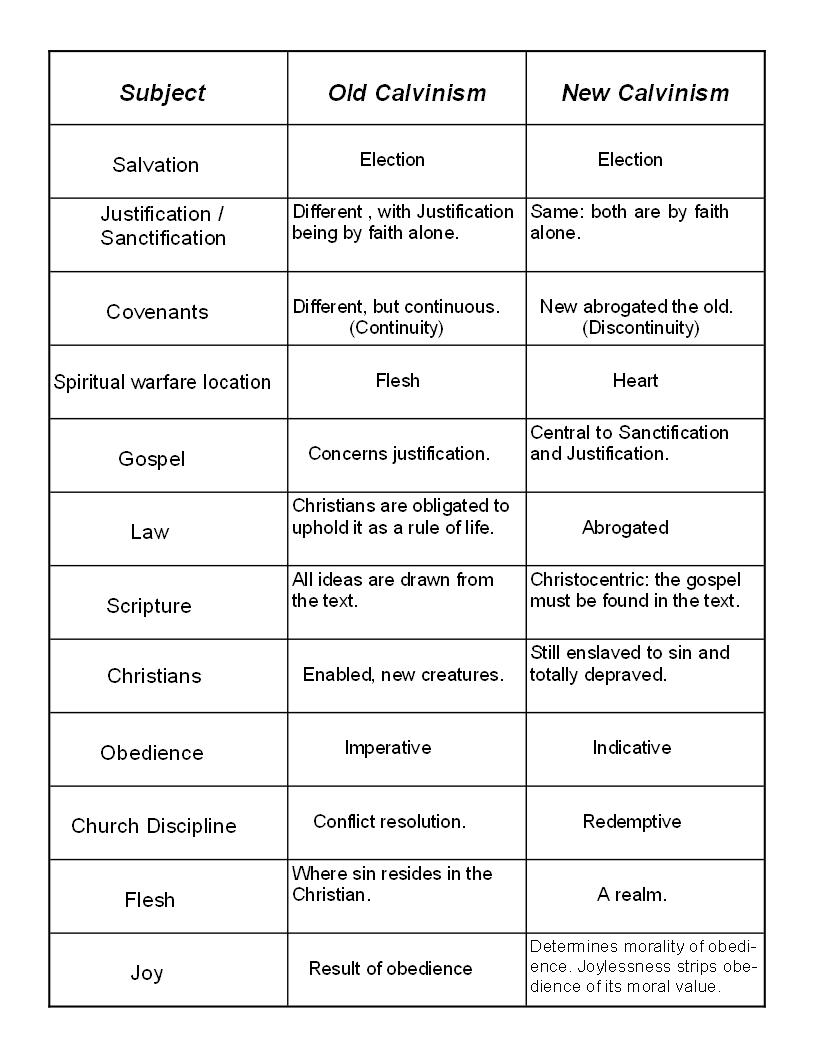
I have a better idea. One of the seventy teachers that are going to be there should make a chart with old Calvinism on the left, and New Calvinism on the right to help explain why it is “new.” List theological elements on the far left and the differences between the two can be noted in the short descriptions under each new/old heading. My proposed chart follows. Please feel free to print it and take it to the conference with you. It is not meant to be comprehensive or indicative of what ALL GS proponents believe, but merely an instrument to provoke discussion. However, the chart does indicate my conviction that the two are only similar on the election issue.
paul
“The ‘Gospel’ Coalition” Series, Part 6: Can Christian Women Gone Wild Save Us From New Calvinism?
I have shared my theory in other posts that contemporary antinomians are like serial criminals. Not in essence of being actual criminals, but in their deep-seated desire to get caught. You have seen the plot in movies—serial criminals always dropping catch me if you can hints to the police. At least two antinomians of our day, Tullian Tchividjian and John Piper, are good examples of this. But first, let me say that I realize that I am one of the very few people around who equate Gospel Sanctification / Sonship theology ( Tim Keller, a significant forerunner of Sonship theology, is one of the founders of TGC) / the gospel-driven life with antinomianism. However, my reasoning is simple; if we are sanctified by justification, that excludes the law either by obligation or ability. Neither do I buy into the idea that thinking the law is good—is an acceptable replacement for an obligation to obey it. Also, the fact that I rubbed shoulders with six GS proponents for several years, and I’m privy to the fact that they bragged about being antinomians is not helpful to those who are trying to persuade me otherwise.
Hold on, my phone is ringing: “Oh! Hi honey. Uh—uh , ya, hmmm. I know sweety, we have discussed this before—getting to the point and such, ya, I will get to the women shortly. Ok, talk to you later, bye!”
Anyway, Tullian Tchividjian recently dropped a really big hint by promoting the idea that preachers should strive to be accused of antinomianism as a way to validate their preaching as having enough Jesus. When one, lone man protested, it made national headlines in Christian circles. But despite Tchividjian’s efforts, it didn’t work. The one, lone protestant focused on the accusation element without considering for a moment that maybe TT really is antinomian. Whew, that was a close one! Michael Horton followed the same week by accusing an accuser of accusing him of antinomianism when the accuser never even used the word in the accusation. Another hint? Hmmmm.
Also, we have John Piper, the First Pope of New Calvinism, continually drawing attention to himself (hints?) by promoting heretics and refusing to correct associates that use profanity in public, while notable evangelicals at large cover for him, and not for a moment considering that any of this has anything to do with the guy’s theology while teaching that what we believe always dictates what we do—unless you’re Pope John the First. A prime example of this is Piper’s invitation to Rick Warren to speak at one of his Desiring God conventions. But hello, when you believe that every verse in the Bible is about the gospel, how can the particular elements of God’s truth really have that much significance? If Warren also believes that the Bible is a plenary gospel narrative, everything else is fair game—so why wouldn’t they hangout together? In fact, a reader sent me a quote by Tchividjian in regard to his defense of Piper for the invite by saying something like this: “All truth is God’s truth, even if it comes from Rick Warren.”
But what’s up with Piper being defended by the likes of Phil Johnson, John MacArthur’s right-hand guy, in the following post: http://teampyro.blogspot.com/2010/04/on-piper-warren-connection.html ? “I love John Piper. People often ask me what living preachers I listen to besides John MacArthur. John Piper is my clear first choice. He’s also one of my favorite authors.” Unbelievable. That is, until you read this in the same post:
“Speaking of Twitter chatter and Facebook feedback, I can’t touch on this whole subject without pointing out that the tone of some of the criticism leveled at Dr. Piper is simply revolting. Within fifteen minutes of Dr. Piper’s live webcast the other night, I had to delete a comment on my Facebook page from a woman who called him a clown. Over the past week I have deleted an average of two or three comments each day that were personally insulting or deliberately disrespectful toward Dr. Piper. One woman expressed a hope that his sabbatical would be permanent.
It intrigues and disturbs me that most (not all, but most) of the overtly impertinent comments have come from women. There’s evidently a growing regiment of self-appointed discernment experts consisting of women who give lip service to the authority of Scripture. They would unanimously affirm that Scripture reserves for men the teaching and ruling elders’ roles in the church. They would, I presume, deplore the ordination of women to such positions of authority. They are not offended by Paul’s statement in 1 Timothy 2:12; rather, they would say amen to it. And yet in practice they have no compunction about posting angry, loud condemnations and insistent demands for the removal of a pastor of John Piper’s stature. These things ought not to be.”
First of all, God is sovereign; it is obvious that God planned before the foundation of the Earth for me to marry Susan and not the woman who called Piper a clown. Besides, in the spirit of defending people just because we like them, are we sure that wasn’t her way of saying Piper is a follower of Edmund Clowney? As I unravel the sorted history of New Calvinism, there is some question as to who was really the father of Sonship theology that is the fundamental basis for neo-Calvinism—Clowney, or John “Jack” Miller. Clowney wrote Preaching Christ in All of Scripture, How Jesus Transforms the Ten Commandments, and Christian Meditation. Any of those themes sound familiar in Piper’s teachings? But if that’s not the case, to Phil Johnson’s point, how dare that woomun call out a man of “Piper’s stature” (did he really say that? Let me check again.Yep, he sure did). Well, that pretty much says it all—if one of the who’s who of the evangelical world teaches error, the uneducated book-buying peasants of American church culture need to keep their mouths shut and submit to the “ruling elders.” Worse yet, if not unthinkable, is the idea that one of the woomun peasants would speak out!
If Phil would check Acts 17:11: the Holy Spirit commends the Bereans for vetting Paul’s (the apostle) teachings and no gender is mentioned. In fact, verse 12 seems to indicate women were among them. And I know this is difficult for Phil, but John Piper is no apostle Paul. Furthermore, Priscilla and Aquila both instructed Apollos (Acts 18:26), and I doubt Piper is an Apollos as well. As far as Phil’s citing of 1Timothy 2:12, because of 1Corinthians 14:34, I would think Paul is referring to the corporate setting, and not the milieu of life in general. Phil’s boss, John MacArthur, agrees; see his comments on 1Timothy 2:12 in his Bible Commentary, page 1783. He states the following: “He is not prohibiting them from teaching in other appropriate conditions and circumstances (cf. Acts 18:26; Titus 2:3,4).” John’s over the Seminary and Phil’s over other stuff, right?
Moreover, now that we have established that women can callout man-leaders of high stature, Phil apparently deleted a woman who was dead-on regarding Piper taking a permanent sabbatical. Piper took an eight-month sabbatical for beyond unbiblical reasons. An eight-month, paid sabbatical to eliminate several “species of heart idols.”? And the obvious logical conclusion as follows: an eight-month sabbatical instead of being counseled by his own elders; where is all of that in the Bible? Add to that his announcement that he is hoping to remain pastor there five years after returning from his sabbatical. The lady is absolutely right, why not just retire and be done with it? And by the way, HOW DO YOU PREDETERMINE HOW LONG IT WILL TAKE TO ELIMINATE “SEVERAL SPECIES OF HEART IDOLS”? ARE THEY THE EIGHT-MONTH TYPE? Have we lost our minds?
Phil also wrote: “It intrigues and disturbs me that most (not all, but most) of the overtly impertinent comments have come from women. There’s evidently a growing regiment of self-appointed discernment experts consisting of women….” Yes, discerning Christian woman gone wild, and thank goodness for them. Phil sates that it is mostly women who are speaking up and calling for leaders to be held accountable. Sad. And the women folk are right about something else: something can be done about it; separation, not inviting them to conferences (Matthew 18:17). Rejection, not fellowship (Titus 3:10 Rom 16:17,18), Rebuke, not excuses (1Timothy 5:19).
John Piper is one of the featured speakers at this years TGC conference in Chicago. Who knows what hint he will drop this time around. Will some Christian woman gone wild have to satisfy his deep-seated desire to be exposed? Can Christian women gone wild save the church from New Calvinism? Stay tuned.
paul

 Paul's Passing Thoughts
12 comments