It’s All About the “O” – Mohler, DeYoung, Lucas: We Own You
 Originally posted September 15, 2012
“You could be in a church that is subtly indoctrinating your family with the idea that they are owned by the government; in this case, church polity.”
Join a New Calvinist Church if you will, but let it be known: they now own you. Newsflash for the husbands: Calvinist elders believe they have the ultimate say and authority in your home. And another thing: the gospel they hold to rejects synergism in sanctification as works salvation. So, guess what? If your wife buys into that, you are now in what they call a mixed marriage. You are now dangerously close to divorce court as the divorce rate in these churches has skyrocketed.
In our recent TANC 2012 conference, author John Immel nailed it—it boils down to who owns man: in the Christian realm, does Christ own you or Reformed elders? In the secular realm, does man own man or does government own man? Recently, our President stated that government owns man. Recently, in a trilogy of articles by three Reformed pastors published by Ligonier Ministries, it was stated that the church owns Christians, and I will give you three wild guesses as to who represents the authority of the church. That would be the elders.
So it’s all about the “O.” It’s all about “ownership.”
As we shall see, these articles plainly state the Reformed tradition that came from Catholic tyranny. The Reformers never repented of the same underlying presuppositions concerning man’s need to be owned by enlightened philosopher kings. The Reformation was merely a fight for control over the mutton with the Reformers seeing themselves as the moral philosopher kings as opposed to the Romish ones. Their doctrine was just a different take on how the totally depraved are saved from themselves. But both doctrines reflect the inability of man to participate in sanctification.
The three articles posted were: Should I Stay or Should I Go? by Albert Mohler; Where and How Do We Draw the Line? by Kevin DeYoung; and, Who Draws the Line? by Sean Michael Lucas. All linked together for your indoctrination convenience.
Al Mohler states in his ownership treatise that Christians have “no right” to leave one church for another because of preferences. Emphasis by underline added:
Far too many church members have become church shoppers. The biblical concept of ecclesiology has given way to a form of consumerism in which individuals shop around for the church that seems most to their liking at that moment. The issue can concern worship and music, relationships, teaching, or any number of other things. The pattern is the same, however – people feel free to leave one congregation for another for virtually any reason, or no reason at all.
Church shopping violates the integrity of the church and the meaning of church membership. When members leave for insufficient reason, the fellowship of the church is broken, its witness is weakened, and the peace and unity of the congregation are sacrificed. Tragically, a superficial understanding of church membership undermines our witness to the gospel of Christ.
There is no excuse for this phenomenon. We have no right to leave a church over preferences about music, personal taste, or even programming that does not meet expectations. These controversies or concerns should prompt the faithful Christian to consider how he might be of assistance in finding and forging a better way, rather than working to find an excuse to leave.
Where to begin? First of all, while many New Calvinist churches will bring you up on church discipline for leaving because of “unbiblical” reasons, those reasons vary from church to church. So, not only do the reasons for leaving vary among parishioners, but what constitutes proper “biblical…. ecclesiology” in regard to departure varies as well. Mohler states in the same post that doctrine is a valid reason to leave a church, but yet, one of the more prominent leaders of the New Calvinist movement (CJ Mahaney), who is strongly endorsed by Mohler, states that doctrine is not a valid reason to leave a church. CJ Mahaney substantiated that New Calvinist position and clearly indicated what New Calvinists are willing to do to enforce that position when he blackmailed the cofounder of SGM, Larry Tomczak:
Transcript of Phone Conversation between C.J., Doris and Larry Tomczak on October 3, 1997 pp. 10-11:
C.J.: Doctrine is an unacceptable reason for leaving P.D.I.
Larry: C.J., I’m not in sync with any of the T.U.L.I.P., so whether you agree or not, doctrine is one of the major reasons I believe it is God’s will to leave P.D.I. and it does need to be included in any statement put forth.
C.J.: If you do that, then it will be necessary for us to give a more detailed explanation of your sins [ie, beyond the sin of leaving for doctrinal reasons].
Larry: Justin’s name has been floated out there when there’s statements like revealing more details about my sin. What are you getting at?
C.J.: Justin’s name isn’t just floated out there – I’m stating it!
Larry: C.J. how can you do that after you encouraged Justin to confess everything; get it all out. Then when he did, you reassured him “You have my word, it will never leave this room. Even our wives won’t be told.”
I repeatedly reassured him, “C.J. is a man of his word. You needn’t worry.” Now you’re talking of publically sharing the sins of his youth?!
C.J.: My statement was made in the context of that evening. If I knew then what you were going to do, I would have re-evaluated what I communicated.
Doris: C.J., are you aware that you are blackmailing Larry? You’ll make no mention of Justin’s sins, which he confessed and was forgiven of months ago, if Larry agrees with your statement, but you feel you have to warn the folks and go national with Justin’s sins if Larry pushes the doctrinal button? C.J., you are blackmailing Larry to say what you want!―Shame on you, C.J.! As a man of God and a father, shame on you!
This will send shock waves throughout the teens in P.D.I. and make many pastors’ teens vow, “I‘ll never confess my secret sins to C.J. or any of the team, seeing that they‘ll go public with my sins if my dad doesn‘t toe the line.”―C.J., you will reap whatever judgment you make on Justin. You have a young son coming up. Another reason for my personally wanting to leave P.D.I. and never come back is this ungodly tactic of resorting to blackmail and intimidation of people!
C.J.: I can‘t speak for the team, but I want them to witness this. We’ll arrange a conference call next week with the team.
Doris: I want Justin to be part of that call. It’s his life that’s at stake.
C.J.: Fine.
(SGM Wikileaks, part 3, p.139. Online source)
Of course, this example and many others makes Mohler’s concern with the “integrity” of the church—laughable. But nevertheless, Mohler’s post and the other two are clear as to what common ground New Calvinists have on the “biblical concept of ecclesiology.”
Besides the fact that parishioners “have no right” to leave a church based on preference, what do New Calvinists fundamentally agree on in this regard? That brings us to the article by Sean Michael Lucas :
Because the church has authority to declare doctrine, it is the church that has authority to draw doctrinal lines and serve as the final judge on doctrinal issues. Scripture teaches us that the church serves as the “pillar and buttress of the truth.”
So, even in cases where New Calvinists believe that doctrine is an acceptable reason for leaving a church, guess who decides what true doctrine is? “But Paul, he is speaking of doctrine being determined by the church as a whole, not just the elders.” Really? Lucas continues:
In our age, this understanding—that the church has Jesus’ authority to serve as the final judge on doctrinal matters— rubs us wrong for three reasons. First, it rubs us wrong because we are pronounced individualists. This is especially the case for contemporary American Christians, who have a built-in “democratic” bias to believe that the Bible’s theology is accessible to all well-meaning, thoughtful Christians. Because theological truth is democratically available to all, such individuals can stand toe to toe with ministerial “experts” or ecclesiastical courts and reject their authority.
Creeped out yet? Well, if you are a blogger, it gets better:
Perhaps it is this individualistic, democratic perspective that has led to the rise of websites and blogs in which theology is done in public by a range of folks who may or may not be appropriately trained and ordained for a public teaching role. While the Internet has served as a “free press” that has provided important watchdog functions for various organizations, there are two downsides of the new media, which ironically move in opposite directions. On the one side, the new media (blogs, websites, podcasts, Facebook, Twitter) allow everyone to be his own theologian and judge of doctrinal matters. But because everyone is shouting and judging, the ironic other side is that those who are the most well known and have the biggest blogs gain the most market share and actually become the doctrinal arbiters of our electronic age. In this new media world, the idea that the church as a corporate body actually has authority to declare doctrine and judge on doctrinal issues is anathema.
Lucas continues to articulate the Reformed tradition that holds to the plenary authority of elders supposedly granted to them by Christ:
For some of us, again reflecting our individualism, such understanding of the church unnecessarily limits voices and perspectives that might be helpful in conversation. But restricting access to debates and judgments about theology to those who have been set apart as elders in Christ’s church and who have gathered for the purpose of study, prayer, and declaration actually ensures a more thoughtful process and a surer understanding of Christ’s Word than a pell-mell, democratic, individualistic free-for-all. Not only do we trust that a multiplicity of voices is represented by the eldership, but, above all, we trust that the single voice of the Spirit of Jesus will be heard in our midst.
So, bottom line: the priesthood of believers is a “pell-mell, democratic, individualistic free-for-all.” Still not creeped out? Then consider how they answer the question in regard to elder error:
Of course, such slow and deliberate processes do not guarantee a biblically appropriate result. After all, the Westminster Confession of Faith tells us that “all synods or councils, since the apostles’ times, whether general or particular, may err; and many have erred” (WCF 31.3). Sometimes, entire denominations err significantly as they prayerfully consider Scripture and judge doctrine. Such error, however, does not negate Jesus’ own delegation of authority to the church and set the stage for a free-for-all.
This brings us to another issue that DeYoung propogates in his post: since Reformed elders have all authority, their creeds and confessions are authoritative and not just commentaries. Hence, they declared in the aforementioned confession cited by Lucas that even though they may be in error, they still have all authority. Whatever happened to the Apostle Paul’s appeal to only follow him as he followed Christ?
DeYoung:
Those who wrote the ancient creeds, such as the Apostles’ Creed, the Nicene Creed, and the Chalcedonian Definition, were not infallible, but these creeds have served as effective guardrails, keeping God’s people on the path of truth. It would take extraordinary new insight or extraordinary hubris to jettison these ancient formulas. They provide faithful summaries of the most important doctrines of the faith. That’s why the Heidelberg Catechism refers us to the Apostles’ Creed, “a creed beyond doubt, and confessed through the world,” when it asks, “What then must a Christian believe?” (Q&A 22–23).
FYI: If you see something in your own Bible reading that contradicts a Reformed creed or confession, you are partaking in visions of grandeur.
This is the crux of the matter, the question of authority. It is almost crazy that Christians don’t have this issue resolved in their mind before they join a church. You could be in a church that is subtly indoctrinating your family with the idea that they are owned by the government; in this case, church polity.
Let there be no doubt about it, New Calvinists are drooling over the idea of another Geneva theocracy with all the trimmings. And someone shared with me just the other day how this shows itself in real life. “Mike” is a local contractor in the Xenia, Ohio area. He is close friends with a farmer in the area who lives next door to a man and his family that attend a New Calvinist church.
One day, his new New Calvinist neighbor came over to inform him that he needed to stop working on Sunday because it is the Lord’s Day, and the noise of his machinery was disturbing their day of rest. Mike’s friend told him, in a manner of speaking, to hang it on his beak. Mike believes what transpired after that came from the neighbor’s belief that he was a superior person to his friend, and that his friend should have honored the neighbors request by virtue of who he is.
The neighbor has clout in the community, and to make a long story short—found many ways to make Mike’s friend miserable through legal wrangling about property line issues; according to my understanding, 8” worth. It was clear that Mike’s friend was going to be harassed until he submitted to this man’s perceived biblical authority.
New Calvinists have serious authority issues, and you don’t have to necessarily join in official membership to be considered under their authority. A contributor to Mark Dever’s 9 Marks blog stated that anyone who comes in the front door of a church proclaiming Christ as Lord is under the authority of that church.
It’s time for Christians to nail down the “O.” Who owns you? Are you aware of who owns you (or at least thinks so)? And are you ok with that?
paul
The Heavenly B-52s Can Save American Christianity From Its Present Dark Age
 Originally published February 11, 2013
We must remember that the Dark Ages were a European thing. And we must remember that Greco-Roman philosophy was the source and then it was turbo charged with the integration of European style religiosity. European religion has always been grounded in Plato’s disdain for humanity. Hence, one philosopher stated well that faith and force together are the destroyers of the modern world. One of the most notable historians of our time, K.R. Popper, fingered Plato specifically in regard to the logic that has wreaked havoc on Western culture through Communism, Islam, Catholicism, and Reformed theology. Augustine, one of the fathers of the Reformation, called Plato a pre-Christian Christian, and the juggernaut of faith and force was thus born.
And primarily, American religion was imported from Europe via the Puritans who were a European style religious political sect. They wanted to create a theocracy of their own in the new world. That’s the “religious freedom” they sought in America—a political one. Ironically, this importation of a European pandemic is romanticized by the Thanksgiving holiday. Somehow, deep in our evangelical American psyche, we think the Puritans could have led us to the religious utopia that we all lust for. And in-fact, deep in our evangelical psyches, we think the war still rages between our Puritan foundations and the evils of Enlightenment philosophy. And if Enlightenment philosophy would surrender, all would be well and the heavenly Jerusalem would finally come down to Earth.
Nothing could be further from the truth. Enlightenment thought, even with its many abhorrent shortcomings, launched America to unprecedented greatness as a nation because of three basic principles that God agrees with: man is free; man is capable; and man is responsible for the sum and substance of his own life before God. Men “small and great” will all stand before God. Plato’s philosopher kings do not stand before God in our stead regardless of the priestly garb that the Reformers have adorned them with.
In the movie, Moneyball, based on a true story, the General Manager of the Oakland A’s baseball team set all time league records with a meager budget and has-been players by breaking tradition with the ways big league teams have always been built. The player’s manager of the team was against the plan, and was a constant hindrance to its implementation. But when the Oakland A’s became the talk of the sports world because of the plan, the player’s manager got all of the credit. In the same way, the manager of American Christianity, the one of 95 Theses fame, Martin Luther, is given credit for America’s greatness. God has blessed America because of the Puritan missionary children that he spawned. Their roots are the lifeblood of America. We were “founded on their Christian principles.” This is a significant departure from reality.
Luther despised reason. He believed that reasoning was a dangerous stunt that the unenlightened masses shouldn’t try at home. And because they are not capable, they have to be protected from themselves; hence, neither are they free. To the degree that we are free the world is in a spree. Man must be saved from himself; by force if necessary, and for the good of the world. Martin Luther to the rescue. Stalin to the rescue. Muhammad to the rescue. The Moral Majority to the rescue. And on every Thanksgiving Day, deep, deep in our American psyche, a small still voice cries out: “Oh but for the Puritans! What could we be?” It’s all the same logic. You can dress it up in different doctrines, but it’s all the same. Logic comes in many doctrinal forms—both secular and religious.
The founding fathers of this country were children of the Enlightenment era. Until America popped up on the history radar screen, force and faith was the big league tradition. Our founding fathers proposed something different: government as the protector of man’s right to be free, capable, and responsible. And a government that served at the pleasure of the people to do so. It is a testimony to the power that is displayed when merely three ideas from God are implemented in our realty. Three ideas from God made America the envy of all world history. In the end, the motif that any child can perceive in the book of Revelation will fill the world with blood up to the horse’s bridles: force and faith. To what is said here, the proffers of force and faith, the Reformed of our day, answer in all of their Puritan glory, “I beg your pardon! Jesus Christ should be the envy of the world!” But which Jesus Christ? The Puritan Jesus Christ? And enlightened minds want to know: “Are we free to decide that for ourselves?” And: “Are we capable of even knowing that?” We fear that the answer to both of these questions is, “No.” And that is why giving you power in our lives at any level is a really bad idea.
Hence, To the degree that the Reformed Dark Age feigns, darkness in the American church does rein. And we are in that Dark Age. It came in essence as logic stowed away in the Mayflower’s diseased European rats bringing the same plague with it. I could drag out all of the apocalyptic data and its many faceted manifestations, but a recent televised top of the hour newscast introduction will suffice:
Here we go again, another sex scandal in the Evangelical church.
You notice they said, “Evangelical” and not “Catholic.” Anybody that knows the facts knows that sexual abuse and the subsequent cover-ups are just as prevalent in the Protestant Evangelical Church as it is in the Catholic Church. The scandals are the same, and the silence among clergy is the same, along with the same disregard for victims. Different doctrines—same logic—same results. Logic always has an endgame; there are many different doctrines that can get you there.
But the American Dark Age takes on a different appearance than the open fires of European religious wars and unspeakable terrors for it is tempered with freedom, capability, and responsibility. In the same way that God’s spies found refuge with a harlot, the American church has been saved from itself by Enlightenment thought. The result has been Reformed Light, and the carnage has been greatly limited. The European Reformers believed that children should be seen and not heard; American Reformed Light allows their children to play in a sandbox. Children are happier when they have a sandbox to play in, and they can form all kinds of ideas in what they make in the sand. But when it is time for dinner, it’s also time to put our little buckets and shovels away, run to the dinner bell, and obey mommy and daddy. They protect us from truth that can cause division because we are unable to handle truth, and they make truth a storybook that we can understand. They read it to us at night, and we are much comforted. We can pretend in the backyard, and we feel safe because mommy is watching from the kitchen window.
But the children of Reformed Light do not grow up. For certain, the American church is every bit like grown adults playing in a sandbox. The real Reformers now come forward and scoff at the pathetic sight, and say they are the answer. Yes, not playing with ideas at all must be the answer. Adults in a sandbox is not the problem, the sandbox is the problem. Sandboxes tempt people to play with truth. The Reformers to the rescue—those half breed Semi-Pelagian parents be damned.
Children in adult bodies will always rape, hate, pillage and steal. It is what it is: spiritually, they were born slaves, born incapable, and born irresponsible. Reformed theology is a bus of misfits, but all believe that it is the only bus going to heaven—the bus of faith alone in Puritan sanctification. All kinds are on the bus, but the tie that binds is womb to the tomb total depravity.
Some do not persevere in accepting their total depravity and the total depravity of others. Some do not trust God’s anointed to get the bus of misfits to heaven, so an Inquisition is needed. The European Reformers used the gallows and the burning stake (if the victim was lucky), brainwashing, and orthodoxy. The American Reformers can use brainwashing and orthodoxy, but because of the founding fathers, the American Reformers must replace the gallows and burning stake with character assassination, authority to condemn eternally, and false criminality. And all of the aforementioned paints the portrait of the present-day American Dark Age in the church. There is a little metal plate on the bottom of the spectacular painting hanging in the gallery of human history, and it reads:
Here we go again.
The Bible is written for mass consumption. All Bible books, save a few, were written to assemblies and not leadership. God has also written his word on the hearts of every person ever born into the world (Romans 2:14). We are all responsible before God, free to obey Him or not obey Him, and obviously, must exercise our minds for understanding. We also live in the information age; so, if man was without excuse in the days of the apostolic church (Romans 2:1) we are certainly without excuse today.
Nations, particularly the USA, have used heavy bombers to drop propaganda leaflets on cities before an invasion or in an attempt to turn the population at large against the enemy leadership. Each bomb usually weighs about 250 lbs. and rains about 60,000 leaflets on a given area. During the Iraq/US war, leaflet bombings resulted in the mass surrender of Iraqi soldiers. In the same way, regardless of what’s going on in the world, God has a message of truth for every person. Invariably, it is man’s responsibility to do what God wants him to do in any given situation.
God has given the truth to all men, and only the truth will set us free. We need to pick up and read the leaflet and surrender to the Chief Shepherd. The Reformation is responsible for this present Dark Age in the American church. It is a doctrine that must be rejected with prejudice, and we must disdain anything that has touched its filthy garments.
A little leaven leavens the whole lump.
paul
The Elephant in the Room: The Historical-Redemptive Gospel
 Originally published September 3, 2013
How Should We Read Our Bibles?
There isn’t a bigger elephant in the Sunday school room or the sanctuary than the issue of Bible interpretation. The reason for this follows: the method of interpretation that comes natural to us is assumed.
What is that method? This gets into an area of study called hermeneutics (the theory of interpretation), and the two primary theories thereof are exegesis and eisegesis. These are big theological words that the average Protestant is not supposed to know. This is because the Protestant interpretation of the Scriptures is based on authority.
We will get to exegesis and eisegesis, but the crux of the issue is authority. The Reformers came from Romanism and clearly, their interpretive construct was based on authority; i.e., the average parishioner was not free to interpret the Bible and follow it according to one’s own conscience:
Rightfully and nobly did the Protestant Reformers claim religious liberty for themselves; but they resolutely refused to concede it to others. [1]
The very foundation of Protestant interpretation is based on authority; that is, the leaders dictate meaning. Therefore, traditionally, the need for Protestants in general to understand interpretive principles would be unnecessary, and as a result, Protestantism functions that way till this very day. In the early days of the Reformation, private interpretation was outlawed [2]; in our day, education regarding the tools needed to interpret the Bible are merely excluded.
This fact brings us to an interesting word, “orthodoxy.” Traditionally, this word is associated with “truth” as a synonym. This is not the case at all. Orthodoxy is the authority of truth based on counsels of any given sect. [3] The opinions of these counsels regarding the meaning of “truth” are known as “creeds” and “confessions.” These are “truths” (actually, opinions concerning the meaning of any given subject) repackaged for those who have limited understanding, and usually recited and learned through catechisms [4].
Authority Versus Individual Interpretation
Hence, Protestant interpretation is based on authority and not individual interpretation. The structure of this interpretive process is orthodoxy formed through counsels, distributed by creeds/confessions, and practiced through catechisms. In Europe and early Colonial America, it was a matter of civil law, in our day the process is tempered by the freedom to choose your own orthodoxy, but it is still orthodoxy. Once a typical American parishioner chooses who they want to believe, they will follow that leader as an authority. A like tendency caused the Apostle Paul to confront the believers at Corinth (1COR 3:1-9).
Of course, the authoritative method of interpretation is at the root of every cult. Traditionally, when people seek to find God, they begin by finding an authority that they are comfortable with. This is why many people prefer authoritative interpretation in a free society: it allows them to choose their own general truth while leaving the hard task of thinking to others. The Apostle Paul said this would be particularly problematic in the last days (2TIM 4:3-5).
The visible authority structure within the church is known as “church polity” or church government. [5] Again, the whole construct is based on authority. If authority is the interpretive prism, roles in the church are going to be seen as positions of authority rather than gifts. When Christ ministered here on earth, disciples were free to follow Him or not follow Him under their own free volition (JN 6:66-69). Christ made it clear to the disciples that their roles in the kingdom were not that of authority (Matthew 20:20-28).
The word “office” inserted in the English translations when associated with “bishop” or “deacon” were added in to the translations and do not appear in the Greek manuscripts while in other places these roles are spoken of as gifts (EPH 4:11-16). We have been given authority to proclaim the gospel of the kingdom on earth, but that is a vertical authority and not horizontal. Those who protest the gift idea versus the authority idea often cite the following text:
Hebrews 13:17 – Obey your leaders and submit to them, for they are keeping watch over your souls, as those who will have to give an account. Let them do this with joy and not with groaning, for that would be of no advantage to you.
The word for “obey” in this verse is πείθω (peithō) which means to persuade by argument. The word “submit” is ὑπείκω (hypeikō) which means “to surrender.” Here is the best rendering according to a heavy paraphrase:
Be persuaded by your leaders’ arguments from Scripture and don’t be stubborn in regard to the truth for this is no advantage to your own spiritual wellbeing. Besides, they have to give an account for how they led you, and let that account be a joyful recital to the Lord rather than a sorrowful report.
Why is this important? Because every person is personally culpable before God for following the truth, not men. Paul was an apostle, yet the Bereans verified what he taught according to their own understanding of Scripture (Acts 17:11). Paul told the Corinthians that he should only be followed as he followed Christ (1COR 11:1). Every individual will stand before God to give an account of the sum and substance of their own lives, not who they followed among mortals.
The Exegesis and Eisegesis of Hermeneutics
The theological word for the science of biblical interpretation is hermeneutics. The first consideration of hermeneutics must be exegesis and eisegesis. Exegesis draws conclusions from written text depending on the grammatical meaning and arrangement of words. Eisegesis approaches the text with an interpretive prism. One who uses the exegetical approach will even approach the text to learn how the text itself should be interpreted. Eisegesis assumes one must approach the text with a proper presupposition in order to properly understand it.
Therefore, this takes us right back to the basic question of authority versus the freedom of individual interpretation. Eisegesis will approach the text with a prescribed method of interpretation while exegesis will look for the best way to interpret the text from the text itself. The interpretive prism for eisegesis comes from an authority. The common contention from those of the authority camp is that everybody approaches the Bible with presuppositions, and this is unavoidable; so, it is important to use the right interpretive prism. Since we are supposedly incapable of approaching the Bible objectively, we should bow to their authority in regard to the proper interpretive prism.
Historical-Grammatical Versus Historical Redemptive: The Elephant in the Room
Eisegesis and exegesis really boils down to authority versus individualism, and so does the two major methods of interpretation in the church: historical-grammatical method and the historical-redemptive method. This is where we get into discussion about the elephant in the room. These two devices of interpretation yield completely different results. When we sit under any given teacher, he/she will be using one of these hermeneutics. The two different approaches will sound the same because each uses all of the familiar terms, “gospel,” “justification,” etc., but the terms mean different things in each construct. This is the elephant in the sanctuary and the Sunday school room that no one is talking about.
As suggested by the terms themselves, one interprets the Bible grammatically, and the other interprets the Bible through a Redemptive prism. The latter seems perfectly reasonable: “Isn’t the Bible primarily about Redemption?” The former would judge that assertion by a grammatical evaluation of the text. In other words, conclusions are drawn by the arrangement of words, their meaning, and what those words meant to people in that historical context. This is exegesis.
The redemptive method presupposes that the Bible is a gospel narrative about the works and personhood of Christ. It presupposes that this is the dominate theme of the Bible and everything else in the Bible is secondary and points back to Christ. For example, biblical commands aren’t really meant for us to obey, but rather illustrate the works that Christ has accomplished for us and illustrative of what we are unable to do. This bypasses the normal grammatical interpretation of an imperative expectation, and interprets it as a finished work that God in fact does not want us to do. This is assumed because of the redemptive presupposition. As Neo-Calvinist Paul David Tripp has said, biblical commands must be seen in their “gospel context.” [6]
The Gospel Transformation Study Bible and the Redemptive-Historical Gospel
Dr. Kathleen Nielson, in a promotional video for the Gospel Transformation study Bible, stated that the historical-redemptive theme is not imposed on the text, “it’s actually in there!” This, we by no means deny, but are the works of Christ and His personhood something that every verse in the Bible points to? Nielson, like many from the redemptive-historical camp, use the grammatical approach to determine that something is in the text, and then make that an authoritative interpretive prism.
I have talked face to face with pastors who use this hermeneutic. As one stated to me, “You might have to cover multiple chapters in one sermon in order to see the Christocentric theme God is showing you at the time.” Others are even more direct:
At this time, resist the temptation to utilize subsequent passages to validate the meaning or to move out from the immediate context. Remembering that all exegesis must finally be a Christocentric exegesis.
Look for Christ even if He isn’t there directly. It is better to see Christ in a text even if He isn’t, than to miss Him where He is. [7]
Again, we see that a “Christocentric exegesis,” something that is in the text grammatically, becomes the authoritative eisegesis. And this elephant is a big one, because interpreting the Bible this way is intrinsically tied to the gospel that comes part and parcel with the redemptive method. The historical-redemptive method is a tool for enabling the believer to live by faith alone in their Christian walk. The historical-redemptive method is actually a gospel in and of itself. To interpret the Bible grammatically is to conclude that God actually wants us to exert our own will in response to commands in the Bible. To proponents of the redemptive-historical method, this is works salvation because Christ is not obeying for us in our Christian life. This is what the Reformation motto, “Christ for us” means. The Neo-Calvinist John Piper has stated it this way, “[Christ] 100% for us.” [8] Piper has also said that “necessary sanctification” comes from faith alone in the Christian life (Ibid).
Therefore, according to proponents of the redemptive model, a historical-grammatical interpretation of Scripture necessarily leads to works salvation and making what we do in the Christian life “the ground of our justification” (Ibid). For all practical purposes, Paul David Tripp has stated such:
….and the Bible does call us to change the way we think about things. But this approach again omits the person and work of Christ as Savior. Instead, it reduces our relationship to Christ to “think his thoughts” and “act the way Jesus would act.” [9]
Here, Tripp concedes that the Bible can be interpreted grammatically, “and the Bible does call us to change the way we think about things.” Grammatically, one assumes the commandments are to us and that we are called to do them. Again, Tripp clearly recognizes this fact. But what does he say the results are?
But this approach again omits the person and work of Christ as Savior.
What happens if we “omit” Christ as “Savior”? Clearly, Tripp is stating that if we interpret the Bible literally and obey it, we are circumventing Christ’s salvific work. Much more than mere semantics are at stake here. The elephant in the room is absolutely huge! This is about the gospel.
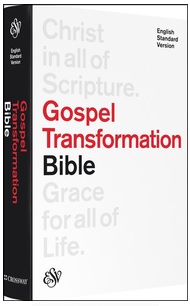
The historical-redemptive method of interpretation is all the rage in contemporary Christianity. Projects and programs that promote this method of interpretation and target all age groups abound. Almost all Christian publishers are on board with the historical-redemptive hermeneutic. The latest project that has been unveiled towards this endeavor is Crossway Publishers’ The Gospel Transformation Bible. It will be available 10/19/13.
The subtitle is, “Christ in all of Scripture, Grace for all of Life.” This is typical of those who promote this method of interpretation and its gospel. Christians will assume that the title only pertains to justification by faith alone, but it doesn’t. “Transformation” or change has to do with the Christian life, and in the subtitle, “Grace” replaces “gospel” to veil the real crux of this doctrine. Basically, it teaches that Christians are transformed by continually revisiting the same gospel that saved them. Not only that, we keep ourselves saved by doing such. This is what is behind the Neo-Calvinist mantra, “We must preach the gospel to ourselves every day.” John Piper has said that the question is not only how one gets saved, but how one must use the same gospel that saved him/her to keep themselves saved. [10] Piper has also said that we must “see” the same gospel that saved us over and over again as a requirement to enter heaven. [11]
Note: This is what’s so critical about the Reformed historical-redemptive interpretative model according to many Calvinists, it enables us to fulfill what is “required of us” to enter heaven (Ibid). In essence, once saved, how we read our Bible determines whether we keep our salvation or not. So therefore, those who promote The Gospel Transformation Bible actually see it as a resource for maintaining one’s salvation.
The “Gospel-Driven” Life
The question that is invariably raised is, “How do proponents of the historical-redemptive model explain obedience and the Christian life?” Primarily, they say Christians must “experience” obedience, but must not be the ones who perform it in the Christian life. By revisiting the gospel afresh, the works of Christ are “manifested” in our lives. When this happens, the obedience is experienced by a willing, joyful spirit. As we use the historical-redemptive model to see how sinful we are (a deeper realization of our sin, the realization that originally saved us), and thereby gaining a greater appreciation for what Jesus did for us, we experience “vivification.” This is some sort of joyful rebirth. Proponents of this hermeneutic, primarily those of Reformed theology, refer to this as “mortification and vivification.” A “daily dying and rising,” a “living out of our baptism.” [12] [13]
The Origin of the Historical-Redemptive Hermeneutic
Where did this hermeneutic originate? Even though Martin Luther’s 95 Theses launched the Reformation, the framework of the Reformation’s doctrine and gospel was articulated by Martin Luther six months later. Essentially, Luther’s Heidelberg Disputation to the Augustinian Order in 1518 is the heart and soul of the Reformation. Calvin’s Institutes of the Christian Religion is a greatly expanded treatise of Luther’s framework. However, every fundamental element of Reformation doctrine can be found in Luther’s Disputation, and this by no means excludes the historical-redemptive hermeneutic. [14]
The primary theme of Luther’s Disputation is known as The Theology of the Cross. It was comprised of the glory story and the cross story. Luther believed that salvation must be maintained by an incessant emptying of self. One’s focus must be OUTWARD only. Any semblance of an inward look was the “glory story.” The outward focus on Christ and His works, and nothing about us whatsoever is the “cross story.” A beginning focus on the cross saves us, and a continued focus on the cross story keeps us saved the same way we were originally saved: by faith alone. Sola Fide also pertains to the Christian walk/life. The historical-redemptive model came from Luther’s Theology of the Cross.
Luther believed the outward focus and utter eradication of self leads to a subjective power displayed by the Holy Spirit that we experience. However, we are not to be concerned with it because there is no way for us to distinguish between our own efforts and those of the Spirit. [15] Mortification and vivification can be ascertained in Theses’ 16 and 17 of the Disputation.
Never have Christians been so oblivious to such a critical issue. What we believe about the gospel and how we convey it to the world is at stake. Every Sunday in America, historical-grammatical parents deliver their children to historical-redemptive teachers while clueless in regard to the ramifications. This reality actually creates mixed families and marriages via two different gospels. One spouse buys into sanctification by faith alone while the other one doesn’t. Eventually, you have a mixed marriage.
The issue with these two hermeneutics is not a matter of semantics and preference—these are two different gospels. This issue is the elephant in the sanctuary and the Sunday school room.
ENDNOTES
1. Nabu Public Domain Reprints: The Principles of the Westminster Standards Persecuting; William Marshall, D.D., Coupar – Angus. Edinburgh, William Oliphant & Co. 1873, p. 13.
2. Ibid., pp. 19-22, 28.
3. Bruce Overton: MacMillan’s Modern Dictionary; The Macmillan Co. New York 1943.
4. Ibid.
5. Ibid. designated as synonymous with “politic” : the science of government.
6. Paul David Tripp: How People Change; Punch press 2006, p. 26.
7. The Biblical Theological Study Center: A Christo-Presuppositional Approach to the Entire Scriptures; Max Strange. Online source: http://goo.gl/5sGjP).
8. John Piper: Desiring God .org blog: Video, If you had 2 minutes with the Pope, what would you say?
9. Paul David Tripp: How People Change; Punch press 2006, p. 27.
10. John Piper: Desiring God .org blog; How Does The Gospel Save Believers? Part 2. August 23, 1998 Bethlehem Baptist Church.
11. Ibid, Part 3.
12. Michael Horton: The Christian Faith: A Systematic Theology for Pilgrims On the Way; Zondervan 2011, p. 661.
13. Paul Washer: The Gospel Call and True Conversion; Part 1, Chapter 1, heading – The Essential Characteristics Of Genuine Repentance, subheading – Continuing and Deepening Work of Repentance.
14. In its fundamental elements. It was not referred to as the historical-redemptive hermeneutic for many years afterward.
15. Heidelberg Disputation: Theses 24.
Reformed Questions in Response to “False Reformation”
Originally published December 11, 2012
Paul,
Just a few questions:
1. If you accept the idea that “flesh” and “spirit” refer to parts of regenerate believers rather than to spheres in which people live and by which we are controlled, where does sanctification take place, in the flesh or in the spirit? The same question applies in terms of “old man”/ “new man.” Which of those grows in sanctification?
Answer: This question reflects the fact that the Reformed crowd doesn’t openly discuss what they really believe about this issue, and I commend you accordingly. Authentic Reformed doctrine holds to the idea that the active obedience of Christ is manifested in the “Spirit realm” as a result of what we see in the Bible being imputed to us by faith alone in sanctification (see Luther’s Heidelberg Disputation, theses 27). We don’t change. The “Spirit realm” and the “flesh realm” are two forces that put pressure on us, and at any given time, we “yield” to one or the other. This is the position of the elders who are over the NANC training center in Springboro, Ohio according to an email I received from them when they thought I was on board with their doctrine.
Of course, the take on this varies among those in the Reformed tradition. Another example would be the idea that we are still dead spiritually, and the living Christ within us is the one obeying. What is consistent is the idea that this obedience is experienced in a certain way: joy and a willing spirit (see LHD, theses 27); that’s how we know Jesus is doing it and not us. At any rate, the crux of Reformed theology is that all good works take place outside of the believer; i.e., Luther’s “alien righteousness” for not only justification, but for sanctification as well. Your question is at the very core of debates that took place between heretic Dr. Ed Welch of CCEF and the commendable Dr. Jay Adams.
Jay Adams oversees INS as he was pretty much run out of NANC and CCEF—largely due to the fact that NANC and CCEF are both bastions of evil. I find it utterly intolerable that thousands are sent to these organizations daily with the hope of change when these Reformed organizations in fact don’t believe that God changes them. There are no words for my loathing of such hideous deception while these organizations also take people’s hard-earned money to boot. And some don’t go along with these ideas, but they stand silent and therefore are just as guilty. And my “whole life” is contending against this? Perhaps, but better that than one’s whole life buying acceptance with silence. Moreover, people praise CJ Mahaney and co. for their tireless night and day service to the “gospel” which is really the work of the kingdom of darkness against the kingdom of light. A pity that I would counter that with my own life.
Unfortunately, Adams, who is much more advanced in patience than I am—associates with them, and in my estimation thereby causes confusion regarding the kind of counseling that will change people. Also, the possibility that the only biblical counseling organization left on the face of the earth that is not infected with Trippism and Powlisonism is also a major concern. Nevertheless, Adams and his associate, Donn Arms, are the only ones who have taken a stand against the heretical onslaught taking place in biblical counseling circles which is fraught with mindless followers, lackeys, lovers of filthy lucre, shameless cowards, and lying integrationists. The idea that these people care about any marriage or the well being of any saint is laughable.
But to answer your question completely, I believe the Scriptures are clear that the old self was put to death and no longer has the ability to enslave us to sin. The old self was “under the law” which means that the law provoked him to sin and a final judgment according to the law. As long as we are alive, our mortality has influence over us in regard to the old ways of being under the law, but the enslavement is broken. We are in fact born again, and have a regenerated “law of our mind.” Hence, “the spirit is willing, but the flesh is weak.” The warfare takes place inside of the believer between the law of his mind and the “law of sin.” The apostle makes it absolutely clear: this warfare takes place between my “inner being” and “in my members.” What is clearer? Unless the Bible is a Reformed gospel narrative that isn’t meant to inform our co-laboring with God in sanctification. But it is, because we are no longer “under” it for justification, but are informed by it for sanctification. Because the Reformers believe we are still under it, we must continue to live by the gospel that saved us from the law. We are still under it, but Jesus keeps it for us. How this is applied to the Christian life by the Reformers is outright Gnosticism to the core.
Furthermore, the “law of my mind” part of the believer that “delights in the law” in our “inner being” is what grows. Something in us is in fact growing: a host of passages that include 1Peter 2:1-3 make this certain. Really? Jesus isn’t really talking to us when he states, “Well done faithful servant”?
2. Do you believe sanctification occurs completely apart from faith? Do we have everything we need at the point of regeneration, so that further dependence on the Holy Spirit is no longer necessary? It sounds as if that is what you are saying.
Answer: Your question is framed within the confines of the Reformed either/or hermeneutic. Reality is either interpreted through the “glory story” or the “cross story.” This is the interpretive foundation of Reformed theology as stated in Luther’s HD. Because sanctification includes us, it must be by faith alone like salvation or it includes our glory as well. Therefore, where faith is, it must be by faith alone because faith is of God who will not share His glory with another. Therefore, if our doing is involved with sanctification, it must occur completely apart from faith. It must be the glory story, or the cross story. Reformed proponent Gerhard Forde states this in no uncertain terms.
Biblicists reject that metaphysical presupposition with prejudice. We stand with our beloved brother James, whom Luther rejected for obvious reasons, in saying that faith and works are together in sanctification while faith is alone in justification. Luther and his Reformed minions believe that grace is fused with works apart from our faith when it is faith in the works of Christ alone in sanctification (LHD theses 25).
Also, “Do we have everything we need at the point of regeneration, so that further dependence on the Holy Spirit is no longer necessary?” Again, we see Reformed metaphysics. If any part of our story is in the narrative, it’s semi-Pelagianism and not the cross story. This is a rather simple concept. All of the power that raised Christ from the dead is credited to our account in salvation. The Holy Spirit, our “HELPER” (ESV) “helps” us (that’s what a “helper” does, they “help”) in appropriating the blessings of salvation. He aids us (that’s what a “helper” does, he “aids”). And those blessings are appropriated “IN” (that’s a preposition) the DOING (James 1:25).
3. Do you believe Jesus’ actions are ever to be considered not only as instructional as a pattern for our obedience, but as motivation to imitate him?
Answer: As many have forcefully argued in several articles, especially Presbyterian Pastor Terry Johnson, God uses many different incentives to motivate us other than gratitude and meditating on the salvific works of Christ. This was also Adams’ primary contention against Sonship Theology.
4. Do you see any difference between God’s work in a believer that replaces his need to obey and God’s work in believers motivating them to obey?
Answer: The very question suggests a “need” to “replace (s)” the “need” of a believer to “obey” in sanctification? Of course, a clear distinction is not made regarding….in sanctification or justification? But, NO SUCH NEED EXISTS for sanctification. Our work in sanctification has NO bearing on our justification. The premise of the question is based on faulty Reformed presuppositions.
5. How do you see the Reformed doctrine as teaching that sanctification completes justification?
Answer: They call it a “CHAIN” (The golden chain of salvation-Romans 8:29,30). What’s a “chain”? What happens if you remove the middle links of a “chain” ? It’s not completed—this would seem apparent.
paul
The Magnum Opus of the Reformation: Martin Luther’s Heidelberg Disputation; Part 2
 Listen to the lesson or download audio file.
Welcome truth lovers to Blog Talk radio .com/False Reformation, this is your host Paul M. Dohse Sr. Tonight, part 2 of “The Magnum Opus of the Reformation: Martin Luther’s Heidelberg Disputation.”
Greetings from the Potters House and TANC ministries where we are always eager to serve all of your heterodox needs. Our teaching catalogue can be found at tancpublishing.com.
If you would like to add to our lesson or ask a question, call (347) 855-8317. Remember to turn your PC volume down to prevent feedback.
Per the usual, we will check in with Susan towards the end of the show and listen to her perspective.
Remember, you may remain anonymous. When I say, “This is your host; you are on the air, what’s your comment or question—just start talking.
If you would like to comment on our subject tonight, you can also email me at paul@ttanc.com. That’s Tom, Tony, Alice, Nancy, cat, paul@ttanc.com. I have my email monitor right here and can add your thoughts to the lesson without need for you to call in. You can post a question as well.
Last week we did pretty well; we began with an introduction and completed the first two theses. Tonight, we begin with thesis 3.
Thesis 3: Although the works of man always seem attractive and good, they are nevertheless likely to be mortal sins.
Human works appear attractive outwardly, but within they are filthy, as Christ says concerning the Pharisees in Matt. 23:27. For they appear to the doer and others good and beautiful, yet God does not judge according to appearances but searches »the minds and hearts« (Ps. 7:9). For without grace and faith it is impossible to have a pure heart. Acts 15:9: »He cleansed their hearts by faith.«
The thesis is proven in the following way: If the works of righteous men are sins, as Thesis 7 of this disputation states, this is much more the case concerning the works of those who are not righteous. But the just speak in behalf of their works in the following way: »Do not enter into judgment with thy servant, Lord, for no man living is righteous before thee« (Ps. 143:2). The Apostle speaks likewise in Gal. 3:10, »All who rely on the works of the law are under the curse.« But the works of men are the works of the law, and the curse will not be placed upon venial sins. Therefore they are mortal sins. In the third place, Rom. 2:21 states, »You who teach others not to steal, do you steal?« St. Augustine interprets this to mean that men are thieves according to their guilty consciences even if they publicly judge or reprimand other thieves.
In this third thesis, Luther declares ALL works of men evil. That includes the works of believers as well. Again, we come to a paramount tenet of the Reformation; total depravity does not only pertain to mankind in general, but also the saints. Even though the works of men appear “good and beautiful” (eerily similar to Plato’s trinity of the good, true, and beautiful), they are evil:
If the works of righteous men are sins, as Thesis 7 of this disputation states, this is much more the case concerning the works of those who are not righteous.
By the way, this is synonymous with the Calvin Institutes 3.14.9-11. Luther hints in this thesis in regard to why all the works of men can be deemed wicked: they are under the law, and no man can keep the law perfectly:
But the works of men are the works of the law…
This is another way of saying that Christians remain under the law just like unbelievers, and since no person can keep the law perfectly, all bets are off. The Calvin Institutes 3.14.10 is an in-depth articulation of this idea. This is amazing because it’s right here where Reformed soteriology falls completely apart and turns the whole Bible upside down. Right here, you are looking at it. It’s the idea that Christians cannot perform a good work because they are still under the law and the law demands perfect obedience.
Also, amazingly, all of the major tenets of the Reformation gospel are in this one thesis. Let’s begin with Luther’s heart theology that actually laid the foundation for the contemporary biblical counseling movement; at least what came out of Westminster’s CCEF. An illustration can be seen below.
Luther cites Matthew 23:27 and Psalms 7:9 to make the point that the outward works of men are meaningless and God looks upon the heart. In this theology, the “heart” is the seat of faith. Even though the believer can do no good work; the believer’s heart (or faith) can be pure. What Luther proffers as we move along is a purity totally disconnected from works, and purity (faith) that is strictly an ability to perceive, and depending on the Reformed camp, experience the works of God completely separate from anything man does. If we pay close attention, we see these ideas in this third thesis.
For without grace and faith it is impossible to have a pure heart.
We must continue to remember that what Luther is saying about the heart is completely disconnected from man’s ability to do a good work. Why? Because everything man does is under the law and no man can keep the law perfectly. Again…
But the works of men are the works of the law…
Everything man does whether lost or saved is under the law, and since no man can keep the law perfectly; all of his works are condemned. The next part is very important:
Acts 15:9: »He cleansed their hearts by faith.«
The heart is cleansed by faith alone, and as we will see further along in our study, Luther believed that these cleansings needed to be repeated for ongoing present sin. But a little bit of thinking will reveal it here as well. If we are still under the law, we continue to sin against the law which necessarily demands a repurification. Especially since this sin is “mortal sin.” However,
But the works of men are the works of the law, and the curse will not be placed upon venial sins. Therefore they are mortal sins.
It boils down to this: if one thinks they performed a good work or are able to perform a good work, that’s mortal (subject to death) sin. But a faith that separates itself from works is venial (forgivable) sin which must be continually sought to receive ongoing cleansing. Luther elaborates on this more in the latter theses, but note how he uses Psalm 143:2 in this regard:
»Do not enter into judgment with thy servant, Lord, for no man living is righteous before thee«
To not completely depend on faith alone, and thinking that you can do a good work is being under the curse of the law:
Gal. 3:10, »All who rely on the works of the law are under the curse.« But the works of men are the works of the law, and the curse will not be placed upon venial sins.
So there is no middle ground; one either depends totally on faith or on works. The belief that one can do a good work is tantamount to being cursed.
This third thesis is the very heart of the Reformation: no man can do a good work, and to believe that is pure faith apart from any good works. Again, faith and good works are separated. Now you know why Luther didn’t like the book of James. The premise for this is the supposed fact that believers remain under law which is a glaring contradiction to Scripture. The “heart” is the seat of pure faith apart from any works; faith and works are mutually exclusive throughout the life of the “believer.”
Thesis 4: Although the works of God are always unattractive and appear evil, they are nevertheless really eternal merits.
That the works of God are unattractive is clear from what is said in Isa. 53:2, »He had no form of comeliness«, and in 1 Sam. 2:6, »The Lord kills and brings to life; he brings down to Sheol and raises up.« This is understood to mean that the Lord humbles and frightens us by means of the law and the sight of our sins so that we seem in the eyes of men, as in our own, as nothing, foolish, and wicked, for we are in truth that. Insofar as we acknowledge and confess this, there is »no form or beauty« in us, but our life is hidden in God (i.e. in the bare confidence in his mercy), finding in ourselves nothing but sin, foolishness, death, and hell, according to that verse of the Apostle in 2 Cor. 6:9-10, »As sorrowful, yet always rejoicing; as dying, and behold we live.« And that it is which Isa. 28:21 calls the »alien work« of God »that he may do his work« (that is, he humbles us thoroughly, making us despair, so that he may exalt us in his mercy, giving us hope), just as Hab. 3:2 states, »In wrath remember mercy.« Such a man therefore is displeased with all his works; he sees no beauty, but only his depravity. Indeed, he also does those things which appear foolish and disgusting to others.
This depravity, however, comes into being in us either when God punishes us or when we accuse ourselves, as 1 Cor. 11:31 says, »If we judged ourselves truly, we should not be judged by the Lord«. Deut. 32:36 also states, »The Lord will vindicate his people and have compassion on his servants.« In this way, consequently, the unattractive works which God does in us, that is, those which are humble and devout, are really eternal, for humility and fear of God are our entire merit.
Here we have the Reformed mainstay doctrine of mortification and vivification. This is a major Reformed soteriological doctrine along with double imputation and the vital union. But in regard to M&V, here it is folks—right here. This is probably where this doctrine is first introduced.
But first, let’s look at the Reformation’s single perspective on the law also in this thesis. Luther makes it clear that the supposed sole purpose of the law is to bring man down into despair because of his total depravity:
This is understood to mean that the Lord humbles and frightens us by means of the law and the sight of our sins so that we seem in the eyes of men, as in our own, as nothing, foolish, and wicked, for we are in truth that. Insofar as we acknowledge and confess this, there is »no form or beauty« in us, but our life is hidden in God (i.e. in the bare confidence in his mercy), finding in ourselves nothing but sin, foolishness, death, and hell, according to that verse of the Apostle in 2 Cor. 6:9-10, »As sorrowful, yet always rejoicing; as dying, and behold we live.« And that it is which Isa. 28:21 calls the »alien work« of God »that he may do his work« (that is, he humbles us thoroughly, making us despair, so that he may exalt us in his mercy, giving us hope), just as Hab. 3:2 states, »In wrath remember mercy.« Such a man therefore is displeased with all his works; he sees no beauty, but only his depravity. Indeed, he also does those things which appear foolish and disgusting to others.
Once we use the law, and God uses circumstances to bring us into despair, that is the mortification part, God brings about vivification, or exaltation. As you can see, Luther uses 2Corithians 6:9,10 to make the case for that. This suffering is actually the good works of God as opposed to the evil works that look good to man; ie., good works done by men whether saved or unsaved. Later in this disputation Luther will define that as the story of man, or the glory story, viz, good and beautiful works done by man, versus the cross story, viz, the works of God that look unattractive. As we will see further along, this is Luther’s very definition of the new birth. The Christian life is a perpetual death (mortification) and resurrection (vivification) cycle that continually repeats itself experientially from despair to joy.
This is also the basis of John Piper’s Christian Hedonism doctrine. Joy must be part of the salvation experience because it is the upside of the perpetual new birth experience that keeps salvation moving forward by faith alone. If you only experience despair, that’s a half gospel. Many are confused by John Piper’s Christian Hedonism doctrine until they understand M&V, then it all makes perfect sense why joy must be part of the salvation experience. Contemporary Reformers state it this way:
Progressive sanctification has two parts: mortification and vivification, ‘both of which happen to us by participation in Christ,’ as Calvin notes….Subjectively experiencing this definitive reality signified and sealed to us in our baptism requires a daily dying and rising. That is what the Reformers meant by sanctification as a living out of our baptism….and this conversion yields lifelong mortification and vivification ‘again and again.’ Yet it is critical to remind ourselves that in this daily human act of turning, we are always turning not only from sin but toward Christ rather than toward our own experience or piety (Michael Horton: The Christian Faith; mortification and vivification, pp. 661-663 [Calvin Inst. 3.3.2-9]).
At conversion, a person begins to see God and himself as never before. This greater revelation of God’s holiness and righteousness leads to a greater revelation of self, which, in return, results in a repentance or brokenness over sin. Nevertheless, the believer is not left in despair, or he is also afforded a greater revelation of the grace of God in the face of Christ, which leads to joy unspeakable. This cycle simply repeats itself throughout the Christian life. As the years pass, the Christian sees more of God and more of self, resulting in a greater and deeper brokenness. Yet, all the while, the Christian’s joy grows in equal measure because he is privy to greater and greater revelations of the love, grace, and mercy of God in the person and work of Christ. Not only this, but a greater interchange occurs in that the Christian learns to rest less and less in his own performance and more and more in the perfect work of Christ. Thus, his joy is not only increased, but it also becomes more consistent and stable. He has left off putting confidence in the flesh, which is idolatry, and is resting in the virtue and merits of Christ, which is true Christian piety (Paul Washer: The Gospel Call and True Conversion; Part 1, Chapter 1, heading – The Essential Characteristics Of Genuine Repentance, subheading – Continuing and Deepening Work of Repentance).
Now, the next thesis is fairly interesting. In the fifth thesis, Luther distinguishes between crimes and mortal sins.
Thesis 5; The works of men are thus not mortal sins (we speak of works which are apparently good), as though they were crimes.
For crimes are such acts which can also be condemned before men, such as adultery, theft, homicide, slander, etc. Mortal sins, on the other hand, are those which seem good yet are essentially fruits of a bad root and a bad tree. Augustine states this in the fourth book of ›Against Julian‹ (Contra Julianum).
This is pretty straight forward. Criminal acts are NOT classified as mortal sins. Criminal acts are works that are condemned among men while mortal sins are the good works of man that are really “fruit of a bad tree.” Those of orthodoxy must deny that man does any good work at all that is not condemned by God. The belief that any man can do any kind of meritorious work falls under sin that will not be forgiven. This means that Reformed persons in the know would seek daily forgiveness for every, and all acts performed by them. It pretty much boils down to this quotation cited by a theological journal:
The flesh, or sinful nature of the believer is no different from that of the unbeliever. “The regenerate man is no whit different in substance from what He was before his regeneration.” — Bavinck [Reformed philosopher Herman Bavink] (Present Truth: Sanctification-Its Mainspring Volume 16 Article 13).
At this point it is fairly easy to draw a watershed conclusion in all of this: the lynchpin idea of the Reformation was that salvation can only be obtained and maintained with a righteousness not our own, but also the exclusion of righteous acts performed by us. At this point, there is only one way forward: a mystical manifestation of works performed by deity; Martin Luther’s Alien Righteousness. This necessarily demanded and still demands a discussion of a philosophical ideology to make manifestation and realm birthing feasible. The Heidelberg Disputation not only does that, but articulates the theoretical life application and how these manifestations are experiences in reality. Luther was very concise in that regard while anticipating future objections.
Thesis 6: The works of God (we speak of those which he does through man) are thus not merits, as though they were sinless.
In Eccles. 7:20, we read, »Surely there is not a righteous man on earth who does good and never sins.« In this connection, however, some people say that the righteous man indeed sins, but not when he does good. They may be refuted in the following manner: If that is what this verse wants to say, why waste so many words? Or does the Holy Spirit like to indulge in loquacious and foolish babble? For this meaning would then be adequately expressed by the following: »There is not a righteous man on earth who does not sin.« Why does he add »who does good,« as if another person were righteous who did evil? For no one except a righteous man does good. Where, however, he speaks of sins outside the realm of good works he speaks thus (Prov. 24:16), »The righteous man falls seven times a day.« Here he does not say: A righteous man falls seven times a day when he does good. This is a comparison: If someone cuts with a rusty and rough hatchet, even though the worker is a good craftsman, the hatchet leaves bad, jagged, and ugly gashes. So it is when God works through us.
Luther’s rusty and rough hatchet is an interesting metaphysical illustration. Notice carefully who the “’good’ craftsman” is. That can’t be us, right? Right, we are the rusty and rough hatchet. A hatchet, like all other tools, is a completely passive instrument. It has no life of its own. It only does what the craftsman does with it. Like one Reformed teacher said to me, “The Christian life is done to us not by us.”
Also, the hatchet doesn’t get any credit for the work, but only the good craftsman using the axe. This is Luther’s cardinal point of the thesis. This is a strict metaphysical dichotomy of good and evil with man defining evil and God defining good (The Calvin Institutes 1.1.1.). All manifestations of good on earth must come from above, and no good can be in man or come out of man.
Of course, this makes God the creator of rusty and rough hatchets; ie., sin and evil, but remember, as Luther stated, the good work of the craftsman only appears to be evil to us, right?
Although there is no room in this series to unravel every Scripture text that Luther twisted for his own purposes, I will speak to his use of Ecclesiastes 7:20 to make his point. All that verse is really saying is that man needs wisdom because he is not sinless and is prone to erroneous ways and death without wisdom. It’s not saying that no man does any good work. The idea in the text as noted by translations like NASB follows: no man does only good exclusively.
A thought before we go to the phones for you who are aware of our ministry’s dustup this week with the Wartburg Watch. Some folks from over there came over to PPT claiming that we have no orthodoxed credentials; therefore, apparently, our views are not relevant. Well, two things: if this is not orthodoxy, what is? And secondly, how can people claim to be advocates for the abused when they hold to this doctrine? They are either blowhards that don’t even understand what they are talking about, or they do understand. Which is it? Let’s go to the phones.

 Paul's Passing Thoughts
3 comments