
New Calvinism and Hotel California
 Last thing I remember, I was
Running for the door
I had to find the passage back
To the place I was before
“Relax,” said the night man,
“We are programmed to receive.
You can check-out any time you like,
But you can never leave.”
Eagles: “Hotel California”
The stories of Christians having trouble leaving New Calvinist churches are commonplace now. I continue to implore people to educate themselves and stay clear of New Calvinist churches. “Yes, but we are just visiting while we check things out.” That’s even a problem—New Calvinists believe they have authority over anybody that enters their neck of the woods. In one case, the husband of a member, who made it a point not to join, was threatened with church discipline. When I met with him, he shared how his family couldn’t believe the elders of that church would attempt such a thing, and then said he doubted that I would believe him as well. I assured him that I was fully confident that it happened.
In most New Calvinist churches, vacating church membership is not at will. In other words, you are required to have a “biblical reason” for moving your membership. Because New Calvinists think they have the only true gospel, they are compelled to have a say in what church you join; ie, is it “gospel-centered,” “gospel-driven”? At times, I find myself counseling people on how to leave a New Calvinist church without turmoil. Leaving a New Calvinist church because of doctrinal reasons will almost always be extremely stressful on your family.
One family I counseled had a very legitimate reason for leaving a New Calvinist church; to help start another church, but the timing was a coincidence, they were on their way out of there for doctrinal reasons anyway. I implored them to only use the positive reason for their departure and they listened to me. But even with that, things got really creepy. The church elders made much ado with a going away party and so forth while claiming that the work the family was leaving for was one of their church plants! I then implored this family to let it go and not make an issue over it. On that, they didn’t listen, and demanded that the elders remove information on the churches website that stated the work as being one of their church plants.
Thankfully, the elders complied and it turned out well. However, some months later, the departing family posted a comment on their Facebook account that offended one of the elders of the former church. The elder then contacted the family and wanted to meet with them. I straightaway warned the family to not host such a meeting as in these situations, New Calvinist elders think they still have authority to bring former members up on church discipline. They listened, and refused to meet with “him”—it is my contention that more than one elder would have shown up. This family saved themselves much grief and turmoil in how they dealt with their departure, but some kind of drama always arises when leaving a New Calvinist church. It is also telling in regard to what one of the elders said to this family when they initially told them they were leaving to start another work: “We would never prevent you from leaving for that reason.” Oh really? How graceful of them!
In yet another situation, a parishioner who was meeting an elder for breakfast every Monday morning informed the elders that he was leaving. Their response was, “You can’t leave right now, you are meeting with an elder about sin issues.” Actually, they were meeting primarily in regard to doctrinal differences. But you must understand—to New Calvinist elders—to disagree with them is a sin issue. The parishioner told them to go fly a kite and the elders then proceeded with church discipline. When the parishioner told them he would be at the worship service with bells on to confront them in front of the congregation—they backed down.
Many more outrageous stories could be told here, but what drives this cultish behavior? It is the whole Reformation/Gospel recovery motif that New Calvinists are rabid about. Worse yet, the movement draws a lot of impressionable young men who are given to arrogance and visions of grandeur to begin with. New Calvinism is endowed with fundamental elements that tend to breed cultism. The following excerpts can be found between pages 131 and 134 in The Truth About New Calvinism:
This whole Reformation motif was started by the Forum which taught that all doctrines either fall into the objective gospel or subjective experience. Subjective spirituality was supposedly spawned by Rome and resulted in a reversal of justification and sanctification. Therefore, the Reformers rediscovered the objective gospel which ignited the Reformation, and also taught that the job wasn’t done (semper reformanda), and you can imagine who contemporary New Calvinists think that duty has fallen to. This is all covered in chapter four along with documentation concerning the fact that John Piper, one of the “elder statesmen” of the New Calvinist movement agrees with that scenario. This us against them mentality was passed down from the Forum and blossoms in the movement to this very day. They are the children of the Reformers—we are Rome.
And this arrogance translates into a predominant characteristic of New Calvinism: heavy-handed leadership style. As far as New Calvinists are concerned, evangelicals have been leading people into hell for the past 100 years (their estimation of when semper reformanda was lost) and any interference with the “unadjusted gospel” will be dealt with—no holds barred…..
Due to the fact that their gospel is “unadjusted,” “underestimated,” and “scandalous,” the attitude is that parishioners need to be spoon-fed the elements of this doctrine until they are “ready” for the full truth. This makes detection very difficult because most of the theological terms are the same by name, but mean different things to the New Calvinists. Couple that with the fact that most of Christianity is unaware of New Calvinism’s doctrine because the movement has had no single focal point in which all of its elements could be identified as one until 2008. That’s when the “New Calvinism” nomenclature began to emerge. Therefore, the pattern is the same: new pastors assume leadership in a church that doesn’t know what New Calvinism is, and the church takes it for granted that their theology is orthodox. Then once in, they replace present leadership with those of like mind, and begin to make vast and rapid changes because they see that church as a bastion of falsehood that has sent many to hell. Then, dissenters are mercilessly mowed down and muzzled, usually via church discipline. In most cases, the dissenters don’t have a full understanding of what they are dealing with, they just know something isn’t right.
All this leads to many New Calvinist churches taking on cult-like tendencies. Exclusiveness (new Reformation), an attitude that some higher knowledge is a part of the movement that many are not “ready” for (the scandalous gospel), and a subjective view of Scripture (a gospel narrative, not instruction) is a mixture that will have bad results, and is the perfect formula for a cult-like church.
Mirrors on the ceiling,
The pink champagne on ice
And she said “We are all just prisoners here, of our own device”
And in the master’s chambers,
They gathered for the feast
They stab it with their steely knives,
But they just can’t kill the beast
Often Asked By Those Looking For a Church: How Do I Know If It Is New Calvinist Or Not? Important Addendum
 There has been an important development for the answering of this question. Specifically, how a pastor interprets Romans 8:30 will determine whether he is New Calvinist, or not New Calvinist. This is best explained by using an excerpt from another recent post, and then I will repost the original article afterward.
As many know, especially my wife, I have spent almost five years researching the present-day New Calvinism movement. The movement has its roots in the Progressive Adventist movement fathered by Robert Brinsmead. The magnum opus of that movement was their interpretation of Romans 8:30. I will pause now and quote an individual who witnessed that remarkable movement firsthand:
In 1971, Brinsmead scheduled a flurry of summer institutes to bring us his latest emphasis. There was more excitement than usual; the latest round of tapes had prepared us for something big. Bob had been studying the Reformation doctrine of justification by faith, comparing it to Roman Catholic doctrines. Reading Luther, he saw that justification is not just a means to the end of perfect sanctification. When we are justified by faith, not only does God impute Christ’s righteousness to us but we also possess Christ Himself—all His righteousness and all His perfection. Eternity flows from that fact.
And those whom he predestined he also called, and those whom he called he also justified, and those whom he justified he also glorified’ (Rom. 8:30).
The same ones he justified he also glorified. We began to realize we had inserted extra steps into Paul’s chain of salvation: sanctification and a final atonement brought about by blotting out sins. Those added steps, in fact, were the heart of the Awakening message—but we had ignored the heart of the real gospel: being justified by faith, we ‘rejoice in hope of the glory of God.’ Our righteousness is in heaven, said Brinsmead:
“The righteousness by which we become just in God’s sight, remain just in His sight and will one day be sealed as forever just in His sight, is an outside righteousness. It is not on earth, but only in heaven…only in Jesus Christ” (Martin L. Carey: Judged by the Gospel: The Progression of Brinsmead’s Awakening )
Brinsmead further articulated this magnum opus in the theological journal, Present Truth:
Then in the golden chain of salvation, Romans 8:30, justification spans our Christian life all the way from calling or conversion to glorification: “Whom He called, them He justified; whom He justified, them He also glorified.” Here justification, our standing before God, is coterminous with sanctification, our being conformed to the image of God’s Son, in Romans 8:29. In 1 Corinthians 1:30 the apostle mentions Christ as our righteousness or justification before he names Him as our sanctification. But in 1 Corinthians 6:11 the order is reversed: “You are washed, you are sanctified, you are justified in the name of the Lord Jesus, and by the Spirit of our God.”
Accordingly, Luther taught that to accept justification by faith in Christ is our whole work for the whole Christian life. We never learn this too well. For the forgiveness of sins is a continuous divine work until we die. Christ saves us perpetually (Luther’s Works, American ed. (Philadelphia: Muhlenberg Press; St. Louis: Concordia, 1955- ), Vol.34, pp.164, 167, 190) [Present Truth: volume 25, pages 11,12].
Now, the term, “golden chain of salvation” did not originate with Brinsmead, but when that term was used by theologians of old, it doesn’t seem to be in reference to Romans 8:30. The term seems to have a contemporary meaning when associated with Romans 8:30, and that is how it will be used in this post. Furthermore, Brinsmead attributes the magnum opus of Progressive Adventism to Martin Luther, and Carey attributes it to Brinsmead who again, states that he learned it from the writings of Luther.
But the need for further research aside, this post will focus on the what. And the what is the following:
[1] Brinsmead’s interpretation of Romans 8:30 combines justification and sanctification, and perpetuates the need for a just standing before God until glorification.
[2] And the need for a progressive justification until glorification, ie.,“Christ saves us perpetually.”
[3] And sanctification is missing from Romans 8:30 because it is “coterminous” with Justification. “Conterminous” means, 1. having the same border or covering the same Area 2. being the same in extent; coextensive in range or scope.
[4] This Romans 8:30 golden chain can be definitively traced throughout the New Calvinism community as a single mainframe that holds the doctrine together and determines its modus operandi.
[5] The Romans 8:30 golden chain manifests itself as, Gospel Sanctification, Sonship Theology, New Covenant Theology, and Christian Hedonism which all dwell in the community of New Calvinism.
Hence, New Calvinists can run, but they can’t hide—their interpretation of Romans 8:30 identifies them. And it also identifies what they will teach, and how they will counsel.
The Two Romans 8:30 and Their Gospels
Therefore, one version of Romans 8:30 suggests that sanctification is missing from the verse because justification and sanctification are the same, and justification is perpetual till glorification. The second interpretation of Romans 8:30 suggests that sanctification is missing from the verse because justification and sanctification are completely separate; and justification is a finished work that makes sanctification possible, but does not directly power it. This position would hold that sanctification is powered by regeneration, and not justification. Hence, Romans 8:30 is missing sanctification because justification is a finished work that guarantees glorification.
These are two completely different gospels. One is monergistic substitutionary sanctification, and the other is monergistic justification and synergistic sanctification. How the gospel is presented from each of these different viewpoints must necessarily be radically different. Moreover, counseling is necessarily, and radically different as well.
New Calvinism is not only dangerous to one’s soul, it is very subtle, and its proponents are deliberately covert. A post on what to look for is overdue, and my thanks to the reader who wrote and reminded me of this need. First, know this: in our day, New Calvinist churches will be the rule and not the exception. When you visit a church, assume that it is in the process of being taken over by New Calvinists, or has been in that camp completely for a period of time. Churches that have been solidly New Calvinist for a number of years will have cult-like characteristics.
Now, let me first begin my list by specifically answering the readers question and then I will expand from there: “….and would like to have a few questions to ask a Pastor to be able to know for sure if he is or is not in the NC camp by how the questions are answered. At the top of your head what questions would you recommend be asked that would be very telling?”
1) The biggie: “What hermeneutic do you use when you are preaching? Do you use the grammatical historical hermeneutic, or the redemptive historical hermeneutic?” Whether the pastor is NC or not, a deer in the headlight look will follow because most parishioners of our day do not know any theology. Think about it for a moment. These are two very different ways of approaching the Bible with the results being radically different; but yet, 99% of the parishioners out there have no idea which one their pastor uses.
GHH seeks to be exegetic; all ideas about everything are drawn from the text. RHH has an eisegetic approach; the sole purpose of the Bible is to gain a deeper understanding of Christ. It is sometimes called the “Chrstocentric” hermeneutic.
If the pastor admits that he is RHH, he is a NC. If he becomes aloof, for example; “Well, why don’t you come and see what we are about at one of our services, and then if you still want to talk about theology, we can do that” (by the way, that’s an actual quote from a pastor in response to my question concerning his hermeneutics), he is suspect. If he claims to be both, he is also suspect. If he is NC, he will know the very second you asked that question that he does not want you in his church.
2) Ask him who his favorite teachers are (you may want to word the question in a different way). If aloofness follows, he is suspect. If his favorite teachers are the likes of John Piper et al, he is either undiscerning or NC. In other words, he’s suspect.
3) You can ask him about his view on obedience, but you have to ask it this way in order not to be roper-doped: “Does all legitimate obedience and duty come out of a deeper understanding of our salvation? And when it does, is it a ‘mere natural flow?’”
4) “Do you believe that we are sanctified (set apart) by contemplating the gospel that saved us, or colaboring with the Holy Spirit in applying the word to our life.”
Bottom line: a skilled NC pastor can get around all of these questions except question number one. Even then, he can claim that he uses both hermeneutics.
Things to Look For
5) Is everything going on in the church about the gospel and Jesus? Is all of the music about redemption? Are all the messages about salvation, even though it’s a Christian setting? Is God the Father and the Holy Spirit rarely mentioned?
6) Another biggie: The missing transition communication technique in teaching and conversation. Like number one, this is huge. A message will begin with the subject of our Christian walk, but then will move into the subject of salvation without a transition in subject, as if the two are the same thing. Really, number one and number six are the most significant answers to the reader’s question.
7) The either/or communication technique, or the missing option C communication technique. The classic example is this prayer I heard spoken by a New Calvinist elder: “Lord, forgive us for obeying you in our own efforts.” The prayer insinuates that it’s either all of our effort, or all of something else that we don’t need forgiveness for. New Calvinists use this communication technique over a wide spectrum of teachings.
The Danger Zone
8.) Don’t forget, New Calvinist elders believe they have authority over you if you are a professing Christian and you are in their neck of the woods. Never, never, never, never meet with an elder or a group of elders ALONE. Never. And document everything. If you find yourself trying to ascertain where a church is doctrinally, and things are getting uncomfortable—that’s a New Calvinist church, or a cult, one or the other. Also, in this type of situation in a NC church, they consider these meetings to be steps of Matthew 18. They also consider any type of formal or informal counseling to be part of the discipline process. Regardless of whether you are a member or not, they will formally excommunicate you from the church universal in a Sunday morning service. And by the way, you have no legal grounds for a lawsuit in any state. Please, please, avoid these situations.
9) Watch for signs of exclusiveness; such as, “We preach the scandalous gospel,” ect. Or, “We teach this, as opposed to the ‘vast majority’ of other Christian churches.” “This is what makes us unique.” If you hear verbiage like this, gather your family and run for the nearest exit door. And don’t look back.
10) Watch out for love bombing. An overemphasis on love usually replaces things that are missing—like TRUTH! True loving relationships, even among Christians, are developed over time.
Also, in a NC church, if you are thought to be discerning, you may be approached by an elder with an unsolicited offer to “disciple” you on a weekly basis. This is more than likely for the purpose of neutralizing you as a threat. In many NC churches, this is considered counseling/discipline whether you are aware of it or not. It is known as “redemptive church discipline.” The goal is to bring you to a “redemptive” view of sanctification.
paul
On Women Pastors: New Calvinists Making Joyful Obedience Difficult
Whether John Piper or John MacArthur, we are now hearing how the Christian life is always “sweet, never bittersweet,” and obedience receives its moral certification when accompanied by joy. As Piper also pontificates: the true love behind a kiss is not in the duty, but in the exhilaration. And then this profundity by Francis Chan: “When it feels like work—it’s work, but when it feels like love—it’s love.”
But these guys are making it hard for me to feel the love on the issue of women being pastors. They are paid millions to communicate truth, but yet, the following videos are examples of what we get.
John Piper versus Marilyn Quayle
During the time that Dan Quayle was Vice President, the second lady was interviewed by Barbara Walters on 20/20. Walters asked her if she held to a literal interpretation of the Bible. Quayle, without hesitation, simply answered, “yes,” and said no more. Walters, taken aback by the simple and straightforward response, rephrased the question: “So, you think the Earth was created in six days and the animals really boarded Noah’s ark two by two?” Quayle, without any hesitation, simply answered, “yes,” and sat silently awaiting Walters’ response. There wasn’t any, and an uncomfortable silence followed that didn’t seem to faze Quayle in the least.
Now watch these two interviews with Piper:
Tim Keller Versus the Housewife on the Oprah Winfrey Show
Watch for the women in the white shirt towards the end of the clip:
Francis Chan Versus Anita the Street Preacher
Hey Steve, you’re a New Calvinist hypocrite because your New Calvinist pals don’t know either, and Anita is a better preacher than Francis.
Let’s Pretend: New Covenant Theology isn’t Connected to New Calvinism
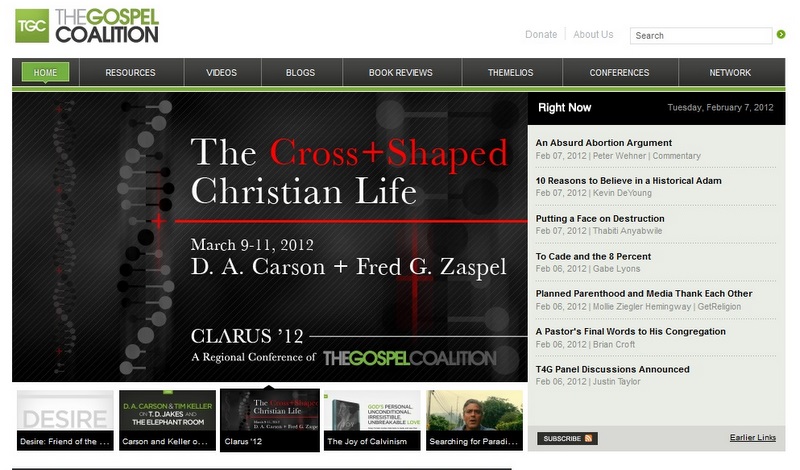
Hmmmm, DA Carson and Fred Zaspel doing a conference together at a New Calvinist church. Say, isn’t Zaspel one of the New Covenant Theology big dogs? And the theme of the conference is Gospel Sanctification, weird. The conference is being promoted by TGC as well. It’s my theory that New Calvinists have stayed aloof from NCT because of its close proximity to Robert Brinsmead and the Forum, but as New Calvinist follows become more and more mindless, and willing to drink the Kool-aid at any cost, these kind of appearances between the two camps will increase. New Calvinism needs the NCT perspective on the law.

 Paul's Passing Thoughts
leave a comment