The PPT Francis Chan Archives
 There have been a lot of requests for information on Francis Chan of late. Not sure why, but nevertheless, hope this helps. Click on title links below:
Can Anybody Say Nothing Better Than Francis Chan?
Francis Chan Not Sure That Hell Is Eternal Suffering
Chan, Carson, Piper, Tchividjian Verses the Holy Spirit On “Rules”
Ok, Let’s Go Over This Again: Crazy Truth
Francis Chan’s “Crazy Love” is Really Antinomian Puppy-Love
“Four Groups” Proposition Simplistic? Consider….
….the following transcript of a sermon delivered at a conservative Baptist church that is in the process of being taken over by New Calvinists. Read the “Four Groups” post first, and then read the following manuscript from the aforementioned sermon. This sermon is also predicated on the philosophical (Gnostic/Marxist) ideas that drive camp #2. It is also interesting to note the following fact regarding a Gnostic group that plagued the first century church: “Nico means ‘conquer’ in Greek, and laitan refers to lay people, or laity; hence, the word may be taken to mean ‘lay conquerors’ or ‘conquerors of the lay people'” (On line source: http://en.wikipedia.org/wiki/Nicolaism).
BEGIN TRANSCRIPT:
Hi. Good morning. Let me just add my welcome to those of you who are coming back here for the first time. For those who are coming back, welcome back. For those of you who are leaving, goodbye. No. We’ll be praying for you as you kind of move in new transitions in life.
We are in a transition here at Shawnee Hills. I mean, it’s fairly obvious because I’m up here. And if you’ve been coming the last several weeks/months, we’ve had a lot of other people who have come here and challenged us. And I don’t know about you, but we’ve heard some really great messages over the last several months. And I’ve really appreciated the people who have come from the outside to kind of challenge us and encourage us in this kind of time of transition. But I’m coming to you as one of us. I am a member of this group. And so when I was asked to share this morning, it’s like okay, what can I say to my brothers and sisters in this local body that would be an encouragement to them and how can I do that in a kind of a one-shot type of deal? Which is always sort of difficult ’cause I really like teaching Sunday school because if I’m working through a book, I know exactly what I’m supposed to do. It kind of goes in line. But if I have to pick something one shot, I mean, here I am.
So that’s what I’m gonna try to do this morning, is we’re gonna talk about the concept of worldly wisdom versus godly wisdom. You know, we got this report from the pulpit committee. They have sixty resumes. Wow. Now I’m glad I’m not on the pulpit committee because, you know, I have trouble – when I go to like Olive Garden or Cheesecake Factory and there’s so many good things on the menus, like I don’t know how to choose. How many of you have this kind of same issue here? Okay. So I’m glad it’s you guys and not me that’s doing that.
But this morning as we kind of talk about this issue of godly wisdom, worldly wisdom, in the end the pulpit committee is gonna go through these resumes. They’re going to sort people out. They’re gonna do that, and then they’re gonna present someone to us. Ultimately, we make the decision. Ultimately, we call a pastor. It’s not the pulpit committee that calls the pastor. And so as we kind of go into this decision-making process about thinking who will be the next senior pastor of Shawnee Hills, it kind of gives us a chance to reflect on how are we going to choose somebody. And not just as we think about issues of choosing a pastor, how do we choose anything? What is the decision-making process? What is the kind of standard or goal that we sort of use to know whether we’re making wise decisions or not? And so this is really what I kind of wanna address today.
And I also want you to know that in a sense, even though when we’re looking at James chapter 3 in quite a bit of detail this morning, in essence I’m preaching him as well to you. I’m gonna sing that hymn at the end of the service and hopefully, the words of the message, and we’re kind of going through this concept of earthly versus – or worldly versus godly wisdom will kind of resonate when we sing the hymn at the end. Hopefully, you can see the connections between the two.
All right. Now if you think about going to a restaurant, making a big decision, or making a decision off the menu, going to a restaurant I hope is not a big decision for you, but oftentimes we tend to choose things that make us comfortable. If you’ve been to, you know, if we go out to eat, oftentimes depending on where we go, I can predict what Therese is gonna order off the menu. Because there’s certain things she likes, she feels comfortable with, and so she’s gonna choose those things. And so if we go to Los Mariachis, it’s gonna be the Mariachi chicken. It’s like that’s just the way it’s going to be even though there’s a lot of good things on the menu.
So we tend to choose things or we tend to kind of go with things that we’re comfortable with. Now that’s okay when you’re dealing with the Mariachi chicken, I guess, at Los Mariachis. But in a time of transition, it really gives us a chance to kind of think about what are the standards that we’re going to use to choose a pastor or anything else. And a couple of weeks ago, we were kind of given the results of a survey that we took to kind of see what we were looking for in a pastor. And, I don’t know, it’s always good to kind of quantify, I guess, what the attitude of the group is, and it’s good to see whether your intuitions of things kind of match everybody else’s, but I don’t know that there was anything particularly really surprising here. When I looked at this, this is what I thought. We would pretty much pick as – it was good to have that quantified for me, but it kind of begs the question. If that’s what we are saying that we want, is it maybe something that we’re comfortable with? And if we’re comfortable with that, may it also cause us to sometimes miss certain other things that we should be looking for?
And so what I want to do today is look at what are God’s standards for how we should be making decisions of any type, whether it’s a pastor or anything else. And to use the pastor issue just as kind of an example, if you think about what a pastor is for a congregation, oftentimes the pastor is our representative. He embodies what we think we should be as believers. So on our list we wanted someone who preaches well, and we wanted someone who has been to seminary and can discern the Word. And we wanted somebody who is married because we think that’s a good thing, or most of us thought that was a pretty good thing. And so the pastor sort of becomes the embodiment of who we think he should be. He embodies our values. So pastors are representatives.
But pastors are also shepherd. It’s another kind of way of looking at this. And when we think about a pastor as a shepherd, he is to be who Christ wants him to be, and he is help mold us into what Christ wants us to be. And so when we need chastening, the pastor needs to chasten us. And when we need encouraging, he needs to encourage us. And hopefully, those two things are the same. Our values, pastor as our representative, God’s values, pastor as our shepherd. If those things are together, that’s great. Now I’m not suggesting to us that in our case that those are necessarily far apart. But they can have a tendency because our values versus God values, they can have a tendency to separate. And I think many a person has been pushed from the ministry because they could not be all things to all people, because they had to try to embrace everyone’s different image of who they were supposed to be. So as we kind of get into this – we’re in this time of transition, I think it’s a good time for us to kind of examine how do we go about making decisions. And so that’s what I’d like to do here today. Because if you don’t, the result can be a lot of division and a lot of quarreling and a lot of fighting. And churches end up splitting over issues like this. And I’m not suggesting that this is gonna happen to us at all, but I think it’s a good time for us to kind of step back and look at the whole issue.
So we’re gonna deal with this issue of wisdom here today. And normally when we think about wisdom, where do we normally start? The book of Proverbs, don’t we? So turn up to Proverbs chapter 9 because that’s usually where people wanna go when we think about wisdom. And Proverbs is a good place, because in Proverbs there’s the contrast between Lady Wisdom and Lady Folly. And as the first several chapters of Proverbs go, the writer keeps contrasting these two views for us. But note, we have this kind of encapsulating statement in Proverbs 9:10. And many of you can quote it, or at least you can quote the first part of the verse. “The fear of the Lord is the beginning of wisdom.” And knowledge – I lost it. “And knowledge of the Holy One is understanding.”
So when we think about this idea of wisdom, wisdom starts with what? It starts with reverence. It starts with awe. It’s the fear of the Lord. Now if you think – and then look at what the writer says here. “And knowledge of the Holy One is understanding.” In essence, knowledge is preceded by what? Wisdom. Normally, when we – and this is kind of counterintuitive for most of us. Most of us, when we think about wisdom, wisdom is knowledgeable people taking what they know and applying it well. But know what the author of Proverbs is telling us, that wisdom is really – precedes knowledge. Because if you have wisdom, if you have the fear of the Lord, it is going to guide even what you think is worth knowing. It guides the process of what you choose to learn. If I think that learning to be a triathlete is a good thing, it’s gonna drive my understanding. It’s gonna drive me to look at certain types of magazines and certain television shows and things like that. So my standard of what is good precedes even my understanding of what is good knowledge.
And that really is counterintuitive to us because most of the time we think that wisdom is knowledge applied. Well, what I really wanna suggest that what wisdom really is is knowledge well applied. Well, what does that mean? It means that whenever we approach this idea of wisdom, wisdom must have a target. Wisdom must have a goal. You’re choosing to learn something so that you can progress toward a certain goal or vision of that which is good. So we send people to school, for example, to become more knowledgeable. But what we choose to teach them, or we could teach them anything. But we choose to teach them certain subjects. Why do we teach them those subjects? Because we think that those are the types of subjects that will allow them to get along well in the world. So we have a vision of what is good that drives what we even choose to learn or teach people.
So when we think about this idea of wisdom, we have to start with this idea of wisdom as a vision of the good and not simply that wisdom comes out of knowing something. In fact, if you think about it, we know lots of intelligent people, I mean, very bright people who don’t start with this fear knowledge of the Lord. And what do they do with their intelligence and knowledge? They oftentimes will use it as a tool to sort of continue in their unbelief. They defend their bad ideas or their irreverent ideas or their idea that God doesn’t exist by using their intelligence or knowledge. They have a vision that starts and it guides how they look at knowledge and information.
So when we begin to think about this idea of wisdom, we first have to start with a fear, reverence, awe of God. Now the passage in James, it’s kind of interesting. When you look at the Old Testament, if you particularly look at Proverbs, we’re contrasting Lady Wisdom, Lady Folly. If you look at, let’s say, Ecclesiastes, in Ecclesiastes, the author of Ecclesiastes kind of goes through and talks about all the things that he’s done and all the things that he’s pursued. And in the end he comes to the conclusion that everything was vanity, or everything was folly. And so he then says, “Everything that I try to pursue was not very good. I should have remembered my Creator in the days when I was young.” And he says, “I should have had a different vision for life.”
James on the other hand is gonna be a little bit more nuanced for us. What James is telling us is that there are two types of wisdom. James has kind of laid out that who’s wise among you. And then he talks about the idea that there’s worldly wisdom, and he’s talking about that there is Godly wisdom. Now remember, wisdom is a vision of what is right or what is good. So what James is really telling us is that there are two visions of what is right or what is good. And we choose to pursue one of those visions. You can pursue a vision of worldly good. And the world defines good in a certain way. Or you can choose to pursue godly wisdom or the godly standard of the good. But what we’ll see is you cannot pursue both. So James kind of lays out for us that there really are two types of visions of the good, two competing ideas of virtue, and says that you need to choose between one of them. And he kind of lays out the differences for us. We’ll come back and look at this here in a minute.
But the kind of thing, the interesting thing to note here for me, I think, is that when we begin to think about this idea of virtue and good, we need to kind of understand that there’s a difference between moral ideas and ethical ideas. Normally, we understand those as sort of synonymous. In fact, we use them synonymously, and that’s technically not right. You act morally as an individual, okay? When you act and you do an action, whether it’s a good or bad action, that is an exercise in your morality. But generally, when you do that, you will do it from some sort of ethical standard, which is corporate. So if you are a good member of Shawnee Hills Baptist Church, how do you know you’re a good member? Because there’s sort of a corporate sort of understanding of what it means to be good here. And you live within that corporate idea of goodness. And if you act that way, we kind of applaud you and pat you on the back and say, “Yes, you’re a good Christian. Way to go.” And if you’re kind of outside of that, we sort of have our little ways of letting you know, “No, you’re not quite in there, right? Okay. And hopefully, if you still wanna be part of us, you kind of mold your attitudes back to get within the good.” Makes sense?
Now the same thing operates if you think about the larger society. There is a concept of what it means to be a good American. And if you’re a good American, you hold to certain ideas and you hold to certain values, and we’ll let you know that you’re a good American if in fact you live according to those values and act to the virtues and you pursue life that way. And most of us, because we live within that environment, we sort of tend to respond to that because we are communal beings. And so if we begin to understand that these ideas of ethics are really waters that we swim in, and because they’re waters that we swim in, they do affect us. And so when we go out there and we are in the bigger ethics of the culture, there’s certain attitudes and values that are pressing on us that say you are a good American if you do this. And the tendency could be that we could bring those attitudes, values, concepts of the good and bring them into here where they may not quite align with what God wants us to be and think and act and do. So we begin to kind of – think about James telling us, “Look, there are two types of virtue; there are two types of wisdom; and you need to choose the right one,” he’s really kind of saying choose as a group, as a community, you need to kind of choose the right ethical vision from which to follow.
Now I want you to think about the vision of the good that is out there for a minute. What does our society, what does our world try to tell us? If you think about it, there are competing messages that we get. For example, fairness is more important than justice in our society. And fairness is, “I need to get mine. It needs to be me.” Justice related more toward what’s good for the community. We are much more – we seem as a society, we’re much more interested in things like consuming goods, which is I consume them as compared to creating goods, which would be for the benefit of everyone. We seem to be much more interested in things like fame. Fame is pretty important to us rather than really truly accomplishing something. I mean, why in the world is Ryan Seacrest so famous? What has he done? I mean, he’s got the best job in the world. He gets to be on TV for the simple reason that he’s famous. What have you done? I don’t know but I’m famous. Okay, we’ll put you on. What a great gig to have. Glamour and beauty seem to be more important than character. Image is more important than holiness. There was a tagline for Sprite once: Image is everything.
Just as kind of an example, think about how people get their news now. Most people tend to get their news from sources that agree with their own opinion. We’ve sort of substituted opinion for true knowledge. And what that ends up doing in the end, again, all these, me versus the group, me versus the group, me versus the group, in the end, this becomes very divisive. It tends to pull apart at us. In the end we start treating other people as competitors. It divides us. We see people as the enemy. In many ways we turn – objectify people. Oh, he’s just an idiot for believing that. And what doesn’t happen is we don’t have unity. We tend to end up with division.
Now this is sort of exactly what James predicts. So if you kind of turn to James chapter 3, the passage that we read this morning, note that James really does kind of lay out certain characteristics of what happens if you follow this worldly vision. What are the results of this? And he notes that the first one is bitter jealousy. What he means here is that we seek our own benefit. We’re not willing to share with others. James as he uses this term, he uses it in a sort of a religious context. It kind of leads to a type of religious zeal or zealotry. And if you can think about the history of religion throughout the centuries, there’s been an awful lot of times where religion has been used, whether we’re talking Christianity or other religions, have been used to sort of promote a particular agenda, an us versus them kind of mentality. And he notes that this is one of the characteristics of worldly wisdom.
We are prone to selfish ambitions. We seek to promote our own ends. And we tend to do that at the exclusion of other people. So we start to use people if we can. In fact, I will try to pursue certain ways of gaining power so that I can pursue my agenda over your agenda. And that might need acquiring wealth because wealth gives me power. It might mean gaining position because position could give me power. It might mean cultivating beauty because beauty and sex appeal may give me power over people. But there’s lots of ways that we can go to cultivate power. And all of those kind of come out of this idea of selfish ambition because this is what we’re trying to do. We’re trying to seek our own end.
Arrogance. Note that James tells us that worldly wisdom leads to a type of arrogance. What it means is that you believe in yourself. You believe in your own vision. James is kind of laying out it’s your sovereignty. It’s your desire for autonomy that comes out, and it makes you arrogant. Now suddenly, your vision of the world becomes the vision for the world. And everyone has this sort of get in line with what you think is the right thing to do.
Self-deception. Notice that sometimes we become unwilling and unable to learn from others. We become unteachable at a certain level. Part of that is because of this arrogance that is cultivated. But part of it is that we are now are unwilling to see things at the way they really are.
In the end all of this leads to division. As worldly wisdom continues to grow and as worldly wisdom sort of becomes the wisdom for a group of people, the end result will always be, as James says, division. It will lead to quarreling. It will lead to fighting. It will lead to everyone – well, it leads to, as Jesus said, a house divided, which will not stand because everyone is now doing, as the author of Judges says, everyone is doing what is right in their own eyes. So in the end, worldly wisdom James kind of points out has this divisive, this corrosive, this kind of effect that pulls people apart because now everyone wants to pursue their own end.
Now obviously, when we present this characteristic of worldly wisdom, it doesn’t look too attractive, does it? It’s like, no, I don’t want to be that. In fact, I’m not that anyway. I am more godly in this regard because you can lay out this way, worldly, godly, okay, these people don’t look very nice. And you don’t really wanna be around people like this, which begs the question, might we be people like this? We certainly don’t want to think that we are.
Now James, you have to understand James is probably the first book of the New Testament that was written. And James is sort of – if anything else about James, he’s really a good psychologist. James understands the human heart. He understands what our – in our sin nature what our natural inclinations, what our natural affections tend to lead us. And he’s sort of warning us that be careful of this. Because if you do this, this is what’s going to happen. And so he’s kind of letting us know that there is this type of wisdom that can be corrosive if you let it take hold of you.
Now it’s kind of interesting that James writes this and then several decades later, we find this whole issue coming to fruition in another church. And another writer of a New Testament book, the Apostle Paul, finds that he has to address it. And he has to address it in the book of 1 Corinthians, because the Church in Corinth is actually exhibiting the very things that James warned of in his book. So when we get to 1 Corinthians, we have a church that is highly divided. And if you kind of read through the first chapter of 1 Corinthians, we have the issue of all kinds of things. One of the things that comes out is they’re divided over pastors, or who were their pastors and who they are pledging allegiance to in an essence. Some say well, I follow Apollos and I follow Paul and I follow Cephas or Peter. And there’s this other group, probably the holier than thou group, well, we follow Christ. So there’s all these kinds of factions in the Church. And Paul is now kind of writing to go through this, ’cause there’s lots of quarreling that’s going on here.
Now if you go through the book, you’ll see that there are issues of division, whose teachings are they gonna follow. There’s lack of community around the Lord’s Table because there’s division there. There’s strife in the Church because people are suing one another. There are people who are priding themselves on their liberty in Christ. So there’s moral laxity going on in the Church. There are issues of people pursuing their own ends. Paul has to address the issue of women taking leadership positions. He has to address the issue of people striving for certain spiritual gifts because those gifts are considered of higher status in the church and therefore will give people more power over what’s going on there. So there’s all kinds of divisions, strife, and things, all things that if you notice were things that James talked about in James chapter 3. So this is the church as really into it. They have embraced a sense of kind of worldly wisdom. And Paul, like James, is gonna have to note this kind of stuff because they’re all kind of pursuing the ends that James had said.
Now let me just kind of point out something about Corinth to you. ‘Cause normally, I think sometimes when we think of Corinth, the equivalent that we have of Corinth is Las Vegas. What happens in Corinth stays in Corinth. And that would be kind of a wrong view of Corinth, I think. Corinth was not some sort of Roman or Greek cultural backwater. Corinth was not some place that you went to sort of blow off hedonistic steam. If you think about Athens and Rome as the cultural and political centers, and our equivalent would be let’s say New York and Washington, Corinth would be like Chicago. Corinth had a striving big commercial center. It was a center for the arts. It was a center for culture and intellectual pursuits. Certainly, there was that hedonistic element that went on in Corinth. But if we think about Corinth only in terms of it was like Las Vegas, we’re gonna sort of miss sort of what it meant to be a Corinthian. ‘Cause what it meant to be Corinthian was that you are sort of a cosmopolitan person. A good Corinthian was someone who understood the arts and understood intellectual pursuits. And it’s kinda like, you know, we’re good New Yorkers because these are all kinds of values of living in the city. If you were a good Corinthian, you kind of embraced this intellectual and cultural and artistic and commercial kind of sense of what it meant to be living in the city.
So now when Paul addresses them and he says to them, he turned to 1 Corinthians chapter 3, know what he says to them. He says, brothers – and note, throughout the book he addresses them as believers. He addresses them as their brothers, as his brothers. He acknowledges they’re saved. But he says to them, note, “Brothers, I wish I could speak to you as spiritual men, but I can’t because you are men of flesh; you are babes in Christ.” Now it kind of begs the question then, what does he mean when he says that they are men of flesh? If you have NIV, it probably says worldly or something like that. What does he mean by this idea of worldly? Well, let’s kind of see if we can find out. What does it mean in fact to be worldly? And depending on the translation you have, you may have something like carnal, which I think is in the King James, kind of a Latin word for meat or flesh. If you have the ESV, I think it says something like men of flesh. The NASB says fleshly. I mean, that’s obvious. We are people of flesh and bone, right? But that’s not what he’s getting at. He’s getting at, okay, I’d like to address you as spiritual people, people who have a spiritual vision of the good. But I can’t because your vision of the good is worldly. Your affections are placed in the world, whereas I’d really like to talk to you as if your affections were placed on godly concerns, so that James’ division between worldly wisdom and godly wisdom.
All right. So he says to them, “Look, I’d like to talk to you this way, but I can’t because you seem to be worldly.” So what does it mean to be worldly? Normally, when we think about the term “worldly,” it’s kind of this idea of moral decadence. He’s just a worldly guy. But that’s really not what Paul is kind of addressing here, particularly if you can understand this idea of being a good cosmopolitan person as being a good Corinthian. To be worldly is to be practical or shrewd. It’s to have an understanding of human affairs. It’s here’s a vision of what is good in the world, and I know that as I make certain decisions, it brings me closer to that vision. I do things that will bring me close to the vision of the good. So for example, a wise decision is one that helps me achieve a certain end. And unwise decision is one that’s not gonna get me there. It’s actually gonna pull me away from it.
So as Paul is addressing them, he says, “Look, your concerns are worldly. You have a worldly vision. And so when you make decisions, what do you do? You make decisions that will help you to pursue this kind of worldly end.” And know what’s been happening in this church. There’s strife, there’s division, there’s quarrelling, all because they are pursuing an agenda of achieving their own ends. Now in this respect, for example, I would consider my father as a wise person. Now my father is not a believer, and he’s not particularly well educated. But when he gives me advice, he understands this is what you really need to do if you wanna accomplish these goals or these ends. And so he’s pretty good at stuff like that. But it’s not a vision of the good that would be considered necessarily a godly vision. But he’s wise in a worldly sense.
So to be ethical in this regard is to be devoted to in pursuing worldly ends. And so when he says to them, “Look, you guys are worldly because you are pursuing worldly ends,” that’s really what’s going on. Now what that really means, because worldly ends almost always focus on me, note that oftentimes in the Scripture, we get these very black and white contrasting statements. I mean, think about in 1 John where you get some of the best ones. If you love the world, you can’t love God. The love of the Father cannot be in you. You cannot serve two masters. You’ll either love the one or hate the other. We see lots of statements like this in the Scripture. Now why do we see these statements? Because what got is telling us in his Word is that there are very different competing visions of the good. And you need to choose which one you’re going to pursue because they are sort of at ends with each other. Now what we’re gonna see is that sometimes we try to do the really dysfunctional thing of trying to combine the two together, which becomes really weird.
So if we cannot follow this as an idea, one of the things that I think is really interesting is the paradox of worldly wisdom. Now if you think about being worldly, sometimes we, for example, when we travel overseas, that helps us to become worldly because you get a bigger vision of the world. You kind of get out from your little provincial, parochial kind of understanding of the world and then you see things in a bigger way. Hopefully, we send you to school so that you get a broader understanding of the world, so that you can become more sophisticated in that regard. The opposite of being worldly is to be, I don’t know, a hick, a bumpkin, a rube, a yokel, a hillbilly, a hoosier, no, not a hoosier. Sorry, dear. But all those other things. So we when we send you – we don’t wanna be those things, right? So we kind of want you to expand your vision of the world.
The odd thing, the irony, I think, of worldly wisdom is the more you pursue it, actually, the more provincial you become. Worldly wisdom is associated only with this world; whereas godly wisdom broadens out from this world to the spiritual. Worldly wisdom only thinks about a particular time; whereas godly wisdom will always think about things in terms of eternity. So the lie of worldly wisdom, the deception of worldly wisdom is, “Oh yes, I’m more sophisticated. I’m more suave. I’m more cosmopolitan,” but in the end it’s really not. What it really causes you is to become even more provincial because you become focused more and more solely on self.
Now why does this happen to us? What is the heart of this worldly wisdom? Turn back to James chapter 3. ‘Cause James says the reason that it leads to arrogance and jealousy and strife and division and all these things is that there are three characteristics of worldly wisdom. The first one is that it is earthly. And when we think of earthly, all James is really saying here is our heart, our affections are tied to things of this world. We’re not seeing beyond this world. We’re seeing only what we can see in this world.
Which leads to the second one, worldly wisdom is sensual or natural. Depending on your translation, the word will be a little bit different there. And I used the word “sensual” here to kind of underscore the idea that it’s tied to the senses. Normally, when we think of sensual, we think of sexual pleasure or something like that; that’s not what James means. All he’s saying is that it’s sort of tied to the senses or to pursuing certain ends. Most of the time it would be things like pursuing pleasure as a good and avoiding pain. Those seem kind of good. I like pleasure. I like to avoid pain. That seems to be kind of natural to us. Hence, it’s natural. Those kind of end up being the goals. You can put them up there.
And the last one is that it is demonic. And what he means by demonic is that the source of worldly wisdom is the exact same thing that cause Satan to rebel. Satan wanted autonomy. Satan wanted sovereignty over God. Because worldly wisdom is self-oriented, the source of worldly wisdom is autonomy and sovereignty. It’s the exact same thing. And so James says the source of worldly wisdom is always in the end going to be demonic in this regard.
Now this is abnormal. This is an abnormal condition for us. God did not create us to be sovereign, independent beings. He did not create us to declare our independence of him, and He always wanted us to be dependent on him. So this condition of autonomy is one that, if we acknowledge that we’re abnormal, then we have to acknowledge why we’re abnormal. And that would bring us back to God. Well, the world doesn’t wanna do that. So what will the world do? The world is gonna try and take this abnormal, self-focused vision of what’s good and try to normalize it, try to make it sound like this is the only really true vision of how things should be.
So what happens? We have things like, oh I don’t know. Autonomy starts to become things like independence and self-sufficiency. Those sound sort of virtuous kind of ideas. Selfishness becomes ambition and goal-orientation. If we wanna quote from that classic 1987 movie, Wall Street, “Greed is good. Greed clarifies. Greed is,” to continue in the speech where Gordon Gekko is making it in the movie, he says, “Greed has always marked the upward surge of mankind. And that greed will save even this dysfunctional corporation known as the United States of America.” Gekko kind of presents this idea of greed as such a virtuous vision that as I practice it individually. And if we all practice it corporately, what will it lead to? Kind of a good outcome for all of us. So the world really does have kind of a vested interest in normalizing this. And so we get books on the virtues of selfishness. We have books saying that selfishness is a genetic thing. And we have little baby girls that say, “You can’t have any of my dolls.”
All right. Now James contrasts this for us. James contrasts worldly wisdom with godly wisdom. And I want you to note that James does not give us sort of the core of godly wisdom like he did with worldly wisdom. He doesn’t tell us, you know, we said with worldly wisdom, “Look, it’s natural. It’s earthly.” He doesn’t do that with godly wisdom. Because he assumes that we understand that the source of godly wisdom is God, that it’s the character of God. Look at James 1:5 from that. If anyone lacks wisdom, what should he do? He should ask of who? God, not your professors, hopefully, they know, but not of knowledgeable people. But the source of real wisdom is going to be God. So he kind of assumes that we know that ’cause he kind of laid that out early in the book. He says, “If you pursue godly wisdom, this is what happens.”
Now I want you to, as we go through this list, if you’re an astute observer, one of the things that you’re going to note is that the list looks an awful lot like the beatitudes of Matthew chapter 5. And what is Christ laying out in the beatitudes? The characteristics of citizens of the Kingdom. If you’re gonna be a good citizen of the Kingdom, this is how you will act. Here are the moral actions within an ethical vision of community. This is how you’re supposed to respond. So what are they? The first one is they were pure, that we are single-minded. We keep ourselves unstained from the world, but we also work to do the will of God toward others.
Look at James 1:27 for a minute. This is pure and undefiled religion in the sight of our God and Father, to visit orphans and widows in their distress, and to keep oneself unstained by the world. Personal piety, while it’s a good thing, if religion is simply defined by personal piety, me keeping my nose clean, that is not godly. It comes from a worldly vision. Because godly wisdom says, “Yes, I will keep myself from sin, but I also work for the benefit of other people.” And we sometimes deceive ourselves when we think personal piety is what being holy is all about. It’s only half of the equation. If it’s only half, it’s not the whole thing. It becomes worldly.
Second one is it is peaceable. It seeks to reconcile others to Christ and to other people. Godly wisdom seeks shalom. It seeks restoration. It seeks to be a peacemaker. And blessed are the peacemakers for they shall be called the Sons of God. So there is that part of the vision. They are gentle. Godly wisdom respects the feelings of others. It is not imposing. It does not force people to believe things. It is not bullying in this regard. And sometimes even in our desire, in our zeal, our religious zeal to get people to live a certain way, we can be forcible, we can be bullying in how we go about this. And while we think the goal is good, we are using a worldly way of understanding to try to bring that about, because godly wisdom is gentle in this regard.
It is reasonable, which means that you’re teachable. You’re not arrogant. You’re willing to submit to the teaching and leading of other people. But it also means that as you try to teach others, you try to show them the reasonableness, why position is good for them, good for others, why it fits into the whole community of faith.
It’s merciful and leads to good fruit. This is the only kind of double one in the group, which I think is kind of interesting. It is compassionate. Godly wisdom is compassionate to those people who are in need of practical help. It deals with needs rather than the source of the problem. Now, for example, we sometimes think, “Oh, well. Look at the situation he’s in. If only he had done this…” That would be a statement that comes out of worldly wisdom because we’re saying, “Look, he is experiencing the natural consequences of what he has done. And therefore, we should just kind of let him in that.” Or if you’d only done this … again, that would be a worldly wisdom type of statement. Godly wisdom understands that you know what, people make mistakes. And sometimes people are affected by the mistakes of others that they didn’t even have to make, and we deal with the consequences of need. Why? Because God was merciful to us. If God dealt with us, well, if the natural effect of your sin is you’re going to hell, we’ll all be in hell. So this idea of merciful and good fruit kind of goes together.
It is unwavering. It is not, as James said, double-minded. To be unwavering means that you have a single-minded vision of what the good is, and it’s this godly one. And you don’t keep flipping back and forth between godly and worldly. Because if you keep flipping back and forth, you are double-minded which means that you will be unstable in all of your ways. So James kind of points out we need to have this kind of unwavering view, and it’s not hypocritical, which means it’s not self-seeking. Sometimes, you know, doing the right thing leads to a good outcome. And so I do it for my benefit. It leads to a good outcome for me. That’s why I’m doing it. True godly wisdom is really motivated by love for others and not love for self.
Now the end of all of this, James says, is that it will lead to peace and righteousness. Now I’m sort of running out of time, so I gotta hurry up here. But I wanna kind of point out the parable of the prodigal son here for a minute. Because there’s one way of reading this parable that really can be a parable of sort of two wisdoms. And we can have a look at godly wisdom and worldly wisdom being kind of played out in the parable of the prodigal son. Because remember we said that wisdom, godly wisdom, is the spiritual, mental, and emotional ability to relate rightly to God, rightly to others, and rightly to the culture. If I have a godly vision of things, I am actually in a position to step back and critique the culture and understand whether the culture is moving toward a right goal or not. And we can do that corporately as a body.
Now think about the parable of the prodigal son here for a minute. If you think about the parable of the prodigal son, both of the sons in the beginning of the parable are acting in a worldly fashion. They both have the exact same motivation. The younger son, who’s normally the focus of the parable, says to his father, “Basically, you’re dead to me. I am so self-focused that in my eyes you are dead, and so you might as well just give me the inheritance now because I don’t even consider that you’re alive to me anymore.” And as the story goes, the father does that. And the younger son goes off and does what with it. He lives decadently. He lives riotously. He splurges. And most of the time we think he has lived a worldly life. And he’s now getting the results of his worldliness because he finds himself lying in a pigsty eating pig pods and wishing he was back with his father because his father is rich. And so he comes to his senses and what does he do? He goes back home. And in humility he says to his father, “I’m not even worthy to be considered your son. Just make me a servant.” But the father kind of welcomes him and brings him back into the household. Okay, we know that part of the story.
Let’s consider for a minute the older son, because the older son is also acting from a sense of worldly wisdom. Now granted, he is much more conservative in his lifestyle. He is the good son. He does everything that a good Jewish boy is expected to do. He listens to his father. He works for his father. He does everything that everybody in this little Jewish community would say you are a good kid. And in fact, everybody in the community probably is patting him on his back, “You’re the good son.” And especially as the tales of the riotous living of his brother get back to the village and say, “Look, he’s such a bad kid. You are a good kid.” In the end, what does he begin to think about himself? I’m in fact the good kid. I’m a good person. But why is he doing all of this? His hard issue really comes back when his brother returns. ‘Cause when his brother returns, father welcomes him to the house, has a party for him, the oldest son finds out what’s going on, he won’t even go into the house. The oldest son, he’s angry. He’s angry. He’s jealous. He’s self-justifying. The father comes out to him and he says to him, “All these years, I have worked. I’ve done everything that you’ve told me to do. I have been the good son. Ask anybody in town.” I’m pretty sure that the other people in the village just don’t understand the father. “Your son called you dead. You’re nuts for bringing him back into your house.” And they’re probably telling the good older son, “You know what? You’re right to be angry with your brother. He’s an idiot. You’ve done everything that you’re supposed to do.” And by the standards of the community, by the standards of the world, he has been the good son. And he becomes justified in his own mind. Yes, in fact, I am the good son. Why? Because I’ve done everything that the world tells me to do. So we have to understand that there’s a type of righteousness in the older son. The world gives us a type of righteousness. There’s a way of living in the world that seems right, seems virtuous, but it can be a normalizing of the sin nature. And the Bible talks about this. There is a type of righteousness, but in the end it is nothing but filthy rags. But we can still be convinced it’s righteous.
So the question for us as a congregation, I think, in this time of transition that we have is do we share God’s values? Do we share God’s heart? Do we want to see His will done at Shawnee Hills Baptist as it is in heaven? And we need to somehow avoid becoming like the Corinthians where the values and attitudes and ideas of what’s virtuous in the world somehow work their way into our vision of what’s right and good and virtuous here in this congregation. ‘Cause at the point that we do that, we will become spiritually very schizophrenic. We will become pretty dysfunctional at that point. And so I think it really kind of behooves us to kind of look at these two visions of virtue, of right wisdom, and act in accordance.
Let’s pray. Father, you have said in your Word that if we lack wisdom, we should ask. And we really do desire to avoid this kind of schizophrenic response since it’s our natural tendency. We saw it in our brothers and sisters at the Church of Corinth. And so we don’t want it to produce a type of Christianity that will make us lukewarm, because we know what your response to lukewarm Christianity is. And so we ask Father that as we come before you and as we search our own hearts and go through the process of calling a new pastor, that we would do so with your heart and your mind and that you would bless this endeavor. We ask in thy Son’s name. Amen.
[END OF TRANSCRIPT]
The Four Groups: Which One Are You?
Humanity in Western culture can be split up into four different groups from two different camps. Think it simplistic if you will, but it explains many things in Christianity that has perplexed me for years.
Camp one believes man is capable, and should be self-dependent as much as possible. The following are the two groups in that camp:
1. Regenerate thinkers. These are saved people who deem themselves capable of knowing truth individually, and are uncomfortable with predominate centrality of control without accountability. They note the fact that we are the only creatures God created upon the earth that can reason, so it stands to reason that God wants us to utilize that capability to the fullest extent in order to improve our environment and help others.
2. Unregenerate thinkers. Like regenerate thinkers, they think man is capable. Their convictions, at least in America, are probably going to be expressed through patriotism and a respect for ideas produced by the Enlightenment era. They are going to be unwilling to trade freedom for supposed guarantees. They are individualistic. Like the regenerate thinkers, they believe strong individuals are better able to help those who really need it.
Camp two believes man is incapable, and should have implicit faith in some sort of elite group or institution. Thinking and reasoning are greatly devalued in this group. The “group” is paramount, and individualism is deemed to be the root of all evil. Following the brain trust of the group is vital for unity and peace. This gives opportunity for the individual to plunge the depths of selflessness—emptying oneself for the sake of the group.
1. Regenerate groupies. This group puts all of its trust in the religious institution or the “Divines.” What they can understand about God and His will is limited. They therefore depend on things like “Daily Bread” short devotionals and creeds. They follow the “polity” (government) of the church to insure they are in good standing with God. Ultimately, God will hold the Divines responsible and not the group—the group is only responsible for following and obeying God’s anointed. The anointed are responsible for determining the deep things of God and presenting them to the group in a way that can be understood. Hence, “orthodoxy” (the authoritative interpretation of the Scriptures by the Divines determined by councils and the confessions that come from them), and creeds.
2. Unregenerate groupies. This group concurs with the governing elite that they are owned by the government. Dependence on the government is paramount, and contribution to its strength the highest form of morality. It is predicated on the basic ineptness of mankind. No big surprise then that after a speech by a politician, political commentators tell us what he/she just said. Again, loyalty to the group is paramount; hence, the group is voted for regardless of many factors because of the fundamental agreement about who owns mankind.
These factors answer questions that I have had for years. Why is church so intellectually unchallenging? Why is it that seminary students don’t teach what they learn in seminary to congregants? Why is empty headed praise music and contemplationism all the rage in today’s church? Why do Christians vote for liberal democrats? Why is the sin of church leaders swept under the rug? Why are people happy to pay taxes? Why are people who ask questions in church feared and ostracized? (they threaten the well-being of the group). What’s up with cults? And why do cult-like denominations and other groups get a pass on being called cults? (Because they manifest the same underlying presuppositions about man in more subtle ways).
This is a paradigm that I plan to develop and expand on, but I believe everyone fits into one of these groups, whether they are aware of it or not. And by the way, which camp were the Reformers in? I will give you a clue:
The following quotes concerning the evil of human reason are from the father of Christian Protestantism, Martin Luther:
Die verfluchte Huhre, Vernunft. (The damned whore, Reason).
Reason is the Devil’s greatest whore; by nature and manner of being she is a noxious whore; she is a prostitute, the Devil’s appointed whore; whore eaten by scab and leprosy who ought to be trodden under foot and destroyed, she and her wisdom … Throw dung in her face to make her ugly. She is and she ought to be drowned in baptism… She would deserve, the wretch, to be banished to the filthiest place in the house, to the closets.
Martin Luther, Erlangen Edition v. 16, pp. 142-148
Reason is the greatest enemy that faith has; it never comes to the aid of spiritual things, but — more frequently than not — struggles against the divine Word, treating with contempt all that emanates from God.
Reason must be deluded, blinded, and destroyed. Faith must trample underfoot all reason, sense, and understanding, and whatever it sees must be put out of sight and … know nothing but the word of God.
There is on earth among all dangers no more dangerous thing than a richly endowed and adroit reason… Reason must be deluded, blinded, and destroyed.
Martin Luther, quoted by Walter Kaufmann, The Faith of a Heretic, (Garden City, NY, Doubleday, 1963), p. 75
Reason should be destroyed in all Christians.
Whoever wants to be a Christian should tear the eyes out of his Reason.
To be a Christian, you must “pluck out the eye of reason.”
People gave ear to an upstart astrologer [Copernicus] who strove to show that the earth revolves, not the heavens or the firmament, the sun and the moon. Whoever wishes to appear clever must devise some new system, which of all systems is of course the very best. This fool wishes to reverse the entire science of astronomy; but sacred scripture tells us [Joshua 10:13] that Joshua commanded the sun to stand still, and not the earth.
Martin Luther, “Works,” Volume 22, c. 1543
paul
It’s All About the “O”: Mohler, DeYoung, Lucas; We Own You
“You could be in a church that is subtly indoctrinating your family with the idea that they are owned by the government; in this case, church polity.”
Join a New Calvinist Church if you will, but let it be known: they now own you. Newsflash for the husbands: Calvinist elders believe they have the ultimate say and authority in your home. And another thing: the gospel they hold to rejects synergism in sanctification as works salvation. So, guess what? If your wife buys into that, you are now in what they call a mixed marriage. You are now dangerously close to divorce court as the divorce rate in these churches has skyrocketed.
In our recent TANC 2012 conference, author John Immel nailed it—it boils down to who owns man: in the Christian realm; does Christ own you or Reformed elders? In the secular realm, does man own man or does government own man? Recently, our President stated that government owns man. Recently, in a trilogy of articles by three Reformed pastors published by Ligonier Ministries, it was stated that the church owns Christians, and I will give you three wild guesses as to who represents the authority of the church. That would be the elders.
So it’s all about the “O.” It’s all about “ownership.”
True, elders have authority, but not beyond the Scriptures that call Christians to interpret them according to their own biblically trained consciences. As we shall see, these articles plainly state the Reformed tradition that came from Catholic tyranny. The Reformers never repented of the same underlying presuppositions concerning man’s need to be owned by enlightened philosopher kings. The Reformation was merely a fight for control over the mutton with the Reformers seeing themselves as the moral philosopher kings as opposed to the Romish ones. Their doctrine was just a different take on how the totally depraved are saved from themselves. But both doctrines reflect the inability of man to participate in sanctification.
The three articles posted were: Should I Stay or Should I Go? by Albert Mohler; Where and How Do We Draw the Line? by Kevin DeYoung; and, Who Draws the Line? by Sean Michael Lucas. All linked together for your indoctrination convenience.
Al Mohler states in his ownership treatise that Christians have “no right” to leave one church for another because of preferences. Emphasis by underline added:
Far too many church members have become church shoppers. The biblical concept of ecclesiology has given way to a form of consumerism in which individuals shop around for the church that seems most to their liking at that moment. The issue can concern worship and music, relationships, teaching, or any number of other things. The pattern is the same, however – people feel free to leave one congregation for another for virtually any reason, or no reason at all.
Church shopping violates the integrity of the church and the meaning of church membership. When members leave for insufficient reason, the fellowship of the church is broken, its witness is weakened, and the peace and unity of the congregation are sacrificed. Tragically, a superficial understanding of church membership undermines our witness to the gospel of Christ.
There is no excuse for this phenomenon. We have no right to leave a church over preferences about music, personal taste, or even programming that does not meet expectations. These controversies or concerns should prompt the faithful Christian to consider how he might be of assistance in finding and forging a better way, rather than working to find an excuse to leave.
Where to begin? First of all, while many New Calvinist churches will bring you up on church discipline for leaving because of “unbiblical” reasons, those reasons vary from church to church. So, not only do the reasons for leaving vary among parishioners, but what constitutes proper “biblical…. ecclesiology” in regard to departure varies as well. Mohler states in the same post that doctrine is a valid reason to leave a church, but yet, one of the more prominent leaders of the New Calvinist movement (CJ Mahaney), who is strongly endorsed by Mohler, states that doctrine is not a valid reason to leave a church. CJ Mahaney substantiated that New Calvinist position and clearly indicated what New Calvinists are willing to do to enforce that position when he blackmailed the cofounder of SGM, Larry Tomczak:
Transcript of Phone Conversation between C.J., Doris and Larry Tomczak on October 3, 1997 pp. 10-11:
C.J.: Doctrine is an unacceptable reason for leaving P.D.I.
Larry: C.J., I’m not in sync with any of the T.U.L.I.P., so whether you agree or not, doctrine is one of the major reasons I believe it is God’s will to leave P.D.I. and it does need to be included in any statement put forth.
C.J.: If you do that, then it will be necessary for us to give a more detailed explanation of your sins [ie, beyond the sin of leaving for doctrinal reasons].
Larry: Justin’s name has been floated out there when there’s statements like revealing more details about my sin. What are you getting at?
C.J.: Justin’s name isn’t just floated out there – I’m stating it!
Larry: C.J. how can you do that after you encouraged
Justin to confess everything; get it all out. Then when he did, you reassured him “You have my word, it will never leave this room. Even our wives won’t be told.”
I repeatedly reassured him, “C.J. is a man of his word. You needn’t worry.” Now you’re talking of publically sharing the sins of his youth?!
C.J.: My statement was made in the context of that evening. If I knew then what you were going to do, I would have re-evaluated what I communicated.
Doris: C.J., are you aware that you are blackmailing Larry? You’ll make no mention of Justin’s sins, which he confessed and was forgiven of months ago, if Larry agrees with your statement, but you feel you have to warn the folks and go national with Justin’s sins if Larry pushes the doctrinal button? C.J., you are blackmailing Larry to say what you want!―Shame on you, C.J.! As a man of God and a father, shame on you!
This will send shock waves throughout the teens in P.D.I. and make many pastors’ teens vow, “I‘ll never confess my secret sins to C.J. or any of the team, seeing that they‘ll go public with my sins if my dad doesn‘t toe the line.”―C.J., you will reap whatever judgment you make on Justin. You
have a young son coming up. Another reason for my personally wanting to leave P.D.I. and never come back is this ungodly tactic of resorting to blackmail and intimidation of people!
C.J.: I can‘t speak for the team, but I want them to witness this. We’ll arrange a conference call next week with the team.
Doris: I want Justin to be part of that call. It’s his life that’s at stake.
C.J.: Fine.
(SGM Wikileaks, part 3, p.139. Online source: http://www.scribd.com/sgmwikileaks)
Of course, this example and many others makes Mohler’s concern with the “integrity” of the church—laughable. But nevertheless, Mohler’s post and the other two are clear as to what common ground New Calvinists have on the “biblical concept of ecclesiology.”
Besides the fact that parishioners “have no right” to leave a church based on preference, what do New Calvinists fundamentally agree on in this regard? That brings us to the article by Sean Michael Lucas :
Because the church has authority to declare doctrine, it is the church that has authority to draw doctrinal lines and serve as the final judge on doctrinal issues. Scripture teaches us that the church serves as the “pillar and buttress of the truth.”
So, even in cases where New Calvinists believe that doctrine is an acceptable reason for leaving a church, guess who decides what true doctrine is? “But Paul, he is speaking of doctrine being determined by the church as a whole, not just the elders.” Really? Lucas continues:
In our age, this understanding—that the church has Jesus’ authority to serve as the final judge on doctrinal matters— rubs us wrong for three reasons. First, it rubs us wrong because we are pronounced individualists. This is especially the case for contemporary American Christians, who have a built-in “democratic” bias to believe that the Bible’s theology is accessible to all well-meaning, thoughtful Christians. Because theological truth is democratically available to all, such individuals can stand toe to toe with ministerial “experts” or ecclesiastical courts and reject their authority.
Creeped out yet? Well, if you are a blogger, it gets better:
Perhaps it is this individualistic, democratic perspective that has led to the rise of websites and blogs in which theology is done in public by a range of folks who may or may not be appropriately trained and ordained for a public teaching role. While the Internet has served as a “free press” that has provided important watchdog functions for various organizations, there are two downsides of the new media, which ironically move in opposite directions. On the one side, the new media (blogs, websites, podcasts, Facebook, Twitter) allow everyone to be his own theologian and judge of doctrinal matters. But because everyone is shouting and judging, the ironic other side is that those who are the most well known and have the biggest blogs gain the most market share and actually become the doctrinal arbiters of our electronic age. In this new media world, the idea that the church as a corporate body actually has authority to declare doctrine and judge on doctrinal issues is anathema.
Lucas continues to articulate the Reformed tradition that holds to the plenary authority of elders supposedly granted to them by Christ:
For some of us, again reflecting our individualism, such understanding of the church unnecessarily limits voices and perspectives that might be helpful in conversation. But restricting access to debates and judgments about theology to those who have been set apart as elders in Christ’s church and who have gathered for the purpose of study, prayer, and declaration actually ensures a more thoughtful process and a surer understanding of Christ’s Word than a pell-mell, democratic, individualistic free-for-all. Not only do we trust that a multiplicity of voices is represented by the eldership, but, above all, we trust that the single voice of the Spirit of Jesus will be heard in our midst.
So, bottom line: the priesthood of believers is a “pell-mell, democratic, individualistic free-for-all.” Still not creeped out? Then consider how they answer the question in regard to elder error:
Of course, such slow and deliberate processes do not guarantee a biblically appropriate result. After all, the Westminster Confession of Faith tells us that “all synods or councils, since the apostles’ times, whether general or particular, may err; and many have erred” (WCF 31.3). Sometimes, entire denominations err significantly as they prayerfully consider Scripture and judge doctrine. Such error, however, does not negate Jesus’ own delegation of authority to the church and set the stage for a free-for-all.
This brings us to another issue that DeYoung propogates in his post: since Reformed elders have all authority, their creeds and confessions are authoritative and not just commentaries. Hence, they declared in the aforementioned confession cited by Lucas that even though they error, they still have all authority. Whatever happened to the Apostle Paul’s appeal to only follow him as he followed Christ?
DeYoung:
Those who wrote the ancient creeds, such as the Apostles’ Creed, the Nicene Creed, and the Chalcedonian Definition, were not infallible, but these creeds have served as effective guardrails, keeping God’s people on the path of truth. It would take extraordinary new insight or extraordinary hubris to jettison these ancient formulas. They provide faithful summaries of the most important doctrines of the faith. That’s why the Heidelberg Catechism refers us to the Apostles’ Creed, “a creed beyond doubt, and confessed through the world,” when it asks, “What then must a Christian believe?” (Q&A 22–23).
FYI: If you see something in your own Bible reading that contradicts a Reformed creed or confession, you are partaking in visions of grandeur.
This is the crux of the matter; the question of authority. It is almost crazy that Christians don’t have this issue resolved in their mind before they join a church. You could be in a church that is subtly indoctrinating your family with the idea that they are owned by the government; in this case, church polity.
Let there be no doubt about it, New Calvinists are drooling over the idea of another Geneva theocracy with all the trimmings. And someone shared with me just the other day how this shows itself in real life. “Mike” is a local contractor in the Xenia, Ohio area. He is close friends with a farmer in the area who lives next door to a man and his family that attend a New Calvinist church.
One day, His new New Calvinist neighbor came over to inform him that he needed to stop working on Sunday because it is the Lord’s Day, and the noise of his machinery was disturbing their day of rest. Mike’s friend told him, in a manner of speaking, to hang it on his beak. Mike believes what transpired after that came from the neighbor’s belief that he was a superior person to his friend, and that his friend should have honored the neighbors request by virtue of who he is.
The neighbor has clout in the community, and to make a long story short—found many ways to make Mike’s friend miserable through legal wrangling about property line issues; according to my understanding, 8” worth. It was clear that Mike’s friend was going to be harassed until he submitted to this man’s perceived biblical authority.
New Calvinists have serious authority issues, and you don’t have to necessarily join in official membership to be considered under their authority. A contributor to Mark Dever’s 9 Marks blog stated that anyone who comes in the front door of a church proclaiming Christ as Lord is under the authority of that church.
It’s time for Christians to nail down the “O.” Who owns you? Are you aware of who owns you (or at least thinks so)? And are you ok with that?
paul
Joseph Prince and John Piper Sitting in a Tree, K-i-s-s-i-n-g and Why John MacArthur is a Hypocrite

Kinder, Gentler Calvinist
“Not only that, Prince et al are kinder, gentler Calvinists who wouldn’t dream of endorsing a serial sheep abuser like CJ Mahaney.”
I have seen something for some time that I just haven’t had time to write on: Joseph Prince, the charismatic prince of Singapore, knows the Reformation gospel to a “T” and does a phenomenal job of articulating it from the pulpit. Really, the big boys, Piper et al, can’t touch this guy when he talks about the Reformation gospel of progressive justification from the pulpit. Check out the video series from when Prince preached at Joel Osteen’s church. It is the Reformed Justification by Faith Alone [for sanctification also] par excellent bar none.
Yes, yes, Prince has a different application of that gospel in some areas of life. He uses progressive justification to promote prosperity. It is not true that Prince promotes a “prosperity gospel”—that’s a red herring to throw folks off the scent—his gospel is the Reformed gospel of Justification by Faith Alone [for sanctification also] to a “T.” In fact, Prince’s application of the gospel is actually less harmful than the New Calvinist spiritual despots. And there are no charges of spiritual abuse or control issues coming from Prince’s camp as yet. Indeed, the prosperity Gospel Sanctification camp seems to be a kinder, gentler Reformed theology (by golly, that’s a tweet).
I was given the opportunity to squeeze this post into my schedule via a Facebook conversation I stumbled into yesterday. Jo Bowyer of The Reformed Traveler blog stated the following on her FB page:
The Resurgence [I am assuming the New Calvinist Resurgence blog] now quoting Joseph Prince? Seriously?????!!!! The quote they used is this:
“The law justified no one and condemned the best of us, but grace saves even the worst of us.” – Joseph Prince
I wasn’t the least bit surprised. It’s the same gospel. The New Calvinist crowd then picks and chooses who they will associate with according to the application thereof and other criteria. Certain biblical anomalies are acceptable because such and such “has the gospel right and the other issue is secondary” while some have “secondary” 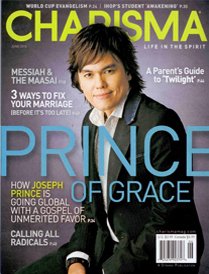 applications that they deem unacceptable. This not only explains the strong ecumenical flavor of New Calvinism, but exposes it for its pervasive hypocrisy.
What better example than John MacArthur who continually rags on Joel Osteen and the likes of Prince while he believes the same gospel. Gag, his hypocrisy makes me sick! Not only that, Prince et al are kinder, gentler Calvinists who wouldn’t dream of endorsing a serial sheep abuser like CJ Mahaney. Like MacArthur does.
Yes, the internet is a wonderful gift from God. While the European oppression of the Scriptures was cured by Gutenberg’s press, the deep deception of Reformed theology is exposed by Google. As Joseph Prince would say, “Thank you Jesus.” I said to self: “Self, I am very busy, what’s the best infogoog for this?” So I typed in, “Joseph Prince John Piper” and came up with a jewel.
It was a post by some Reformed guy objecting to the fact that many people think Justification by Faith Alone “for the baptized as well as the unsaved” is all of Joseph Prince’s idea. He makes the case that the Reformers had the idea first, and posted two videos by John Piper and RC Sproul to prove it. Too rich.
Now look, I am really busy and must move on, but you bloggers out there, with the help Gootenberg, can have a lot of fun with this. Trust me, the infogoog on this is vast.
paul

 Paul's Passing Thoughts
leave a comment