Reformed Questions in Response to “False Reformation”
 Paul,
Paul,
Just a few questions:
1. If you accept the idea that “flesh” and “spirit” refer to parts of regenerate believers rather than to spheres in which people live and by which we are controlled, where does sanctification take place, in the flesh or in the spirit? The same question applies in terms of “old man”/ “new man.” Which of those grows in sanctification?
Answer: This question reflects the fact that the Reformed crowd doesn’t openly discuss what they really believe about this issue, and I commend you accordingly. Authentic Reformed doctrine holds to the idea that the active obedience of Christ is manifested in the “Spirit realm” as a result of what we see in the Bible being imputed to us by faith alone in sanctification (see Luther’s Heidelberg Disputation, theses 27). We don’t change. The “Spirit realm” and the “flesh realm” are two forces that put pressure on us, and at any given time, we “yield” to one or the other. This is the position of the elders who are over the NANC training center in Springboro, Ohio according to an email I received from them when they thought I was onboard with their doctrine.
Of course, the take on this varies among those in the Reformed tradition. Another example would be the idea that we are still dead spiritually, and the living Christ within us is the one obeying. What is consistent is the idea that this obedience is experienced in a certain way: joy and a willing spirit (see LHD, theses 27); that’s how we know Jesus is doing it and not us. At any rate, the crux of Reformed theology is that all good works take place outside of the believer; i.e., Luther’s “alien righteousness” for not only justification, but for sanctification as well. Your question is at the very core of debates that took place between heretic Dr. Ed Welch of CCEF and the commendable Dr. Jay Adams.
Jay Adams oversees INS as he was pretty much run out of NANC and CCEF—largely due to the fact that NANC and CCEF are both bastions of evil. I find it utterly intolerable that thousands are sent to these organizations daily with the hope of change when these Reformed organizations in fact don’t believe that God changes them. There are no words for my loathing of such hideous deception while these organizations also take people’s hard-earned money to boot. And some don’t go along with these ideas, but they stand silent and therefore are just as guilty. And my “whole life” is contending against this? Perhaps, but better that than one’s whole life buying acceptance with silence. Moreover, people praise CJ Mahaney and co. for their tireless night and day service to the “gospel” which is really the work of the kingdom of darkness against the kingdom of light. A pity that I would counter that with my own life.
Unfortunately, Adams, who is much more advanced in patience than I am—associates with them, and in my estimation thereby causes confusion regarding the kind of counseling that will change people. Also, the possibility that the only biblical counseling organization left on the face of the earth that is not infected with Trippism and Powlisonism is also a major concern. Nevertheless, Adams and his associate, Donn Arms, are the only ones who have taken a stand against the heretical onslaught taking place in biblical counseling circles which is fraught with mindless followers, lackeys, lovers of filthy lucre, shameless cowards, and lying integrationists. The idea that these people care about any marriage or the well being of any saint is laughable.
But to answer your question completely, I believe the Scriptures are clear that the old self was put to death and no longer has the ability to enslave us to sin. The old self was “under the law” which means that the law provoked him to sin and a final judgment according to the law. As long as we are alive, our mortality has influence over us in regard to the old ways of being under the law, but the enslavement is broken. We are in fact born again, and have a regenerated “law of our mind.” Hence, “the spirit is willing, but the flesh is weak.” The warfare takes place inside of the believer between the law of his mind and the “law of sin.” The apostle makes it absolutely clear: this warfare takes place between my “inner being” and “in my members.” What is clearer? Unless the Bible is a Reformed gospel narrative that isn’t meant to inform our co-laboring with God in sanctification. But it is, because we are no longer “under” it for justification, but are informed by it for sanctification. Because the Reformers believe we are still under it, we must continue to live by the gospel that saved us from the law. We are still under it, but Jesus keeps it for us. How this is applied to the Christian life by the Reformers is outright Gnosticism to the core.
Furthermore, the “law of my mind” part of the believer that “delights in the law” in our “inner being” is what grows. Something in us is in fact growing: a host of passages that include 1Peter 2:1-3 make this certain. Really? Jesus isn’t really talking to us when he states, “Well done faithful servant”?
2. Do you believe sanctification occurs completely apart from faith? Do we have everything we need at the point of regeneration, so that further dependence on the Holy Spirit is no longer necessary? It sounds as if that is what you are saying.
Answer: Your question is framed within the confines of the Reformed either/or hermeneutic. Reality is either interpreted through the “glory story” or the “cross story.” This is the interpretive foundation of Reformed theology as stated in Luther’s HD. Because sanctification includes us, it must be by faith alone like salvation or it includes our glory as well. Therefore, where faith is, it must be by faith alone because faith is of God who will not share His glory with another. Therefore, if our doing is involved with sanctification, it must occur completely apart from faith. It must be the glory story, or the cross story. Reformed proponent Gerhard Forde states this in no uncertain terms.
Biblicists reject that metaphysical presupposition with prejudice. We stand with our beloved brother James, whom Luther rejected for obvious reasons, in saying that faith and works are together in sanctification while faith is alone in justification. Luther and his Reformed minions believe that grace is fused with works apart from our faith when it is faith in the works of Christ alone in sanctification (LHD theses 25).
Also, “Do we have everything we need at the point of regeneration, so that further dependence on the Holy Spirit is no longer necessary?” Again, we see Reformed metaphysics. If any part of our story is in the narrative, it’s semi-Pelagianism and not the cross story. This is a rather simple concept. All of the power that raised Christ from the dead is credited to our account in salvation. The Holy Spirit, our “HELPER” (ESV) “helps” us (that’s what a “helper” does, they “help”) in appropriating the blessings of salvation. He aids us (that’s what a “helper” does, he “aids”). And those blessings are appropriated “IN” (that’s a preposition) the DOING (James 1:25).
3. Do you believe Jesus’ actions are ever to be considered not only as instructional as a pattern for our obedience, but as motivation to imitate him?
Answer: As many have forcefully argued in several articles, especially Presbyterian Pastor Terry Johnson, God uses many different incentives to motivate us other than gratitude and meditating on the salvific works of Christ. This was also Adams’ primary contention against Sonship Theology.
4. Do you see any difference between God’s work in a believer that replaces his need to obey and God’s work in believers motivating them to obey?
Answer: The very question suggests a “need” to “replace (s)” the “need” of a believer to “obey” in sanctification? Of course, a clear distinction is not made regarding….in sanctification or justification? But, NO SUCH NEED EXISTS for sanctification. Our work in sanctification has NO bearing on our justification. The premise of the question is based on faulty Reformed presuppositions.
5. How do you see the Reformed doctrine as teaching that sanctification completes justification?
Answer: They call it a “CHAIN” (The golden chain of salvation-Romans 8:29,30). What’s a “chain”? What happens if you remove the middle links of a “chain” ? It’s not completed—this would seem apparent.
paul
New Calvinism is Bad News for Those Who Suffer
 There seems to be some bad news in regard to our “good news” gospel-centered churches: your suffering is good news. The evidence continues to mount: New Calvinism is authentic Reformed doctrine. Martin Luther’s Heidelberg Disputation was/is the foundation of Reformed doctrine. It was the first document after his 95 Theses (six months later) which confronted the bad behavior of his fellow philosopher kings, but his Disputation to the Augustinian Order was his doctrinal theses. By the way, according to Luther himself, his Disputation was heavily influenced by the writings of Pope St. Gregory and St. Augustine.
Like the New Calvinists of our day; no, exactly like the New Calvinists of our day, and according to the Disputation, Luther believed that the laity are not able to draw propositional truth from the Bible. He taught that spiritual knowledge and discernment only serve to inflame the evil desires of people whether they are saved or not. Therefore, God issued the Bible for the sole purpose of self-depravation, or “humbleness.” Knowledge “puffs up,” but what he called the “cross story” humbles—leading to “resurrection.” Luther saw the Christian life as a continual cycle of death and life, or “humbleness” followed by “grace.” ALL other considerations, especially anything to do with ourselves, are the “glory story.” This constant cycle of death and resurrection (humbleness and grace) was his redefinition of the new birth.
Luther defined love as something that seeks need [Theses 28]. Sounds good, no? But that was his only definition of love. Love seeks nothing for itself, but only seeks need. The problem begins in the anthropological fact that the love of good and justice feeds our desires because we desire to see such and experience it. But Luther attributed that notion to Aristotle and rejected it. True life was to be found in the suffering of the cross story only and any other life story that serves to bring us low—leading to resurrection. Any and all suffering in our life identifies us with the suffering of Christ, and leads to His resurrection:
Although the works of God are always unattractive and appear evil, they are nevertheless really eternal merits.
That the works of God are unattractive is clear from what is said in Isa. 53:2, »He had no form of comeliness«, and in 1 Sam. 2:6, »The Lord kills and brings to life; he brings down to Sheol and raises up.« This is understood to mean that the Lord humbles and frightens us by means of the law and the sight of our sins so that we seem in the eyes of men, as in our own, as nothing, foolish, and wicked, for we are in truth that. Insofar as we acknowledge and confess this, there is »no form or beauty« in us, but our life is hidden in God (i.e. in the bare confidence in his mercy), finding in ourselves nothing but sin, foolishness, death, and hell, according to that verse of the Apostle in 2 Cor. 6:9-10, »As sorrowful, yet always rejoicing; as dying, and behold we live.« And that it is which Isa. 28:21 calls the »alien work« of God »that he may do his work« (that is, he humbles us thoroughly, making us despair, so that he may exalt us in his mercy, giving us hope), just as Hab. 3:2 states, »In wrath remember mercy.« Such a man therefore is displeased with all his works; he sees no beauty, but only his depravity. Indeed, he also does those things which appear foolish and disgusting to others.
This depravity, however, comes into being in us either when God punishes us or when we accuse ourselves, as 1 Cor. 11:31 says, »If we judged ourselves truly, we should not be judged by the Lord«. Deut. 32:36 also states, »The Lord will vindicate his people and have compassion on his servants.« In this way, consequently, the unattractive works which God does in us, that is, those which are humble and devout, are really eternal, for humility and fear of God are our entire merit [Theses 4].
Now you ask: What then shall we do? Shall we go our way with indifference because we can do nothing but sin? I would reply: By no means. But, having heard this, fall down and pray for grace and place your hope in Christ in whom is our salvation, life, and resurrection. For this reason we are so instructed-for this reason the law makes us aware of sin so that, having recognized our sin, we may seek and receive grace. Thus God »gives grace to the humble« (1 Pet. 5:5), and »whoever humbles himself will be exalted« (Matt. 23:12). The law humbles, grace exalts. The law effects fear and wrath, grace effects hope and mercy. Through the law comes knowledge of sin (Rom. 3:20), through knowledge of sin, however, comes humility, and through humility grace is acquired. Thus an action which is alien to God’s nature (opus alienum dei) results in a deed belonging to his very nature (opus proprium): he makes a person a sinner so that he may make him righteous [Theses 16].
The manifest and visible things of God are placed in opposition to the invisible, namely, his human nature, weakness, foolishness. The Apostle in 1 Cor. 1:25 calls them the weakness and folly of God. Because men misused the knowledge of God through works, God wished again to be recognized in suffering, and to condemn »wisdom concerning invisible things« by means of »wisdom concerning visible things«, so that those who did not honor God as manifested in his works should honor him as he is hidden in his suffering (absconditum in passionibus) [Theses 20].
A theology of glory calls evil good and good evil. A theology of the cross calls the thing what it actually is.
This is clear: He who does not know Christ does not know God hidden in suffering. Therefore he prefers ,works to suffering, glory to the cross, strength to weakness, wisdom to folly, and, in general, good to evil. These are the people whom the apostle calls »enemies of the cross of Christ« (Phil. 3:18), for they hate the cross and suffering and love works and the glory of works. Thus they call the good of the cross evil and the evil of a deed good. God can be found only in suffering and the cross, as has already been said. Therefore the friends of the cross say that the cross is good and works are evil, for through the cross works are dethroned and the »old Adam«, who is especially edified by works, is crucified. It is impossible for a person not to be puffed up by his »good works« unless he has first been deflated and destroyed by suffering and evil until he knows that he is worthless and that his works are not his but God’s [Theses 21].
Luther answered the obvious objection to all of this with the following:
Nor does speaking in this manner give cause for despair, but for arousing the desire to humble oneself and seek the grace of Christ [Theses 17].
More and more, this is the Reformed perspective of pastors in evangelical churches. It represents about 90% of the perspective among certified biblical counselors associated with NANC and CCEF. Does it leave any doubt as to why there is so much indifference to abuse and tyranny in our churches?
And excuse me while I shudder—the thought of hurting people being sent to such counselors by the thousands on a daily basis.
paul
Today’s Christian Husband and Father: Killing His Family with Awesome Preaching
Bob is on his way to Jerry’s house for dinner. Bob is the chairman of their church’s elder board. Jerry is being considered for eldership and Bob will be dining at his house for a pre-interview en lieu of further discussion. Pizza is the cuisine. And apparently, not just on this night—Bob notes that every trashcan in the house is stuffed with pizza boxes. Dishes full of M & Ms also adorn many of the table tops. Bob is taken to the kitchen by Jerry to meet his wife, and Bob perceives no less than twenty-five bags of potato chips staked about in various places. One corner of the kitchen is occupied with a tall stack of Coca-Cola 12packs. Big on taste—small in nutrition. Precious few will disagree that Bob’s family is headed for serious health problems if they do not change their ways. Yet, Bob is a picture of how the vast majority of Christian husbands oversee the spiritual diets of their families. However, the “Bob” motif falls woefully short of making the point; at least Bob knows what his family is eating for better or worse. Christian husbands of our day don’t even know the difference between Redemptive Historical hermeneutics and Grammatical Historical hermeneutics. In fact, when the subject comes up, a rolling of the eyes follows. That’s because the preaching/teaching is awesome where they go to church. Uncompromising, and God glorifying. As one pastor exhorted me when inquiring about what hermeneutic he used in his preaching: “Come and see if it tastes good, and if you still want to, we will talk about theology.” But I never doubt it will taste good. Who doesn’t love pizza for dinner, potato chips as a side, Coke to drink, and M&Ms for desert? Fact is, nearly 90% of preaching/teaching in today’s American church is fundamentally based on Luther’s Heidelberg Disputation. This document is the very heart of the Reformation and the engine that drives the present-day New Calvinist movement. Its premise was based on the idea that all spiritual reality, wisdom, and truth comes from the combination of two perspectives, and only these two: the holiness of God, and the wretchedness of all men whether they are Christians or not. Luther called this perspective the “theology of the cross.” It has come to be known as Gospel-Centered preaching/teaching. It is also the foundation of the Calvin Institutes. Everything in the Calvin Institutes, in some way, points to the glory of God “as set against our sinfulness.” This has become job one: as described in the Heidelberg Disputation; this way of teaching is the “cross story,” and all other spiritual wisdom is the “glory story.” Hence, the contemporary clarion call of the Reformation derived from Luther’s Disputation is, the centrality of the objective gospel outside of us. Anything at all that has anything to do with us is “subjective,” and part of the “glory story.” Unless it concerns our wretchedness. Therefore, the Disputation ridiculed a negative attitude towards suffering as well for this serves to further reveal our woeful state in life which magnifies the redemptive work of Christ and our utter worthlessness. The whole motif can be visualized by the following Reformed chart:  Yes, you can preach wonderful sermons on those two dimensions. They are both abundantly true. Charles Spurgeon is known as the “prince of preachers.” All of his sermons are based on the “cross story.” All, I repeat “all” of John Piper’s sermons and the (seems like) 600 books he has written are based on nothing but, I repeat, nothing but the “cross story.” Amen, pass the potato chips. In circa 1994, John MacArthur abandoned the “glory story” aspects of his preaching and now focuses on the “cross story.” Amen, pass the M&Ms. And those babies slide down nice with a big swig of Coca-Cola. “But Paul, what’s so sweet about focusing on our own wickedness?” My dear friend, haven’t you seen any Staples commercials? It’s easy. You totally stink. Nothing is expected of you: “Hey honey! Good news! We don’t change! Our marriage isn’t about a bunch of do’s and don’ts! Our failures make us wiser!” That was easy. In fact, teachers like Michael Horton and John Piper continually espouse the idea that expectations are just, “more bad news.” And regarding leaders? “Alright, time to prepare my message for tomorrow, and all I have to do is look for two things, and two things only in the text: how great God is, and how bad we are.” That was easy. In fact, we find the following on a well-known Reformed blog regarding instruction on how to prepare a Bible lesson:
At this time, resist the temptation to utilize subsequent passages to validate the meaning or to move out from the immediate context. Remembering that all exegesis must finally be a Christocentric exegesis. Look for Christ even if He isn’t there directly. It is better to see Christ in a text even if He isn’t, than to miss Him where He is.
But as the apostle asked rhetorically, “What saith the Scriptures?” Is there another story other than the “cross story”? Anybody interested in the House on a Rock story?
Matthew 7:24 -“Everyone then who hears these words of mine and does them will be like a wise man who built his house on the rock. 25 And the rain fell, and the floods came, and the winds blew and beat on that house, but it did not fall, because it had been founded on the rock. 26 And everyone who hears these words of mine and does not do them will be like a foolish man who built his house on the sand. 27 And the rain fell, and the floods came, and the winds blew and beat against that house, and it fell, and great was the fall of it.”
Learn and do. That’s how we have a life built on a rock. It is the very definition of a disciple:
Matthew 19 – Go therefore and make disciples of all nations, baptizing them in the name of the Father and of the Son and of the Holy Spirit, 20 teaching them to observe all that I have commanded you. And behold, I am with you always, to the end of the age.”
So, here is my suggestion. When you go to church this Sunday, and other days following that involve sitting under the teachings of your leaders, take a legal pad with you. Draw a line at a downward angle on the bottom labeled, “our sin.” Draw a line at the top with an upward angle, and label it “Christ.” Then draw a line in the middle and label it, “What? Why? And How?” Or, “Not only what Jesus did, but what did He SAY?” Or simply, “Life built on a rock.” If there isn’t a three-dimensional balance—get out of there. You either love your family or you don’t. You will be judged by Christ accordingly. I was approached by my wife Susan this morning. My son by marriage had approached her asking questions about demonology. Apparently, he had questions concerning some things he had heard about the subject in the secular realm. I was astonished; though both of them have been in church for a combined total of 72 years, they didn’t even know the basics regarding this subject. My wife wanted to know the answers to his questions—other than the usual answers: “Jesus” and “gospel.” And if we don’t know, the world will gladly inform our children accordingly. Knowledge equals authority. Men, wake up. paul
Are Calvinists Saved?
 The begging of the question has a sound Scriptural argument.
This ministry has made much of the critical importance of separating justification (salvation) and sanctification (growth in holiness, or kingdom living). The Reformed (Calvin/Luther Reformation doctrine/gospel) “never separate, but distinct” doublespeak doesn’t cut it in the arena of truth, and we will see why. “Never separate” =’s false gospel. If you get a little lost in the first part of my argument which gives the lay of the land, don’t worry, when I get into the specific Scriptural argument, it will clear things up and make it all come together for you.
It must delight the ghosts of the Reformation that the argument has always been in the arena of freewill verses predestination. It’s the primary thrust of this ministry to change that argument. This isn’t a quibbling about semantics in the mainstream—this is about the truth of the gospel. As New Calvinist Russ Kennedy once thundered from the pulpit in his mousy voice: “Any separation of justification and sanctification is an abomination!”
I have often argued from the standpoint of this issue. If sanctification is the middle of the Reformed “golden chain of salvation” then sanctification is part of finishing justification. This means that what happens in sanctification determines whether or not justification is properly finished. What’s a chain? John Piper even preached a message about the eternal importance of our contribution to the “links” in just the right way. In essence, sanctification becomes a spiritual minefield.
This is exactly the same thing that the Reformed crowd has always accused Rome of: the fusing together of justification and sanctification. However, as we shall see, they are both guilty of the exact same heresy/false gospel. As we shall see, both teach that sanctification finishes justification.
This is a linear gospel (one unified chain from salvation to resurrection (glorification) versus a parallel gospel with salvation on one plane as a finished work before the foundation of the world, and kingdom living that runs parallel with the finished work and reflects the reality of our salvation until glorification. Typical in the linear gospel is the idea that Christ died for all of our past sins, but we must now finish the work (with the Holy Spirit’s help [sanctified works salvation]) until glorification when we are completely transformed into complete holiness. This is the often-heard bemoaning of “Christ PLUS something.”
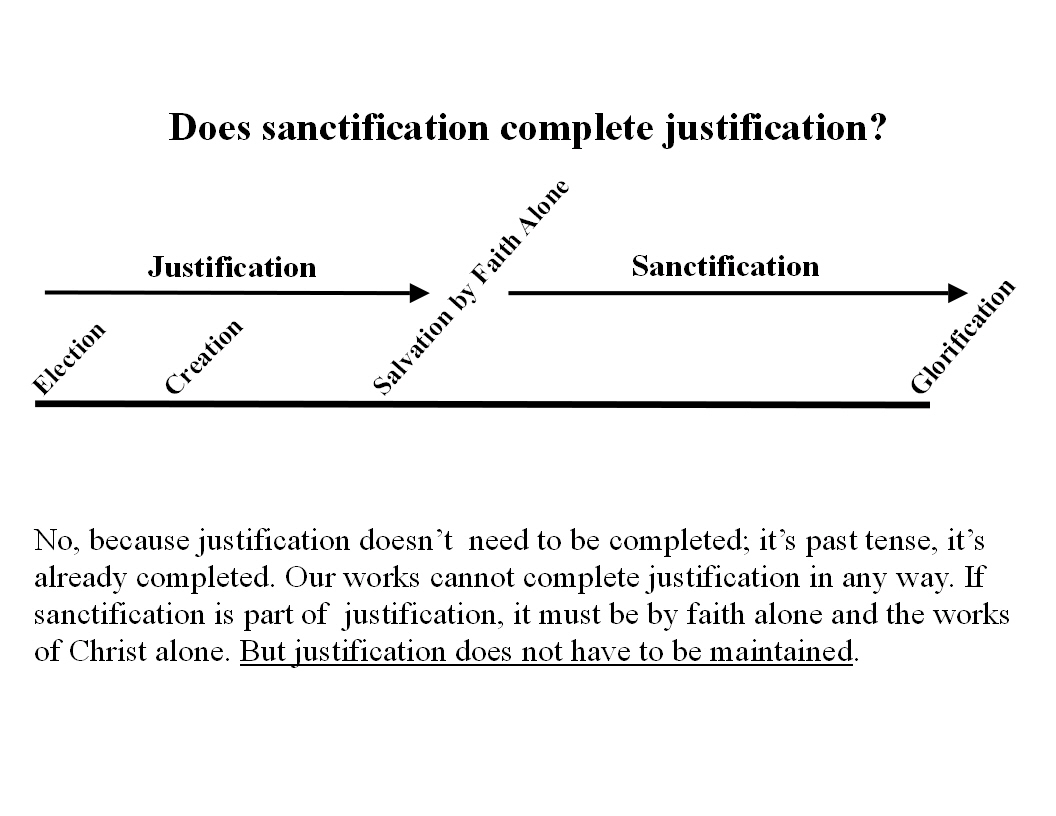
An excellent example is some strains of Freewill Baptists who teach that Christ died for all of our past sins, but with the help of the Holy Spirit, we must confess and repent of every sin we commit until the resurrection; e.g., Christ plus salvation by repentant prayer for sins committed after we are “saved.” My grandparents were saved out of this tradition. When my grandfather asked my grandmother if she thought that God could ever forgive him of all the sins he committed, she answered: “Yes, but you are going to have to pray awful hard!” Praise God that through the ministry of several individuals my grandparents eventually abandoned that gospel for the true one of salvation by faith alone as a finished work.
Likewise, Rome teaches that you must let the Catholic Church finish your justification through ritual; e.g., Christ plus Catholic ritual. The Reformation gospel is also Christ plus something else, but the something else is ever-so-subtle. In both cases, sin must be dealt with in sanctification in order for the saint to remain justified until the final judgment. In other words, the righteous standard of justification must be maintained on our behalf. Like all other proponents of a linear gospel, the Reformed crowd contends that anything less than the perfection demanded of the law (“all sin is transgression of the law”) is “legal fiction.” So both Rome and the Reformers agree: justification must be maintained by sanctification, and in the case of the Reformers specifically, they believe that the perfect standard of the law must be maintained until glorification; otherwise, our justification is “legal fiction.”
Here is where Reformed subtlety is uncanny: Christ keeps the law for us in sanctification. He maintains the perfect standard. All the fruit of sanctification (obedience/good works) flows from the life He lived on Earth and His death on the cross. Christ plus the works of Christ to finish salvation. “But Paul, what in the world is wrong with that!” Here is what is wrong with it: works are still required to maintain justification. That is a huge problem, even if it is Christ doing the work. What did the Hebrew writer say about Christ’s work for justification not being complete?
And even more subtle is the following Reformed idea: believing that the law is no longer a standard for maintaining justification is antinomianism. Antinomianism =’s legal fiction. Their definition of antinomianism is the removal of the law from justification as the standard for maintaining it. Traditionally, among Biblicist, antinomianism is the removal of the law from sanctification, and herein lays even further steroidal subtlety: the Reformed theologians would refute a removal of the law from sanctification as well, not only because they think justification and sanctification are the same thing, but because its perfect keeping is required to maintain a true declaration of the just that is not “legal fiction.”

However, the Biblicist believes that the law is a standard for kingdom living and is no longer a standard for justification. Therefore, if we attempt to obey it with the Holy Spirit’s help, and to please/serve the Lord, it can have no bearing on our just state. While the Biblicists think they are therefore joint contenders with the Reformers against antinomianism, such is far from the truth. The Reformed mind believes the Biblicist is either a legalist or an antinomian, or both. The Biblicist is supposedly an antinomian because he/she has removed the law from justification as a just standard, or is a legalist because they think they should strive to keep the law in sanctification. Since sanctification finishes justification’s perfect standard of law keeping, our “own” attempts to keep the law in sanctification is an attempt to finish justification. Hence, what the Biblicist fails to understand is the Reformers belief that Christ must maintain the law for us in sanctification because justification and sanctification are not separate. Anything more or less is supposedly works salvation.
On the other hand, because it is vital that Christ obeys the law for us in sanctification, the likes of John Piper and Tullian Tchividjian contend that those who are really preaching the Reformed gospel will indeed be accused of antinomianism. All in all, their position is easy to see if you pay attention. John Piper and many other Calvinists often state that, “Good works are the fruit of justification.” And, “Justification is the root, and sanctification is the fruit.”
Well, the average Biblicist then thinks, “Yes, but of course, our salvation makes good works in sanctification possible.” But that’s not what they are saying. If you pay closer attention, they are saying that justification is a tree that produces its own fruit. Justification is the root, and whatever happens in true sanctification is the fruit of the root of the justification tree. Problem is, justification doesn’t grow. Justification is a finished work. What Calvinists refer to as “progressive sanctification” is really the fruit of the root: progressive justification. Another name for this that they throw around is “definitive sanctification.” The word “definitive” refers back to the definite completion of justification.

Revision: this ministry now rejects the idea that orthodoxy is truth; orthodoxy is the traditions of men. Never in Scripture do we find premise for a body of teaching that explains the teaching. The above illustration is valuable for demonstrating that the fruit of justification is glorification, NOT sanctification.
This brings us to the Scriptural argument which begins with a question I asked myself just this morning: “Paul, you are always harping about the crucial importance of the separation of justification and sanctification—a parallel gospel versus a linear one. But where does the Bible say specifically that this is critical?”
First, the very definition of a lost person in the Bible is one who is “under the law”:
Romans 3:19
Now we know that whatever the law says it speaks to those who are under the law, so that every mouth may be stopped, and the whole world may be held accountable to God.
Romans 6:14
For sin will have no dominion over you, since you are not under law but under grace.
Romans 6:15
What then? Are we to sin because we are not under law but under grace? By no means!
1 Corinthians 9:20
To the Jews I became as a Jew, in order to win Jews. To those under the law I became as one under the law (though not being myself under the law) that I might win those under the law.
Romans 7:1
Or do you not know, brothers —for I am speaking to those who know the law—that the law is binding on a person only as long as he lives?
Romans 7:2
For a married woman is bound by law to her husband while he lives, but if her husband dies she is released from the law of marriage.
Romans 7:3
Accordingly, she will be called an adulteress if she lives with another man while her husband is alive. But if her husband dies, she is free from that law, and if she marries another man she is not an adulteress.
The unsaved are “under the law” and will be judged by it in the end. This is the very definition of the unsaved. Calvinists define Christians the same way—we are supposedly still under the law and will be judged by it in the end. That’s why Christ must keep the law for us—because we are still under it.
If not this position, why do many in the Reformed tradition hold to the idea that Christ’s perfect obedience is imputed to our sanctification? His death justifies us, and His perfect life sanctifies us. Hence, His death pays the penalty for past sins, and then His perfect life imputed to our sanctification keeps us justified. Why would an imputation to our sanctification be necessary if we are no longer under the law? This is known as the Reformed view of “double imputation” and has been called out as heresy by many respected theologians for this very reason: it implies that Christians are still under the law.
In regard to sustaining the law in our stead, why? It has been totally abolished in regard to our just standing:
Romans 3:20
For by works of the law no human being will be justified in his sight, since through the law comes knowledge of sin.
Romans 3:21
But now the righteousness of God has been manifested apart from the law, although the Law and the Prophets bear witness to it—
Romans 4:15
For the law brings wrath, but where there is no law there is no transgression.
The keeping of the law by anybody DOES NOT do anything to justify mankind:
Romans 3:28
For we hold that one is justified by faith apart from works of the law.
Here is where the separation of justification and sanctification is vital on this first point: we ARE NOT under the law for justification, but rather UPHOLD THE LAW in sanctification. The two must be separate because of the differing relationships to the law:
Romans 3:31
Do we then overthrow the law by this faith? By no means! On the contrary, we uphold the law.
Romans 6:15
What then? Are we to sin because we are not under law but under grace? By no means!
Furthermore, if we are still under the law (whether or not Christ obeys it for us to keep us in a just standing), this means we are still under the power of sin. Being under the law and also under its spell to provoke sin in the unregenerate is spoken of as being synonymous in the Bible. Those who are “under the law” are also under the power of sin and enslaved to it:
Romans 7:4
Likewise, my brothers, you also have died to the law through the body of Christ, so that you may belong to another, to him who has been raised from the dead, in order that we may bear fruit for God.
Romans 7:5
For while we were living in the flesh, our sinful passions, aroused by the law, were at work in our members to bear fruit for death.
Romans 7:6
But now we are released from the law, having died to that which held us captive, so that we serve in the new way of the Spirit and not in the old way of the written code.
Romans 7:8
But sin, seizing an opportunity through the commandment, produced in me all kinds of covetousness. For apart from the law, sin lies dead.
If we are still under the law, and will be judged by it, whether or not Christ stands in the judgment for us with His own works, we are still enslaved to sin by virtue of being under the law…. for justification. And Calvinists know this to be true, that’s why they say we are still…. what? Right, even as Christians, “totally depraved.” And, “enemies of God.” Of course, throughout the Bible, Christians are spoken of as being friends of God and no longer His enemies. Our status as enemies of God is stated in the past tense. But the Reformed crew continually state that Christians are vile enemies of God and are enslaved to sin. They realize that this goes hand in hand with being under the law.
To the contrary, dying to the law in the death of Christ….for justification—sets us free to be enslaved to the righteousness that is defined by the law. We are dead to the law for justification and alive to obey truth….for sanctification:
Romans 8:2
For the law of the Spirit of life has set you free in Christ Jesus from the law of sin and death.
Romans 8:3,4 [emphasis by author]
For God has done what the law, weakened by the flesh, could not do. By sending his own Son in the likeness of sinful flesh and for sin, he condemned sin in the flesh,….in order that the righteous requirement of the law might be fulfilled in us, who walk not according to the flesh but according to the Spirit.
Romans 8:7
For the mind that is set on the flesh is hostile to God, for it does not submit to God’s law; indeed, it cannot.
Romans 9:31
but that Israel who pursued a law that would lead to righteousness did not succeed in reaching that law.
John 17:17
Sanctify them in the truth; your word is truth.
James 1:25
But the one who looks into the perfect law, the law of liberty, and perseveres, being no hearer who forgets but a doer who acts, he will be blessed in his doing.
So, that is the separation that must be for the true Christian: Justification has no law for which we are judged, and we live by the law of blessings in sanctification.
This brings us to another important separation in the two: the judgments. Those under the law and sin will stand in a final judgment which will be according to the law. Again, because Calvinists believe that we are still under the law, albeit that Christ obeyed/obeys it for us, Christians will supposedly stand in the same judgment as the damned who are under the law and enslaved to it. At that time, the children of God, according to Calvinists, will be “made manifest.”
But because Christians are not under the law and cannot be judged by it, they will stand in a judgment for rewards and not a judgment that determines a perfect keeping of the law by Christ in our stead. Hence, there will be two different resurrections: one for those under the law and another for those under grace, and two different judgments for the same two groups. One for rewards, and one to determine if those under the law kept it perfectly. That judgment doesn’t go well for any standing in it.
Luke 14:12-14
He said also to the man who had invited him, “When you give a dinner or a banquet, do not invite your friends or your brothers or your relatives or rich neighbors, lest they also invite you in return and you be repaid. 13 But when you give a feast, invite the poor, the crippled, the lame, the blind, 14 and you will be blessed, because they cannot repay you. For you will be repaid at the resurrection of the just.” [Notice that this is a resurrection for the “just.” They are already determined to be just before they are resurrected].
2Corinthians 5:9,10
So whether we are at home or away, we make it our aim to please him. 10 For we must all appear before the judgment seat of Christ, so that each one may receive what is due for what he has done in the body, whether good or evil.
1Corintians 3:11-15
For no one can lay a foundation other than that which is laid, which is Jesus Christ. 12 Now if anyone builds on the foundation with gold, silver, precious stones, wood, hay, straw— 13 each one’s work will become manifest, for the Day will disclose it, because it will be revealed by fire, and the fire will test what sort of work each one has done. 14 If the work that anyone has built on the foundation survives, he will receive a reward. 15 If anyone’s work is burned up, he will suffer loss, though he himself will be saved, but only as through fire.
Hebrews 6:10
For God is not unjust so as to overlook your work and the love that you have shown for his name in serving the saints, as you still do.
Revelation 20:6
Blessed and holy is the one who shares in the first resurrection! Over such the second death has no power, but they will be priests of God and of Christ, and they will reign with him for a thousand years.
Revelation 20:11-15
Then I saw a great white throne and him who was seated on it. From his presence earth and sky fled away, and no place was found for them. 12 And I saw the dead, great and small, standing before the throne, and books were opened. Then another book was opened, which is the book of life. And the dead were judged by what was written in the books, according to what they had done. 13 And the sea gave up the dead who were in it, Death and Hades gave up the dead who were in them, and they were judged, each one of them, according to what they had done. 14 Then Death and Hades were thrown into the lake of fire. This is the second death, the lake of fire. 15 And if anyone’s name was not found written in the book of life, he was thrown into the lake of fire.
Don’t let anyone tell you that eschatology is a “secondary” or “nonessential” consideration. Your eschatology is your gospel. It will state your position regarding whether or not you fuse justification and sanctification together; ie, likening Christians to those under the law.
Yet another vital difference in sanctification and justification is repentance. Repentance for salvation (when you are justified) is different from our repentance in sanctification. Among many in the Reformed tradition where the “same gospel that saved you also sanctifies you,” the repentance is the same. Repentance unto salvation is not a onetime “washing,” but rather a means to continue “in the gospel” through what they call, “deep repentance.” Biblicism holds to repentance in sanctification that restores his/her fellowship and communion with God as His children. They would see repentance unto salvation as differing, and only necessary for salvation—a onetime decision to take one’s life in a new direction by following Christ, and believing in his death, burial, and resurrection.
Reformed repentance, according to the likes of Paul David Tripp and others is a “daily rescue.” Our original repentance was for rescue, and we need rescue today as much as we needed rescue when we were saved. Again, this indicates their belief that we are still under the curse of the law and need to be continually rescued from it while remaining under the bondage of sin.
However, Christ made it clear to Peter (John 13:6-11) that those who have been washed (1Corinthians 6:11, Romans 8:30) do not need another washing. Those who drink of the living water do not thirst again (John 4:13,14).
Lastly, though many other separations could be discussed, why saints can be considered just while they still sin at times is of paramount importance. There is no sin in our justification because there is no law, and where there is no law, there is no sin. Though unfortunate, there can be sin in our sanctification because it is totally separate from justification and can’t affect our just standing with God.
Basically, all of the aforementioned makes it of necessity to deny the new birth. If we have God’s seed in us, and we do (1John 3:9), that dispels total depravity, and without total depravity, justification and sanctification cannot be fused together. The new birth is a huge problem for Reformed theology. If the old man that was under the law is dead (Romans 7:1ff), and the seed of God is in the saved person, and the sin due our weakness in the flesh cannot be laid to our account for justification, then our justification is not “legal fiction” because we do not exhibit perfect obedience to the law. This is another grave consideration because Christ said, “You must be born again.” Obviously, despite their denials that they deny the new birth—you can’t be both totally depraved and born again.
Reformation doctrine is clearly a false gospel. Its version of justification does not void the law, and denies the new birth while distorting everything in-between. Freewill verses predestination is hardly the issue, the very gospel itself is the issue.
paul
John MacArthur’s Showing Without Telling: The Reformed Way of Preaching Progressive Justification
“Moreover, this paradigm, according to many Calvinists in our day including John MacArthur, asserts that Christians often obey and experience biblical truth that they are unaware of intellectually.”
“MacArthur had a choice: the authority of Scripture or Reformed orthodoxy; he chose the latter.”
“And, what exactly are the ‘implications’ that John MacArthur ‘explains’ from the text? If you assume a many-faceted full counsel of God, your assumptions would be dead wrong.”
Progressive justification is the gospel of John Calvin and present-day neo-Calvinists of all stripes. Forget the freewill/election debate; forget all of the haranguing over the residual issues; progressive justification is simply a false gospel.
It teaches that the power for our Christian living comes from our salvation or justification. At first, you may object to my objection on the bases that salivation makes Christian living possible, and I agree, but making Christian living possible and being directly powered by it are two opposing ideas with a crucial difference.
If Christian living is powered by our salvation (justification), and if our salvation does more than change our standing, position, or status, Christian living (sanctification) remains connected to our justification. This makes sanctification a spiritual minefield with endless and sobering implications.
Of which the least is not: preaching. When justification and sanctification are fused together, we are interacting with our justification throughout life; this would seem evident and terrifying to those who understand the implications because we can supposedly do things in our sanctification that can affect our standing before God.
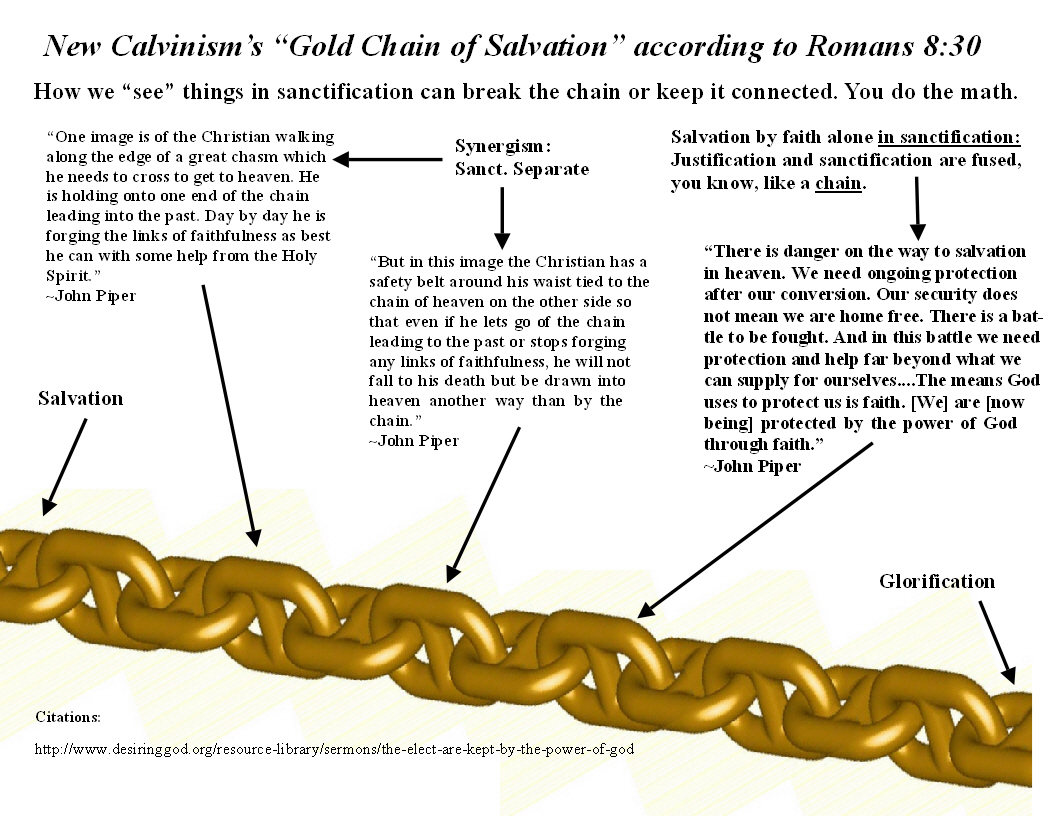
Hence, in this fusion of the Reformed “golden chain of salvation” (what’s a chain?) we must be careful in how we (according to John Piper) participate in the links because we are not home free and there is a danger in sanctification. No kidding. There would be when justification and sanctification are fused together.
Furthermore, because this makes sanctification very tricky, the children of God (according to Doug Wilson) will be manifested at the last judgment. I sometimes receive complaints here at PPT that John Piper et al seem to state that we cannot know for certain whether we are saved or not until the last judgment. I am not surprised by these questions; they would be consistent with the logical conclusions one must draw from the theology.
This now brings us to our discussion about preaching. Obviously, Reformed pastors are going to be very careful not to preach in a way that will lead us in making our sanctification the ground of our justification. Or, leaping from the imperative to obedience. If we do not pre-bathe all obedience in our salvation, it is “making our sanctification the ground of our justification.” In Reformed circles, they call this, “The biblical command is grounded in the indicative event.” The indicative “event” is the crucifixion of Christ—all obedience flows from that event directly as the empowerment thereof—not a possibility that we participate in.
Therefore, all true obedience in the life of a believer is a mere natural flow experienced by joy and a willing spirit IF it is powered by our salvation. This is obtained through using our Bible to meditate on our salvation, and the works of Christ, and then just letting the Spirit take things from there. If the Spirit then instigates the obedience, it’s the Spirit applying justification to our sanctification and not us. Hence, we are safe from “making our own sanctification the ground of our justification.” Again, this is supposedly manifested and verified by joy (which Piper makes absolutely synonymous with saving faith and the struggle thereof dependent on our salvation [When I Don’t Desire God p.35]). Likewise, John MacArthur mimics the same nonsense as documented in the following PPT post:
Hence, creepy similarities to Piper’s theology appear in “Slave,” especially Pipers belief that true Christian obedience is always experienced as an unhesitating, natural response accompanied by joy. Throughout the book, MacArthur describes Christian obedience as “pure delight” and “joy-filled.” On page 208, he describes our experience as slaves to Christ as “not partially sweet and partially sour, but totally sweet.” This, despite what the apostle John clearly experienced as recorded in Revelation. But regardless of the fact that there is nothing sweeter than being a slave of Christ, to suggest that our experience is never mixed with bitterness (taste, not attitude) is just plain nonsense. A believer who has lost an unbelieving relative or close friend would be an example. Also, even though I realize the importance of joy in the Christian life, I make this observation in “Another Gospel” (page 78):
“Only problem is, among many, is the eleventh chapter of Hebrews contradicts everything in Piper’s statement above. Hebrews 11 is one of the more extensive statements on saving faith in Holy writ. The Hebrew writer defines the faith of at least twenty believers in regard to the decisions they made and obedience. Joy or pleasure, even pleasure in God, is not named once as being an attribute of their faith. The only semblance of feelings or emotions mentioned is that of strife and fear of God more than man. The truth of Hebrews 11, as well as many other Scriptures, makes a mockery of Piper’s theory of Christian hedonism.”
According to John Piper, if we find ourselves in a situation where we find no joy in the obedience—go ahead and obey, but be sure to ask God for forgiveness because of your sinful obedience (John Piper: Treating Delight as Duty is Controversial; pdf booklet available on Desiring God .org). Moreover, this paradigm, according to many Calvinists in our day including John MacArthur, asserts that Christians often obey and experience biblical truth that they are unaware of intellectually. A prime example of this would be the following excerpt from an article written by New Calvinist Bill Baldwin:
Give me a man who preaches the law with its terror and Christ with his sweetness and forgets to preach the law as a pattern of the fruit of sanctification and what will result? In two months his parishioners will be breaking down his door begging to be told what behavior their renewed, bursting with joy, hearts may best produce. And when he tells them, they will be surprised (and he will not) to discover that by and large they have produced exactly that. And where they haven’t, take them back to Christ again that they may contemplate him in all his glorious perfection so that they may better understand what sort of God and man he was and is (Bill Baldwin: Sanctification, Counseling, and the Gospel 08/02/1996).
My best information is that MacArthur bought into this nonsense circa 1994. He was persuaded by, among others, John Piper and Michael Horton that the Reformers in fact held to a progressive justification. MacArthur had a choice: the authority of Scripture or Reformed orthodoxy; he chose the latter. Therefore, MacArthur’s preaching will ape that of most Reformed teachers: heavy on the glory of God and very light on practical application or specific instruction. As Baldwin states it: “….the law as a pattern of the fruit of sanctification.”
And even though MacArthur is far more subtle in his anti-instruction/application than most Calvinists (probably due to the habits of his prior preaching which was heavy on sanctification elements), Christians have nevertheless noticed his lack of application (most likely due to the contrast) and questioned him on it. His defense reveals his dastardly selling out of the truth.
In, “Why doesn’t John MacArthur add much application to his sermons?” (Online source: http://goo.gl/P0eR9), MacArthur defends his Reformed Application Light sermons. But for you skeptics, let me get your attention. In regard to my accusation that this paradigm doesn’t require intellectual knowledge for experience or application, MacArthur concludes his defense by stating the following:
So now you know. You’ve been experiencing this. You had no idea what you were experiencing, right? (Applause) Okay.
The “applause” part of the transcript is the barf factor when one ponders the mindless following of philosopher kings such as “Pastor” John MacArthur Jr. Nevertheless, MacArthur continues:
Now let me tell you what happens when you preach effectively. You do explanation. In other words, you explain the meaning of Scripture, okay? The explanation carries with it implication. In other words, there are implications built into this truth that impact us. You add to that exhortation. And I’ve said things tonight to exhort you to follow what is implied by the text. Now when you deal with the text and the armor of God, like tonight, all I can do is explain it. That’s all it does. There aren’t any applications in that text. It doesn’t say, “And here’s how to do this if you’re 32 years old, and you live in North Hollywood.” “Here’s how to do this the next time you go to a Mall.” “Here’s how to do this when you go in your car and you’re driving in a traffic jam.” It doesn’t tell you that. And if I made my message mostly a whole lot of those little illustrations, I would be missing 90 percent of you who don’t live in that experience.
Unfortunately, MacArthur has gone the way of New Calvinist ungodly communication. He makes application of Scriptures the same thing as applying it to petty life concerns; such as, going to the mall. It’s the classic New Calvinist demeaning of biblical application and obedience. What is really behind it is an antinomian spirit. Let me point out MacArthur’s error in regard to the above quote concerning the idea that there is no application in Ephesians 6:16-20, only “explanation.” That text is full of imperatives and applications in regard to the full armor of God: “Put on…., stand against…, take up…, that you may be able…., having done all…., having put on…., Stand therefore…., having fastened…., and having put on…., in all circumstances [what circumstances? It would be wrong to draw examples from our life?]…., with which you can…., to that end…., [etc., etc., etc].” To imply that Ephesians 6:16-20 doesn’t contain instruction for practical application is ludicrous.
Also, adding to the absurdity of MacArthur’s statement is the fact that “putting on” is a major theme of that passage. This refers back to Ephesians 4:20-24, and the Apostle Paul’s discussion of putting off the old nature and putting on the new. So, MacArthur is not only denying application from our life experience, but specific life application specified in Scripture. Dr. Jay E. Adams notes 45 life applications to the putting off/putting on concept that he didn’t deduct from life observation, but are specifically mentioned in Scripture regarding life application (INS Training in Biblical Counseling by Extension: Introduction Principles and Practices; pp.22-24).
Surely, other than what good preachers should be able to draw from life for biblical application, specific biblical applications regarding life are too numerous to list. For example, Paul states in I Corinthians 7:41 that Christians should only marry “in the Lord.” The life application is what Nehemiah stated about Solomon when he didn’t follow that mandate; ie., even a man of his spiritual wherewithal fell into grievous sin by violating said spiritual principle.
Nehemiah 13:26
Was it not because of marriages like these that Solomon king of Israel sinned? Among the many nations there was no king like him. He was loved by his God, and God made him king over all Israel, but even he was led into sin by foreign women.
No life application in that? Really?
MacArthur continues:
It’s not for me to do that. Application belongs to the Spirit of God. All I’m interested in is explanation and its implications [What about 2Timothy 3:16,17 and the issue of “instruction” ?]. And the power comes in the implication and the Spirit of God takes the implications of what I’ve said tonight, all these things I’ve said, I don’t need to say all kinds of little scenarios to you and paint all kinds of little individual circumstances. All I need you to know is this is what the Word of God says and the implications are powerfully brought to bear with authority on your life and I exhort you to respond to those implications, it is the Spirit’s work to drive those implications into direct and personal application. That’s why you’re not going to, like so many preachers, you’re not going to hear me create all kinds of practical scenarios about how this all fleshes out in everybody’s world because you may hit somebody, you may hit a person here or there, that’s kind of a rifle-shot approach, the shot-gun approach that sprays everybody is the implicational essence of Scripture. That’s the power. And that’s when everybody walks out and says, “Wow, that hit me!” because you already have a commitment to the authority and the power of Scripture.
So, Reformed preaching merely explains Scripture, and the Holy Spirit applies it. So what do we need “instruction” for? (2Timothy 3:16,17). As we have clearly seen, this is an iffy proposition. If this is the case, why does the Bible command specific life application? Does the Spirit need to inform Christians as to what He may or may not do in their lives? I contend that this is MacArthur’s nuanced way of propagating the whole Reformed idea that the Holy Spirit obeys for us, so that our sanctification will not be the “ground of our justification.”
MacArthur further explains:
You already have a commitment to the truthfulness of Scripture. All I want you to understand is what it means. And in the meaning expanded beyond the given text to other texts so that you build all the theological implications, I leave you with the implications and an exhortation to be obedient and I leave the application to the Spirit.
Obedient to what? Obviously, there can be no specific instruction from the pulpit, only “explaining.” Instruction would imply specific application of the text. So, not only does the Holy Spirit apply the text, does he also teach the Christian how to apply it specifically? Or does that just come as a mere natural flow? Well, since, “So now you know. You’ve been experiencing this. You had no idea what you were experiencing, right?” Answer: like Baldwin, and for that matter, all New Calvinists, the “obedience” is “experienced” (not personally applied) without necessary intellectual understanding or knowledge. Let me reiterate MacArthur’s exact words:
So now [present tense] you know. You’ve been [past tense] experiencing this [experiencing what? Answer: obedience]. You had no idea [this should speak for itself….] what you were experiencing, right?
Right John. Whatever you say.
And, what exactly are the “implications” that John MacArthur “explains” from the text? If you assume a many faceted full counsel of God, your assumptions would be dead wrong. MacArthur makes it clear what should be primarily mined from the Scriptures in his Forward to Rick Holland’s Gnostic masterpiece, Uneclipsing The Son:
As believers gaze at the glory of their Lord—looking clearly, enduringly, and deeply into the majesty of His person and work—true sanctification takes place as the Holy Spirit takes that believer whose heart is fixed on Christ and elevates him from one level of glory to the next. This is the ever-increasing reality of progressive sanctification; it happens not because believers wish it or want it or work for it in their own energy, but because the glory of Christ captures their hearts and minds. We are transformed by that glory and we begin to reflect it more and more brightly the more clearly we see it. That’s why the true heart and soul of every pastor’s duty is pointing the flock to Christ, the Great Shepherd….The pastor who makes anything or anyone other than Christ the focus of his message is actually hindering the sanctification of the flock.
What MacArthur endeavors to “explain” in every verse of Scripture is Jesus and His works (as stated by many New Calvinists), “not anything we would do.” As can be seen in the above MacArthur quote, he also follows the Reformed tradition of making God the Father and the Holy Spirit of lesser significance than Christ. Sadly, throughout church history, those of Reformed tradition has burned many at the stake for misrepresenting the Trinity while they are in fact guilty of the same thing.
There is certainly no reason to believe that MacArthur has not completely embraced this doctrine which also suggests that the saints can only get an adequate explanation of the Scriptures from Reformed elders. Saints dare not even fill up half of their plate with anything but Reformed elder preaching:
You think, perhaps, that [you] can fill up the other half of the plate with personal study, devotions, or quiet times, or a radio program. Beloved, you cannot. Scripture is relatively quiet on such practices. But on preaching, the case is clear and strong. Neglect preaching and neglect your soul (Elder Dr. Devon Berry: How to Listen to a Sermon; Clearcreek Chapel .org).
MacArthur’s defense of his preaching being discussed here implies the same idea:
But I want you to understand, if you don’t already understand, what I think should happen in effective biblical preaching. You heard a testimony tonight in the waters of Baptism from Juan about how he kept coming to Grace Church. And in spite of the fact that he wanted to be a hypocrite, the power of the Scripture began to overwhelm him.
Notice that the “power of the Scripture,” which should be understood in context of what we are discussing here, is not the primary crux of the point, but rather, “….he kept coming to Grace Church.” The “power of the Scripture” coming from the pulpit at Grace Church seems to be the point, and would also fit with the Reformed view of anointed elder preaching. MacArthur’s Bible Commentary is now published in the official New Calvinist translation of the Bible, The English Standard Version. It is published by Crossway, which is totally in the tank for New Calvinism. In the following promotional video clip, MacArthur hails the translation as the best ever: http://youtu.be/L1VxhQqsGXU. Again, MacArthur is now a dyed in the wool New Calvinist in the same order of the ones he supposedly despises like Mark Driscoll. While whining about their view of alcohol use among Christians and other residual issues, he is a believer in the same gospel (progressive justification).
The fact that John MacArthur is one of the most popular preachers in church history should be a chilling realization for those Christians who still love the truth.
He is also an excellent acid test for those who really want to know if they are followers of men or followers of the truth.
paul

 Paul's Passing Thoughts
20 comments