The New Calvinist Anti-Apostle Paul Movement Comes With a T-Shirt
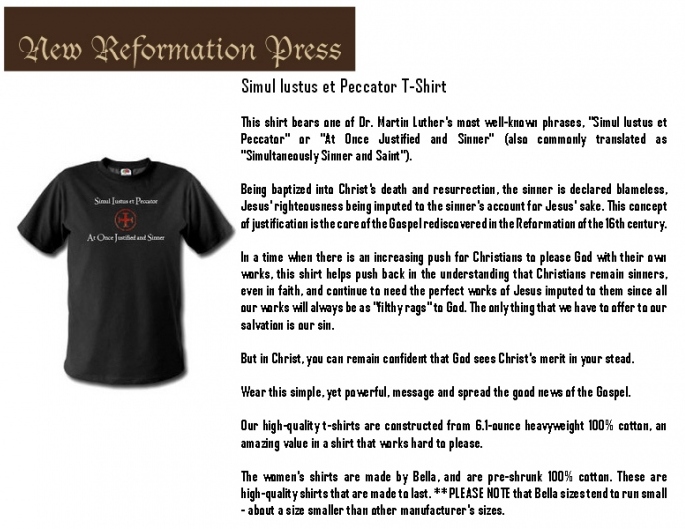
New Calvinist (like Al Mohler, John Piper, Jerry Bridges, John MacArthur, etc.) have a new t-shirt that can be proudly worn to protest what the apostle Paul wrote to the Corinthians:
“So we make it our goal to please him, whether we are at home in the body or away from it” (2Cor. 5:9).
New Calvinist will have no part of that! In Part, the ad reads as follows:
“In a time when there is an increasing push for Christians to please God with their own works, this shirt helps push back in the understanding that Christians remain sinners, even in faith, and continue to need the perfect works of Jesus imputed to them since all our works will always be as ‘filthy rags’ to God. The only thing that we have to offer to our salvation is our sin. But in Christ, you can remain confident that God sees Christ’s merit in your stead.”
Yes, that’s what the apostle Paul said. He said “we” (subjective personal pronoun) make (verb) it (direct object) “our” (possessive pronoun ) “goal” (predicate nominative) to please him (prepositional phrase). Yep, he said it’s our work in sanctification. Of course, any idiot should know that it must be either ALL the Spirit or ALL of us, it can’t be both; and surely, Christ must have misspoke when He called the Holy Spirit our “helper.”
The Sonship / New Calvinist / Gospel Sanctification crowd also apposes Paul’s idea that we don’t “remain sinners”:
“Therefore, if anyone is in Christ, he is a new creation; the old has gone, the new has come!” (2Cor. 5:17).
And then there is Paul’s stupid idea that Christ will judge the works of Christians when they are really all His to begin with, and some of our supposed works will be good works! (the good works Tim Keller says we should repent of):
“For we must all appear before the judgment seat of Christ, that each one may receive what is due him for the things done while in the body, whether good or bad” (2Cor. 5:10).
Here is a jpeg representation of the ad:
Rick Holland’s “Uneclipsing The Son” Part 4: Mr. Holland Was For Obedience Before He was Against It, And The Sonship / AF Connection
 On pages 46 through 56 (most of chapter 4), Holland makes a case that the book of Job is all about Christ. Of course, New Calvinist believe every verse in the Bible is about Christ so that’s no surprise. Though I believe his exegesis is a stretch to come to that conclusion, these pages are by far the less ghastly so far and have some merit. In addition to making this point, he seems to slightly redefine the word transcendence as primarily the difference between two things, rather than something that is superior or not confined by immanence. I know, this seems like nitpicking, but Holland seems to use his primary definition to make some sort of strict dichotomy between the Son and the Father that effects how we perceive the Trinity, and such dichotomies tend to make me suspicious. Not only that, it’s eerily similar to the “objective” part of COG (the centrality of the objective gospel) which teaches that gospel reality is completely outside of us. This can subtly set up a prism that requires all realities about the Father to be seen through the Son, rendering the Father as true, but insignificant when compared to Christ; and in fact, our biggest problem—with Christ coming to the rescue. Of course, there is some truth to that, but that approach also makes me uncomfortable with what seems like an unbalanced view of the Trinity that can lead to bad places.
Nevertheless, what follows is much easier to expound on. On page 59, Holland reiterates what makes GS what it is: contemplative spirituality. Holland states on page 59: “In other words, we see Christ now, and the more we know Him and the more we study Him, the more we become like the clear image we see of Him. Looking for [emphasis mine. This is supposedly what job one is for Christians when reading their Bible] and seeing and gazing [my emphasis] at the excellencies, the glories of Jesus leads to greater vision, sharper focus, deeper awareness of Jesus and His permanent abiding presence. It elevates the soul to a higher vantage point of worship. We must learn to stare at the Son of God such that we are blinded to all the allurements of the world! All encumbrances aside, all slack hardeness aside, everything aside but…Him.”
Along with this statement being a superb specimen of how GS instructs followers to read the Bible, looking for Jesus only; and specifically, his “excellencies” and “glories,” the statement shows the kinship between GS and Sonship Theology. In a book Jay Adams’ wrote to warn the church about Sonship, he wrote the following:
“The problem with Sonship is that it misidentifies the source of sanctification (or the fruitful life of the children of God) as justification. Justification, though a wonderful fact, a ground of assurance, and something never to forget, cannot produce a holy life through strong motive for it.”
And,
“Certainly, all of us may frequently look back to the time when we became sons and rejoice in the fact, but there is no directive to do so for growth, or even an example of this practice, in the New Testament….The true reminder of the good news about Jesus’ death for our sins is the one that he left for us to observe-the Lord’s supper (‘Do this in remembrance of Me’).”
Holland follows this up on page 60 and 61 with the usual GS slight of hand. On page 60, using John 14:21 as a point of reference, he makes several orthodox statements concerning obedience. He seems to be clearly saying that obedience is the gateway to a deeper love for Christ. He seems to be saying the same thing Christ is clearly saying in that text: obedience to Christ is synonymous with loving Him. In other words, obedience is a loving act (John 3:16).
I used to become perplexed by these sudden bursts of orthodoxy after reading page after page of “truth” seasoned with nuance because God’s people are not yet ready to accept that we have been supposedly living under a false gospel for the past 100 years. I calmly read pages 60-61 while enjoying a nice lunch Susan fixed for me. Two all beef patties smothered in pepper-jack cheese and jalapeños. No buns because I’m on a low-carb diet that is working fabulously (email me at pmd@inbox.com if you want the details). She also brought me a glass of tea sweetened with something other than sugar, but it was really good. Before I finished the last bite, Holland began to explain exactly what he means by “obedience” on page 61. He was for it on page 60, but on page 61, well, you see, what Jesus meant in John 14:21 is love and obedience are the same thing.
But you say: “Paul, that agrees with what you just said was orthodox!” Not exactly. I said that obedience is an act among many that is a demonstration of love. On page 61, Holland makes the point that they are the same thing, but obedience must be defined by love, and now we must ask ourselves what “love” is. Hmmmmm—get you hand on your wallet:
“So what does it mean to love Jesus? Yes, we’ve already seen obedience. That’s a given [I’m sure]. But [just like the “But”Light commercial: “Here we go!”] true Christians are distinguished from unbelievers not only by their obedience, but by their love for Christ. Let this question echo in your soul: Do you love Christ? Is He precious to you, as He was to Peter? Is He the hub of your faith and your life, [and here is the crux:] or have you made Christianity something of a way to live instead of a person to love?”
NOTE, after saying obedience and love are intrinsically connected, he makes a dichotomy that is impossible to distinguish in real life. How can one possibly distinguish Godly obedience from making “Christianity something of a way to live instead of a person to love?” It’s a false dichotomy that forces the reader to decide whether true love is a way of life or a “person to love.” And again, and again, regardless of a calling to live in a new way throughout Holy Writ, Holland does not qualify the statement.
HOWEVER, Holland then defines what this true love is on pages 61-67 after the pesky subject of obedience is relegated to its proper place in the back of the bus. He then breaks down a “biblical” definition of love into three categories: Love And Faith (p.61), Love And Understanding (p.64), and Love And Affections (p.66).
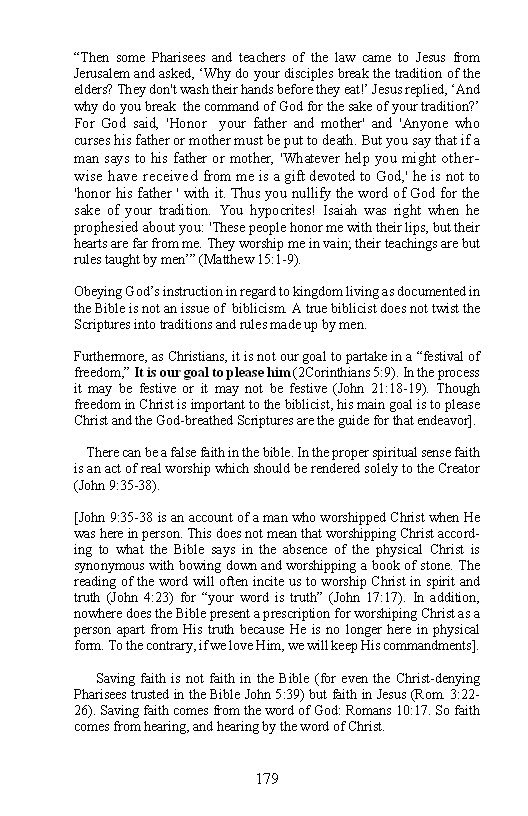
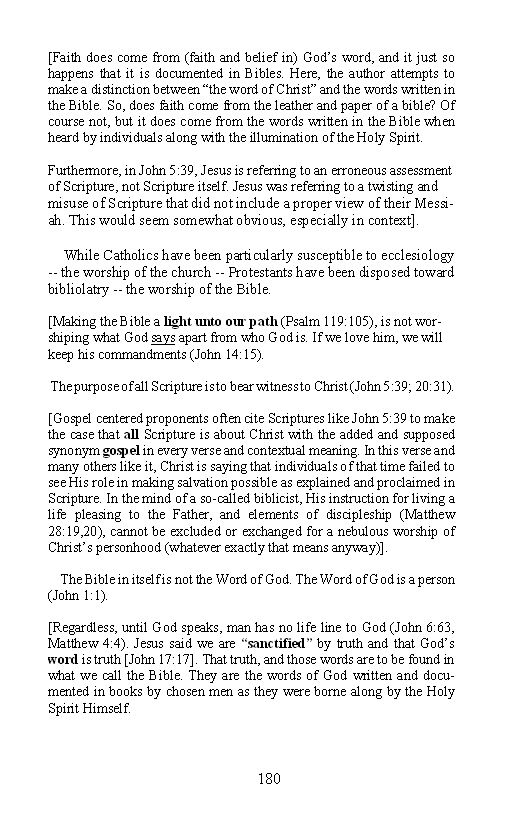
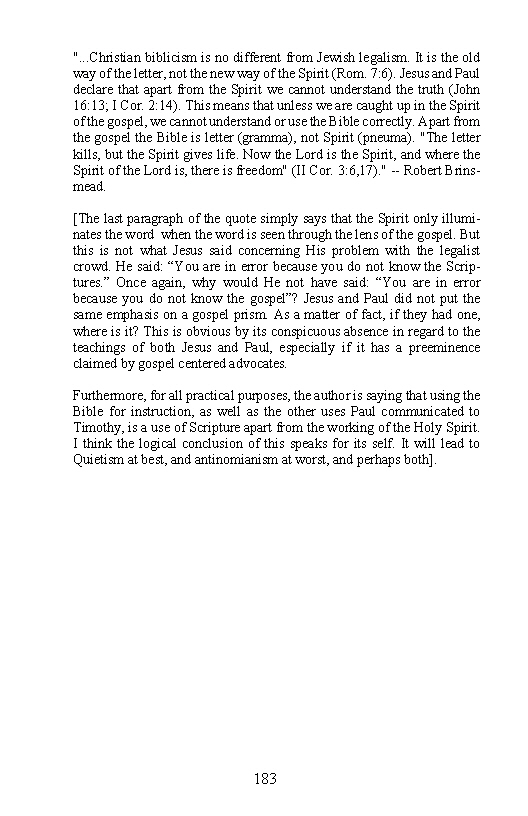
In the first segment, “Love And Faith,” Holland clearly shows this book’s kinship with the Australian Forum. I devote a whole chapter in my book, “Another Gospel” to Robert Brinsmead’s interpretive prism as taught by him and Paxton / Goldsworthy. Following this post, a full copy of that chapter can be viewed. On page 62, Holland describes faith as the “eye of the soul.” He then writes that Scripture is the lens used by faith and the Holy Spirit illuminates Scripture for one purpose and one purpose only: “Suddenly the Bible comes alive and we see Christ’s excellence, His splendor!” Hence, this is the EXACT position of the AF: the Bible’s only purpose is to obtain a deeper knowledge of the gospel, and the Holy Spirit will not illuminate anything else but that. Holland writes on page 63: “There must be a faith that engages with God’s Word on Jesus and estimates it to be the most important information in the world” [which then becomes the interpretive mode of operation].
Therefore, the Bible is for the purpose of plunging the depths of seeing the glory of Christ and nothing else. Any other information in the Bible that seems to be contrary to that thesis is descriptions of what Christ has done and should teach us more about Him instead of being an instruction book for a different “way to live.” All of the commands in the Bible are meant to show us what Christ has done for us already, and to humble us because we can’t keep all of them perfectly anyway. As I heard one pastor say from a pulpit about three months ago: “You can’t keep all of God’s law anyway, so don’t even try.” Pondering the volume of commands should also drive us to the foot of the cross and more dependence on Christ. Supposedly.
Therefore, the only logical conclusion is that obedience is a natural result of “Staring At The Son” (the actual title of chapter 5). But how do we know when we are committing the horrible sin of “obeying Jesus in our own efforts?” Well, because it will FEEL like it—that’s how you supposedly know, and Holland emphasizes that point throughout the rest of chapter 5. Throughout the book, Holland reiterates the same worn-out GS points made by Francis Chan (“When it’s love, it feels like love”), John Piper (“Beholding as a way of becoming” and joy is synonymous with faith), Paul David Trip (Christians are still spiritually dead), and Michael Horton (we only grow spiritually when we “revisit the gospel afresh”). The following is the chapter of my future book where the AF view of interpretation is dealt with—which is the same approach propagated by Holland:




Francis Chan Not Sure That Hell Is Eternal Suffering
The Bible’s clear message of eternal torment for those who reject Christ poses a problem for New Calvinism’s doctrine of Gospel Sanctification. The most troubling aspect of GS is how John Piper’s contribution to the doctrine (Christian Hedonism) effects the all important presentation of the gospel. The need of repentance is not included for fear that the hearer would think that “they could do something to be saved.” Piper believes that gospel presentations must only include a description of the gospel as a treasure to be desired, and as such, saving faith will always be earmarked by joy. Likewise, Michael Horton describes any participation by us in the salvation process as “just more bad news” instead of good news. Hence, a call to repentance or a call to escape hell may cause a hearer to accept the gospel with wrong motives, making it unclear as to whether God was really at work in the decision.
So, the dilemma: should we include things that the Bible talks about in gospel presentations or not? And if not, what is the purpose for such information in the Christian life? Frankly, this is the problem with all false doctrines—proponents spend most of their time coming up with new explanations and answering hard questions. Who can deny that New Calvinism is constantly morphing?
But secondly, hell also brings up the whole issue of accepting what God says whether we like it or not. In other words, the whole concept of being obedient to the truth, but not liking it, and even having a distaste for it. However, also knowing that our distaste is due to our lack of understanding from God’s righteous perspective. This is obedience to the truth without the joy which runs afoul of Piper’s Christian Hedonism. According to one of Piper’s favorite illustrations to make this point: If there is no joy in the duty of kissing our wife, the duty is stripped of its moral value. Or, would we bring our wife flowers and tell her that we did it out of mere duty? Therefore, supposedly, we can fool our wife but we can’t fool God—He knows that our duty is without moral value.
Missed in these supposedly profound illustrations is how real life really works. Getting my wife flowers may be an inconvenience because I am under the gun to finish a project, but after I die to self and get her the flowers, I am thrilled because of how happy she is to receive the flowers. My initial denial of self does not strip the deed of its moral value just because the self-denial didn’t initially feel good. And in regard to escaping hell being a motivation for one to give their life to Christ, I like what a pastor friend of mine said about that: “If someone gives their life to Christ to escape hell—that tells me they knew they deserved to go there.”
Moreover, that’s why in their endeavor to make round theological pegs fit in square holes, GS advocates like Francis Chan have to ignore the literal plain sense of Scripture. In an interview with Christianity Today conducted by Mark Galli regarding Francis Chan’s book Erasing Hell (which is supposedly a rebuttal to Rob Bell’s recent book), Chan proclaimed himself “agnostic” in regard to believing that hell is eternal torment. Here is how Galli framed the question:
“In your book you seem agnostic as to whether hell is a conscious eternal torment or annihilation.”
Chan answered this way:
“That was one of the things I was a little surprised by: the language [uh, you mean God’s language?]. I would definitely have to say that if I leaned a certain direction I would lean toward the conscious torment that’s eternal. But I couldn’t say I’m sure of that, because there are some passages that really seem to emphasize a destruction. And then I look in history and find that’s not really a strange view. There are some good, godly men—and maybe even the majority—that seem to take the annihilation view [so what? They are men—not Scripture]. I was surprised because all I was brought up with was conscious torment. And I see that. I see that in Scripture and I would lean more that way but, I’m not ready to say okay I know it’s this one. So say here Here are a couple of views.’ I don’t even remember if I wrote that I lean towards that, but maybe it comes across.”
This brings to mind the rank hypocrisy of New Calvinists that mock Joel Olsteen for this same kind of double-minded pontification while praising Chan for being “one of the greatest Christian thinkers of our age.” Though many verses could be cited, I think this chilling passage from the book of Revelation speaks clearly in regard to the issue:
“’If anyone worships the beast and his image and receives his mark on the forehead or on the hand, he, too, will drink of the wine of God’s fury, which has been poured full strength into the cup of his wrath. He will be tormented with burning sulfur in the presence of the holy angels and of the Lamb. And the smoke of their torment rises for ever and ever. There is no rest day or night for those who worship the beast and his image, or for anyone who receives the mark of his name.’ This calls for patient endurance on the part of the saints who obey God’s commandments and remain faithful to Jesus.”
Sometimes obedience isn’t joyful at all. I have relatives who are dear to me that aren’t saved. The thought of them going out into eternity, and into eternal torment, is beyond horrifying. But yet, I stand on Psalm 145:17 which states that God is righteous in all of His ways. It’s a trust in God, a resolve to stand on Scripture regardless of how it makes me feel. This is an issue of obeying truth rather than strong feelings about truth. Feelings cannot dictate what our doctrine is—this is a recipe for disaster. Furthermore, in the same issue, Chan eludes to other issues about hell that throws a monkey wrench into GS:
“I think there is also some misunderstanding on degrees of punishment. I do see Jesus saying that judgment is going to be worse for some, like the rewards are going to be better for some. But that might be a slight issue.”
Chan sees it in Scripture (so he’s for it), “But that might be a slight issue” (but he might be against it before he is for it). This is a huge problem for GS doctrine because it assumes God recognizes human merit in some way—even among the lost. Galli’s subtitle is also telling: “Why ‘Erasing Hell’ was his most difficult book, how ‘Love Wins’ prompted repentance, and whether ‘Believe in Jesus or you’ll go to hell’ is good news.” So, should hell be in our gospel presentations? And if not, since the same gospel that saved us also sanctifies us, what is information about hell all about?
New Calvinism is nothing more than a novelties empire full of all kinds of misfits vying for book sales, popularity power, and if CJ Mahaney’s recent fall is any indication—glorious greenbacks. It’s a sideshow of rebels like Bell pushing the envelope too far while others try to clean up the mess in various and sundry ways to keep the empire’s cash cow alive. Piper, who at times creates controversy by who he invites to conferences, excommunicated Bell with a tweet, while Chan told Galli that Bell’s book was bad, but had good things in it, but bad things too, but also led him to repent for certain sins in his (Chan’s) life. And yes, it has error, but the kind of error that makes us think, which is good error—right?
paul

 Paul's Passing Thoughts
4 comments