The Biblical Emphasis on Pastors and Their Authority: Where is It? Romans 15:14
 Listen to the show audio or download the video file here.
Welcome to Blogtalk Radio False Reformation this is your host Paul M. Dohse Sr. Tonight, “The Biblical Emphasis on Pastors and Their Authority: Where is It?” If you would like to add to our lesson or ask a question, call (347) 855-8317. Remember to turn your PC volume down to prevent feedback. Per the usual, we will check in with Susan towards the end of the show and listen to her perspective.
If you would like to comment on our subject tonight, you can also email me at paul@ttanc.com. That’s Tom, Tony, Alice, Nancy, cat, paul@ttanc.com. I have my email monitor right here and can add your thoughts to the lesson without need for you to call in.
We are going to begin tonight by surveying the present landscape. The church invests billions in the education and accreditation of pastors. Of course, this is all made possible by the working class laity. Pastorate authority is expressed in church polity, and they are seen as the gatekeepers of orthodoxy. Never before in history have so many willingly paid so much for the privilege of being subservient.
Let me just pull the rabbit out of the hat right now. Let me go ahead and reveal where I am going with all of this tonight, and then I will make my case. We know that America was the first idea in human history that rejected the marriage of faith and force, and the results speak for themselves. We also know why some people deny what America has done for the world because of their ancient presuppositions concerning mankind; i.e., if mankind is allowed to self-govern, chaos will ensue.
There is that crowd, then there is the crowd that thinks mankind is just outright evil, and the American idea emphasizes life and liberty, so America is the antitheses of this whole idea that mankind is evil. And remember, this is not just a religious idea. No, no, no. This is also very prevalent among secular ideas. Some environmentalists would be included among them.
In the minds of the framers of the American Constitution, the marriage of faith and force always leads to tyranny, and history would agree. It all starts with those who are specially gifted to know truth that the masses are not able to understand, and for their own good, the masses that is, or the “great unwashed” if you will, the great seers call on the state to enforce their wisdom for the good of mankind and its overall survival. It is a striving for social justice leading to utopia.
We know that this basic presupposition about man’s ability to self-govern always leads to tyranny, and it now begs the question: culturally, in the church, if truth is married with pastoral authority, is the same tyranny inevitable? We think the answer is “yes.” The marriage of faith and authority in the church will yield the same results as the marriage of faith and force among governments. The problem is the injunction of truth on the majority by the few.
Without getting into another body of study altogether, let me answer some anticipated objections. A couple of weeks ago while Charlie Rose was interviewing the president of Syria, here is a paraphrase of what he said: “Society in general doesn’t accept the use of chemical weapons.” Interesting. What was he in essence saying albeit probably unwittingly? Answer: Romans chapters one and two. The law of God is written on the hearts of every man and his God-given conscience passes judgement on his actions. Why do we need government? For people who are deficient in regard to their faculties of conscience—that’s why.
Let’s note something important moving forward. The behavior evidenced in the church in our present day is consistent across all religions and denominations. Why? Because they all have one thing in common: they marry faith and authority. This is just another institutional church elephant in the room; the question of pastoral authority. And how churches get around this is soooo smooth:
“As pastors, our only authority is in the word of God.”
Well, that’s just wonderful because the Bible covers every nuance of life. While that answer usually assumes the Bible is boss and pastors only point people to its authority, what is really being said is the Bible determines the parameters of their authority which is without bounds if determined by the Bible.
What does this across-the-board authority look like regardless of the particular breed of church? What does it mean when we say that pastors “have authority”? It all starts with a same presupposition concerning mankind. Basically, mankind in general is not able to properly understand reality in a way that brings about social justice resulting in utopia. Man needs to be ruled over for his own good, and those who believe man can self-govern must be neutralized for the good of the many.
This is why the line between churches and liberal leftwing politics is often blurred. Why did some church, I think in New York, recently sue Walmart to ban their gun sales? Because in their mind, you just can’t have people in general running around with guns. In their minds, that’s a disaster waiting to happen.
So, it starts with that philosophy. Now, how does it seek to implement this philosophy? What system dictates the application for the greater good? Again, in ALL religions and denominations it’s the same: mediation, authority, orthodoxy, progressive justification, polity, political collectivism, resulting in the EXACT same results and behavior. This is the technical definition of “the church.” Take note of how often you hear “the church” in the everyday white noise of churchianity.
Mediation. The Bible makes it clear that there is one mediator between God and man: Christ, period. All institutional churches have a concept of what Protestants call the “power of the keys.” This is the idea that the institution represents the body of Christ on earth. Hence, institutional membership is synonymous with salvation. The institution represents Christ’s mediation on earth by proxy. Whatever the church binds on earth will be bound in heaven, and whatever the church looses on earth will be loosed in heaven.
Authority. Vested in the elders/pastors of the church regardless of the fact that Christ clearly stated that ALL authority in heaven and earth has been given to Him. Pastors are men who have been preordained and specially gifted to know things that the common Christian does not know. Therefore, God has supposedly given them authority on earth for the collective good of mankind. Every institutional church has its own breed of popery.
“But Paul, I am a Southern Baptist and our churches are” …and this is so adorable… “independently autonomous.”
OK, now try to be a pastor of a Southern Baptist church without a degree from a Southern Baptist seminary. Good luck with that. If you are not credentialed, if you do not speak according to authority given you by the church, if your words do not carry authority by the aping of those credentialed, you are nothing but a little yapping mutt that will be ignored. If you tithe enough, people will put up with you and that’s about it.
For the time being, file this away: this is the exact same system Christ was up against when he came. How did He deal with it? Confirming miracles. Remember the paraplegic He healed so that people would know that the Son of Man has authority to forgive sins on earth?
Orthodoxy. This is the extra-biblical authoritative body of teaching that is developed by those in authority. Since the great unwashed cannot understand truth, orthodoxy takes the higher knowledge of truth and puts it in story form for the spiritually adolescent masses. It’s exactly like story books written for children that explain reality via narratives that they can understand. In church culture, orthodoxy is synonymous with truth itself. This is why in seminary you are told straight up that the knowledge you are learning there is not anything you will be teaching at local churches—they can’t understand it. However, you will learn a lot about being a good spiritual cowboy who keeps the herd from being spooked resulting in a stampede. You will also be taught how to deal with those who think they can know truth, also known as Mad Cow disease.
Progressive justification. All religions and denominations have some form of progressive justification. This soteriology is the necessary gospel that must go hand in hand with mediation, authority, and orthodoxy. It is the teaching that salvation progresses from point A to point B, and the institutional church is the overseer of that progression. This is a hard-fast rule. The church cannot function or survive by propagating the true gospel—it’s impossible and we will look at why this is the case tonight. Why are there so many different religions and denominations? It’s all disagreement on how you get from point A to point B.
Polity. Or “church polity.” This is a soft term for “church government.” All churches have church government. It’s different levels of authority and an epistemological pecking order. In contrast, biblical contra church assemblies are based on fellowship with the Father and His Son—not authority. Historically, churches enforce polity by getting into bed with the government, but post America, the emphasis is control over your salvation.
In pre-American history, if you didn’t believe the church had the authority to take away your salvation, they would simply hang you, drown you, cut you in half, or burn you, not necessarily in that order. So, in our day, the heavy emphasis is authority and control over your eternal destiny. Why do people obey the outrageous notions that flow from the traditions of men? Because their eternal salvation depends on it, and “faith believes all things,” right? One of the favorite truisms vomited out by the clergy is this whole Lutheresque idea that “knowledge puffeth up” and makes people proud.
The real problem is that informed people are very difficult to control. Let me pull another rabbit out of the hat right now. I will make the case tonight that cultism goes hand in hand with elder authority. It is absolutely impossible to separate horizontal authority among God’s people and cultism. Religion plus horizontal authority ALWAYS equals cult. This is an unavoidable and hard-fast rule.
Political collectivism. Here is the dirty little secret: ultimate control is really in the hands of the populous. Why? It’s simple; they outnumber government. In China, if the people decide to rise up, the Chinese government is totally screwed. There are particular things common to people that the framers of the American constitution recognized such as those things that are “self-evident.” All in all, the church has merely stuck its nose in the debate over who owns truth: mankind in general or the state?
This necessarily demands a conversation about the church’s dominion theology. Is God’s kingdom presently on earth, or is it presently in heaven? If it is presently down here, then obviously the church has a dog in the fight. Therefore, since populous rule is the real power in the world, power is determined by how many people you have effectively brainwashed. The church cannot avoid being a political animal seeking to gain control by numbers and infrastructure because it believes it is a nation builder on earth.
This includes all of the trappings of doing good works to endear numbers, and formal education for the purposes of indoctrinating people. Most church hierarchies openly admit that their agenda is to take over every aspect of culture; i.e., education, the arts, etc, etc. The specific quotations abound and are not the least bit ambiguous.
Also, watch out for the “Oh my, missionaries are being persecuted for the gospel in this country, that country, or the other country.” No, many countries are more privy to the dominion aspirations of the church than their own missionaries. In many cases, it is feared that missionaries will incite an insurrection. A cursory observation of history confirms this as a valid concern. Traditionally, church missionaries not only want to get people saved, they want to quote, “transform the culture.” They say it all the time!
Let me stick this idea in here. Do you know how home fellowships could do world evangelism? We could find people gifted to be elders in other countries and bring them stateside to live for a while in the home fellowship network. They would live with a sponsoring family and learn/experience the New Testament model. As they learn and experience, they could be feeding the information back to their country of origin. This would be dirt cheap and very effective.
Do you know how expensive and ineffective world missions are in the institutional church? It’s horrific, and mostly predicated on Western arrogance. I have heard missionaries say it: “Without our academic wherewithal, effective ministry is impossible.” Behold the arrogance: after hundreds of years of trial and error and oceans of ink used in the pontification of orthodoxy, 1600 people a day leave the church and become Nones or Dones. 1500 pastors per month leave the ministry for good. But yet, the church continues to export this failed model overseas on the financial backs of the laity. It’s beyond insane.
Behavior. The results are all the same. Spiritual abuse in the church is just a symptom of the specific problem, church. Stuff happening in the church is not the problem—church is the problem. Thanks to the internet, we now know that the church produces the exact same behavior over and over and over again. We now know that the institutional church is nothing more or less than a super-cult.
Let’s begin to look at the evidence.
Yes, once again, Calvary Temple of Sterling, Va. is back in the news. Let’s listen to the recent news report by MRC TV titled “Sexual Abuse, Broken Families, and Race Cars: The Story Of An Alleged D.C.-Area Cult” dated 4/2/2015/. As you listen to this clip, make a list of the elements such as “authority,” “broken family relationships,” “control,” “divorce,” etc.
Listen, whether the HBO documentary I mentioned last week on Scientology, or my wife’s testimony in regard to her experience in the Baptist church, or what my son shared with me the other night about a Jehovah Witness that he works with and what that guy is going through with his church, or my own testimony, or myriads of testimonies that you can read via the internet discernment blogs, it is all the same basic elements in regard to behavioral outcomes.
Sure, John MacArthur Jr. isn’t going to marry a twenty-year-old and buy a dragster and a race car, he just oversees an in-house police station at Grace Community Church that will escort you out to your car if you ask too many questions in Sunday school. I know from firsthand testimony that MacArthur rules that church with an iron fist. I rubbed shoulders with some of his elders for years. In addition, accusations from relatively sound people that Grace Community Church is a cult abound. One such site is The Watchman Wakes .com / John MacArthur’s cult. Google that and the exact link should come up. Look, all one needs to know for purposes of confirming these allegations is MacArthur’s own words from last week’s sound bites; the inevitable result of the belief that elders have authority on earth is cultism.
Let’s also look at the obvious manifestation of well-behaved tyranny. Even though some church pastors would not engage in some of the more outrageous behavior, by and large, the well-behaved tyrants of the church turn a blind eye to the behavior and even cover for it. MacArthur is absolutely notorious for turning a blind eye to the atrocities committed by the institutional church. Why? The obvious answer is the church’s authority to forgive sins on earth. Without the institutional church, there is no means of salvation for anyone so the church must be saved at all cost. I am not sure what is more obvious.
Look, for example, Jack Hyles could have been shut down years ago. All it would have taken is twenty-five IFB pastors walking down the isle of First Baptist Church of Hammond, Ind. and rebuking the guy publically on a Sunday morning. Game over. Why doesn’t that ever happen even though it is the exact biblical prescription? Because the institution has to be preserved as God’s authority on earth by proxy—that’s why.
I am not going to rehearse the outrageous details of the ABWE scandal, but in reaction to ABWE refusing to deal with the situation, not one GARB church withdrew from the association in protest, and as far as I know, not one church withdrew support from ABWE. One GARB pastor that I know who was mortified by the scandal nevertheless allowed Michael Loftis, at that time the president of ABWE to speak at their church.
Why?!!!! because there is only one name under heaven by which man is saved—the institutional church and its authority on earth by proxy. This isn’t complicated. Support the church if you will, but also know that you are supporting the divine right of kings to rape, pillage and steel at will.
“But my pastor isn’t like that!” Yes he is—he turns a blind eye to it!
It’s all the same, and they all operate by the same principles; for example, let’s just take one, orthodoxy. For Baptists, what is it? The First and Second London Baptist Confessions. For Presbyterians, what is it? The Westminster Confession. For Jehovah Witnesses, what is it? The Watchtower. For Mormons, what is it? The Book of Mormon. For Islam, what is it? The Quran. It’s all the same stuff resulting in the same behavior. Read history for yourself—none of these religions acted any differently until America came along.
At any rate, the church invests billions in the education and accreditation of pastors. Their authority is expressed in church polity, and they are seen as the gatekeepers of orthodoxy. When one surveys the emphasis on pastors in the church, certainly we should expect to easily find abundant information about them in the Scriptures. A cursory observation of Scripture should reveal their purpose, scope of authority, and a description of their duties.
But in reality, the lack of biblical emphasis on pastors and elders is stunning when compared to the emphasis experienced in the institutional church. If a pastor has authority, where does that authority begin and end? While the idea of elder authority is common, any discussion of the parameters is extremely uncommon and such ambiguity can lead anywhere, and it does. Furthermore, their assumed authority is nowhere to be found in holy writ.
In regard to their importance in general, the specific gift of elder/pastor is mentioned a meager four times in Scripture.
In the most vital portions of Scripture where elders would be prevalent according to their assumed authority, they are not mentioned. In the corrective letters to Corinth where Christianity was completely off the reservation, elders are not mentioned once. In the book of Romans, the magnum opus of soteriology, again, elders are not written about.
In Paul and Peter’s mini-treatises regarding submission starting in the home, to the workplace, and society in general, again, no mention of elders (Eph 5:22-33, 1Pet 2:13-3:7).
In the protocol for solving conflict among believers in Matthew 18, the same. If a person finally refuses to repent of what he has done to a fellow brother, the passage doesn’t say to go tell the elders, it says to go tell the assembly. The process in Matthew 18 is commonly thought to be a process under the control and auspices of the elders, but if that’s the case, where are they?
Sure, when the Greek widows were treated unfairly as documented in Acts 6:1ff, the people appealed to the apostles, but who was given the responsibility to choose what I think were the first Deacons? Right, the saints in general. Not only that, notice that the solution offered by the apostles met the approval of the people. They did not go to the apostles for an edict—they sought their counsel and leadership in the situation, but it obviously needed the approval of the people.
In Philippians 4:2,3, Paul entreats the whole congregation to reconcile the two women who were in some kind of rift, and this is the same pattern found in Matthew 18 as well. Listen, we could go on and on and on and add Acts 17:11 as well, but is this sinking in? Where are the big bad elders? Where are they and their supposed authority? I do believe the apostles had authority, but clearly what they emphasized is the model that would follow after their departure; appeal to the one mind of Christ and not the dictation of authority.
Moreover, not only are elders conspicuously missing, the saints in general are told throughout the New Testament that they are qualified to do ministry that is normally attributed to elders exclusively. A good example is Romans 15:14.
I myself am satisfied about you, my brothers, that you yourselves are full of goodness, filled with all knowledge and able to instruct one another.
Another one is 1John 2:27.
But the anointing that you received from him abides in you, and you have no need that anyone should teach you. But as his anointing teaches you about everything, and is true, and is no lie—just as it has taught you, abide in him.
Clearly, when it gets right down to it, God’s people can do without elders. Eldership is a gift that is no more or less important to the body of Christ than any other gift. Yes, if God’s people are serious about furthering the testimony and deepening fellowship, they should seek out good elders. But eldership is not a horizontal authority granted by God. Eldership does not represent God’s authority on earth.
Indeed, the apostles did have some of God’s authority, and that’s why they will sit on twelve thrones judging Israel in the final days, but that authority was NOT passed on to the elders. This is why the apostles predominately appealed to the one mind of Christ and not authority.
So, what is in fact the biblical model? Let’s compare the biblical model point by point with the institutional model. Here we go.
Presuppositions concerning mankind. Simple, Romans chapters one and two. Man can know reality and is personally and individually accountable to God. Throughout history for the most part, society in general determines law and what is acceptable. But please do not underestimate the real debate underlying the more visible debates manifested in this question: does man understand the reality that he lives in. He most certainly does. Mankind does not need seers to rule over them who have special insight into a reality that the masses do not understand.
History is a vicious cycle of the masses buying into that philosophy resulting in revolts when the tyranny of it becomes more than they can bear. Life gets to the point where it is not worth living and there is an uprising. The framers of the American Constitution observed this vicious historical cycle of serfism, tyranny, war, freedom, serfism, tyranny, war, freedom, serfism, tyranny, war, freedom, and the lightbulb turned on. America is the greatest country ever because it is the first ever government by the people and for the people.
The Bible is clear, people stand before God at the judgement individually. Be sure of this: the church’s emphasis on pastors comes from the world’s debate on man’s ability to self-govern. According to the Bible, and more specifically 1John, God’s people are able to self-govern because all of them have the same anointing of the Holy Spirit. When it gets right down to it, we have no need for anyone to teach us.
Mediation. There is only one mediator between God and man—Christ. Clearly, the church posits elders as sub mediators. This does not pass biblical muster.
Orthodoxy. There isn’t any. God’s people do not need a dumbed down version of truth written by sub-mediators creating…watch it… here it is, “subordinate truth.” Really? This is absolutely nothing new and the very reason that the Bible is constantly drilling down on oneness: one truth, one mind, one mediator, one Spirit, one baptism, one anointing, one Lord, etc., etc., ect. There isn’t two minds, there is only one and one truth accordingly. And really? There is such a thing as a lesser truth? No, it is either true or it isn’t true.
Progressive justification. No institution or religious hierarchy is needed to get us from salvation point A to salvation point B. This is why we constantly hear, “We don’t believe the gospel and then move on to something else, we never leave the gospel.” “The gospel isn’t the ABCs of salvation, it’s the A-Z,” etc., etc., etc. If your salvation is finished, and you do move on to something else, guess who you no longer need?
The elements of the institutional church follow a logical progression: presuppositions concerning mankind; sub-mediation; orthodoxy or sub-truth; the gospel of progressive justification; church government (polity) because authority trumps fellowship; political activism because God’s kingdom is supposedly on earth (if it wasn’t authority would be absent), and the subsequent bad behavior ordinarily exhibited by the divine right of kings, mind control cults, and institutional ownership of truth.
Church polity (government). Christ’s assembly does not have a government structure. There is no church polity. There is a body made up of gifts that seeks to mature by “mutual edification” through fellowship under one head. There is no government, but rather organization. Here is the organization: gifted elders equip the saints for ministry, and deacons/deaconesses oversee need. There aren’t any bosses; it’s a cooperative striving for a common goal. It’s an organized body where every part is equally valued. It’s just this simple, and this is the exact same analogy seen throughout the New Testament: to the degree that your body is sound, you can accomplish work. Ephesians 4:1-16 spells it out point by point, and so does 1Corinthians chapter 12. That’s not a government—it’s an organized body.
Political collectivism. It is not the concern of Christ’s assembly to take over every aspect of culture. Our concern is to build up the body in love and let the world watch. And watch they will. Our kingdom is NOT on earth—it’s still up in heaven. That’s why we are called “ambassadors” in the Bible. What’s an “ambassador”? An ambassador doesn’t live in a country to…here it is, we hear this constantly…”take over the culture for Christ.” No, we are here to represent another kingdom that is not presently here.
Behavior. The goal is to think like our big brother Jesus Christ and do what He would do. And trust me, the world will take note.
Here are some references that you should read on your own: Matt 23:8, Psalm 133:1, Acts 4:32, Rom 12:16, Rom 14:19… Rom 15:5, 1Cor 1:10, 2Cor 13:11, Eph 4:3, Phil 1:27, Phil 2:2, Phil 3:16, 1Peter 3:8.
Elder authority, where is it? Where is the emphasis on body striving for unity in one mind? EVERYWHERE! Let’s now go to the phones.
The Protestant Twisting of 1John: A Clarification, Part 3
 Listen to full show audio here in separate window.
Welcome to Blogtalk Radio False Reformation. This is your host Paul M. Dohse Sr. Tonight, part 3 of “The Protestant Twisting of 1John: A Clarification.” If you would like to add to our lesson or ask a question, call (347) 855-8317. Remember to turn your PC volume down to prevent feedback. Per the usual, we will check in with Susan towards the end of the show and listen to her perspective.
If you would like to comment on our subject tonight, you can also email me at paul@ttanc.com. That’s Tom, Tony, Alice, Nancy, cat, paul@ttanc.com. I have my email monitor right here and can add your thoughts to the lesson without need for you to call in.
We are going to back up a little bit to start tonight’s lesson in order to observe some very important addendums to our series. I am just going to simply state the first one that is something to keep in mind while you read the book of 1John. John states two primary purposes for writing the letter. First…
1John 1:4 – And we are writing these things so that our joy may be complete.
Tradition holds that the apostle John wrote this book, and obviously on behalf of the apostles. Note how the ESV translates “our joy.” Taking other translations into consideration, the “our” probably includes all those who have fellowship with the Father. Also…
1John 5:13 – I write these things to you who believe in the name of the Son of God that you may know that you have eternal life.
The achievable goal for every Christian is joy and assurance of salvation. Obviously, falling into the false teachings that John was contending against was going to steal that from them. More importantly, we must keep in mind that this letter claims to have the knowledge that leads to joy and full assurance of salvation.
But in addition, there is something else I want to take note of. It’s a third primary reason that John writes this epistle:
1John 1:3 – that which we have seen and heard we proclaim also to you, so that you too may have fellowship with us; and indeed our fellowship is with the Father and with his Son Jesus Christ.
You might miss it because instead of referring to the writing of it, John wrote that “we proclaim also to you,” and the stated reason is mutual fellowship with the Father and the Son. These aren’t the only stated reasons for writing this epistle, but they are primary and let’s review them: joy, assurance, and fellowship.
Note that the apostles didn’t write this letter demanding that their authority be followed. The letter is written for the benefit of the readers and fellowship. Again, notice the fellowship is mutual fellowship with the Father and His Son. The goal is a mutual goal of fellowship, joy, and assurance. We find this elsewhere in Scripture.
2Corinthians 1:21 – And it is God who establishes us with you in Christ, and has anointed us, 22 and who has also put his seal on us and given us his Spirit in our hearts as a guarantee.
23 But I call God to witness against me—it was to spare you that I refrained from coming again to Corinth. 24 Not that we lord it over your faith, but we work with you for your joy, for you stand firm in your faith.
That’s it. Teachers don’t lord it over people’s faith, they co-labor for their joy. This pattern of co-laboring versus authority saturates the New Testament while elder authority is conspicuously missing. Do you know why proponents of elder authority always go to Hebrews 13:17? Because that’s the only verse they have, so let’s address it. This series is about why Protestants twist 1John and we have looked at a lot of things in the first two parts, but a distorted view of what Christian assembly really is also comes into focus in this discussion.
Are we merely part of a club that gets us into heaven in the end, or is salvation a settled issue leading to the gathering together for service and good works? Obviously, as with the Protestant case, if you need a continued forgiveness of “present sin,” and that forgiveness can only be found in allegiance to the institutional church, your whole interpretation of Scripture is going to be overshadowed by that.
The introduction to 1John emphasizes what gathering together as Christians is all about: fellowship, not authority. Home fellowships are an organized body of gifts under one head for the purpose of faith working through love. The church is a mediator of progressive salvation through authority structure and co-mediation with Christ. The goal of the institutional church is getting people from salvation point A to salvation point B and collecting a temple tax for that purpose. The goal of home fellowships is the full exploitation of the gifts granted to every believer. Leaders equip for that purpose and lead by example while the only authority is Christ. Throughout the New Testament assemblies are called on to strive for unity in the one mind of Christ.
That’s what we are going to focus on tonight. We are going to debunk the whole notion that there is horizontal authority in the body of Christ. All authority is vertical because Christ said ALL authority has been given to Him, and ALL means “all.” Let’s think about this: a horizontal authority also assumes the dictation of truth by those who have an elevated ability to understand truth. Folks, you cannot separate authority from a claim on truth. We hear this all of the time in the church, this idea that the elders need to be obeyed because they are preordained to understand things you cannot understand. We hear this all of the time. And does this impact the book of 1 John? Sure it does.
1John 2:19 – They went out from us, but they were not of us; for if they had been of us, they would have continued with us. But they went out, that it might become plain that they all are not of us. 20 But you have been anointed by the Holy One, and you all have knowledge. 21 I write to you, not because you do not know the truth, but because you know it, and because no lie is of the truth. 22 Who is the liar but he who denies that Jesus is the Christ? This is the antichrist, he who denies the Father and the Son. 23 No one who denies the Son has the Father. Whoever confesses the Son has the Father also. 24 Let what you heard from the beginning abide in you. If what you heard from the beginning abides in you, then you too will abide in the Son and in the Father. 25 And this is the promise that he made to us—eternal life.
26 I write these things to you about those who are trying to deceive you. 27 But the anointing that you received from him abides in you, and you have no need that anyone should teach you. But as his anointing teaches you about everything, and is true, and is no lie—just as it has taught you, abide in him.
Why do you think John wrote that? Those who were trying to deceive them were claiming a higher knowledge that the common believers were supposedly not privy to. And by the way, this is a hallmark of Gnosticism which was cut from the same block as Plato’s epistemological caste system. Anyway, let’s debunk this whole idea of horizontal authority among God’s people.
Before I do, I would like to add yet another thought. I have spent eight years researching the Protestant false gospel of progressive justification and refuting it, but I am beginning to think of it as just another mere symptom of the bigger problem: “the church,” the marriage of authority and Christianity.
The Bible states that there is one mediator between God and man, the Lord Jesus Christ (1Timothy 2:5). I now realize the real significance of that after eight years of research. I see “one” really means “one.” Something has happened this week that this ministry is taking note of: HBO’s documentary “Going Clear” on Scientology premiered 3/29/2015. Megan Kelly of Fox News interviewed one of the key figures featured in the documentary who shared an astonishing bit of information: members who offend leadership are locked up in a literal prison until they repent of whatever the offense is; release is contingent on signing a written confession. Kelly was incredulous that any adult would agree to such a thing and asked the guest if he could explain it. I was surprised when the guest said he could not explain it.
Maybe the explanation is too simple, but here it is: every false gospel opposed to the gospel of Jesus Christ is predicated on the idea of an additional mediator between God and man other than Christ. Even if one man or women is representative of the false doctrine, it will always be expressed in the form of an institution and its authority. Rather than all authority and mediation being in Christ, a subset of Christ’s mediation and authority is claimed; a claim that has no biblical merit whatsoever. These religious institutions always claim authority to grant salvation on behalf of God as co-mediators, but will also use the authority of government whenever they can get away with it.
So why do the institutional members of “the church” agree to every insane notion proffered by these institutions? It’s not complicated in the least: their salvation depends on it. The temptation is great; people relate truth with authority and want to be told how to get to heaven. Some sort of lofty authority gives the seekers confidence that God will accept their salvific pedigree. And Scientology has all of the elements common with these institutions, especially a strong emphasis on glorious infrastructure.
This documentary is important because Scientology is indicative of institutional religion in general. It claims authority and mediation it doesn’t have, quibbles over words, and entangles itself in the frivolous affairs of the world. And another important element–a major one should be noted as well: cults are spawned by authority. Hence, religious institutions often get a pass on being cultic because people don’t understand the catalyst of cultism: authority.
The alternative is a functioning body under one head. Gifts replace rank, and fellowship replaces authority. The goal is agreement on truth as defined by Christ and agreement according to conscience determines who fellowships together. Christ said, “All authority has been given to me.” ALL means “all.” If people get together for the purpose of following an authority anyway, why not Christ as opposed to some man or institution? If the divide in regard to what Christ is saying is too wide, go start your own group–Christ is the final judge anyway. A final point: institutions focus on getting people to heaven; fellowships focus on the unfinished work of service to God and others.
The following are relevant audio clips that make the point. First two are from Pastor John MacArthur Jr., and the third is from Pastor James MacDonald.
These clips are just too rich and could be the whole show. I mean surely, someone has some thoughts on theses clips. Where to start? When MacArthur talks about putting ourselves under the authority of godly men, what are the parameters of such authority? Historically in regard to the institutional church, this authority knows no bounds. And did you notice who decides what your gifts are? That’s right, not you, the leadership. Oh my, let’s just throw out one little example of this going completely wrong. If a guy gets saved but his wife doesn’t, she just may divorce him eventually. The Bible is very clear on this; the believing spouse is no longer obligated to that marriage. But if that young man comes to believe that he is called to be an elder—you can forget it. So, he will not fulfill his gift because of the traditions of men, and that’s a pity.
Many more examples could be given, but let’s get into our argument against authority among God’s people, or what I will call horizontal authority. The argument is that God’s people are a body of gifts cooperating together with one head. Horizontal co-laboring with vertical authority. I am going to be arguing this from a message I taught on Romans 14:2-12 titled, “Authority’s Assault on Unity.” So here we go, let’s see if we can learn anything.
The week before this lesson we talked about the mystery of the gospel. The mystery is God’s intention to bring Jew and Gentile into one body by the Spirit. Undoubtedly, this posed significant unity challenges because of the diverse cultures. When the Romans inquired of Paul as to whether or not they should bother associating with Jews due to these cultural differences, it sent Paul scrambling for his writing utensil because that issue is one of the core values of the gospel itself.
The bone of contention was dietary laws and the observance of days which would have been deeply entrenched traditions for the Jews. In addition, there were a plethora of issues among the Jews concerning the decadent culture of the Gentiles. Some of these issues included the eating of meat and its preparation according to Old Testament law. For sure, pork was out, but there were other issues, apparently, with meat sacrificed to idols and then sold on the open market at a reduced price. Hence, because what had been done with meat would have been ambiguous in many cases as far as its source and preparation, it’s possible that many Jews decided to play it safe and become vegetarians.
As far as convictions concerning the observance of days in this transition from the old covenant to the new, there would have been many days sacred to the Jews that would have had little significance among the Gentiles. So, what is Paul’s solution to these differences for purposes of fulfilling the mystery of the gospel?
In verse 2, Paul identifies the two parties: Gentiles who believe they can eat anything, and the weak Jew who understandably was not yet up to speed on the mystery of the gospel in regard to the law. Also consider, much like today, the Jews had been dumbed down in regard to Scriptural knowledge. The leadership of that day replaced Scriptural truth with the traditions of men. Specifically, like today, the integration of Gnosticism with Scripture saturated Jewish thought and religion.
In verse 3, Paul defines the attitudes that fueled the division between Jew and Gentile: the ones who eat should not “despise” the ones who don’t eat; i.e., the Jews, and the Jews should not “judge” the ones who eat according to what? Right, the law. And why? Because God had come to receive who? Right, the Gentile. Paul shifts his focus to the Jewish responsibility of accepting the ones God received into the one body regardless of the fact that they did not keep or regard much of the Old Testament law. This would have been a really challenging transition of thought for the Jew. But the main point here is that the Jew had a tendency to “judge” because they had the what? Right, the law.
The way Paul addresses this (v. 4) towards the Jew is very interesting. In that culture or the Jewish culture as well, it would have been very uncouth to tell another person’s slave what to do. It would have been absurd. In ancient times there were many types of slaves in regard to social strata, but let me use the types of slaves that were more like today’s employee as an example. It would be like a manager from Wendy’s walking into a Kentucky Fried Chicken and telling those employees what to do. Or, closer to the point Paul is making, openly criticizing them in some way. The absurdity demonstrated in this illustration falls a little short because the servants Paul is talking about only served their own masters whereas in my illustration you could argue that the Wendy’s manager was a customer at KFC and had a right to complain about something. But slaves of Paul’s day only served one master. Christ used the same kind of illustration Paul is using here when he said you cannot serve two masters.
So, what Paul is saying is that ALL Christians, Jew and Gentile, only have one master, Jesus Christ.
4 Who are you to pass judgment on the servant of another? It is before his own master that he stands or falls. And he will be upheld, for the Lord is able to make him stand.
“It is before his own master that he stands or falls” is a reflection of the slave culture. Typically, slaves only answered to one master. This is interesting to think about in our day. First, like most of the New Testament writings, and for that matter the Old Testament writings as well, the letter is addressed to the whole group. It also regards the problem with arguing over what Paul called, “opinions.” In all of this, where is elder involvement discussed? Thirdly, Paul is about to teach us that no one has a right to judge you or others in the Christian realm because everyone answers to one master and one master only—Jesus Christ.
The more one studies the Scriptures independently, the more one notices that elders (or pastors) are conspicuously missing. The context of Romans 14 makes the absence of elders odd in our minds because of what we have been taught about “elder authority.” We see this elsewhere concerning conflict among God’s people. In Matthew 18:15-20, again, elders are conspicuously missing. Often we hear the call to be willing to “place ourselves under the authority of godly men.” What I understand here is that we only have one master. Salvation is not in view here, the authority to pass judgment on another is what is in view. What is in view is a judge who is able to make the Christian “stand or fall.”
What becomes more and more clear is the fact that “pastor” or “elder” is just another gift and has NO element of authority. It has even been suggested that elders are optional for home fellowships where Christians gather together for edification and fellowship. The suggestion is that 1Timothy 3:1 could refer to a fellowship’s desire to have an elder and not necessarily an individual’s desire to be an elder. Practically, this makes sense because wherever God’s people meet there may not be any elders. What I am saying follows: in geographies where there is no sound gathering of professing Christians, saints are not forced to fellowship there because eldership validates an assembly. Clearly, it can be surmised that some 1st century Christian fellowships had elders and others didn’t.
But at any rate, elders are not lords (1Pet 5:3), they are leaders. Even the apostle Paul stated that he was to be followed only as long as he followed Christ (1Cor 11:1).
Putting all of these ideas together, I like the rendering of 1Timothy 3;1 by the Complete Jewish Bible (CJB):
Here is a statement you can trust: anyone aspiring to be a congregation leader is seeking worthwhile work.
Elders lead by example. I believe their oversight is primarily a proper interpretation of the Bible. They are ministers of the word (Acts 6:4). We only have one Lord—Jesus Christ. The apostle Paul continually pointed to the authority of God’s truth as the only authority:
Galatians 1:8 – But even if we or an angel from heaven should preach to you a gospel contrary to the one we preached to you, let him be accursed.
1Corinthians 3:21 – So let no one boast in men. For all things are yours, 22 whether Paul or Apollos or Cephas or the world or life or death or the present or the future—all are yours, 23 and you are Christ’s, and Christ is God’s.
Paul sets forth another rule in verse 5: Each believer should be persuaded (KJV) in their OWN mind. There needs to be space given for everyone to grow in wisdom. See here that we don’t believe certain things just because certain people believe it. We are to be persuaded in our OWN minds through the continued study of God’s word. PERSUASION is a major theme in the New Testament. The idea of persuasion is often translated “obey” in English translations for some incredibly strange reason. Listen, “obedience” is not the heavy emphasis among believers, persuasion is the key. Here is the word for persuaded in verse 5:
g4135. πληροφορέω plērophoreō; from 4134 and 5409; to carry out fully (in evidence), i. e. completely assure (or convince), entirely accomplish:— most surely believe, fully know (persuade), make full proof of. AV (5)- be fully persuaded.
Listen, before I develop this important aspect of persuasion, I am going to jump ahead to Paul’s next principle of motive in verse 6:
The one who observes the day, observes it in honor of the Lord. The one who eats, eats in honor of the Lord, since he gives thanks to God, while the one who abstains, abstains in honor of the Lord and gives thanks to God.
Giving room for motive is huge in our day because we are all so dumbed down theologically. Admittedly, these are difficult waters, but if the home fellowship movement is going to work, we need to chill out on the dogma thing and emphasize the fact that we all need room to grow in God’s word. What we are looking for is honest seekers of truth—people who are persuaded by truth and the one mind of Christ that brings unity. Basically, a genuine love for the truth. That’s THE truth not A truth.
Meanwhile, Paul is saying that the spiritually weak have the right motives and are thankful to God. Other than a love for the truth, even the spiritually weak will have a spirit of thankfulness.
Probably, the beginnings of fellowship should begin with a fundamental agreement on the gospel of first importance and the sufficiency of God’s word. From there, you study the Scriptures together and let all be fully persuaded in their own minds. It boils down to this…
Does the person love THE truth? (2Thess 2:10).
Now, back to developing verse 5. I am going to develop this point by looking at Hebrews 13:17:
Obey your leaders and submit to them, for they are keeping watch over your souls, as those who will have to give an account. Let them do this with joy and not with groaning, for that would be of no advantage to you.
As we can ascertain so far, no one among God’s people can demand that you believe anything—only Christ has the authority to demand that you believe something. Otherwise, it would have been like passing judgment on someone else’s slave which was an absurd notion in that culture. In contrast, what is in vogue in our day is this whole idea of “putting yourself under the authority of godly men” lest you be a spiritual sluggard. A verse often used is Hebrews 13:17.
The word for “obey” is the following word:
g3982. πείθω peithō; a primary verb; to convince (by argument, true or false); by analogy, to pacify or conciliate (by other fair means); reflexively or passively, to assent (to evidence or authority), to rely (by inward certainty):— agree, assure, believe, have confidence, be (wax) content, make friend, obey, persuade, trust, yield.
The idea is to be persuaded, or following as a result of being persuaded or convinced. The same word is used about 50 times this way in the New Testament. Here is just one example:
Matthew 27:20 – Now the chief priests and the elders persuaded (peithō) the crowd to ask for Barabbas and destroy Jesus.
There is a Greek word for outright obedience, it is…
g5219. ὑπακούω hypakouō; from 5259 and 191; to hear under (as a subordinate), i. e. to listen attentively; by implication, to heed or conform to a command or authority:— hearken, be obedient to, obey.
Here is one example of about 20 in regard to how the word is used in the New Testament:
Matthew 8:27 – And the men marveled, saying, “What sort of man is this, that even winds and sea obey (hypakouō) him?”
Again, among fellow Christians, we don’t demand obedience, we persuade. Elders lead, but they do not have Christ’s authority. You obey Christ no matter what. Such is not the case with elders or pastors. Notice in all of chapter 14, the key to unity is not the authority of leaders.
Continuing on…
7 For none of us lives to himself, and none of us dies to himself. 8 For if we live, we live to the Lord, and if we die, we die to the Lord. So then, whether we live or whether we die, we are the Lord’s. 9 For to this end Christ died and lived again, that he might be Lord both of the dead and of the living.
Honestly, I am not entirely sure of the point Paul is making in verses 7-9. There is even the transition “For” that links this idea to the previous thought in verse 6, but it’s like Paul just parachutes this idea in here out of nowhere. Each sentence in verses 7-9 link together with verse 6 by a conjunction, “For,” “So then.” Somehow, Christ being the Lord of those who have passed on figures into the equation, but I simply don’t know how.
At any rate, Paul is back to the main point with verses 10-12:
10 Why do you pass judgment on your brother? Or you, why do you despise your brother? For we will all stand before the judgment seat of God; 11 for it is written, “As I live, says the Lord, every knee shall bow to me, and every tongue shall confess to God.” 12 So then each of us will give an account of himself to God.
This is clear, we will all give an account for ourselves regarding what we have done as Christians in the body (1Cor 3:10-15, 2Cor 5:10). Therefore, do not judge a fellow believer who is doing his/her best to honor God with what knowledge they presently have.
Second, let them be convinced in their OWN minds.
Third, stay focused on glorifying God in regard to the purposes of the mystery of the gospel.
At this time, let’s go ahead and take calls.
The Protestant Twisting of 1John: A Clarification, Part 1
Listen to audio or download audio file.
Welcome to Blogtalk Radio False Reformation this is your host Paul M. Dohse Sr. Tonight, we are going to attack and unravel interpretive abuses of 1John, particularly 1John 1:9 and 2:1. There is only one other text twisted for ill use more than these two verses, and that would be Galatians 2:20 and 3:1-3. Later, In part 2, I will toss in an exegesis of those verses as a bonus.
There may be a lot of different religions and even more denominations, but for all practical purposes they all have one thing in common: this whole idea that salvation is a process with a beginning and an end. This makes salvation a process that includes our present life.
So, the argumentation between religions and denominations involves the correct way of getting from point A to point B. But there is no point A and point B. When you believe God unto salvation, you get the complete package and the salvation part of your life is finished. It is an instantaneous quickening of the Spirit that transports you from one kingdom to another, from one master to another, from being under law to being under grace, from the old person to the new person, and from darkness to light. You don’t become a servant of righteousness on the installment plan, and you don’t become a kingdom citizen on an installment plan.
How is 1John used to argue for a progressive salvation, and what is John really saying in his epistle? That’s what we are discussing tonight. If you would like to add to our lesson or ask a question, call (347) 855-8317. We will check in with Susan towards the end of the show and listen to her perspective. If you would like to comment on our subject tonight, you can also email me at paul@ttanc.com. That’s Tom, Tony, Alice, Nancy, cat, paul@ttanc.com. I have my email monitor right here and can add your thoughts to the show.
Way back at the beginning of this ministry, I had this nailed down. If salvation is a process, and eternal life as opposed to eternal punishment is at stake, the Christian life is really a minefield. The focus isn’t being the best kingdom citizen; the focus is making sure you don’t mess up your salvation. The focus is salvation, not discipleship. The focus is fear of judgement, not love.
I realize many Christians hold to OSAS, once saved always saved, but the problem is how they are led by pastors trained in seminaries deeply grounded in Protestant tradition. That tradition looks to the institutional church as the primary way of getting God’s people from point A to point B in regard to their salvation. Whether OSAS or not, they are led to do the same things week in and week out. Be here at this time or that time; stand up; sing; sit down; listen to announcements; stand up; sing; sit down; listen to the special music presentation; put your tithe in the plate; listen to the sermon (always about the gospel just in case there are lost people present, wink, wink); stand up; sing “Just As I Am” until someone walks the isle so you can stop singing “Just As I Am”; pray; be dismissed; be cordial to people and tell them how much you love them; go home, and come back next week and do it again.
Why? Because all of that ritualism “imparts grace” and enables us to “grow in grace.” It enables us to “grow up in our salvation.” After all, discipleship is the “growing part of our salvation.” We have all said it, but salvation doesn’t grow. While believing in OSAS, most parishioners are led by pastors who believe in progressive salvation/justification which was clearly the foundational premise of Protestantism with the progression being overseen by the Protestant institutional church.
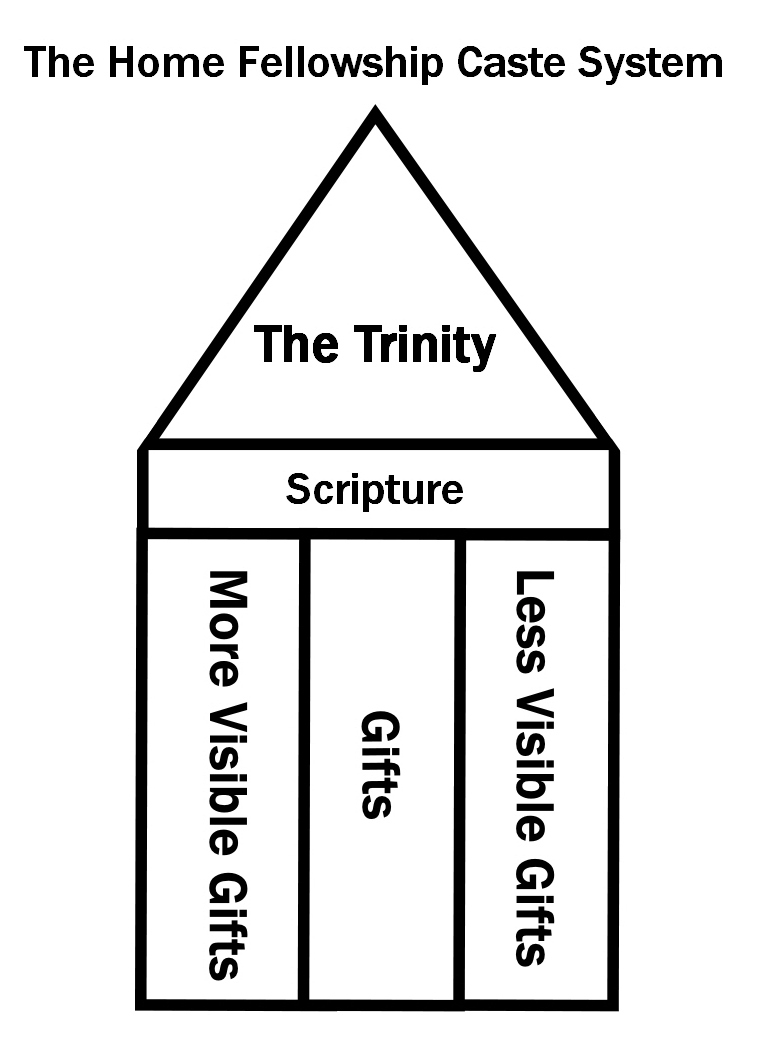
Moreover, let’s face it; while believing in OSAS, there is only one reason people put up with all of the nonsense and drama of the institutional church—OSAS means that if someone leaves the institutional church, they were never saved to begin with. Right? In other words, they function according to the idea that they are led by. It’s OSAS as long as you are “faithful” to the institution. Then each church has its own little “faithfulness” caste system. Those who show up for all of the services are the “core members” that run the church. Those “less faithful” that only come on Sunday mornings are a lower class of member in the caste system.
You have the pastors, staff and deacons, then the “faithful” that attend all of the services and tithe at least 10%, the “casual” attenders that tithe, and then the bottom of the caste strata, even lower than the serfs, the putrid “nonmembers.”
Whether Calvin or Luther, the two icons of Protestantism, these beliefs follow after the doctrine they established for the Protestant institutional church. Access to the institutional church was through water baptism, and the critical need according to the Reformers for formal church membership follows: as Christians, forgiveness for present and future sins can only be found in the institutional church, and those sins condemn us. Forgiveness for all sins does not occur at salvation, but only for past sins. Water baptism initiates us into church membership where forgiveness for present and future sins can be obtained through the sacraments; ie., “gospel preaching,” the Lord’s Table, and anything else deemed as acts of faithfulness to the institutional church not to exclude tithing by any means. Calvin states this explicitly in his institutes, 4.15.1.
All in all, you can say that in Protestantism, the status of sin does not change for the believer—it still condemns requiring perpetual resalvation for every sin committed.
Therefore, 1John 1:9 and 2:1 is interpreted in this light: “If we confess our sins, he is faithful and just to forgive us our sins and to cleanse us from all unrighteousness” (1:9). “My little children, I am writing these things to you so that you may not sin. But if anyone does sin, we have an advocate with the Father, Jesus Christ the righteous” (2:1).
These verses seem to bolster the authentic Protestant position on justification. Confession of sin in our Christian lives keeps us saved. And if we confess our sins, Jesus is up in heaven as our advocate with the Father continuing His work as a propitiation for our sins.
The problem is that this interpretation stands in stark contrast to what other Scriptures state about justification. Biblically, sin has a different classification after salvation—it can’t condemn; it can bring chastisement and present consequences, but it can’t condemn—its ability to condemn has been taken away. Hence, there is no need to have some institution that prevents future condemnation.
Nevertheless, it is easy to understand why the institutional church not only gets a pass on outrageous behavior, but the money keeps pouring in. What will people pay for their salvation and décor that glorifies the institution that saves them? Apparently, no price or compromise is too large. One can also appreciate the fear of so-called excommunication because the institutional church is the only place where one can receive continued forgiveness for present and future sins.
Before I move on, I will solidify my present point. Romans 8:1 states that there is presently NO condemnation for those who are in Christ. In Contrast, Calvin stated that “even saints cannot perform one work which, if judged on its own merits, is not deserving of condemnation” (CI 3.14.9, last sentence). Obviously, the focus is going to be avoiding condemnation, not our freedom to pursue aggressive love in discipleship.
So what are these verses in 1John really saying? Let’s begin to unpack that using the historical grammatical approach to interpretation as opposed to the traditional Protestant means of interpretation, the historical redemptive method. Since Protestantism sees salvation as a process, “redemptive” means that the Bible must be approached with a redemptive prism; ie., the Bible is about salvation. Clearly, this is eisegesis; going to the Bible with a presupposition.
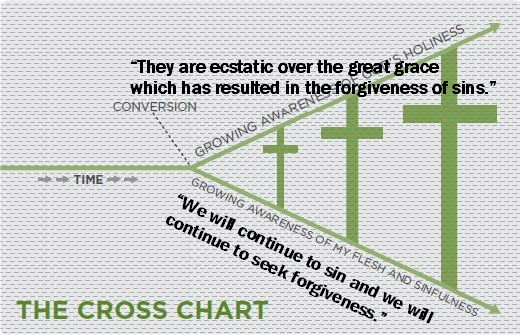
In regard to the history part, this is the belief that history is an unfolding drama about salvation. Hence, all of reality is interpreted through salvation. All of history and the Bible continually reveals the one two-fold redemptive truth/reality: the sinfulness of man and the holiness of God. Salvation begins when we see or understand this reality, and the experience of that reality increases until final salvation.
In contrast, the historical grammatical method uses historical facts to bring more meaning to the text, and all truth is determined by what can be concluded by the grammar—this is known as exegesis. All meaning and truth comes out of the text without anything being read into the text except conclusions from other texts.
In fact, Protestant tradition holds to the idea that a historical grammatical approach to the Scriptures invariably leads to works salvation. Protestant tradition insists that the Scriptures must be interpreted through the prism of total depravity. In this year’s TANC conference, this is what I am going to be hitting on. Christians, save a few, have no idea that Protestant pastors that are leading them view reality in a totally different way than most parishioners. And this is why church looks like it does. And there is no salvaging it—it’s a completely broken system.
So, if you interpret said verses in 1John redemptively, it fits right into their narrative, right? You have to continue to repent for new sins in your Christian life in order to not be condemned and to keep your salvation. A good old fashioned Baptist lady who I am sure would hold OSAS stated this to my wife Susan in the grocery store a couple weeks ago. When Susan asked her why Christians need to go forward during alter calls, she answered, “they have sin that needs to be forgiven.” Well, why can’t they get that forgiveness by praying at home? You ought to see the reaction Susan and I get when we suggest her mother was saved even though not a member of a church.
Protestantism and all of its offshoots including the Baptists is nothing more or less than functioning Calvinism. Election isn’t the point, progressive salvation is the point. Protestants think salvation grows—salvation doesn’t grow—you are either forgiven once and for all time or you aren’t. Look, if you are going to stay in the institutional church, it makes absolutely no difference where you go. Please, stop driving 15 miles to the Baptist church when there is a Catholic Church right across the street—it’s a shameful waste of gas. It’s all progressive justification.
In contrast, we have to see 1John in its exegetical historical context. It must be interpreted according to what was going on during the time that prompted this letter. And what was that?
John was pushing back against the number-one nemesis of the assemblies during that time: Gnosticism. Now, there were many, many different veins of Gnosticism during that time, but like denominationalism, there are basics that are fundamentally the same. Denominationalism quibbles about how to get from point A to point B, but it is all progressive salvation.
When you understand the basics of Gnosticism, it is easy to see that John’s first epistle is a point by point rebuttal of Gnosticism, and NOT the proffering of progressive justification. Protestants can bicker with Catholics all they want to about how to get from point A to point B, but again, it’s all progressive justification. If it’s a religious institution, it’s selling final salvation, PERIOD.
If we follow John’s arguments in this epistle, it also apes the fundamental basics of Gnosticism, and that’s what we are going to do:
1John 1:1 – That which was from the beginning, which we have heard, which we have seen with our eyes, which we have looked upon, and our hands have handled, of the Word of life; 2 (For the life was manifested, and we have seen it, and bear witness, and shew unto you that eternal life, which was with the Father, and was manifested unto us;) 3 That which we have seen and heard declare we unto you, that ye also may have fellowship with us: and truly our fellowship is with the Father, and with his Son Jesus Christ. 4 And these things write we unto you, that your joy may be full. [KJV].
The Gnostics taught that it really wasn’t the spiritual Christ that died on the cross. Gnosticism holds to the idea that material is evil and only the invisible spiritual world is good. Gnosticism rejected the idea that the spiritual realm, or godhood can be one with the material. You must understand: the biblical concept of Godman is a direct affront to the foundation of all false religions, or the knowledge of good and evil. It is the idea that true knowledge cannot be one with the material. Knowledge is good, material is evil and is only a shadow of true knowledge. Knowledge of the material is enslaved and dependent on the five senses.
Now, stop right there. Let me simplify this for you. All false religion flows from the religion of the knowledge of good and evil presented to Eve in the garden. This is also the first sentence of the Calvin Institutes and all of the Calvin Institutes flow from the foundation of 1.1.1., first sentence, viz, ALL wisdom is the knowledge of man and the knowledge of God; man is inherently evil and God is inherently good.
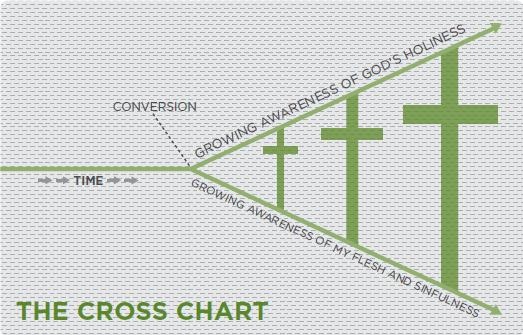
Also, the first sentence of the Calvin Institutes is the primary theses of Luther’s Heidelberg Disputation which is the Magnum Opus of the Reformation. All fundamentals found in contemporary evangelicalism can be found in the Heidelberg Disputation and flow from it. Calvin’s Institutes further articulated the former. In contemporary evangelicalism, we hear constantly that true biblical knowledge is “the knowledge of our own sinfulness as set against God’s holiness.” This is also the pronounced fundamental foundation of the contemporary biblical counseling movement as constantly stated publically in no uncertain terms.
Why am I interjecting this? Because even though much of our knowledge concerning first century Gnosticism comes from the writings of the early church fathers and while they railed against Gnosticism, they themselves were also Gnostics. However, in the process of railing against Gnosticism, they confirm unequivocally that John’s letter addressed the Gnosticism of their day; it just wasn’t the Gnosticism that they preferred.
And by the way, according to some church fathers, John was addressing a Gnostic named Cerinthus who was a contemporary of John and a personal nemesis.
Cerinthus was a gnostic and to some, an early Christian, who was prominent as a heresiarch in the view of the early Church Fathers. Contrary to proto-orthodox Christianity, Cerinthus’s school followed the Jewish law, used the Gospel according to the Hebrews, denied that the Supreme God had made the physical world, and denied the divinity of Jesus. In Cerinthus’ interpretation, the Christ came to Jesus at baptism, guided him in his ministry, but left him at the crucifixion.
He taught that Jesus would establish a thousand-year reign of sensuous pleasure after the Second Coming but before the General Resurrection, a view that was declared heretical by the Council of Nicaea. Cerinthus used a version of the gospel of Matthew as scripture.
Cerinthus taught at a time when Christianity’s relation to Judaism and to Greek philosophy had not yet been clearly defined. In his association with the Jewish law and his modest assessment of Jesus, he was similar to the Ebionites and to other Jewish Christians. In defining the world’s creator as the demiurge, he emulated Platonic philosophy and anticipated the Gnostics.
Early Christian tradition describes Cerinthus as a contemporary to and opponent of John the Evangelist, who may have written the First Epistle of John and the Second Epistle of John to warn the less mature in faith and doctrine about the changes he was making to the original gospel. All that is known about Cerinthus comes from the writing of his theological opponents (Wikipedia).
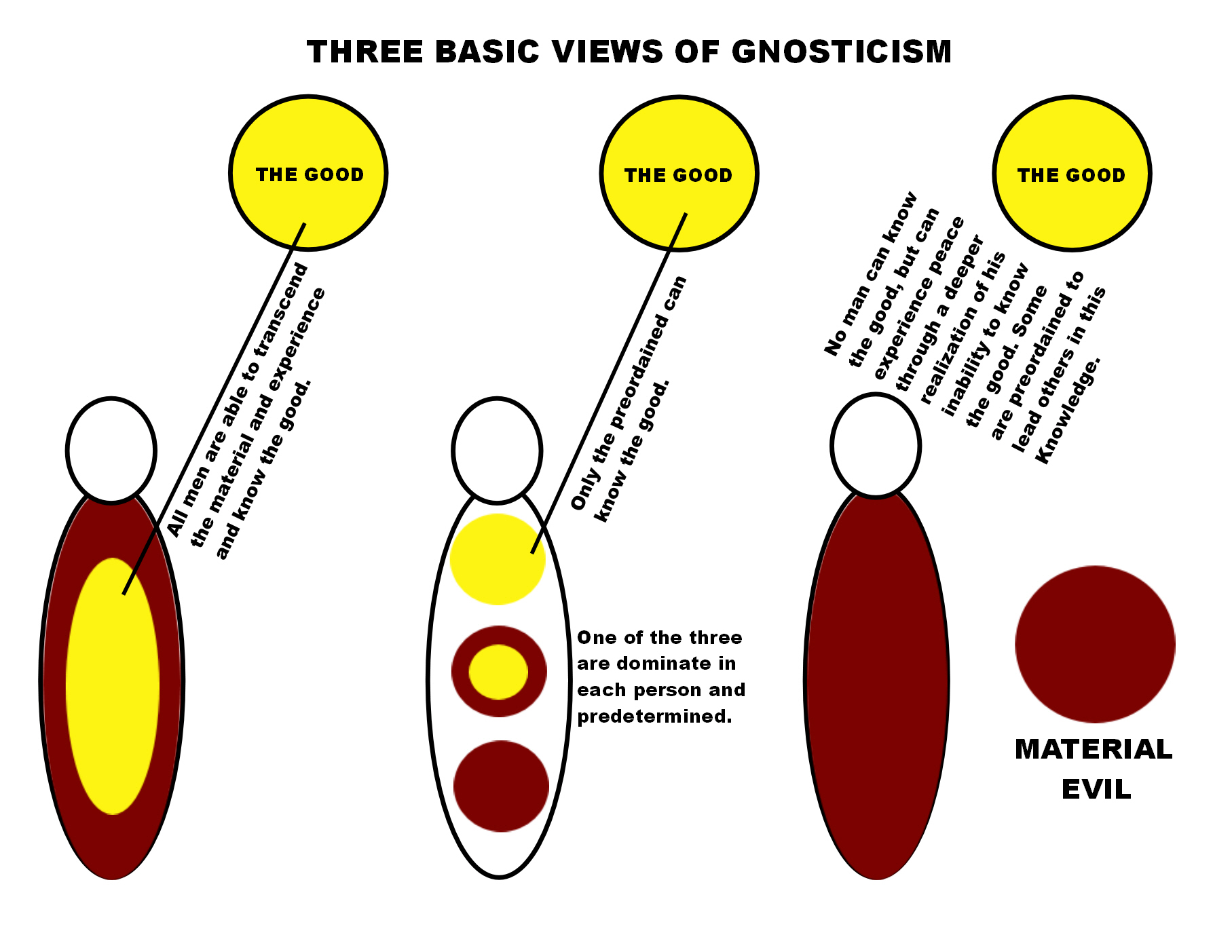
At any rate, the teachings of Cerinthus follow the basic fundamentals of 1st century Gnosticism of which there were two schools of thought unchanged from the cradle of society: intuitive knowledge within versus knowledge outside of man. While both schools held to the strict dichotomy of material being evil and the invisible good, and true knowledge being beyond the five senses, they disagreed on where that knowledge is found and whether or not it is intuitive among all men, or a select few preordained by nature or some supreme being.
Cerinthus followed the philosophical school of Idealism which holds to the belief that the one cosmic mind has an intuitive connection within every individual. Finding that knowledge is often a complex mind-numbing epistemology, but curiously, Luther and Calvin had their own angle that built on the Neo-Platonic teachings of St. Augustine.
This Gnostic bent actually allowed for Christ to be human, or at least some form of humanity. Apparently, God became exasperated with man’s penchant for trying to gain knowledge through the material world, and said in essence, “Ok, since you like to think you can know something and try to gain knowledge through the things that are seen, I am going to send my Son to die on the physical cross, and now all knowledge will only be gained through suffering—there mankind, take that!” This is the essence of the Heidelberg Disputation which is a philosophical treatise, not a theological one by any stretch of the imagination. Luther states plainly in the document that ALL knowledge is hidden in the suffering of the cross. Anyone who thinks they can understand Protestantism without a good grasp of world philosophy is sadly misguided. It is one of the historical necessities of historical grammatical hermeneutics.
Hence, in the Gnostic Protestant construct, Christ and His gospel is the only true objective knowledge and is outside of man. Man is not to seek any knowledge within himself, but all knowledge must be sought outside of him in contemplation of the gospel. All of reality is interpreted by the suffering of the cross. The cross is the epistemology from the material to the invisible, or from the evil to the good.
In contrast, other schools believe the epistemology is intuitive within all men because all men have a spiritual being separate from their material being, and the spiritual part of man is nonmaterial and therefore SINLESS. The material body of man is evil because it is material, but his invisible being is good and has a connection to the cosmic spiritual world that must be cultivated by transcending the material. This was key to the drug culture of the 60’s as LSD trips enabled the individual to transcend the five senses and see into the invisible spiritual world. Supposedly.
Other schools of thought believed that even though all men have a material and spiritual aspect, the spiritual anthropology has classifications in regard to who is able to see true knowledge and who isn’t as determined by the cosmos or cosmic mind; ie., determinism. And consequently, if utopia is to ever be achieved, those with the ability to see knowledge must rule over those who have the inability to transcend the material and are enslaved to it. How do you reason with people hopelessly enslaved to the material? They either understand that they can’t know reality and get with the program, or you kill them.
According to the Reformers, utopia is achieved by understanding that all reality is interpreted through the cross of redemption. This concept was established by Luther’s Heidelberg Disputation and is known as being a “theologian of the cross.” Theologians of the cross are able to know the “cross story,” or interpret reality through the cross, and all others are enslaved to the “glory story” or the story of man. This is the dichotomy of the knowledge of good and evil, or material versus spiritual.
Furthermore, the Reformers believed that the new birth entailed the gift of outward seeing only. All goodness remains outside of man. This is the pious distinction they claim over their fellow Gnostics. Unlike Cerinthus, who would be the modern equivalence of existentialism, no good can be in man, because that does not limit knowledge to suffering and the cross. Even though the early church fathers believed that material is evil and only the invisible is good like all ancient Gnostics, they labeled those heretics who believed that the invisible spirit within man was a connection to the good. That was heresy in their minds. And if you really understand what John Piper et al believe in our day, NOTHING HAS CHANGED.
The true Christians of that day had a different metaphysical take: the material realm is NOT evil, it’s weak. Something that is weak can still be good. The born again Christian struggles with sin because he/she is weak, not because the material realm is inherently evil. Christ really did come adorned in humanity in every since of the meaning because the material is not evil. This understanding of being fits together with the true gospel.
But what Cerinthus et al was teaching speaks directly to what John wrote in his first epistle, and we have addressed some of it in John’s introduction. John, in essence, said the following: Christ was 100% humanity and 100% God. We saw Him, we heard Him, we touched Him, we saw Him die on the cross, there isn’t two Christs, there is only one.
What Cerinthus et al taught explains everything John wrote in this epistle and why he wrote it. It not only explains why John wrote what he wrote in 1:9 and 2:1, it sheds light on why John wrote what he wrote in the rest of the book as well.
And that is what we will look at next week. We will do a point by point fly over of 1John while interpreting it according to this historical context of Gnosticism. John will address the definition of sin in contrast, the definition of knowledge and truth in contrast, the definition of the true gospel in context, the definition of love and hate in contrast, and the definition of the new birth in contrast.
See you next week.



How Christians Change: Biblical Dynamics of Change in Sanctification; Part 3, Doing the Christian Walk
Good evening, everyone. Welcome to Blog Talk Radio False Reformation. This is your host, Paul Dohse. If you would like to call in and add to the lesson tonight, the number is 347-855-8317. You will hear me say, “You are on the air. This is your host, Paul. What is your question or comment?” and just start talking. Identifying yourself is optional.
Per the usual, we’ll be checking in towards the end of the conclusion of our presentation and try to get a conversation going with Susan about the topic at hand to kind of round everything out.
This is our third part in the series, “How Christians Change: Biblical Dynamics of Change in Sanctification.” In the first part we defined the enemy; in the second part we defined the Christian, and now we are getting into the actual nuts and bolts of Christian living. How, yes, how do we walk in the Spirit or according to the will and desires of the Spirit? These are also our desires because we are born of God.
Again, this series is designed to address the core basics of sanctification and we trust that folks will add to their understanding through independent Bible study. We must remember, for more than 500 years, Protestantism has focused on justification while making sanctification a subjective outflow of salvation. Christian living is therefore a vast untapped knowledge.
Taking the first two parts together, we understand that the Christian is not only declared righteous by God, we are in fact new creatures who are holy. Perfect sinlessness is not the issue, change of direction is the issue. We have examined why sin in the Christian life does not exempt the Christian from being truly righteous and why that is not “legal fiction.”
This is important: the only soteriological imputation spoken of in the Bible is our sins to Jesus. Righteousness is not imputed to the Christian nor does the Bible state that anywhere. Christians are MADE righteous by the new birth. There is no so-called “double imputation.”
Romans 6:4 – We were buried therefore with him by baptism into death, in order that, just as Christ was raised from the dead by the glory of the Father, we too might walk in newness of life. 5 For if we have been united with him in a death like his, we shall certainly be united with him in a resurrection like his. 6 We know that our old self was crucified with him in order that the body of sin might be brought to nothing, so that we would no longer be enslaved to sin. 7 For one who has died has been set free from sin.
The righteousness of God is not merely imputed to us, the new birth has made us the righteousness of God because we are His literal offspring. This is important to know if we are to live a sanctified life as kingdom citizens.
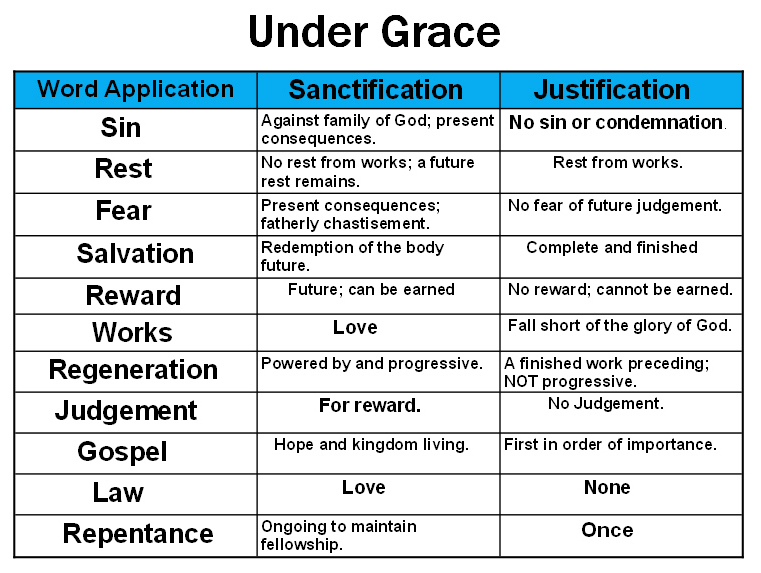
In order to adequately tap into the vast riches of sanctification via the Scriptures, it is essential that justification and sanctification not be confused. Regardless of what English translations seem to say, “gift” and “reward” cannot be confused. Salvation is a gift, sanctification, or the Christian walk involves rewards. Anything spoken of in the Bible as a reward CANNOT refer to salvation.
This part is going to be a summary on some of the methods of change for Chrsitians. Let’s start with the basic ones and move on from there. First of all, we are disciples, or learners. Gaining wisdom in sanctification is critical.
It is also critical that Scripture is your authority. Therefore, for all practical purposes, that means independent study and not a total dependence on teachers who are a help, NOT an authority. The only authority is Scripture (Acts 17:11).
Also, the method of interpretation should be grammatical historical as illustrated by the Sermon on the Mount. Jesus prescribed a learning and applying in order to have a life built upon on a rock. The audience was the uneducated peasantry of that day. The Bible is to be interpreted according to its plain sense of the words and how they are arranged in sentences. Historical context and rules of grammar should be observed as well.
Never forget this: all rules for interpreting the Bible are found within the Bible itself. Also, always remember to interpret a passage in context of justification or sanctification.
Do you know who you are as a Christian other than a holy one? You are a disciple, or learner. One of your primary objectives is to continually gain wisdom for Christian living. That’s sanctification.
1Thessalonians 4:1 – Finally, then, brothers, we ask and urge you in the Lord Jesus, that as you received from us how you ought to walk and to please God, just as you are doing, that you do so more and more. 2 For you know what instructions we gave you through the Lord Jesus. 3 For this is the will of God, your sanctification: that you abstain from sexual immorality; 4 that each one of you know how to control his own body in holiness and honor, 5 not in the passion of lust like the Gentiles who do not know God;
In the first two studies, we looked at how sin uses desire to make its appeal. Sin’s goal is to sell you on obeying its desires. Unbelievers, as we just read, are marked by obeying their desires.
Romans 6:12 – Let not sin therefore reign in your mortal body, to make you obey its passions. 13 Do not present your members to sin as instruments for unrighteousness, but present yourselves to God as those who have been brought from death to life, and your members to God as instruments for righteousness. 14 For sin will have no dominion over you, since you are not under law but under grace.
As born again believers, we are going to have desires like those of the Holy Spirit who indwells us.
Galatians 5:16 – But I say, walk by the Spirit, and you will not gratify the desires of the flesh. 17 For the desires of the flesh are against the Spirit, and the desires of the Spirit are against the flesh, for these are opposed to each other, to keep you from doing the things you want to do. 18 But if you are led by the Spirit, you are not under the law. 19 Now the works of the flesh are evident: sexual immorality, impurity, sensuality, 20 idolatry, sorcery, enmity, strife, jealousy, fits of anger, rivalries, dissensions, divisions, 21 envy, drunkenness, orgies, and things like these. I warn you, as I warned you before, that those who do such things will not inherit the kingdom of God. 22 But the fruit of the Spirit is love, joy, peace, patience, kindness, goodness, faithfulness, 23 gentleness, self-control; against such things there is no law. 24 And those who belong to Christ Jesus have crucified the flesh with its passions and desires.
25 If we live by the Spirit, let us also keep in step with the Spirit. 26 Let us not become conceited, provoking one another, envying one another.
Again, our members, or mortality is not inherently evil. When Paul wrote “the desires of the flesh” that refers to when the flesh is being used in service to sinful desires. We have firmly established that our members can also be used for holy purposes. We also looked at the fact that our bodies are the Holy of Holies where the Holy Spirit resides. When we were “under law” we were enslaved to sinful desires and free to do good, but as ones “under grace” we are enslaved to righteousness and unfortunately free to sin.
It’s a reversal of overall direction predicated mostly by a love for God’s truth versus indifference to God’s law. That’s the glaring difference between a lost person and a saved person; though the unregenerate might be moral and practically wise in many areas of life, there will be a marked indifference to God’s opinion about things. People under grace love the truth:
2Thessolonians 2:9 – The coming of the lawless one is by the activity of Satan with all power and false signs and wonders, 10 and with all wicked deception for those who are perishing, because they refused to love the truth and so be saved. 11 Therefore God sends them a strong delusion, so that they may believe what is false, 12 in order that all may be condemned who did not believe the truth but had pleasure in unrighteousness.
Wisdom teaches that Christians must discern between the desires of the Spirit and the desires of sin. I assume sinful desires will usually have pleasure as their goal, while godly desires will often look beyond pleasure to some higher goal. This can get pretty complex and would be a vast field of study in and of itself. Greed, taking shortcuts in dealing with life, and many other considerations would come into play.
At any rate, we learn of an extremely important principle in Romans 6. We become slaves to whatever desires we obey.
Romans 6:15 – What then? Are we to sin because we are not under law but under grace? By no means! 16 Do you not know that if you present yourselves to anyone as obedient slaves, you are slaves of the one whom you obey, either of sin, which leads to death, or of obedience, which leads to righteousness? 17 But thanks be to God, that you who were once slaves of sin have become obedient from the heart to the standard of teaching to which you were committed, 18 and, having been set free from sin, have become slaves of righteousness. 19 I am speaking in human terms, because of your natural limitations. For just as you once presented your members as slaves to impurity and to lawlessness leading to more lawlessness, so now present your members as slaves to righteousness leading to sanctification.
20 For when you were slaves of sin, you were free in regard to righteousness. 21 But what fruit were you getting at that time from the things of which you are now ashamed? For the end of those things is death. 22 But now that you have been set free from sin and have become slaves of God, the fruit you get leads to sanctification and its end, eternal life. 23 For the wages of sin is death, but the free gift of God is eternal life in Christ Jesus our Lord.
When someone comes to you with an addiction, they have become addicted because they have become enslaved to that desire by obeying it over and over again. Whether believer or unbeliever, we become enslaved to what we obey. When we don’t feel like doing something that perhaps is an obligation like going to work, and we obey that feeling, the feeling becomes stronger and stronger to the point where it dominates us.
People who are lazy are enslaved to a certain feeling. And feelings talk, right? In this case, the feeling is saying, “I don’t want to go to work.” A lazy person must stop obeying that feeling.
Then you have stuff like pornography. People can be what we call “attractive.” So, whether men or women, we want to avoid soft porn. If you begin by obeying a desire to view soft porn, it’s just going to escalate from there. This is why I stay away from the magazine racks at grocery stores. It’s saying no to soft porn. If you say no to soft porn and set boundaries, it will always be easy to say no—the desire is weak. Saying yes makes you a slave to whatever you need to be saying no to.
And porn is dangerous because it can intermingle with the reality of an innocent recognition that there is attractiveness among people. Some people are easy on the eyes, other people not so much. This is reality. But wisdom comes into play here as well. There is an inner beauty and outer beauty which is a subject worthy of a whole book in and of itself.
Another thing we learn from Scripture is the principle of life and death. This is an active principle in both the believer and unbeliever. People either choose life or death. What we obey in life either brings about death or life. When we obey a sinful desire, it brings about some sort of death which in many cases is an extremely subtle form of death. In the life of an unbeliever, the overall direction in various degrees is death leading to ultimate death. That’s why there are degrees of eternal punishment. The end of a believer’s life is going to be eternal life, but that can look pretty sad in many cases.
More on this later, but it is clear in Scripture that a believer wallowing in anemic sanctification can sin unto death. I don’t think Ananias and Sapphire were struck dead because of their onetime act of hypocrisy, I think it was the final straw in a long succession of choices leading to death.
This is where we might plug in another sanctification dynamic. In regard to justification, we should have no fear. There is no condemnation for those who believe in Christ. But, we are commanded to have fear in sanctification throughout the New Testament. Why? This life and death dynamic in regard to what we obey. This is heavily emphasized throughout the New Testament.
1Peter 4:17 – For it is time for judgment to begin at the household of God; and if it begins with us, what will be the outcome for those who do not obey the gospel of God? 18 And “If the righteous is scarcely saved, what will become of the ungodly and the sinner?”
Before we build on this life and death construct, let’s look more at desires. It is important for Christians to know that they can put sinful desires to death in their lives. And sinful desires can take on all sorts of forms. Among unbelievers who are under law, you name it: a desire to murder. What happens when someone obeys that desire? They become a what? Right, serial killer. What about a desire to have sex with animals? What about thrill-seeking which can take on all kinds of manifestations? See, believers don’t understand these dynamics. Sin manifests itself differently in different people through different desires. Unbelievers can only be freed from these desires by dying:
Romans 6:6 – We know that our old self was crucified with him in order that the body of sin might be brought to nothing, so that we would no longer be enslaved to sin. 7 For one who has died has been set free from sin.
Oh my, what a wonderful evangelism tool! Offering the good news to people that they can die with Christ and be resurrected with Him in Spirit baptism which will free them from sinful desires. Homosexuals do not have to be hounded by that desire the rest of their lives. They may also learn they are called to singleness. Because of lack of wisdom, I think some unbelievers reason that if they don’t desire the opposite sex, they must be homosexual. Also, be sure of this: not saying no to sexual desire might lead anywhere. Most homosexuality begins with unfettered sexual desires with the same sex as well as sexual fantasies of all sorts. In a passage we read, it speaks of drunken orgies that would have involved group sex fueled by alcohol, and undoubtedly, anything goes in those settings. Point being: obeying sexual desires of all sorts can lead to anything and the slavery thereof.
Those desires can be put to death.
Colossians 3:5 Put to death therefore what is earthly in you: sexual immorality, impurity, passion, evil desire, and covetousness, which is idolatry. 6 On account of these the wrath of God is coming. 7 In these you too once walked, when you were living in them. 8 But now you must put them all away: anger, wrath, malice, slander, and obscene talk from your mouth. 9 Do not lie to one another, seeing that you have put off the old self[d] with its practices 10 and have put on the new self, which is being renewed in knowledge after the image of its creator.
Sinful desires can be put to death. How? By disobeying the desire, and robbing the desire of provisions:
Romans 13:14 – But put on the Lord Jesus Christ, and make no provision for the flesh, to gratify its desires.
The word for “provision” is pronoia; it means to give forethought in caring for something. We are to cut off anything that gives a thought to the desire. No, if you are a former homosexual, you don’t associate with homosexuals. No, if you are a former alcoholic, you don’t associate with people who drink. And no, you don’t keep alcohol in the house for any reason.
If you have repented of gluttony, you don’t keep excess amounts of food in the house, and if you are on a diet, you keep certain foods out of the house. Many more examples could be used—you get the picture. You don’t feed the desire because desire is what sin uses to make its appeal, and strong appeals make it harder to say no.
As we look at this further, INCENTIVE is so huge in all of this. Note 2Timothy 2:15.
Do your best to present yourself to God as one approved, a worker who has no need to be ashamed, rightly handling the word of truth.
Note the use of the word “worker.” The same Greek word is mostly translated “laborer” elsewhere. This couldn’t be talking about salvation. Paul isn’t telling Timothy to earn his salvation. This not only means that a Christian can be ashamed, but that their entry into heaven can be a foggy and fearful affair:
2Peter 1:5 – For this very reason, make every effort to supplement your faith with virtue, and virtue with knowledge, 6 and knowledge with self-control, and self-control with steadfastness, and steadfastness with godliness, 7 and godliness with brotherly affection, and brotherly affection with love. 8 For if these qualities are yours and are increasing, they keep you from being ineffective or unfruitful in the knowledge of our Lord Jesus Christ. 9 For whoever lacks these qualities is so nearsighted that he is blind, having forgotten that he was cleansed from his former sins. 10 Therefore, brothers, be all the more diligent to confirm your calling and election, for if you practice these qualities you will never fall. 11 For in this way there will be richly provided for you an entrance into the eternal kingdom of our Lord and Savior Jesus Christ.
If adding these things listed to our lives can result in a rich entry into heaven, I have to believe that a not-so-rich entry is also possible. Every indication here is that one can go to heaven shrouded in doubt. Peter could not be telling Christians to make every effort to finish their salvation—that’s not what is in view here. Paul described his own rich entry:
2Timothy 4:5 – As for you, always be sober-minded, endure suffering, do the work of an evangelist,. 6 For I am already being poured out as a drink offering, and the time of my departure has come. 7 I have fought the good fight, I have finished the race, I have kept the faith. 8 Henceforth there is laid up for me the crown of righteousness, which the Lord, the righteous judge, will award to me on that Day, and not only to me but also to all who have loved his appearing.
Key to the rich entry is “fulfill your ministry.” As we read in one of the many passages cited here tonight, EVERY Christian has been granted gifts for the purpose of the ministry they are called to. Fulfill that ministry. At least for Paul, the ability to stare death in the face without even flinching is tied to the fact that he fulfilled his ministry, and I strongly suspect it is no different for us. And let’s face it, we know how much emphasis there is on individual gifts in the institutional church.
Not only that, the only ministry that is taken seriously is performed by those who purchased a degree from a seminary. In a home fellowship, the gifts of the individuals in that small group are right in front of you every week. Individual service is the focus—not all of the distractions of an institution bewitched by authority. Leaders of a home fellowship are focused on individual gifts—not all of the drama that goes along with an institution.
Wise sanctification is rewarded richly in this life and the life to come. You can have eternal life, and be miserable in this life. Jesus came that we may have life and have it more abundantly. Hey, you’re here, while you are it you might as well love life.
1Peter 3:10 – For “Whoever desires to love life and see good days, let him keep his tongue from evil and his lips from speaking deceit; 11 let him turn away from evil and do good; let him seek peace and pursue it. 12 For the eyes of the Lord are on the righteous, and his ears are open to their prayer. But the face of the Lord is against those who do evil.” (Psalms 34:12).
Is it fair to say that depressed people don’t love life? Is it fair to say that depression is a form of death? Remember when I told you that choosing death or making death choices can be very subtle? Well, many times a series of subtle death choices can culminate into depression and often people will have no idea where the depression came from. This is where we get into people thinking depression is a chemical imbalance etc. Now look, depression can be medical, so definitely go to the doctor, but also be sure to take a hard look at your life—do both.
Susan and I are involved with a young person right now that can’t tell the truth about anything. I don’t know a whole lot, but I know this: if that person doesn’t repent they aren’t going to love life and see good days. If for no other reason, please start a home fellowship for the sake of our young people. Why? Because the institutional church is not going to teach this stuff to our children. No, no, that would be making them Pharisees. So, what do we see coming out of the institutional church in regard to our youth? Death, and death more abundantly unto death. Weak sanctification delegates God’s people to death, period.
Ephesians 6:1 – Children, obey your parents in the Lord, for this is right. 2 “Honor your father and mother” (this is the first commandment with a promise), 3 “that it may go well with you and that you may live long in the land.” 4 Fathers, do not provoke your children to anger, but bring them up in the discipline and instruction of the Lord.
Mark 10: 28 – Peter began to say to him, “See, we have left everything and followed you.” 29 Jesus said, “Truly, I say to you, there is no one who has left house or brothers or sisters or mother or father or children or lands, for my sake and for the gospel, 30 who will not receive a hundredfold now in this time, houses and brothers and sisters and mothers and children and lands, with persecutions, and in the age to come eternal life. 31 But many who are first will be last, and the last first.”
Luke 14:12 – He said also to the man who had invited him, “When you give a dinner or a banquet, do not invite your friends or your brothers or your relatives or rich neighbors, lest they also invite you in return and you be repaid. 13 But when you give a feast, invite the poor, the crippled, the lame, the blind, 14 and you will be blessed, because they cannot repay you. For you will be repaid at the resurrection of the just.”
What is missing in Christianity is a whole new way of life defined in kingdom living. We are merely ambassadors here, and are to live as sojourners and aliens (1Peter 2:11). Neglected is a body of knowledge that encompasses kingdom living from how we think to citizenship.
Missing is this whole concept of incentive for kingdom living. Obviously, when salvation is emphasized, and sanctification is looked at as an endeavor to keep our salvation, life more abundant in the here and now is not going to be emphasized. Our individual calling is not emphasized, keeping our salvation is emphasized.
This is the great calling of the home fellowship movement: an emphasis on sanctification and kingdom living. I was going to have several other parts to this series until I started researching; then I realized that I would be doing nothing but this till the second coming and none of our other projects would ever get done. So this is it. Next week we move on to something else. But I do believe that the Scriptures hold the answers for life’s most difficult problems, and it is up to us to find those answers in the Scriptures.
However, I am doing another series that is a critical supplement to this study; the whole issue of the “race of faith.” Part one, What is the Race of Faith? Justification or Sanctification? Or Both? A Biblical Evaluation, Part 1: First Letter of John 1:7-10 is complete and posted on PPT. Yes, this whole idea of perseverance that fuses justification and sanctification together. Is salvation in part a reward? Is salvation the reward for persevering, or is salvation strictly a gift?
Protestantism clearly states that salvation is a gift, but also a reward for persevering. This fits perfectly with their progressive justification construct. We contend that even though the English translations seem to indicate salvation as reward, that in the overall consensus of Scripture, mixing gift and reward is absolutely impossible—the two MUST be kept separate. I believe that a Christian can throw in the towel, but that doesn’t mean he loses his salvation—it means he loses reward in this life and the life to come. The idea of losing eternal reward is difficult for me to grasp, but losing rewards presently—not so much. It’s hard to love life when you have no hope. An example of eternal reward follows:
Daniel 12:3 – And those who are wise shall shine like the brightness of the sky above; and those who turn many to righteousness, like the stars forever and ever.
That sounds pretty cool, but then there is this:
1 Corinthians 3:10 – According to the grace of God given to me, like a skilled master builder I laid a foundation, and someone else is building upon it. Let each one take care how he builds upon it. 11 For no one can lay a foundation other than that which is laid, which is Jesus Christ. 12 Now if anyone builds on the foundation with gold, silver, precious stones, wood, hay, straw— 13 each one’s work will become manifest, for the Day will disclose it, because it will be revealed by fire, and the fire will test what sort of work each one has done. 14 If the work that anyone has built on the foundation survives, he will receive a reward. 15 If anyone’s work is burned up, he will suffer loss, though he himself will be saved, but only as through fire.
This is pretty clear, no? Saved people will suffer loss of reward. The “through fire” part is a little unsettling, and it should be, but nevertheless, gift and reward cannot be confused. ANY passage that speaks of gift apart from spiritual gifts for service MUST refer to justification/salvation. ANY passage that speaks of reward MUST be speaking to Christian living. And when you start reading your Bible that way, it makes sense. For instance, James 1:12.
Blessed is the man who remains steadfast under trial, for when he has stood the test he will receive the crown of life, which God has promised to those who love him.
So, if life is about Life and death choices, wouldn’t it make sense that one of the eternal rewards is for someone who persevered well in the Christian life? Specifically, a crown of life? Note what else James writes in the very next verse and following:
13 Let no one say when he is tempted, “I am being tempted by God,” for God cannot be tempted with evil, and he himself tempts no one. 14 But each person is tempted when he is lured and enticed by his own desire. 15 Then desire when it has conceived gives birth to sin, and sin when it is fully grown brings forth death.
Look, we all make choices in life that brings forth some sort of death, but that doesn’t mean we lose our salvation. Yes, yes, I know how the Reformed get around the accusation of Christ plus perseverance; already not yet which means that perseverance is merely a manifestation of who God has already elected. Well lovely—that just overfloweth with hope.
So, your assurance is only as good as your response to the next trial. And by the way, I heard John MacArthur Jr. say that. In fact, it was said to me by a Reformed counselor during a hard time that I was going through; I had to persevere through the trial in order to show myself approved.
Ok, so that’s it, part three of our series and next week we move on to something else.
Addendum: (more…)

 Paul's Passing Thoughts
1 comment