The Protestant Twisting of 1John: A Clarification, Part 1
 Originally published March 22, 2015
Listen to audio or download audio file.
Welcome to Blogtalk Radio False Reformation this is your host Paul M. Dohse Sr. Tonight, we are going to attack and unravel interpretive abuses of 1John, particularly 1John 1:9 and 2:1. There is only one other text twisted for ill use more than these two verses, and that would be Galatians 2:20 and 3:1-3. Later, In part 2, I will toss in an exegesis of those verses as a bonus.
There may be a lot of different religions and even more denominations, but for all practical purposes they all have one thing in common: this whole idea that salvation is a process with a beginning and an end. This makes salvation a process that includes our present life.
So, the argumentation between religions and denominations involves the correct way of getting from point A to point B. But there is no point A and point B. When you believe God unto salvation, you get the complete package and the salvation part of your life is finished. It is an instantaneous quickening of the Spirit that transports you from one kingdom to another, from one master to another, from being under law to being under grace, from the old person to the new person, and from darkness to light. You don’t become a servant of righteousness on the installment plan, and you don’t become a kingdom citizen on an installment plan.
How is 1John used to argue for a progressive salvation, and what is John really saying in his epistle? That’s what we are discussing tonight. If you would like to add to our lesson or ask a question, call (347) 855-8317. We will check in with Susan towards the end of the show and listen to her perspective. If you would like to comment on our subject tonight, you can also email me at paul@ttanc.com. That’s Tom, Tony, Alice, Nancy, cat, paul@ttanc.com. I have my email monitor right here and can add your thoughts to the show.
Way back at the beginning of this ministry, I had this nailed down. If salvation is a process, and eternal life as opposed to eternal punishment is at stake, the Christian life is really a minefield. The focus isn’t being the best kingdom citizen; the focus is making sure you don’t mess up your salvation. The focus is salvation, not discipleship. The focus is fear of judgement, not love.
I realize many Christians hold to OSAS, once saved always saved, but the problem is how they are led by pastors trained in seminaries deeply grounded in Protestant tradition. That tradition looks to the institutional church as the primary way of getting God’s people from point A to point B in regard to their salvation. Whether OSAS or not, they are led to do the same things week in and week out. Be here at this time or that time; stand up; sing; sit down; listen to announcements; stand up; sing; sit down; listen to the special music presentation; put your tithe in the plate; listen to the sermon (always about the gospel just in case there are lost people present, wink, wink); stand up; sing “Just As I Am” until someone walks the isle so you can stop singing “Just As I Am”; pray; be dismissed; be cordial to people and tell them how much you love them; go home, and come back next week and do it again.
Why? Because all of that ritualism “imparts grace” and enables us to “grow in grace.” It enables us to “grow up in our salvation.” After all, discipleship is the “growing part of our salvation.” We have all said it, but salvation doesn’t grow. While believing in OSAS, most parishioners are led by pastors who believe in progressive salvation/justification which was clearly the foundational premise of Protestantism with the progression being overseen by the Protestant institutional church.
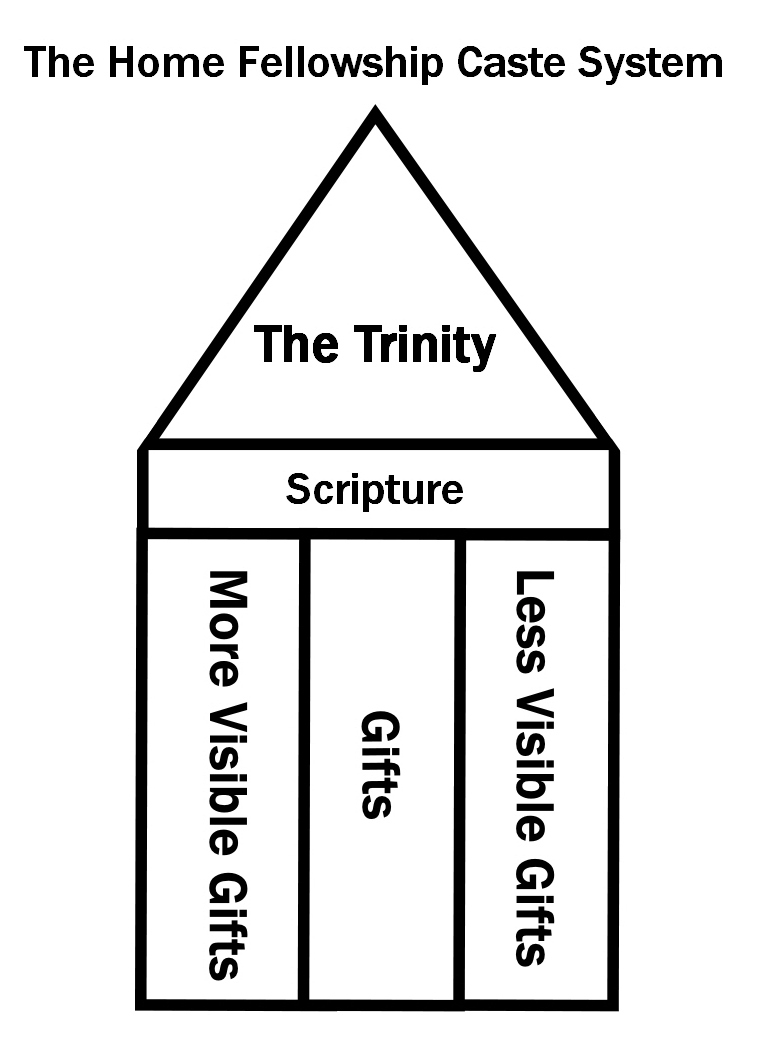
Moreover, let’s face it; while believing in OSAS, there is only one reason people put up with all of the nonsense and drama of the institutional church—OSAS means that if someone leaves the institutional church, they were never saved to begin with. Right? In other words, they function according to the idea that they are led by. It’s OSAS as long as you are “faithful” to the institution. Then each church has its own little “faithfulness” caste system. Those who show up for all of the services are the “core members” that run the church. Those “less faithful” that only come on Sunday mornings are a lower class of member in the caste system.
You have the pastors, staff and deacons, then the “faithful” that attend all of the services and tithe at least 10%, the “casual” attenders that tithe, and then the bottom of the caste strata, even lower than the serfs, the putrid “nonmembers.”
Whether Calvin or Luther, the two icons of Protestantism, these beliefs follow after the doctrine they established for the Protestant institutional church. Access to the institutional church was through water baptism, and the critical need according to the Reformers for formal church membership follows: as Christians, forgiveness for present and future sins can only be found in the institutional church, and those sins condemn us. Forgiveness for all sins does not occur at salvation, but only for past sins. Water baptism initiates us into church membership where forgiveness for present and future sins can be obtained through the sacraments; ie., “gospel preaching,” the Lord’s Table, and anything else deemed as acts of faithfulness to the institutional church not to exclude tithing by any means. Calvin states this explicitly in his institutes, 4.15.1.
All in all, you can say that in Protestantism, the status of sin does not change for the believer—it still condemns requiring perpetual resalvation for every sin committed.
Therefore, 1John 1:9 and 2:1 is interpreted in this light: “If we confess our sins, he is faithful and just to forgive us our sins and to cleanse us from all unrighteousness” (1:9). “My little children, I am writing these things to you so that you may not sin. But if anyone does sin, we have an advocate with the Father, Jesus Christ the righteous” (2:1).
These verses seem to bolster the authentic Protestant position on justification. Confession of sin in our Christian lives keeps us saved. And if we confess our sins, Jesus is up in heaven as our advocate with the Father continuing His work as a propitiation for our sins.
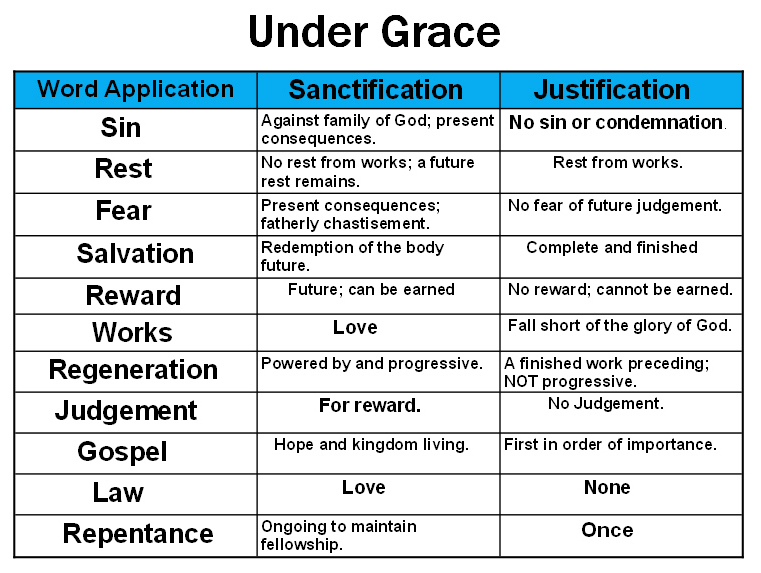
The problem is that this interpretation stands in stark contrast to what other Scriptures state about justification. Biblically, sin has a different classification after salvation—it can’t condemn; it can bring chastisement and present consequences, but it can’t condemn—its ability to condemn has been taken away. Hence, there is no need to have some institution that prevents future condemnation.
Nevertheless, it is easy to understand why the institutional church not only gets a pass on outrageous behavior, but the money keeps pouring in. What will people pay for their salvation and décor that glorifies the institution that saves them? Apparently, no price or compromise is too large. One can also appreciate the fear of so-called excommunication because the institutional church is the only place where one can receive continued forgiveness for present and future sins.
Before I move on, I will solidify my present point. Romans 8:1 states that there is presently NO condemnation for those who are in Christ. In Contrast, Calvin stated that “even saints cannot perform one work which, if judged on its own merits, is not deserving of condemnation” (CI 3.14.9, last sentence). Obviously, the focus is going to be avoiding condemnation, not our freedom to pursue aggressive love in discipleship.
So what are these verses in 1John really saying? Let’s begin to unpack that using the historical grammatical approach to interpretation as opposed to the traditional Protestant means of interpretation, the historical redemptive method. Since Protestantism sees salvation as a process, “redemptive” means that the Bible must be approached with a redemptive prism; ie., the Bible is about salvation. Clearly, this is eisegesis; going to the Bible with a presupposition.
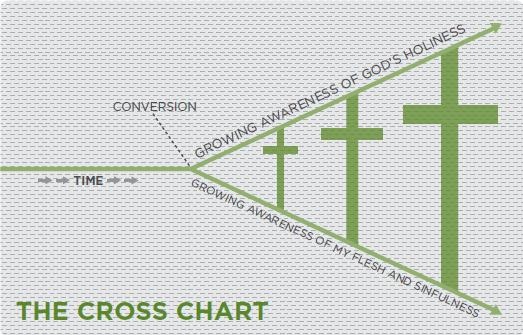
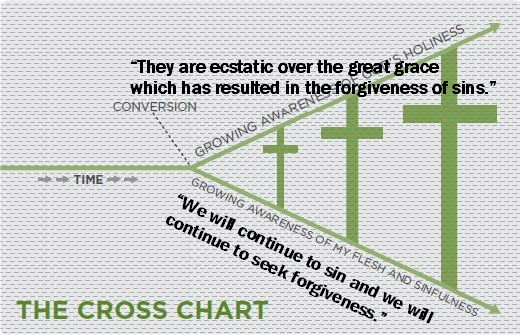
In regard to the history part, this is the belief that history is an unfolding drama about salvation. Hence, all of reality is interpreted through salvation. All of history and the Bible continually reveals the one two-fold redemptive truth/reality: the sinfulness of man and the holiness of God. Salvation begins when we see or understand this reality, and the experience of that reality increases until final salvation.
In contrast, the historical grammatical method uses historical facts to bring more meaning to the text, and all truth is determined by what can be concluded by the grammar—this is known as exegesis. All meaning and truth comes out of the text without anything being read into the text except conclusions from other texts.
In fact, Protestant tradition holds to the idea that a historical grammatical approach to the Scriptures invariably leads to works salvation. Protestant tradition insists that the Scriptures must be interpreted through the prism of total depravity. In this year’s TANC conference, this is what I am going to be hitting on. Christians, save a few, have no idea that Protestant pastors that are leading them view reality in a totally different way than most parishioners. And this is why church looks like it does. And there is no salvaging it—it’s a completely broken system.
So, if you interpret said verses in 1John redemptively, it fits right into their narrative, right? You have to continue to repent for new sins in your Christian life in order to not be condemned and to keep your salvation. A good old fashioned Baptist lady who I am sure would hold OSAS stated this to my wife Susan in the grocery store a couple weeks ago. When Susan asked her why Christians need to go forward during alter calls, she answered, “they have sin that needs to be forgiven.” Well, why can’t they get that forgiveness by praying at home? You ought to see the reaction Susan and I get when we suggest her mother was saved even though not a member of a church.
Protestantism and all of its offshoots including the Baptists is nothing more or less than functioning Calvinism. Election isn’t the point, progressive salvation is the point. Protestants think salvation grows—salvation doesn’t grow—you are either forgiven once and for all time or you aren’t. Look, if you are going to stay in the institutional church, it makes absolutely no difference where you go. Please, stop driving 15 miles to the Baptist church when there is a Catholic Church right across the street—it’s a shameful waste of gas. It’s all progressive justification.
In contrast, we have to see 1John in its exegetical historical context. It must be interpreted according to what was going on during the time that prompted this letter. And what was that?
John was pushing back against the number-one nemesis of the assemblies during that time: Gnosticism. Now, there were many, many different veins of Gnosticism during that time, but like denominationalism, there are basics that are fundamentally the same. Denominationalism quibbles about how to get from point A to point B, but it is all progressive salvation.
When you understand the basics of Gnosticism, it is easy to see that John’s first epistle is a point by point rebuttal of Gnosticism, and NOT the proffering of progressive justification. Protestants can bicker with Catholics all they want to about how to get from point A to point B, but again, it’s all progressive justification. If it’s a religious institution, it’s selling final salvation, PERIOD.
If we follow John’s arguments in this epistle, it also apes the fundamental basics of Gnosticism, and that’s what we are going to do:
1John 1:1 – That which was from the beginning, which we have heard, which we have seen with our eyes, which we have looked upon, and our hands have handled, of the Word of life; 2 (For the life was manifested, and we have seen it, and bear witness, and shew unto you that eternal life, which was with the Father, and was manifested unto us;) 3 That which we have seen and heard declare we unto you, that ye also may have fellowship with us: and truly our fellowship is with the Father, and with his Son Jesus Christ. 4 And these things write we unto you, that your joy may be full. [KJV].
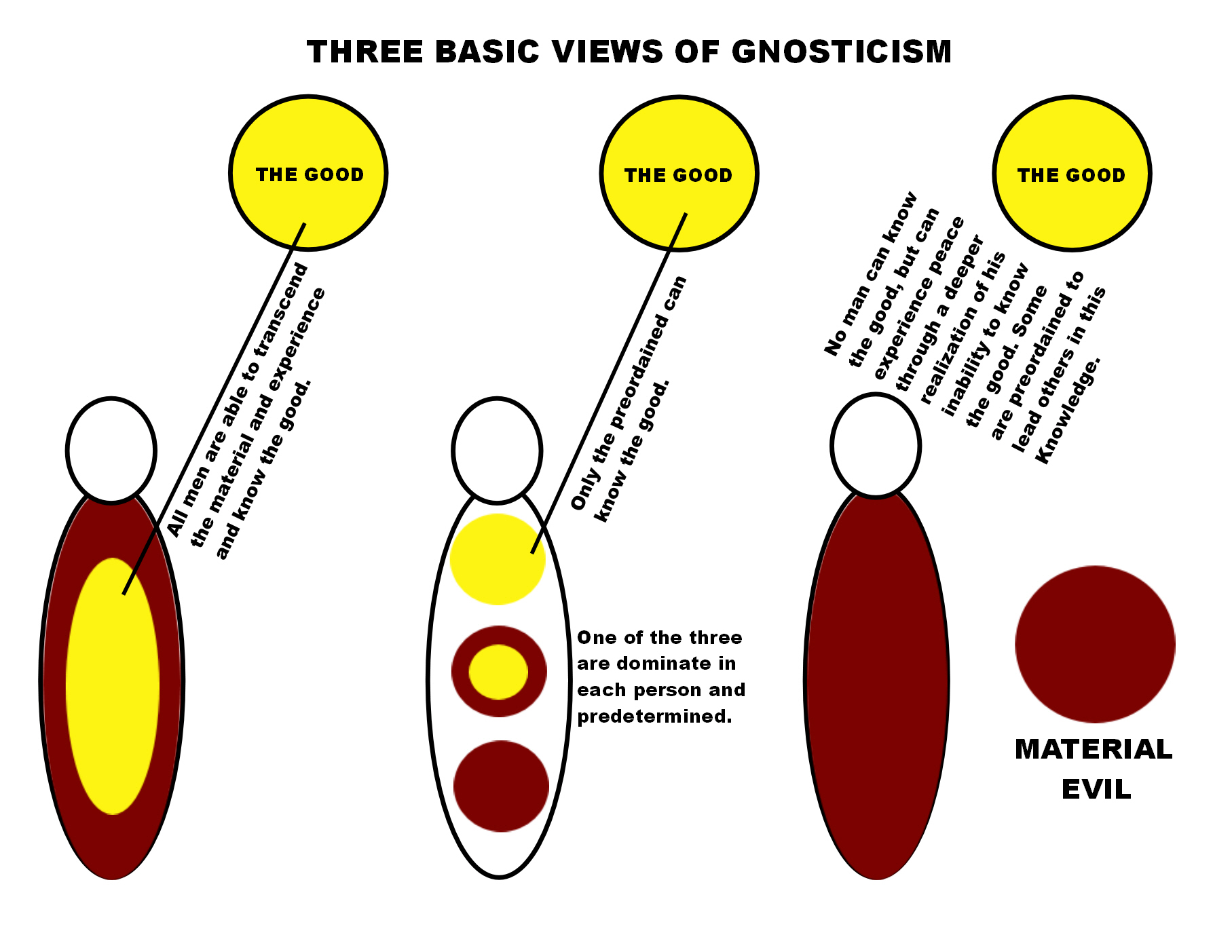
The Gnostics taught that it really wasn’t the spiritual Christ that died on the cross. Gnosticism holds to the idea that material is evil and only the invisible spiritual world is good. Gnosticism rejected the idea that the spiritual realm, or godhood can be one with the material. You must understand: the biblical concept of Godman is a direct affront to the foundation of all false religions, or the knowledge of good and evil. It is the idea that true knowledge cannot be one with the material. Knowledge is good, material is evil and is only a shadow of true knowledge. Knowledge of the material is enslaved and dependent on the five senses.
Now, stop right there. Let me simplify this for you. All false religion flows from the religion of the knowledge of good and evil presented to Eve in the garden. This is also the first sentence of the Calvin Institutes and all of the Calvin Institutes flow from the foundation of 1.1.1., first sentence, viz, ALL wisdom is the knowledge of man and the knowledge of God; man is inherently evil and God is inherently good.
Also, the first sentence of the Calvin Institutes is the primary theses of Luther’s Heidelberg Disputation which is the Magnum Opus of the Reformation. All fundamentals found in contemporary evangelicalism can be found in the Heidelberg Disputation and flow from it. Calvin’s Institutes further articulated the former. In contemporary evangelicalism, we hear constantly that true biblical knowledge is “the knowledge of our own sinfulness as set against God’s holiness.” This is also the pronounced fundamental foundation of the contemporary biblical counseling movement as constantly stated publically in no uncertain terms.
Why am I interjecting this? Because even though much of our knowledge concerning first century Gnosticism comes from the writings of the early church fathers and while they railed against Gnosticism, they themselves were also Gnostics. However, in the process of railing against Gnosticism, they confirm unequivocally that John’s letter addressed the Gnosticism of their day; it just wasn’t the Gnosticism that they preferred.
And by the way, according to some church fathers, John was addressing a Gnostic named Cerinthus who was a contemporary of John and a personal nemesis.
Cerinthus was a gnostic and to some, an early Christian, who was prominent as a heresiarch in the view of the early Church Fathers. Contrary to proto-orthodox Christianity, Cerinthus’s school followed the Jewish law, used the Gospel according to the Hebrews, denied that the Supreme God had made the physical world, and denied the divinity of Jesus. In Cerinthus’ interpretation, the Christ came to Jesus at baptism, guided him in his ministry, but left him at the crucifixion.
He taught that Jesus would establish a thousand-year reign of sensuous pleasure after the Second Coming but before the General Resurrection, a view that was declared heretical by the Council of Nicaea. Cerinthus used a version of the gospel of Matthew as scripture.
Cerinthus taught at a time when Christianity’s relation to Judaism and to Greek philosophy had not yet been clearly defined. In his association with the Jewish law and his modest assessment of Jesus, he was similar to the Ebionites and to other Jewish Christians. In defining the world’s creator as the demiurge, he emulated Platonic philosophy and anticipated the Gnostics.
Early Christian tradition describes Cerinthus as a contemporary to and opponent of John the Evangelist, who may have written the First Epistle of John and the Second Epistle of John to warn the less mature in faith and doctrine about the changes he was making to the original gospel. All that is known about Cerinthus comes from the writing of his theological opponents (Wikipedia).
At any rate, the teachings of Cerinthus follow the basic fundamentals of 1st century Gnosticism of which there were two schools of thought unchanged from the cradle of society: intuitive knowledge within versus knowledge outside of man. While both schools held to the strict dichotomy of material being evil and the invisible good, and true knowledge being beyond the five senses, they disagreed on where that knowledge is found and whether or not it is intuitive among all men, or a select few preordained by nature or some supreme being.
Cerinthus followed the philosophical school of Idealism which holds to the belief that the one cosmic mind has an intuitive connection within every individual. Finding that knowledge is often a complex mind-numbing epistemology, but curiously, Luther and Calvin had their own angle that built on the Neo-Platonic teachings of St. Augustine.
This Gnostic bent actually allowed for Christ to be human, or at least some form of humanity. Apparently, God became exasperated with man’s penchant for trying to gain knowledge through the material world, and said in essence, “Ok, since you like to think you can know something and try to gain knowledge through the things that are seen, I am going to send my Son to die on the physical cross, and now all knowledge will only be gained through suffering—there mankind, take that!” This is the essence of the Heidelberg Disputation which is a philosophical treatise, not a theological one by any stretch of the imagination. Luther states plainly in the document that ALL knowledge is hidden in the suffering of the cross. Anyone who thinks they can understand Protestantism without a good grasp of world philosophy is sadly misguided. It is one of the historical necessities of historical grammatical hermeneutics.
Hence, in the Gnostic Protestant construct, Christ and His gospel is the only true objective knowledge and is outside of man. Man is not to seek any knowledge within himself, but all knowledge must be sought outside of him in contemplation of the gospel. All of reality is interpreted by the suffering of the cross. The cross is the epistemology from the material to the invisible, or from the evil to the good.
In contrast, other schools believe the epistemology is intuitive within all men because all men have a spiritual being separate from their material being, and the spiritual part of man is nonmaterial and therefore SINLESS. The material body of man is evil because it is material, but his invisible being is good and has a connection to the cosmic spiritual world that must be cultivated by transcending the material. This was key to the drug culture of the 60’s as LSD trips enabled the individual to transcend the five senses and see into the invisible spiritual world. Supposedly.
Other schools of thought believed that even though all men have a material and spiritual aspect, the spiritual anthropology has classifications in regard to who is able to see true knowledge and who isn’t as determined by the cosmos or cosmic mind; ie., determinism. And consequently, if utopia is to ever be achieved, those with the ability to see knowledge must rule over those who have the inability to transcend the material and are enslaved to it. How do you reason with people hopelessly enslaved to the material? They either understand that they can’t know reality and get with the program, or you kill them.
According to the Reformers, utopia is achieved by understanding that all reality is interpreted through the cross of redemption. This concept was established by Luther’s Heidelberg Disputation and is known as being a “theologian of the cross.” Theologians of the cross are able to know the “cross story,” or interpret reality through the cross, and all others are enslaved to the “glory story” or the story of man. This is the dichotomy of the knowledge of good and evil, or material versus spiritual.
Furthermore, the Reformers believed that the new birth entailed the gift of outward seeing only. All goodness remains outside of man. This is the pious distinction they claim over their fellow Gnostics. Unlike Cerinthus, who would be the modern equivalence of existentialism, no good can be in man, because that does not limit knowledge to suffering and the cross. Even though the early church fathers believed that material is evil and only the invisible is good like all ancient Gnostics, they labeled those heretics who believed that the invisible spirit within man was a connection to the good. That was heresy in their minds. And if you really understand what John Piper et al believe in our day, NOTHING HAS CHANGED.
The true Christians of that day had a different metaphysical take: the material realm is NOT evil, it’s weak. Something that is weak can still be good. The born again Christian struggles with sin because he/she is weak, not because the material realm is inherently evil. Christ really did come adorned in humanity in every since of the meaning because the material is not evil. This understanding of being fits together with the true gospel.
But what Cerinthus et al was teaching speaks directly to what John wrote in his first epistle, and we have addressed some of it in John’s introduction. John, in essence, said the following: Christ was 100% humanity and 100% God. We saw Him, we heard Him, we touched Him, we saw Him die on the cross, there isn’t two Christs, there is only one.
What Cerinthus et al taught explains everything John wrote in this epistle and why he wrote it. It not only explains why John wrote what he wrote in 1:9 and 2:1, it sheds light on why John wrote what he wrote in the rest of the book as well.
And that is what we will look at next week. We will do a point by point fly over of 1John while interpreting it according to this historical context of Gnosticism. John will address the definition of sin in contrast, the definition of knowledge and truth in contrast, the definition of the true gospel in context, the definition of love and hate in contrast, and the definition of the new birth in contrast.
See you next week.



Is America a Christian Nation? Dissecting the Worldview
 Originally aired January 31, 2015
Tonight we are discussing the question, “Is America a Christian nation?” Is America a Christian nation? The fact that the question is trending really should alarm us. The fact that the very question is trending is an open display of the average Christian’s errant view of history and really reality itself. Because of Protestant tradition, most Christians have a completely bogus worldview. Nevertheless, we will answer the question biblically tonight. We will present a truly biblical worldview. We’re not going to spend a lot of time on that. I’m going to present what I think is the biblical worldview at the end of the presentation reading from Romans Chapter [UNINTELLIGIBLE 0:03:35]. Really another way you could ask it is, “How should true Christians process reality itself?”
Well, where to start? First, let’s start with defining what a Christian is. Christian is one of those generic words that we kind of throw around, right? We are going to stop here and ask why that is. Why do we just kind of – are able to throw around these words like Christian, Gospel and so on and so forth? And we need to look at that because it speaks hugely to the point at hand here. How can we have this conversation without a definitive understanding of what the word Christian means? This question is discussed on radio and other venues, that is, the question of “Are we a Christian nation?” America, that is. The question is discussed on radio and other venues comfortably while crossing every line between everything and the kitchen sink that calls itself Christian, and nobody blinks. How can this happen? Well, here’s how. Because all stripes under the nomenclature of Christian define the word this way. You ready? Not secular. That’s the definition of Christianity, not secular.
So during the day when Christian soccer moms are running the home base and listening to this discussion on the radio via the Janet Mefferd Show or whatever, it can be Catholic, Jehovah Witness, Mormon, Unitarian or whatever. To all of them, the word Christian in this context means the same thing: not secular. Yes. While this subject is being discussed, all theological differences can be put away because all of these parties have one thing in common. They believe in God in one way or the other. For the time being, they are united against the greater evil, the secular, the big S, those who don’t believe in God. And as we know, the godless have been out to destroy the godly since the beginning of time, us against them. Yes, as we think, the primary nemesis of the Church has been all of those secular people who don’t believe in God. And on the other hand, you could also say their definition of secular are those who don’t believe in God. Usually, more times than not, it’s just equated with atheism. Secular equals atheism.
This so not human history. Do this. Find one account in human history where a secular government persecuted religion. Well, your answer is probably going to be, “Well, Marxism.” But even if that’s true, even if you could use Marxism as an example, Marxism is a parenthetical historical anomaly really. But let’s look at the notion. Marxism was/is an equal opportunity persecutor when it gets right down to it, that is merely intolerant of different views on how to achieve its utopia. I think it’s fair to say for the most part Marxism doesn’t care what you believe. It primarily believes whether or not you give them any trouble or stand in their way. Those who die under its tyranny usually do so as a result of its policies, not a targeted persecution. Its targeted persecution is usually against dissenters. Even if you find fault with my assessment, remember Marxism is primarily a 19th and 20th century phenomenon. And, by the way, secular governments in general are really a post-American Revolution phenomenon. Before that, church states were the norm, and by church, which is a very handy word with a 5th-century etymology, we mean organized religion. Organized church states were always the norm by and large before the American Revolution, and again, really, the whole secular government thing is kind of a post American Revolution phenomenon.
Okay. So here at TANC, which sponsors this radio show, we are big on defining words because words mean things. “Church” is defined as a religious institution with an authority structure. By and large, all international violence in human history is predicated by religious intolerance. This is a violence that will not even tolerate those who keep their mouths shut and look the other way. This is a violence that goes door to door demanding that you agree with them. This is an intolerance that one day announces that your race has been proclaimed anathema. Have a nice day. Please note the first step kind of sounds like this: Don’t you want a government ruled by godly principles? Of course, you do. Christian good, secular bad. Those who believe in God, good. Those who don’t believe in God, bad. Second step, once they get into power using that ploy, hark! Not all who claim God really believe in God. Then the secular boogeyman that never existed in the first place is now the pseudo-Christian. Let the slaughter begin. That’s history, period. This is the way it always happens.
So this is what we really are asking when we ask if America was founded on Christian principles. Was America founded on belief in God? Was belief in God principal in which the nation was supposed to function? After all, don’t we have money with “In God we trust” printed on it? We have defined what is really behind the trending conversation. I’m going to pause and give a short answer to the question, really longer than I thought it would be, and then develop the first notion. Really, I’m going to first develop more the second notion, that is, what’s behind the trend? I’m going to address the second notion first, actually. What is the true historic answer to the question? Then I’m going to conclude with what a true biblical worldview should be. (more…)
The Protestant Road to Salvation; Gaining Salvation with More and More Salvation by Using the Bible to be Brought Down to Hell
 The Heidelberg Disputation Series: Theses 15-18.
Listen to audio or download audio file.
Welcome truth lovers to Blog Talk radio.com/False Reformation, this is your host Paul Dohse. Tonight, part 10 of “The Magnum Opus of the Reformation: Martin Luther’s Heidelberg Disputation, Thesis 15 ff. The Protestant Road to Salvation; Gaining Salvation with More Salvation by Using the Bible to be Brought Down to Hell
Greetings from the Potters House and TANC ministries where we are always eager to serve all of your heterodox needs. Our teaching catalog can be found at tancpublishing.com.
If you would like to add to our lesson or ask a question, call (347) 855-8317. Remember to turn your PC volume down to prevent feedback. If you choose to use Skype to listen to the show, my advice is to just dial direct from your Skype account without using any of the Blogtalk links. 347-855-8317.
Per the usual, we will check in with Susan towards the end of the show and listen to her perspective.
Remember, you may remain anonymous. When I say, “This is your host; you are on the air, what’s your comment or question”—just start talking.
If you would like to comment on our subject tonight, you can also email me at paul@ttanc.com. That’s paul@Tom, Tony, Alice, Nancy, cat.com. I have my email monitor right here and can add your thoughts to the lesson without need for you to call in. You can post a question as well.
Tonight, we continue in our sentence by sentence evaluation of the HD (Heidelberg Disputation) starting with thesis 15. Yes, tonight, we really get into the meat of the Protestant gospel, and it ain’t pretty.
Due to the fact that I can’t decide where to stick this with a fork first tonight, let’s begin by reading the 15th thesis:
Thesis 15: Nor could free will remain in a state of innocence, much less do good, in an active capacity, but only in its passive capacity (subiectiva potentia).
The Master of the Sentences (Peter Lombard), quoting Augustine, states, »By these testimonies it is obviously demonstrated that man received a righteous nature and a good will when he was created, and also the help by means of which he could prevail. Otherwise it would appear as though he had not fallen because of his own fault.« He speaks of the active capacity (potentia activa), which is obviously contrary to Augustine’s opinion in his book ›Concerning Reprimand and Grace‹ (De Correptione et Gratia), where the latter puts it in this way: »He received the ability to act, if he so willed, but he did not have the will by means of which he could act.« By »ability to act« he understands the original capacity (potentia subiectiva), and by »will by means of which he could,« the active capacity (potentia activa).
The second part (of the thesis), however, is sufficiently clear from the same reference to the Master.
We discussed the two primary elements of Martin Luther’s bondage of the will in part 7. They are active will and passive will. Man has no active will, his will is passive. It’s like water; it just sits there until it is acted upon by something from the outside. In Luther’s bondage of the will construct, man is dead as a passive being. We normally think of death as a termination of life, but according to Luther, death is a realm where works can be performed, but they are dead works.
As often pontificated by the Reformed, their favorite illustration in regard to this is the resurrection of Lazarus in John 11. Supposedly, this is illustrative of sanctification (the Christian life). From there, the Reformed put metaphysical feet on it in various and sundry philosophical ways, but the major premise is the same.
A caution when studying Reformed ideology/philosophy: separate the major premises from the various applications or you will drive yourself nuts. The major premises such as the total inability of mankind are consistent, but the so-called life applications are not. Let me give an example.
Some of the Reformed believe that man is not active in any regard as far as the will. Everything that happens is because God acted upon man. Others believe man has a free will to do dead works in the material realm, but all manifestations of good works are the result of God acting upon man’s passive will. So, one view sees all human events as a result of God’s active will while others see the distinction in only good or evil acts. Man is passive in regard to good works, but has an active will in regard to all things evil.
Hence, it’s fine to go about your business and live life as it comes just so you believe that everything you do is evil. That qualifies you to be forgiven on Sunday. In the other application, you have no active will at all, but ALL things are preordained by God for His glory. Your goal is only to SEE and EXPERIENCE what God is doing. In the final analysis, these varying applications are not going to cause much of a rift in Reformed circles; the tie that binds is the total inability of man.
But here is another tie that binds: the idea that God created evil for His own glory. Most Protestants think that Protestants believe that Adam and Eve were sinless/holy/pure before the fall and they are just dead wrong in that idea, no pun intended. Authentic Protestant soteriology holds to the idea that Adam and Eve were created with passive wills as clearly stated by Luther in the thesis at hand. Either they had a propensity to do evil and God acted to prevent it until the appointed time, or God actively incited their fall as well.
It can be demonstrated clearly that the creation of evil by God is a Reformed mainstay, but the various philosophical applications make it possible for the Reformed to play all kinds of metaphysical shell games in order to keep people confused and controlled.
As stated before, the Reformation was first and foremost about philosophy and NOT theology. Clearly, the Reformation was about the integration of Dualism with the Bible. One aspect of Dualism insists that nothing can exist without a counterpart to define it. Without darkness, there can be no light, etc. When we get to thesis 28, we will see that Luther’s counterpart to love is evil. Since God is love, the only logical conclusion, other than the fact that Jonathan Edwards and many others have stated it directly, is that God Himself cannot exist without evil because He is the defining counterpart. Some suggest that God existed, but for all practical purposes was nonexistent until He created evil. This is nothing new. This is a resurgence of the exact same Platonist/Neo-Platonist/Gnostic doctrines that plagued the first century church. Take note of what James was pushing back against in that day:
James 1:13 – Let no one say when he is tempted, “I am being tempted by God,” for God cannot be tempted with evil, and he himself tempts no one. 14 But each person is tempted when he is lured and enticed by his own desire. 15 Then desire when it has conceived gives birth to sin, and sin when it is fully grown brings forth death.
16 Do not be deceived, my beloved brothers. 17 Every good gift and every perfect gift is from above, coming down from the Father of lights with whom there is no variation or shadow due to change. 18 Of his own will he brought us forth by the word of truth, that we should be a kind of firstfruits of his creatures.
Of course, the Reformed deny that they teach such things; specifically, that God created evil for His own glory, and dance around the fact with their shell-game communication skills. An example is the following excerpt from an article written by John MacArthur:
Evil originates not from God but from the fallen creature. I agree with John Calvin, who wrote,
. . . the Lord had declared that “everything that he had made . . . was exceedingly good” [Gen. 1:31]. Whence, then comes this wickedness to man, that he should fall away from his God? Lest we should think it comes from creation, God had put His stamp of approval on what had come forth from himself. By his own evil intention, then, man corrupted the pure nature he had received from the Lord; and by his fall drew all his posterity with him into destruction. Accordingly, we should contemplate the evident cause of condemnation in the corrupt nature of humanity-which is closer to us-rather than seek a hidden and utterly incomprehensible cause in God’s predestination. [Institutes, 3:23:8]
~ Is God Responsible for Evil? Grace to You catalogue #A189.
Ok, so it originates from the creature and not God as if that has nothing to do with how God created man. The only alternative is the idea that God created man in His holy image, and with a free will, but don’t hold your breath and wait for them to ever agree to that.
Note Calvin’s language very carefully. It wasn’t one, then another individual deceived by the serpent; it was a propensity inherent in the kind. Also, in the same section of 3.23.8, Calvin attributes the fall to God’s predestination for His glory. It is unclear if Calvin would have agreed with Luther’s bondage of the will via man’s passive will, but Calvin clearly believed that man was created with a level of integrity that could not obtain full fellowship with god even if man had not fallen:
Even If man had remained in his integrity, still his condition was too base for him to attain to God. How much less could he have raised himself so far, after having been plunged by his ruin into death and hell, after staining himself with so many defilements nay, even stinking in his corruption and all overwhelmed with misery?
~The Calvin Institutes 2.12.1. Henry Beveridge translation varies slightly.
Shockingly, the Henry Beveridge translation has it that man’s condition was too base to attain to God “without a Mediator” note capital “M.” Clearly, Calvin is saying that man needed a mediator before the fall.
Thesis 16: The person who believes that he can obtain grace by doing what is in him adds sin to sin so that he becomes doubly guilty.
On the basis of what has been said, the following is clear: While a person is doing what is in him, he sins and seeks himself in everything. But if he should suppose that through sin he would become worthy of or prepared for grace, he would add haughty arrogance to his sin and not believe that sin is sin and evil is evil, which is an exceedingly great sin. As Jer. 2:13 says, »For my people have committed two evils: they have forsaken me, the fountain of living waters, and hewed out cisterns for themselves, broken cisterns, that can hold no water,« that is, through sin they are far from me and yet they presume to do good by their own ability.
Now you ask: What then shall we do? Shall we go our way with indifference because we can do nothing but sin? I would reply: By no means. But, having heard this, fall down and pray for grace and place your hope in Christ in whom is our salvation, life, and resurrection. For this reason we are so instructed-for this reason the law makes us aware of sin so that, having recognized our sin, we may seek and receive grace. Thus God »gives grace to the humble« (1 Pet. 5:5), and »whoever humbles himself will be exalted« (Matt. 23:12). The law humbles, grace exalts. The law effects fear and wrath, grace effects hope and mercy. Through the law comes knowledge of sin (Rom. 3:20), through knowledge of sin, however, comes humility, and through humility grace is acquired. Thus an action which is alien to God’s nature (opus alienum dei) results in a deed belonging to his very nature (opus proprium): he makes a person a sinner so that he may make him righteous.
This thesis is a good summary of the Reformation gospel. Man remains unchanged accept for the ability to see how evil he is and his continued need for the same gospel that saved him. Any notion that there is anything in man that could choose God is double sin and hewing out cisterns for himself that cannot hold water.
Also assumed in the rhetoric is efficacious good works to maintain the law as a standard for justification.
Luther then states what “saved” sinning lost people are to do since they can do nothing but sin. One is to focus on their sin as a way to see a continued need for salvation resulting in more grace…for salvation and continued justification. Instead of being indifferent to sin, embrace it as a means of seeing your need for continued “grace,” herein a more nuanced word than outright “justification” or “salvation.” Again, this nuancing of words incessant with the Reformed began right here in the HD. Following is a contemporary example:
In the following video trailer from the 2011 Resolved Conference, Al Mohler states that the only purpose of the law in the life of a believer is to show us our ongoing need for salvation. Of course, he doesn’t word it that way. He states that believers have an ongoing need for Christ (which no Christian would refute), but note carefully: he is speaking in context of our initial salvation. So, instead of saying plainly that Christians need to be continually saved, or continually justified, he replaces that wording with “Christ.” However, again, the context is clearly salvation. He is saying that we need Christ in the same way that we needed Him for salvation.
Mohler is also saying that the law has the same relationship/purpose to unbelievers as it does believers: to show us our need for Christ. So, obviously, this is in contrast to any ability on the part of the believer to keep it. All the law can do is show NEED. Need for what? Well, what’s the context? Mohler also presents an either/or choice in regard to the law: it either shows us our need for Christ (again, what need specifically?), or we are using it to “rescue ourselves from sin.” Hmmm, what does it mean to “rescue ourselves from sin”? I believe Mohler deliberately uses the word “rescue” instead of “save” in order to add nuance to his point. “Rescue” is less direct, and could refer to a believer trying to overcome sin on his own. This is the same reason he replaces “salvation” with “Christ” in his prior point. It’s deliberate deception. Excluded is any mentioning that the law can be used by the believer to please God and glorify Him in all we do by “observing all that I have commanded.”
~Paul’s Passing Thoughts.com: Why Al Mohler is a Heretic; April 10, 2012
Thesis 17: Nor does speaking in this manner give cause for despair, but for arousing the desire to humble oneself and seek the grace of Christ.
This is clear from what has been said, for, according to the gospel, the kingdom of heaven is given to children and the humble (Mark 10:14,16), and Christ loves them. They cannot be humble who do not recognize that they are damnable whose sin smells to high heaven. Sin is recognized only through the law. It is apparent that not despair, but rather hope, is preached when we are told that we are sinners. Such preaching concerning sin is a preparation for grace, or it is rather the recognition of sin and faith in such preaching. Yearning for grace wells up when recognition of sin has arisen. A sick person seeks the physician when he recognizes the seriousness of his illness. Therefore one does not give cause for despair or death by telling a sick person about the danger of his illness, but, in effect, one urges him to seek a medical cure. To say that we are nothing and constantly sin when we do the best we can does not mean that we cause people to despair (unless we are fools); rather, we make them concerned about the grace of our Lord Jesus Christ.
Ok, so not much commentary needed here—this is pretty plain. As believers we are still sick, and hey, telling someone that they need a doctor continually is not bad news, but good news. All of the Christian life is seeking to be concerned about “grace.” Again, that means salvation. As we have discussed many times before, “grace” is a biblical word that has broad meaning including, for the most part, “help.” Though Luther calls any assertion that this would instill despair in people “foolish,” historical facts beg to differ.
Thesis 18: It is certain that man must utterly despair of his own ability before he is prepared to receive the grace of Christ.
The law wills that man despair of his own ability, for it »leads him into hell« and »makes him a poor man« and shows him that he is a sinner in all his works, as the Apostle does in Rom. 2 and 3:9, where he says, »I have already charged that all men are under the power of sin.« However, he who acts simply in accordance with his ability and believes that he is thereby doing something good does not seem worthless to himself, nor does he despair of his own strength. Indeed, he is so presumptuous that he strives for grace in reliance on his own strength.
Here we have it again. The sole use of the Bible is to show us our worthlessness so as to be brought down to hell in order to prepare ourselves to receive more salvation/justification. As Dr. Michael Horton has said, the sole Purpose of the Bible is to “drive us to despair of self-righteousness.” This is, of course, the mortification part of the Reformed doctrine of mortification and vivification.
With that, let’s go to the phones.
Wed. Night Addition: Is There a Difference Between Catholics and Protestants?
Listen to audio or download audio file here.
Subject of program is this article: What is the difference between Catholics and Protestants_-GRACE VINE
The Heidelberg Disputation Series Part 9: The Truth About Galatians 2:20
Listen to audio or download audio file.
Welcome truth lovers to Blog Talk radio .com/False Reformation, this is your host Paul M. Dohse Sr. Tonight, part 9 of “The Magnum Opus of the Reformation: Martin Luther’s Heidelberg Disputation, The Truth About Galatians 2:20.”
Greetings from the Potters House and TANC ministries where we are always eager to serve all of your heterodox needs. Our teaching catalog can be found at tancpublishing.com.
If you would like to add to our lesson or ask a question, call (347) 855-8317. Remember to turn your PC volume down to prevent feedback. If you choose to use Skype to listen to the show, my advice is to just dial direct from your Skype account without using any of the Blogtalk links. 347-855-8317.
Per the usual, we will check in with Susan towards the end of the show and listen to her perspective.
Remember, you may remain anonymous. When I say, “This is your host; you are on the air, what’s your comment or question”—just start talking.
If you would like to comment on our subject tonight, you can also email me at paul@ttanc.com. That’s Tom, Tony, Alice, Nancy, cat, paul@ttanc.com. I have my email monitor right here and can add your thoughts to the lesson without need for you to call in. You can post a question as well.
Galatians 2:20 is the go-to verse for all stripes of progressive justification. For those who seek to live an aggressive sanctification and life of fearless love, its constant twisting by proponents of progressive justification is an ongoing nuisance of biblical proportions. This episode attempts to end the argument once and for all.
What is the constant mantra that we here today in regard to Galatians 2:20? “See, it is not I who lives, I am still spiritually dead, and the life I appear to live is really Christ living through me.”
First, what is our specific beef with this notion? Ok, so folks have a passive view of sanctification (Christian living); so what? The so what follows: a passive approach to sanctification assumes that justification is an unfinished process, and therefore, any actions by “saved” people must not circumvent the justification (salvation) process. That’s default works salvation because we are involved in keeping the salvation process going, albeit doing nothing with intentionality.
This is the crux of the Protestant gospel; justification by faith. We are justified by faith alone in the same gospel that saved us because not doing anything but believing is supposedly a faith alone work. But not doing anything with intentionality is doing something—that’s the problem. And as we will see, the biblical definition of faith is contrary to the Reformed definition of faith.
Let me walk you through our process tonight. We will begin by looking at the proper interpretive method that must be used in rightly dividing Galatians 2:20. Then we will look at the proper context, followed by the right definitions of the words used in the verse resulting in correct interpretive conclusions.
Let’s look at the proper interpretive method for rightly dividing Galatians 2:20. We call this hermeneutics. Whenever we read our Bibles, we must ask ourselves if the context is justification or sanctification. What is the difference?
Justification, unlike the Reformed definition, is a state of being brought about by the new birth. It is not merely a legal declaration that changes our status. The Bible uses the words “justification” and “righteousness” interchangeably.
Know the difference between the Biblicist remedy to prevent legal fiction, and the Reformed remedy to prevent legal fiction. The Reformed remedy states that the declaration is not legal fiction because the righteousness of Christ is imputed to the “believer” and substitutes the believer’s righteousness with the righteousness of Christ. This is Martin Luther’s alien righteousness and the Reformed doctrine of Christ for us. Even though the saint remains a sinner, Martin Luther’s Simul iustus et peccator, or simultaneously saint and sinner, covers the believer with the righteousness of Christ. In Reformed thought, the standard of this righteousness is the law.
The Biblicist remedy doesn’t cover sin, it ends it. The standard for righteousness in being justified is the new birth, not the law. We are not only declared righteous, we are righteous because we are born again into the literal family of God. In essence, the Trinity became a family. That’s huge. For eternity the Trinity was only one between the three of them, but their remedy for sin was to make mankind one with them as a family. In the plan of salvation, in the election of the salvific plan, God became a Father, and the Messiah became a Son. This nomenclature denotes the plan of salvation specifically; God not only redeems man, He makes Him His literal family through the agency of the Holy Spirit.
Hence, righteousness is not a declaration made true by a double substitution, it is true because the new birth makes us righteous; it is a state of being, not a mere forensic declaration. The new birth is a onetime event that results in the Spirit living within us forever. Our hearts are truly redeemed, but we are still weak and therefore susceptible to breaking the law. Yet, we are righteous because God’s seed dwells within us, and the law’s ability to judge us has been cancelled. More on that later.
Therefore, Scripture verses must be interpreted by the context of justification or sanctification. Does the verse pertain to the new birth which is a onetime finished event, or the Christian life which is ongoing? What is the difference between the two?
Simply stated, one is a gift, and the other is a reward. Does the context speak of the gift, or what we do to earn our rewards? Does the context speak of the finished work of salvation, or our endeavor to live in fearless and aggressive love followed by its rewards and blessings?
Let’s define the difference by defining the lost versus the saved; the unrighteous versus the righteous. The two have a different master, a different reward, and a different law. The master correlates to the wages received according to their slavery.
We are all born under sin which is defined in the Bible as a master. In this sense, we are/were enslaved to sin. As slaves under the Sin master, though they can do good works, the only wage that can be received is death and condemnation. The law, or the Bible, condemns those who are “under law.”
In contrast, Christ purchased all men with His blood by paying the penalty for sin. He has effectively purchased all slaves from the other slave master. You were “bought with a price.” If you believe this, you are now a slave to the new Master through the new birth. You can only receive wages for life, and there is no condemnation. As Christians, our goal is not to stop doing sinful things; our goal is to gain things pertaining to life. Christians focus on sin way too much—our focus should be love. Peter said that “above all” focus on love because love covers a multitude of sins. The Bible is now our guide for loving God and others, and does not condemn us.
Moreover, salvation is not a mere assent to the facts of the death, burial, and resurrection of Christ, it is a decision to follow Christ in death and resurrection through the baptism of the Holy Spirit that results in the new birth and the permanent receiving of the Holy Spirit. The old you literally dies and you are resurrected a new person.
Amazingly, lost people know this intuitively; the most common reason that the unregenerate don’t want to become saved is because they know it means giving up their present life, and being resurrected to the uncertainty of being a totally new person sold out to the kingdom. I believe that to be the focus of Christ’s exchange with Nicodemus in John 3.
And this is also the focal point of Galatians 2:20. Proponents of progressive justification use this verse to refute Biblicism which proffers a radical dichotomy between justification and sanctification. But in truth, Paul is attacking the Galatian error of progressive justification which substitutes the believer’s love in sanctification for a ritual that keeps justification moving forward. It’s the exact same error propagated by the Reformation.
The context is Paul’s rebuttal regarding how the Galatians were attempting to be justified. Justification is clearly the context. The fact that Paul is addressing the subject of justification in the body of text where Galatians 2:20 resides, is clearly evident (three times alone in Galatians 2:16, Galatians 2:17, 2:21, 3:8, 3:11, 3:24, 5:4). The Galatians were being led away into error via a justification which has law as its standard. It’s the same old song and dance with progressive justification; some sort of ritual or tradition fulfills the whole law which is not the standard of justification to begin with.
Since people cannot keep the law perfectly, the law is dumbed down into some sort of ritual or ceremony. Paul therefore warns them that if they want to be justified by the law, they are responsible for all of the law, not just the recognition of a few rituals:
Galatians 5:2 – Look: I, Paul, say to you that if you accept circumcision, Christ will be of no advantage to you. 3 I testify again to every man who accepts circumcision that he is obligated to keep the whole law. 4 You are severed from Christ, you who would be justified by the law; you have fallen away from grace.
Obviously, they believed that circumcision satisfied what many call today the “righteous demands of the law,” or a satisfaction “under the eyes of the law.” It is clear that a salvation by circumcision (ordinance) is in the mix here: 2:3, 2:12, 5:2, 5:3, 5:6, and 5:11. Perhaps circumcision saved you, and then the ongoing observance of other rituals maintained ones “just standing” (Gal 4:10, 11). At any rate, this results in the “relaxing of the law” for purposes of love in sanctification. Or in other words, antinomianism:
Galatians 2:15 – We ourselves are Jews by birth and not Gentile sinners; 16 yet we know that a person is not justified[b] by works of the law but through faith in Jesus Christ, so we also have believed in Christ Jesus, in order to be justified by faith in Christ and not by works of the law, because by works of the law no one will be justified.
17 But if, in our endeavor to be justified in Christ, we too were found to be sinners, is Christ then a servant of sin? Certainly not! 18 For if I rebuild what I tore down, I prove myself to be a transgressor.
Galatians 5:7 – You were running well. Who hindered you from obeying the truth? 8 This persuasion is not from him who calls you. 9 A little leaven leavens the whole lump.
Galatians 5:13 – For you were called to freedom, brothers. Only do not use your freedom as an opportunity for the flesh, but through love serve one another. 14 For the whole law is fulfilled in one word: “You shall love your neighbor as yourself.”
Of particular interest to further the point is Paul’s assertion as to what actually fulfills the law; LOVE, not ritual or tradition, especially since we are not justified by the law to begin with.
Now, as we move into the focal point of Galatians 2:20, it is important to define the words used in the verse.
I am crucified with Christ: nevertheless I live; yet not I, but Christ liveth in me: and the life which I now live in the flesh I live by the faith of the Son of God, who loved me, and gave himself for me (KJV [nevertheless I live excluded by ESV]).
Look, this verse is nothing more or less than run of the mill Pauline soteriology. It speaks of the Spirit’s baptism and the new birth. It is arguing against progressive justification by reiterating the new birth. “I am crucified with Christ” speaks of the old us that was crucified with Christ:
Romans 6:1 – What shall we say then? Are we to continue in sin that grace may abound? 2 By no means! How can we who died to sin still live in it? 3 Do you not know that all of us who have been baptized into Christ Jesus were baptized into his death? 4 We were buried therefore with him by baptism into death, in order that, just as Christ was raised from the dead by the glory of the Father, we too might walk in newness of life.
5 For if we have been united with him in a death like his, we shall certainly be united with him in a resurrection like his. 6 We know that our old self[a] was crucified with him in order that the body of sin might be brought to nothing, so that we would no longer be enslaved to sin. 7 For one who has died has been set free[b] from sin. 8 Now if we have died with Christ, we believe that we will also live with him. 9 We know that Christ, being raised from the dead, will never die again; death no longer has dominion over him. 10 For the death he died he died to sin, once for all, but the life he lives he lives to God. 11 So you also must consider yourselves dead to sin and alive to God in Christ Jesus.
12 Let not sin therefore reign in your mortal body, to make you obey its passions. 13 Do not present your members to sin as instruments for unrighteousness, but present yourselves to God as those who have been brought from death to life, and your members to God as instruments for righteousness. 14 For sin will have no dominion over you, since you are not under law but under grace.
In light of Romans 6 and 7, here is what I think this verse is saying:
The old I was crucified with Christ, but nevertheless the new I lives, not the old I, but the new I that is indwelt by Christ. The new I lives by faith in Christ who loved me and died for me.
In light of other Scripture, this is the only conceivable interpretation. And we must also consider the biblical definition of “by faith.” Galatians 5:6 makes the definition absolutely certain:
For in Christ Jesus neither circumcision nor uncircumcision counts for anything, but only faith working through love.
Also note what James said about faith:
James 2:14 – What good is it, my brothers, if someone says he has faith but does not have works? Can that faith save him? 15 If a brother or sister is poorly clothed and lacking in daily food, 16 and one of you says to them, “Go in peace, be warmed and filled,” without giving them the things needed for the body, what good is that? 17 So also faith by itself, if it does not have works, is dead.
18 But someone will say, “You have faith and I have works.” Show me your faith apart from your works, and I will show you my faith by my works. 19 You believe that God is one; you do well. Even the demons believe—and shudder! 20 Do you want to be shown, you foolish person, that faith apart from works is useless? 21 Was not Abraham our father justified by works when he offered up his son Isaac on the altar? 22 You see that faith was active along with his works, and faith was completed by his works; 23 and the Scripture was fulfilled that says, “Abraham believed God, and it was counted to him as righteousness”—and he was called a friend of God. 24 You see that a person is justified by works and not by faith alone. 25 And in the same way was not also Rahab the prostitute justified by works when she received the messengers and sent them out by another way? 26 For as the body apart from the spirit is dead, so also faith apart from works is dead.
This is the EXACT same faith that is advocated by progressive justification soteriology in general, and Reformation soteriology in particular; a faith without works that invokes some kind of substitution for our works in sanctification. And they love to use Galatians 2:20 to promote it. Last week, we looked at this in-depth through the ministry of one of the more mainline evangelical churches; John MacArthur’s Grace to You ministries. We deconstructed a sermon on Galatians 2:20 by one of the ministry’s most prominent leaders, Phil Johnson, [also see Part 2 here].
In his Reformed run of the mill evaluation of the verse, he advocated the idea that it is a paradox; Paul was speaking of one man that is both dead and alive. Because of Christ, we are dead to the law because Christ fulfilled the law for us. We are alive when Christ’s fulfillment of the law is imputed to us in sanctification. Justification does not change the person in any way, shape, or form, but because of Christ, we are dead to the law for justification and alive to the law in sanctification because Christ fulfills the law in our place. There is no real exchange of masters because justification does not change us; the other Master, Christ, is a servant for us while we remain a slave sold under sin.
As John Piper once stated it, Christ is a school teacher that does our homework for us, and takes the test for us as well. He is also, for all practical purposes, a Master who purchased us with His blood, and then does our work for us. Again, it’s a matter of several single perspectives that unites what God separates. And in fact, the Reformed state constantly that Christians are still enslaved to sin.
This also unites gift and reward making salivation the reward for living by their definition of faith alone. This makes faith alone a work for purposes of earning our salvation. It is doing nothing with intentionality because love in sanctification is deemed works salvation. The servant is not free to love. The servant is not free to serve the other Master because he/she is still under the law that cannot be kept perfectly. But, it is love that fulfills the law, not law-keeping.
Note the following text:
Hebrews 6:9 – Though we speak in this way, yet in your case, beloved, we feel sure of better things—things that belong to salvation. 10 For God is not unjust so as to overlook your work and the love that you have shown for his name in serving the saints, as you still do. 11 And we desire each one of you to show the same earnestness to have the full assurance of hope until the end, 12 so that you may not be sluggish, but imitators of those who through faith and patience inherit the promises.
Note that God would be “unjust” in not rewarding their love and servitude. Why? Because sanctification is about the earning of reward while justification is a gift. Scripture must be interpreted according to the context of justification or sanctification accordingly.
Faith works in love. Faith works—this is not mere contemplationism or faith in Christocentric facts, it’s a working faith that we will be rewarded for. Let’s now define how faith works by, or through love. It’s the freedom to obey the law of the Spirit of life as opposed to the law of sin and death that the new man was under (Romans 6:14 and 8:2). This is what fulfills the law, not a dumbed down tradition. This is why Christ said that our righteousness must surpass that of the Pharisees; it must be a righteousness that works through love and fulfills the law accordingly. Not that the law is a standard for justification to begin with, but this is set against the idea that it is. The new birth frees the saint to aggressively love through obedience without any fear of condemnation.
Because the Pharisees sought to fulfill the law with their traditions, they relaxed the law and ignored its weightier tenets of mercy and love. As a result, they were rank antinomians on the inside and the outside (Matthew 23:28, Luke 11:39), and just another example of those who hold to progressive justification.
Moreover in closing, if justification does not change us through the baptism of the Spirit and Galatians 2:20 pertains to mere death and life experiences imputed to us by Christ as proponents of progressive justification assert, that leaves us with the raw reality of what the institutional church will look like. As ones still under the law of sin and death, the reading and teaching of God’s law will actually provoke people to sin:
Romans 7:7 – What then shall we say? That the law is sin? By no means! Yet if it had not been for the law, I would not have known sin. For I would not have known what it is to covet if the law had not said, “You shall not covet.” 8 But sin, seizing an opportunity through the commandment, produced in me all kinds of covetousness. For apart from the law, sin lies dead. 9 I was once alive apart from the law, but when the commandment came, sin came alive and I died. 10 The very commandment that promised life proved to be death to me. 11 For sin, seizing an opportunity through the commandment, deceived me and through it killed me. 12 So the law is holy, and the commandment is holy and righteous and good.
13 Did that which is good, then, bring death to me? By no means! It was sin, producing death in me through what is good, in order that sin might be shown to be sin, and through the commandment might become sinful beyond measure.
Sin is empowered by its ability to condemn through the law (1Cor 15:56). Sin is empowered and alive via condemnation. The person who is not reborn is under the law and its condemnation. Sin is still empowered by its ability to condemn through the law. This is why Christ came to end the law (Romans 10:4). Regardless of what kind of front the institutional church is able to erect, progressive justification keeps people under the law, under the Sin master, and the law itself will only provoke and promote sin.
In fact, in regard to youth groups, they will turn your children into antinomian rebels. This is irrefutable and a foregone conclusion regarding any doctrine that keeps people under the law. The law will only provoke them to sin because of its ability to condemn those who are still under it. In contrast consider the following:
Romans 7:1 – Or do you not know, brothers—for I am speaking to those who know the law—that the law is binding on a person only as long as he lives? 2 For a married woman is bound by law to her husband while he lives, but if her husband dies she is released from the law of marriage. 3 Accordingly, she will be called an adulteress if she lives with another man while her husband is alive. But if her husband dies, she is free from that law, and if she marries another man she is not an adulteress.
4 Likewise, my brothers, you also have died to the law through the body of Christ, so that you may belong to another, to him who has been raised from the dead, in order that we may bear fruit for God. 5 For while we were living in the flesh, our sinful passions, aroused by the law, were at work in our members to bear fruit for death. 6 But now we are released from the law, having died to that which held us captive, so that we serve in the new way of the Spirit and not in the old way of the written code.
See what is really going on in Galatians 2:20? Take the “yet not I, but Christ liveth in me” and interpret it with, “you also have died to the law through the body of Christ.” Because the verse is strictly about how we are truly justified, it must be interpreted with the law in mind. And you can see that context in the venue of Galatians 2:20 with a capital C. Consider another interpretive paraphrase:
I am crucified with Christ and no longer under the law that enslaved me to sin, nevertheless I live according to the new way of the Spirit; yet not the I that was under the law, but the I with Christ living in me because I died to the law through His body: and the life which I now live in the flesh I live by faith working through love according to the Spirit’s law of life.
This is a fair paraphrase unless you want to totally disregard Romans 6, 7, and 8, or worse yet, contradict those chapters. So why in the world is Galatians 2:20 worded this way? First, remember, it is ONE verse, and unlike any other verse about justification. Is this some sort of thumbnail statement that represents the corpus of Paul’s teachings on justification? I think that is very likely. Paul bemoans throughout his letter to the Galatians that he had invested all kinds of time in teaching them about law and gospel. It is very likely that this is a bumper sticker statement that represents the corpus of that teaching. If this verse says what purveyors of progressive justification say that it says, the rest of Pauline soteriology is clearly and completely upside down.
But be certain of this: this teaching of Galatians 2:20 is exactly why the institutional church looks like it does today. It is a return to Pharisee-like antinomianism traditions. It was in fact the Judaizers that were troubling the saints at Galatia.
With that, let’s go to the phones.

 Paul's Passing Thoughts
1 comment