Take Heart, the Scotts are Out There, We are NOT Alone
 Sometime in the night while sleeping, I received an article via email written by the Queen of Anomia, Elyse Fitzpatrick. So as I sit here this morning not without coffee and reviewing emails, I have decided to use this specimen to make some points.
Per the usual, this New Calvinist diva arrogantly pontificates while the following fact runs in the background like Lou Priolo justification: the New Calvinists have been working on running the American church for 44 years now, and have dominated American evangelicalism for ten years; so, where’s the beef?
Second point: New Calvinism is a return to authentic Protestantism which is Gnostic at its core. Of course we can’t be saints in the flesh—flesh is of the material realm. Again, I beseech Christians everywhere to read the foundation of Protestant doctrine, the Heidelberg Disputation; it is expressly Gnostic. I might also add that the New Calvinist movement is a good thing because it is forcing God’s people to come to grips with our evil Protestant roots.
Third point: Queen Elyse, like the commentator “Lori,” states something we hear often that is a smoking gun…pointing out that we aren’t perfect—we don’t keep the law perfectly.
Stop right there. This simply means that they see Christians as still under the law whereof the standard is perfection. This is a twofold error: there is NO law in justification, and justification is a finished work and is no longer to be of concern to the Christian. The unjustified are “under law,” but the justified are justified “apart from the law.” Protestantism fuses justification with the law, and keeps Christians under the law. That’s the Pauline definition of the unregenerate.
Point A under point three: antithetical to Pauline soteriology, this posits the idea that there is life in the law because Jesus keeps it for us. Who keeps it isn’t the point—the point is that there is no life in the law.
Point B under point three: contrary to Pauline theology, if perfect law-keeping can bring life, there are TWO SEEDS and not ONE; Jesus and the law both. No! Jesus came to “end the law.” The Promise did not say that there are two seeds, but only one. The Promise is not of law.
Point C under point three: if law and justification are fused together, there is still condemnation for the believer. Our sins are only covered, not ended.
Point D under point three: if perfection is still the standard for Christians, there is no new birth because the old us who died with Christ is still under the law and not free to serve under the law of the Spirit. See Romans 7:1ff. By the way, this is not to be confused with the GOAL of perfection in sanctification.
Point E under point three: yes, in regard to justification, we are, in fact, perfect because there is no law to judge us. Protestantism therefore makes sin against a law justification (a metaphysical anomaly for the Christian) the same as sin in family relationship. Hence, they are saying we sin under the old seed that died. We are not truly brothers/sisters with Christ—we are not literally born of God.
Point four: This is why Protestantism is a vile and egregious false gospel that turns holy writ completely upside down from Genesis to Revelation.
Point five: almost everyone, Prince, MacArthur, Osteen, Driscoll, Jeremiah, Lawson, Wright, Mohler, Johnson, et al, either believe or unwittingly function according to this progressive justification. They are all theological thieves sitting at the poker table bickering at one another.
Point six: making the law of sin and death the same thing as the law of the Spirit of life is the essence and formal definition of antinomianism, the paramount religion of the last days according to Christ. The king of antinomianism will be the antichrist himself. We know who the queen is.
Point seven: not everyone is wrong; we have “Scott”:
Thanks for this, Elyse. I would like to suggest that in your desire to bring folks to reality, you miss a distinction that is too often overlooked by my reformed brothers and sisters. Paul does not describe us as, by NATURE, sinners. He says we are new creations in which old things have (past tense) passed away. He says we ‘became obedient from the heart’ in Romans 6:17. He commands us to ‘Let not sin reign…’ In Romans 6:12. And in Romans 8:9 he says, after telling us to now expect to see the law fulfilled as we walk according to the Spirit, that we are not even in the flesh anymore! ‘You are not in the flesh, but in the Spirit.’ (I’m not making this up.)
So what’s the catch? Certainly we should all agree with you that there is plenty of sin that flows in our marriage and that we are no longer under condemnation. So what’s the difference in what I am saying?
Here it is: Paul says that our problem is not that we are by nature sinners. He says that we are by nature saints. Yes he does, in each of his letters. But he also says that we live in unredeemed bodies where the power of sin still dwells, and he calls that the flesh. Nothing good dwells in my flesh! Nada. But I am no longer in the flesh. I’m in the Spirit, and that is not just “positional truth,” any more than Christ being in us by the Holy Spirit is just “positional truth.”
At this point most people will tune out and say “What’s the big deal? It’s just semantics.” Well, Paul spends two and a half chapters in Romans and many other key verses in Galatians, Ephesians and Colossians talking about those “semantics”.
But here’s the secret: If we remember a few key things in the gospel, we can accomplish what you desire in this article and a lot more.
First, remember that, as you kind of said, any emphasis on technique in marriage that takes our focus away from Christ and Christ in us is law!
Second, remember that if we never get it right, we are still justified and destined to reign with Christ forever!
Third, expect nothing good to come from your flesh. If Paul said nothing good dwells in His flesh, then we need to be comfortable with that! Don’t be shocked. Your flesh is capable of any sin you can imagine.
But fourth, know that you really are a brand new creature in Christ where old things have passed away and new things have come. Expect righteousness to flow as you learn to walk in the Spirit and not after the flesh! Expect Galatians 2:20 to become a reality as you recognize who you are in Christ and live by faith in the indwelling Christ.
If I am finding my joy and peace and identity in Christ rather than in my spouse, then I will, like you and your husband, be in it for the long haul because of the covenant we have made.
Point eight: I would only correct Scott on a few issues. First, you are wrong Scott. Queen Elyse does not have good intentions; she is a wicked false teacher. Secondly, yes, Paul said that there is no good thing in our flesh, but that is not to say that flesh (also “members”) cannot be used for good purposes as you pointed out. Flesh is not inherently evil in and of itself, that’s Gnosticism. It is the sin in the flesh that is inherently evil; the sin is the sin. “In the flesh” does not mean flesh is inherently evil; it refers to when the members are being used for evil purposes rather than holy purposes. Something that is inherently evil cannot be used for holy purposes or “holy sacrifice.” The flesh is “weak,” but not inherently evil. The earth is also weak, but not inherently evil, and groans with us for redemption. The earth also proclaims the glory of God and testifies to His glory.
Last point: Scott, you get it; come out from among them and be separate. Do not continue to touch the unclean thing.
paul
Does the Law Really Lead People to Christ by Revealing Sin?
Originally posted on Paul’s Passing Thoughts:
The insanely celebrated return to our Reformed roots teaches the following about the law:
We are unable to keep the law perfectly. And since a perfect keeping of the law is the standard for righteousness required to live with God forever, our inability to keep the law perfectly leads us to Christ who must keep/fulfill it for us. As Christians, we continue to use the law in this way to “preach the gospel to ourselves.” The more we use the law to show our innate sinfulness, the more we experience “vivification” (a joyful, perpetual rebirth).
The bogus idea that perfect law-keeping is justification’s standard aside, the most popular text that supposedly supports this idea is Galatians 3:24 –
So then, the law was our guardian until Christ came, in order that we might be justified by faith.
We are ALL Calvinists. Yes, You Too
 Why has the Neo-Calvinist movement all but completely taken over the church? Because we are all Calvinists to begin with.
“What! I don’t believe in election! I’m not even a one-point Calvinist!”
See what I mean? Christians believe Calvinism is defined by the sovereign grace issue. No, Calvinism is defined by the plenary inability of man issue. Calvinism completely owns the prism in which Western Christianity interprets reality and the Bible. This was their goal from the very beginning, and I must give them credit for the excellent job they have done.
I catch on slow, but apparently, I eventually catch on. For years I have been sending emails to the who’s who of the Not Reformed among us stating the following:
“Uh, guys, Calvinism holds to a blatantly false justification, and this is simple theological math. If people of your stature start talking about this—they are done.”
Not one reply ever, except from a well-known evangelical that told me what I should have already known:
“We all believe the same gospel.”
Yep. What has become obvious to me is that the academics on both sides feed all of the drama to keep the dumb sheep distracted from the real issue: Protestantism is a false gospel. Arminians and Calvinists have the same gospel at stake and all of the money that goes with it. Catholicism and Protestantism both are institutions that collect a tax, and foundational to any religious institution is the idea of human mediators. In other words, religious institutions must have a spiritual caste system.
This confuses body life with authority, and the purpose of the body of Christ. The body of Christ and institutions are mutually exclusive. This is what all of the academia on both sides of the Calvinism/Arminian debate don’t want the herd to figure out. The called out assembly of Christ was based on the fellowship of likeminded believers in one mind, or one truth. It’s based on conscience and not authority. Get into the New Testament and find an institution construct that resembles what we have today in any regard—good luck. That’s not to say there isn’t organization; there most certainly is, but that’s not the same as institutional caste.
A religious institution must have one particular gospel in order to survive: a linear one; specifically, the “golden chain of salvation” (eerily similar to the “golden chain of philosophers” or the “golden chain of Platonic succession”). It isn’t complicated; justification/salvation isn’t finished and you need the religious scholars to help you make sure you finish it correctly. Come now, look around. We don’t find our own understanding in the Bible with the help of the Holy Spirit, we listen to men. Christian academia is a multi-billion dollar a year business. While we say, “The Holy Spirit is my counselor and He uses the Scriptures which I am called on to study,” that’s not how we function at all. The idea that salvation is not finished dominates the American institutional church.
“But I believe that my salvation is finished!”
No you don’t. You believe that YOUR part of it is finished while Jesus is finishing your salvation for you, lest it be by works. This is why Calvinists and Arminians only stop arguing about election long enough to say in unison, “But for the grace of God there go I.” And, “We are all just sinners saved by grace.” Calvinists and Arminians teach the exact same inability in sanctification gospel. Why? Since salvation is an ongoing process in their minds, any ability on our part in sanctification suggests a colaboring in our justification. Martin Luther taught the following: if any good work done by a Christian was “attended to with fear,” God would not consider it a mortal sin. The contemporary version of this is the often heard, “I didn’t do it, the Holy Spirit did it.” Indeed, Christians caught doing a good work even in our day must plead their case.
If salvation is truly finished, and we have ability to pursue our gifts because the only possible motive is love, that obviously decentralizes the need for authority. In contrast, the steroidal introspection continually called for in the institutional church Sunday after Sunday, after Sunday is clearly on display.
The institutional church is that research foundation looking for the latest and best way to work by faith alone so that Jesus will not be angry. You need them, and they need your money to research the best way to let Jesus finish your salvation for you, lest your part is a work that is really a work and you find yourself in hell. People will pay big money for that information, and obviously do. We have a name for all of the theories that come out of this research: Denominations. This is nothing more or less than different theories on how to live our Christian life by faith alone.
The placard below is what inspired this post; it is indicative of the Protestant gospel that encompasses all of the various denominational labels, but what they all have in common is faith alone in sanctification because justification isn’t finished. Note that each statement is a blatant contradiction to many different Bible verses. Rather than the Bible being a tool for aggressive obedience in sanctification, it is a tool for reminding us how weak we are, even in the new birth, and reminding us of how much we still need the same gospel that saved us lest we try to help Jesus finish our salvation.
paul

Stop Saying That Jesus’ Righteousness Is Imputed to US Because it’s NOT True
 Christians ought to speak the truth and not throw around spiritual bumper stickers that are not true. Jesus’ righteousness is not imputed to us. Actually, the statement is a false gospel.
First, it’s Calvinism. Are you a Calvinist? If not, just stop saying that Jesus’ righteousness is imputed to us. It was God the Father’s righteousness that is imputed to us, not Christ’s. Does it really make that much difference? Yes, it makes a huge difference.
For the very much most part, the Bible attributes our righteousness to God the Father, a few verses could be cited to imply Jesus’ righteousness is imputed to us, but the arguments are weak. Nevertheless, why are we not emphasizing what the Bible clearly emphasizes and instead emphasizing the righteousness of Christ being imputed to us?
The reason is because the contrary emphasis is tied to the false gospel of Protestantism which hinges its gospel on the idea that Christ came to fulfill the law rather than end it. Fulfillment verses ending is the difference between a true gospel and a false gospel.
So, fulfillment posits the idea that Christ not only came to die for our sins, but also had to live a perfect life so His perfect obedience to the law could be imputed to us as well. This turns the true gospel completely upside down and rejects the new birth. The power of sin is death and condemnation, and any violation of the law is sin—that’s why Christ came to end that law, not fulfill it. There is no life in that law even if Christ did fulfill it, and if He did fulfill it for our justification, there is not one seed, but two. Christ came to end that law, there is therefore no condemnation for us and the power of death is broken.
I say “that” law, and not “the” law because there are two laws. John Calvin and his heretic buddies only recognized one law, and that is a huge problem. Yes, it is one law as far as the same words, but with two different relationships to life and death. For the unbeliever, it is “the law of sin and death,” for the believer, it is “the law of the Spirit of life.” When the Bible talks about fulfillment of the law, it is talking about the fulfillment of the law of the Spirit of life “through us” (Rom 8:4).
Also keep in mind that the law couldn’t be completely fulfilled to begin with because of future unfulfilled prophecy. Not only that, when Christ said He came to fulfill the law, the New Testament had not even been written, and most of it, actually all of it, was written after His ascension. Keep in mind that there is unfulfilled Bible prophecy in the Old Testament as well.
Here is where we get into a huge problem: the idea that there is one law and the atonement is two-fold; His death for sin, and obedience to the law by Christ because the one law of sin and death is the standard for righteousness. Think about this, if there is one law, the law of sin and death, and it is the standard of righteousness, then the perfect demands of that law must continue to be satisfied in order to keep us saved. That’s the crux of Protestant heresy—a one law that must be perpetually satisfied in order to keep us saved.
But when we believe, we are no longer under that law because it is ended for us. We are no longer “under law,” but “under grace.” That means that we are now under the law of the Spirit of life. When we sin, we cannot be condemned, but unfortunately, we grieve the Holy Spirt who has sealed us until the day that our bodies are redeemed.
This is where it is necessary for the Reformed heretics to say that Jesus’ righteousness (obedience) is perpetually applied to the law of sin and death in our stead. That law is not ended, it must be perpetually satisfied for us. This is what those heretics are talking about when they verbalize the truism, “Jesus 100% for us.” This keeps “Christians” under law and not under grace in regard to justification. Sanctification fulfills the law of the Spirit of life and is completely separate from Justification. This is why Protestantism calls for a sanctification by faith alone; if we live by faith alone in sanctification, the same way we were justified (“We must preach the gospel to ourselves every day”), the perfect obedience of Jesus will continue to satisfy the law of sin and death in our stead.
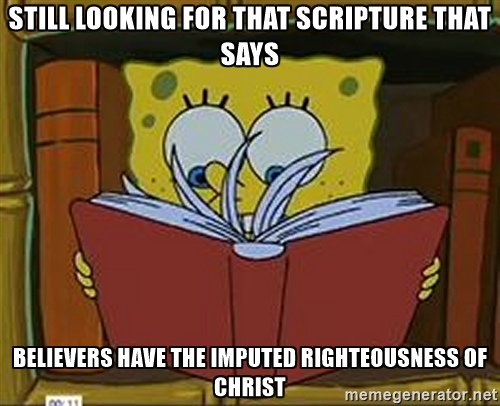 The contra Reformation gospel frees the Christian to aggressively obey God in sanctification because the only possible motivation is love because the other law is ended and has nothing to do with our justification. That is a finished work that has nothing to do with our Christian life. We are free to aggressively love without fear instead of being afraid that we are not properly living by faith alone which supposedly circumvents the satisfaction of the law via Jesus.
Learn to interpret your Bible accordingly: “Is this a justification verse, or a sanctification verse, and which law is being addressed?”
paul

 Paul's Passing Thoughts
leave a comment