TANC 2015 – Paul Dohse, Session 3: What is the Gospel?
We don’t hear much about one of the primary biblical terms used for “gospel.” The gospel is also known throughout Scripture as “the promise.” A promise made by God; think about that. But who is the promise to?
Acts 2:36 – Let all the house of Israel therefore know for certain that God has made him both Lord and Christ, this Jesus whom you crucified.”
37 Now when they heard this they were cut to the heart, and said to Peter and the rest of the apostles, “Brothers, what shall we do?” 38 And Peter said to them, “Repent and be baptized every one of you in the name of Jesus Christ for the forgiveness of your sins, and you will receive the gift of the Holy Spirit. 39 For the promise is for you and for your children and for all who are far off, everyone whom the Lord our God calls to himself.” 40 And with many other words he bore witness and continued to exhort them, saying, “Save yourselves from this crooked generation.” 41 So those who received his word were baptized, and there were added that day about three thousand souls.
This is an extraordinary text. Clearly, the gospel is a promise to all men contingent on believing in the promise, and resulting in the “gift” of the Holy Spirt. This is a fundamental principle of Biblicism: when a particular text is absolutely clear, and barring all assumptions, everything else must align logically with the concepts that are clearly stated.
Hence, the Protestant definitions of “election,” “called,” and “chosen” must be completely reevaluated. The gospel is a promise and a gift offered to all men.
…and you will receive the gift of the Holy Spirit. 39 For the promise is for you and for your children and for all who are far off, everyone whom the Lord our God calls to himself.
And who does the Lord call to himself? Everyone.
Turn to me and be saved, all the ends of the earth! For I am God, and there is no other (Isa 45:22).
And I, when I am lifted up from the earth, will draw all people to myself (Jn 12:32).
Say to them, ‘As surely as I live, declares the Sovereign LORD, I take no pleasure in the death of the wicked, but rather that they turn from their ways and live. Turn! Turn from your evil ways! Why will you die, people of Israel?’(Eze 33:11).
Biblicism does not reject mystery, or paradox, but always approaches the latter with extreme skepticism. Biblicists consider paradox guilty until proven innocent. God is not a God of confusion, but be sure of this: the paradox card is more times than not a license for a mystery that only the spiritual elite understand—those who have the rule over you.
If the promise and the gift are verbally offered to all people, but the offer is not legitimate for all, that makes the use of these words completely illogical. Though the issue of election will not be explored in this series, the basic wrongness of Protestants who propagate so-called “sovereign grace” must call their deterministic gospel into question. Those who have the basic gospel completely wrong cannot be trusted with the rest of the story.
However, the fact that salvation is a promise and a gift will be key to exposing the false gospel of Protestantism in simple terms. The Bible defines the gospel with these specific words for good reason – words mean things.
What is the Gospel?
1Corinthians 15:3 – For I delivered to you as of first importance what I also received: that Christ died for our sins in accordance with the Scriptures, 4 that he was buried, that he was raised on the third day in accordance with the Scriptures, 5 and that he appeared to Cephas, then to the twelve. 6 Then he appeared to more than five hundred brothers at one time, most of whom are still alive, though some have fallen asleep.
These are the facts of the gospel, but in Paul’s statement much more is assumed rightly because of other texts that further define what is being stated here in 1Cor 15:3-6. Obviously, no one is saved by a mere believing of the facts concerning the gospel. As James wrote, the devils believe also and do tremble in regard to their future condemnation. The facts do need to be believed, but what saves is the following of Christ in these facts. In other words, it’s not a mere believing of the facts, but also the belief of what the results of believing are, and a desire to want that for yourself.
You believe the promise, and the gift, and you want the gift for yourself. The gift is the baptism of the Spirit, and believing in the transaction that takes place. It’s believing the promise and “receiving” the gift.
Romans 6:1 – What shall we say then? Are we to continue in sin that grace may abound? 2 By no means! How can we who died to sin still live in it? 3 Do you not know that all of us who have been baptized into Christ Jesus were baptized into his death? 4 We were buried therefore with him by baptism into death, in order that, just as Christ was raised from the dead by the glory of the Father, we too might walk in newness of life.
5 For if we have been united with him in a death like his, we shall certainly be united with him in a resurrection like his. 6 We know that our old self[a] was crucified with him in order that the body of sin might be brought to nothing, so that we would no longer be enslaved to sin. 7 For one who has died has been set free from sin. 8 Now if we have died with Christ, we believe that we will also live with him. 9 We know that Christ, being raised from the dead, will never die again; death no longer has dominion over him. 10 For the death he died he died to sin, once for all, but the life he lives he lives to God. 11 So you also must consider yourselves dead to sin and alive to God in Christ Jesus.
12 Let not sin therefore reign in your mortal body, to make you obey its passions. 13 Do not present your members to sin as instruments for unrighteousness, but present yourselves to God as those who have been brought from death to life, and your members to God as instruments for righteousness. 14 For sin will have no dominion over you, since you are not under law but under grace.
It’s amazing that the unsaved understand this in their own way. It’s just a fact that the unsaved understand the gospel intuitively better than the vast majority of Protestants. Most unsaved people know that salvation involves the loss of who they presently are in exchange for a new life that is in the wind so to speak. This is what Christ was telling Nicodemus as recorded in John 3 and why Nicodemus came to Him under cover of darkness—Christ was a threat to the present life he knew. The fact that Christ told him that he must be born again which would result in a new, and completely unpredictable life correlates with the fact that Nicodemus came to Him under cover of darkness. Nicodemus was afraid of losing his present life, and therefore, Christ addressed the issue forthwith.
“Just believe” and “faith alone” minus the new birth is a Protestant hallmark. It boils down to a mere glorified assent to the facts of the gospel. It is not the losing of present life in order to find the new one. It is not repentance, i.e., a turning from the old life and following Christ in literal death and resurrection. Water baptism is a public confession that you understand this. Now many will protest that we are doing something to be saved other than believe; we are “following” Christ. But it is a decision, not some work of following. The Spirit does the baptizing, not us. We are saved by wanting that for our life and accepting the gift that is offered.
But likewise with any gift, once it is given, the receiver owns it. It is now up to us to work out our own salvation with fear and trembling (Phil 2:12,13). Here, “salvation” refers to redemption (the saving of the body, Rom 7:24, 8:23), not the saving of the soul, and work/fear refers to the new Christian person and life, not our onetime new birth. The Christian life is a process; the new birth is a onetime event. Before we were saved, our fear regarded condemnation. Now our fear regards chastisement and sin that leads to unnecessary deaths (consequences for sin). There is no work FOR salvation, but there is a work IN the Christian life, specifically, a work of love (Gal 5:6).
On the flipside, even though there is not a work FOR salvation (justification), there is a work IN being unsaved that has a specific wage paid by a specific master. We met him in the previous session, the sin master. This is how the Bible frames this: there are two masters who pay two different wages: one pays wages for death, and the other pays wages for life. ALL people in the world are earning one or the other in varying degrees. Either group can do bad or good works (Rom 6:20), but one can only be credited for death, and the other can only be credited for life. These are two different wages paid by two different masters.
These two groups, lost and saved, are under two different laws that determine their wages. The lost who belong to the sin master are “under law” and its condemnation, the law of sin and death. Those under this law can only bear fruits of death. In contrast, those purchased by Christ (“you have been bought with a price” 1Cor 6:20, 7:23) can only bear fruits for life. They are identified as “under grace,” or under the law of the Spirit of life (Rom 6:14, 8:20).
Romans 6:15 – What then? Are we to sin because we are not under law but under grace? By no means! 16 Do you not know that if you present yourselves to anyone as obedient slaves, you are slaves of the one whom you obey, either of sin, which leads to death, or of obedience, which leads to righteousness? 17 But thanks be to God, that you who were once slaves of sin have become obedient from the heart to the standard of teaching to which you were committed, 18 and, having been set free from sin, have become slaves of righteousness. 19 I am speaking in human terms, because of your natural limitations. For just as you once presented your members as slaves to impurity and to lawlessness leading to more lawlessness, so now present your members as slaves to righteousness leading to sanctification.
20 For when you were slaves of sin, you were free in regard to righteousness. 21 But what fruit were you getting at that time from the things of which you are now ashamed? For the end of those things is death. 22 But now that you have been set free from sin and have become slaves of God, the fruit you get leads to sanctification and its end, eternal life. 23 For the wages of sin is death, but the free gift of God is eternal life in Christ Jesus our Lord.
This is why Christ came to end the law (Rom 10:4). The law that He ended is the law of sin and death. EVERYONE born into the world is under the law of sin and death and condemnation. This is how we know Christ died for everyone ever born into the world. He also purchased mankind from the sin master; eternal life is the promise, new birth is the gift (if received by faith) resulting in freedom from condemnation and the fruits of death. The believer now “upholds” the law he/she is free to serve: the law of the Spirit of life also known as the “law of Christ” and the “law of liberty.” Salvation is a free gift, but the Christian life is a work that can earn rewards.
Hebrews 6:10 – For God is not unjust so as to overlook your work and the love that you have shown for his name in serving the saints, as you still do.
God would be unjust to forget you labor of love in sanctification because you are earning rewards, and there is no fear in regard to condemnation because that concerns judgement:
1John 4:18 -There is no fear in love, but perfect [mature] love casts out fear. For fear has to do with punishment, and whoever fears has not been perfected in love. [Because they fear condemnation].
This is what is critical about the new birth, or the baptism of the Spirit. The old man that was under the law of sin and death died with Christ, and is now free to “serve another” through being resurrected with Christ:
Romans 7:1 – Or do you not know, brothers—for I am speaking to those who know the law—that the law is binding on a person only as long as he lives? 2 For a married woman is bound by law to her husband while he lives, but if her husband dies she is released from the law of marriage. 3 Accordingly, she will be called an adulteress if she lives with another man while her husband is alive. But if her husband dies, she is free from that law, and if she marries another man she is not an adulteress.
4 Likewise, my brothers, you also have died to the law through the body of Christ, so that you may belong to another, to him who has been raised from the dead, in order that we may bear fruit for God. 5 For while we were living in the flesh, our sinful passions, aroused by the law, were at work in our members to bear fruit for death. 6 But now we are released from the law, having died to that which held us captive, so that we serve in the new way of the Spirit and not in the old way of the written code.
Here is a good place to speak of God’s calling to mankind. This is a good place to talk about how God pushes man to the brink of salvation—to the gates of the kingdom. God, in His calling of man, does everything but make the decision for him.
First, God creates every human being with the works of God’s law written on their hearts, and a conscience that either excuses or accuses them. Those without the word of God will be judged by this internal law, while the religious will be judged by both (Rom 2:12-16). Until a human being develops a conscience, they are not under any law and therefore without sin (Rom 4:15). Man has intuitive knowledge of God’s gospel (Rom 1:18-21).
Secondly, the Holy Spirit uses the law of sin and death to convict the world of sin, righteousness, and the judgment to come (Jn 16:8).
Thirdly, believers use the law of sin and death to convict the world of sin, righteousness, and the judgment to come.
Fourthly, believers testify about God to the world with their lives (Matt 5:14-16).
Fifthly, Christ has purchased all men with His death on the cross. Their sin debt is prepaid. They have already been purchased from the sin master. They themselves choose to remain under the control of their present master, but their contract has been bought out, they are free to choose Christ as their new master.
Sixthly, even the law that condemns unbelievers holds their sin captive. Even the law of sin and death is a “ministry” (2Cor 3:7-11). The first covenant which is passing away (Heb 8:13) held sin captive in the law of sin and death until Christ came (Gal 3:19-27). Christ ended the law for righteousness to those who believe in Him. Our sins are not merely covered—they are ENDED along with the law of sin and death. ALL sin was held captive in the law of sin and death that the old us was under, but upon believing, that man died and is now under the law of the Spirit of life (Rom 8:2). We are now fee to work through love as guided by the Scriptures (Gal 5:6,7). Our obedient love fulfills the law (Gal 5:14, Rom 8:4, Rom 13:8-10, Matt 22:34-40).
Seventh, God increased the law through the first covenant to drive man towards him (Rom 5:20).
Eighth, God made man a living being, but after the fall he made mankind His very family (Gal 3:29, Heb 2:11).
Ninth, in the end, God will vacate heaven and dwell with His family on earth. God Himself comes DOWN to earth to dwell with man (Rev 21:3).
This is some of the good news of God’s love for mankind.
TANC 2015, Andy Young – Session 3: The Believer’s Identity
This is session 3. We’ve been challenging presuppositions regarding a believer’s identity, especially this notion that believers are sinners. That’s what we hear most often in just about every Christian circle, in just about every church you go to around the world. The emphasis that we are sinners. That because we are sinners we still need a savior. And of course this particular emphasis flows right out of the reformation. This was taught by Calvin and Luther, this idea that believers don’t change, that they are still under law, that they are still in need of daily salvation. We have a term for that, it’s called progressive justification. And whether people want to admit it or not, anyone who echoes these kinds of sentiments – and this is just one indication of the kind of theological ignorance that exists among believers, they are actually espousing a progressive justification viewpoint with these kinds of statements.
So we’re trying to reverse the damage that has been done to the spiritual psyche of the believer as a result of years and years of having this mantra constantly pounded into our heads. You are a sinner, you are a sinner, you are not perfect, you are totally depraved, your righteousness is filthy rags. We need to stop telling ourselves these things, and we need to change the narrative and look at what the Bible actually has to say in this regard.
Session 1 was devoted to our identity with respect to the new birth. What that actually means to be born again, and why that is important. And then in session 2 we explored the contrast between the old and the new, and we saw how that the “New Man” is actually a reference to the one spiritual body that was made up of people from every nation and status in the world. How we are no longer identified as either Jew or Greek, etc…and we become part of this New Man, the Body of Christ.
So now in this last session on the believer’s identity, I want to take a look at a few more ways that the scriptures refer to believers. And these won’t spend as long as we did on the first two, so we should be able to run through these rather quickly, but that doesn’t make them any less important. Each one of these is a critical part of our identity as believers.
So the Bible says the believer is born again, he is a new creature, he is part of the New Man, the Body of Christ. What else is he?
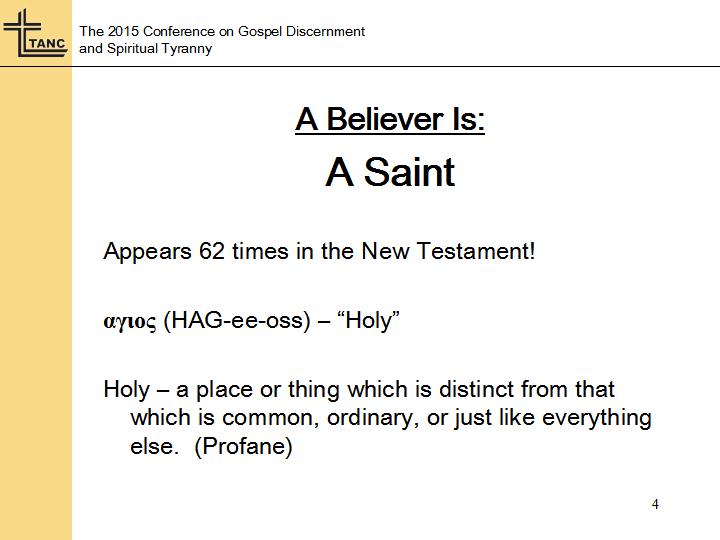
A saint
How is that for a title? Did you know you’re a saint? Now here is a word that couldn’t be any farther opposite from sinner! Do you know how many times believers are referred to as sinners? I could probably point to no more than maybe 5 at most. And even in those instances it is always in the past tense. Do you realize the frequency that believers are referred to as saints? 62 times in the NT, believers are referred to as saints. 62 times! I’m not going to show you all of them, but here are a few select. You’ll see that in just about every epistle the believers are addressed as saints in the salutation.
Romans 1:7 “To all that be in Rome, beloved of God, called to be saints: Grace to you and peace from God our Father, and the Lord Jesus Christ.”
1Corinthians 1:2 “Unto the assembly of God which is at Corinth, to them that are sanctified in Christ Jesus, called saints, with all that in every place call upon the name of Jesus Christ our Lord, both theirs and ours:”
Ephesians 1:1 “Paul, an apostle of Jesus Christ by the will of God, to the saints which are at Ephesus, and to the faithful in Christ Jesus:”
Romans 15:25-26 “But now I go unto Jerusalem to minister unto the saints. 26 For it hath pleased them of Macedonia and Achaia to make a certain contribution for the poor saints which are at Jerusalem.”
Ephesians 4:12 “For the perfecting of the saints, for the work of the ministry, for the edifying of the body of Christ:”
And we could go on and on and on. Believers are saints. Now, as if that wasn’t exciting enough, take a look at this word in the Greek. Do you know what the word saint is in the Greek?
αγιος (hag-ee-oss) – “Holy”
Look at that. Holy. In each of the 62 instances it is this word for holy. That means you could go through each instance, 62 times in the NT, and replace the word saint with holy, or holy ones. The Bible calls believers “holy ones”. You are holy. Did you know that? You are not a sinner, you are holy! You are a holy one.
Now if any of you watching online now or maybe later on when this is archived, if you tuned in last year for the conference you will remember I talked about Sanctification. And in my first session last year I walked us through scripture and we were able to derive a truly biblical, meaningful definition of this word holy? Does anyone remember what we came up with? If you don’t remember or if you didn’t tune in for that session, here is the definition we came up with for holy.
Holy – a place or thing which is distinct from that which is common, ordinary, or just like everything else. (profane)
And as we worked through our understanding of this word we discovered that the opposite of holiness was not sinfulness, but profane. And profane in the Biblical sense has to do with this idea of being common, or ordinary, or just like everything else. So, while it is true that believers are not sinners – we’ve already established that through the new birth – we have a special status. We are holy. We are distinct from that which is profane. We are not common, we are not just like everybody else. Some people like to use the term “set apart” as a means of understanding our sanctification, and that’s a good way to look at it because it encompasses this notion of being distinct. Setting something apart makes it distinct.
So this takes us back to the sanctification issue that I talked about last year. And I think it begs the question, if we are saints, if we are holy, if we are distinct, ought we to not act like it? And I don’t mean we go around casting judgment on others and act like we are better than everyone else. But if we are in fact holy, don’t you think our behavior should reflect that holiness? See, we don’t let our behavior define who we are, but rather I think it’s the other way around, who we are should manifest itself in our behavior. And you can think back to our last session on the New Man, were we had this contrast between behaviors that characterized the old man, like lying and arguing and licentiousness, and behaviors that characterize the New Man, loving each other, caring for each other, and so on. And you see the motivation for this is love. This has to do with love for the law and keeping the law. Not for justification, but because we love our Father and we love others, so we use the law in this way, we keep the law out of a motivation of love. And this is the reality of what it means to be a saint; to be a holy one.
So believer’s are saints. What else are we? How does the Bible refer to believers?
Oh I love this one.
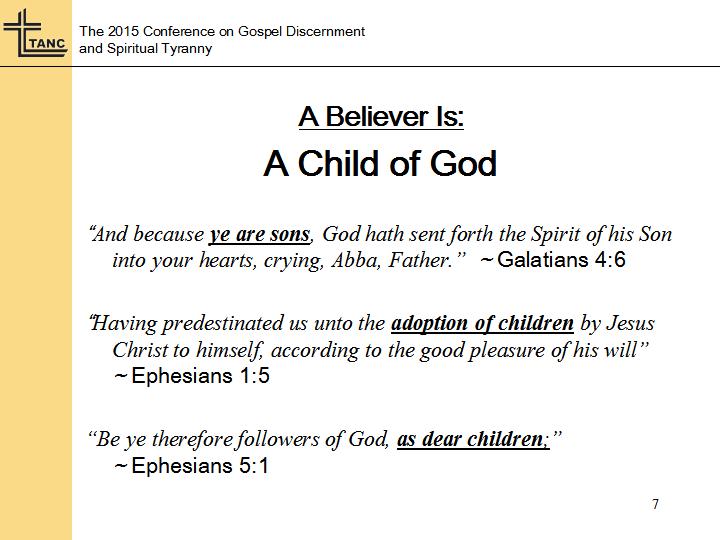
A child of God
I know I have a lot of references here, but can we just take the time to read through these. It’s such a good reminder, and it’s such a blessing!
Romans 8:14 “For as many as are led by the Spirit of God, they are the sons of God.”
Romans 8:16-17 “The Spirit itself beareth witness with our spirit, that we are the children of God: 17 And if children, then heirs; heirs of God, and joint-heirs with Christ; if so be that we suffer with him, that we may be also glorified together.”
Romans 9:26 “And it shall come to pass, that in the place where it was said unto them, Ye are not my people; there shall they be called the children of the living God.”
2 Corinthians 6:18 “And will be a Father unto you, and ye shall be my sons and daughters, saith the Lord Almighty.”
Galatians 3:26 “For ye are all the children of God by faith in Christ Jesus.”
Galatians 4:6 “And because ye are sons, God hath sent forth the Spirit of his Son into your hearts, crying, Abba, Father.” (daddy reference)
Ephesians 1:5 “Having predestinated us unto the adoption of children by Jesus Christ to himself, according to the good pleasure of his will”
Ephesians 5:1 “Be ye therefore followers of God, as dear children;”
1 Thessalonians 5:5 “Ye are all the children of light, and the children of the day: we are not of the night, nor of darkness.”
1 John 3:1-2 “Behold, what manner of love the Father hath bestowed upon us, that we should be called the sons of God… 2 Beloved, now are we the sons of God…”
And of course this goes right back to all the things we talked about in session 1. How is it that we are children of God? We are children by virtue of the new birth. Do you see how significant the new birth is?
Being born again, being born of the spirit is being born of God. Where God is your Father, and you are His child. If you deny the new birth, you deny your identity as a child of God and you forfeit all the rights that go with that as being sons.
Now there’s a lot more that can be said about the significance of being a child of God. You saw the reference about being an adopted child. Now an adopted child is what, one who was not born to the parents who have legal custody of him, right? So I don’t want us to misunderstand when Paul uses this terms referring to adopted children. The new birth is a reality. We are born of God in every sense of that word. The new birth is an actual birth. It is not something that we have already that God then accepts as His own and reforms it.
What Paul is referring to here to the Ephesians has to do with the relationship to Israel. There was always this distinction between promises made to Israel that will be fulfilled with Israel, and how Israel would always have a claim to the promises and covenants that God made to her children. And since the Gentiles were not part of Israel, what happens when a Gentile believes is that he is then made part of Israel, adopted in that sense, and so he then has access to those same promises by rights as an adopted child. He said this also in Galatians that those who come to faith in Christ are considered the children of Abraham, adopted into the promises made to Israel. And he elaborates on this even further in Romans. So I want you to understand that this notion of adoption is a reference to being included with Israel in the promises and does not contradict the reality of the new birth.
There is another significance to being a child of God. Let me ask you something. Those of you who have children, when your children disobey you, do they stop being your children? When your child fails somehow, does he stop being your child? Or when your child grows up and starts his own family, even though he is no longer under your roof, does he stop being your child? Does your child ever stop being your child? No, and so from this we begin to understand this doctrine of eternal security. You want to know why you can never lose your salvation? Because you are a child of God. God never disowns you. You can’t be unborn into His family.
Now of course we know of instances where our children may not want to be a part of our family. They may run off and not act like our child. But they are still our child. There is some aspect of this to be found in the parable of the prodigal son. Now I understand that the main purpose of that parable was to draw a contrast between the Pharisees and the other religious leaders and the remainder of Israel, and that Israel was like a lost son who had run away from his Father. Jesus said he came to save the lost children of Israel. And so there is this picture of God calling out to his lost children to come home to him. But if you notice something else in that story, the prodigal son never stopped being a son. The Father looked for him every day to come home. He was ready to bestow upon him the riches that were there for him. And so in that sense there are sometimes believers who wander away and don’t act like sons, but they never stop being sons.
And I kind of touched on another point there; this thing about being a child has other significance too that I will get to in a moment. But before we get to that, along with being a child of God is this next point.
A brother of Christ
This one might be a little controversial because it’s not something that you here brought up much if at all. But I think it is a reality that is taught in scripture. Scripture doesn’t say much about Christ being our brother, but there are a few passages that reference it. Let’s start with this.
Matthew 12:46-50
“While he yet talked to the people, behold, his mother and his brethren stood without, desiring to speak with him. 47 Then one said unto him, Behold, thy mother and thy brethren stand without, desiring to speak with thee. 48 But he answered and said unto him that told him, Who is my mother? and who are my brethren? 49 And he stretched forth his hand toward his disciples, and said, Behold my mother and my brethren! 50 For whosoever shall do the will of my Father which is in heaven, the same is my brother, and sister, and mother.”
Alright, so what exactly is Jesus saying here? Let’s first understand that when we read the word “disciples” in any of the synoptic gospels that it’s not just a reference to the 12 disciples. It is clear if you read the gospels that Jesus had a lot more disciples or learners that just Peter, Andrew, James, John, and the rest. Whenever the writer wants to make this distinction he usually refers to them as “the twelve”. But whenever we see the generic reference “disciples” that’s a reference to all of them. And this was a number that reached into the hundreds at times.
So among these disciples following Jesus, are any of them his mother? No. So it’s easy to assume that when Jesus makes this statement in verse 49 that it is not a literal reference to his physical earthly family. Not only that, but Jesus Himself states very plainly what he means by his statement. He explains it. Whosoever shall do the will of my Father which is in heaven, the same is my brother, and sister, and mother. We all have people in our lives that we regard as family who are not literally a part of our family. I have a very good relationship with my wife’s parents, and I regard them as my mother and father ever though they did not give birth to me. I even call them Mom and Dad. That’s the kind of relationship we have. That is how close we are. You may have a best friend who you think of more as a brother or sister than simply a friend. And of course this has to do with the nature of your relationship with them.
So the point Jesus is making in this statement has to do with how He views His relationship with those who do the will of the Father. He views them as family. Now by extension, we can take this one step further. When we consider the reality of the new birth, that those who do the will of the Father are those who are born again, then in reality, we are then literally part of God’s family, including the Son, Jesus. So as far as God’s family is concerned, we are all brothers and sisters, and that would include Jesus. We can be considered as brothers and sisters of Christ. And I believe in this passage here in Matthew, that is exactly what Jesus is talking about. But what else does scripture have to say about this family relationship we have with Jesus?
Romans 8:29
“For whom he did foreknow, he also did predestinate to be conformed to the image of his Son, that he might be the firstborn among many brethren.”
I’ve underlined the key phrase in that verse. If you study the grammatical structure of that verse, “firstborn among many brethren” is speaking of the Son. And the preposition “among” is inclusive. It indicates inclusiveness. If you are among something you are part of it. If you are among the crowd you are included in the crowd. What Paul says here is that there are many brethren, and Jesus is one of them, more than that, he’s the oldest. He is the firstborn. And if we think back to our study of the Body of Christ, the New Man, His right as firstborn makes Him the Head. How is it that Jesus is firstborn? He was the first resurrected following the ending of the law. And as such, each believer, by virtue of the new birth is resurrected just like Christ, we are born anew, as new creature that is not under law. A new creature that is also a child of God. And if we are a child of God, and Jesus is the Son of God, that makes Jesus our brother. Our oldest brother, our firstborn brother. We see this same idea expressed here as well.
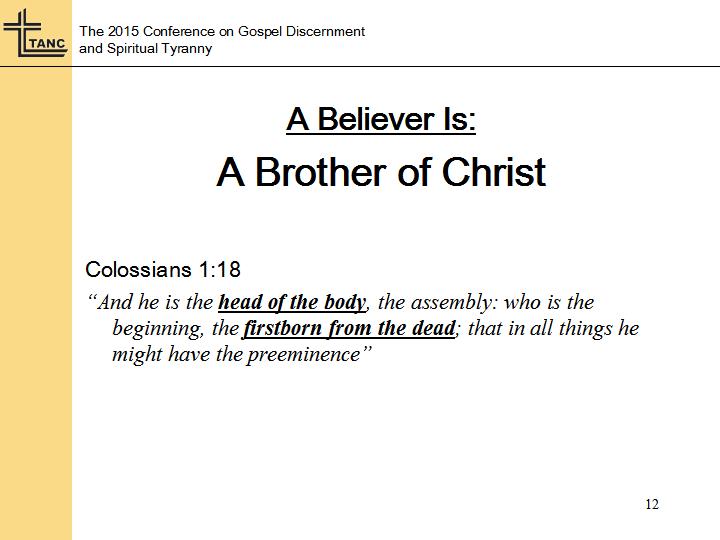
Colossians 1:18
“And he is the head of the body, the assembly: who is the beginning, the firstborn from the dead; that in all things he might have the preeminence”
Here again is that reference to Jesus being the firstborn, and His right as firstborn to be the Head of the Body. If any of you out there are an only child and have always wanted a brother or a sister, think about what a wonderful reality it is to know that you are now part of a family full of brothers and sisters, and the God of Heaven is your Father. And because of that, Jesus, the King of Kings, is your brother!
Now we’re talking about brothers and sisters and families, and I want to jump back to another point I alluded to earlier when we were talking about being a child of God. I mentioned how that being a child of God has another significance to it. As the Son of God, Jesus was entitled to certain privileges. As the firstborn, He is made Head of the Body. We have certain privileges as well, since we are also children of God because of the new birth.
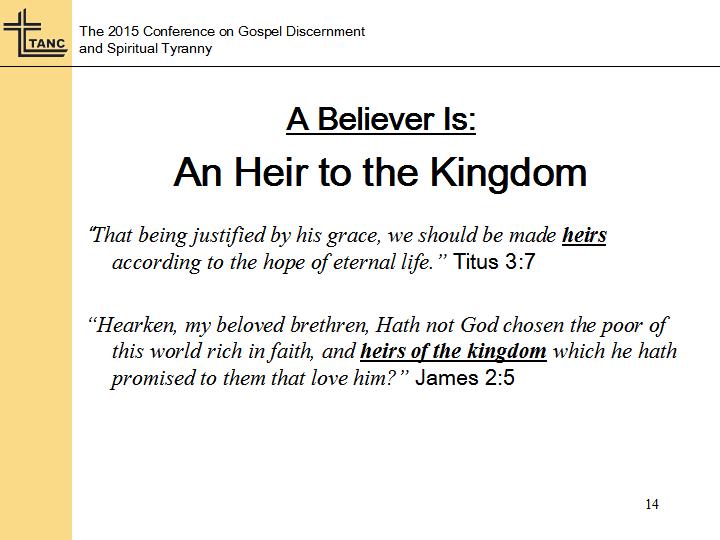
Because of the new birth, the believer is an heir to the Kingdom of God.
An heir to the Kingdom
And this is the last point I have about a believer’s identity. An heir to the Kingdom! Take a look at some of these passages
Romans 8:17
“And if children, then heirs; heirs of God, and joint-heirs with Christ; if so be that we suffer with him, that we may be also glorified together.” Here’s another reference that alludes to Jesus being our brother. We are joint heirs with Christ.
Galatians 3:29
“And if ye be Christ’s, then are ye Abraham’s seed, and heirs according to the promise.”
Being born again makes us part of Abraham’s children and eligible to participate in the promises and covenants made to Israel.
Titus 3:7
“That being justified by his grace, we should be made heirs according to the hope of eternal life.”
James 2:5
“Hearken, my beloved brethren, Hath not God chosen the poor of this world rich in faith, and heirs of the kingdom which he hath promised to them that love him?”
Of course when you talk about being an heir to something that means that there is an inheritance waiting for you.
Inheritance
Ephesians 1:14
“Which is the earnest of our inheritance until the redemption of the purchased possession, unto the praise of his glory.”
This is talking about the Holy Spirit. The Holy Spirit is an earnest payment. Like a down payment. A good faith payment that there will be a full payment coming at a later time. The Holy Spirit is a part of our inheritance given to us now as an indication of a promise of more that is to come later.
Ephesians 1:18
“The eyes of your understanding being enlightened; that ye may know what is the hope of his calling, and what the riches of the glory of his inheritance in the saints,”
Colossians 1:12
“Giving thanks unto the Father, which hath made us meet to be partakers of the inheritance of the saints in light:”
Colossians 3:24
“Knowing that of the Lord ye shall receive the reward of the inheritance: for ye serve the Lord Christ.”
1 Peter 1:3-4
“Blessed be the God and Father of our Lord Jesus Christ, which according to his abundant mercy hath begotten us again unto a lively hope by the resurrection of Jesus Christ from the dead, to an inheritance incorruptible, and undefiled, and that fadeth not away, reserved in heaven for you,”
And there are several things that are in view here with regard to inheritance, eternal life not the least of them. An incorruptible body, eternal fellowship with the Father. We don’t really know what we will be doing for eternity, but we know for certain that there is a Kingdom that awaits us. This is what Jesus came to earth to offer. You may have heard pastors say, what did Jesus preach? What was His message? And they’ll say He preached the gospel. We need to preach the gospel. Well what gospel? The word for gospel simply means a good message. Any good message is the gospel. The word for evangelist is literally “good messager” To evangelize means to “good message” someone. To deliver a good message. To deliver the gospel. But what gospel?
When you go back and read through the NT, if you study carefully, what you will notice consistently is that when a reference is made to the gospel, it is consistently referred to as the gospel of the Kingdom. When Jesus is introduced in the gospels, when His ministry first starts, it says he was preaching the gospel of the Kingdom. The apostles preached the gospel of the Kingdom. This is what we have to offer people when we tell them about Christ. He came to offer a Kingdom. And your ticket into the Kingdom is the new birth through faith in Christ. The new birth makes you a child of God. As His child you have an inheritance waiting for you. You have the right to everything that the Father owns. He bestows it upon you.
One day, this old heaven and earth are going to melt away with a fervent heat. And in their place will be a new heaven and a new earth. And the City of God, the New Jerusalem will descend from heaven and come down upon this new earth. And God will make His tabernacle with man. God will dwell with man forever and ever. This is the city that Abraham looked for. A city not made with hands, whose builder and maker is God. And we will dwell there with the Father. This is what we have to look forward to! This is our inheritance as believers.
I hope that at the end of this study you have a better understanding of just who we are. We are not sinners. We are not totally depraved, unrighteous, wretched people. We are new creatures. We are born again. We are part of the New Man with Christ as the Head. We are God’s children. Son’s and Daughters of the heavenly Father. We a part of God’s family with Jesus as our brother, joint heirs with Him in a heavenly inheritance that awaits us. This is the blessed hope that Paul spoke of. Not hope as in a wishful thinking. This is a hope that is a joyful anticipation of something that is assured. As believers, this is the way we need to be thinking. We need to be aware of just who we are. This is knowledge that empowers us and affects everything we do in life. We go into the world armed with this knowledge, think of how much more effective our witness and our testimony is to those we’re trying to reach with the gospel. Think of how much better our own lives will be. We focus on the good instead of evil. We don’t rejoice in iniquity.
And I could go on and on here, but I hope you get the point. And I think that might be a good way to wrap up this session, by opening things up to you out there, and let me ask you, how do you apply this to your life? What does this mean for you personally? How does this affect you? What ways does this make you think differently? I leave you with these questions, so please feel free to answer and share with us any thoughts you might have.
Podcast link: listen or download audio file.










Reformed Questions in Response to “False Reformation”
Originally published December 11, 2012
Paul,
Just a few questions:
1. If you accept the idea that “flesh” and “spirit” refer to parts of regenerate believers rather than to spheres in which people live and by which we are controlled, where does sanctification take place, in the flesh or in the spirit? The same question applies in terms of “old man”/ “new man.” Which of those grows in sanctification?
Answer: This question reflects the fact that the Reformed crowd doesn’t openly discuss what they really believe about this issue, and I commend you accordingly. Authentic Reformed doctrine holds to the idea that the active obedience of Christ is manifested in the “Spirit realm” as a result of what we see in the Bible being imputed to us by faith alone in sanctification (see Luther’s Heidelberg Disputation, theses 27). We don’t change. The “Spirit realm” and the “flesh realm” are two forces that put pressure on us, and at any given time, we “yield” to one or the other. This is the position of the elders who are over the NANC training center in Springboro, Ohio according to an email I received from them when they thought I was on board with their doctrine.
Of course, the take on this varies among those in the Reformed tradition. Another example would be the idea that we are still dead spiritually, and the living Christ within us is the one obeying. What is consistent is the idea that this obedience is experienced in a certain way: joy and a willing spirit (see LHD, theses 27); that’s how we know Jesus is doing it and not us. At any rate, the crux of Reformed theology is that all good works take place outside of the believer; i.e., Luther’s “alien righteousness” for not only justification, but for sanctification as well. Your question is at the very core of debates that took place between heretic Dr. Ed Welch of CCEF and the commendable Dr. Jay Adams.
Jay Adams oversees INS as he was pretty much run out of NANC and CCEF—largely due to the fact that NANC and CCEF are both bastions of evil. I find it utterly intolerable that thousands are sent to these organizations daily with the hope of change when these Reformed organizations in fact don’t believe that God changes them. There are no words for my loathing of such hideous deception while these organizations also take people’s hard-earned money to boot. And some don’t go along with these ideas, but they stand silent and therefore are just as guilty. And my “whole life” is contending against this? Perhaps, but better that than one’s whole life buying acceptance with silence. Moreover, people praise CJ Mahaney and co. for their tireless night and day service to the “gospel” which is really the work of the kingdom of darkness against the kingdom of light. A pity that I would counter that with my own life.
Unfortunately, Adams, who is much more advanced in patience than I am—associates with them, and in my estimation thereby causes confusion regarding the kind of counseling that will change people. Also, the possibility that the only biblical counseling organization left on the face of the earth that is not infected with Trippism and Powlisonism is also a major concern. Nevertheless, Adams and his associate, Donn Arms, are the only ones who have taken a stand against the heretical onslaught taking place in biblical counseling circles which is fraught with mindless followers, lackeys, lovers of filthy lucre, shameless cowards, and lying integrationists. The idea that these people care about any marriage or the well being of any saint is laughable.
But to answer your question completely, I believe the Scriptures are clear that the old self was put to death and no longer has the ability to enslave us to sin. The old self was “under the law” which means that the law provoked him to sin and a final judgment according to the law. As long as we are alive, our mortality has influence over us in regard to the old ways of being under the law, but the enslavement is broken. We are in fact born again, and have a regenerated “law of our mind.” Hence, “the spirit is willing, but the flesh is weak.” The warfare takes place inside of the believer between the law of his mind and the “law of sin.” The apostle makes it absolutely clear: this warfare takes place between my “inner being” and “in my members.” What is clearer? Unless the Bible is a Reformed gospel narrative that isn’t meant to inform our co-laboring with God in sanctification. But it is, because we are no longer “under” it for justification, but are informed by it for sanctification. Because the Reformers believe we are still under it, we must continue to live by the gospel that saved us from the law. We are still under it, but Jesus keeps it for us. How this is applied to the Christian life by the Reformers is outright Gnosticism to the core.
Furthermore, the “law of my mind” part of the believer that “delights in the law” in our “inner being” is what grows. Something in us is in fact growing: a host of passages that include 1Peter 2:1-3 make this certain. Really? Jesus isn’t really talking to us when he states, “Well done faithful servant”?
2. Do you believe sanctification occurs completely apart from faith? Do we have everything we need at the point of regeneration, so that further dependence on the Holy Spirit is no longer necessary? It sounds as if that is what you are saying.
Answer: Your question is framed within the confines of the Reformed either/or hermeneutic. Reality is either interpreted through the “glory story” or the “cross story.” This is the interpretive foundation of Reformed theology as stated in Luther’s HD. Because sanctification includes us, it must be by faith alone like salvation or it includes our glory as well. Therefore, where faith is, it must be by faith alone because faith is of God who will not share His glory with another. Therefore, if our doing is involved with sanctification, it must occur completely apart from faith. It must be the glory story, or the cross story. Reformed proponent Gerhard Forde states this in no uncertain terms.
Biblicists reject that metaphysical presupposition with prejudice. We stand with our beloved brother James, whom Luther rejected for obvious reasons, in saying that faith and works are together in sanctification while faith is alone in justification. Luther and his Reformed minions believe that grace is fused with works apart from our faith when it is faith in the works of Christ alone in sanctification (LHD theses 25).
Also, “Do we have everything we need at the point of regeneration, so that further dependence on the Holy Spirit is no longer necessary?” Again, we see Reformed metaphysics. If any part of our story is in the narrative, it’s semi-Pelagianism and not the cross story. This is a rather simple concept. All of the power that raised Christ from the dead is credited to our account in salvation. The Holy Spirit, our “HELPER” (ESV) “helps” us (that’s what a “helper” does, they “help”) in appropriating the blessings of salvation. He aids us (that’s what a “helper” does, he “aids”). And those blessings are appropriated “IN” (that’s a preposition) the DOING (James 1:25).
3. Do you believe Jesus’ actions are ever to be considered not only as instructional as a pattern for our obedience, but as motivation to imitate him?
Answer: As many have forcefully argued in several articles, especially Presbyterian Pastor Terry Johnson, God uses many different incentives to motivate us other than gratitude and meditating on the salvific works of Christ. This was also Adams’ primary contention against Sonship Theology.
4. Do you see any difference between God’s work in a believer that replaces his need to obey and God’s work in believers motivating them to obey?
Answer: The very question suggests a “need” to “replace (s)” the “need” of a believer to “obey” in sanctification? Of course, a clear distinction is not made regarding….in sanctification or justification? But, NO SUCH NEED EXISTS for sanctification. Our work in sanctification has NO bearing on our justification. The premise of the question is based on faulty Reformed presuppositions.
5. How do you see the Reformed doctrine as teaching that sanctification completes justification?
Answer: They call it a “CHAIN” (The golden chain of salvation-Romans 8:29,30). What’s a “chain”? What happens if you remove the middle links of a “chain” ? It’s not completed—this would seem apparent.
paul
Escaping Church and its Culture of Death
 “This isn’t a technique for boosting our spiritual growth; this is a means of re-salvation because we are still technically lost and under law. ‘Under grace’ merely qualifies us for perpetual re-salvation. That’s Protestantism…period!”
Week in, and week out, and days in-between, professing Christians meet at a local institutional church to further indoctrinate their families in the Protestant culture of death. It doesn’t seem like death as families cheerfully socialize together and lift up their hands as the hipster praise bands make a joyful noise to the Lord. In addition, charismatic orators speak of things that are clearly in the Bible.
But let’s talk about good old fashioned theological math found in the Bible. The Bible addresses the only two people groups that exist in the world: the lost and the saved. As professing Christians, we want to be biblically defined as saved people, no? Can a case be made in this post that present-day evangelicals define themselves according to what the Bible defines as “lost.” Yes. All in all I am sure you will agree; any religion that defines itself as unregenerate is a really bad idea.
Here is how the Bible defines the two people groups:
Romans 6:14 – For sin will have no dominion over you, since you are not under law but under grace.
Every person living in the world is under law or under grace; lost or saved. Protestants define themselves as under law with under grace as a covering. Romans 6:14 is defined this way:
We are under grace because the righteousness of Christ continually saves us from being under law.
So, with Protestantism, it’s both. Under grace means we are still under law but progressively saved by grace. Under law is who we are, while we “experience” grace. Under law is what we do, under grace is what we experience. Supposedly, when Paul stated that we are “not” under law, what he really meant to say is under law is the absence of grace. The lost are only under law, but the saved are under both.
Hence, we are still under the “righteous demands of the law,” but if we are under grace, Jesus keeps the law for us. This is achieved by focusing on our sinfulness against the law, and returning to the same gospel that originally saved us out of gratitude. Objections to this idea are met with accusations of indifference to Christ’s sacrifice. Therefore, the “Christian” must live a “lifestyle of repentance” and constantly seek a “greater revelation of self” which is inherently sinful. The goal is to plunge the depths of our supposed total depravity. And if you are paying attention, our sin and the original gospel that saved us are the constant drumbeats we hear in the institutional church week in and week out.
Consequently, our goal is to see more and more of our reality of being under law resulting in an increased joy regarding our original salvation. Mainline evangelical Paul Washer states it this way:
At conversion, a person begins to see God and himself as never before. This greater revelation of God’s holiness and righteousness leads to a greater revelation of self, which, in return, results in a repentance or brokenness over sin. Nevertheless, the believer is not left in despair, for he is also afforded a greater revelation of the grace of God in the face of Christ, which leads to joy unspeakable. This cycle simply repeats itself throughout the Christian life. As the years pass, the Christian sees more of God and more of self, resulting in a greater and deeper brokenness. Yet, all the while, the Christian’s joy grows in equal measure because he is privy to greater and greater revelations of the love, grace, and mercy of God in the person and work of Christ. Not only this, but a greater interchange occurs in that the Christian learns to rest less and less in his own performance and more and more in the perfect work of Christ. Thus, his joy is not only increased, but it also becomes more consistent and stable. He has left off putting confidence in the flesh, which is idolatry, and is resting in the virtue and merits of Christ, which is true Christian piety (Paul Washer: The Gospel Call and True Conversion; Part 1, Chapter 1, heading – The Essential Characteristics Of Genuine Repentance, subheading – Continuing and Deepening Work of Repentance).
This not only turns the Bible completely upside down, but leaves the Christian in a lifestyle of death while rejoicing in it. This is a true celebration of death, and church is the culture thereof. Romans 6 is clear about what it means to remain under law:
3 Do you not know that all of us who have been baptized into Christ Jesus were baptized into his death? 4 We were buried therefore with him by baptism into death, in order that, just as Christ was raised from the dead by the glory of the Father, we too might walk in newness of life.
5 For if we have been united with him in a death like his, we shall certainly be united with him in a resurrection like his. 6 We know that our old self was crucified with him in order that the body of sin might be brought to nothing, so that we would no longer be enslaved to sin. 7 For one who has died has been set free from sin. 8 Now if we have died with Christ, we believe that we will also live with him. 9 We know that Christ, being raised from the dead, will never die again; death no longer has dominion over him. 10 For the death he died he died to sin, once for all, but the life he lives he lives to God. 11 So you also must consider yourselves dead to sin and alive to God in Christ Jesus.
Obviously, if we believe our formal sinful self has been “brought to nothing,” Paul Washer’s sanctification construct is impossible, and his statement speaks to the authentic soteriology of the Protestant Reformation. How do you achieve a greater revelation of your sinful self when your former sinful self has been “brought to nothing”?
You don’t, which leaves the “believer” yet under law and in need of salvation. The “believer” needs to continually return to the same gospel that saved him/her in order to remain saved. Instead of the new birth being a onetime event that brings the former sinner to “nothing,” the new birth is defined as a joy experience resulting from revisiting the gospel afresh for forgiveness of sin that still condemns us.
This cycle simply repeats itself throughout the Christian life. As the years pass, the Christian sees more of God and more of self, resulting in a greater and deeper brokenness. Yet, all the while, the Christian’s joy grows in equal measure because he is privy to greater and greater revelations of the love, grace, and mercy of God in the person and work of Christ (Ibid).
We are asking the question, How does the gospel save believers?, not: How does the gospel get people to be believers?… Believers need to be saved. The gospel is the instrument of God’s power to save us. And we need to know how the gospel saves us believers so that we make proper use of it (John Piper: Part 2 of a series titled, “How Does the Gospel Save Believers”).
Progressive sanctification has two parts: mortification and vivification, ‘both of which happen to us by participation in Christ,’ as Calvin notes….Subjectively experiencing this definitive reality signified and sealed to us in our baptism requires a daily dying and rising. That is what the Reformers meant by sanctification as a living out of our baptism….and this conversion yields lifelong mortification and vivification ‘again and again.’ Yet it is critical to remind ourselves that in this daily human act of turning, we are always turning not only from sin but toward Christ rather than toward our own experience or piety (Michael Horton: The Christian Faith; mortification and vivification, pp. 661-663 [Calvin Inst. 3.3.2-9]).
…by new sins we continually separate ourselves, as far as we can, from the grace of God… Thus it is, that all the saints have need of the daily forgiveness of sins; for this alone keeps us in the family of God (John Calvin: Commentaries on the Catholic Epistles; The Calvin Translation Society 1855. Editor: John Owen, p. 165 ¶4).
Moreover, the message of free reconciliation with God is not promulgated for one or two days, but is declared to be perpetual in the Church (2 Cor. 5:18, 19). Hence believers have not even to the end of life any other righteousness than that which is there described. Christ ever remains a Mediator to reconcile the Father to us, and there is a perpetual efficacy in his death—viz. ablution, satisfaction, expiation; in short, perfect obedience, by which all our iniquities are covered (The Calvin Institutes: 3.14.11).
Where we land on these issues is perhaps the most significant factor in how we approach our own faith and practice and communicate it to the world. If not only the unregenerate but the regenerate are always dependent at every moment on the free grace of God disclosed in the gospel, then nothing can raise those who are spiritually dead or continually give life to Christ’s flock but the Spirit working through the gospel. When this happens (not just once, but every time we encounter the gospel afresh), the Spirit progressively transforms us into Christ’s image. Start with Christ (that is, the gospel) and you get sanctification in the bargain; begin with Christ and move on to something else, and you lose both (Michael Horton: Christless Christianity; p. 62).
Nor by remission of sins does the Lord only once for all elect and admit us into the Church, but by the same means he preserves and defends us in it. For what would it avail us to receive a pardon of which we were afterwards to have no use? That the mercy of the Lord would be vain and delusive if only granted once, all the godly can bear witness; for there is none who is not conscious, during his whole life, of many infirmities which stand in need of divine mercy. And truly it is not without cause that the Lord promises this gift specially to his own household, nor in vain that he orders the same message of reconciliation to be daily delivered to them (The Calvin Institutes: 4.1.21).
Therefore, “under grace” is defined as a mere qualification to return to the same gospel that saved us; in other words, “We must preach the gospel to ourselves every day” in order to keep ourselves saved. How prevalent is this idea in the contemporary church? Consider this laundry list from Peter Lumpkins .com:
“As Pastors we must first preach the gospel to ourselves before we proclaim to the world the necessity of a Savior” Scott Thomas, President of Acts 29 Network.
“Yet even when we understand that our acceptance with God is based on Christ’s work, we still naturally tend to drift back into a performance mindset. Consequently, we must continually return to the gospel. To use an expression of the late Jack Miller, we must “preach the gospel to ourselves every day” Jerry Bridges, Reformed author.
“We must preach the Gospel to ourselves and one another every day” Ashland Avenue Baptist Church Distinctives, Lexington, KY
“The Gospel must be central to our lives and central to our message. Strive to keep the Gospel in the center of your worship ministry. Jerry Bridges tell us that we must preach the Gospel to ourselves everyday. It has been said that we never move on from the Cross, only to a more profound understanding of the Cross”
Dr. Greg Brewton, Associate Dean for Music and Worship Leadership at The Southern Baptist Theological Seminary.
“We must preach the Gospel to ourselves” Francis Chan, Passion 2011
“Yesterday was a powerful moment in the Word of God as we studied Romans 8:1-4. I challenged those present to learn to preach the gospel to ourselves daily. Why? If we do not preach the gospel to ourselves daily, we will return to sin, bondage, guilt, the Law, and legalism…You see, this is why we must preach the gospel to ourselves daily” Ronnie Floyd, former Chairman of the Great Commission Resurgence Task Force
“I’ve been re-reading Jerry Bridges’ excellent book The Discipline of Grace…Bridges reminded me of just how important it is to “preach the gospel to ourselves everyday” if we are going to be transformed into the likeness of Christ” Tullian Tchividjian, Senior Pastor, Coral Ridge Presbyterian Church
“…I once assumed…that the gospel was simply what non-Christians must believe in order to be saved… But I’ve come to realize that once God rescues sinners, his plan isn’t to steer them beyond the gospel, but to move them more deeply into it. The gospel, in other words, isn’t just the power of God to save you, it’s the power of God to grow you once you’re saved… . This idea that the gospel is just as much for Christians as it is for non-Christians may seem like a new idea to many but, in fact, it is really a very old idea” Tullian Tchividjian, Senior Pastor, Coral Ridge Presbyterian Church
“We must preach the gospel to ourselves everyday… . As we preach the gospel to ourselves, we should be both encouraged and overwhelmed with gratitude, and both should give us a desire to deal with the sin in our lives” Casey Lewis, student, Southwestern Baptist Theological Seminary
“A Prayer for Preaching the Gospel to Ourselves… . …Most gracious Lord Jesus, even as Paul was eager to preach the gospel to believers in Rome, so I’m eager to preach it to my own heart today…” Scotty Smith, Guest blogger at Justin Taylor’s The Gospel Coalition site and Pastor, Christ Community Church, Franklin, TN
“We must constantly be preaching the gospel to ourselves, filling our hearts with your beauty and bounty, Lord Jesus… . Dear heavenly Father, it’s not about “mind over matter,” or the power of positive thinking, or the pragmatic good of cognitive therapy. It’s all about preaching the gospel to ourselves every opportunity we get…” Scotty Smith, Pastor, Christ Community Church, Franklin, TN (here and here, respectively)
“We must constantly be preaching the gospel to ourselves, filling our hearts with your beauty and bounty, Lord Jesus… . Dear heavenly Father, it’s not about “mind over matter,” or the power of positive thinking, or the pragmatic good of cognitive therapy. It’s all about preaching the gospel to ourselves every opportunity we get…” Scotty Smith, Pastor, Christ Community Church, Franklin, TN (here and here, respectively)
“How can we not shift from the hope of the Gospel? By preaching the Gospel to ourselves daily… . “Preaching the Gospel to yourself” is a phrase I first ran across in The Discipline of Grace by Jerry Bridges, and have observed for years in the life of my good friend, C.J. Mahaney. C.J. has written persuasively, biblically, and practically on this topic in his new book, Living the Cross Centered Life… . Don’t take a day off from preaching the Gospel to yourself” Bob Kaulfin, Director of Worship Development for Sovereign Grace Ministries and worship leader at Covenant Life Church led by Josh Harris.
“Far too many Christians are passive in their fight for joy…. What can I do?’ Well, God does not mean for us to be passive. He means for us to fight the fight of faith t he fight for joy. And the central strategy is to preach the gospel to yourself… . John Piper, When I Don’t Desire God, p.81, as quoted by Bob Kauflin
I am thoroughly engrossed with Joe Thorn’s personal mediations on preaching the gospel to oneself” Tom J. Nettles, Professor of Historical Theology, Southern Baptist Theological Seminary, promoting Joe Thorn’s book, Note to Self: the Discipline of Preaching to Oneself
“In the few months prior to Verge God was really working on me. I’ve been doing a lot of repenting of the idols in my heart. I’ve been preaching the gospel to myself” Steve McCoy, SBC Pastor
“This may sound really selfish, but faithfully preaching the gospel to myself is actually what enables me to share it faithfully to others” Timmy Brister, SBC Associate Pastor.
“I chose not to include the response to the gospel…but just tried to focus on what the gospel actually is. I edit it regularly as I try to grasp and preach the gospel to myself” Ed Stetzer, LifeWay
This isn’t a technique for boosting our spiritual growth; this is a means of re-salvation because we are still technically lost and under law. “Under grace” merely qualifies us for perpetual re-salvation. That’s Protestantism…period!
And the culture that will result is defined in the Bible:
Romans 6:15 – What then? Are we to sin because we are not under law but under grace? By no means! 16 Do you not know that if you present yourselves to anyone as obedient slaves,[c] you are slaves of the one whom you obey, either of sin, which leads to death, or of obedience, which leads to righteousness? 17 But thanks be to God, that you who were once slaves of sin have become obedient from the heart to the standard of teaching to which you were committed, 18 and, having been set free from sin, have become slaves of righteousness. 19 I am speaking in human terms, because of your natural limitations. For just as you once presented your members as slaves to impurity and to lawlessness leading to more lawlessness, so now present your members as slaves to righteousness leading to sanctification.
20 For when you were slaves of sin, you were free in regard to righteousness. 21 But what fruit were you getting at that time from the things of which you are now ashamed? For the end of those things is death. 22 But now that you have been set free from sin and have become slaves of God, the fruit you get leads to sanctification and its end, eternal life. 23 For the wages of sin is death, but the free gift of God is eternal life in Christ Jesus our Lord.
Christ said, “You must be born again.” This is clearly a doctrine that redefines the new birth by defining the “believer” as unchanged and yet under law. Along with that is an unavoidable conclusion that this also includes a fruits unto death existence that is part and parcel with being under law.
This will, and does make sin and condemnation the focus and theme of church while the Bible emphasizes ADDING virtue to our faith in contrast to a continual re-visitation of our supposed depravity.
1Peter 4:8 – Above all, keep loving one another earnestly, since love covers a multitude of sins.
2Peter 1:3 – His divine power has granted to us all things that pertain to life and godliness, through the knowledge of him who called us to his own glory and excellence, 4 by which he has granted to us his precious and very great promises, so that through them you may become partakers of the divine nature, having escaped from the corruption that is in the world because of sinful desire. 5 For this very reason, make every effort to supplement your faith with virtue, and virtue with knowledge, 6 and knowledge with self-control, and self-control with steadfastness, and steadfastness with godliness, 7 and godliness with brotherly affection, and brotherly affection with love. 8 For if these qualities are yours and are increasing, they keep you from being ineffective or unfruitful in the knowledge of our Lord Jesus Christ. 9 For whoever lacks these qualities is so nearsighted that he is blind, having forgotten that he was cleansed from his former sins.
Romans 15:14 – I myself am satisfied about you, my brothers, that you yourselves are full of goodness, filled with all knowledge and able to instruct one another.
Hebrews 10:24 – And let us consider how to stir up one another to love and good works.
In the past, Protestants were confused enough about their own soteriological traditions that the fruits unto death were minimal, but during this Neo-Reformed resurgence that we are witnessing presently, such is not the case; the institutional church is a blatant culture of death. And those who would expose their children to it are woefully undiscerning. Ask yourself this simple question: do I leave church better equipped to see something that the Bible states isn’t there or better equipped to love God and others? Am I better at seeing my own depravity, or have I learned new ways to love which covers a multitude of sins anyway?
The remedy for this malady is a return to where the gathering of believers belongs: in home fellowships where believers are equipped to love God and others as a lifestyle, NOT a “lifestyle of repentance.” The institutional church was first called “church” when it was founded in the 4th century, and it was founded on the same idea that believers remain under law. Therefore, an authoritative institution was created that supplied official re-salvation for those under law. The institutional church goes hand in glove with the idea that it supplies a place for re-salvation, i.e., those qualified to receive it by being “under grace.”
To impart this blessing to us, the keys have been given to the Church (Mt. 16:19; 18:18). For when Christ gave the command to the apostles, and conferred the power of forgiving sins, he not merely intended that they should loose the sins of those who should be converted from impiety to the faith of Christ; but, moreover, that they should perpetually perform this office among believers” (The Calvin Institutes: 4.1.22).
Secondly, This benefit is so peculiar to the Church, that we cannot enjoy it unless we continue in the communion of the Church. Thirdly, It is dispensed to us by the ministers and pastors of the Church, either in the preaching of the Gospel or the administration of the Sacraments, and herein is especially manifested the power of the keys, which the Lord has bestowed on the company of the faithful. Accordingly, let each of us consider it to be his duty to seek forgiveness of sins only where the Lord has placed it. Of the public reconciliation which relates to discipline, we shall speak at the proper place (Ibid).
Come out from among them and be separate.

 Paul's Passing Thoughts
leave a comment