The Reformed False Gospel of “As If”
 Gospel Sanctification is the original false gospel of the Reformation that presently dominates the institutional church. Basically, it is the gospel of New Calvinism. It is often expressed by the truism, “We must preach the gospel to ourselves every day.” Most people assume this to be a biblical prescription for enhancing our sanctification, or a reminder to be thankful for our original salvation.
In reality, what is it? It is a perpetual return to the same gospel that saved us in order to keep ourselves saved. It confines all obedience to repentance via focusing on our sin. This ongoing need for repentance unto salvation is satisfied by returning to the same gospel that saved us because as many proponents state it: “We never stop needing the gospel.” This is because “Christians” are said to have an ongoing need for salvation.
Dr. John Piper, the elder statesman of New Calvinism, states the position in no uncertain terms:
“We are asking the question, How does the gospel save believers?, not: How does the gospel get people to be believers?… Believers need to be saved. The gospel is the instrument of God’s power to save us. And we need to know how the gospel saves us believers so that we make proper use of it.” Part 2 of a series titled, “How Does the Gospel Save Believers.”
Obviously, if salvation is not a onetime finished work by God alone, and we have to do something to obtain continued salvation – in this case a return to the gospel for re-forgiveness of sins – that is a form of works salvation. It also denies the new birth which makes us new creatures that have “passed (past tense) from death to life.”
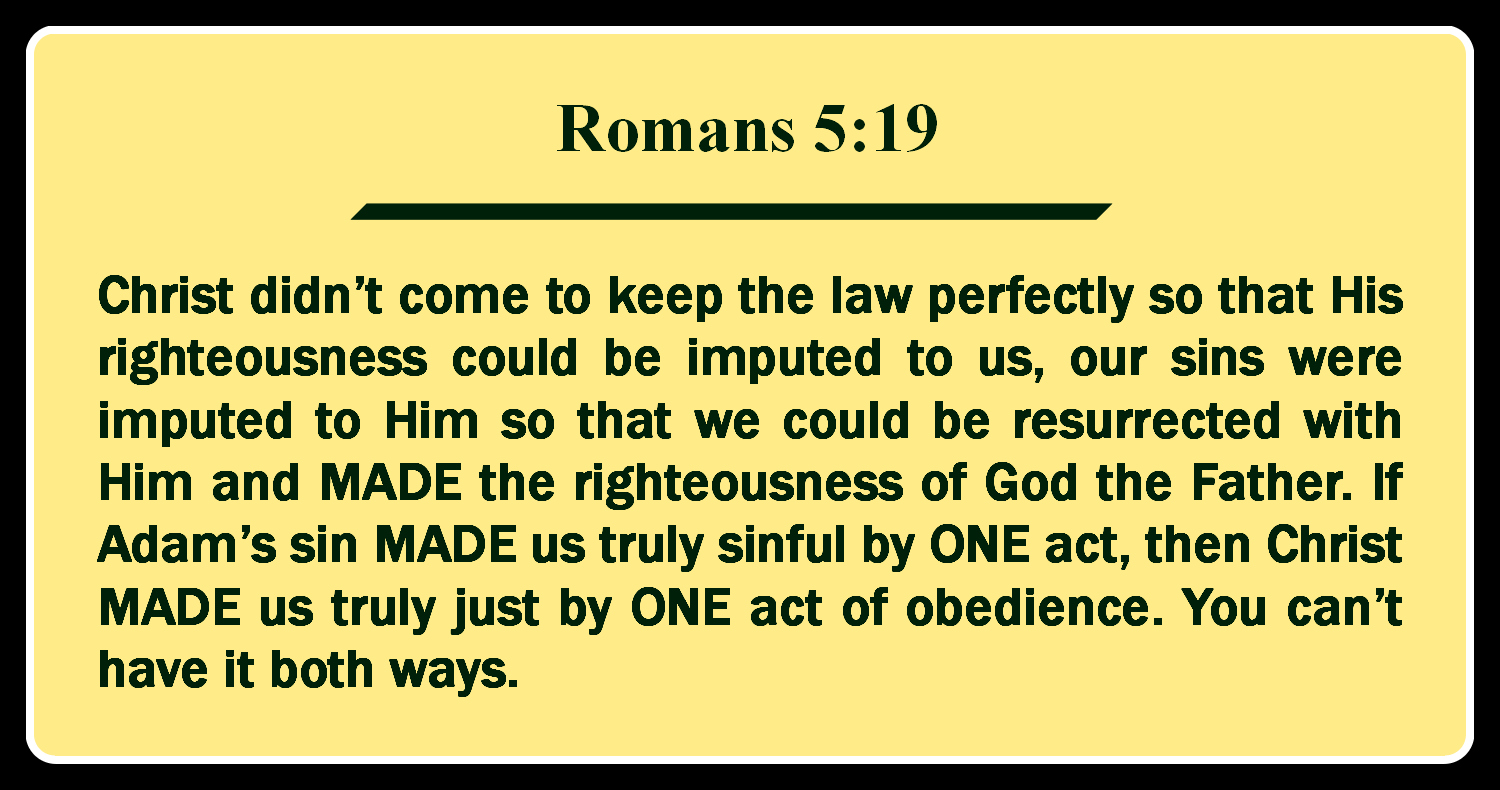
One aspect of this gospel is called “double imputation.” Each time we return to the same gospel that saves us, the perfect obedience of Christ is credited to our account. This is the idea that Christ came to die for our sins (Christ’s passive obedience), and also came to live a perfect life so that His obedience can be imputed to our lives each time we return to the gospel (Christ’s active obedience).
When proponents of Gospel Sanctification speak of the “obedience of faith,” what they mean to say is that Christians only EXPERIENCE the obedience of Christ imputed to us, and are not really performing the act directly. This leads many to believe that proponents are advocating direct obedience by the “believer,” but that is not the case at all.
Therefore, according to Gospel Sanctification, the “believer” is able to live a life of FAITH ALONE, or in other words, a like faith alone that saved him/her. This is nothing new. In his epistle to the Jewish Christians, James refuted a “faith without works.” In reality, FAITH WORKS through love (Galatians 5:6).
Of late there is a new truism roaming about that depicts this double imputation aspect of Gospel Sanctification: “On the cross Jesus was treated as if He lived our life so we could be treated as if we lived His life.” Notice that we are treated “as if” we live a godly life, but we really don’t. We are only experiencing the active obedience of Christ. If we are directly responsible for any act of obedience; that’s supposedly works salvation.

The Magnum Opus of the Reformation: Martin Luther’s Heidelberg Disputation; Part 5
Connecting the Dots: Tullian Tchividjian and Luther’s Theologian of the Cross
Listen to audio or download audio file.
That’s pastor Tullian Tchividjian…
…welcome truth lovers to Blog Talk radio .com/False Reformation, this is your host Paul M. Dohse Sr. Tonight, part 5 of “The Magnum Opus of the Reformation: Martin Luther’s Heidelberg Disputation.”
Greetings from the Potters House and TANC ministries where we are always eager to serve all of your heterodox needs. Our teaching catalog can be found at tancpublishing.com.
If you would like to add to our lesson or ask a question, call (347) 855-8317. Remember to turn your PC volume down to prevent feedback.
Per the usual, we will check in with Susan towards the end of the show and listen to her perspective.
Remember, you may remain anonymous. When I say, “This is your host; you are on the air, what’s your comment or question”—just start talking.
If you would like to comment on our subject tonight, you can also email me at paul@ttanc.com. That’s Tom, Tony, Alice, Nancy, cat, paul@ttanc.com. I have my email monitor right here and can add your thoughts to the lesson without need for you to call in. You can post a question as well.
At the beginning of tonight’s program, you heard an excerpt from a sermon via pastor Tullian. It is an example of what drives other Reformed leaders nuts, but they can complain all they want to, pastor Tullian is a Luther purest. His resignation last week from Coral Ridge Presbyterian Church brought me to remembrance in regard to what an excellent example he is of Martin Luther’s application of the Heidelberg Disputation in our day. So, tonight, this is an interlude of sorts that we are going to use to solidify what we have learned to this point.
Tullian lends credence to two accusations that the Reformed fear most: the charge of progressive justification, and antinomianism. I don’t know exactly why, but these are the two accusations that set a fire under their rumps, and along with it, a flood of cognitive dissonance. Yes, we are going to examine the arguments used to refute the charge of antinomianism and progressive justification, and as we will see, the arguments are so pitiful they would be deemed ridiculous by an adolescent which should be telling.
But first, I want to unpack the opening excerpt as a segue into the program tonight. Short excerpt, but packed with Luther’s foundational theology. In that short statement, we see the Reformed doctrines of mortification and vivification, Luther’s Theology of the Cross, deep repentance, double imputation, and total depravity.
Tullian stated first that we, as Christians, don’t merely need help with our walk, but we need to be raised from the dead. Let me pause here for a moment. What we are about to discuss are facts about the Reformation and Protestant soteriology in general that Protestants don’t understand. Fact: 98% of professing Calvinists really have no idea what Calvin believed, taught, and propagated. This is why the New Calvinism movement creates so much division between so-called Old Calvinists and New Calvinists; when the original article was rediscovered, by a Seventh-Day Adventist by the way, present-day Calvinists believed it was a false gospel. I was one of them. I set out to expose the New Calvinists and discovered they are the real Calvinists. I also discovered the fact that the Reformation is the biggest hoax ever perpetrated on mankind. The facts are irrefutable. So, is there hope? Of course there is; stop listening to men, turn on the light switch of the brain God gave you for a purpose, and read the gospels, the book of Acts, and Romans for yourself. Read those books, think for yourself, and just let the words say what they say. When the meaning isn’t apparent, don’t immediately run to a book full of someone else’s thoughts, what we call a “Commentary,” do your own independent research.
Why would Tullian say that Christians continue to be raised from the dead? That’s right out of theses 16-18 of the Heidelberg Disputation (HD). As I have stated before, the HD which came about 6 months after the 95 Theses is the foundational document of the Reformation, and then Calvin articulated and expanded Luther’s foundation in the Calvin Institutes. This progressive justification component of dying and rebirthing ourselves into heaven came to be known as mortification and vivification in the Calvin institutes. This brings us to Tullian’s mention of “Christians” being confessors, or the doctrine of deep repentance; that is the mortification component of mortification and vivification. By continually seeing our sinfulness in a deeper and deeper way, and being brought to the point of despair, or what Luther called “death at hand,” we then experience resurrection, or a revisitation of the joy of our salvation. Reformed scholars such as Michael Horton call this, “reliving our original baptism.” Listen, New Calvinist mantras like “We must preach the gospel to ourselves every day” do not come from nowhere. This is the source. We get to heaven by perpetually revisiting the same gospel that saved us. Those of you familiar with this ministry are worn out from me citing Michael Horton and Paul Washer on this, so let me change things up a little by quoting a guy that commented on a Tullian article posted on Justin Taylor’s blog over at TGC (The Gospel Coalition).
It’s not that complicated: the ground of all Christian obedience is the faithfulness of Jesus Christ. Justification occurs EACH time a believer confesses and receives forgiveness for his sins. The pattern of justification is illustrated by Paul in Romans 4. Abraham believes in the God who justifies the ungodly (in this case gentile Abraham), David is forgiven for his adultery and murder. God’s condemnation for sin has reached into history at the cross, glorification has reached into history at conversion where believers experience a foretaste of glory. Neither Old or New Covenant obedience require moral perfection, they both require obedience of faith….so, having been justified from faithfulness we have peace with God!
Indeed it is not complicated. “Faithfulness” to “confession” continually re-justifies us. And, as a result, we experience resurrection/joy/vivification. The confession is mortification/deep repentance/death at hand, the rising from the dead that Tullian is talking about is vivification and re-justification. Tullian’s emphasis on us being no different from unbelievers is based on the following idea: the ONLY difference between the saved and unsaved is the saved start getting saved by confessional faith alone resulting in perpetual re-salvation. Then, at the final judgement, we find out who lived by faith alone well enough to be saved and who didn’t. That’s authentic Protestantism in a nutshell, and the facts supporting this reality are irrefutable. And of course, it’s an in-your-face denial of the new birth as defined biblically in 1John 3 and many other places.
This also speaks to total depravity. Throughout the short excerpt Tullian pounds home the fact of moral equivalency, or the idea that one sinner is not any worse than any other. This comes from justification being defined and based on the law. This is major in the HD, but Calvin articulates this Reformation tenet in 3.14.9,10 of the Calvin Institutes. If you break the law on one point, you are guilty of breaking all of the law. “But Paul, isn’t that what James said in James 2:10?” No, that’s not what James was talking about. James wasn’t proffering a justification based on law as its standard. That concept is really the Achilles’ heel of Reformation soteriology. James was pushing back against the idea that some tradition of some sort replaces the law of love. Only love can fulfill the law. James was pushing back against the idea that justification’s standard is the law. No, there is NO law in justification; law and justification are mutually exclusive. In essence, what James was stating follows:
You can’t live by some orthodoxy devised by men and then live anyway you want to. Whatever your tradition is, it doesn’t fulfill the law. If your justification is based on the law, you break all of the law when you break it at any given point. Only love according to the law fulfills the law. The apostle Paul called this “faith working through love” in his letter to the Galatians. The standard for justification is what? Right, the new birth, NOT law! What is the official Reformed position on justification’s standard? Right, the law. This idea is what Paul spent his whole ministry refuting—this very idea that turns the gospel completely upside down! Clearly, the Reformers redefined justification by replacing its new birth premise with the law. Again, this concept of law/gospel was Paul’s number one nemesis.
This leads us to the question of how we are justified when we are supposedly justified anew. Tullian speaks of this in the excerpt when he alludes to what Jesus has done for us, not anything we do. In the excerpt, he thanks God that the gospel is not about anything we do, but rather only what Jesus has done for us. This is the Reformed doctrine of Christ for us, or, Christ 100% for us, or…double imputation. This is a huge Reformed mainstay.
What is it? This is the idea that Christ not only came to die for our sins once and for all on the cross, but that He also came to live a perfect life for the fulfilling of the law so that His obedience/righteousness can be imputed to us in vivification. Every time we confess, or according to Luther, “accuse ourselves,” or “visit the gospel afresh” (Michael Horton), the righteousness of Christ obtained by His perfect obedience to the law is imputed to us. Hence, every time we “visit the gospel afresh,” His propitiation and righteousness are both reapplied. This is the exact problem Paul addressed at Galatia. He argued that if the law was the standard for justification, that life is not given by the promise, but by law. He also argued that if law justifies us—there is a law that can give life while only God can give life. Making law the standard for justification is making the law a fourth member of the Trinity. That’s pretty much Paul’s argument.
In contrast, we are forgiven because the old us is dead, and no longer under the law. Look at Romans 7; one who has died is NOT under the law or its jurisdiction. This is why Christ died once: to end the law via us following Him in death. The new us is resurrected with Christ by the Spirit and able to fulfill the law through loving God and others. If perfect law-keeping, even by Christ, is the standard for justification rather than our death and resurrection through the new birth, it is impossible for us to love God and others—Christ must love for us; our love must be substituted by Christ’s love. And that in fact is the meaning of “Christ 100% for us.” Yes, Christ loves for us along with anything else that would be meritorious before God and the “righteous demands of the law.” Consequently, you often see these Reformed written motifs about sinners coming to the law with nothing in their hands but the obedience of Christ. That puts the law on a throne sitting beside the Father and the Son as a co-life-giver. That’s heresy in the extreme and a blatant denial of the new birth.
In concluding on this point, we now come Tullian’s mentioned disdain for “theologians of glory.” What’s that? That’s right out of the HD. It’s the counterpart, or one piece of the two-fold metaphysical theme of the document. The more I learn about this stuff, the more I am annoyed by Protestants who think they know what they are talking about, and we will soon be discussing one of them.
Luther divided the interpretation of all reality into two categories: the cross story and the glory story. Luther saw all of reality as a metaphysical narrative written by God with the cross being the primary epistemology; not only the cross, but the suffering of the cross in particular. Luther believed all wisdom is hidden in suffering. Luther, in keeping with Augustine’s Neo-Platonist worldview, demanded that all invisible things be interpreted through the suffering of the cross. Said Luther in theses 19:
That person does not deserve to be called a theologian who looks upon the »invisible« things of God as though they were clearly »perceptible in those things which have actually happened«
Thesis 20: He deserves to be called a theologian, however, who comprehends the visible and manifest things of God seen through suffering and the cross.
The manifest and visible things of God are placed in opposition to the invisible, namely, his human nature, weakness, foolishness. The Apostle in 1 Cor. 1:25 calls them the weakness and folly of God. Because men misused the knowledge of God through works, God wished again to be recognized in suffering, and to condemn »wisdom concerning invisible things« by means of »wisdom concerning visible things«, so that those who did not honor God as manifested in his works should honor him as he is hidden in his suffering.
Thesis 21: This is clear: He who does not know Christ does not know God hidden in suffering. Therefore he prefers ,works to suffering, glory to the cross, strength to weakness, wisdom to folly, and, in general, good to evil. These are the people whom the apostle calls »enemies of the cross of Christ« (Phil. 3:18), for they hate the cross and suffering and love works and the glory of works. Thus they call the good of the cross evil and the evil of a deed good. God can be found only in suffering and the cross, as has already been said Therefore the friends of the cross say that the cross is good and works are evil, for through the cross works are dethroned and the »old Adam«, who is especially edified by works, is crucified. It is impossible for a person not to be puffed up by his »good works« unless he has first been deflated and destroyed by suffering and evil until he knows that he is worthless and that his works are not his but God’s.
Thesis 22: That wisdom which sees the invisible things of God in works as perceived by man is completely puffed up, blinded, and hardened.
This has already been said. Because men do not know the cross and hate it, they necessarily love the opposite, namely, wisdom, glory, power, and so on. Therefore they become increasingly blinded and hardened by such love, for desire cannot be satisfied by the acquisition of those things which it desires. Just as the love of money grows in proportion to the increase of the money itself, so the dropsy of the soul becomes thirstier the more it drinks, as the poet says: »The more water they drink, the more they thirst for it.« The same thought is expressed in Eccles. 1:8: »The eye is not satisfied with seeing, nor the ear filled with hearing.« This holds true of all desires.
Thesis 24: He, however, who has emptied himself (cf. Phil. 2:7) through suffering no longer does works but knows that God works and does all things in him. For this reason, whether God does works or not, it is all the same to him. He neither boasts if he does good works, nor is he disturbed if God does not do good works through him. He knows that it is sufficient if he suffers and is brought low by the cross in order to be annihilated all the more. It is this that Christ says in John 3:7, »You must be born anew.« To be born anew, one must consequently first die and then be raised up with the Son of Man. To die, I say, means to feel death at hand.
Luther’s worldview calls for the condemnation of anything that can be perceived by the five senses, and that would of course include any work by mankind, in exchange for the work of faith that seeks death at hand by self-condemnation and the incessant confession of our own sin. All or any good work performed by us must be disavowed. This is the only work of faith that a Christian is to do; deep repentance that results in vivification. This is Luther’s definition of the new birth. Our only task is deep repentance resulting in only experiencing works that God may, or may not perform according to His own will. It is interesting what I am learning from Susan and her research on Jonathan Edwards. He believed that saving faith is a sixth sense that is able to perceive the works of God. That fits with what we are discussing here. Faith only confesses and then experiences the work of Christ following.
Any notion that man, saved or unsaved, can do anything at all that has merit with God is the glory story propagated by theologians of glory; this is what Tullian was referring to specifically in that sentence, no more—no less.
Before we move on, let me say this: to me, the more I study all of this, the more I am incredulous that congregations are forcing these guys caught with their hands in the cookie jar to resign. Why? It plainly shows the disconnect between the average Protestant’s understanding of their own faith and what their leaders teach. It’s totally inconsistent with the doctrine. “They sinned, well duh, so what?”
However, this is not always the case. Tullian has a close friend, also a pastor, who pretty much was fairly impious in broad daylight and never had to resign. In fact, he was the subject of a whole chapter in a book titled Sin Boldly: A Field Guide for Grace by Cathleen Falsani. This is where we segue into our second part. As I said, the two accusations that the Reformed camp is sensitive about are progressive justification and antinomianism. And especially in the area of antinomianism, the denial is beyond cognitive dissonance. It’s just borderline childish.
Let’s start by asking where Cathleen Falsani got the title for her book. “Sin Boldly,” do you know where she got that? It’s a quote by Martin Luther. Here is the whole quote from his letter to Philipp Melanchthon:
God does not save those who are only imaginary sinners. Be a sinner, and let your sins be strong (sin boldly), but let your trust in Christ be stronger, and rejoice in Christ who is the victor over sin, death, and the world.
Here, we see plainly that Luther saw salvation as ongoing for condemning sin. God does not save imaginary sinners. What is the tense there? That is answered in the next sentence: “Be a sinner.” So obviously, it’s a present continuous idea; it’s progressive. And if condemning sin is present continuous, obviously salvation must be present continuous as well. You must continually deem yourself a sinner in need of salvation. Be a sinner, or else you are denying that you need salvation.
Nevertheless, the arguments we hear against the idea that Protestantism is progressive justification sound like this from John MacArthur Jr.: “Justification and sanctification cannot be separated, but are distinct.” So, the two are distinct because one is progressive and the other is not, but yet, they are not separate. This is an attempt to answer the accusation that Reformed soteriology fuses justification and sanctification together which would of course be progressive justification. MacArthur attempts to deny that Protestantism fuses the two together by stating that the two are “distinct.” But this is like saying that a cat is never separate from its catness, but distinct from its catness when it progresses by walking. A cat is never separate from its catness, but distinct when it is walking; the argument is ridiculous.
In an article I wrote on PPT titled The Gospel According to John MacArthur’s Reformation Myth, I deconstruct MacArthur’s position on this in agonizing detail. Along Reformed lines, he states that justification is solely a forensic declaration that doesn’t change the individual. He then makes a distinction between Catholicism and Protestantism. The former infuses righteousness into the individual, and according to MacArthur, that is the fusion of justification and sanctification together resulting in progressive justification. In contrast, Protestantism disavows this infusion and replaces it with the imputation of Christ’s righteousness and obedience to the believer for sanctification, or Christian living if you will. So yes, justification and sanctification are not separate, but distinct in the fact that one declares us justified while the other is the manifestation of Christ’s righteousness. They can’t be separate because both are a predication on a single dimension of the law, ie., it’s for condemnation only and can only be fulfilled by Christ in our stead.
I am not going to get into the Protestant misrepresentation of Catholicism, suffice to say for now that it is also progressive justification based on Aristotelian philosophy instead of Platonism, but both are progressive justification. However, we can pause here to define the word “antinomianism” according to the Reformed: it is the absence of law as the standard for justification. In other words, that makes me an antinomian according to them. This is in contrast to the true definition of antinomianism from the Bible: the absence of the law for faith working through love. In other words, the use of the law for love is denied. In addition, the biblical dual perspective on the law is refuted and replaced with a single perspective on the law—condemnation instead of the Spirits twofold use of the law: to convict the world of sin and the judgement to come, and for sanctifying the saints. True antinomianism circumvents the law for sanctification and deprives the saints of their calling to love God and others.
If law is the standard for justification, a perfect keeping of it must be maintained by double imputation which calls on the “believer” to use it for gospel contemplation only rather than using it to love God and others. All obedience points to justification instead of love. This is why Christ said that in the latter days the love of many will wax cold, because of an increase of “anomia” which is “antinomianism” according to the English.
It’s ironic, the Reformed camp recently had a hissy fit over a statement made by Joel Osteen’s wife during one of their services at Lakewood Church—the largest Protestant church in America boasting some 25,000 members. Apparently, she stated that we should not obey God to please God, but should obey God to please ourselves. Pray tell, a single focus on deep repentance to keep ourselves saved through double imputation is better? At least Osteen is propagating a many faceted obedience that might lobe some love at somebody. Moreover, isn’t a single focus on sin for purposes of joyful vivification, in fact, delighting in evil? Sure it is.
As some of you know, I got into a little back and forth on Twitter this week with Janet Mefferd. It started with me pushing back against her assertion in a recent article that Tullian isn’t an antinomian. My contention centered on a tweet by Tullian that read…

Where does that come from? That comes right out of the HD, and if you are keeping up with this series, you see this plainly. Because Tullian sees all of his works as mortal sin, even stopping the blind grandmother from walking out into traffic, all of his sin is therefore venial and can be forgiven by perpetually revisiting the gospel. Mefferd replied with the same old worn out Reformed responses. I am particularly amused by the classic one I call the cat hermeneutic. If Calvin writes in the Institutes that he saw a cat run across the road, Calvin doesn’t necessarily mean that he saw a cat run across the road. You see, you must read the whole corpus of his writing to really know for certain that he intended to say that he saw a cat run across the road. Really? Am I here right now?
Look, I could make the point very well tonight that Mefferd, like most Protestants, is completely clueless. But I think I will close with another angle. Tonight, I have picked this apart from a doctrinal standpoint, but we must remember that Jesus liked to give folks a really simple rule of thumb while they are in the process of learning the doctrine. Here it is: “By their fruits you will know them.” Yes, I am simply going to close with a comment that was posted on PPT today, and then we will go to the phones:
Sean, and others, do any of you know what Janet Mefferd’s background is? Specifically, what is her education? She obviously does not know that Luther advocated the use of state-sponsored violence, torture and murder against the Mennonites and other Anabaptists, that Luther was an anti-Semite, and had horrible demeaning attitudes towards women. On the latter, here are some quotes:
“The word and works of God is quite clear, that women were made either to be wives or prostitutes.”
Martin Luther, Works 12.94
“Men have broad and large chests, and small narrow hips, and more understanding than women, who have but small and narrow breasts, and broad hips, to the end they should remain at home, sit still, keep house, and bear and bring up children.”
Martin Luther, Table Talk
“Even though they grow weary and wear themselves out with child-bearing, it does not matter; let them go on bearing children till they die, that is what they are there for.”
Martin Luther, Works 20.84
“God created Adam master and lord of living creatures, but Eve spoilt all, when she persuaded him to set himself above God’s will. ‘Tis you women, with your tricks and artifices, that lead men into error.”
“We may well lie with what seems to be a woman of flesh and blood, and yet all the time it is only a devil in the shape of a woman.”
“No gown worse becomes a woman than the desire to be wise.”
I could go on and quote his anti-semitic statements too. Oh, and Martin Luther despised reason. Here are some quotes:
“Reason is the Devil’s greatest whore; by nature and manner of being she is a noxious whore; she is a prostitute, the Devil’s appointed whore; whore eaten by scab and leprosy who ought to be trodden under foot and destroyed, she and her wisdom … Throw dung in her face to make her ugly. She is and she ought to be drowned in baptism… She would deserve, the wretch, to be banished to the filthiest place in the house, to the closets.”
Martin Luther, Erlangen Edition v. 16, pp. 142-148
“Reason is the Devil’s greatest whore; by nature and manner of being she is a noxious whore; she is a prostitute, the Devil’s appointed whore; whore eaten by scab and leprosy who ought to be trodden under foot and destroyed, she and her wisdom … Throw dung in her face to make her ugly. She is and she ought to be drowned in baptism… She would deserve, the wretch, to be banished to the filthiest place in the house, to the closets.”
Martin Luther, Erlangen Edition v. 16, pp. 142-148
“There is on earth among all dangers no more dangerous thing than a richly endowed and adroit reason… Reason must be deluded, blinded, and destroyed.”
Martin Luther, quoted by Walter Kaufmann, The Faith of a Heretic, (Garden City, NY, Doubleday, 1963), p. 75
Also, Luther was an advocate of drinking alcohol in excessive amounts. I could go on, but Luther’s quotes make me ill and nauseous. Obviously, Janet Mefferd has studied Christian history well.
______________________
Visit “The Oligarchy White Paper” for additional perspective.
Hey Bristol, It’s Not About the Law—It’s About Love
 The present 20-40-something generation indoctrinated by the Protestant institutional church keeps on doin’ its thing. Yes, this is the “sinners saved by grace” generation. These are sinners that love on their own terms.
What brought all this up? My present midlife blogger crisis. In 2009 when I started blogging, a Protestant scandal only came along once a year or something like that. What made that blog worthy is that Protestants are supposed to be one-up on the Catholics as far as righteousness goes. Everybody knows Catholics do anything they want to and then go to confession afterwards. Protestants have always been deemed as above such religious wantonness.
Now blogging has become like children who get chocolate too often. It’s no longer a treat; it’s a common occurrence, and the chocolate just doesn’t melt in one’s mouth like it used to. I have watched trending Protestant scandals increase to bi-monthly, monthly, weekly, and now approaching daily. Yawn, we sit at the dinner table and ask the complaining rhetorical question to momma blogger: “Chocolate again?”
It’s hard medicine, but the only thing to blog about now is the why? The what has run its course. However, what most of us do not realize is that there is a new and exciting trail to blaze in our present day: the art of godly living. But first, we must examine why that is possible in the face of this impossible dream.
It’s possible because Protestant tradition has always made Christian living all about our original salvation. Jesus died on the cross to save us from this horrible world that can be fun at times; Jesus will get us through it, so eat and drink for tomorrow we die. After all, we are all just sinners saved by grace. So, eat, drink, and be merry, and when you get caught, or a bad choice actually yields cause and effect, merely pull out your Woe is me a lowly sinner membership card. Jesus is president of the club.
So what’s the why? The why is because Protestantism with all of its pulpit pounding about justification by faith alone is really about keeping people under the law. We remain under law, and keep it when the opportunity matches our desires or when it is convenient, but all in all, it’s impossible to keep the law perfectly so Jesus came to live on earth to fulfill it for us. When we keep the law, we didn’t do it, Jesus did it “through us.” When we get caught, or a bad a choice yields bad fruit, that’s “disappointing,” but thank goodness that’s why Jesus came to LIVE and DIE.
And that is a lie from the pit of hell. Christ came to end the law, not keep it for us. When we believe on Christ, our past sins are forgiven because Christ ended the law that we sinned against, and in regard to the future, there is no law to condemn us. The law of condemnation has been ended.
How? Because Christ died so that you can follow Him in death, and a dead person is no longer under the law of condemnation. Then, Christ was resurrected so that you can follow Him in resurrection as well. More accurately, when you follow Christ in death, the Spirit comes and resurrects you as He did Christ. That’s the new birth. Now you are free from the law in regard to condemnation, for the old you died and is no longer under the jurisdiction of the law’s condemnation. But…your resurrection to new life frees you to love according to the law of love, not condemnation. Same law—different use. Same law, different state of being.
Oops, I almost forgot, the new scandal. “Which one?” This one: Bristol Palin, Sarah Palin’s daughter, is once again pregnant out of wedlock. The family, members of the New Calvinist Wasilla Bible Church, survived the publicity of the first “disappointing” choice, but obviously nothing was learned from the first incident, the blessings of a child being brought into the world notwithstanding.
I am not going to bore you with what she said on her blog about the news; it is the same old Protestant song and dance. In essence, and for all practical purposes: Oops; me, a lowly sinner, once again has sinned. Per the usual, we all fall short of keeping the law perfectly, but praise God for Jesus—it’s not about what we do, but what he has done.
That misses the whole point. Jesus didn’t come to keep the law for us; He came to end the law, and set us free to love. Like all Protestants, Palin confuses law and love. Here is the huge problem: if Christ kept/keeps the law for us, He also loves for us. Like most Protestants, Palin dichotomizes law and love in Christian living because she remains under the law of condemnation and is not free to follow the law as love.
Hence, as she pontificated on her blog, she can dishonor her family while still loving them. As far as dishonoring her family and bringing shame upon them, Jesus died for that, but of course she still loves her family.
Listen, whenever love is something different than obedience to God’s law, whenever a failure to truly love is not called out for what it is, that means one thing and one thing only: that person is still under the condemnation of the law that Jesus supposedly keeps for us.
Listen “sister,” it’s not about the law, it’s about love. Google the following and find out who said it… “If you love me, keep my commandments.” One cannot change until the real problem is diagnosed. Palin failed to love God and her family.
Christ did not come to keep the law for us anymore than He came to love for us—we either love or we don’t love. If we truly understand salvation, “We love Him because He first loved us.” That means He loved us first by dying on the cross to end the law so that we are free to love him through obedience apart from being justified by the law. And as much as we love Him, we love others as well.
It’s not about the law—it’s about love. And that is the new frontier for recovering Protestants.
paul
________________
Visit “The Oligarchy White Paper” for additional perspective.
The Magnum Opus of the Reformation: Martin Luther’s Heidelberg Disputation; Part 4
 Listen to Show or download audio file.
Welcome truth lovers to Blog Talk radio .com/False Reformation, this is your host Paul M. Dohse Sr. Tonight, part 4 of “The Magnum Opus of the Reformation: Martin Luther’s Heidelberg Disputation.”
Greetings from the Potter’s House and TANC ministries where we are always eager to serve all of your heterodox needs. Our teaching catalog can be found at tancpublishing.com.
If you would like to add to our lesson or ask a question, call (347) 855-8317. Remember to turn your PC volume down to prevent feedback.
Per the usual, we will check in with Susan towards the end of the show and listen to her perspective.
Remember, you may remain anonymous. When I say, “This is your host; you are on the air, what’s your comment or question”—just start talking.
If you would like to comment on our subject tonight, you can also email me at paul@ttanc.com. That’s Tom, Tony, Alice, Nancy, cat, paul@ttanc.com. I have my email monitor right here and can add your thoughts to the lesson without need for you to call in. You can post a question as well.
Ok, so last week we only covered thesis 7, and as discussed, sometimes these Reformed guys are as clear as mud. Where the confusion comes in regards Luther’s position on mortal versus venial sin. Per Susan’s contribution last week, we know that Luther and Calvin never left the Catholic Church, and Susan assessed the Catholic position on mortal and venial sin. With that said, what was Luther’s position?
Look, here is the same advice I gave Susan in regard to her research on Jonathan Edwards: sometimes, there is just no way of knowing what these guys are trying to say, so you have to look for the places that can be defined and draw conclusions accordingly. The way Luther goes about thesis 7 could be debated until the second coming. So what’s he saying definitively? Well, let’s go to thesis 12:
In the sight of God sins are then truly venial when they are feared by men to be mortal.
This becomes sufficiently clear from what has been said. For as much as we accuse ourselves, so much God pardons us, according to the verse, »Confess your misdeed so that you will be justified« (cf. Isa. 43:26), and according to another (Ps. 141:4), »Incline not my heart to any evil, to busy myself with wicked deeds«.
Bingo. That’s pretty clear. For all practical purposes, according to Luther, the deeds of the saved and unsaved alike are all mortal sins. Even if Luther makes room for sins being authentically venial in the subjective Christian life, it makes no difference because mankind cannot do a good deed or any work that would be meritorious before God. In order to be saved, an individual must disavow the possibility of good works and assume every act is a mortal sin.
Susan is in the midst of some very heavy research, and has been sharing some of it with me. At times she will read excerpts from Edwards and there is no way in hades to know what the guy is saying. But, according to the subject, you can draw from what the guy has said in other places and draw your conclusions. And that’s what we are doing here.
While we are on thesis 12, let’s note this:
For as much as we accuse ourselves, so much God pardons us, according to the verse, »Confess your misdeed so that you will be justified« (cf. Isa. 43:26).
Bingo—that’s the Reformation gospel in a nutshell. You are still a wretched unregenerate sinner, and a perpetual return to the same repentance that saved you keeps you justified. The saving death of Christ is continually reapplied to your life along with His imputed obedience as well. This is what Paul David Trip et al call “A lifestyle of repentance” echo, echo, echo, echo.
And by the way, if you have any complaint at all about the way your church is run, this is what you will probably hear: “Who are you to judge? You should be busy accusing yourself rather than others lest you fall from grace.” And I don’t have a problem with that and nether should you. Why? Well at least they know what Protestantism is about. They are just being good Protestants, it is what it is.
And here’s another thing; I claim a liberty for myself that I think is biblical. I refuse to pass judgement on who is going to hell and who isn’t. Not only is hell a terrible place of eternal torment that I would not literally wish on anybody, but I choose to leave that assessment where it belongs; in the hands of God. Do you know why people want me to draw the hell conclusion from my assessment of true gospel versus false gospel? Here’s why: they want to use that to shut down discussion and subsequent discovery. See, when TANC ministries comes up, they want to say, “Ya, Dohse believes that Martin Luther and John Calvin are burning in hell.” See, that shuts down discussion. But if they tell the truth and say, “Dohse believes the Reformation gospel is progressive justification,” well, now that induces curiosity and discovery.
Listen, who am I to be going around saying that this guy is going to hell and that guy is going to hell? That’s not my place, but the bigger point is that such behavior becomes the topic and not the substantive discussion of true gospel versus false gospel. The former utilizes a jump from presuppositions to conclusion so that the substantive is circumvented. Don’t fall for that garbage.
Let’s now proceed to thesis eight:
Thesis 8: By so much more are the works of man mortal sins when they are done without fear and in unadulterated, evil self-security.
The inevitable deduction from the preceding thesis is clear. For where there is no fear there is no humility. Where there is no humility there is pride, and where there is pride there are the wrath and judgment of God, »for God opposes the haughty. Indeed, if pride would cease there would be no sin anywhere.
This thesis supplies a couple of major hallmarks of the Reformation. But I better pause here to head off a danger at the pass. Don’t be tempted to think that this point by point assessment of the FIRST Reformation doctrinal statement is redundant. It’s not. In all of this, I am becoming more and more appreciative of Luther’s genius. Throughout this document, Luther is not only putting forth a foundational doctrinal statement, he is teaching people how to think and what to think about the finer points of life. Luther isn’t saying the same things in a different way, he is redefining the elements of collective thinking that are possible exits out of the foundational premise. At the end of this study, one could put together a counter disputation, and maybe I will.
Here, he defines “pride.” What is that according to Luther, and frankly every Reformer after him? Pride, according to Luther, is the heart of sin: “Indeed, if pride would cease there would be no sin anywhere.” Here we see two major epistemologies or metaphysical hermeneutics of the Reformation: First, the common man cannot only do anything that would find favor with God, the common man cannot know reality. Second, every truth has a counter truth. Said another way, opposites define each other. In Plato’s theory of forms, reality descends from the immutable objective to the mutable and shadowy subjective. Ascent to the objective begins by finding those things that are immutable in the subjective shadow world.

For Plato, that was math among other things, but along this same line of epistemology is dualism, or what’s called “co-eternal binary opposition, a meaning that is preserved in metaphysical and philosophical duality discourse but has been more generalized in other usages to indicate a system which contains two essential parts.” Do you see this in thesis 8? It’s pride and humility. We also refer to this as the either/or hermeneutic. There is no in-between, it’s either/or. There is no taking pride in what you do without being prideful. There is no taking of satisfaction from a job well done; you are either humble or prideful.
And, this is also key, what is humbleness’ key attribute? Right, fear; specifically fear of condemnation…”For where there is no fear there is no humility. Where there is no humility there is pride, and where there is pride there are the wrath and judgment of God.”
Your only chance of getting into heaven in the end is doubts that you will. Luther and Calvin both equated eternal security with damning pride. Tullian Tchividjian once joked that Presbyterians differ from Baptists because Presbyterians don’t call each other “brothers” because no one knows for certain whether that’s the case or not. The joke bought the house down, but as the saying goes, the truth in a joke is what often makes it funny.
Once again, this is also right out of the Calvin Institutes:
Let us, therefore, embrace Christ, who is kindly offered to us, and comes forth to meet us: he will number us among his flock, and keep us within his fold. But anxiety arises as to our future state. For as Paul teaches, that those are called who were previously elected, so our Savior shows that many are called, but few chosen (Mt. 22:14). Nay, even Paul himself dissuades us from security, when he says, “Let him that thinketh he standeth take heed lest he fall,” (1 Cor. 10:12). And again, “Well, because of unbelief they were broken off, and thou standest by faith. Be not high-minded, but fear: for if God spared not the natural branches, take heed lest he also spare not thee,” (Rom. 11:20, 21). In fine, we are sufficiently taught by experience itself, that calling and faith are of little value without perseverance, which, however, is not the gift of all (CI 3.24.6).
As we have discussed before, Calvin’s election construct has three categories: the non-elect, the temporary elect, and those who persevere. No one knows whether they make it or not until they are revealed as such in the final judgement. This is known as “final justification when the sons of God are made manifest.” Apparently, they are made manifest by their “accompanied good works” which were really performed by Jesus and not them. This aversion to eternal security is also demonstrated by the likes of John Piper:
There is danger on the way to salvation in heaven. We need ongoing protection after our conversion. Our security does not mean we are home free. There is a battle to be fought (John Piper: Bethlehem Baptist Church Minneapolis, Minnesota; The Elect Are Kept by the Power of God October 17, 1993).
Of course, the apostle John’s stated purpose for writing the book of 1John directly contradicts this idea. Let’s move on to thesis 9:
Thesis 9: To say that works without Christ are dead, but not mortal, appears to constitute a perilous surrender of the fear of God.
For in this way men become certain and therefore haughty, which is perilous. For in such a way God is constantly deprived of the glory which is due him and which is transferred to other things, since one should strive with all diligence to give him the glory-the sooner the better. For this reason the Bible advises us, »Do not delay being converted to the Lord.« For if that person offends him who withdraws glory from him, how much more does that person offend him who continues to withdraw glory from him and does this boldly! But whoever is not in Christ or who withdraws from him withdraws glory from him, as is well known.
Luther here has a problem with the idea that good works can be performed by the unbelieving or believing and such works do not condemn, but are merely dead works that cannot earn merits for justification. This now brings us to what the Reformers believe is the sole purpose for all existence: God’s glory. Any concession that man can do anything good robs God of glory.
Man can indeed do good works, but in regard to the unsaved, it is true that in the end that only results in less condemnation, but Luther isn’t even willing to conceded that. If people can do good works resulting in less condemnation—that robs God of glory. Furthermore, it removes fear of condemnation from some works which also robs God of glory.
This is why Luther’s disputation is said to be the cross story versus the glory story: any glory not given to God is claimed by man; hence, the glory story, or the story of man. It can’t be a story about God and man, All glory must be granted to God. You are either living in the cross metaphysical narrative or the glory of man metaphysical narrative.
Thesis 10: Indeed, it is very difficult to see how a work can be dead and at the same time not a harmful and mortal sin.
This I prove in the following way: Scripture does not speak of dead things in such a manner, stating that something is not mortal which is nevertheless dead. Indeed, neither does grammar, which says that »dead« is a stronger term than »mortal«. For the grammarians call a mortal work one which kills, a »dead« work not one that has been killed, but one that is not alive. But God despises what is not alive, as is written in Prov. 15:8, »The sacrifice of the wicked is an abomination to the Lord.«
Second, the will must do something with respect to such a dead work, namely, either love or hate it. The will cannot hate a dead work since the will is evil. Consequently the will loves a dead work, and therefore it loves something dead. In that act itself it thus induces an evil work of the will against God whom it should love and honor in this and in every deed.
This thesis makes another argument against the idea that good works can be performed by mankind, but they are dead works in regard to justification. If mankind can perform a good deed, if mankind is competent, if mankind has some sort of ability, then why would that not include the ability to choose? This speaks to the Reformed doctrine of total inability. The Reformed continually claim this doctrine as uniquely Reformed and contrary to all other religions throughout history. This is not true; in fact, the total depravity of mankind coupled with determinism of some sort has been the overwhelming norm from the beginning of time. We delved into this historical fact in our Romans series (lessons 55-64).
What I would like to focus on in this thesis is Luther’s mention of grammar and the “grammarians.” What is a grammarian? A grammarian is someone who studies world linguistics. A grammarian also studies the connections between linguistics and the interpretation of reality. By and large, a grammarian is going to take a literal approach to interpreting reality; ie., things are as they appear. Another way of stating it: reality can be understood empirically. Hence, man can reason and understand reality.
This is going to be my subject at this year’s conference. The Reformers did not hold to a literal interpretation of realty. Obviously, St. Augustine was heavily steeped in allegory. This is what most Christians don’t understand: the Reformation was about the interpretation of reality itself, and how the Bible should be used for that purpose.
The Reformers didn’t reject biblical grammarianism, but made it secondary to the redemptive view of reality, or the idea that all of reality should be interpreted by “the gospel.” If the use of grammar leads to a redemptive outcome, wonderful. If it doesn’t, you use allegory to insure a redemptive outcome. The Reformed therefore often claim to be grammarians which is blatantly disingenuous. And look, the Reformed camp is not the least bit shy about all of this. We can see in this thesis how Luther was willing to use the grammar for the outcome he desired. In essence, he is saying: look, if the simpleton grammarians even think that something dead cannot contribute anything to life, how much more should we believe it as well?
And look, the Reformed camp is not the least bit shy about all of this. In his book, “Uneclipsing The Son,” by John MacArthur confidant and rumored heir apparent Rick Holland, he states that “bad grammar makes good theology” (page 39). The who’s who of American evangelicalism endorsed the book, and John MacArthur wrote the forward. As should be surmised by the title, the book is an in-your-face Gnostic treatise. The whole eclipsing the sun motif is a well-traveled illustration in Neo-Platonist/Gnostic circles. In the forward, MacArthur makes shocking statements that include the following idea: the subordination of God the Father and the Spirit to the Son.
If one does not interpret the Bible as a grammarian, all bets are off. While the Catholics made printing the Bible illegal, the Protestants merely took away individual interpretation and made biblical knowledge “the Gnosis.” Also, here is an aside: why did Christ emphasize the new birth to Nicodemus? The guy was “the” teacher in Israel and had never even heard of the new birth. Why? because Judaism was saturated with Gnostic philosophy and the infusion of divinity into a mortal being was unthinkable. The guy’s very name even reflects the Gnostic politic: nico; victory; demus; people; or, victory over the people. The most prominent Gnostic sect of the day was the Nicolaitans which means “victory over the laity.”
Now, next week, we are going to use theses 11 and 12 as an introduction to thesis 13 and following where Luther gets into the foundational position of free will according to the Reformation. We have heard lots of discussion about freewill for many years; next week, we will define the issue.

 Paul's Passing Thoughts
leave a comment