The Gospel of Sovereignty? Romans Series Interlude: Predestination, a Potter’s House Journey; Part 7

sov·er·eign·ty [sov-rin-tee, suhv-] noun, plural sov·er·eign·ties.
1. the quality or state of being sovereign.
2. the status, dominion, power, or authority of a sovereign; royalty.
3. supreme and independent power or authority in government as possessed or claimed by a state or community.
4. rightful status, independence, or prerogative.
5. a sovereign state, community, or political unit.
“The sovereignty of God” is a phrase that we hear often in Christian circles; in fact, it is a subject that dominates Christian discussion in our day. Moreover, it is an attribute of God that Christians make intrinsic to the gospel itself. In my contention against progressive justification in our day, the argument I hear most is, “You don’t understand the sovereignty of God.”
And no wonder, one of the premier evangelicals of our day, John MacArthur Jr., had this to say in a message titled, “An Explanation of the Sovereign Gospel.”
So we know it has been laid upon us to be faithful in our evangelistic responsibility. At the same time, sometimes we struggle with this reality of divine sovereignty and what it is that we can do when everything is predetermined by God and worked by the Holy Spirit.
Well, the simple answer to the question is God has not only ordained whom He will save, but He has ordained that we in our faithful evangelism would be the means by which He would save His own. To be useful to Him is the purpose in the fulfillment of His sovereign plan, to be an instrument that He can use, to be a vessel unto honor, fit for the Master’s use. To be obedient because that brings, of course, blessing, reward in this life and eternal reward as well (Grace Community Church | Romans 9-11 | September 03, 2011).
Of course, if God has predetermined who will be saved, and uses our evangelism to carry that out, our obedience to evangelism must be preordained as well. As discussed in a previous lesson in this series, this necessarily requires the redefining of the words “obedience” and “reward” as well as many other words and the normative understanding of them. But the main point I want to make here is MacArthur making salvation synonymous with sovereignty which is defined as CONTROL.
Herein is the problem: the word “sovereign” does NOT mean “control,” it means that one has the right to have authority in a given jurisdiction. Even some among the Reformed admit this:
What does it mean to say that God is sovereign? The refrain has become so common, almost clichéd, in Reformed writing and preaching that it sometimes slips away from the reader or listener without lodging meaning in the mind. Worse, we typically hear the phrase to mean something it doesn’t. When Christians affirm that “God is sovereign,” they often mean “God is in control.” Paul Tripp, for example, wrote in his excellent book Lost in the Middle that “God truly is sovereign . . . there is no situation, relationship, or circumstance that is not controlled by our heavenly Father.”
The problem is that the English word sovereignty does not mean control. The U. S. government is sovereign within American territory, but that doesn’t mean the government controls everything within American borders or causes all that happens. If you look up sovereignty in the dictionary you’ll not find control in the definition—nor even as a synonym in a thesaurus.
Sovereignty means “rightful authority.” A dictionary gives “supreme rank” as one definition, and a thesaurus lists jurisdiction and dominion as synonyms. The doctrine of God’s sovereignty tells us God is the rightful ruler of the universe. He has legitimate claim to lordship. His government is just. In fact, justice is defined as his rule. God’s sovereignty doesn’t tell us whether God does in fact rule—just that he ought to, and that we should acknowledge his rule and obey it. (Is “Sovereign” the Best Descriptor for God? Paul D. Miller).
Miller goes on to say…
Once again, it is true God is sovereign. It’s also true he’s in control of everything that happens and he causes all that happens. But that is the doctrine of God’s providence, not his sovereignty.
Does God CAUSE everything to happen? Perhaps, but that’s not what providence means either.
prov·i·dence [prov-i-duhns] noun
1. the foreseeing care and guidance of God or nature over the creatures of the earth.
2. God, especially when conceived as omnisciently directing the universe and the affairs of humankind with wise benevolence.
3. a manifestation of divine care or direction.
4. provident or prudent management of resources; prudence.
5. foresight; provident care.
First, the word “sovereign” appears nowhere in the Bible which should give people pause in regard to the frivolousness of its use in Christian circles. Secondly, it does NOT mean, control, preordination, or predetermination. Certainly, if God wanted to control everything, He could, but does He? Did God know sin was going to come into the world? Yes, so why didn’t he prevent it beforehand? The best answer points to the importance of freewill. God did not cause sin by not preventing it. God tempts no one with sin and is not the creator of evil (James 1:13-18).
When the attributes of God are considered (most theologians name 21 different attributes), absolute deterministic control is not one of them. Even with said attributes, God at times chooses to forfeit the attribute for a period of time. Therefore, if God is predeterminist, He wouldn’t always necessarily choose to predetermine. Some attributes of God are temporarily mutable, and others are NOT ever mutable. An immutable attribute of God is His love towards mankind for all the living. Clearly, an example of an attribute that God has temporarily suspended at times is omniscience:
Genesis 18:20 – Then the Lord said, “Because the outcry against Sodom and Gomorrah is great and their sin is very grave, 21 I will go down to see whether they have done altogether according to the outcry that has come to me. And if not, I will know.”
Mark 13:32 – But concerning that day or that hour, no one knows, not even the angels in heaven, nor the Son, but only the Father.
Also, yes, in regard to some things God is immutable, but in contrast, he can be persuaded by prayer:
Isaiah 38:1 – In those days Hezekiah became sick and was at the point of death. And Isaiah the prophet the son of Amoz came to him, and said to him, “Thus says the Lord: Set your house in order, for you shall die, you shall not recover.” 2 Then Hezekiah turned his face to the wall and prayed to the Lord, 3 and said, “Please, O Lord, remember how I have walked before you in faithfulness and with a whole heart, and have done what is good in your sight.” And Hezekiah wept bitterly.
4 Then the word of the Lord came to Isaiah: 5 “Go and say to Hezekiah, Thus says the Lord, the God of David your father: I have heard your prayer; I have seen your tears. Behold, I will add fifteen years to your life. 6 I will deliver you and this city out of the hand of the king of Assyria, and will defend this city.
2Chronicles 16;12 – In the thirty-ninth year of his reign Asa was afflicted with a disease in his feet. Though his disease was severe, even in his illness he did not seek help from the LORD, but only from the physicians (NIV).
We have established that sovereign would be the wrong word to describe God as causing all that happens, and those things being according to His desired will. It has also been mentioned that the word “sovereign” is not in the Bible. Even if sovereign did mean that all things are predetermined according to God’s pleasure, would it be correct to make that part and parcel with the gospel as most do in our day? Below is yet another version of the infamous Cross Chart that can be applied to this question:
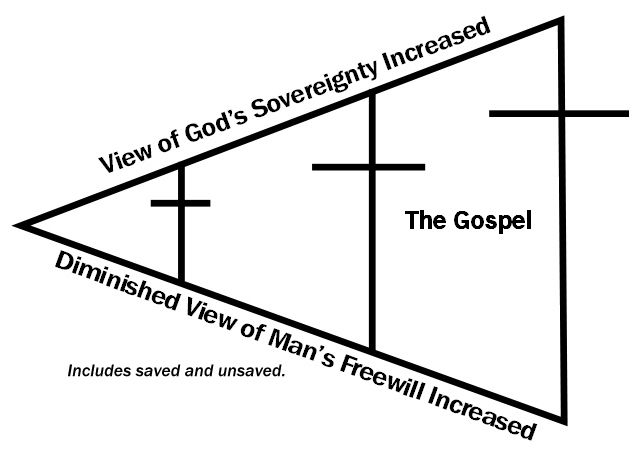
The Problem is defining the gospel according to God’s sovereignty as opposed to God’s love and the good news thereof. Why would the idea that God preordained people to hell be good news? This also speaks to man’s worth. Did Christ die for humanity because it has some kind of worth to God? We can again utilize the cross chart for this question:
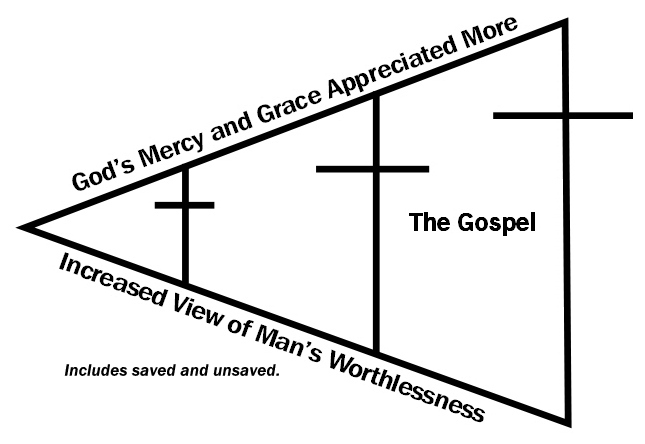
To the extent that man has worth, the gospel gets smaller and God’s grace, and the degree of His sacrifice are diminished. A gospel based on the sovereignty of God must completely eliminate man altogether, and John Immel’s point made in this year’s TANC conference is well taken: it eventually boils down to Man having no right to exist.
All of this greatly hinders the proper answering of questions people have about the Bible. Take note of John Piper’s answer to the question, “Why was it right for God to slaughter women and children in the Old Testament? How can that ever be right?”
It’s right for God to slaughter women and children anytime he pleases. God gives life and he takes life. Everybody who dies, dies because God wills that they die.
God is taking life every day. He will take 50,000 lives today. Life is in God’s hand. God decides when your last heartbeat will be, and whether it ends through cancer or a bullet wound. God governs.
So God is God! He rules and governs everything. And everything he does is just and right and good. God owes us nothing.
If I were to drop dead right now, or a suicide bomber downstairs were to blow this building up and I were blown into smithereens, God would have done me no wrong. He does no wrong to anybody when he takes their life, whether at 2 weeks or at age 92.
God is not beholden to us at all. He doesn’t owe us anything.
Now add to that the fact we’re all sinners and deserve to die and go to hell yesterday, and the reality that we’re even breathing today is sheer common grace from God.
I could make the question harder. As it was stated, it doesn’t feel hard to me, because God was stated as the actor.
My basic answer is that the Old and New Testaments present God as the one who has total rights over my life and over my death.
“The Lord gave, and the Lord has taken away; blessed be the name of the Lord” (Job 1:21). How he takes away is his call. He never wrongs anybody.
~ Ask Pastor John | Desiring God .org | February 27, 2010
In essence, you see the mentality in this answer that man does not have the right to exist, and has no worth. Yet…
Malachi 3:17 – They shall be mine, says the LORD of hosts, in the day when I make up my treasured possession, and I will spare them as a man spares his son who serves him.
John Piper has been called out many times publicly for making these kinds of statements in regard to tragedies, but no one seems to understand the ideology behind such statements. Some also notice tacit acceptance of terrorism as well, and the lack of justice in the institutional church for those who have been abused speaks for itself. If the president of the flagship seminary in service to the largest denomination in the world thinks that “One man’s terrorist is another man’s patriot,” what are we to expect?
When one thinks of life past the fatalistic prism of the “sovereign” gospel that saturates today’s church and reads the Bible in the same thinking way, much better answers evolve. Unfortunately, life teaches us that terrorists cannot be reasoned with. I heard a retired high-ranking military official state this week that the only way to deal with terrorists is to eliminate them. Keep in mind, this is because they do not value mankind or life because of the same presuppositions that we are discussing.
When Israel was getting ready to enter the Promised Land, it could very well be that God knew certain cultures in the area would continually harass Israel and were completely unreasonable while having no regard for life. Israel’s lack of obedience in following God’s command to completely wipe out certain cultures came back to bite them for hundreds of years—even until this very day. These were cultures very much like ISIS, the Islamic State of Iraq and Syria who are presently wreaking havoc in the Middle East and mercilessly slaughtering thousands. These people, unfortunately, cannot be negotiated with.
Lastly, another problem with a gospel that is based on deterministic fatalism follows. There is only one person spoken of less in our day than the Holy Spirit: Satan. The Bible warns us throughout to be aware of the devil’s schemes, and that he “deceives” the world. Why would this be relevant and how do you “deceive” someone who is already preordained for eternal punishment? The Bible continually places blame on Satan for leading people into condemnation.
In the final analysis, a “sovereign” gospel devalues prayer, God’s promises, evangelism, sin, justice, hope, life value, future reward, and the belief that what we do in this life is relevant. I have come to believe that people will perish because we have been neutralized by ignorance:
Ezekiel 3:16 – And at the end of seven days, the word of the Lord came to me: 17 “Son of man, I have made you a watchman for the house of Israel. Whenever you hear a word from my mouth, you shall give them warning from me. 18 If I say to the wicked, ‘You shall surely die,’ and you give him no warning, nor speak to warn the wicked from his wicked way, in order to save his life, that wicked person shall die for his iniquity, but his blood I will require at your hand. 19 But if you warn the wicked, and he does not turn from his wickedness, or from his wicked way, he shall die for his iniquity, but you will have delivered your soul. 20 Again, if a righteous person turns from his righteousness and commits injustice, and I lay a stumbling block before him, he shall die. Because you have not warned him, he shall die for his sin, and his righteous deeds that he has done shall not be remembered, but his blood I will require at your hand. 21 But if you warn the righteous person not to sin, and he does not sin, he shall surely live, because he took warning, and you will have delivered your soul.”
John MacArthur claims that Christians should take part in God’s “sovereign” plan, and therefore find blessings in being obedient to evangelism. I have heard this same take from people who equate freewill with an unsovereign gospel/false gospel. Again, God’s “sovereignty” is the attribute that primary drives the gospel and not love. But the following is irrefutable, such obedience must also be preordained and not really of our own volition. Furthermore, the reward is invalid as well.
I have also come to believe that there are no paradoxes in God’s election. I believe the confusion can be eliminated, and people motivated to labor in God’s ministry field with zeal. But I believe the study will be very hard work.
Nevertheless, let us begin it posthaste.
The God Who Seeks Us
“Supralapsarianism and infralapsarianism are not good news. It will make evangelism anemic, and will defile what little evangelism takes place.”
We have all heard it many times: no one seeks after God. Salvation isn’t like God throwing us a life preserver; we are floating in the water dead—we can’t even grab the life preserver. We have no choice in the matter in regard to an ability to choose God for salvation. If left to ourselves, we will always choose death. So yes, man can choose, but unless God intervenes he will always choose eternal death. He only has an ability to not choose God, God must choose him first. The verse most often cited is:
Romans 3:10 – As it is written, There is none righteous no not one. 11 There is none that understandeth: there is none that seeketh God. 12 They have all gone out of the way: they have been made altogether unprofitable: there is none that doeth good, no not one. 13 Their throat is an open sepulcher: they have used their tongues to deceit: the poison of asps is under their lips. 14 Whose mouth is full of cursing and bitterness. 15 Their feet are swift to shed blood. 16 Destruction and calamity are in their ways: 17 And the way of peace they have not known. 18 The fear of God is not before their eyes (Geneva Bible 1599). Psalms 13:1-3, 5:10, 139:4, 9:28, 35:2, Isaiah 59:7,8 (LXX Brenton). Psalms 14:1-3, 53:1-3, 5:9, 140:3, 10:7, 36:1, Proverbs 1:16, Isaiah 59:7,8 (Masoretic AV).
As the apostles did many times in their writings, Old Testament quotations in the New were a combination of many different verses to make one point. But should this text be interpreted as a specific rule, or does it characterize the enemies of God? Does the subject of these references, the “fool” understand absolutely nothing about God? Is he completely devoid of any good work? Does the fool NEVER fear God etc., or is this a characterization rather than a hard fast rule? Since other Scriptures contradict the rule, for example, there are many instances of unbelievers fearing God in the Bible; we must conclude that this description characterizes the unbeliever, but is not a definitive description. It is like saying, “You never _______.” We aren’t saying that they never do this, that, or the other, it is a manner of speaking that regards a life pattern.
Granted, man does not initiate a relationship with God. We see this in the fall of man. Adam and Eve hid from God after they sinned, and it was God who searched for them in the garden. After Cain slew Able, it was God who confronted Cain to elicit repentance.
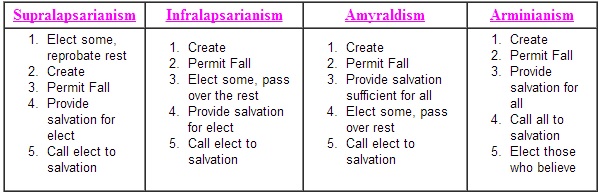
Did God create man as a despised thing in order to bring Himself glory? Did God predetermine the fall of man in order to contrast evil with His good? Does His wrath demonstrate His righteousness? Does His wrath accentuate His grace? Protestantism can be divided into two camps in this regard: supralapsarianism and infralapsarianism. The following chart (other source) demonstrates the difference between the two views.

As you can see, supralapsarianism holds to the position that God preordained the fall of man. Infralapsarianism holds to the idea that it was God’s intent to create man, but not His intent that man fall. In other words, God didn’t create man for the express purpose of his fall. Both hold to the idea that God preselected some for eternal life and others for eternal destruction. Calvin was a superlapsarian.
The human mind, when it hears this doctrine, cannot restrain its petulance, but boils and rages as if aroused by the sound of a trumpet. Many professing a desire to defend the Deity from an invidious charge admit the doctrine of election, but deny that any one is reprobated (Bernard. in Die Ascensionis, Serm. 2). This they do ignorantly and childishly since there could be no election without its opposite reprobation. God is said to set apart those whom he adopts for salvation. It were most absurd to say, that he admits others fortuitously, or that they by their industry acquire what election alone confers on a few. Those, therefore, whom God passes by he reprobates, and that for no other cause but because he is pleased to exclude them from the inheritance which he predestines to his children. Nor is it possible to tolerate the petulance of men, in refusing to be restrained by the word of God, in regard to his incomprehensible counsel, which even angels adore. We have already been told that hardening is not less under the immediate hand of God than mercy. Paul does not, after the example of those whom I have mentioned, labour anxiously to defend God, by calling in the aid of falsehood; he only reminds us that it is unlawful for the creature to quarrel with its Creator (Institutes 3.23.1).
Hence, evangelism is a “savor of death, and a savor of life,” and God is glorified by both. Evangelism isn’t for the purpose of “saving” the lost; it is for the purpose of putting a response to the gospel on display for the glory of God.
There is a universal call, by which God through the external preaching of the word invites all men alike, even those for whom he designs the call to be a savour of death, and the ground of a severer condemnation (Institutes 3.24.8).
He arranges all things by his sovereign counsel, in such a way that individuals are born, who are doomed from the womb to certain death, and are to glorify him by their destruction (3.23.6).
Calvin also held to the idea that Adam and Eve were fallen before the fall:
Even If man had remained in his integrity, still his condition was too base for him to attain to God. How much less could he have raised himself so far, after having been plunged by his ruin into death and hell, after staining himself with so many defilements nay, even stinking in his corruption and all overwhelmed with misery? (Institutes 2.12.1).
This is in stark contradiction to Genesis 1:28-31;
28 And God blessed them. And God said to them, “Be fruitful and multiply and fill the earth and subdue it, and have dominion over the fish of the sea and over the birds of the heavens and over every living thing that moves on the earth.” 29 And God said, “Behold, I have given you every plant yielding seed that is on the face of all the earth, and every tree with seed in its fruit. You shall have them for food. 30 And to every beast of the earth and to every bird of the heavens and to everything that creeps on the earth, everything that has the breath of life, I have given every green plant for food.” And it was so. 31 And God saw everything that he had made, and behold, it was very good. And there was evening and there was morning, the sixth day.
If Eve was “very good,” we must assume free will at that point.* Eve had a choice to trust and obey God who had glorious plans for mankind without the fall (Genesis 1:28). Evil entered into the world through the angelic rebellion led by Satan (Eze 28:11-19, Isa 14:12-14, Rev 12:3,4), and apparently, though speculative, this is a backdrop that effected the way God decided to interact with Adam and Eve. He installed two trees in the garden amidst many other trees, and the one tree that they were forbidden to eat of was the tree of the knowledge of good and evil. They were allowed to eat of the tree of life, but not the other tree of the knowledge of good and evil. God didn’t keep it from them that evil existed, He just didn’t want them to experience it (Gen 2:2-8, 15,16).
It is interesting to note that God intervened to prevent Adam and Eve from eating of the tree of life which would have resulted in them living forever, so He banned them from the garden (Gen 3:22-24). Therefore, we must conclude that to some extent the world and man operates separately from the will of God and God therefore intervenes in the affairs of men, in time, to bring about His desired outcome. We see the same in Genesis 11:1-9—God confused the languages to prevent an undesired outcome. As an aside, let me mention that Gen 11:6 does not bode well for the idea of total inability:
And the Lord said, “Behold, they are one people, and they have all one language, and this is only the beginning of what they will do. And nothing that they propose to do will now be impossible for them.
This study focuses on the fact that God intervenes in the affairs of men by seeking them and calling them to repentance. Does He do this according to a predetermined outcome, or does He know what’s going to happen, and how men will react to specific circumstances? Is God’s intervention merely for the sport of self-glorification in life and death, or does God exhaust every effort to call man to Himself, and when it gets right down to it (in the final analysis), does every person have an ability to choose, the fact that God knows the future notwithstanding?
The latter is for forthcoming study, but we will now look at how God seeks to be reconciled to man.
John 1:12 – But to all who did receive him, who believed in his name, he gave the right to become children of God, 13 who were born, not of blood nor of the will of the flesh nor of the will of man, but of God.
In the garden, Adam and Eve hid from God, they did not seek Him, He sought them out. Neither was it their will to come up with a means of reconciliation according to God’s righteousness. God announced that on the spot after He confronted them:
Genesis 3:15 – and I will put enmity between thee and the woman, and between thy seed and her seed: he shall bruise thy head, and thou shalt bruise his heel (ASV).
Man doesn’t seek God, and he certainly did not come up with the plan of salvation, but does that mean he has no choice when he is cornered by God with the solution for his sin? It seems to me that many verses concerning God’s seeking and His means of reconciliation are interpreted as inability to choose.
We have discussed before how man is created with an intuitive knowledge of God and His righteousness and deliberately suppresses that truth in unrighteousness. Mankind descended from Adam and Eve who talked with God face to face. Creation also testifies about God. Man has been endowed with an ability to know God. Supralapsarianism posits the belief that God predetermined to endow mankind with an inability to choose God before the fall, infralapsarianism posits the belief that inability came after the fall. Their concern is the idea that God is the creator of evil. But in their assessment that God chooses some and not others for salvation, are those not chosen being tempted to greater evil by God in accordance with James 1:13? In other words, is God temping some to greater condemnation with the “good news”? Well, if God is glorified by the savor of death, it would seem so.
There are many ways that God seeks us, but let us name one as evangelism with the “good news” which would seem to be good news to some, but very bad news to others who are endowed with more condemnation every time they hear the gospel. I have even heard some pastors use this savor unto life/death as an incentive for evangelizing. What is the PURPOSE of the good news, to save only, or further condemn as well? (Perhaps John 3:17 answers that question).
Consider that the offer of reconciliation to all men is a legitimate offer. Christ secured salvation for all men—Christ died for all men—this is irrefutable:
2Peter 2:1 – But false prophets also arose among the people, just as there will be false teachers among you, who will secretly bring in destructive heresies, even denying the Master who bought them, bringing upon themselves swift destruction.
Being “bought with a price” is salvific language in the New Testament (1Cor 6:20). Also, we are warned to not “neglect” salvation in Hebrews 2:3. How can we neglect something that is not truly ours for the taking?
God seeks us out with a legitimate offer of salvation. We are also told that we can understand the offer, and even experience the goodness of the offer, and yet reject it (Heb 6:4-6). Final judgment is horrific and eternal because they have rejected the Christ who died for them.
Secondly, God seeks us by sending the Holy Spirit after Christ’s ascension to convict the world of sin:
John 16:6 – But because I have said these things to you, sorrow has filled your heart. 7 Nevertheless, I tell you the truth: it is to your advantage that I go away, for if I do not go away, the Helper will not come to you. But if I go, I will send him to you. 8 And when he comes, he will convict the world concerning sin and righteousness and judgment: 9 concerning sin, because they do not believe in me; 10 concerning righteousness, because I go to the Father, and you will see me no longer; 11 concerning judgment, because the ruler of this world is judged.
Thirdly, as we have discussed in previous parts, it is not God’s desire that any person perish. This is further demonstrated by the fact that God did not create hell for man, but the devil and his angels (Matthew 25:41). In contrast, the prepared place for mankind is God’s mansion (John 14:2,3). I think this is telling; the Bible NEVER states that God created hell for mankind. In light of supralapsarianism and infralapsarianism, this doesn’t add up.**
As we move forward in promoting home fellowships, it is important to me that our incentive for evangelism is valid. Our incentive should be that God died for the sins of every person. Our incentive should be that it is His desire that all men be saved. It should be a call to not neglect such a great salvation. It should be a call not to go to a hell that was not prepared for them.
Supralapsarianism and infralapsarianism are not good news. It will make evangelism anemic, and will defile what little evangelism takes place.
Notes
*Keep in mind the “holy” angels as well. Those who followed Satan in the rebellion must have done so by choice. Inherent in their created being was an ability and freedom to choose.
**A good study is the “book of life.” It would appear that all people born into the world are originally written in the book of life which includes the righteous. It would also appear that they are only “blotted out” when they ultimately reject God’s way of reconciliation.
Other views (other source):
Romans Series Interlude: Predestination, a Potter’s House Journey, Part 3; Election and Total Depravity were NOT New with the Reformers and Far from being Unique
“MacArthur’s common assertion that inability is contrary to all other world religions is a gross historical fallacy. The necessity of predeterminism due to inability has been a common doctrine in both religious and secular camps since the cradle of civilization. The idea of total depravity is not unique to Calvinism by any stretch of the imagination.”
“Predeterminism and election are in the Bible, but the biblical view is one view among many that have dominated the philosophical landscape of human history. The Reformation was NOT philosophically unique—it was the norm. I think it important to note in our journey, as a stepping stone of understanding, the following: The biblical view of election and predestination is unique, but Calvinism takes its place in the philosophical norm of human history. Our journey must be an honest one that does not allow the rewriting of history.”
Purveyors of Calvin’s election soteriology often boast that there is no doctrine more humbling to man who is naturally self-dependent. Election is presented as the most despised doctrine among men in all of human history, an anomaly that grates against his very being that clings to some claim of righteousness, no matter how minute.
The doctrine of human unwillingness and inability is perhaps the most attacked doctrine wittingly or unwittingly. The idea that sinners are completely helpless to redeem themselves or to make any contribution to that redemption from sin and divine judgment is the most attacked because in the big picture, it is the most despised doctrine.
Consequently, it is the most distinctively Christian doctrine, contrary to all non-Christian views of men. All religions in the world are some form of a works righteousness system. And at the foundation of all those religions other than the true faith in the true gospel is the idea that people can be good and good enough to contribute to their salvation, to somehow merit favor with deity and a happy after life. Because this is the universal foundational doctrine of all false systems of religion, it is therefore the most – because, I should say, the opposite of it is the foundation of all these religions, it is therefore the most attacked Christian doctrine. It is distinctively Christian because it affirms the absolute inability of man to do anything to contribute to his salvation.
It is a contrary doctrine as well. It doesn’t sit well with the sinner because one of the dominant features of universal human fallenness is deception about one’s true condition. Based on the dominating reality of human pride, the sinner is unwilling to see himself in his true condition and is convinced to one degree or another of his goodness (John MacArthur: 2008 T4G session 3).
This is not the case at all. MacArthur’s common assertion that inability is contrary to all other world religions is a gross historical fallacy. The necessity of predeterminism due to inability has been a common doctrine in both religious and secular camps since the cradle of civilization. The idea of total depravity is not unique to Calvinism by any stretch of the imagination.
Total depravity, or the incompetence of mankind, has always been a close companion to predeterminism. Obviously, any doctrine of predeterminism minimizes man’s ability to participate in his own fate. Predeterminism precedes total depravity, and elitism follows; this in fact has always been the predominate social model of humanity. At the root of humanity’s various caste systems is predeterminism. Sure, even though some men are arrogant and boastful, humanity has never been at loss for the humble who believe humanity has no worth.
One example of this is environmentalism. Proponents deem man worthless and harmful to planet Earth. The only purpose for man at all is to save the earth from man himself.
The Voluntary Human Extinction Movement (VHEMT) is an environmental movement that calls for all people to abstain from reproduction to cause the gradual voluntary extinction of humankind. VHEMT supports human extinction primarily because, in the group’s view, it would prevent environmental degradation. The group states that a decrease in the human population would prevent a significant amount of man-made human suffering. The extinctions of non-human species and the scarcity of resources required by humans are frequently cited by the group as evidence of the harm caused by human overpopulation.
VHEMT was founded in 1991 by Les U. Knight, an American activist who became involved in the environmental movement in the 1970s and thereafter concluded that human extinction was the best solution to the problems facing the Earth’s biosphere and humanity… Knight believes that Earth’s non-human organisms have a higher overall value than humans and their accomplishments, such as art: “The plays of Shakespeare and the work of Einstein can’t hold a candle to a tiger”. He argues that species higher in the food chain are less important than lower species. His ideology is drawn in part from deep ecology, and he sometimes refers to the Earth as Gaia. He notes that human extinction is unavoidable, and that it is better to become extinct soon to avoid causing the extinction of other animals. The potential for evolution of other organisms is also cited as a benefit. Online source | http://en.wikipedia.org/wiki/Voluntary_Human_Extinction_Movement
Obviously, John Calvin has nothing on Les U. Knight; in fact, in regard to human depravity Knight has raised the ante. Nor is VHEMT anywhere near to being a fringe nutball minority. The impact of this philosophy on our culture should be evident as the same people who put their lives in peril to save whales are strong proponents of abortion, and not to mention insane legislation that protects the snail darter and turtles at the expense of national security. Lazy-thinking Evangelicals chalk it all up to the insanity of sin, but that’s not the case at all. Insanity is not the issue; logic is the issue, and presuppositions concerning mankind. In regard to logic and presuppositions concerning mankind, there is absolutely NO difference between Knight and Calvin: both believe in the total depravity of man and a predestined outcome. This makes MacArthur’s well-traveled theses at T4G 2008 utter folly.
And this is paramount in our journey to understand predestination. If we buy into a prism of understanding, we might as well buy into the final analysis and call it a day. The tenet of Calvinism’s inability doctrine as a distinction that opposes all other schools of human thought stacks the metaphysical deck in Calvinism’s favor, but the premise is utterly false.
Predeterminism and election are in the Bible, but the biblical view is one view among many that have dominated the philosophical landscape of human history. The Reformation was NOT philosophically unique—it was the norm. I think it important to note in our journey, as a stepping stone of understanding, the following: The biblical view of election and predestination is unique, and Calvinism takes its place in the philosophical norm of human history. Our journey must be an honest one that does not allow the rewriting of history.
Inability begins in the garden. Satan approached Eve and suggested she had an inability to properly understand God. Satan then presented himself as an elitist efficacious to proper understanding. This is fairly evident. This isn’t a children’s story; this is the beginning of the very fiber of human existence: the totally depraved unenlightened masses being led by the elitist enlightened. Either by a natural selection, or a personal god, the enlightened are preordained to rule over the great unwashed masses. Everywhere you look in human history, you see social caste and economic strata along with the unpardonable sin of social mobility.
There is no sin against self; there is only sin against the collective good. This boils down to the question of purpose in the metaphysical schema of predeterminism. Whether the preordained are destined to lead man in the sole purpose of glorifying God and giving him pleasure with their own destruction, or leading man in his own destruction for the purpose of saving lower life forms so that true goodness will have a better chance—it’s the same metaphysical prism of understanding:
Predetermination →Total Depravity → Elitism → Social Caste → Collectivism → Final Solution.
Social caste is the fiber of culture in its historical duration and metaphysical spectrum. All blood ever spilled upon the earth finds its root cause in the question of free will, ability, individualism, and social mobility, and its effect on the collective. Fate is predetermined, and it is a war between those who hasten fate and those who are perceived as kicking against the inevitable. It is a war against those who prolong humanities mercy killing to the glory of a god, natural selection, or some other higher power of your choice. And the final solution is usually an escape from the material—a disdain for anything that can be perceived with the five senses. Calvinism is no different when all of these factors are considered. Calvinist Paul David Tripp has said that the essence of sin is sin against relationships. That’s code for the collective community. Albert Mohler, the president of Southern Seminary has said that Reformed pastors are preordained to save God’s people from ignorance. In the aforementioned session by John MacArthur, he stated that we should “Call the sinner to flee from all that is natural and all that powerfully enslaves him.” Let us now update our predeterminist prism:
Predetermination →Total Depravity → Elitism → Social Caste → Collectivism → Final Solution → Escape from all things natural/material.
We have no prayer of having a biblical understanding of predestination if we are led astray with red herrings—the Reformed construct is not unique, it is the same old song and dance. Everyone admits that Augustine is the father of Reformed doctrine, and a cursory observation of his writings reveals that he integrated the Bible with Platonism. Plato dignified ancient predeterminative doctrines. What was once mythology became dignified orthodoxy. Plato’s Academy set the mode of operation for Western education in both realms of secular and religious until this day. The ability for those of lower social strata to obtain a formal education that enables one to influence society did not come till very late in history (post WWII America). Slavery and prejudice find their roots in the cradle of civilization and its accompanied doctrines of predeterminism.
Christ spoke of predeterminism, and in our journey, we must document what we can know for certain as building blocks to a final conclusion. This part has a building block that we can write into the conclusion column: Christ’s predestination construct had different fruit. Christ came to push back against predestination as usual. When Christ came he crashed the predestination status quo. He was righteousness in a human body, that turned a lot of religion upside down in and of itself. The material can possess goodness. The material can possess pure knowledge.
He also completely bypassed Plato’s education model. Christ threw orthodoxy and its authority to the dogs. He deliberately chose twelve uneducated blue collar workers to lay the foundation of His assembly. He chose them against status quo predestination. His authority didn’t come from the certification of men; it came directly from heaven and was verified by miracles. No doubt, He chose the twelve, but it is interesting that we have here a predestination against a predestination—the two have different fruits.
Another fruit of Christ’s predestination is individualism versus collectivism. The fate of the individual is a higher priority than the collective good. The individual is not expendable for the “collective good.”
John 11:45 – Many of the Jews therefore, who had come with Mary and had seen what he did, believed in him, 46 but some of them went to the Pharisees and told them what Jesus had done. 47 So the chief priests and the Pharisees gathered the council and said, “What are we to do? For this man performs many signs. 48 If we let him go on like this, everyone will believe in him, and the Romans will come and take away both our place and our nation.” 49 But one of them, Caiaphas, who was high priest that year, said to them, “You know nothing at all. 50 Nor do you understand that it is better for you that one man should die for the people, not that the whole nation should perish.” 51 He did not say this of his own accord, but being high priest that year he prophesied that Jesus would die for the nation, 52 and not for the nation only, but also to gather into one the children of God who are scattered abroad. 53 So from that day on they made plans to put him to death.
54 Jesus therefore no longer walked openly among the Jews, but went from there to the region near the wilderness, to a town called Ephraim, and there he stayed with the disciples.
Even though Caiaphas unwittingly prophesied the will of God, this citation demonstrates the age-old collective good mentality. The few are expendable for the collective good. This can even escalate into the idea that an inferior race can threaten a superior race—that’s commonly known as genocide. The collective good mentality is set against what Christ taught:
Matthew 18:10 – “See that you do not despise one of these little ones. For I tell you that in heaven their angels always see the face of my Father who is in heaven. 12 What do you think? If a man has a hundred sheep, and one of them has gone astray, does he not leave the ninety-nine on the mountains and go in search of the one that went astray? 13 And if he finds it, truly, I say to you, he rejoices over it more than over the ninety-nine that never went astray. 14 So it is not the will of my Father who is in heaven that one of these little ones should perish.
Luke 15:8 – “Or what woman, having ten silver coins, if she loses one coin, does not light a lamp and sweep the house and seek diligently until she finds it? 9 And when she has found it, she calls together her friends and neighbors, saying, ‘Rejoice with me, for I have found the coin that I had lost.’ 10 Just so, I tell you, there is joy before the angels of God over one sinner who repents.”
In religious caste systems, the enlightened are deemed unexpendable because chaos will ensue if the inept sheep-like masses have no shepherd. Many among the unenlightened masses often buy into this philosophy as sold to them from generation to generation. This, and nothing else, explains why Protestants and Catholics alike cover for those who abuse parishioners, especially when the religious figure is iconic to the organization. The fall of the individual could harm the group as a whole. Therefore, the victim is expendable for the sake of the collective. This mentally was seen over and over again in the ABWE/Donn Ketcham scandal. It was continually suggested to the victims that they fall on their swords for the sake of ABWE and all of the good that it does for the collective.
This elitist construct is always predicated on a choosing by God, a predetermination. Hence, anyone who has received a dollar for every time they have heard a man say that he was “called” by God would certainly be a billionaire by now. Again, the idea of choosing and predetermination is in the Bible, but in our journey for understanding, we are noting that biblical election prescribes different fruit from the typical approach throughout the ages.
Another different fruit is leadership versus authority. This is under the category of individualism. If the individual is competent and culpable, he/she needs gifted leadership more than authority.
Matthew 20:25 – But Jesus called them to him and said, “You know that the rulers of the Gentiles lord it over them, and their great ones exercise authority over them. 26 It shall not be so among you. But whoever would be great among you must be your servant, 27 and whoever would be first among you must be your slave, 28 even as the Son of Man came not to be served but to serve, and to give his life as a ransom for many.”
1Peter 5:1 – To the elders among you, I appeal as a fellow elder and a witness of Christ’s sufferings who also will share in the glory to be revealed: 2 Be shepherds of God’s flock that is under your care, watching over them—not because you must, but because you are willing, as God wants you to be; not pursuing dishonest gain, but eager to serve; 3 not lording it over those entrusted to you, but being examples to the flock. 4 And when the Chief Shepherd appears, you will receive the crown of glory that will never fade away (NIV).
1Corinthians 14:29 – Let two or three prophets speak, and let the others weigh what is said.
1Corithians 11:1 – Be imitators of me, in so far as I in turn am an imitator of Christ (Weymouth New Testament).
Acts 17:10 – The brothers immediately sent Paul and Silas away by night to Berea, and when they arrived they went into the Jewish synagogue. 11 Now these Jews were more noble than those in Thessalonica; they received the word with all eagerness, examining the Scriptures daily to see if these things were so.
Caste systems always enforce the predestined pecking order by authority, and force if necessary. Christ never endorsed the use of force to compel acknowledgment and the following of truth. It is clear that what He endorsed was the freedom of choice. It is clear that the Reformation fathers endorsed force for purposes of compelling people to follow orthodoxy in the face of glaring scriptural contradiction.
In regard to social strata, the gods of religious caste have always collaborated with the power-brokers of the world. We find evidence in the New Testament that people equated wealth as proof of special favor from God. Well, God did choose a social strata (not to the complete exclusion of the other), but it wasn’t the typical upper crust:
1Corintians 1:26 – For consider your calling, brothers: not many of you were wise according to worldly standards, not many were powerful, not many were of noble birth. 27 But God chose what is foolish in the world to shame the wise; God chose what is weak in the world to shame the strong;
James 2:1 – My brothers, show no partiality as you hold the faith in our Lord Jesus Christ, the Lord of glory. 2 For if a man wearing a gold ring and fine clothing comes into your assembly, and a poor man in shabby clothing also comes in, 3 and if you pay attention to the one who wears the fine clothing and say, “You sit here in a good place,” while you say to the poor man, “You stand over there,” or, “Sit down at my feet,” 4 have you not then made distinctions among yourselves and become judges with evil thoughts? 5 Listen, my beloved brothers, has not God chosen those who are poor in the world to be rich in faith and heirs of the kingdom, which he has promised to those who love him? 6 But you have dishonored the poor man. Are not the rich the ones who oppress you, and the ones who drag you into court? 7 Are they not the ones who blaspheme the honorable name by which you were called?
Yet another distinction between the two predestinations is one mediator versus multiple mediators between God and man. Clearly, the Reformers believed that elders had the authority to forgive sins. Absolution was no less a Protestant concept than Catholic. This gives new meaning to you were chosen in Christ. There is only one mediator between God and man: Jesus Christ. Christ was also elected according to the Bible; this is in contrast to many being elected as our mediators. There was only one elected to be our mediator: Christ the Lord. In Reformed thought, even though one’s life is predetermined, the preordained elders seem to be able to trump fate with Calvin’s power of the keys to the kingdom; viz, whatever they bind on earth will be bound in heaven. Hence, making sure the elected elders like you is your free pass out of fatalism.
Another distinction is real time cause and effect as opposed to plenary predeterminism. In more contemporary Reformed circles, the Christian living paradigm is the willful entry into a redemptive meta-narrative completely preordained by God. This is why the Christian life as “story” is a dominate theme in today’s Christianity. Those of the Reformed camp often refer to the “divine drama” and use other similar phrases. Some refer to the gospel as an invitation by God to “enter into the plot.” Living outside of the redemptive narrative preordained by God is the very definition of madness and living in a contra-reality world.
The Bible is supposedly a prototype of the meta-narrative, and is organized into categories that “your own story” fits into. In the book How People Change by Paul David Tripp, the Bible narrative is categorized by heat, thorns, cross, and fruit. Your preordained story may be a different experience, but always fits into one of those four categories. The “Christian” classic Pilgrim’s Progress was based on this same principle. In contrast, Christ continually emphasized cause and effect in regard to our choices, and in the final analysis, man will be judged according to his choices. The Bible states that what happened to Old Testament believers is an example to us that we are to learn from for the purpose of making better decisions:
1Corinthians 10:11 – Now these things happened to them as an example, but they were written down for our instruction, on whom the end of the ages has come.
The word “instruction” is also translated “warning.” For certain, there is predestination in the Bible, but yet, the Bible is also saturated with the idea that we are individually capable of making godly decisions and personally responsible for them. Perhaps our journey can sort this out, but yet, that will not be possible if we do not begin by weeding out the traditions of men.
Let’s look at another distinction. All forms of predestination look for world domination by a single entity. This is always the wiping out of distinctions between peoples. Genocide and Aryan-like theories of predestination are always associated with purity of genetics that produce race. However, instead of a one world empire that enforces utopia, sometimes called, “destiny,” God elected little Israel to eventually be the head of the nations and not the tail while allowing distinctions between the peoples. That would be the millennial kingdom.
All other forms of predestination that make up the vast majority of religious and secular thought hold God’s election of Israel in contempt. The Reformers held that Israel’s election was based on a covenant between Israel and God and Israel broke that covenant. Therefore, Israel was replaced with the “church.” And of course, Israel’s rebellion was predetermined. It begs the question: “Does biblical election allow free will while predeterming an overall outcome desired by God?” This is one of our working theories in the journey, and would certainly answer a lot of questions about election. At any rate, the point here is the election of Israel versus all other (or at least most) predestination constructs that hold Israel in contempt.
Let’s sum up with the illustration below (click on to enlarge):

Christ came and turned a predominate worldview completely upside down. Predetermination was the dominate worldview until the Enlightenment era. Deism and Natural Theology does not arrive until the seventeenth century, yet, MacArthur et al make Deism the essence of man’s psyche and the root of all false religions. This is a metaphysical and historical fallacy—it is utter folly.
For certain, Deism was an overreaching pushback to the norm, but the amount of good heaped upon the earth as a result of its premise should be well noted and demands our consideration. A tree is known by its fruit. If we are to have a biblical understanding of predestination, we must weed out the traditions of men.
Lord willing, our journey will continue next week with part 4.
Romans Series Interlude: Predestination, a Potter’s House Journey; Part 2
I am very concerned with knowing the right wisdom that determines how we function as Christians. Another major concern of mine is evangelism. Evangelism has always been a struggle among Protestants, and it would seem that when it does happen the incentive is misguided.
I believe one of the major problems among Christians in our day is lazy thinking. When it gets right down to it, the human condition is predicated on good ideas versus bad ideas. Ideas are extremely important. Faith, by no means, is a license for simplicity. Angels, who need not faith, or trust, or hope, have not been given all of the answers on a silver platter. Yet, being holy, they “desire” to investigate the gospel (1Peter 1:12).
What we think, how we think, and what we believe forms our logic, and our logic will determine what we do. What we do is very important to me. What we do is very important to God. Here is a problem: when we hear someone talk about their “Christian worldview,” we assume this is a generic term that means the same to everyone and I find that assumption chilling. What we believe about predestination is very important. Be sure of this: the premise of every third world country and its misery following is a certain belief about predestination.
Predestination, or election, is in the Bible, I grant that. But I also think we should be sure of what we speak of when we use those terms. I know the prevailing views of our day, and I also know that accepting those views as our own without investigation is a big mistake. That is the journey we are on, and I have chosen 2Peter 3:1-18 as our foundation.
This is now the second letter that I am writing to you, beloved. In both of them I am stirring up your sincere mind by way of reminder, 2 that you should remember the predictions of the holy prophets and the commandment of the Lord and Savior through your apostles, 3 knowing this first of all, that scoffers will come in the last days with scoffing, following their own sinful desires.
I use the English Standard Bible (ESV). It is a Neo-Calvinist translation heavily slanted towards authentic Reformed doctrine. Throughout the Bible, we find that the redeemed part of the believer is their mind (http://wp.me/pmd7S-FH). The KJV states that our Christian minds are “pure.” The ESV tempers that with the weaker idea of “sincere.” The following is the actual word:
g1506. εἰλικρινής eilikrinēs; from εἵλη heilē (the sun’s ray) and 2919; judged by sunlight, i. e. tested as genuine (figuratively):— pure, sincere. AV (2)- sincere 1, pure 1; pure, sincere, unsullied found pure when unfolded and examined by the sun’s light.
What we have here is a sanctification principle stated by Peter. The apostles had taught so much to the believers of that day they forgot much of it, and this exposed them to the possibility of being led astray by false teachers. Note false teachers of that day often led believers astray by misrepresenting Bible prophecy:
4 They will say, “Where is the promise of his coming? For ever since the fathers fell asleep, all things are continuing as they were from the beginning of creation.” 5 For they deliberately overlook this fact, that the heavens existed long ago, and the earth was formed out of water and through water by the word of God, 6 and that by means of these the world that then existed was deluged with water and perished. 7 But by the same word the heavens and earth that now exist are stored up for fire, being kept until the day of judgment and destruction of the ungodly.
Let me also note what the standard of truth was for them in that day:
This is now the second letter that I am writing to you, beloved. In both of them I am stirring up your sincere mind by way of reminder, 2 that you should remember the predictions of the holy prophets and the commandment of the Lord and Savior through your apostles,
The Scriptures are the standard of truth taught by teachers and confirmed by the saints:
Acts 17:10 – The brothers immediately sent Paul and Silas away by night to Berea, and when they arrived they went into the Jewish synagogue. 11 Now these Jews were more noble than those in Thessalonica; they received the word with all eagerness, examining the Scriptures daily to see if these things were so. 12 Many of them therefore believed, with not a few Greek women of high standing as well as men.
The more I study the Bible, the more I am convinced that the primary strategy of the kingdom of darkness is to lead us away from transforming our mind and lives with the truth of God’s word (Eph 4:20-24). What better way than to teach every verse in the Bible is about justification, and that God has preordained everything? What better way than to teach Christians can only experience the works of Christ without direct participation in obedience? What better way than to teach that our choices have no cause and effect? What better way than to teach we will only be judged on how well we let Jesus do everything for us?
If we had no choices, God wouldn’t motivate us with incentives, and one of those incentives is the imminent return of Christ like a thief in the night. At a time when we think not, Christ will return and a sudden, horrific seven-year judgment will unfold on the earth. This is where we must be careful about biblical words like “salvation.” This word does not always mean eternal salvation for the Christian. Christ, speaking to the assembly at Philadelphia said the following:
Revelation 3:10 – Because you have kept my word about patient endurance, I will keep you from the hour of trial that is coming on the whole world, to try those who dwell on the earth. 11 I am coming soon. Hold fast what you have, so that no one may seize your crown.
Christians in this age have already been saved for eternity, will be saved from coming judgment, will be saved from this weak, sinful and mortal body (Rom 7:24,25), and Christians during the tribulation will be saved alive if they follow the Lord’s instructions (Matt 10:22,23). When we use biblical words, we must be careful to mean what the Bible means. Interpreting salvation as always meaning eternal salvation proffers the idea that salvation is a process that requires our perseverance in order to finish it. That’s a bad idea.
I want to use 2Peter 3:1-18 for our foundation because we learn from it that God prolongs His coming so that more people will be saved. It is not His intention to predetermine people to eternal judgment:
9 The Lord is not slow to fulfill his promise as some count slowness, but is patient toward you, not wishing that any should perish, but that all should reach repentance.
As I explained in a post last week (http://wp.me/pmd7S-32O), the ESV uses the pronoun “you” instead of “us-ward” (KJV [hemas]) which means “us” or “we.” The ESV actually uses a word that is second person singular, and only draws a possible plural meaning from the context. It’s obvious that the ESV translators wanted to confine the object of God’s patience to the elect only, or if you will, believers. The KJV rendering could go either way in regard to the idea of mankind in general or just Christians. But as we will see, “us-ward” refers to mankind in general.
Because of the way the sentence is constructed, the “any” or the “all” is determined by “us-ward” or “you.” The idea that God prolongs judgment because He does not intend (g1014. βούλομαι boulomai: stronger than g2309. θέλω thelō which denotes preference) that any perish does violence to the idea of predetermination. If you put this together with 1Timothy 2:1-4 which uses thelo, we can conclude that God prefers that all come to a knowledge of the truth while not condemning anybody with intentionality. He prolongs judgment so that as many people as possible will be saved. However, God will not strive with man forever (Gen 6:3). Indeed, now is the time to be reconciled to God for the time is short (2Cor 6:2).
Who are the “us-ward”?
The predetermination crowd say the text means that God is only patient for the sake of those he has elected beforehand; once the fullness of His elect believe, the judgment will then come because He is not willing that any of the elect parish. If they are to exclude mankind from God’s intent to predetermine condemnation, they must restrict “us-ward” to the elect only:
God is patient to ______→ determines the “any” and “all” that are the object of God’s patience and unwillingness to condemn.
CLICK TO ENLARGE

The only problem is, the preposition “to” is irrefutable in the text. It is the Greek preposition eis and is a primary preposition.
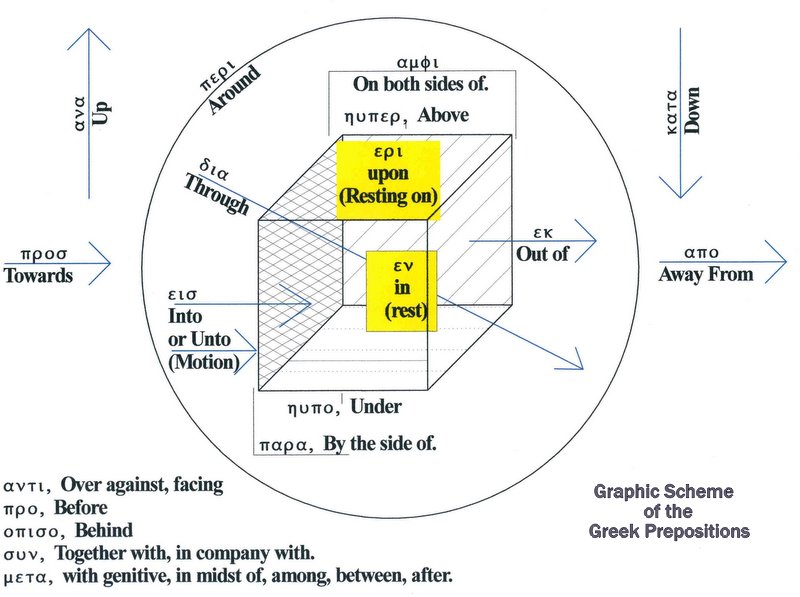
To say that God is patient to mankind for the sake of the elect or because of the elect would require a modification of the sentence structure in regard to adding another prepositional phrase.
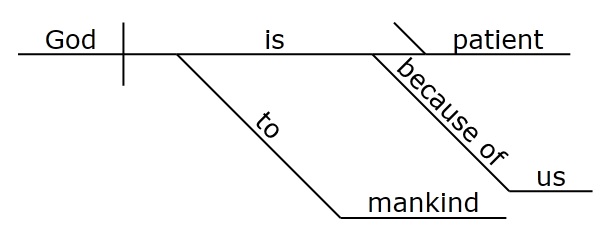
The actual sentence:

Also, Peter could have stated definitively that the elect alone are in view:
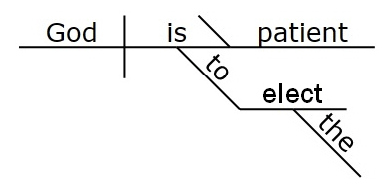
Therefore, supposedly, the elect are the sole object of God’s patience. However, this makes the elect subjects that need God’s patience in order to dissuade judgment. This makes the elect worthy of God’s judgment; therefore, he must be patient towards them in successive generations for the sake of the elect themselves. This is unavoidable unless you add another prepositional phrase to the text: God is patient towards the judgment-deserving elect for the sake of the elect.
This fits perfectly with Reformed soteriology, Calvinism if you will. The elect are still under the condemnation of the law, and mankind in general, or the non-elect, are not the beneficiaries of God’s patience in the least. God is only patient with the elect, because they are worthy of judgment, for the sake of the elect until they all believe.
So, you are going to interpret this Scripture according to your view of justification/salvation. Making “us-ward” the elect only fits with the idea that Christians are looking for a final salvation:
14 Therefore, beloved, since you are waiting for these, be diligent to be found by him without spot or blemish, and at peace. 15 And count the patience of our Lord as salvation,
Again, this fits because part and parcel with a predestined view of salvation and Calvinism is the idea that Christians, or the elect, still need God’s patience unto salvation. The “salvation” in verse 14 doesn’t pertain to the whosoever will of mankind, it pertains to the elect only. The elect still need God’s patience unto salvation. Why does God need to be patient? Because of sin, What kind of sin? The kind that deserves the judgment to come.
Certainly, God is patient with us, but it is a fatherly patience. If you don’t believe that Christians still need a patience that dissuades the final judgment until the other elect believe, “us-ward” must mean mankind in general. This presents the idea that Christians “hasten” the day of Christ’s coming (they anxiously await for it) while understanding that the Lord’s patience means salvation. Salvation for whom? Well, Christians already have salvation.
The former idea asserts that Christians need God’s patience because they deserve judgment, and God is patient with them because He is not willing that any of the other elect perish.
Unless you interpret this text with a proper view of salvation, “us-ward” is ambiguous. However, assessing the text with a proper view of salvation makes “us-ward” mankind because Christians are not the cause of the coming judgment—God doesn’t need to be patient with Christians in that way.
Once again, we see that eschatology is far from being a “secondary” issue. False teachers have always used eschatology to throw Christians off track (here and 2Thess 2:1-12). We live in an age when the return of Christ is imminent, and we are to be found faithful upon His arrival. This is a time of urgency seen in this text. While we hasten the day of the Lord, we understand that His patience means salvation for many. We are to work while it is still daylight:
Romans 13:11 – Besides this you know the time, that the hour has come for you to wake from sleep. For salvation is nearer to us now than when we first believed. 12 The night is far gone; the day is at hand. So then let us cast off the works of darkness and put on the armor of light.13 Let us walk properly as in the daytime, not in orgies and drunkenness, not in sexual immorality and sensuality, not in quarreling and jealousy.14 But put on the Lord Jesus Christ, and make no provision for the flesh, to gratify its desires.
Ephesians 5:15 – Look carefully then how you walk, not as unwise but as wise, 16 making the best use of the time, because the days are evil. 17 Therefore do not be foolish, but understand what the will of the Lord is. 18 And do not get drunk with wine, for that is debauchery, but be filled with the Spirit, 19 addressing one another in psalms and hymns and spiritual songs, singing and making melody to the Lord with your heart, 20 giving thanks always and for everything to God the Father in the name of our Lord Jesus Christ, 21 submitting to one another out of reverence for Christ.
Where is our urgency? It’s missing because we don’t have a dog in the fight, everything is predetermined—there is no cause and effect. Que, sera, sera, what will be will be. Who the “us-ward” are in this passage determines how we will function as Christians. I find the Reformed talking point that evangelism is exciting because it makes us a part of God’s predetermination wanting. You can add to that John MacArthur’s “because God said so” assertion, and God is glorified by people rejecting Him because of the “savor of death.”
Again, the Reformers didn’t even have salvation right, we must be Bereans and see for ourselves what is true about this issue. But in the final analysis, a view of God’s predestination must be tempered with the knowledge that God desires for all men to be saved and does not select people for damnation with intent. God takes no pleasure in the death of the wicked (Eze 18:32, 33:11). God does not seek glory in condemning people to eternal judgment:
http://www.jimmcguiggan.com/reflections3.asp?status=Calvinism%2C+worst+face+of&id=913
Why Every Self‐Respecting Premillennialist Isn’t a Calvinist

“One’s eschatology will be consistent with their view of justification—unless you’re John MacArthur.”
At the 2007 Shepherds’ Conference, Pastor John MacArthur gave the opening message titled, “Why Every Self‐Respecting Calvinist Is a Premillennialist.” The message caused a hyper hissy fit among the authentic Geneva style Calvinists that used to associate with MacArthur. Most of the hysterical reviews were whining rants about how the message was an “ambush.” They came to the conference to hear solid fatalistic Reformed doctrine while enjoying sweet fellowship among philosopher kings and instead were personally dressed down at the very beginning of the conference that they attended with hard earned parishioner money. It just ain’t right.
No doubt, the message left amillennialism naked and freezing outside in the cold. Well, sort of, depending on your understanding of Calvin’s election construct. This is why the various responses danced around the real issue and were in bondage to MacArthur’s fundamental misunderstanding about what Calvinism is while calling himself one. Paul warned the Corinthians that elitist academia is not the venue that God works from, and this fiasco is just one good example among many as to why that is so. The Geneva popes could not expose the fact that MacArthur’s fundamental premise is wrong—that would expose what Calvin really believed about election—a truth that the totally depraved artisans can’t handle.
MacArthur said this during the message:
But bottom line here, of all people on the planet to be pre-millennialist it should be Calvinists; those who love sovereign election. Let’s leave amillennialism for the Arminians. It’s perfect! [laughter] It’s ideal. It’s a no-brainer. God elects nobody and preserves nobody. Perfect! Arminians make great amillennialists. It’s consistent. But not for those who live and breathe the rarified air of sovereign electing grace. That makes no sense. We can leave amillennialism to the process theologians . . . The irony is that those who most celebrate the sovereign grace of election regarding the church, and its inviolable place in God’s purpose from predestination to glorification, and those who most aggressively and militantly defend the truth of promise and fulfillment, those who are the advocates of election being divine, unilateral, unconditional, and irrevocable by nature for the church, unashamedly deny the same for elect Israel. That is a strange division.
Ok, so MacArthur highlighted one of the assumed positive notes that can be taken from the idea of Calvin’s election: Once saved always saved. And, absolute assurance of salvation because it is God’s work alone—we can’t mess it up. And, how can you proffer election for the individual and ignore the fact that Israel was elected? This put the Geneva popes in a tough spot because they know that this apparent contradiction fits perfectly with Calvin’s doctrine of election.
Calvin believed in three categories of election: the non-elect, the called elect, and the chosen elect. This necessarily denies assurance because the called elect don’t know for certain whom among them have been chosen. Calvin stated this in no uncertain terms:
Let us, therefore, embrace Christ, who is kindly offered to us, and comes forth to meet us: he will number us among his flock, and keep us within his fold. But anxiety arises as to our future state. For as Paul teaches, that those are called who were previously elected, so our Savior shows that many are called, but few chosen (Mt. 22:14). Nay, even Paul himself dissuades us from security, when he says, “Let him that thinketh he standeth take heed lest he fall,” (1 Cor. 10:12). And again, “Well, because of unbelief they were broken off, and thou standest by faith. Be not high-minded, but fear: for if God spared not the natural branches, take heed lest he also spare not thee,” (Rom. 11:20, 21). In fine, we are sufficiently taught by experience itself, that calling and faith are of little value without perseverance, which, however, is not the gift of all (CI 3.24.6).
You can be called, and you can have faith, but that doesn’t seal the deal, said Calvin:
The expression of our Savior, “Many are called, but few are chosen,” (Mt. 22:14), is also very improperly interpreted (see Book 3, chap. 2, sec. 11, 12). There will be no ambiguity in it, if we attend to what our former remarks ought to have made clear—viz. that there are two species of calling: for there is an universal call, by which God, through the external preaching of the word, invites all men alike, even those for whom he designs the call to be a savor of death, and the ground of a severer condemnation. Besides this there is a special call which, for the most part, God bestows on believers only, when by the internal illumination of the Spirit he causes the word preached to take deep root in their hearts. Sometimes, however, he communicates it also to those whom he enlightens only for a time, and whom afterwards, in just punishment for their ingratitude, he abandons and smites with greater blindness (CI 3.24.8).
So, this fits perfectly with Calvin’s eschatology; Israel was temporarily elected just like many individuals are temporarily elected. The logical conclusion of Calvin is that God’s word did, in fact, fail (Romans 9:6). Moreover, and in direct contradiction to 1John 5:13, authentic Reformed doctrine has always denied assurance. This is reflected in many contemporary authentic Calvinists:
There is danger on the way to salvation in heaven. We need ongoing protection after our conversion. Our security does not mean we are home free. There is a battle to be fought (John Piper: Bethlehem Baptist Church Minneapolis, Minnesota; The Elect Are Kept by the Power of God October 17, 1993).
Words mean things. Piper is clearly saying that our battle in sanctification is a battle for justification. If you really understand the Reformed view of justification, you know the following: the “battle” is against our supposed propensity to gain favor with God through works in sanctification (effot to please/love God changed to; merit for salvation). There is no separation of justification and sanctification so works in sanctification must be sanctified with a faith alone formula. It’s salvation by Christ plus not doing any works in sanctification (Christ + antinomianism to maintain our salvation). We must be sanctified the same way we were justified so that we can properly finish justification. Therefore, Calvin believed that sins committed in the Christian life separate us from grace, and a continual repentance, the same repentance that saved us, is needed to maintain our salvation. Unless we live by faith alone in sanctification, Christ’s blood will not be applied to the new sins we commit. This is the battle Piper is talking about. Said Calvin:
…by new sins we continually separate ourselves, as far as we can, from the grace of God… Thus it is, that all the saints have need of the daily forgiveness of sins; for this alone keeps us in the family of God (John Calvin: Commentaries on the Catholic Epistles; The Calvin Translation Society 1855. Editor: John Owen, p. 165 ¶4).
And, guess what? It just so happens that your local Reformed elder, via the Reformed power of the keys, has the authority to forgive those pesky sins that take away your salvation. Who would have thunk it?
To impart this blessing to us, the keys have been given to the Church (Mt. 16:19; 18:18). For when Christ gave the command to the apostles, and conferred the power of forgiving sins, he not merely intended that they should loose the sins of those who should be converted from impiety to the faith of Christ; but, moreover, that they should perpetually perform this office among believers (The Calvin Institutes: 4.1.22).
Secondly, This benefit is so peculiar to the Church, that we cannot enjoy it unless we continue in the communion of the Church. Thirdly, It is dispensed to us by the ministers and pastors of the Church, either in the preaching of the Gospel or the administration of the Sacraments, and herein is especially manifested the power of the keys, which the Lord has bestowed on the company of the faithful. Accordingly, let each of us consider it to be his duty to seek forgiveness of sins only where the Lord has placed it. Of the public reconciliation which relates to discipline, we shall speak at the proper place (Ibid).
Calvinism is an egregious false gospel being flaunted in broad daylight by academic elitists who are in reality clueless, which brings me to my second point. This is where the vast majority of American Christians are functioning Calvinists…among many other ways while vehemently denying Calvin. Specifically, the whole idea that eschatology is a “secondary issue.” No, no, no, no, no, no, no! Eschatology is gospel; you cannot separate the cross from eschatology. One’s eschatology will be consistent with their view of justification—unless you’re John MacArthur.
The number of resurrections and judgments, and who stands in those judgments, are indicative of a particular view of justification, and election in particular. MacArthur’s dispensationalism coupled with naming the name of Calvinistic soteriology, which really isn’t Calvin’s soteriology, to begin with, is a dumbfounding contraction that leaves one without words to fully explain. Calvin’s eschatology calls for one resurrection and one judgment at the end of time where everyone sweats it out while waiting to find out if they were antinomian enough. Some of the books at the Great White Throne Judgment are the books of the law that will be used by God to judge the works of those standing in that judgment. As one aspect of Christian security, we will not stand in that judgment because we are not under the law. Furthermore, we don’t wait to see if our antinomianism sufficiently utilized the “doing and dying” of Christ to cover our sins—our sins have been completely eradicated.
The number of resurrections and judgments speak to our view of what part of Christ’s works on the cross are finished and not finished, the separation of justification and sanctification, the new birth, election, and future Israel. Eschatology is gospel.
That’s why every self‐respecting premillennialist isn’t a Calvinist, and why MacArthur isn’t a Calvinist, but he thinks he is a Calvinist. As stated by Richard Muller,
There is every likelihood that John MacArthur’s “Calvinism” would probably not be recognized by Calvin himself.
It’s all simply pathetic.
paul

 Paul's Passing Thoughts
1 comment