Election and the Real Golden Chain of Salvation: Part 2
 “Those who still need salvation have that need for a reason; they yet remain damned. Furthermore, they saturate themselves with a justification only perspective on the law which will magnify their damnation unless they repent.”
An item of particular interest in regard to the Reformed use of Romans 8:29,30 for the ordo salutis (order of salvation or the golden chain of individual salvation) is that sanctification is missing from the process. Sanctification is not in Romans 8:29,30. Let there be no doubt about it when the least common denominator is front and center: this issue concerns two different gospels. One gospel states that sanctification is not mentioned because it is the same thing as justification; the other gospel states that sanctification is missing because justification and sanctification are totally separate.
And obviously therefore, one states that salvation is a finished work while the other sees salvation as a process that the individual experiences and lives in while the process is ongoing. This is why Protestantism has ALWAYS been characterized by weak sanctification and lack of assurance. If justification and sanctification are the same thing, there is going to be an over emphasis on justification; if we are in the midst of the justification “process” and our salvation depends on whether or not God chose us to believe, and our individual election will not be verified until the “tribunal,” assurance will be lacking.
The Bible is clear. Assurance is based on two things: confidence in the FINISHED election process preordained by God, and the ability to work out the gifts given to us with our finished and final salvation being of no consideration in regard to our works of love. In other words, one of the purposes of election is to radically separate justification and sanctification leading to assurance and aggressive sanctification. The Reformed order of salvation uses election to fuse justification and sanctification together resulting in that train wreck we call “Protestantism.”
This is why I think Romans 8:29,30 is in the past tense; it concerns justification ONLY as a finished work. Yet, the Reformed use it to make a case for a salvation that is yet future; in other words, the Reformed throw out grammatical considerations regardless of whether it is in the English, Hebrew, or Greek. While they claim deep knowledge of the languages are efficacious to valid understanding of the Scriptures, they rape and ravage normative grammatical rules unfettered. While using knowledge of the languages to intimidate the great unwashed, they say, “good grammar makes bad theology” as if there are no rules of grammar in the Greek and Hebrew. But there are, and the rules are fairly consistent in all languages. Knowledge of Greek and Hebrew is oversold for purposes of control. More relevant than anything is a good working knowledge of grammar.
Romans 8:29,30 speaks of a group, or classification of people who were pre-loved, predestined, called, justified, and glorified. However, not all who are called within the group answer the call, but rather reject it. Those who accept the invitation of the calling are part of the elect group. In the same way, Israel was elected, but not all Israelites accept the invitation. Therefore, God also preordained the Gentiles for salvation in order to make the Jews jealous. In part one, I cite Matthew 22:1-14 to make this case in regard to the “called”, and would also like to add Romans 11. The “remnant” can also be considered an elect group as well, and any Jew can be saved by becoming a part of it IF they believe individually (Romans 11:23).
Throughout the Bible, people are called to believe and are warned that they will be judged if they don’t. The means of salvation being elected rather than individuals, and those individuals being called on to become part of the elect group excludes the need to relegate the gospel to paradox. God is not a God of confusion. If the “called” are not distinguished from the definition of “elect,” the Bible becomes utterly confusing. Nevertheless, Matthew 22:1-14 seems to end the argument altogether; many are called but few are elect. The elect are the ones who accept the invitation to the wedding feast.
Admittedly, this is a working hypothesis for consideration among the laity, but the following is certain: the Protestant gospel of a progressive order of salvation must be rejected with extreme prejudice for many, many definitive reasons. And Biblicism knows the following concretely in regard to its alternative gospel: justification is a finished work by God alone and the saint is free to love aggressively without fear of condemnation. We leave the cross and move on to maturity in love. Those who still need salvation have that need for a reason; they yet remain damned. Furthermore, they saturate themselves with a justification only perspective on the law which will magnify their damnation unless they repent.
At any rate, the idea that a group is elected for a certain purpose without all in the group being saved is far from being unbiblical, and Israel is the primary example (NASB):
Deuteronomy 7:6
“For you are a holy people to the LORD your God; the LORD your God has chosen you to be a people for His own possession out of all the peoples who are on the face of the earth.
Exodus 19:4-6
‘You yourselves have seen what I did to the Egyptians, and how I bore you on eagles’ wings, and brought you to Myself. ‘Now then, if you will indeed obey My voice and keep My covenant, then you shall be My own possession among all the peoples, for all the earth is Mine; and you shall be to Me a kingdom of priests and a holy nation.’ These are the words that you shall speak to the sons of Israel.”
Psalms 135:4
For the LORD has chosen Jacob for Himself, Israel for His own possession.
Isaiah 41:8-9
“But you, Israel, My servant, Jacob whom I have chosen, Descendant of Abraham My friend, You whom I have taken from the ends of the earth, And called from its remotest parts And said to you, ‘You are My servant, I have chosen you and not rejected you.
Isaiah 43:10
“You are My witnesses,” declares the LORD, “And My servant whom I have chosen, So that you may know and believe Me And understand that I am He Before Me there was no God formed, And there will be none after Me.
Isaiah 44:1-2
“But now listen, O Jacob, My servant, And Israel, whom I have chosen: Thus says the LORD who made you And formed you from the womb, who will help you, ‘Do not fear, O Jacob My servant; And you Jeshurun whom I have chosen.
Isaiah 45:4
“For the sake of Jacob My servant, And Israel My chosen one, I have also called you by your name; I have given you a title of honor Though you have not known Me.
Amos 3:2
“You only have I chosen among all the families of the earth; Therefore I will punish you for all your iniquities.”
In Romans 11:2, the apostle Paul even writes that God “foreknew” Israel. This is the election and foreknowledge of a group of which all are not saved. God calls all of those belonging to the group, but many within the group reject the call. Again, note Matthew 22:1-14. If they answer the call, they are elect because they are part of the group that was elected. It is plain that election is not defined by individual pre-selection alone, and in fact, specific verses that seem to indicate the election of individuals are not only rare, but ambiguous at best while the former are ample and concise.
Let me throw a couple of thoughts in here that would be prompted by reading almost anywhere throughout the New Testament. First, if individuals are pre-selected, the Scriptures pass on the opportunity to make that clear over and over again. For example:
Luke 16:27 – And he said, ‘Then I beg you, father, to send him to my father’s house— 28 for I have five brothers—so that he may warn them, lest they also come into this place of torment.’ 29 But Abraham said, ‘They have Moses and the Prophets; let them hear them.’ 30 And he said, ‘No,father Abraham, but if someone goes to them from the dead, they will repent.’ 31 He said to him, ‘If they do not hear Moses and the Prophets, neither will they be convinced if someone should rise from the dead.’”
If the issue is pre-selection, why wouldn’t Abraham merely say so? Why is the source of information that would persuade the rich man’s brothers the issue rather than God’s choosing? Individual pre-determinism makes the Bible an illogical convoluted mess, not to mention a god that is playing head games with mankind.
Secondly, if there is no future purpose for Israel, or the “church” has taken Israel’s place, which is an idea firmly embedded in Reformed tradition via amillennialism and supersessionism, does that not deny a true link in the election chain? Does it not make some aspects of election temporary? Why not? In part 1 we discussed John Calvin’s interpretation of the “called” as those who are temporarily chosen and therefore relegated to a greater damnation in the end.
So, what is the true golden chain of salvation? We begin to explore that in part 3.
paul
Also recommended: Live: Friday 9/17/2015 @ 7pm. Call in and join the conversation!
Election and the Real Golden Chain of Salvation: Part 1
Let’s discuss yet another Reformed doctrine; the ordo solutis, or “order of salvation.” This is also known as the “golden chain of salvation” and the proof text is Romans 8:29,30.
For those whom he foreknew he also predestined to be conformed to the image of his Son, in order that he might be the firstborn among many brothers. 30 And those whom he predestined he also called, and those whom he called he also justified, and those whom he justified he also glorified.
It goes something like this: God fore-loved certain individuals and not others. He then predestined them to salvation. He then at some point in time calls them, and then justifies them resulting in glorification. Here is a Reformed illustration below:
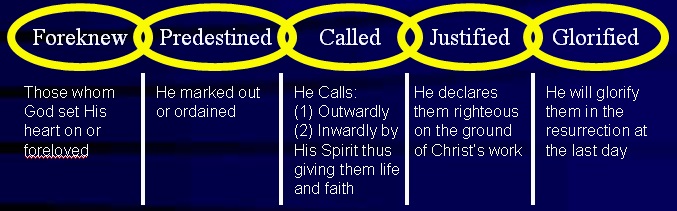
Catholic theologians often object to this take on Romans 8:29,30 because they reject once saved always saved, but they misunderstand, authentic Protestantism does NOT hold to OSAS. More to the point here, the golden chain of salvation is seen as individual, rather than a means of salvation. And that’s what election is: it chooses the means of salvation, and chooses individuals who have roles in the various purposes of salvation. God chose Christ to die on the cross, therefore Christ is elect; He chose the holy angels for certain roles in the salvation process, therefore they are elect; He chose the nation of Israel as part of the process, therefore the nation of Israel is elect, and He chose certain individuals throughout history to contribute to the process of salvation, therefore they are chosen as well to play a part in the means of salvation. That does not mean that they did not have a choice to follow God prior to that choosing for a role in God’s salvific plan. For instance, obviously, God chose the virgin Mary to bear and give birth to Christ as part of the salvation plan. It is also obvious that Mary was saved prior to that choosing. It is obvious that Christ chose the 12 disciples for a role in the slavific plan, but that doesn’t mean they had no choice in choosing God prior to that, hence,
You did not choose me, but I chose you and appointed you so that you might go and bear fruit—fruit that will last—and so that whatever you ask in my name the Father will give you. This is my command: Love each other.
In context, Christ is referring to their election as apostles, not some inability to choose God. As we shall see in the future parts, the REAL golden chain of salvation is a mode of salvation and those used by God to execute it, not a golden chain of salvation that pertains to individual salvation through determinism. Let me now make a beginning case for your consideration. Let me create some reasonable doubt in regard to the Reformed ordo solutis.
First, if you will note once again the Reformed illustration posted in this first part, it illustrates a past tense that preludes present continuous action. This, of course, is necessary for a deterministic conclusion. However, if you carefully examine Romans 8:29,30 it is strictly past tense. Paul is speaking of something that has already taken place. Any other conclusion is presumptuous at best. Paul is writing about something that has been established in the past, or a group of people who have already been glorified. This clearly casts reasonable doubt on the ordo solutis.
Secondly, the ordo solutis would indicate that all of those who are called are also justified, or saved. This is clearly not the case.
Matthew 22:1 – And again Jesus spoke to them in parables, saying, 2 “The kingdom of heaven may be compared to a king who gave a wedding feast for his son, 3 and sent his servants to call those who were invited to the wedding feast, but they would not come. 4 Again he sent other servants, saying, ‘Tell those who are invited, “See, I have prepared my dinner, my oxen and my fat calves have been slaughtered, and everything is ready. Come to the wedding feast.”’ 5 But they paid no attention and went off, one to his farm, another to his business, 6 while the rest seized his servants,treated them shamefully, and killed them. 7 The king was angry, and he sent his troops and destroyed those murderers and burned their city. 8 Then he said to his servants, ‘The wedding feast is ready, but those invited were not worthy. 9 Go therefore to the main roads and invite to the wedding feast as many as you find.’10 And those servants went out into the roads and gathered all whom they found, both bad and good. So the wedding hall was filled with guests.11 “But when the king came in to look at the guests, he saw there a man who had no wedding garment. 12 And he said to him, ‘Friend, how did you get in here without a wedding garment?’ And he was speechless. 13 Then the king said to the attendants, ‘Bind him hand and foot and cast him into the outer darkness. In that place there will be weeping and gnashing of teeth.’ 14 For many are called, but few are chosen.”
In this passage, the “called” are defined: the called are all peoples who are invited to believe in the gospel of the kingdom, and those who except the invitation are of the elect group. Not all of the called are elect. This throws a very large monkey wrench into the Reformed golden chain/order of salvation. Hence, John Calvin came up with three categories of individual preselection: the non-elect; the called; or those temperately chosen/illumined/born again, and those who persevere; or those who are both called and elected in the final analysis. Therefore, assurance of salvation is absolutely impossible in context of the ordo solutis. NO ONE can really know for certain that they are saved until they are “manifested” in the “final tribunal” where “final justification” is determined.
Yet, the apostle John wrote an epistle so that we may “know” presently that we are born again (1John 5:13). The Reformed order of salvation seems apparent based on its deterministic presuppositions, but further investigation is needed.
paul
Romans 9:11- God Does Not Choose, He Calls
How should we interpret our Bibles? Clearly, Christ set the example. Throughout the gospels He reasoned with many via interpretation based on the technical meaning of words and how they are used in a sentence. We are to interpret the Bible grammatically. Also, the Bible is purposely written in a way that defines certain words according to the plain sense of context; so, while knowing Greek and Hebrew may be helpful, it’s far from being a prerequisite to understanding. The rules of grammar, for the most part, transcend culture. A noun is a noun, and a verb is a verb in any language. To even cite examples of this is to state the obvious, but I will mention Christ arguing for the resurrection based on the tense of “I am” in Matthew 22:31,32.
So, in regard to the question of determinism and the idea that God chooses some for salvation and others for damnation, we find something in the grammar of Romans 9:11 that should give us pause.
…though they were not yet born and had done nothing either good or bad—in order that God’s purpose of election might continue, not because of works but because of him who calls—(ESV)
If the point of Romans 9 is God’s pre-choosing of some for salvation and not others, why would Paul not have written, “because of him who chooses” rather than “him who calls”? Did Paul have a senior moment? Also peculiar to this passage is the stated purpose of election: the eradication of works from salvation. It seems that election accomplishes this for purposes of God calling all people to accept salvation as a pure gift rather than God’s choosing being the linchpin. Note the following:
For the gifts and the calling of God are irrevocable (Rom 11:29).
Again, why is it not the choosing of God that is irrevocable rather than the calling? This grammatical roadblock to determinism was not missed by John Calvin. If choosing and calling are something different, it could mean that the means of salvation was chosen for a particular purpose and then offered to all people as a gift that they could choose themselves or reject. Hence, Calvin separated determinism into 3 separate categories: the non-chosen, the temporarily chosen (the called), and the truly chosen (those who persevere). But of course, Calvin’s three-fold election construct is rarely discussed in Reformed circles for obvious reasons. You can add this fact to the list of other Reformed dirty little secrets relegated to the closets lest they would incite some sort of chemical reaction of thought within the cranium cases of Reformed Kool-Aid drinkers. And of course, no one is going to challenge me to come up with the specific citations from the Calvin Institutes because they know I can.
Here is my rudimentary hypothesis at this time: “election” is primarily a noun in the Scriptures that denotes a category of people and purpose while “calling” is the action taken by God, or the verb. God calls people, He doesn’t choose them. God chose the means of salvation, and calls all people to accept the means of salvation as a gift. The purpose of election is that salvation would be by PROMISE, and not works. Also, “election” is primarily defined in terms of miraculous new birth into the family of God and something made entirely possible by God alone. Any Bible passages that seem to make a direct connection between election and God’s choosing of individuals are rare, or completely absent at most, and ambiguous at least.
Let’s also remember that those who are not in need of salvation are also considered to be God’s “elect”; namely, the holy angels and Christ. The nation of Israel is elect for a particular purpose, and this is perhaps the best definition of election: it is a chosen means to obtain a particular purpose. God chooses the means of salvation, not individuals. Election makes salvation a pure gift and promise apart from the will of man or his abilities, but mankind is free to choose or reject the gift. True, because man fears the condemnation of God, his tendency is to not seek God, but the loving God seeks out mankind through the gospel. God seeks out man and corners him with the truth of the gospel, but man’s tendency to hide from God does not mean he has no ability to make a choice.
A good example of the ambiguity that surrounds the idea of God choosing individuals is 1Peter 5:13. Depending on the translation, it’s the “sister” that is chosen or the “church.” If the latter, that makes my point, but more interesting is the disagreement in translations concerning “elect” used as a noun or adjective as opposed to “chosen” or “elected” regarding those defined by an action, or verb. While the likes of the ESV translate “elect” as… “elected,” or “chosen,” many other mainstream translations like the ASV translate it “elect” without the ed suffix. In other words, a statement concerning the fact that we are all part of the family of God and His plan of salvation does not necessarily equal determinism, or the idea that “elect” equals those who were predetermined to be in the family of God coupled with total inability on man’s part to choose God.
And, if Christ wasn’t mincing words in His argument for the resurrection, neither is this consideration by any stretch of the imagination. And it’s funny; when I was doing word study on this and initially observed 1Peter 5:13 with the word “elected,” I assumed that if my hypothesis held any water that I would also find translations using the word “elect,” and as noted, that in fact ended up being the case.
If you follow the apostle Paul’s argument throughout Romans 9, 10, and 11, and Galatians 3 for good measure, the concern is that salvation is solely by the promise of miraculous new birth. Whether Sarah, Rebekah, Elizabeth, Mary, or the Spirit’s role described in Galatians 3, salvation is NOT by any will or work of man, but a onetime miraculous new birth. A denial of literal new birth paves the way for progressive justification via determinism which is the number one nemesis of the true gospel.
The new birth is a work of God alone, but that doesn’t mean man cannot choose it.
paul
A Clarification on my Anti-Reformation, Anti-Protestant Stance
 It is true, I have totally written off every Calvinist that has ever lived in regard to having any value for sanctification or justification except for two, one being Dr. Jay Adams. After all, I don’t want to be extreme.
So, what’s my excuse for excusing Adams? He brings something to the table that isn’t Reformed. Sure, he may argue that it is Reformed, but nevertheless the results are the same: people find a measure of real help in a contemporary church where there isn’t any help. In fact, the consensus is in: people are better off after they leave church. This ministry has witnessed several marriages on their way to divorce court until the couple simply stopped going to church. In fact, I dare say their marriages are getting better.
We are in a Protestant Dark Age. A movement is needed where the wisdom of God found in the Scriptures is rediscovered in Western culture. What needs to be rediscovered specifically? It starts with the knowledge that the Bible is written for the able individual. That’s first.
Secondly, the issue of how we interpret reality must be addressed. The Reformers did not interpret reality literally, and that tradition was passed down to all that followed them. In the church today, by and large, the pastorate does not interpret state of being in the same way that congregants do. The Reformers reinterpreted every word and term according to their own worldview. For example, “God’s glory” really means “God’s self-love.” Stated simply, John 3:16 in reverse.
The Reformers devised an ingenious indoctrination system of sliding metaphysics. They redefined every word and term, and allowed the listeners to assume what they meant by each word and term. In the process of using these words and terms in a certain way, listeners are slowly indoctrinated in accordance with the primary goal of the Reformers: a desired functionality albeit foggy understanding.
Let me give some specific examples. Total depravity. From the beginning in Reformed thought, this included believers. So, while assuming total depravity pertains to the unregenerate only, many are eventually indoctrinated into the original Reformed idea that this also includes believers.
Sola scriptura. The assumption is Scripture alone, but the Reformers knew that few would ask the following question: “What exactly did the Reformers believe about the Scriptures?” Sure, Scripture alone, but for what purpose?
Election. The assumption is that this argument focuses on man’s ability to choose God for salvation, but it goes much, much deeper than that and is directly relevant to what the Reformers believed about reality itself. Few know that Calvin believed in three classes of elect: non-elect, temporarily elect, and the final elect, or those who persevere.
The Reformers believed that reality is a narrative written by God in which mankind is written into the script. Reformers such as Jonathan Edwards believed that man has no will per se, but God preordains every thought that precedes every act of man which makes it seem as if man has a will. My wife Susan will be doing three sessions on Jonathan Edwards at this year’s TANC conference. Many will find her research fairly shocking.
Sola fide. The assumption is faith alone for salvation/justification. By far, this is the one that the Reformers get the most mileage out of. Using this assumption, they continually talk about sanctification in a justification way. Eventually, sanctification becomes justification. Eventually, the Christian life becomes perpetual re-justification which is the Reformation gospel in a nutshell.
Protestantism is truly the super-cult of the ages.
And the institutional church finds itself in a huge dilemma. Traditional institutional worship beginning with the Reformation was tailored for perpetual re-justification down to the alter call routine. The Lord’s Table is a solemn ceremony where additional grace is imparted through repentance. In reality, the first century assemblies met for dinner, and the fellowship meal was supposed to remind them of their fellowship with God and His Son. It was all very informal and not for the purpose of imparting additional grace.
The gatherings were an extension of worshipful living specifically designed for private homes and nothing more. The institutional version is an extension of two pillars of Reformed theology: the doctrine of progressive justification, and the politics of church-state. Hence, traditional institutional worship necessarily circumvents the original intent of Christ’s mandate for His assemblies.
With all of that said, Adams supplies a little help that can be found right now in the institutional church, and at least for the time being, we need to seize upon everything we can get. I am not talking about those who think they are helped by adopting a Reformed worldview of zero-sum-life (viz, “second generation” biblical counseling). I am not talking about those who seem to stand strong in the face of adversity because they see all of life as nothing but a divine prewritten narrative for the sole benefit of a divine self-love. No, here is my reasoning in regard to Adams per a comment I posted yesterday:
God used Jay Adams to save my life. How? Jay emphasized the need for biblical counseling using a grammatical approach to the Scriptures. This approach proffered the idea that seizing upon the literal promises of God in the Bible is curative. Of course, this would seem evident. That gives hope; if I follow God’s instruction on this, God will do that.
In the midst of the hell I found myself in, I could begin to please God. Nothing could keep me from doing so except myself, and in God’s timing, and in God’s way, it would be curative as well.
As someone who prided himself as a knowledgeable, objective evangelical, Jay’s teachings exposed the fact that I was really a functioning mystic that used all of the orthodox verbiage. While I disagree with Jay on many things, this is the powerful approach that he brings to the table.
“Christians” have a choice to make in regard to how they will interpret the Scriptures and reality itself: grammatically, or according to Christocentric Gnosticism. I am not talking about pseudo grammatical interpretation used for a purely redemptive outcome, I am talking about authentic exegetical interpretation, not cross-centered eisegesis leading to the antinomianism of “second generation” biblical counseling.
And, Jay is an example to all of us in practicing our gifts faithfully to the end. There is no retiring from a love for the ministry that you are called to whatever it is.
May the Lord give God’s people many more years of his living sacrifice.
Am I willing to give a Calvinists credit where credit is due? Yes, if he brings something to the table that can give life. If we were in a time when the laity has retaken its rightful place in Christ’s mandate supplying ample sanctification wisdom, would I recommend Adams in any regard? I am not sure, my due to him in this particular age notwithstanding. But for the time being, we must scrape up everything we can get until the laity obeys its calling, as long as it is truly worth scraping up.
The Reformation has failed. A resurgence of it commenced in 1970. By 2008, it dominated American evangelicalism and continues to do so today. But, the chickens are coming home to roost. Its leaders are dropping like flies. The damage control is now unmanageable. The institutional church is a train wreck while the Nones and the Dones are laying about everywhere on the landscape. The latest trail blazer of the neo-resurgence to fall at the hands of his own gospel sanctification Reformed doctrine is Tullian Tchividjian. He is one of seven of the most visible leaders of the movement to resign for misconduct in less than two years. Others have been the focus of controversial bully-like conduct in the same time frame, along with numerous Neo-Calvinist mega church pastors who have resigned for sexual misconduct, three in the Orlando, Florida area alone.
The answer is NOT Reformation—the answer is a laity revolution. The laity has been conned into investing huge sacrifice in Reformed academia, and to what end? Who will deny that the laity understands less about Christian living than we ever have? Rather than seeking God’s face on our own, we run to orthodox sand boxes like The Warburg Watch and play with the same regurgitated Reformed talking points. This only serves to help the failed Reformation with its damage control. It only serves to send the message that being confused is acceptable.
But we do not serve a God of confusion. It’s time for the laity to stop worshiping Reformed academia and give honor to the one who sanctifies us with truth—not the traditions of mere men.
paul

 Paul's Passing Thoughts
2 comments