
Sin, Sin, Sin, Sin, Sin, Sin, Sin, Sin
 Got sin? You do if you are a Protestant, and a lot of it. The “T” in TULIP doesn’t stand for total depravity for no good reason, no pun intended. The only good thing is focusing on the bad thing: your nasty, wicked self.
Sin is a really big deal in Protestantism because we get ourselves into heaven by dwelling on the fact that we are “sinners.” If we can do any good work, if ALL of our works are NOT filthy rags—that’s not living by “faith alone” for our justification. Supposedly, if we think we can do anything good, that’s not living by faith alone in what Jesus has accomplished for us, but rather living in the “confidence of the flesh.”
The foundation of Protestant soteriology is the idea that “Christians” live under the possibility of condemnation and should fear accordingly. Christians remain under the condemnation of the law and remain covered by professing that they can do no good work. By continually returning to the same gospel that saved us for forgiveness of works, both good and bad, the righteousness of Jesus continues to be imputed to us. Hence, “We have no righteousness of our own in salvation or the Christian life.”
In contrast, the emphasis of our Christian lives should be LOVE. We still sin, but it is not sin unto condemnation, but rather sin against our Father as a family matter. We may receive chastisement, but we are in no danger of condemnation. Not so with the Protestant gospel: the “Christian” remains under eternal condemnation and is only covered through faith alone by returning to the same gospel that saved us. This is why Protestantism has always been weak in the area of discipleship. This is why there is an obsession with making saved people rather than disciples. And by the way, the only place we can find continued forgiveness for “sin that removes us from grace” (Calvin/Luther) is under the “authority” of the local church. Go figure.
Even in Baptist churches, pastors bemoan the fact that “10% of the congregants do 90% of the work.” Well, dah, I am surprised that even 10% are doing anything as the focus is keeping oneself saved by focusing on how inept we are.
More and more in counseling, I am telling people to stop focusing so much on sin. Clearly, especially in the Protestant contemporary biblical counseling movement, the specific instruction is to “find the sin beneath the sin” as a means of growing your salvation as if salvation grows to begin with. If our focus is sin- searching as a means of spiritual wellbeing, and good works tempt us to think we did something good (again, Luther/Calvin), what in the world will be the results? Well, look around for yourself—it’s called “the church.”
 A focus on sin will not prevent sin or promote love. If there is something to be gained by finding sin, it will be far from us to fight against it. Why would we cut off our supply of blessings by making the cross smaller? It becomes a supply and demand issue.
The Bible endorses a focus on love, not sin-searching. We are to look for ways to love God and others, not ways to find the “sin beneath the sin” or some endeavor to “peel back the layers of sin.” No doubt, there is a CONTROL conspiracy involved with this supposed method of sanctification as well. Stripping people of an accurate evaluation of self is a very efficient way of controlling them. Being worthy enough to hold others accountable for their own good will not get you into heaven—only returning daily to the same gospel that saved you for a fresh set of downs to get into the salvation end zone.
And what will eventually happen to any marriage if the constant focus is your spouse’s sin? No wonder then that the present-day biblical counseling movement (mostly sponsored by Reformed churches) is overflowing with marriage counseling cases. Week in, and week out, teaching will knock down any notions that either spouse can do any work that is not “filthy rags.” And, the only real sin is not knowing that everything you do is sin; if you don’t know that, you may find yourself in so-called church discipline. We do know this: those who will not accept this premise are deemed “unteachable.”
We have not been given a spirit of fear under the law of sin and death and its condemnation. We, instead, have been given the Holy Spirit and boldness to love God and others without any fear of condemnation.
We are to be enslaved to love—not to a fear of condemnation.
paul
Church “Covenants” and How You Should Behave in a Protestant Church
 One endeavor on the long list of objectives here at TANC ministries is to get solid legal insight into what has become protocol in evangelical churches. That process began yesterday during a consultation with a local attorney. As documented here at PPT, the Association of Certified Biblical Counselors (ACBC) and its network of churches has become a virtual divorce mill. The pattern that this ministry continues to be made privy to is documented in an open letter to the executive director of ACBC, Heath Lambert.
Simply stated, New Calvinism, which is a return to the original church polity of the Reformation, does not have the force of state to compel church members to follow its orthodoxy. So, it improvises. Instead of simply burning heretics at the stake, or burning a hole through the tongues of those who ask questions in a challenging way, they ruin names and finances.
We must remember, the orthodoxy of the Protestant Reformation was tailored for a church state. America was originally founded by the Pilgrims who didn’t like how the Church of England did church-state, so they came to America and founded “New England.” The name is not happenstance. The American Revolution put an end to the Pilgrims’ theocracy that dominated the colonies. Actually, “Pilgrims” is a soft term for “Puritans.” And please, spare me the emails about the differences between the Pilgrims and the Puritans—the differences are insignificant in the whole scheme of things.
That brings us to the discussion of soft terms. First, the original Protestant Reformation was a simple church state, but in reality, the definition of “cult” comes into play when church states had to improvise in order to control people because of the American Revolution. A cult is defined as follows: it is any religious organization that controls people by means other than a church state. The etymology of the word “cult” does not become significant until post American Revolution.
In other words, without the force of the state to compel people to obey its orthodoxy, it must resort to manipulation and brainwashing to control people. Yes, church states also emphasize brainwashing because murdering people is costly in its implementation, and fewer people amounts to less resources, but brainwashing becomes even more important and refined when the final solution has been outlawed in an open society.
So, let’s state a definitive definition of cult: it is any religious organization that controls people by means other than a church state, and combines faith with authority. Like its church state predecessor, it assumes that the nature of man cannot obtain unity for a given cause without being ruled by those with superior knowledge of realty.
After the American Revolution, churches became a hybrid of orthodoxy and enlightenment thinking. It became an alphabet soup with a broad range of attitude concerning the ability of man to rule self. But, this never resulted in the full-blown focus on individual responsibility mirrored by the 1st century assembly of Christ. The concept of “church” spawned in the 4th century has always permeated the American church psyche, i.e., orthodoxy being a storybook form of truth written by church “Divines” that the saints can understand, and enforced for their own wellbeing.
With that said, soft terms become vital to the American church as we know it today. Church polity is a soft term for church government; church discipline is a soft term for Unam sanctam, or John Calvin’s power of the keys that gives church authority to decide someone’s salvation on behalf of God. It goes without saying that you obey someone that can take away your salvation.
And, “church covenant” is a soft term for “church contract.” Basically, when you sign a church covenant church contract, you are signing away your right to be heard. In most of these contracts, you agree to obey the leadership and to be “teachable.” Hence, from now on, when our ministry hears, “Gee whiz, all I did was ask questions and now my life is being destroyed,” the subject will mostly likely hear, “No, what you did is breach of contract so take your medicine.”
Note: in many churches that deem themselves congregational, the parishioners unwittingly circumvent that reality by agreeing to a revised church covenant prepared and presented by the elders. See how that works?
Moreover, these third party contracts often negate rights found under civil and criminal law. This ministry, more specifically I, stands corrected in my assertion that coercion is being used to control parishioners. In fact, it is not coercion, but according to what the parishioner has agreed to and signed, especially regarding permission to leave church membership. It’s a contract—you signed it, so shut up, nod your head, say amen, and put your money in the plate. It’s all good; if the elders like you—you will more than likely “be able to stand in the judgement.”
What are the redeeming facts here, if any? Education: NEVER sign a church contract. It’s NOT a “covenant” bolstered by your signature—it’s a CONTRACT. This is why TANC does what it does; education, then solution/alternative.
Is there a way to get justice after signing our rights away? Perhaps, because apparently, marriage is also a contract. Rather than burning you at the stake and burying you in the church yard under a stone edict condemning you to hell, which of course is against the law presently, they will begin by ruining your name, and then destroy you financially via divorce.
The process goes something like this: you break your contract and stop being “teachable.” This tells the leadership that you no longer see yourself as a sinner, and you have become “insubordinate.” A dozen or so respected leaders and their wives start telling your wife that you are no longer “humble” and whether she realizes it or not, she is married to an “angry man.” And hark, behavior that your wife formerly assumed not to be abusive, in fact is abusive. Yes, she is married to a man who “doesn’t love her like Christ loved the church.” It’s all downhill from there.
Apparently, legally, this is interference with a marriage contract. Damages would be determined by a jury if the situation ends in divorce. Also, the idea that ACBC could eventually be subject to a class action lawsuit is not all that farfetched.
However, this is just more evidence that the premise and foundations of the institutional church is egregiously flawed and was designed for a church state to begin with. The solution is the cooperation of spiritual gifts, not authority, and fellowship—not membership.
Meanwhile, if you do not like the solution, behave yourself in the Protestant church. Stop going to discernment blogs and whining—you signed the contract, shut up and live by it.
paul
Smoking Gun: ACBC is a Nationwide Divorce Mill
 Christ made it clear that what God has brought together NO man is to separate. Does this mean God predetermines every marriage in regard to particular spouses? I doubt it. This probably refers to God’s covenant of marriage and the theology of vows. At any rate, death, unrepentant adultery, and an unbeliever who abandons their believing spouse are the only exceptions.
How does one live happily with a spouse who has become difficult? For Protestants, that is a hard question because the focus has been on justification for 500 years with little emphasis on the biblical art of godly living (sanctification). When you are supposedly sanctified by a perpetual “return to the gospel afresh”… knowledge on how to repair a marriage is going to be what it is today, practically nonexistent. And of course, living by the same gospel that saves us (not saved us) is a very complex matter needing the ongoing “research and development” of gospel-centered experts.
Add to that: Protestants don’t even have justification right. Little wonder then that the institutional church is a train wreck after 500 years of scholarship and trillions of hard-earned laity dollars. What is the answer? The answer is a laity movement that will reclaim the priesthood of believers seized by Gnostic hacks dressed in biblical garb.
The answers will come through one Lord, and one word interpreted by individuals indwelt by the Spirit who gives all knowledge needed for life and godliness liberally. In case we forget the obvious, “I was only obeying the elders” will not cut it when you stand before Christ and His blazing eyes of fire. The Nazis were very good at being “subordinate,” and many were hanged accordingly. I realize Reformed elders claim God gave them His authority to rule on earth, but you may want to rethink that claim.
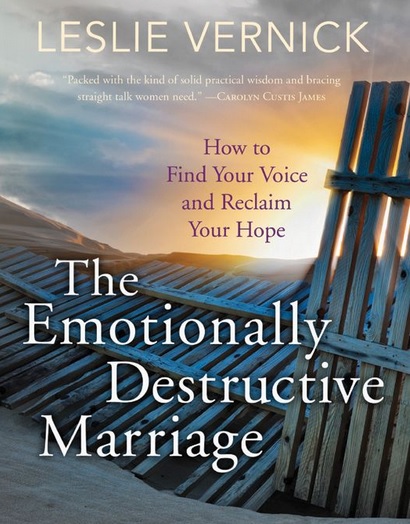
As predicted, the biblical counseling movement overseen primarily by the Association of Certified Biblical Counselors (ACBC) has become a divorce mill via its efforts to build marriages that “look like the gospel.” And the smoking gun is a book written by Leslie Vernick titled The Emotionally Destructive Marriage: How to Find Your Voice and Reclaim Your Hope that is widely used among ACBC counselors.
The obvious problems here are first seen in the title of the book. As Christians, is it really our goal to, “find our voice”? I thought it was our goal to please God in every circumstance. Secondly, the idea of emotional destruction is subjective at best and a ticket to do anything you want at worst. To make the point here, Google “American Civil Law.” In a culture judging anything that causes bad feelings to be abuse, such an approach to “biblical counseling” should give one pause.
Thirdly, why do Christians need a 240 page book written by a serial regurgitator of other people’s thoughts to FIND hope? You would think that by now Christians would be fairly certain about where hope is found.
Chilling is the examination of the 61-question survey found in the book that supposedly determines if one is in an abusive relationship or not. In the hands of a person that is unhappy in their marriage, the outcome will be a foregone conclusion. It’s like asking a chicken if Colonel Sanders is an emotional abuser.
The lynchpin becomes the ACBC’s loose interpretation of 1Corinthians 7:12-16. If the spouse is already an unbeliever, emotional abuse is tantamount to departing from the marriage even if they have not left physically or filed for divorce. Church discipline takes care of the pesky obstacle of the “abusive” spouse being a believer—they can be declared an unbeliever…actually MADE an unbeliever by elder authority supposedly vested to them by God. This paves the way for sanctified divorce.
It boils down to this: whoever is handed the book by the counselor is coronated as the abused spouse. Be sure of this: if both counselees in a bad marriage were handed the book, both would be guilty of the same thing. This is the smoking gun: it depends on who the ACBC “biblical counselor” wants to label abusive for whatever the motives might be.
I think a present situation that I am involved in says it all. I know enough about the situation to know that if the person I am talking with took the book’s survey, the other spouse would be judged as emotionally abusive hands down. The other spouse was handed the book because of who the ACBC counselor wanted to label “abusive.”
This is the niche service that Leslie Vernick now supplies to ACBC counselors.
paul

 Paul's Passing Thoughts
1 comment