Simple Post Title by Rick Phillips Reveals Presbyterian False Gospel
 Call yourself a Presbyterian if you will, but it is a denomination fathered by John Calvin. Call yourself a Calvinist if you must, but he clearly believed that Christians remain under the law and its demand for perfection. Therefore, sanctification must be lived by faith alone for the following efficacious result: the perfect obedience of Christ performed during His life on earth as a man will be “imparted” to our Christian lives to fulfill the law and keep us justified. This is called, double imputation. Christ died on the cross to “impute” righteousness (justification) positionally, and lived a perfect life so that righteousness could also be “imparted” to our sanctification (Christian life).
Presbyterians not well endowed in nuance will often state it this way: “Christ died for our justification and lived for our sanctification.” That’s a false gospel. Why? Because it keeps Christians under the law. It denies that Christ came to end the law. And it posits the idea that there is a law that can give life. And it denies Christians the ability to fulfill the law by love because their focus must be living by the same gospel that saved us so Christ will keep the law satisfied for us. Supposedly, it’s ok to be under the law because Jesus keeps it for us. Jesus didn’t come to fulfill the law of love through us, He came so that we could fulfill the law of condemnation through Him. In the final analysis, that defines Christianity as unregenerate; under law and NOT under grace.
This is simple theological math, and the final equation is keeping ourselves saved by faith alone. Sanctification becomes a complicated affair of defining what is a work in the Christian life and what isn’t a work in the Christian life. We must “live by the same gospel that saved us” in order to keep ourselves saved. We are not free to focus on the law as an instruction book of love, but the focus is not “making the fruit of sanctification the root of our justification.” Justification isn’t a finished work, it is a growing tree that must bear its own fruit. If the fruit comes from us, that’s “making the fruit the root.” That’s “fruit stapling.”
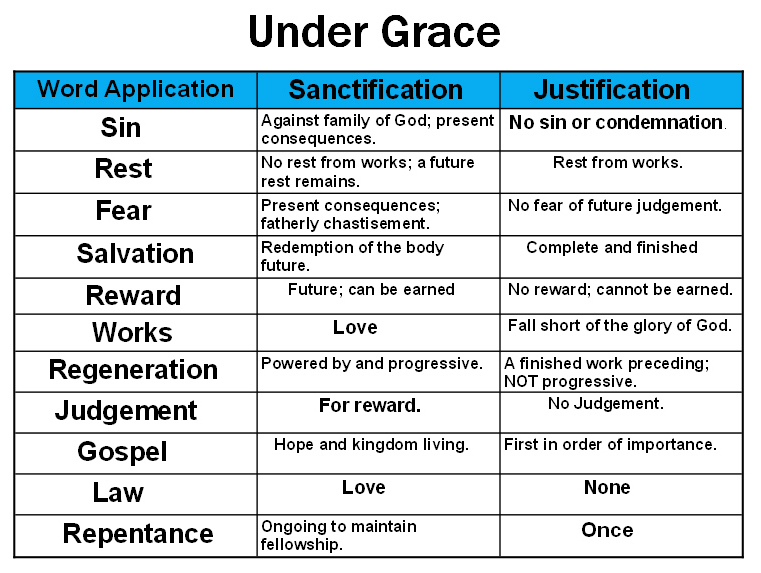
Salvation doesn’t grow. It is finished. I believe the doctrine of election completely eradicates works from justification, makes justification a finished work before the foundation of the world, and creates an infinite dichotomy between justification and sanctification. This does not negate our free will to choose in time, but seals our future glory in the Holy Spirit. God throws our sins as far as the east is from the west. All of our sins were under the law, and Christ ended the law. Where there is no law there is no sin. The law now works through love, not condemnation. A Christian cannot sin against the law of condemnation; what law? As Christians, our sin is not covered—it’s ENDED. We don’t keep ourselves saved by perpetually accessing imputation and impartation by doing certain things “by faith.”
Unlike what Calvin taught, the Christian life is not a rest, we rest in justification, but sanctification is a labor of love. And there remains another rest for God’s people, but that is not now. We don’t continue to rest in justification in order to keep ourselves saved. Doing ANYTHING to keep ourselves saved is a work, even when under the auspices of rest. When you are resting, you are doing something by default. If nothing else, rest is a decision. You are doing something to keep yourself saved. Justification is finished; sanctification is not. Sanctification is progressive; justification is not. Sin is ended; not covered. The law of justification covered, but it was ended on the cross; now the law only works through love.
Stop fearing the law and start loving—there is no fear in love. Calvin clearly taught a Christian Sabbath by faith alone motivated by fear of condemnation. This is not arguable on any level. I painstakingly document these facts in It’s Not About Election. Of course Christians are totally depraved according to Calvin; according to him, we are still under the law. When we are under grace, we obey the law out of no other motive but love, IF we know that justification is finished and we are free to aggressively obey the law for love…
“If you love me, keep my commandments.”
Among many other egregious tenets generated by this false gospel, Calvin insisted that all sins committed by Christians cause them to fall from grace, and there must be a perpetual forgiveness imputed to the “believer,” and the perpetual forgiveness for falling short of the law of condemnation can only be found in the institutional church overseen by preordained Reformed elders. Hence, church membership is primarily about receiving perpetual forgiveness for sins committed under law which demands perfection. This is also why any Presbyterian criticism of Romanism is a mockery of the true gospel. Both propagate the same progressive justification that keeps “Christians” under law. Different means of being able to “stand in the judgment” will not save any of them.
This brings me to a post sent my way written by Rick Phillips titled, “The Gospel Includes Sanctification.” Regardless of all of the whining about Tullian Tchividjian who they use for cover, they believe no whit different on any wise than Tchividjian or any other person propagating works salvation by antinomianism. Who keeps the law or kept the law for us is not the issue—law in justification is the issue, and this can be seen in the simple title of the aforementioned post by Phillips.
Phillips employs the usual nuance that masks the Presbyterian false gospel by replacing words; in this case, “justification” for the more ambiguous, “gospel.” What the title really states is…
Justification Includes Sanctification.
Would Phillips deny this? Would he deny that “gospel” includes the idea of justification? This clearly makes justification a process, and not a finished work. This is the Achilles’ heel of Presbyterianism and Calvinism in particular. If we are in-between a beginning justification and a “final justification,” we are somehow involved in the finishing of justification; there is no way around this. Phillips flavors this progressive justification with the idea that salvation saves the “whole man” with both “imparted” and “imputed” righteousness. “Wholeness” does not occur completely at the new birth, it makes regeneration a progression of justification. Therefore, sanctification is not a result of justification; it is part of the justification process. This makes sanctification a spiritual minefield with a focus away from aggressive, worry-free love, and instead, a fearful concern that we will make “the fruit of sanctification the root of justification.” There is a danger of this because as fellow Presbyterian Lou Priolo notes; like our computers, justification is the program always running in the background.
Go figure, by everyone’s assessment, the confusion concerning sanctification in our day is rampant; yet, in no time ever have we had more highly paid Reformed academics waxing eloquent from coast to coast. It’s not that they are overpaid communicators; it’s a clear case of a gospel that doesn’t add up biblically. That’s where the confusion is coming in—the problem is not in your set.
Unless of course, they are your best shot at being able to “stand in the judgment.” Their father clearly stated that Reformed elders have the “power of the keys,” and whatever they bind or loose on earth will be the same in heaven. Let me interpret that for you: if Rick Phillips or Lou Priolo like you, you’re in.
That’s an equation that adds up perfectly.
paul

 Paul's Passing Thoughts
leave a comment