Religious Tyranny: A Case Study; Introduction and Chapter One
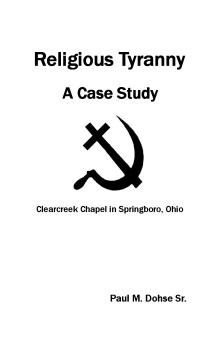
Cover: Religious Tyranny; A Case Study
Preamble
I need another project right now like I need a hole in the head; nevertheless, recent events have impressed upon me the immediate need for this work. As I accomplish each part I will be posting it here on PPT and making all readers part of an editing committee. So, comment here, email me here mail@ttanc.com, and pass judgment on content, grammar, style or whatever else editors do. The compilation will be available in a free ebook or hardcopy book form that can be purchased.
Thank you for your input.
paul
Introduction
“…I have sworn upon the altar of god eternal hostility against every form of tyranny over the mind of man.” – Thomas Jefferson to Dr. Benjamin Rush, September 23, 1801
This book flows not from the winepress of sour grapes, but rather from thankfulness. Whether secular or religious tyranny, these endeavors always yield freedom. Tyranny was a usurper into God’s creation and challenges man’s innate need to be free. Therefore, sin finds itself in a quandary; it is utterly driven by a lust to enslave, but this will eventually drive men to a fight or flight. Tyranny is affliction, but it will always awaken man to his freedom duty. For this, we can be thankful.
This book is an in-depth look into religious tyranny using Clearcreek Chapel in Springboro, Ohio as a case study. However, this case study is a story that reads like most church experiences in our day, and the personal testimonies read the same as well. The information written within will come from the author’s firsthand experience and the testimonies of others, but there is no need to focus on a few people when this is the like testimony of many. Hence, the study will focus on common experiences and not particular individuals.
Most people are saved according to the experience described by the apostle Paul in 1Thessalonians 1:5,
For our gospel came not to you in word only, but also in power, and in the Holy Ghost, and in much assurance; as you know what manner of men we were among you for your sake (KJV).
Yet, most professing Christians doubt their salvation, and furthermore, most professing Christians know there is something fundamentally missing in church; something isn’t right, but they can’t put their finger on it. The present mass exodus from the institutional church is well documented while most people leaving the church don’t know specifically why they are leaving. They are leaving because something is missing, but they are not sure what that something is. The salvation that came with much power and assurance has faded into doubt and indifference.
On the other hand, the church, whether Catholic or Protestant, seems to be supported by many others who are unwavering despite tyranny, illogical contradictions, hypocrisy, and evils not even spoken of in the secular world. How can this be? How can a church like Clearcreek Chapel now embrace beliefs that would have been rejected out of hand with extreme prejudice by the same Chapel parishioners twenty years prior? How can the present leadership behave in a way that would not have been tolerated for a moment twenty years prior by the same people who now embrace it wholeheartedly?
This study proposes to answer all of these questions in no uncertain way, but one final question needs to be answered to complete the study; once the indictment is clarified, what should our response be? What is the solution?
So then, how can we have full assurance of salvation? What is wrong with church? Why is tyranny acceptable? And what should we do about it?
Because only truth sanctifies (John 17:17),
Paul M. Dohse Sr.
Chapter One: The Chapel’s Unique Place in Church History
Clearcreek Chapel in Springboro, Ohio played an important and telling role in contemporary church history. Founded by a young Dr. John D. Street in the latter 1980’s, it sought to be relevant in contemporary culture. Dr. Street often described the church at that time as “ministering to the present culture while wearing bellbottom pants.” Street also patterned the Chapel ministry after his mentor, Pastor John MacArthur Jr.
Dr. Street also made an emerging movement at that time a hallmark of the Chapel ministry; the biblical counseling movement founded by Dr. Jay Adams. The advent of said movement began with Adams’ controversial book, “Competent to Counsel” (1970). The Chapel became a training center for the biblical counseling movement founded by Adams, and in large part a face of the biblical counseling movement.
Adams, a Presbyterian minister, was provoked by his own confession that he was unable to help people with serious problems, and indicted the church as a whole in the same way. What made this indictment painfully obvious was the integration of secular Psychology into religious thought during the 1980s. This integration was a movement that peaked in the 80’s. Help could not be found in the church so people looked for help outside of the church. The biblical counseling movement peaked in the 1990’s and this is when it experienced a true biblical revival, and Clearcreek Chapel was one of the epicenters of that spiritual awakening.
It is now very important to explain what that revival looked like because the implications are profound. This is the first point in beginning to answer the questions presented in the introduction: what’s wrong with church? Why do so many Christians doubt their salvation? Why do so many embrace churches that practice open tyranny? And lastly, what should we do about it?
If most Christians are honest, they see very little progressive change in the people they attend church with. If most Christians are honest, they admit people who are saved from the outside secular world into an enduring life testimony are very few and far in-between. Yet, this was not what was going on at the Chapel during the 90s. In one year (1995) as a result of the biblical counseling focus, twelve people were saved in 1Thessalonians 1:5 fashion and stayed the course. During this time other churches influenced by the Chapel shared the same testimony.
But let’s back up for a moment; Jay Adams’ testimony is startling. As one who came from the elitist hallowed halls of Protestant brain trust, he openly admitted himself that he was clueless in regard to helping people with real life problems. Furthermore, this was his indictment against the church at large as well. We must pause and ponder this fact soberly; after more than 500 years and oceans of Protestant scholarly ink, it was commonly accepted that most ministers were unable to take the word of God and help people with serious problems. There is a very simple answer in regard to why that was the reality and still is, and we will arrive there in due process. But before we move on, it is interesting to note that while the Protestant brain trust openly confessed its inability to help people with deep personal problems, it wailed and screamed in sackcloth and ashes that the void was filled with secular Psychology.
The brainchild of Adams’ biblical counseling construct is even more startling. In beginning his quest for helping people with real problems, he sought out none other than O. Hobart Mowrer, a notable secular Psychiatrist who fathered a kind of responsibility therapy movement championed by the likes of Dr. Phil McGraw and Dr. Laura Schlessinger. Adams wrote in the introduction of Competent To Counsel,
Reading Mowrer’s book The Crisis in Psychiatry and Religion, as I said, was an earth-shaking experience. In this book Mowrer, a noted research psychologist who had been honored with the Presidency of the American Psychological Association for his breakthrough in learning theory, challenged the entire field of psychiatry, declaring it a failure, and sought to refute its fundamental Freudian presuppositions. Boldly he threw down the gauntlet to conservative Christians as well. He asked: “Has Evangelical religion sold its birthright for a mess of psychological pottage?”
In Crisis, Mowrer particularly opposed the Medical Model from which the concept of mental illness was derived. He showed how this model removed responsibility from the counselee. Since one is not considered blameworthy for catching Asian Flu, his family treats him with sympathetic understanding, and others make allowances for him. This is because they know he can’t help his sickness. He was invaded from without. Moreover, he must helplessly rely on experts to help him get well. Mowrer rightly maintained that the Medical Model took away the sense of personal responsibility. As a result, psychotherapy became a search into the past to find others (parents, the church, society, grandmother) on whom to place the blame. Therapy consists of siding against the too-strict Super-ego (conscience) which these culprits have socialized into the poor sick victim.
In contrast, Mowrer antithetically proposed a Moral Model of responsibility. He said that the “patient’s” problems are moral, not medical. He suffers from real guilt, not guilt feelings (false guilt). The basic irregularity is not emotional, but behavioral. He is not a victim of his conscience, but a violator of it. He must stop blaming others and accept responsibility for his own poor behavior. Problems may be solved, not by ventilation of feelings, but rather by confession of sin.
From my protracted involvement with the inmates of the mental institutions at Kankakee and Galesburg, I was convinced that most of them were there, as I said, not because they were sick, but because they were sinful. In counseling sessions, we discovered with astonishing consistency that the main problems people were having were of their own making. Others (grandmother, et al.) were not their problem; they themselves were their own worst enemies. Some had written bad checks, some had become entangled in the consequences of immorality, others had cheated on income tax, and so on. Many had fled to the institution to escape the consequences of their wrongdoing. A number had sought to avoid the responsibility of difficult decisions. We also saw evidence of dramatic recovery when people straightened out these matters. Humanistic as his methods were, Mowrer clearly demonstrated that even his approach could achieve in a few weeks what in many cases psychotherapy had been unable to do in years.
I came home deeply indebted to Mowrer for indirectly driving me to a conclusion that I as a Christian minister should have known all along, namely, that many of the “mentally ill” are people who can be helped by the ministry of God’s Word. I have been trying to do so ever since.
This experience was the breakthrough that launched the biblical counseling movement and its subsequent success. Without Mowrer’s observations, the biblical counseling movement never happens. Nevertheless, Adams then states the following in the same introduction:
Let me append one final word about Mowrer. I want to say clearly, once and for all, that I am not a disciple of Mowrer or William Glasser (a writer in the Mowrer tradition who has become popular recently through the publication of Reality Therapy,a book that has confirmed Mowrer’s contentions in a different context). I stand far off from them. Their systems begin and end with man. Mowrer and Glasser fail to take into consideration man’s basic relationship to God through Christ, neglect God’s law, and know nothing of the power of the Holy Spirit in regeneration and sanctification. Their presuppositional stance must be rejected totally. Christians may thank God that in his providence he has used Mowrer and others to awaken us to the fact that the “mentally ill” can be helped. But Christians must turn to the Scriptures to discover how God (not Mowrer) says to do it.
All concepts, terms and methods used in counseling need to be re-examined biblically. Not one thing can be accepted from the past (or the present) without biblical warrant. Biblical counseling cannot be an imposition of Mowrer’s or Glasser’s views (or mine) upon Scripture. Mowrer and Glasser have shown us that many of the old views were wrong. They have exposed Freud’s opposition to responsibility and have challenged us (if we read their message with Christian eyes) to return to the Bible for our answers. But neither Mowrer nor Glasser has solved the problem of responsibility. The responsibility they advocate is a relative, changing human responsibility; it is a non-Christian responsibility which must be rejected as fully as the irresponsibility of Freud and Rogers. At best, Mowrer’s idea of responsibility is doing what is best for the most. But social mores change; and when pressed as to who is to say what is best, Mowrer falls into a subjectivism which in the end amounts to saying that each individual is his own standard. In other words, there is no standard apart from God’s divinely imposed objective Standard, the Bible. Tweedie is correct, therefore, when he rejects Mowrer’s “projected solution” to the problem of sin as an “acute” disappointment.
During the years that followed, I have been engrossed in the project of developing biblical counseling and have uncovered what I consider to be a number of important scriptural principles. It is amazing to discover how much the Bible has to say about counseling, and how fresh the biblical approach is. The complete trustworthiness of Scripture in dealing with people has been demonstrated. There have been dramatic results, results far more dramatic than those I saw in Illinois.
In light of the entire context stated here, Adams’ paradoxical twist on Mowrer is both stunning and perplexing, but don’t miss the much larger point; Adams’ perspective as documented here is profoundly indicative of what is fundamentally wrong with church. Yes, it is the something that is wrong that few are able to put their finger on. However, we are still in the history stage of our study. In regard to why Clearcreek Chapel is a paramount case study for religious tyranny, we are still laying the historical groundwork.
Chapter Two: The Insurgency
Utterly Shameless: Egotism of Local Pastors Far More Important Than People’s Lives
 Regardless of the outrageous behavior of Clearcreek Chapel located in Springboro, Ohio, local pastors continue to associate with the Chapel elders and participate in its “ministry.” The well documented creepiness of the leadership aside, first and foremost is the concern regarding reports that this ministry still receives from people who have entered the “biblical” counseling program at CCC. The Chapel elders, particularly its director Greg Cook, continue to snuff out marriages that arrive there as smoldering wicks. And apparently, Cook is still living up to his reputation for verbally abusing counselees. Cook’s penchant for rubbing his eyes while aping a baby crying as a way to mock husbands continues to be a report that we hear of since circa 2007.
At issue is their view of church authority: they clearly believe they have authority over families who have been referred to them. Imagine a pastor counseling a wife alone and telling her that her husband’s theology is “180 degrees” from the truth. No pastor, I repeat, no pastor has the right to diminish a woman’s view of her husband in any way, shape, or form. Any counselor worth their salt knows that spouses need little help in that area, and it is not beneficial to any marriage in any way.
The pattern over eight years has become abundantly clear: the CCC elders first ascertain which spouse is going to submit to their authority, and then work to separate the “foolish” spouse from the other. Sadly, some go there seeking to merely make their marriage better, and end up on the verge of divorce six months later. The errant spouse who would dare question the CCC anointed, usually the husband, is then slandered in various and malicious ways to gain assumptions from the congregations that are involved.
One of their favorite tactics is to ask flock groups for a love offering on behalf of the poor abused wife when no such financial need exists. Obviously, it sends the message that said husband is not supporting his family. Existing side by side financial documentation supports this accusation, and I assume CCC continues to use this ploy. This was employed by Greg Cook in 2008 against a counselee while he himself was indebted to the IRS for, according to one source, 180,000 dollars. Another favorite tactic is to exaggerate family problems and suggest that a family member live with a parishioner for awhile. Particularly when it is a daughter, the assumptions that result are evident. And of course, no repertoire of sanctified slander would be complete without the public “unspoken prayer request” for the spouse chained to another who does not appreciate the superior mantle placed on Reformed elders by the Almighty.
In short, the CCC elders have a long and documented history of character assassination that would have made Adolf Hitler blush. At least in two cases, husbands took their families and fled the state of Ohio while two other attempts by others failed. In these attempts to get one’s family away from CCC, the CCC elders counter by claiming abandonment. These are wicked tyrants who should be avoided at all cost.
The CCC elders enjoyed evangelical fame as a counseling center for many years after the departure of the founding pastor, Dr. John Street who built the ministry on Jay Adams so-called first generation biblical counseling. After Street’s departure, Russ Kennedy (CCC pastor of “spiritual vision”) and company quickly moved to totally gut and reconstruct the counseling program. A group of families who had come to CCC to covertly take it over quickly moved into leadership. This group was led by the creepy New Covenant Theology guru and cultist Chad Bresson. This group, behind the scenes, despised John Street and were waiting to pounce upon his departure. The covert persecution of those whom they perceived as a threat was relentless. This is a leadership that has amassed numerous unresolved conflicts with many, many professing Christians, and the lending of credibility to them by other pastors is unconscionable.
In addition, and in true CCC form, they still allow counselees who come there to believe that they hold to Jay Adams first generation counseling when in reality, they despise Adams. As one who had breakfast with Greg Cook every Monday morning for the better part of a year, you can trust me on that one.
So then, following is a list of local pastors who insist on supporting CCC and their continued destruction of families. I deem it my duty to warn others about them because birds of the feather flock together. These pastors are endeared to CCC for one reason or another. More than likely, they are just feeding their egos on what is left of CCC’s status in biblical counseling circles, but at any rate, their associations with CCC make them a concern to the well being of hurting families.
Tim Pasma, pastor at LaRue Baptist Church, LaRue, Ohio. Continues to support CCC’s bogus counseling program.
Jim Koerber, pastor at New Covenant Life Church, Blanchester, Ohio. Continues to support the counseling program at CCC.
Danny Wright, Greenville Grace, Clayton, Ohio. Will speak at a conference hosted by CCC in March of 2016.
Joe Godwin, pastor at Patterson Park Church, Dayton, Ohio. Will speak at a conference hosted by CCC in March of 2016.
Greg Birdwell, pastor at Providence Bible Fellowship, West Chester, Ohio. Will speak at a conference hosted by CCC in March of 2016. Greg Birdwell is well aware of the numerous controversies surrounding CCC and their unreconciled status with many Christian families. Yet, he unabashedly fellowships with them and supports them. Lest these men would pass on any opportunity to mock God, the theme of the conference hosted by CCC is, “Cultivating Companionship.”
Paul Dohse
TANC Ministries
12/10/2016
Why Jay Adams Had to be Neutralized by the New Calvinists
 Originally posted March 11, 2012
Susan and I had a glorious fellowship with another Christian couple this afternoon. They are in a ministry of significant influence and will be unnamed. At some point, the conversation turned to New Calvinism. As Susan and I sat and listened to the husband’s testimony concerning what he valued in John Piper’s teachings, I was filled with an understanding in regard to why Piper’s teachings are so attractive. I might add that I was very impressed with his calm, articulate answer immediately following my comment that I believe Piper to be one of the premier heretics of our day.
What this brother described was the fact that serious Christians were looking for an alternative to the fallout from the first gospel wave in contemporary Christian History: raise your hand, sign a card, don’t drink, smoke, chew, or hang out with girls that do. Christianity had been reduced to living by a list of do’s and don’ts by people who didn’t have any life to show for it. Fair enough. Guilty as charged.
But the fact of the matter is that Jay Adams did offer a viable alternative. It was based on hearing the word of God and applying it to our lives according to the whole counsel of God’s wisdom and not just, “stop doing that.” I saw firsthand how this “first generation” biblical counseling movement changed lives in radical fashion, including my own. And the movement continues to do so today even though the fact of that matter is covered up by a whole lot of New Calvinist noise.
To me the crux of the matter is in this brother’s testimony. New Calvinists have effectively sold the idea that they are offering the only alternative to easy believeism in our day. That’s only true because they got rid of the other alternative through slander and persecution, and they know it. Jay Adams’ “first generation” biblical counseling was a threat to the emerging New Calvinist tsunami. Why? 1) Because it worked and God used it to change lives. 2) It was/is the antithesis of New Calvinism because the latter fuses justification and sanctification while first generation counseling doesn’t. Furthermore, this is what New Calvinist David Powlison said was the fundamental difference between the two while teaching at John Piper’s church:
This might be quite a controversy, but I think it’s worth putting in. Adams had a tendency to make the cross be for conversion. And the Holy Spirit was for sanctification. And actually even came out and attacked my mentor, Jack Miller, my pastor that I’ve been speaking of through the day, for saying that Christians should preach the gospel to themselves. I think Jay was wrong on that.
If we associate justification with “conversion,” and we do, Powlison’s statement can be reworded as follows for clarification:
Adams had a tendency to make the cross be for justification (justification cannot be separated from conversion). And the Holy Spirit was for sanctification.
Second generation counseling/New Calvinism is sanctification by justification, and that was also propagated by his mentor that he mentions. New Calvinists choose their words carefully. Imagine how far the movement would get if they didn’t replace “justification” with “gospel”:
The same finished work of justification that saved you also sanctifies you. Or, we must preach justification to ourselves every day. Or, sanctification is the finished work of justification in action.
I explained to the brother that the other alternative was relentlessly persecuted, and that’s why it would seem that there is only one alternative. He concurred that he perceives criticism of Adams taking place on a continual basis. Why? Because the truth he teaches is the competition. It’s a threat.
This is an approach that I have never used before: 1) Powlison admits a fundamental difference between first generation and second generation counseling; ie, sanctification by the cross (justification) verses sanctification by the Spirit apart from the finished work of justification. 2) An alternative is confirmed. 3) You only have the New Calvinists’ testimony that they are the only alternative. 4) Why not investigate and find out for yourself?
He agreed, and was sent off with a copy of The Truth About New Calvinism. Please pray for the situation. Christianity doesn’t need a second gospel wave. The first wave devalued sanctification by focusing on justification only; the second devalues it as well by making it the same thing as justification. Both are just as deadly, and when the novelty of New Calvinism wears off, the results will be worse.
paul
The New Calvinism Divorce Mill
 The purpose of this post is to merely state the facts—you can draw your own conclusions in regard to motives. As predicted by this ministry several years ago, divorces overseen and endorsed by Reformed churches has now become an epidemic. That’s an understatement.
From several testimonies to us over time, we have concluded that the unfolding of these divorces share an identical storyline.
It all begins with couples seeking to improve their marriage via the formal counseling of the Reformed biblical counseling movement. The consistent testimony that we constantly hear follows: in the milieu of the issues, the counselors gravitate to, and take sides with the spouse who is willing to submit to church authority. Then, the unwillingness of the other spouse to submit to church authority becomes the primary issue and fodder for potential church discipline.
Once the church discipline has been executed, the “unteachable” spouse is declared unregenerate, and the marriage is now a mixed marriage. Usually, the excommunicated spouse doesn’t worry about it all that much because after all, he/she is “pleased to live with the ‘believing’ spouse.”
But not so fast. Protocol doesn’t limit “abandonment” (“if the unbelieving spouse departs let them depart” 1Cor 7:12-15) to a physical leaving; yes, there is also an “abandonment of the heart.” No, the spouse hasn’t left physically, but the actions and words of the spouse show that they are not really “pleased to dwell with the believing spouse and are staying for ulterior motives.” Of course, as ascertained by the “expert” biblical counselor.
The “believing” spouse is now given the green light to divorce the “unbelieving” spouse. The judgement regarding the salvation of either spouse is based on a willingness to submit to church authority. And obviously, there are many words or actions that can be used as proof to deem the other spouse as unpleased to dwell with the other. The judgment is subjectivism on steroids.
As this ministry has documented, the Reformed biblical counseling movement is nonexistent in zip codes where the average income is below $50,000 per year. Because the church where the counseling takes place offers support to the believing spouse in the midst of the decision to divorce, that spouse will almost always join said church and faithfully tithe 10% of the alimony as New Calvinist churches are now routinely disciplining people for not tithing at least 10%. In some cases, the submission of financial statements is part of the membership covenant.
And sadly, the word is out on some of these churches: it’s a place you can go to get sanctified permission to dump your spouse. Somebody play 50 Ways to Leave Your Lover by Simon and Garfunkel.
And even sadder, some of the counseling starts with a couple merely wanting tips on tuning up their marriage and getting the most out of it; a year later they are in divorce court.
This ministry is primarily recommending Marriage Works through the state of Ohio. It’s not counseling, but rather workshops on practical things that improve a marriage. We also reluctantly recommend the Institute of Nouthetic Studies (Jay Adams). Because Jay will not make a complete break with New Calvinist minions such as Lou Priolo and Martha Peace, we recommend extreme caution. Nevertheless, aspects of Jay’s counseling are a major help. Susan and I offer counseling as a third option.
paul
What is “The Church”?

We hear it constantly, references to “the Church.” When discussing statistics, they are always in reference to “the church.” This is the term used constantly regardless of the fact that “church” can refer to Catholicism and an array of Protestant denominations including Charismatics and a myriad of Baptist stripes.
So, what is meant by “the church”? The concise definition is very obvious: the church is institutional theism. At least in Western culture, that is the starting point of accepted goodness that must prevail for the survival of humanity. In the same way that some parents send their children to Sunday school because “everybody needs some morals,” being a “Christian” is the minimal requirement for being unhazardous to humanity.
Hence, we have another definition: a “Christian” is someone who is identified with institutional theism, or “church.” And again, this is a societal Good Person Seal of Approval. For example, even President Obama claims to be a Christian and is a member of an institutional church. No Presidential candidate would have a prayer of being elected without some sort of religious affiliation whether Catholic or some breed of Protestantism. Quality of faith is far from being the issue, but the minimal requirement is a wink towards “the church.”
Being a Christian in America means you are a member of the institutional church which is anything theism. If you are a member of a theistic institution, you have good intentions and nobody has a right to judge your path to the pearly gates. Go to any Baptist church and start criticizing Catholics and you will quickly hear about all the Catholic friends they have who are saved and loved by God. Go to any of the National Day of Prayer gatherings and you will see that everything but the religious kitchen sink is there.
“The church” is the “Christian” club and means, not atheist, but rather any and all things theistic. Even the umber pragmatic Rush Limbaugh concurs. Just the other day on his radio program he stressed the importance of people, especially political candidates, having some “concept of God.” Bingo. A belief in some sort of deity: good; not believing in some sort of deity: bad. Limbaugh associated atheism (the Greek article “a” which means “anti” prefixed to “theism”) with being deceived about all sorts of things including global warming which he mentioned specifically.
Dr. Jay Adams, in a recent article, assumes that there are enough doctrinally sound churches in a given town or city to prevent “church tramping.” In my book, “church” and “tramp” are mutually inclusive.
When did “church” begin? The etymology of the word is German (kirche), and replaced the Greek word for “assembly” found in the Bible manuscripts (ecclesia). The word “synagogue” also means “assembly” or “congregation.”
The first complete English bible was the Tyndale bible in about 1524, and that bible did not use the word “church” anywhere in its pages, it used the word “congregation.” Sometime after this bible, they started replacing the word “congregation” with the word “church” (Christ’s Ekklesia and The Church Compared: Richard Anthony; http://www.ecclesia.org/truth/ekklesia.html).
However, the concept of church started much earlier in history after the deaths of the twelve apostles. The early church fathers, at least according to the English translations, used the word “church” often. Several of the early church fathers were disciples of the original twelve apostles and deemed authoritative theologians of that era.
Unfortunately, an apostolic succession controversy took place immediately following the passing of the twelve apostles. Regardless of the fact that the twelve established a home fellowship model led by elders and organized by deacons, and predicated by gifts rather than authority, many of the church fathers argued that chaos and doctrinal abyss would ensue unless the authority of the twelve was replaced with a like central authority.
However, even the apostles pointed to Christ as the only head and rarely implemented apostolic authority. The principle protocol was that of persuasion by apt teaching from the Word. Nevertheless, the church fathers insisted on a central hierarchy located in Rome that would rule over what they called “the church.” The first “ruling bishop” of Rome was Linus who was a disciple among the original twelve and an early church father, and for all practical purposes, the first pope. Later, Protestantism came out of the institutional church which originated in Rome.
The home fellowships established by the apostles contended against the institutional church for about 200 years until home fellowships finally began to give way in the 4th century. Unfortunately, the home fellowship model only continues in certain geographies because of necessity, usually economic or governments that prohibit organized religions that follow Christ.
Obviously, “the church” is little concerned with “sound doctrine” emphasized by the original twelve. The focus is some “concept of God” defined by “Christianity.” It is quite enough that the first Republican announcing his candidacy is calling himself a “Christian,” and has included video of his family praying before a meal in a TV ad—no one will ask for any particulars, the main concern is that he’s not an atheist and is a member of formal theism. The main concern is, does he have a “concept of God”?
This is where the home fellowship movement has opportunity. We are NOT “the church.” And by today’s definition, we are NOT “Christian.” And if nothing else, that will spark curiosity. But more than that, when the freedom to pursue sound doctrine is fully exploited, I wonder what the Spirit might do?
paul

 Paul's Passing Thoughts
leave a comment