David Powlison’s Gnostic Counseling Paradigm
David Powlison is the major figure representing the counseling wing of Westminster Theological Seminary: the Christian Counseling and Educational Foundation (CCEF). Powlison was mentored by Dr. John Miller who was a professor at Westminster. Miller was the father of Sonship Theology which was his own twist on the rediscovery of the doctrine of perpetual justification (Gospel Sanctification) via the Australian Forum think tank formed in 1970.
Powlison took the concept of progressive justification and used it to develop his Dynamics of Biblical Change project which is the foundation of counseling education at Westminster. Two former students of his, Paul David Tripp, and Timothy Lane, wrote a book entitled “How People Change”(HPC) which is a treatise on the “practical application” of Gospel Sanctification (the doctrine of the present-day New Calvinist movement). The title of the book is a lie; as we shall see, New Calvinists do not really believe that people change.
This is most evident when one reads pages 64 and 65 of HPC. Tripp and Lane describe Christians as “powerless,” “enslaved,” and “dead.” They further elaborate by writing, “When you are dead, you can’t do anything” (p. 64, HPC). How do dead Christians change? Obviously, they don’t. Hence, this is why the vast majority of present-day biblical counseling controlled by the CCEF machine is a farce: the counseling is not about change.
So what’s going on? Basically, it starts with Plato and what was later known as Gnosticism. Some refer to Gnosticism as “Platonism for Dummies,” but the basics are easier to explain through fundamental Platonism. Plato believed man was unable to know reality. The following excerpt is a good explanation of Platonism 101:
Plato, the most creative and influential of Socrates’ disciples, wrote dialogues, in which he frequently used the figure of Socrates to espouse his own (Plato’s) full-fledged philosophy. In “The Republic,” Plato sums up his views in an image of ignorant humanity, trapped in the depths and not even aware of its own limited perspective. The rare individual escapes the limitations of that cave and, through a long, tortuous intellectual journey, discovers a higher realm, a true reality, with a final, almost mystical awareness of Goodness as the origin of everything that exists. Such a person is then the best equipped to govern in society, having a knowledge of what is ultimately most worthwhile in life and not just a knowledge of techniques; but that person will frequently be misunderstood by those ordinary folks back in the cave who haven’t shared in the intellectual insight….the Allegory also attacks people who rely upon or are slaves to their senses (Analysis of The Allegory of the Cave by Plato Online source:123helpme.com/view.asp?id=135077).
Because the common man is enslaved to his own senses and can only comprehend what he can sense from the material world which is merely shadows of reality, Plato devised what we now call a cybernetic loop. This is a process that evaluates the outcomes of experience/circumstances/data for the purposes of making adjustments or reaching goals. Since the common man is not enlightened, the next best thing is to devise a system that gives him guidance from the criteria that he can experience with his senses. The enlightened ones, who should lead and govern the common man, develop these cybernetic loops to help guide mankind in their world of dark shadows. Plato believed in a world ruled by philosopher kings. Below are some illustrations of cybernetic loops:
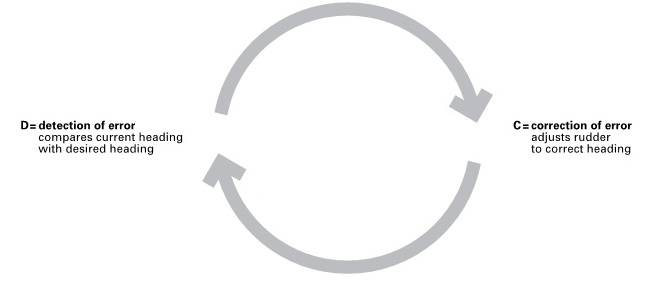
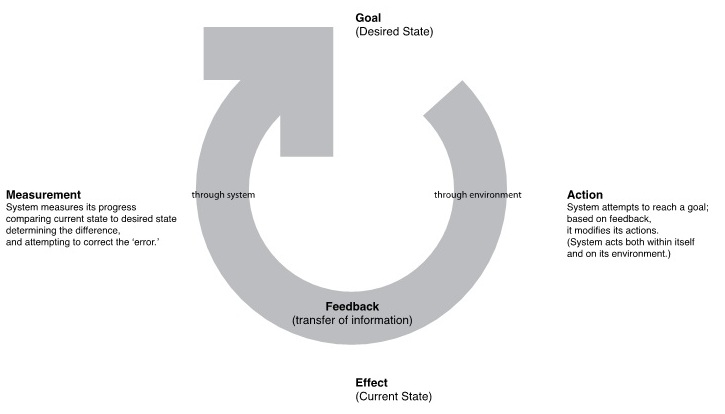
These loops can be complicated and may involve loops that evaluate other loops. Below is another illustration in regard to Plato’s philosophy:
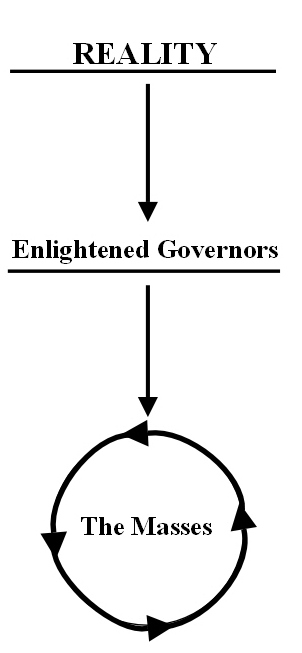
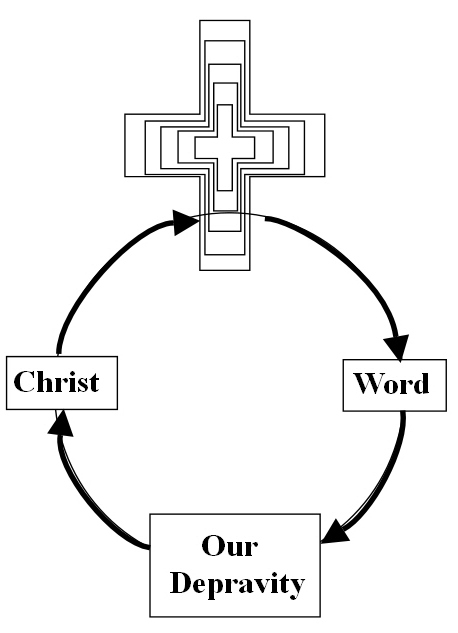
Plato had a vast influence on Augustine who is primarily responsible for the total depravity of the saints tenet found in Reformed theology. This prism had a profound influence in the forming of the gospel of perpetual atonement, or the idea that the effects of Christ’s death on the cross wasn’t a finished work, but was progressive for the purpose of maintaining a righteous standing for the saints. See illustration below:
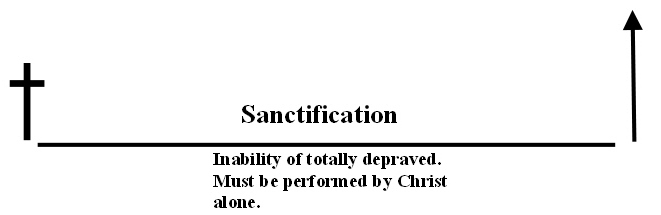
This is opposed to the gospel that rejects the total depravity of the saints and propagates an enablement through the new birth:

In the second model, the believer has the responsibility to learn and apply the word of God to their lives. But the first model, because it relies mostly on Platonist philosophy, also borrows the cybernetic loop for its “practical application.” Therefore, New Calvinists merge progressive justification into various cybernetic loops for “practical application.” Since the saints are supposedly unable to keep the law because they are still totally depraved, there has to be a way for the saints to continually partake in the same gospel that saved us. In order to come up with a way to do this, the New Calvinists went back to the basics: Plato. The first illustration of this is from CCEF’s The Journal of Biblical Counseling vol. 18, number 1, Fall 1999:
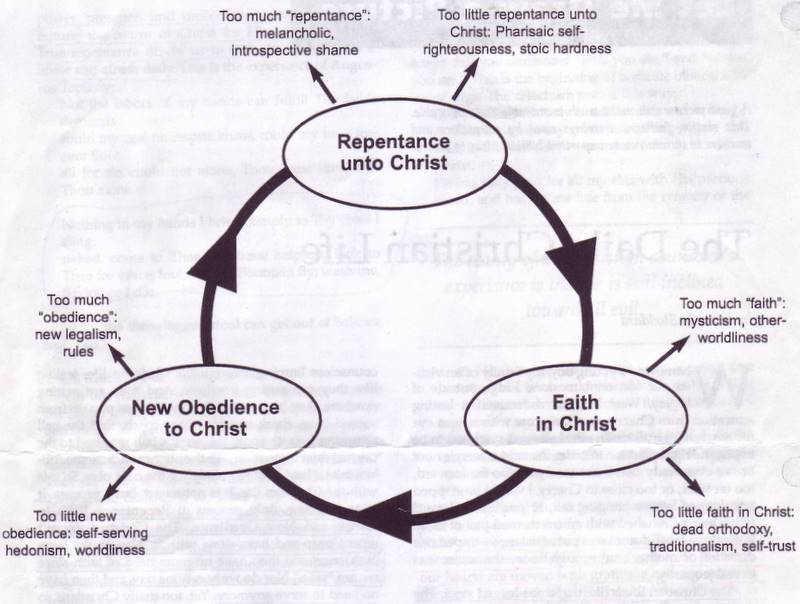
The following are illustrations from HPC and Powlison’s Dynamics of Biblical Change:


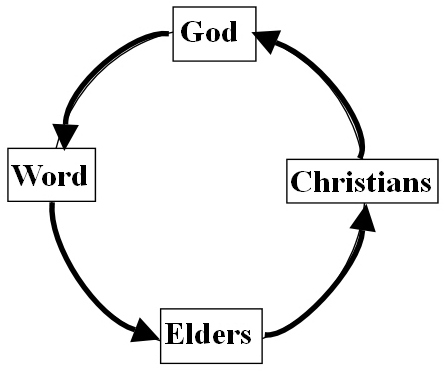
In the following excerpt from Dr. Devin Berry’s “How to Listen to a Sermon,” Berry uses a C-loop concept to explain the New Calvinist theory on how the saints receive the word of God. The illustration following the excerpt is mine:
Note this cycle: Paul, from the Word, delivers words. The Bereans, from Paul’s words, go to the Word. The Word cycles from God, through the preacher, to the people, back to the Word, and this, verse 12 tells us, produced belief in the God of the Word. An important thing to note is that this happened daily – suggesting a regular interaction between preaching, personal study, and the Word.
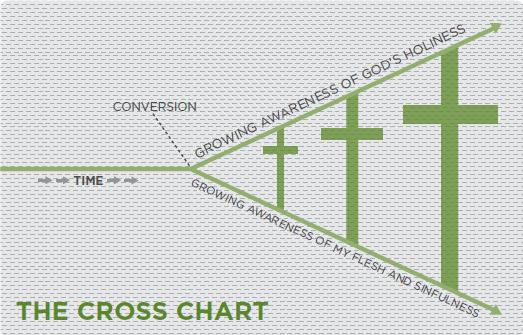
The goal of all of this is not change in the believer which is impossible anyway according to their theology because Christians are still totally depraved. The goal is to make the cross (or, the works of Christ) bigger by a deeper and deeper knowledge of how totally depraved we supposedly are. This is illustrated by the following chart produced by a New Calvinist organization:
 Below is a C-loop that can illustrate the above chart:
New Calvinist Dr. Devon Berry: Elder Preaching is Infallible
 Devon Berry, the “elder” at Clearcreek Chapel who delivered this message, is also one of the primary instructors for the NANC training center at CCC. The following is my critique of his message. I apologize for how difficult it is to unravel this clever twisting of God’s word. However, if you try to follow my argument thoughtfully, I think by the end it will come together for you. The title of his message was, “How to Listen to a Sermon.”
In his message, “How to Listen to a Sermon, the elder strays away from the main point to strongly emphasis the idea that spiritual growth comes primarily from preaching and teaching, and is an absolute, paramount necessity accordingly:
You think, perhaps, that [you] can fill up the other half of the plate with personal study, devotions, or quiet times, or a radio program. Beloved, you cannot. Scripture is relatively quiet on such practices. But on preaching, the case is clear and strong. Neglect preaching and neglect your soul. I know that some are kept from services for legitimate reasons which are out of their control, but I doubt that is the case for most. I beseech you, change your ways for the good of this people and for the good of your own selves. Give the Word its rightful place. As I have often said, there is no better place you could be than here, under the preaching of the Word.
Actually, I believe “devotions,” “quiet times,” and “radio programs” are added in to mask the disturbing part of this statement: “personal study.” Nowhere , but nowhere, does the Scriptures ever say that personal study is expendable when compared to preaching or teaching. In fact, IF I wanted to make the case that preaching and teaching could be done without, I would cite the following:
1 John 2:27
”As for you, the anointing you received from him remains in you, and you do not need anyone to teach you. But as his anointing teaches you about all things and as that anointing is real, not counterfeit—just as it has taught you, remain in him.”
This verse clearly teaches that when it gets right down to it, the indwelling Holy Spirit is our teacher, and that human teachers are not an absolute necessity as this elder is clearly saying. At the very least, he is in grave error concerning the level of importance between the two.
But even more disturbing is the logical conclusion that must be drawn from this assertion. If personal study is expendable (please note; in his list of examples, he names devotions, quiet times, and radio programs in the same list. One can only assume that if they are in the same list to make his point, they share the same level of importance. Surely then, no one would deny that Christians could do without radio programs or devotionals), then how could it (personal study) be sufficiently empowered to discern the truthfulness of the sermon? The conclusion must necessarily be that personal interpretation is always at the mercy of preaching. Do you think my statement is a subjective conclusion in regard to what he is saying? Think again. He actually uses Acts 17:10,11 (a text that clearly states the importance of personal study to confirm truthfulness) to imply that preaching is a critical link in the learning process, with personal study being secondary:
In addition to coming with anticipation, we must come to a sermon prepared. Coming to the hearing of the Word prepared is both a matter of our hearts and our behaviors. I think the example of the Bereans in Acts 17 is helpful. Verse 11 says, ‘Now these Jews were more noble than those in Thessalonica; they received the word with all eagerness, examining the Scriptures daily to see if these things were so.’ We can note from earlier in the chapter what exactly it was the Bereans were responding to – verses 2-3 tell us that Paul’s pattern was to reason with his hearers from the Scriptures, explaining and proving that Jesus was the Christ. What made the Jews in Berea more noble than the Jews in Thessalonica? Well for one, they did not run Paul out of town, and secondly, they took Paul’s preaching seriously enough to go to the Word to test it [he is not talking about a test in regard to the truth, but rather, a nebulous concept of testing the Christocentric interpretation in everyday life. He covers this idea in another part of the same sermon. Note that “it” in his statement refers to God’s word, not Paul’s preaching]. The text here implies that there was an interactive nature between three entities: The preacher, the hearers, and the Word. Note this cycle: Paul, from the Word, delivers words. The Bereans, from Paul’s words, go to the Word. The Word cycles from God, through the preacher, to the people, back to the Word, and this, verse 12 tells us, produced belief in the God of the Word. An important thing to note is that this happened daily – suggesting a regular interaction between preaching, personal study, and the Word. The Bereans eagerly prepared by paralleling their own Bible reading and study with Paul’s preaching. So a good preparation for the public preaching of the Word is the private consumption of the Word. It will be the seasoning that brings out the flavor – salt on your French fries, if you will.”
Where to begin in the unraveling of this hideous twisting of God’s word! First of all, I had to actually draw a diagram to unravel what he is saying in regard to this part of the quote:
“Note this cycle: Paul, from the Word, delivers words. The Bereans, from Paul’s words, go to the Word. The Word cycles from God, through the preacher, to the people, back to the Word, and this, verse 12 tells us, produced belief in the God of the Word.”
Read the quote carefully. Think about it. God’s word goes through the “preacher” first, before getting to the “people,” making the preacher’s words synonymous with God’s words. Also note that he cites 17:1,2:
“We can note from earlier in the chapter what exactly it was the Bereans were responding to – verses 2-3 tell us that Paul’s pattern was to reason with his hearers from the Scriptures, explaining and proving that Jesus was the Christ.”
Let me cut to the chase here: what he is saying is that all Christocentric and gospel-centered preaching is infallible. Hence, any preacher teaching from a Christocentric perspective is also infallible. He also emphasizes this in his conclusion (emphasis mine):
On to our last point, then. It is simple. The lens set forth by Christ himself on the road to Emmaus, in Luke 24, is the lens through which we should hear every sermon. Here it is from the text: …everything written about me in the Law of Moses and the Prophets and the Psalms must be fulfilled… You should always listen to a sermon looking for Christ and the redemptive plan that God has set out in history to accomplish through his Son. We must be Christ-centered listeners.
In other words, when the Scriptures are being taught from the Christ / gospel perspective, error is impossible, and likewise, neither can the preacher teaching from that perspective be in error as well. If the mere intention is to present Christ from the text, the Holy Spirit then becomes involved, making error impossible. Another elder at the same church (Chad Bresson) projected this same idea in an article entitled “The Word of God is a Person.” He quotes Robert Brinsmead to make his point:
That which makes the Bible the Bible is the gospel. That which makes the Bible the Word of God is its witness to Christ. When the Spirit bears witness to our hearts of the truth of the Bible, this is an internal witness concerning the truth of the gospel. We need to be apprehended by the Spirit, who lives in the gospel, and then judge all things by that Spirit even the letter of Scripture.
Said another way, the Holy Spirit “lives in the gospel,” so when your doin’ gospel, your doin’ truth, end of discussion.
Going back now to the elder’s use of Acts 17 and the original sermon of interests here, he completely ignores any sort of basic grammatical rules at all to draw his conclusions. He gives the following reasons for the nobility of the Bereans:
What made the Jews in Berea more noble than the Jews in Thessalonica? Well for one, they did not run Paul out of town, and secondly, they took Paul’s preaching seriously enough to go to the Word to test it.
But the excerpt he speaks of is a compound sentence:
“Now these Jews were more noble than those in Thessalonica; they received the word with all eagerness, examining the Scriptures daily to see if these things were so.”
In a compound sentence the ideas must be related, this is a hard-fast rule. Therefore, the specific reason for their nobility is obviously in the second independent clause, which does not include anything mentioned by the elder. Furthermore, in the second clause, the proving of what Paul taught is obviously the (purpose) object of both verb phrases, both directly and indirectly. Clearly, the reason for their nobility was the fact that they proved what Paul was teaching to be true through personal study. Not only that, the elder also said the following:
“An important thing to note is that this happened daily – suggesting a regular interaction between preaching, personal study, and the Word.”
But this is clearly an improper correlation. “Daily” in this sentence refers to “examining the Scriptures” and not Paul’s preaching (which is not even in the compound sentence which begins with “now“—introducing a separate idea). The elder is suggesting an inseparable correlation (“cycle”) between preaching and personal study that cannot be separated from the word for proper understanding. Instead of personal study proving the truthfulness of preaching or teaching, he is making preaching an absolute necessity to understanding truth, with personal study supplying a mere “seasoning” to the preaching, instead of testing its truthfulness. Besides this, he also assumes that the Bereans knew what Paul was going to teach before he came:
“The Bereans eagerly prepared by paralleling their own Bible reading and study with Paul’s preaching.”
Not only is this an assumption, given the technology of the time, it is also highly unlikely. What tense in the text even remotely suggests that the Bereans “examined” the Scriptures before Paul preached? Clearly, the intent of this elder is to discourage a proving of truthfulness in regard to Chrisocentric preaching after the fact, but rather a prior, personal study that merely “flavors” the preaching instead of proving its truthfulness. At any rate, it is a complete bastardization of the biblical text.
I might also mention that another elder in this same church, and previously mentioned, preached a sermon entitled “Adam’s Insurrection, Man Jettisons God from the Educational Process,” in which he argues that the essence of Adam’s fall was a rejection of Christocentric teaching that was outside of himself (Adam). The theme of that sermon seems to be similar to the sermon that is the subject of this post; namely, and at the very least, it strongly discouraged a mentality that elevates personal discernment to the same level of teaching outside of ourselves.
So, it now begs the question that is the subject of this post; in regard to elders teaching from the Christocentric perspective, does Christocentric theology teach that they are infallible? I suspect that this belief is more than likely to be prominent among churches that hold to Sonship / GS theology.
paul

 Paul's Passing Thoughts
2 comments