Israel: The Capstone of Justification; Part 3
 “And this is by design. Confused people are easy to control.”
It’s nice to know who you are and what you believe. Like most Christians, until recently, I didn’t have a grip on what it really means to be a Christian. I will admit that I functioned on what I was told by others, and even though I was a diligent student of God’s word, I read it through the prism of what I was told.
The result? I really didn’t understand how justification and sanctification works in the Christian life. I didn’t understand covenants. I didn’t understand biblical prophecy. I didn’t understand law. It took a climatic event in my life to send me on a journey of freedom; my desire to know the Bible in a relevant way was destined to clash with the formal church.
And look, don’t give me a load on this issue. Part of our ministry is struggling to find ways to help Christians understand core foundational truths of the Bible. Confusion about covenants, Israel, prophecy, and soteriology abound. Discussions with Christians on basic doctrines are adorned with blank stares. They have no idea what you are even talking about. By design, Christians function on the Cliff Notes of orthodoxy. And this is by design. Confused people are easy to control.
Our Sunday night fellowship was primarily fellowship around fun activities. I was amazed at how much fun people were having as I compiled the booklets for this third lesson to be studied at home. It is the conclusion of our study on justification from the book of Romans, and concludes with the capstone of chapters 9-11: Israel.
With permission, we have recopied John J. Parsons’ excellent work on Remnant Theology and incorporated it into our position here at the Potter’s House. It coincides with what we have seen for ourselves in the book of Romans. It is an excellent summation to our final series on justification.
I just find myself full of joy that we have made our own determination on this apart from the traditions of men. Truth is freeing. Don’t live a life based on some man’s interpretation of the Bible. Live the calling you have from God. You have to determine that calling yourself, only you will stand before the Lord, no one will stand there in your place if you are a Christian.
Not even Christ. He has ALREADY taken our place for justification. He has ALREADY stood in our place before God. “It is finished.” As Christians, we will stand before Him to give an account for the sum and substance of what we have done with the gifts He has given us. And listening to “important” men will be no excuse. You are a workman that need not be ashamed. Don’t stand ashamed before the Savior that died for you. You will be saved, “yet so, by fire.” Make the fire that will burn up the wood, hay, and stubble a small one.
As a pastor, it’s not my job to tell people what to do. I have NO authority over anybody who comes to the Potter’s House. We have been given the authority to tell people what God’s word states. We have been given authority to teach the full council of God. The authority is in God’s word, not the man. We have also been given the authority to baptize. Granted, to the extent that the full counsel of God is properly taught, congregants are more accountable to God. I sometimes wonder if that’s why people want to put themselves under the authority of the traditions of men. In many ways, it is sooooo much easier:
“Hey, we are just a bunch of wicked sinners. Stuff happens. Don’t worry, be happy. Que sera, sera.”
This is a journey, and we have so much more to learn. And as a pastor, being freed from my own opinion is a feeling I can’t even explain. To have the word of God as authority is such an awesome privilege that should be exercised to the fullest. And what a joy to work through these issues with those who only want their convictions to be those of the Lord, and not their own ideas.
Israel: The Capstone of Justification; Part 2


A Protestant tradition among its so-called elders is the incessant wrangling over philosophical knowledge. Past the Protestant golden rule of orthodoxy canned for the totally depraved unenlightened masses, the “humbleness” of not knowing anything for certain rules the day. This is a Protestant family tradition.
This abrogation of truth is rife in regard to the subject of Bible prophecy. The logical conclusion is that 25% of the Bible which comprises prophecy is composed by a capricious god who enjoys confusing his children by writing things they can’t understand.
But I suspect the real concern is that the saints, by and large, will obtain a solid understanding of justification through Bible prophecy. Wisdom and understanding does not lend itself to control. True wisdom and understanding places confidence in God and not the traditions of men. Justification, the covenants, and prophecy fit together in one unified explanation of truth. The truth sets people free.
Justification is the goal, the covenants are the application and building of the plan, and prophecy explains the final outcome. God’s people are to know the goal, the plan, and the outcome, and are to be sure of it. That surety comes from seeing how the goal of justification, covenants, and prophecy fit together perfectly. The messenger told Daniel that the prophecy was “sure”; blessings are promised for those who study the prophecy of Revelation; those who have the hope of prophesy’s consummation purify themselves; but yet, the expected outcome is mystery? Doesn’t make sense.
In a general sense, this is what the apostle Paul is looking to do in the 9th, 10th and 11th chapters of Romans. Getting Israel right is getting justification right: “Salvation is of the Jews.” The framework of justification, covenants, and prophecy can be found in these three chapters. Let us begin in Romans 9:
Romans 9:1 – I am speaking the truth in Christ—I am not lying; my conscience bears me witness in the Holy Spirit— 2 that I have great sorrow and unceasing anguish in my heart. 3 For I could wish that I myself were accursed and cut off from Christ for the sake of my brothers, my kinsmen according to the flesh. 4 They are Israelites, and to them belong the adoption, the glory, the covenants, the giving of the law, the worship, and the promises. 5 To them belong the patriarchs, and from their race, according to the flesh, is the Christ, who is God over all, blessed forever. Amen.
This is stated in the present tense. To national Israel belongs the adoption, the glory, the covenants, the giving of the law, the worship, and the promises. We are going to focus on the covenants and the promises. Notice that both are in the plural and present tense. National Israel is still relevant and part of an overall redemptive plan. “Kinsmen” is the following word:
g4773. συγγενής syggenēs; from 4862 and 1085; a relative (by blood); by extension, a fellow countryman:— cousin, kin (- sfolk,- sman). AV (12)- kinsman 7, cousin 2, kinsfolk 2, kin 1; of the same kin, akin to, related by blood in a wider sense, of the same nation, a fellow countryman
“Israel” refers to the nation of Israel. Let’s establish that they were elected by God as a nation:
Because He loved your forefathers and chose their descendants after them, He brought you out of Egypt by His Presence and His great strength. — Deut. 4:37.
The Lord did not set His affection on you and choose you because you were more numerous than other peoples, for you were the fewest of all peoples. But it was because the Lord loved you and kept the oath He swore to your forefathers that He brought you out with a mighty hand and redeemed you from the land of slavery, from the power of Pharaoh king of Egypt. — Deut. 7:7, 8.
After the Lord your God has driven them out before you, do not say to yourself, “The Lord has brought me here to take possession of this land because of my righteousness.” No, it is on account of the wickedness of these nations that the Lord is going to drive them out before you. It is not because of your righteousness or your integrity that you are going in to take possession of their land; but on account of the wickedness of these nations, the Lord your God will drive them out before you, to accomplish what He swore to your fathers, to Abraham, Isaac and Jacob. Understand, then, that it is not because of your righteousness that the Lord your God is giving you this good land to possess, for you are a stiff-necked people. — Deut. 9:4-6.
Yet the Lord set His affection on your forefathers and loved them, and He chose you, their descendants, above all the nations, as it is today. — Deut. 10:15.
“But you, O Israel, My servant, Jacob, whom I have chosen, you descendants of Abraham My friend. — Isa. 41:8.
But now, this is what the Lord says—He who created you, O Jacob, He who formed you, O Israel: “Fear not, for I have redeemed you; I have called you by name; you are Mine.”
— Isa. 43:1.
“But now listen, O Jacob, My servant, Israel, whom I have chosen. This is what the Lord says—He who made you, who formed you in the womb,
and who will help you: Do not be afraid, O Jacob, My servant, Jeshurun, whom I have chosen.”—Isa. 44:1, 2.
“For the sake of Jacob My servant, of Israel My chosen, I call you by name and bestow on you a title of honor though you do not acknowledge Me.”— Isa. 45:4.
These are but a few, and it is also important to note that the promises to Abraham, our spiritual father, are part and parcel with the idea of his descendants being a nation:
The Lord had said to Abram, “Leave your country, your people and your father’s household and go to the land I will show you. I will make you into a great nation and I will bless you; I will make your name great, and you will be a blessing. I will bless those who bless you, and whoever curses you I will curse; and all peoples on earth will be blessed through you.”— Gen. 12:1-3.
Understanding justification and biblical prophecy is impossible if Israel ceases to be a nation. Israel is the factor that makes both add up to the only equation that makes sense. God’s salvific plan focuses on the saving of nations/races through his chosen nation, Israel. His elect King, Jesus Christ, will bring salvation to the nations through Israel:
“Here is My Servant, whom I uphold, My chosen One in whom I delight;
I will put My Spirit on Him and He will bring justice to the nations.” —Isa. 42:1.
He says: “It is too small a thing for You to be My Servant to restore the tribes of Jacob and bring back those of Israel I have kept. I will also make You a light for the Gentiles, that You may bring My salvation to the ends of the earth.”
— Isa. 49:6
The whole idea of Christ being the elect (chosen) of God always puzzled me until I looked at it from the perspective of Christ being the elect King of Israel. He is the king of a nation that will bring salvation and justice to the nations. And God is particularly pleased with justice being displayed. This explains the “kingdom” language of the Bible. We should also remember that justice is important to God. Frankly, lack of emphasis in the church on justice is troubling to me. A zeal for what is simply right. One of God’s purposes of ruling the nations through Christ will be to put justice on display.
Israel as a chosen nation ruled by Christ to bring salvation to the nations is absolutely paramount to understanding justification and the Bible in general. Many leaders throughout church history have sought to separate Christians from this construct because when it gets right down to it, if you approach the Bible with this in mind, you don’t need them. Removing future Israel with Christ as its King throws understanding of the Scriptures into turmoil.
Even in the present age, being alienated from Christ is synonymous with being alienated from the “commonwealth” of Israel:
Ephesians 2:11 – Therefore remember that at one time you Gentiles in the flesh, called “the uncircumcision” by what is called the circumcision, which is made in the flesh by hands— 12 remember that you were at that time separated from Christ, alienated from the commonwealth of Israel and strangers to the covenants of promise, having no hope and without God in the world.
“Commonwealth” means the same thing in English….
g4174. πολιτεία politeia; from 4177 (“polity”); citizenship; concretely, a community:— commonwealth, freedom. AV (2)- freedom 1, commonwealth 1; the administration of civil affairs a state or commonwealth citizenship, the rights of a citizen.
….it is an independently sovereign state/community in the midst. Ephesians 2:11ff. is our first clue that the covenants and promises build on each other because they, for the most part, are always stated in the present tense; they all still serve a purpose in the restoral of national Israel. Paul states that the Gentiles in this present age were formally “alienated” from those things. You can’t be alienated from something that is no longer in existence or no longer valid or no longer serves a purpose. Now, let’s move on to Paul’s next point: The word of God has not failed because Israel rebelled;
Romans 9:6 – But it is not as though the word of God has failed. For not all who are descended from Israel belong to Israel, 7 and not all are children of Abraham because they are his offspring, but “Through Isaac shall your offspring be named.” 8 This means that it is not the children of the flesh who are the children of God, but the children of the promise are counted as offspring….11 though they were not yet born and had done nothing either good or bad—in order that God’s purpose of election might continue, not because of works but because of him who calls—
Elect Israel has an elect within it, or the “remnant” that are the spiritual descendants of Abraham so that the election of Israel is by grace alone and not works (verse 11). But we want to also balance this out with Paul’s statement concerning the whole nation. A Que Sera, Sera (Whatever Will Be, Will Be) is not part of Paul’s outlook on election. Paul desired salvation for every Jew and evangelized like it depended on him. I can only assume that in some way it does depend on us. Election, though critical to assurance and aggressive sanctification, does not equal fatalistic determinism. What we do in the here and now matter immensely and makes a difference. How God weaves that together with his election is an understanding that I have not yet arrived at.
No one is to misinterpret the fall of Israel because of the non-elect within Israel that rejected Christ the King—the stumbling block of Zion. They rejected the chief corner stone that was the end of the law and attempted to establish a righteousness of their own. I think the remnant are those who are the beginning of the so-called church age which is better called the “last days.” They will all go up in the rapture at the end of the “church age” which is interesting because apparently, in an astounding display of God’s grace, the stiff-necked variety of Jews will be saved during the tribulation period, or the “time of Jacob’s trouble” (JER 30:7):
Zechariah 12:1 – The oracle of the word of the Lord concerning Israel: Thus declares the Lord, who stretched out the heavens and founded the earth and formed the spirit of man within him: 2 “Behold, I am about to make Jerusalem a cup of staggering to all the surrounding peoples. The siege of Jerusalem will also be against Judah. 3 On that day I will make Jerusalem a heavy stone for all the peoples. All who lift it will surely hurt themselves. And all the nations of the earth will gather against it. 4 On that day, declares the Lord, I will strike every horse with panic, and its rider with madness. But for the sake of the house of Judah I will keep my eyes open, when I strike every horse of the peoples with blindness. 5 Then the clans of Judah shall say to themselves, ‘The inhabitants of Jerusalem have strength through the Lord of hosts, their God.’
6 “On that day I will make the clans of Judah like a blazing pot in the midst of wood, like a flaming torch among sheaves. And they shall devour to the right and to the left all the surrounding peoples, while Jerusalem shall again be inhabited in its place, in Jerusalem.
7 “And the Lord will give salvation to the tents of Judah first, that the glory of the house of David and the glory of the inhabitants of Jerusalem may not surpass that of Judah. 8 On that day the Lord will protect the inhabitants of Jerusalem, so that the feeblest among them on that day shall be like David, and the house of David shall be like God, like the angel of the Lord, going before them. 9 And on that day I will seek to destroy all the nations that come against Jerusalem.
Him Whom They Have Pierced
10 “And I will pour out on the house of David and the inhabitants of Jerusalem a spirit of grace and pleas for mercy, so that, when they look on me, on him whom they have pierced, they shall mourn for him, as one mourns for an only child, and weep bitterly over him, as one weeps over a firstborn. 11 On that day the mourning in Jerusalem will be as great as the mourning for Hadad-rimmon in the plain of Megiddo. 12 The land shall mourn, each family[a] by itself: the family of the house of David by itself, and their wives by themselves; the family of the house of Nathan by itself, and their wives by themselves; 13 the family of the house of Levi by itself, and their wives by themselves; the family of the Shimeites by itself, and their wives by themselves; 14 and all the families that are left, each by itself, and their wives by themselves.
Notice what Paul states in Romans 11:5;
So too at the present time there is a remnant, chosen by grace.
“At this present time” refers to the present age, and they all go up in the rapture. The tribulation Jews are therefore another category, or so it would seem. Since God’s kingdom will not be reestablished on earth till the end of the tribulation period, I would assume that explains the term, “kingdom of heaven.” While God is grafting the Gentiles into Israel, the kingdom is in heaven until Christ returns and establishes the millennial kingdom on earth. At any rate, this is not “kingdom” in a spiritual since per se, this is a literal kingdom and spiritualizing the kingdom will not lend to understanding.
In Romans 11:1-10 Paul reiterates the remnant and those that are hardened, and then states the following starting in verse 11:
So I ask, did they stumble in order that they might fall? By no means! Rather through their trespass salvation has come to the Gentiles, so as to make Israel jealous. 12 Now if their trespass means riches for the world, and if their failure means riches for the Gentiles, how much more will their full inclusion mean!
This couldn’t be clearer. A full inclusion of Israel is yet future. What God wanted at Mt. Sinai will come to pass and will be established forever.
Romans 11:13 – Now I am speaking to you Gentiles. Inasmuch then as I am an apostle to the Gentiles, I magnify my ministry 14 in order somehow to make my fellow Jews jealous, and thus save some of them. 15 For if their rejection means the reconciliation of the world, what will their acceptance mean but life from the dead? 16 If the dough offered as firstfruits is holy, so is the whole lump, and if the root is holy, so are the branches.
This is where Paul begins his tree illustration. What is this tree? I would say that it is the Abrahamic covenant or The Promise. God’s holiness is the root. The covenant is based on God’s holiness. But as an aside, is there a ministry to the Jews in our day? Yes, and the ministry is made clear in the above cited text. This should be the premise or foundation of any ministry for the Jews.
Romans 11:17 – But if some of the branches were broken off, and you, although a wild olive shoot, were grafted in among the others and now share in the nourishing root of the olive tree, 18 do not be arrogant toward the branches. If you are, remember it is not you who support the root, but the root that supports you. 19 Then you will say, “Branches were broken off so that I might be grafted in.” 20 That is true. They were broken off because of their unbelief, but you stand fast through faith. So do not become proud, but fear. 21 For if God did not spare the natural branches, neither will he spare you. 22 Note then the kindness and the severity of God: severity toward those who have fallen, but God’s kindness to you, provided you continue in his kindness. Otherwise you too will be cut off. 23 And even they, if they do not continue in their unbelief, will be grafted in, for God has the power to graft them in again. 24 For if you were cut from what is by nature a wild olive tree, and grafted, contrary to nature, into a cultivated olive tree, how much more will these, the natural branches, be grafted back into their own olive tree.
The covenant never changes because it is steadfast according to God’s election. The unbelief of some Jews results in God grafted in unnatural branches. The root is God’s holiness, the tree is the covenant, the natural branches are national Israel, the broken branches are those who were hardened, and the unnatural branches are the Gentiles. Paul warns the Gentiles at Rome to not posit the idea that the unnatural branches have replaced the natural branches. Of course, the Western church has broken that commandment with malice and all tenacity. Moreover, this approach will turn understanding of the Bible completely upside down. A proper understanding of the Jewish covenants is the paramount threat to Western clergy because if you have a proper understanding of God’s relationship to the Jews, you don’t need them to interpret the Bible for you.
Romans 9-11, especially chapter 11, is perhaps the most difficult in the Bible to preach on because there is nothing to study—it is what it is. However, it supplies a basic interpretive framework from which the rest of the Bible is interpreted. Salvation begins with the Jews and their King, and ends with the Jews and their King. The Reformed rejection of Israel’s election by the sultans of election displays the kind of confusion that transpires when you rebel against God’s revealed choices. The Reformers criticize the Jews for rejecting the Messiah while downplaying the remnant of Israel. Meanwhile, they arrogantly inform Christ that they accept Him, but not His chosen people. In chapter 11, Paul makes the eternal standing of those who posit such—ambiguous at best.
Furthermore, let us not depart this point without acknowledging the redeemed heart of the apostle Paul that is on display here. A redeemed heart loves the Jews, period. A redeemed heart, like Paul’s, wishes for the salvation of Israel. This stands in stark contrast to Reformed writings that go forth like vomit spewing from gluttonous stomachs.
Romans 11:25 – Lest you be wise in your own sight, I do not want you to be unaware of this mystery, brothers: a partial hardening has come upon Israel, until the fullness of the Gentiles has come in. 26 And in this way all Israel will be saved, as it is written, “The Deliverer will come from Zion, he will banish ungodliness from Jacob”; 27 “and this will be my covenant with them when I take away their sins.” 28 As regards the gospel, they are enemies for your sake. But as regards election, they are beloved for the sake of their forefathers. 29 For the gifts and the calling of God are irrevocable. 30 For just as you were at one time disobedient to God but now have received mercy because of their disobedience, 31 so they too have now been disobedient in order that by the mercy shown to you they also may now receive mercy. 32 For God has consigned all to disobedience, that he may have mercy on all.
Clearly, we are in what the Bible calls the time of the Gentiles. Paul barely stops short of saying we owe our salvation to the Jews. We have benefited from them being enemies of the gospel, but they are still God’s elect, and that is irrevocable. They are “beloved for the sake of their forefathers” till “The Deliverer will come from Zion, he will banish ungodliness from Jacob.” All Gentiles are saved by being grafted into the covenant that starts with the Jewish forefathers and ends with the banishment of ungodliness from Jacob.
I will conclude with the illustration below. This sums it up in the least common denominator. The following should be kept in mind when you read your Bible.
TANC/PPT Doctrinal Statment
TANC Doctrinal Statement Revised March 2012
Scripture
All Scripture is God-breathed, and is sufficient to make the believer adequate for every good work pleasing to God. God used man to write the Scriptures as they were born along by the Holy Spirit. No iota or dot of Scripture has ceased to benefit the believer in some way. Scripture’s truth and accuracy has always been superintended by God. The Scriptures have been completely delivered to the saints, and terrible woe will come to those who add to it or take away from it (2Timothy 3:16,17; Matthew 4:4; 2Peter 1:19-21; Matthew 5:18; Jude 3; Revelation 22:18,19).
Authority of Scripture
The authority of Scripture supersedes that of elders and the Presbytery. Our first allegiance is always to the Chief Shepherd and all that He has commanded. We only follow men when they follow Christ (Acts 17:11,12; 1Cortinthians 4:6; 1Corinthians 11:1; Galatians 1:8,9 Matthew 28:18,19).
The Trinity
The Father, Son, and Holy Spirit are one God, but also three distinct persons who are the fullness of all deity in, and of themselves. God is sovereign over the affairs of men, pure and righteous in all of His affairs, loves those who seek Him, and hates evil doers. The Son will return to execute judgment on Earth at a time like the days of Noah, and will establish an everlasting kingdom of righteousness ruled by the Father and Son. Until then, God’s people are to be holy as He is holy, glorify His name by the way they live, and be ever watchful and ready for His Son’s return. All of redemptive history is moving toward God the Father being “all in all” (Deuteronomy 6:4; 1Timothy 2:5; John 1:1; Acts 5:3,4; 2Corinthians 3:17,18; Habakkuk 1:13; Malachi 1:11; Matthew 5:8; Philippians 2:15; John 3:16; Psalms 5:5; 11:5; Hosea 9:15; Malachi; 1:2,3; Matthew 5:13-16; Matthew 24:37; Revelation 22:1; 1Peter 1:15; Matthew 24:42; 1Corinthians 15:25-28).
Creation
The Trinity created the heavens and Earth in six solar days. Light and darkness were created as one in the first day amidst water. God then separated the darkness and light in the first day also. (Genesis 1:1-31).
Salvation
Salvation is Trinitarian. God the Father justifies, the Son saves, and The Holy Spirit regenerates. God retains all glory for salvation unto Himself. Those whom the Father has elected, He has also called. Those whom the Father has called, He has glorified. God has done this before creation, and His election guarantees glorification. All that the Father has elected, he will lead to the Son. All that He leads to the Son are justified. Therefore, glorification is secured before the foundation of the Earth for all of God’s children. Hence, sanctification has no bearing on the Father’s justification.
All who come to the Father must come through the Son by believing in His death, burial, and resurrection. He is the only mediator between God and mankind. With the aid of the Holy Spirit and the power that raised Christ from the grave, and obedience to the word of God, the believer can experience the full assurance of the Father’s election. The Holy Spirit will illumine believers and counsel them with the word of God. He will actively work with the believer to be set apart for God’s glory (Romans 8:30; Ephesians 1:3-10; John 17:17; John 14:15-17; 1Timothy 2:5; 2Peter 1:3-21; Ephesians 1:15-20; John 6:44; 1 Corinthians 6:14; 15:1-8).
Evangelism
People are not saved without the preaching of the gospel. God’s offer of salvation to all people is a legitimate offer. God takes no pleasure in the death of the wicked. It is God’s desire that all people come to repentance and be saved (Ezekiel 33:11; John 3:16-19; Acts 17:30; 1 Timothy 2:3,4; 2 Peter 3:9; Romans 10:14; Matthew 23:37).
The New Birth
We affirm the new birth. There is no salvation without it. We are created into totally new creatures, and the old self has been put to death. Therefore, sin’s ability to enslave us has been broken, and we are free to obey God with the aid of the Holy Spirit and instruction from the Scriptures. A robust effort in sanctification through the new birth will be richly rewarded in this life and the life to come according to the promises of God, and with no ability to add or take away from justification.
We reject all teachings that present the new birth as a realm or manifestation of the Spirit without the co-laboring of the believer. Christians are declared righteous, and in fact are righteous through the new birth. Christians continue to sin because of the flesh and mortality. Sinfulness resides in the flesh of the believer, while the heart of the believer is redeemed. We are washed, but need forgiveness for our failings while walking in the world. This is not forgiveness to maintain justification, but forgiveness to maintain a harmonious relationship with our Father. Jesus Christ will reward us for our holy works and loving accomplishments while on Earth, and destroy the works of the flesh by fire (John 3:3-15; John 1:12,13; 2Corinthians 5:17; Colossians 3:9,10; Ephesians 5: 20-24 1Corinthians 3:9; 1Thessalonians 3:2; 2Corinthians 6:1; Philippians 4:8,9; John 13: 6-11; 1Thessilonians 4:3 Romans 7:23; Mark 13:48; Galatians 5:16).
The Church
The church is the universal body of Christ with local expressions. Local assemblies should be guided by a group of pastors. The other offices of the church are deacon and deaconess. These are individuals, both female and male, who have all the qualifications of “elder” except, “apt to teach.” They are to handle the affairs of the church in order to free the elders for prayer and the “ministry of the word.” The local assembly should be led by elders, and confirmed by the congregation in regard to their decisions and calling. Elders are not to lord it over the flock. The office of elder and deacon/deaconess is a spiritual gift, and therefore a lifetime appointment. However, the privilege of practicing these gifts can be halted by the congregation for dereliction of duty and other sins.
Elders who sin are to be rebuked before the entire congregation so the other elders will fear. Elders are to equip the saints for ministry, and the saints/congregation are the ministers. The elders are not the ministers. The saints are to be equipped with the full counsel of God. The attempt to fully equip the saints with the same gospel that justified us is a false gospel. It should also be noted that elders have no authority in the Christian home outside of the church. The authority structure in the home is clearly stated in Ephesians 5:22-27. The husband is the pastor of his home, not the elders (Acts 14:23; Titus 1:5-9; Acts 15:1-29; 16:4,5; 20:17; 20:28-32; 21:18; 1Timothy 5:17-19; 1Peter 5:1-5; 1Timothy 4:14; James 5:14,15 Acts 6:1-6; 1Timothy 3:1-13 1Timothy 5:20).
Separation
The Bible instructs regarding “self-discipline” and the “Lord’s discipline” but states nothing about “church discipline” Church discipline is a misnomer. The Bible teaches separation that results in the discipline of the Lord and other practical consequences. This is both local and universal, and is critical in regard to purity of doctrine and practice. This is a practice that should be implemented, when applicable, between individuals and churches, churches and other congregations, and between denominations/organizations. The lack of this practice is greatly responsible for the rampant error of our day. Unity is based on truth. Truth is the life substance of unity, not the avoidance of confrontation. Biblically, division is always framed in context of false doctrine.
The Bible calls for this separation after several different procedures have been applied to the correct situation. We reject a Matthew 18 grid for every situation that occurs in the church. Separation is intended for sins of the baser sort, and is not a tool for fine-tuning God’s people; for instance, counseling, etc. Lastly, involvement of the whole congregation should always precede separation to insure that all in the situation and their actions are vetted. ([Note differences. Sins against brothers: Matt.18:15-20; false teaching that causes division:1Tim.6:3-5, 2John:10,11 Titus 3:10, Rom.16:16,17; sinning Elders:1 Timothy 5:19; broken fellowship between parishioners: Phil. 4:2,3; Idleness: 2Thess. 3:6-15; gross Immorality: 1Cor. 5:1- 13] 1Corinthians 5:6; Revelations 2:1-3:22; Hebrews 12:5-11; 1Cor. 11:30; 1Cor. 11:31-32).
Eschatology
The coming of Jesus Christ to secure the Father’s salvation through His sacrifice, and His return, mark the beginning and the end of the last age of the ages. It will be an age marked by deception and an unprecedented onslaught against God’s truth. The primary falsehood of this age will be antinomianism. In fact, the antichrist will be a consummate antinomian. The coalition believes that New Calvinism could be a latter-day antinomian blitzkrieg as the Scriptures predict will come in the last days (Hebrews 1:1,2; Hebrews 9:26; 2Peter 3:3-10; 2Timothy 4:2,3; 1John 2:18; 1John 4:1; 2Corinthians 11:13; 2Thessalonians 2:1-3; 2Timothy 3:1-5; 2Timothy 3:13; Matthew 24:3,4. The following refers to how the last days are framed in regard “anomia”: love, Matthew 24:11,12; Judgment, Matthew 7:23; 13:41; fellowship, 2Corinthians 6:14; mystery of anomia, 2Thessalonians 2:7; antichrist is called the “anomia one” or “man of anomia” three times in 2Thesslonians chapter two. Redemption, Titus 2:14).
Israel: The Capstone of Justification; Part 1
We are now on the last leg of Paul’s vast study regarding justification. Paul wrote the book of Romans for the purpose of teaching the full-orbed gospel. It is a significant study for understanding the ends and outs of living a godly life and how it works. It is the what, why, and how of spiritual living. It does not concern poetic writings for meditation, it is not a narrative, it concerns knowledge and wisdom. It concerns doctrine. It concerns systematic theology. It arms the Christian with knowledge.
Paul started with the study of anthropology and its relationship to the gospel, now he ends in Romans10:10-11:36 with the capstone of justification: Israel’s role and relationship to justification. In a moment of sanity, John MacArthur once said that “if you get Israel right, you get the Bible right,” and that is absolutely right. It would be doubtful that he still holds to that position as he is now solidly in the Reformed camp, his usual confusion notwithstanding. The big three of the Reformation, Augustine, Luther, and Calvin despised the Jews.
The Abrahamic Covenant is “The Promise” that justifies both Jew and Gentile. Both Jew and Gentile look for the new heavens and new earth that is the final consummation of The Promise. ALL the nations will be blessed through the father of our faith, Abraham. God made it clear in that covenant that He would bless those who bless Abraham, and curse those who curse him. The Reformers cursed the Jews in no uncertain terms. If for no other reason, the Reformers should be rejected out of hand for that reason alone.
The long anti-Semitic tradition propagated by the Reformation must be necessarily exposed and adjusted by the book of Romans. The apostle Paul sternly warned against the very prejudice that we see against the Jews in the contemporary church. Paul explains the central role that Israel plays in justification while warning that wrong attitudes towards Israel can result in being cut off from justification itself. A bitter root concerning Israel is indicative of a serious spiritual problem.
The Romans, as well as most Gentiles integrated into the church, had an inferiority complex because the early church was a Jewish church. “Salvation is of the Jews” were the very words of Jesus Himself. Initially, He only came to the lost sheep of Israel. In much of the book of Romans Paul strives to reassure the Romans that they have inherited all of the blessings of the kingdom possessed by the Jews. But with that reassurance comes a stern warning: do not turn this into boasting against the Jews. Let’s begin to observe what Paul states in the verses following:
Romans 10:10 – For with the heart one believes and is justified, and with the mouth one confesses and is saved. 11 For the Scripture says, “Everyone who believes in him will not be put to shame.” 12 For there is no distinction between Jew and Greek; for the same Lord is Lord of all, bestowing his riches on all who call on him. 13 For “everyone who calls on the name of the Lord will be saved.”
Apparently, Paul is writing about a principle found throughout the Old Testament and not a particular chapter and verse which didn’t divide the Bible at that time. Several, very similar texts appear in the book of Isaiah. Paul wants to show the Roman Gentiles that their inclusion was planned from the beginning. The authority of Scripture in making this point, as well as all of Paul’s other points are obviously assumed. “All” who call on the Lord will be saved and the riches of the Lord will be bestowed upon them. I think “riches” refers to the will language we have discussed previously.
Let’s not stray too far from the point at hand: Paul wants to give the Roman Gentiles assurance that they are legitimate members of the kingdom by showing them via the authority of Scripture that this was God’s plan from the beginning. Paul then continues with the following:
Romans 10:14 – How then will they call on him in whom they have not believed? And how are they to believe in him of whom they have never heard? And how are they to hear without someone preaching? 15 And how are they to preach unless they are sent? As it is written, “How beautiful are the feet of those who preach the good news!” 16 But they have not all obeyed the gospel. For Isaiah says, “Lord, who has believed what he has heard from us?” 17 So faith comes from hearing, and hearing through the word of Christ.
Paul states a principle before he moves on to make his point. This should inspire us in regard to the authority of God’s word. Nobody can believe on Christ without hearing the gospel, and faith comes by hearing the word of God. If we don’t preach the word, people will not get saved. If God has used you to save someone, it wasn’t through silence, a song, prayer only, or anything else other than the “word of Christ” That’s why the Potter’s House is not a “Christ-centered ministry,” it’s a Bible-centered ministry and that suits Christ just fine. We aren’t spiritual elitists who seek deep knowledge of Christ’s “personhood.” Rather, we are ones who observe all that He commands in His word. The Scriptures give the lost faith when they hear it, comforts God’s children, and equips us for every good work. It gives us all we need for life and godliness.
And Paul is about to share a very important truth in his letter to the Romans. Christ, the chief cornerstone, being rejected by national Israel and thus paving the way for Gentile inclusion is a constant theme throughout the Old Testament. What happened when Christ came the first time and the birth of the church should have been plainly foreseen in the Old Testament Scriptures. This is the point that Paul will now make:
Romans 10:18 – But I ask, have they not heard? Indeed they have, for “Their voice has gone out to all the earth, and their words to the ends of the world.” 19 But I ask, did Israel not understand? First Moses says, “I will make you jealous of those who are not a nation; with a foolish nation I will make you angry.” 20 Then Isaiah is so bold as to say, “I have been found by those who did not seek me; I have shown myself to those who did not ask for me.” 21 But of Israel he says, “All day long I have held out my hands to a disobedient and contrary people.”
Honestly, it’s a little difficult to figure Paul’s usage of Psalm 19:4 to answer his first question. By the way, only in recent history was it discovered that our solar system orbits in space as stated by Psalm 19:6. Looking at the text in context may lend some understanding:
The heavens declare the glory of God, and the sky above proclaims his handiwork. 2 Day to day pours out speech, and night to night reveals knowledge. 3 There is no speech, nor are there words, whose voice is not heard. 4 Their voice goes out through all the earth, and their words to the end of the world. In them he has set a tent for the sun, 5 which comes out like a bridegroom leaving his chamber, and, like a strong man, runs its course with joy. 6 Its rising is from the end of the heavens, and its circuit to the end of them, and there is nothing hidden from its heat.
7 The law of the Lord is perfect, reviving the soul; the testimony of the Lord is sure, making wise the simple; 8 the precepts of the Lord are right, rejoicing the heart; the commandment of the Lord is pure, enlightening the eyes; 9 the fear of the Lord is clean, enduring forever; the rules of the Lord are true, and righteous altogether. 10 More to be desired are they than gold, even much fine gold; sweeter also than honey and drippings of the honeycomb. 11 Moreover, by them is your servant warned; in keeping them there is great reward.
The point may be that in the same way that God’s glory is not hidden in all the earth because of creation, nether is the truth of His word. God makes sure the truth of His law reaches to the ends of the earth in every generation. I do not think that Paul is putting forth the idea that creation preaches the gospel in a way that can save people by general revelation alone. But more specific is Paul’s citation of Moses who taught Israel in no uncertain terms that God would save the Gentiles for the purpose of making Israel angry/jealous. Israel disobeyed God’s commands to not follow the ways of Egypt or Canaan. Yet, though Israel followed their ways they still possessed an attitude of entitlement as God’s chosen people. So God hardened their hearts against Christ, the stumbling block of Zion, and saved “those who did not seek me; I have shown myself to those who did not ask for me.”
Romans 9:32….They stumbled over the stumbling stone, 33 just as it is written, “Behold, I lay in Zion a stone of stumbling and a rock of offense, And he who believes in Him will not be put to shame.”
Romans chapter eleven, verse one, and following, are not in need of any explanation. There is a reason the Gentiles should be confident that they are included because it is a result of Israel stumbling over Christ, and this was foreseen from the beginning, but….
I ask, then, has God rejected his people? By no means! For I myself am an Israelite, a descendant of Abraham, a member of the tribe of Benjamin. 2 God has not rejected his people whom he foreknew. Do you not know what the Scripture says of Elijah, how he appeals to God against Israel? 3 “Lord, they have killed your prophets, they have demolished your altars, and I alone am left, and they seek my life.” 4 But what is God’s reply to him? “I have kept for myself seven thousand men who have not bowed the knee to Baal.” 5 So too at the present time there is a remnant, chosen by grace. 6 But if it is by grace, it is no longer on the basis of works; otherwise grace would no longer be grace.
7 What then? Israel failed to obtain what it was seeking. The elect obtained it, but the rest were hardened, 8 as it is written, “God gave them a spirit of stupor, eyes that would not see and ears that would not hear, down to this very day.” 9 And David says, “Let their table become a snare and a trap, a stumbling block and a retribution for them; 10 let their eyes be darkened so that they cannot see, and bend their backs forever.”
This is interesting: Paul uses himself as proof that God hasn’t rejected Israel. This seems to be a pretty straightforward argument. Then he says God has not rejected His people that he “foreknew” or elected. Like in Romans nine, Paul refers once again to the remnant, and then we are reminded once again of election’s purpose:
“So too at the present time there is a remnant, chosen by grace. But if it is by grace, it is no longer on the basis of works; otherwise grace would no longer be grace.”
Remember, as we study our Bibles we must keep this in mind as one of our building blocks of understanding: election is all about completely removing works from justification. And I believe this frees us to not worry about works in our Christian life. The key to a powerful Christian life is to not worry about obedience in sanctification having bearing on justification. We like to call this, “aggressive sanctification.” While having dinner with a Christian man in Columbus this week, the reality of the 10/90 rule was discussed. What’s that? That is the reality of 10% of the people in a given congregation doing 90% of the work. Not only is that a leadership issue, it’s a theology issue and is directly linked to the Protestant fusion of justification and sanctification.
Consider the line of thought starting in Romans 8:30 and ending with Romans 8:39—nothing can separate us from the love of God because our justification was settled before the foundation of the earth. Sanctification is not in that verse because that would involve us in some way with justification which would be disastrous. Election enables the mortal saint to love God without jeopardizing his/her salvation. Hence, NOTHING can separate us from the love of God. Know this: advocating election with the fusion of justification and sanctification is a theological oxymoron. It would seem evident that sanctification is absent from Romans 8:30 because it is not there.
Now, at this point, I am going to jump ahead a little bit to make a point:
Romans 11:28 – As regards the gospel, they are enemies for your sake. But as regards election, they are beloved for the sake of their forefathers. 29 For the gifts and the calling of God are irrevocable. 30 For just as you were at one time disobedient to God but now have received mercy because of their disobedience, 31 so they too have now been disobedient in order that by the mercy shown to you they also may now receive mercy. 32 For God has consigned all to disobedience, that he may have mercy on all.
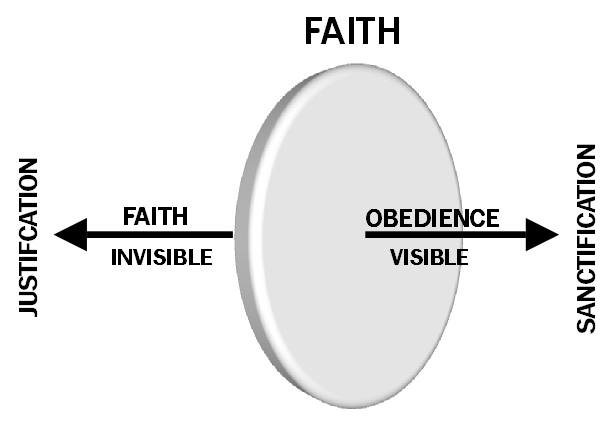
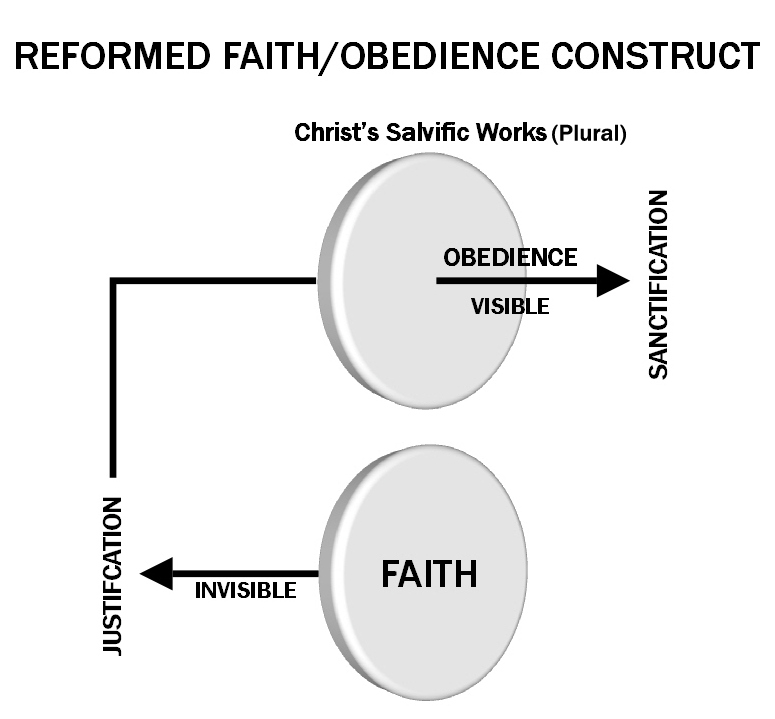
I think we have another building block of understanding here. Paul makes a distinction between the gospel and election. Though the Jews are enemies of the gospel, they will be saved because of election. The calling of God is irrevocable. I also remind you of Paul’s reference to disobedience. We are not saved by obedience/works. Again, the words obedience and faith are used interchangeably. Obedience is merely the life of faith. Faith is invisible; obedience is merely the visible life of faith. In the passage we just read, it reads the same if you replace disobedience with unbelief and faith with obedience. They are the same because we are not saved by obedience or works, but yet, the words are used interchangeably. Again, this is because our faith is a living faith. Curiously, the Reformers taught that faith is a lifeless conduit to the Spirit realm. But the bigger point is: understanding that our faith is a living faith clears up a lot of confusion in regard to the relationship of faith/obedience in justification versus sanctification. That’s the point.
But in regard to your justification, God’s call is irrevocable. This leads to fearless, aggressive sanctification. Paul also makes the point that the Jews were allowed to be enemies of the gospel for the benefit of the Gentiles who like the Jews were once disobedient:
For God has consigned all to disobedience, that he may have mercy on all.
So, both the Jews and the Gentiles were unbelieving so that he could have mercy on both. The Jews were chosen first, but when they rebelled, God reserved a remnant for Himself according to election and used the rebellion for the benefit of the Gentiles. This benefit is a set time called “the times of the Gentiles.” It has a specific beginning in time and a specific end. Apparently, election pertains primarily to the Jews and the gospel primarily to the Gentiles. The Jews were/are enemies of the gospel for the sake of the Gentiles, but beloved for the sake of election. Obviously, this merely scratches the surface of a vast wealth of knowledge thereof.
Now, next week, we are going to look at this deeper in regard to eschatology. We are going to look at how Bible prophecy is absolutely essential to understanding justification and how God fulfills The Promise. He chooses the Jews, appoints the time of the Gentiles as a response to their rebellion, and then fulfills The Promise to Abraham after the end of the times of the Gentiles. The Gentiles are an inclusion, not a replacement. Replacement Theology, also known as Supersessionism, is specifically what Paul is warning against in Romans 11:
25 Lest you be wise in your own sight, I do not want you to be unaware of this mystery, brothers: a partial hardening has come upon Israel, until the fullness of the Gentiles has come in. 26 And in this way all Israel will be saved, as it is written, “The Deliverer will come from Zion, he will banish ungodliness from Jacob”; 27 “and this will be my covenant with them when I take away their sins.”
Next week, we will look at this from the perspective of prophecy in part two. But in the following week, part 3, we will look at this from the standpoint of covenants. Note carefully: the rebellion of the Jews did not result in the New Covenant replacing the Old Covenant. The Covenants build on each other in order to consummate The Promise to Abraham to bless all nations through him. All the covenants belong to the commonwealth of Israel (Ephesians 2:11-16) and build on each other for the final consummation of The Promise. The rebellion does not replace any of the covenants with a new one; the rebellion is merely used by God to include the Gentiles in the Promise.
Inclusion, not replacement in regard to prophecy and covenants. Understanding the true relationship between election, the Jews, Gentiles, justification, sanctification, prophecy, and covenants has catastrophic ramifications for understanding God’s salvific plan for the ages.
Hence, our hefty endeavor will need much prayer and study moving forward into parts two and three.
Inclusion, not replacement regarding the church.
Progression of covenants, not replacement of the old with the new.
Romans 10:6-9; Righteousness, Faith, Life, and Law
Click on illustrations to enlarge.

I have been wrestling with this passage all week long through pondering and praying. Last week, we looked at Christ being the end of the law for righteousness, or for all practical purposes, justification. Then, we noticed that to further his points, Paul referred to his Old Testament commentaries. We wanted to read those commentaries along with Paul to better understand what he was teaching about righteousness/justification. Those two words mean the same thing for all practical purposes.
But reading the passages from Moses that Paul cites led to utter confusion. What Moses wrote seems to contradict Paul. Moses states that life comes through obedience to God’s law while Paul states that justification comes through faith in Jesus Christ alone. As we have seen, a righteousness apart from the law. Here is what Paul states:
Roman 10:5 – For Moses writes about the righteousness that is based on the law, that the person who does the commandments shall live by them. 6 But the righteousness based on faith says, “Do not say in your heart, ‘Who will ascend into heaven?’” (that is, to bring Christ down) 7 “or ‘Who will descend into the abyss?’” (that is, to bring Christ up from the dead). 8 But what does it say? “The word is near you, in your mouth and in your heart” (that is, the word of faith that we proclaim);
These are the two passages written by Moses that Paul is referring to:
Leviticus 18:1 – And the Lord spoke to Moses, saying, 2 “Speak to the people of Israel and say to them, I am the Lord your God. 3 You shall not do as they do in the land of Egypt, where you lived, and you shall not do as they do in the land of Canaan, to which I am bringing you. You shall not walk in their statutes. 4 You shall follow my rules and keep my statutes and walk in them. I am the Lord your God. 5 You shall therefore keep my statutes and my rules; if a person does them, he shall live by them: I am the Lord.
Deuteronomy 30:11 – “For this commandment that I command you today is not too hard for you, neither is it far off. 12 It is not in heaven, that you should say, ‘Who will ascend to heaven for us and bring it to us, that we may hear it and do it?’ 13 Neither is it beyond the sea, that you should say, ‘Who will go over the sea for us and bring it to us, that we may hear it and do it?’ 14 But the word is very near you. It is in your mouth and in your heart, so that you can do it.
15 “See, I have set before you today life and good, death and evil. 16 If you obey the commandments of the Lord your God that I command you today, by loving the Lord your God, by walking in his ways, and by keeping his commandments and his statutes and his rules, then you shall live and multiply, and the Lord your God will bless you in the land that you are entering to take possession of it. 17 But if your heart turns away, and you will not hear, but are drawn away to worship other gods and serve them, 18 I declare to you today, that you shall surely perish. You shall not live long in the land that you are going over the Jordan to enter and possess. 19 I call heaven and earth to witness against you today, that I have set before you life and death, blessing and curse. Therefore choose life, that you and your offspring may live, 20 loving the Lord your God, obeying his voice and holding fast to him, for he is your life and length of days, that you may dwell in the land that the Lord swore to your fathers, to Abraham, to Isaac, and to Jacob, to give them.”
The idea that is in vogue in our day is that Moses continually prodded the Israelites to try to live by the law so that they would be driven to despair and see their need for Christ. This is the popular interpretation of what Paul meant by the law being a schoolmaster that leads us to Christ. In fact, we supposedly still use the law in that way to perpetually live by faith alone in sanctification. The law shows us our sinfulness and continual need for Christ’s saving grace and forgiveness. “Life” is not really found in obedience; Moses was just saying that to show us our inability to obey the law perfectly and thus be justified by it. Be sure of it: this is 90% of what is being taught in the church today. That fact alone should make us suspicious for a great revival is NOT predicted for the latter days; the contrary is predicted in no uncertain terms.
This approach demands a nonsensical approach to a massive portion of Scripture. The concept of happiness, blessings, and life being found in obedience to God’s word dominates the Scriptures from Genesis to Revelation. Let’s look at an example:
Ephesians 6:1 – Children, obey your parents in the Lord, for this is right. 2 “Honor your father and mother” (this is the first commandment with a promise), 3 “that it may go well with you and that you may live long in the land.” 4 Fathers, do not provoke your children to anger, but bring them up in the discipline and instruction of the Lord.
It might also be interesting to note King David’s final instructions to his son Solomon:
1Kings 2:2 – “I am about to go the way of all the earth. Be strong, and show yourself a man, 3 and keep the charge of the Lord your God, walking in his ways and keeping his statutes, his commandments, his rules, and his testimonies, as it is written in the Law of Moses, that you may prosper in all that you do and wherever you turn, 4 that the Lord may establish his word that he spoke concerning me, saying, ‘If your sons pay close attention to their way, to walk before me in faithfulness with all their heart and with all their soul, you shall not lack a man on the throne of Israel.’
So, what in the world is going on here? First, please hang on to this principle of Bible study: when you begin the study of any given passage, read it intently and look for what the passage is plainly stating, and pay particular attention to specific words. Do not underestimate the intended meaning of any given word by assuming its singular concept does not have vast implications.
Secondly, as Christians we must function on objective truth that we know definitively. Often, those truths will be building blocks that add to a more complete building of truth. And in my struggle to understand what Paul is trying to teach in this passage, we have a building block. The building block of truth that we can use to build more understanding is that faith and obedience are the exact same thing. No, I am not saying that obedience is a result of faith—I like the two sides of the same coin illustration. One side of the coin didn’t come before the other. You may see one side of the coin before you see the other, but one didn’t come before the other. They are the same. It might even be said that the inside of the coin is never seen as well. It might also be said that the coin has two sides that can’t be seen at the same time and an invisible aspect.
We tend to dichotomize faith and obedience; I doubt the Bible does that. Here is another building block: faith does have a result; it’s not obedience, but it is “life.” Faith and obedience are one, life is the result.
So, where can we back this up with Scripture? Well, first, let’s look at what Paul is pointing to in his Isaiah commentary, and then we will go back at some point to his Moses commentary. Paul reads it as follows:
Romans 10:15 – And how are they to preach unless they are sent? As it is written, “How beautiful are the feet of those who preach the good news!” 16 But they have not all obeyed the gospel. For Isaiah says, “Lord, who has believed what he has heard from us?”
Obey the gospel? Seems like a peculiar way to state it, until Paul rehearses what Isaiah says, “who has believed what he has heard from us?” We see that Paul has simply replaced believe with obey. This is not nearly the only place where Scripture does this:
John 3:35 – The Father loves the Son and has given all things into his hand. 36 Whoever believes in the Son has eternal life; whoever does not obey the Son shall not see life, but the wrath of God remains on him.
Obviously, the antithesis of faith is disobedience. In other passages, believing the gospel is replaced with obeying the gospel:
2 Thessalonians 1:8 – in flaming fire, inflicting vengeance on those who do not know God and on those who do not obey the gospel of our Lord Jesus.
1 Peter 4:17 – For it is time for judgment to begin at the household of God; and if it begins with us, what will be the outcome for those who do not obey the gospel of God?
Now, let’s go back to Moses. When Paul quotes Moses as saying, “if a person does them, he shall live by them,” that is simply a statement of fact. Before Christ came, people were born again by believing God. We know from Christ’s conversation with Nicodemus that the new birth was prior to the cross. Any kind of standard is not the point, believing God is the point. And remember, obedience is faith. So, saving faith is a heart inclined towards God. Reaching a standard isn’t the point; an inclination towards God is the point.
Abundant life is found in obedience, but that’s not where justification comes from. Justification comes from faith only, and then faith will always be looking for a way to please God. Reaching a standard has never been part of justification; therefore, perfection has never been required for salvation. A goal of perfection (desire for) will be the inclination of faith, but has never been a standard for justification. In Exodus 19, the Israelites agreed to the covenant before they knew the details—they simply agreed to follow God wherever it led them by faith. Faith makes us able to obey in a way pleasing to God because the word is in our hearts and in our mouths as a visible manifestation of faith. The invisible part of faith is belief in our hearts; the visible part of faith is what we do. What we do brings blessings, but not salvation. That’s why the principle of blessings and cursings is the same in the Old Testament and New Testament. That’s why King David’s exhortation and promise to Solomon is the same as Paul’s exhortation to children in the New Testament (EPH 6:1-3). Now, let’s read Moses in full context and see if we can observe these principles:
Deuteronomy 30:9 – The Lord your God will make you abundantly prosperous in all the work of your hand, in the fruit of your womb and in the fruit of your cattle and in the fruit of your ground. For the Lord will again take delight in prospering you, as he took delight in your fathers, 10 when you obey the voice of the Lord your God, to keep his commandments and his statutes that are written in this Book of the Law, when you turn to the Lord your God with all your heart and with all your soul.
11 “For this commandment that I command you today is not too hard for you, neither is it far off. 12 It is not in heaven, that you should say, ‘Who will ascend to heaven for us and bring it to us, that we may hear it and do it?’ 13 Neither is it beyond the sea, that you should say, ‘Who will go over the sea for us and bring it to us, that we may hear it and do it?’ 14 But the word is very near you. It is in your mouth and in your heart, so that you can do it.
15 “See, I have set before you today life and good, death and evil. 16 If you obey the commandments of the Lord your God that I command you today, by loving the Lord your God, by walking in his ways, and by keeping his commandments and his statutes and his rules, then you shall live and multiply, and the Lord your God will bless you in the land that you are entering to take possession of it. 17 But if your heart turns away, and you will not hear, but are drawn away to worship other gods and serve them, 18 I declare to you today, that you shall surely perish.
Like I said, these are building blocks and I am not sure how this all fits together, but let me add a third building block: Christ is the end of the law for righteousness. This doesn’t mean that there was previously righteousness in obedience to the law, but it means the following:
Galatians 3:17 – This is what I mean: the law, which came 430 years afterward, does not annul a covenant previously ratified by God, so as to make the promise void. 18 For if the inheritance comes by the law, it no longer comes by promise; but God gave it to Abraham by a promise.
19 Why then the law? It was added because of transgressions, until the offspring should come to whom the promise had been made, and it was put in place through angels by an intermediary. 20 Now an intermediary implies more than one, but God is one.
21 Is the law then contrary to the promises of God? Certainly not! For if a law had been given that could give life, then righteousness would indeed be by the law. 22 But the Scripture imprisoned everything under sin, so that the promise by faith in Jesus Christ might be given to those who believe.
23 Now before faith came, we were held captive under the law, imprisoned until the coming faith would be revealed. 24 So then, the law was our guardian until Christ came, in order that we might be justified by faith. 25 But now that faith has come, we are no longer under a guardian, 26 for in Christ Jesus you are all sons of God, through faith. 27 For as many of you as were baptized into Christ have put on Christ. 28 There is neither Jew nor Greek, there is neither slave nor free, there is no male and female, for you are all one in Christ Jesus. 29 And if you are Christ’s, then you are Abraham’s offspring, heirs according to promise.
Granted, I am foggy on how all of this works in the first covenant, but the word that was in their heart and in their mouth is now replaced with Christ as the object of faith:
Romans 10:5 – For Moses writes about the righteousness that is based [“based” not in the manuscripts, added by ESV] on [*] the law, that the person who does the commandments shall live by them. 6 But the righteousness based [Ibid] on [*in both cases could be “of” instead of “on”] faith says, “Do not say in your heart, ‘Who will ascend into heaven?’” (that is, to bring Christ down) 7 “or ‘Who will descend into the abyss?’” (that is, to bring Christ up from the dead). 8 But what does it say? “The word is near you, in your mouth and in your heart” (that is, the word of faith that we proclaim);
Perhaps the law was the object of their faith because it promised Christ, a will that was inaugurated by blood and executed upon the death of the testator (HEB 9:15-22), but the object of faith justifies, and obedience brings life. Obedience doesn’t justify per se, it is just the body life of faith. We are justified by faith alone, obedience merely shows forth the life of faith:
James 2: 14 – What good is it, my brothers, if someone says he has faith but does not have works? Can that faith save him? 15 If a brother or sister is poorly clothed and lacking in daily food, 16 and one of you says to them, “Go in peace, be warmed and filled,” without giving them the things needed for the body, what good is that? 17 So also faith by itself, if it does not have works, is dead.
18 But someone will say, “You have faith and I have works.” Show me your faith apart from your works, and I will show you my faith by my works. 19 You believe that God is one; you do well. Even the demons believe—and shudder! 20 Do you want to be shown, you foolish person, that faith apart from works is useless? 21 Was not Abraham our father justified by works when he offered up his son Isaac on the altar? 22 You see that faith was active along with his works, and faith was completed by his works; 23 and the Scripture was fulfilled that says, “Abraham believed God, and it was counted to him as righteousness”—and he was called a friend of God. 24 You see that a person is justified by works and not by faith alone. 25 And in the same way was not also Rahab the prostitute justified by works when she received the messengers and sent them out by another way? 26 For as the body apart from the spirit is dead, so also faith apart from works is dead.
Also, we have a choice in sanctification to enhance life through obedience. The blessings are “in” the “doing” (James 1:25). We can apply biblical wisdom to our lives in order to have a life built on a rock (MATT 7:24-27), and experience life more abundantly (2PET 2-11). But remember, This is apart from justification by faith alone that has an invisible reality and a visible reality:
Romans 10:9 – because, if you confess with your mouth that Jesus is Lord and believe in your heart that God raised him from the dead, you will be saved. 10 For with the heart one believes and is justified, and with the mouth one confesses and is saved.
This can be best summed up by “The just shall live by faith” (HEB 10:38, HAB 2:4). “Just” is our position and imputed righteousness of God; the faith that we live by justified us, but the obedience of our faith lives in sanctification. These two, faith and obedience, cannot be separate for faith without works is dead.
In the final analysis, because national Israel rejected Christ, they sought righteousness in that which pointed to Christ instead of Christ Himself. By “Christ Himself” I mean faith in Christ’s death and resurrection as stated in the Scriptures, and submission to His Lordship commands that are also found in the Scriptures. In other words, faith in Christ and the obedient life that is also faith. Hence:
John 5:39 – You search the Scriptures because you think that in them you have eternal life; and it is they that bear witness about me, 40 yet you refuse to come to me that you may have life. 41 I do not receive glory from people. 42 But I know that you do not have the love of God within you. 43 I have come in my Father’s name, and you do not receive me. If another comes in his own name, you will receive him. 44 How can you believe, when you receive glory from one another and do not seek the glory that comes from the only God? 45 Do not think that I will accuse you to the Father. There is one who accuses you: Moses, on whom you have set your hope. 46 For if you believed Moses, you would believe me; for he wrote of me. 47 But if you do not believe his writings, how will you believe my words?”
It would seem, at least in my mind, that this whole concept of obedience and faith being one lends understanding to a host of difficult passages.
ADDENDUM:
Three Constructs
1. Reformed
A. Perfect keeping of the law is the standard for righteousness.
B. We can’t keep the law perfectly.
C. Christ must keep the law for us via faith alone in sanctification to maintain just
standing.
2. Reformed New Covenant Theology
A. The law has been eliminated or abrogated by the New Covenant.
B. Life and godliness guided by single law of love as mediated by our consciences.
3. Biblicism
A. Our righteousness is apart from the law and by faith alone in Christ.
B. The law informs our obedient faith for sanctification.

 Paul's Passing Thoughts
1 comment