The Protestant Twisting of 1John: A Clarification, Part 4; Gospel and Obedience
 Listen to audio or download audio file.
Welcome to Blogtalk Radio False Reformation this is your host Paul M. Dohse Sr. Tonight, part 4 of “The Protestant Twisting of 1John: A Clarification.” If you would like to add to our lesson or ask a question, call (347) 855-8317. Remember to turn your PC volume down to prevent feedback. Per the usual, we will check in with Susan towards the end of the show and listen to her perspective.
If you would like to comment on our subject tonight, you can also email me at paul@ttanc.com. That’s Tom, Tony, Alice, Nancy, cat, paul@ttanc.com. I have my email monitor right here and can add your thoughts to the lesson without need for you to call in.
Initially, I wanted to just address 1John 1:9 in a thorough way to debunk this whole Protestant idea that we keep ourselves saved by returning to the same gospel that saved us. And, the way we reutilize the same gospel that saved us is a continued repentance for “present sin.” It’s this whole idea that Jesus died for our past sins, but we must ask forgiveness for known present sin in order to keep ourselves saved. When we do that, it’s a reapplication of Jesus’ death for present sin. Hence, 1John 1:9.
But it doesn’t stop there in Protestant soteriology. They then concern themselves with the question of true righteousness. If our sins are forgiven, that keeps us out of hell, but it doesn’t make us truly righteous. What to do? So here is what they came up with: Jesus came to die for our forgiveness, past and present IF we return to the same gospel that saved us by faith alone, but He also came to keep the law perfectly so that His perfect obedience could be imputed to “Christian” life. The Reformed call this “double imputation.”
And it turns the true biblical gospel completely upside down. First, it makes the law the standard for justification. There is no law in justification, we are justified APART from the law. Why would Christ obey the law for us when justification is apart from the law? Then what is the standard for righteousness? NOT the law, but rather God’s righteousness. What’s that? For one, and primarily, it’s the new birth. For us, the standard of righteousness is being a child of God. Being the offspring of God is what makes us righteous. Kinship, not law.
Secondly, we are not justified by the law, no matter who keeps it—who keeps it is not the point, the law itself is the point, because there is no law that can give life. Only the new birth gives life (Galatians 3:21).
Thirdly, double imputation is obviously a covering for sin with the righteousness of Christ and not an ENDING of sin. Our sins are not “taken away” they are only covered. “Christianity” is about living a life of faith only to maintain a covering for sin. Therefore, we are not the ones really obeying, and therefore, we are not the ones performing love either.
And boy does this notion land us right where we are at in 1John. I have invested so much in the untwisting of 1John 1:9 in this series, that I thought, “I might as well finish the book out and make it our 1John commentary.” And so it is.
This is our theses: the new birth creates us anew into people who love the truth, and therefore practice oblove. That’s a new word that I made up. What is the definition of oblove? It’s the combination of the words “love” and “obedience.” Biblically, you cannot separate these two words, they are synonymous. The law is the Bible, and it is a book of condemnation to the unsaved and a beloved love manual for those born again. This is also why our sins are not covered, they are taken away (1John 3:5). Christ came to take away sin, not cover it.
You know, many go to church and sing the hymns, and many listen to Christian radio and raise their hands in praise while stopped at red lights, but a lot of that good Protestant music is just really bad theology that imperils the soul and stops far short of inciting the curiosity of the unsaved. One example is a beautiful song by Steve Camp titled, “He Covers Me.” But again, the premise of the song is that our sins are covered and not ended.
You know, there is a quiet revolution going on in Christianity. Christian husbands are beginning to stand up and assume their rightful role as spiritual leaders. This necessarily means leaving the institutional church which deliberately seeks to emasculate the men among us. One thing that I hear back is that fathers are beginning to stand silent and not sing traditional songs that are deviations from the truth. Good for them. I even hear back that their children ask, “Daddy, why aren’t you singing?” And they tell them why. Undoubtedly, children and wives will get way more out of these types of examples rather than 365 different versions of the same gospel that saved us.
“Why is it that all we ever hear about in the church is the gospel?” Because we have to keep returning to the same gospel that saved us to keep ourselves saved, and by the way, the only place that this continued atonement is valid is in the institutional church. Sure, Protestants will deny salvation by church membership; they will rather become indignant and state that salvation is only found in the gospel. However, the fact remains that they also believe that authority to preach the gospel is vested in the institutional church.
If our sins are only covered, the focus of the Christian life is to keep ourselves covered, not obedience because now obedience is defined by law-keeping. We have been trained mentally to think of obedience as something demanded by the law. This makes the law a co-life-giver with God. At least in one regard, the idea of one God connects with this idea. There is only one life-giver (Galatians 3:10-21).
I strongly suspect that when the Bible talks about God being one, it in no way includes the context of the Trinity. It’s interesting to note that in context of Galatians 3:10-21, the point is that the law is not a coequal with God—there is only one God.
1John 3:1 – See what kind of love the Father has given to us, that we should be called children of God; and so we are. The reason why the world does not know us is that it did not know him. 2 Beloved, we are God’s children now, and what we will be has not yet appeared; but we know that when he appears we shall be like him, because we shall see him as he is. 3 And everyone who thus hopes in him purifies himself as he is pure.
4 Everyone who makes a practice of sinning also practices lawlessness; sin is lawlessness. 5 You know that he appeared in order to take away sins, and in him there is no sin. 6 No one who abides in him keeps on sinning; no one who keeps on sinning has either seen him or known him. 7 Little children, let no one deceive you. Whoever practices righteousness is righteous, as he is righteous. 8 Whoever makes a practice of sinning is of the devil, for the devil has been sinning from the beginning. The reason the Son of God appeared was to destroy the works of the devil. 9 No one born of God makes a practice of sinning, for God’s seed abides in him, and he cannot keep on sinning because he has been born of God. 10 By this it is evident who are the children of God, and who are the children of the devil: whoever does not practice righteousness is not of God, nor is the one who does not love his brother.
11 For this is the message that you have heard from the beginning, that we should love one another. 12 We should not be like Cain, who was of the evil one and murdered his brother. And why did he murder him? Because his own deeds were evil and his brother’s righteous. 13 Do not be surprised, brothers, that the world hates you. 14 We know that we have passed out of death into life, because we love the brothers. Whoever does not love abides in death. 15 Everyone who hates his brother is a murderer, and you know that no murderer has eternal life abiding in him.
16 By this we know love, that he laid down his life for us, and we ought to lay down our lives for the brothers. 17 But if anyone has the world’s goods and sees his brother in need, yet closes his heart against him, how does God’s love abide in him? 18 Little children, let us not love in word or talk but in deed and in truth.
19 By this we shall know that we are of the truth and reassure our heart before him; 20 for whenever our heart condemns us, God is greater than our heart, and he knows everything. 21 Beloved, if our heart does not condemn us, we have confidence before God; 22 and whatever we ask we receive from him, because we keep his commandments and do what pleases him. 23 And this is his commandment, that we believe in the name of his Son Jesus Christ and love one another, just as he has commanded us. 24 Whoever keeps his commandments abides in God, and God in him. And by this we know that he abides in us, by the Spirit whom he has given us.
The law is not the standard for justification; it is the standard for our love, obedience, and submission. If there is a standard for justification at all, it would simply be defined by the new birth. We are justified by virtue of being in God’s family. The first man was a created being. God did not decide to save man by restoring a covenant of works, or restoring man’s image created in the likeness of God, or to restore paradise lost. He decided to save man by making him His literal family. The gospel isn’t about restoring things; it’s about making all things new. This defines you as pure, albeit in mortality. Nevertheless, being born of God in mortality results in the inevitable morphing into more and more purity:
See what kind of love the Father has given to us, that we should be called children of God; and so we are. The reason why the world does not know us is that it did not know him. 2 Beloved, we are God’s children now, and what we will be has not yet appeared; but we know that when he appears we shall be like him, because we shall see him as he is. 3 And everyone who thus hopes in him purifies himself as he is pure.
Let’s ask an interpretive question here. What did Jesus mean when He told John the Baptist that His baptism by John would fulfill all righteousness? I think it fulfilled all righteousness by representing the literal new birth, or Spirit baptism. Though we still reside in mortal bodies, the decision to be saved is a decision to follow Christ in baptism, or a decision to be born again. That’s the gospel. That’s what the gospel is.
Romans 6:1 – What shall we say then? Are we to continue in sin that grace may abound? 2 By no means! How can we who died to sin still live in it? 3 Do you not know that all of us who have been baptized into Christ Jesus were baptized into his death? 4 We were buried therefore with him by baptism into death, in order that, just as Christ was raised from the dead by the glory of the Father, we too might walk in newness of life.
5 For if we have been united with him in a death like his, we shall certainly be united with him in a resurrection like his. 6 We know that our old self was crucified with him in order that the body of sin might be brought to nothing, so that we would no longer be enslaved to sin. 7 For one who has died has been set free from sin. 8 Now if we have died with Christ, we believe that we will also live with him. 9 We know that Christ, being raised from the dead, will never die again; death no longer has dominion over him. 10 For the death he died he died to sin, once for all, but the life he lives he lives to God. 11 So you also must consider yourselves dead to sin and alive to God in Christ Jesus.
12 Let not sin therefore reign in your mortal body, to make you obey its passions. 13 Do not present your members to sin as instruments for unrighteousness, but present yourselves to God as those who have been brought from death to life, and your members to God as instruments for righteousness. 14 For sin will have no dominion over you, since you are not under law but under grace.
The more you study the apostle John, the more you will see the apostle Paul. Romans 6 is key here. The perfection of the law is not the standard for righteousness, passing from life to death is the standard. Though we still sin, we are dead to sin. Being deemed righteous in our present state is defined by a reversal of slavery leading to a new direction in life. Romans 6 explains, as we shall see, 1John 3. The literal new birth, in essence reverses slavery (Romans 6:20). This also debunks the whole Reformed total depravity song and dance. Before the baptism of the Spirit that comes by believing on Christ, the unregenerate are free to do good, but enslaved to the law of sin and death (Romans 8:2).
Being under the curse of the law is both a forensic statement and a state of being. It is true, while under law, a perfect keeping of the law is demanded. But this is key: when it gets right down to it, unbelievers are indifferent to the Bible or the law of God. And remember, the law and the Bible are the same thing. Man is capable of doing good, and in fact does do good, but because he/she has no love for God’s truth, and in fact are indifferent to it, life decisions lead to many-faceted forms of death, and ultimately, eternal death. Unbelievers that live according to conscience will suffer a lesser punishment in this life and the life to come.
Believers can in fact make life and death decisions, but are inclined towards obeying the law because of the new birth. Clearly, the Bible states that there is a reversal of slavery. The believer is enslaved to righteousness, but unfortunately free to sin. But according to Paul, a believer can stupidly enslave themselves to certain sins by obeying the desire that the sin produces. The believer is no longer enslaved to sin, but can be ignorant of this fact. And keep in mind, Protestantism is predicated on the idea that we are still enslaved to sin as believers which goes part and parcel with still being under the law and law continuing to be the standard for justification.
Listen, here is why the home fellowship movement is going to eventually take off: the alternative is Protestantism which defines the believer according to how the Bible defines an unbeliever. Eventually, people are going to figure out that they have been proudly proclaiming themselves as unregenerate in the name of Christ.
Lastly, this is defined by the fact that believers have the freedom to present their bodies as living sacrifices, or in other words, present their members for holy purposes that please God. The body is not inherently evil because it is part of the material world. Whether saved or unsaved, the body can be used for good purposes. However, in the case of an unbeliever, good behavior doesn’t lead to life more abundantly, it just leads to lesser punishment and a more bearable eternal state. For the unbeliever, good behavior merely leads to less death. For the believer, obedient love leads to more life.
Now with all of this in mind, let’s read further in 1John Chapter 3:
4 Everyone who makes a practice of sinning also practices lawlessness; sin is lawlessness. 5 You know that he appeared in order to take away sins, and in him there is no sin. 6 No one who abides in him keeps on sinning; no one who keeps on sinning has either seen him or known him. 7 Little children, let no one deceive you. Whoever practices righteousness is righteous, as he is righteous. 8 Whoever makes a practice of sinning is of the devil, for the devil has been sinning from the beginning. The reason the Son of God appeared was to destroy the works of the devil. 9 No one born of God makes a practice of sinning, for God’s seed abides in him, and he cannot keep on sinning because he has been born of God. 10 By this it is evident who are the children of God, and who are the children of the devil: whoever does not practice righteousness is not of God, nor is the one who does not love his brother.
John wrote what he wrote in 1John 3 because of what Paul wrote in Romans 6—it’s saying the same thing. Obeying the law isn’t the issue, a “commitment” to obey the law isn’t the issue, the reality of the new birth is the issue.
1Corinthians 15:1- Now I would remind you, brothers, of the gospel I preached to you, which you received, in which you stand, 2 and by which you are being saved, if you hold fast to the word I preached to you—unless you believed in vain.
3For I delivered to you as of first importance what I also received: that Christ died for our sins in accordance with the Scriptures, 4 that he was buried, that he was raised on the third day in accordance with the Scriptures, 5 and that he appeared to Cephas, then to the twelve. 6 Then he appeared to more than five hundred brothers at one time, most of whom are still alive, though some have fallen asleep.
This is, as Paul called it, the gospel of “first importance” or literally “the gospel of first order of importance.” There is way more behind this than a mental ascent to the facts of the gospel. You have to believe that this first happened to Christ in order to believe that it really happened to you spiritually. Repentance is a change of mind in regard to many things concerning your life and the life of Christ.
By the way, there was an evangelical movement for a while that emphasized the new birth. It peaked in the 70’s and was considered to be the most egregious of all false gospels. The Australian Forum, the think tank that gave birth to the present-day return to authentic Reformed soteriology, actually published an article titled, “The False Gospel of the New Birth.”
John continues in chapter 3 to explain one of the characteristics of being born again, love. But let me insert this, and this is VERY important: the characteristics of the new birth are framed in what the Bible refers to as “abiding.” If God’s seed “abides in” us (1John 3:9), other things also abide in us: the fact that we abide in Him also; the truth abides in us; we know the truth; we love the truth; we love fellow Christians; we do not practice sin, but rather practice righteousness as a life direction and pattern; we love God’s law; we submit to need; we obey; we seek to please God; we have a hunger for learning more of God’s word, and many more can be listed.
Let’s read more of John 3 with this in mind:
11 For this is the message that you have heard from the beginning, that we should love one another. 12 We should not be like Cain, who was of the evil one and murdered his brother. And why did he murder him? Because his own deeds were evil and his brother’s righteous. 13 Do not be surprised, brothers, that the world hates you. 14 We know that we have passed out of death into life, because we love the brothers. Whoever does not love abides in death. 15 Everyone who hates his brother is a murderer, and you know that no murderer has eternal life abiding in him.
16 By this we know love, that he laid down his life for us, and we ought to lay down our lives for the brothers. 17 But if anyone has the world’s goods and sees his brother in need, yet closes his heart against him, how does God’s love abide in him? 18 Little children, let us not love in word or talk but in deed and in truth.
See, the order in which John discusses these things is in no wise disconnected. We need to start thinking about “obedience” in reference to love and the new birth. Really, the Christian life is about love. But listen, any love that flows from you starts with a love for truth. Also, please take note of a more biblical definition of love: love is a submission to need—that’s love. When the Scriptures tell women to submit to their husbands, that’s just another way of telling wives to love their husbands. When the Bible tells men to love their wives, it’s simply telling men to submit to their needs. Look at 1John 3:17 again. How does benevolence get parachuted into that body of text out of nowhere? John goes from discussing murder to meeting financial need; it seems like he is all over the map, but not really.
Lastly, working out the new birth with love leads to assurance.
19 By this we shall know that we are of the truth and reassure our heart before him; 20 for whenever our heart condemns us, God is greater than our heart, and he knows everything. 21 Beloved, if our heart does not condemn us, we have confidence before God; 22 and whatever we ask we receive from him, because we keep his commandments and do what pleases him. 23 And this is his commandment, that we believe in the name of his Son Jesus Christ and love one another, just as he has commanded us. 24 Whoever keeps his commandments abides in God, and God in him. And by this we know that he abides in us, by the Spirit whom he has given us.
Assurance of salvation comes through working out our new birth in fear and trembling. Assurance of salvation is grounded in the ending of the law because the old us died with Christ resulting in no condemnation, while our new relationship to the law leads us in love and life. Now listen, even a casual student of the Bible can begin to hang Bible verses all over this framework.
Next week, we will build on this as we go into chapter 4—let’s go to the phones.
Outraging the Spirit of Grace by Preaching the Gospel to Ourselves Everyday
 There is no new thing under the sun—just different variations of the same thing. Sure, a company in Israel has developed a car that can run on water, that seems to be new, but they stole the idea from fish.
Likewise, man is heck-bent on either being owned to quiet his fears derived from presuppositions or being one of the elite owners of men. The argument most used for this cause is the biblical Old Covenant. Hence, there will always be various and sundry variations of a priestly class ruling over the great unwashed masses.
It goes something like this: the Old Covenant sacrifices were a shadow of Christ who offered himself once for the sins of man. Everybody agrees, but the devil is in the details; was Christ’s death a modification of the Old Covenant covering that still needs to be repeated albeit a different way? Did the Old Covenant sacrifices cover sins, or take them away? Did Christ present a variation of atonement (covering), or did He end atonement? Sure, Christ only died once as opposed to the repetition of the Old Covenant sacrifices, but must we continually return to the one time offering of Christ in order for our sins to be continually covered?
According to this construct, we remain the same except for a continual return to the sacrifice of Christ in remembrance for the forgiveness and covering of sin; after all, we still sin, right? Present sin must still be covered, no? So, instead of offering animal sacrifices, we continue to remain covered or atoned for by “remaining” faithful to the New Covenant.
How do we do that? It’s pretty clear: faithfulness to the local church through formal membership, obeying the New Covenant priests, tithing (and don’t forget “offerings” as well, and the building program, and…), baptism, sitting under elder preaching of the gospel, and especially the Lord’s Table which is one of the “grace imparting” ordinances of the church. We ALL still need grace, right?
But here is the money question: What is meant by “grace”? It can mean “help,” or it can refer to salvation. In this construct, trust me, it’s the latter.
Here is the second money question: is the New Covenant a covering of sin or a taking away of sin? “Paul, it’s only a covering because if our sins were taken away we wouldn’t sin anymore.” One of the most popular rhetorical questions in our day for someone who dares think that Christians no longer need “the gospel” (in a salvation sense) follows: “Did you sin today?” As one commented on PPT, “Well, I would hope we have forgiveness for present sin!” Hence, present sin would condemn us if we don’t continue to receive a covering for our sins. And, this covering can only be obtained in the institutional church through the “ordinances that impart grace.” You still need grace don’t you? “Are you saying that you don’t need grace?”
Therefore, “We must preach the gospel to ourselves every day.” “The same gospel that saved us also sanctifies us.” “You need the gospel just as much today as you did when you were saved.” “The gospel is not the ABCs of the Christian life; it is the A-Z.” “The gospel is not a rung on the ladder, it’s the whole ladder.” “If you leave the gospel and move on to something else, you lose justification and sanctification both.”
What does the Bible really say about all of this?
Let’s start with the Old Covenant which was, in fact, a covering for sin, but spoke of an actual ending of sin (taking away) and saints made presently holy regardless of sin.
In Leviticus 16, we find the regulations for the Day of Atonement (covering). The sacrifice included one bull, one ram, and two goats. Only the High Priest, Aaron, could perform the part of the ceremony that involved entering the Holy of Holies or the “Holy Place.” This was the inner chamber of the tabernacle separated from the entry chamber by a veil where the Ark of the Covenant was located. The fact that only the High Priest could enter the inner chamber is very significant. There was only ONE priest that executed that function. While other ceremonies only required hand washing, this ceremony required the complete washing of the body.
Laxness in regard to any ceremony connected with the Holy Place directly or indirectly resulted in instant death. This is what happened to Aaron’s two sons. The Holy Place was VERY inaccessible. The terror of the Old Covenant was for the express purpose of drawing a contrast between the Old Covenant and New Covenant.
The one priest, the inaccessibility to the Holy Place, the washing of the whole body, and the two goats are what we want to focus on in order to meet the objective point of this post. We have covered the first three, let’s consider the two goats. One was sacrificed. In regard to the sacrifices for sins, Aaron had to wash his whole body and sprinkle the blood on the mercy seat of the Ark in the Holy Place. In regard to the other goat, Aaron laid his hands on it and pronounced the sins of the people upon it, and then turned it loose into the wilderness. So there is a death resulting in a complete washing and the taking away of sin.
Now let’s go to Hebrews to find out how this all applies to the New Covenant. The Hebrew writer, probably Paul writing on behalf of the Apostles, is dealing with the same age-old problem of covering versus ending. That is the mere covering of sin versus the ending of sin. This also defines who the Christian is. If our sins are only covered we are only declared holy, but are not personally holy. If our sins are taken away, we are personally holy and possess the righteousness of God. “But Paul, we still sin!” I will get to that.
Also, if our sins are not ended, continued atonement is needed as well resulting in a system that accesses that continued atonement. For the Hebrews, that was easy because Old Covenant Judaism was alive and well. In our day, that has been replaced with some sort of system that returns us to Christ’s sacrifice for sins. Or in other words, a return to the same gospel that originally saved us.
The glaring problem with this is the fact that Christ only entered the Holy Place once to offer one sacrifice for all time, and made the Holy Place accessible to all people. That’s the coup de grace for all of these types of systems; if what Christ did is only a covering, the Holy Place would not be open to all. Christ would still be the only one who could enter the Holy Place on our behalf like Aaron did for the Israelites:
Hebrews 10:19 – Therefore, brothers, since we have confidence to enter the holy places by the blood of Jesus, 20 by the new and living way that he opened for us through the curtain, that is, through his flesh, 21 and since we have a great priest over the house of God, 22 let us draw near with a true heart in full assurance of faith, with our hearts sprinkled clean from an evil conscience and our bodies washed with pure water.
We ourselves have access to the Holy Place without the representation of a High Priest walking on holy eggshells lest he is struck dead. There is only one way we can enter that Holy Place—if we are truly holy. If we are not truly holy, and our sins are only covered, only Jesus would have access to the Holy Place—not us. Notice also that we have full access with our bodies completely washed from sin—the sins carried into the wilderness by the other goat.
Curiously, most English translations interpret the Holy Place in Heb 10:19 as “holy places.” Plainly, in the context that is an anomaly, but it should be noted that the KJV (“holiest”) and the Complete Jewish Bible (“Holiest Place”) have it correct.
So, how is it possible for us to have access to the Holiest Place while we in fact still sin? One thing and one thing only: belief in Christ’s death and resurrection resulting in the new birth or the baptism of the Spirt of grace. Legally, we died with Christ and are no longer under the condemnation of the law (Roman 6,7), and Spiritually, our minds are renewed (Ibid) and we have the very seed of God within us (1Jn 3:9). Even though we still reside in a mortal body where sin can harass us, our mind is regenerated and we are enabled to use our bodies as holy sacrifices unto God (Rom 12:1).
Christ offered one sacrifice to set us free from sin’s slavery, and we are now free to offer holy sacrifices to God in sanctification. The flesh is weak, but not inherently sinful. In fact, since the Holy Spirit permanently indwells us, it is His temple:
1Corinthians 6:19 – Or do you not know that your body is a temple of the Holy Spirit within you, whom you have from God? You are not your own, 20 for you were bought with a price. So glorify God in your body.
Unfortunately, sin still dwells in our mortality, but sin’s power comes from its ability to condemn. Christ died on the cross to end the law and its ability to condemn (Rom 10:4, 1Cor 15:56), but that’s only one side of the coin; on the other side is the reality that the Holy Spirit also raised us to new life with Christ. This means we are no longer under the slavery of the law and its condemnation (we were bought with a price from the slave master), and free to serve the Spirit of God (Rom 7:6).
Before we were saved, sin was able to use the law to provoke us to sin through desires of various kinds (Rom 7:5), this is when we were “living in the flesh” because sin was our master and had the upper hand (Rom 6:20). Now, that same sin wars against us and the Spirit who dwells within (Gal 5:16, 17, 1Pet 2:11). The “lust of the flesh” refers to when sin uses our body to bring about fruits for death; it does not mean the flesh is inherently evil. The flesh, like creation, is presently “weak.”
All in all, we must define present holiness the way the Bible defines it. But the denial of our personal holiness also denies the new birth and denies us access to the Holy Place. In that case, only Christ can enter in. Christ has not sat down at the right hand of the Father, but rather still offers the daily sacrifice (Heb 10:10-14). So, instead of our focus being…
Hebrews 10:24 – And let us consider how to stir up one another to love and good works, 25 not neglecting to meet together, as is the habit of some, but encouraging one another, and all the more as you see the Day drawing near.
…and faith working through love (Gal 5:6), keeping yourself saved through a perpetual need for atonement is the focus.
That denies the new birth and outrages the Spirit of grace (Heb 10:29). A return to the same gospel that saved us suggests that we are still under law and did not die with Christ; and additionally, not free to serve in the new way of the Spirit via being resurrected with Christ—Christ must continue to stand in the Holy Place and continue to offer His blood daily. He has not sat down at the right hand of the Father.
This is how preaching the gospel to ourselves every day outrages the Spirt of grace.
paul
A Doctrinal Evaluation of the Anti-Lordship Salvation Movement: Part 3
Originally published August 15, 2014
Do Christians Have Two Natures?
My belief strata is probably similar to most Christians: A. Dogma, firm on that fact; B. Not dogmatic, sounds logical, going with that for now; C. That’s a bunch of boloney. The idea that Christians have two natures has always been categorized under B for me.
Where do I think a stake needs to be driven most in the arena of Christianity right now? Who we are. We are righteous. We are able. We are good. We are not just righteous positionally, we are in fact righteous in and of ourselves. Righteousness is a gift from God, we cannot earn it, but once we have accepted the gift, we possess it. I fear that most gospels in our day propagate a rejection of the righteousness gift, and I strongly suspect that this is the point of the Parable of the Talents. Clearly, the paramount gospels of our day promote a meditation on the gift in order to keep our salvation. To put the gift into practice is to make His story our own story exclusively.
What is the gift? Is the gift just a gift, or is it also a calling? The “church” is a “called out assembly.” Is answering the call works salvation? And what are we called to? We are called to holiness. In part 2 we have looked at the primary problem with anti-Lordship Salvation. They make answering the call works salvation. How do they rationalize this? As we have discussed, it is the age-old Protestant golden chain gospel. Because justification and sanctification are not separate, a calling to holiness is a declaration that progresses in sanctification; if we commit to holiness in order to be saved, we now have to participate in that progression by obedience to the law.
ALS solves that problem by eliminating the commitment all together and making obedience in sanctification optional—a nice gesture unto the Lord, and it will kinda make your life better. If we doubt our salvation because of behavior, it shows a fundamental misunderstanding of grace; so, the solution is to return to the same gospel that saved us and re-preach it to ourselves. Both ALS and the Calvinists they despise proffer this same construct.
Calvinists deal with the progression of justification in sanctification a different way: by all means we are saved by making a commitment to obedience, but the commitment we are making is a commitment to living by faith alone in sanctification which results in the commitment being fulfilled by Christ. In fact, both camps speak of experiential sanctification; viz, we only experience the works of the Spirit being done through us and we kinda really aren’t doing the work. In Reformed circles, even our “good” works are sin, and our demeanor in obedience gives a clue that the work may be executed by the Lord in that instance, but we don’t know for certain. They call this the “subjective nature of sanctification.” It is manifested in Arminian camps via, “I didn’t do it—it was the Holy Spirit doing it through me.” Really, in all Protestant camps, accomplishment and meekness are mutually exclusive; you can’t have both.
And with ALS as well as Calvinism, righteousness is defined by perfect law-keeping. When their fusion of justification and sanctification is challenged, both camps retort, “Did you sin today?” In BOTH cases, they make no distinction between sin against the law of sin and death, and sin against the law of the Spirit of life in sanctification—violations that grieve the Spirit. That’s because they see justification and sanctification as the same (though both camps are outraged in regard to the accusation).
Because ALS, like Calvinism, makes perfect law-keeping the essence of righteousness, they cannot not deem the Christian perfect in regard to justification. They posit the idea that the Christian is only positionally righteous and not practically righteous. Unfortunately, that same view of our righteousness is then juxtaposed into sanctification because they fuse the two together. To not continually drive home the idea that we are just “sinners saved by grace” is to suggest that we can keep the law perfectly. But the question is… “What law?” There is no law in justification, and where there is no law there is no sin (Rom. 4:15).
Christ primarily died on the cross to end the law of sin and death. Now there is no law to judge us, and that can be coupled with the fact that we are born again of the Spirit and have the seed of God within us (1Jn. 3:9). The new birth is a reversal of slavery resulting in a change of direction. We were once enslaved to sin and free to do good, resulting in a direction away from God (under law Rom. 6:14), but now are enslaved to righteousness and free to sin (Rom. 6:20). As we will see in Romans 7, we were once enslaved to the law of sin and death (Rom. 8:2), but now we are enslaved to the law of the Spirit of life. In both cases, there is a reverse freedom as well. Unfortunately, the Christian is still harassed by the law of sin and death, which is a law standard by the way, and free to sin against it. We will discuss exactly how this happens.
But, because ALS, like the Reformed only see one nomos (law), and Christians obviously sin, the Christian must be both saint and sinner in sanctification. This is Martin Luther’s Simul iustus et peccator—at the same time righteous and a sinner. But, this means saint by declaration and position only while the Christian remains in the same state. The only change is the recognition of his vileness—this defines faith according to Reformed ideology.
Likewise, since the Christian cannot keep the law of sin and death perfectly, and that is justification’s standard, the ALS has its own version of the Simul iustus et peccator: the two natures. Sure, it’s soft Simul iustus et peccator, or Simul iustus et peccator Light, but it’s the same concept. I am not going to take time here to articulate all of the versions, but suffice to say all denominations are spawned by the question of how we do justification in sanctification. There are only two religions in the world: Progressive Sanctification and Progressive Justification. One is a call to holiness and you get justification in the bargain. The other is a call to be declared righteous while remaining a sinner. The former is a call to be made righteous. Answering the call saves you, following the call sanctifies you, but the two are separate with the demarcation being the new birth—following the call does not justify you. Accepting the gift justifies you—but the gift is a calling to holiness. Seeing the gift and the execution of the gift as being the same is the monster of confusion known as Protestantism.
The idea of two natures is contradictory to the new birth.
There is only one us. The other guy is dead. His nature is not hanging around with us. He is not sort of dead, and we are not sort of under the law. We are not under the law at all. The guy’s death did not merely weaken him, it utterly slaughtered him. You are not kinda the old you, there is no old you, that person is not you at all, he is dead.
So what’s going on? I am going to pull the theses out of the barn from the get-go. Think, “sin.” This all starts with a very simple word that has very deep metaphysical ramifications that will not be investigated here, but it all begins with sin as a master. Sin was originally found in God’s most magnificent angel, Lucifer, “son of the morning.” How did sin get there? Far be it from us to discuss that here, but there are theories.
Secondly, a law that should promise life, but sin uses the law to create sinful DESIRES within the individual.
Thirdly, this is daring, but it is best to think of the “flesh,” also, “members” as neutral. Our members can be used for both good and evil. The “flesh” IS NOT the old nature.
Fourthly, fruits unto death and fruits unto life.
The Theses Articulated
Much more study needs to be done in this area; this study is designed to get the ball rolling, but you could spend a lifetime articulating it.
When man is born into the world, sin is within him and sin is a master. When people are born into the world, they are sold into slavery:
Romans 7:14 – For we know that the law is spiritual, but I am of the flesh, sold under sin.
Paul is not saying that flesh =’s evil, he is saying that sin resides in our mortal members. He is saying our birth sold us under sin. Sin is a master. According to the New Testament, this is synonymous with being born “under law” as in… “the law of sin and death.” Christ was the only man ever born under that law who could keep it perfectly. All others are condemned by it.
Let’s look at sin as master:
Genesis 4:6 – The Lord said to Cain, “Why are you angry, and why has your face fallen? 7 If you do well, will you not be accepted? And if you do not do well, sin is crouching at the door. Its desire is for you, but you must rule over it.”
Sin is a master who desires to rule over the individual. Sin is the problem. This does not mean mankind is totally depraved and his will is in complete bondage to sin, he/she is still free to do good and obey the conscience, but the overall direction is away from God and to sin.
Sin resides in the mortal body, but the mortal body, as we shall see, is somewhat neutral. I am not going to get into anthropological dichotomies and theories, but the Bible seems to say that the mind within the body is what’s redeemed when we are saved. Our thesis here contends that the battle within is between our redeemed righteous minds and SIN, not the old us that is dead. However, we are using the same body that the old man (the former us) used and the body can be habituated to some degree. We are to put off those habits and build new ones into our lives:
Ephesians 4:17 – Now this I say and testify in the Lord, that you must no longer walk as the Gentiles do, in the futility of their minds. 18 They are darkened in their understanding, alienated from the life of God because of the ignorance that is in them, due to their hardness of heart. 19 They have become callous and have given themselves up to sensuality, greedy to practice every kind of impurity. 20 But that is not the way you learned Christ!— 21 assuming that you have heard about him and were taught in him, as the truth is in Jesus, 22 to put off your old self, which belongs to your former manner of life and is corrupt through deceitful desires, 23 and to be renewed in the spirit of your minds, 24 and to put on the new self, created after the likeness of God in true righteousness and holiness.
The putting off of the old self is the likeness of the old self, not the literal old self. The body is habituated by the old ways, and we can bring those same habits into the Christian life with the same ill results. Note that the mind is being renewed, and we are putting off the old ways and putting on new ways. We are not “sinners” just because we fall short of perfect putting off and putting on, we are righteous persons in the process of renovation. The flesh is not inherently evil because it can be used for righteousness:
Romans 12:1 – I appeal to you therefore, brothers, by the mercies of God, to present your bodies as a living sacrifice, holy and acceptable to God, which is your spiritual worship.
Romans 6:19 – I am speaking in human terms, because of your natural limitations. For just as you once presented your members as slaves to impurity and to lawlessness leading to more lawlessness, so now present your members as slaves to righteousness leading to sanctification.
The flesh is weak, sin resides there, and our bodies will be redeemed; in that sense, “nothing good dwells in me,” but our members are to be used as instruments for righteousness nevertheless. Let me caution in regard to this study. This is not a study that should be approached with sloppy research. For instance, consider Romans 7:24:
Wretched man that I am! Who will deliver me from this body of death?
We now hear, “See! See! Paul stated that we are still wretched sinners!” Problem is, the Greek word translated “wretched” in this verse means to persevere in affliction. Paul is longing to be saved from his mortal body where the conflict rages. He is not saying that Christians remain as wretched sinners. Likewise, was Paul really saying elsewhere that at the time of his writing that he was the premier sinner in the entire world at that time? The “chief” of sinners? I doubt it. One may ponder the idea that…it’s obviously not true. Paul was making some other point that will not be addressed here.
So, what is the dynamic that we are really fighting against? We are set free from the law of sin and death because Christ purchased us on the cross:
1 Corinthians 6:19 – Or do you not know that your body is a temple of the Holy Spirit within you, whom you have from God? You are not your own, 20 for you were bought with a price. So glorify God in your body.
When we are saved, ownership is transferred to another master. We are no longer enslaved to Master Sin. Let’s look at what that slavery looked like:
Romans 7:4 – Likewise, my brothers, you also have died to the law through the body of Christ, so that you may belong to another, to him who has been raised from the dead, in order that we may bear fruit for God. 5 For while we were living in the flesh, our sinful passions, aroused by the law, were at work in our members to bear fruit for death. 6 But now we are released from the law, having died to that which held us captive, so that we serve in the new way of the Spirit and not in the old way of the written code.
As Christians, we are no longer enslaved to sin which used our passions aroused by the law to provoke us to sin. Apparently, the cancelation of the law’s ability to condemn us comes into play here. If we cannot be condemned by the law, sin’s motivation is gone. Being condemned by the law is how sin enslaved us. If Christ died for sin, and the penalty is paid, and there is no condemnation in regard to the Christian, sin is robbed of its power. In addition, I assume it goes much deeper than this, but that is another study. We may assume that the intrinsic power of sin over us was broken as well.
Sin was able to produce sinful desires within us that provoked us to break God’s law; we were enslaved to a lawless master. Hence, and this is VERY important, phrases like, “For while we were living in the flesh” should not be interpreted as flesh=evil; it means that the unbeliever was living in a mortal body that was controlled by the Master Sin dynamic that used the law to condemn us and control us, and destroy us. No doubt, sin uses sinful desires to get even unbelievers to violate their consciences against the works of the law written on their hearts (Rom. 2:12-16).
This is why many unbelievers will obey their passions in things that are in the process of destroying them. They are enslaved by passions that Sin uses to get them to violate their consciences. In this sense, we were living according to the flesh—our flesh was controlled by the triad dynamic of sin, sinful desire, and the law of sin and death. Now we are controlled by a different triad dynamic: the Holy Spirit, His law, and godly desires. To insinuate in any way that a believer remains the same as before or is in some way marginally different borderlines on blasphemy against the Holy Spirit and troddens underfoot the blood of Christ.
We will look at another text to build on our point:
Galatians 5:16 – But I say, walk by the Spirit, and you will not gratify the desires of the flesh. 17 For the desires of the flesh are against the Spirit, and the desires of the Spirit are against the flesh, for these are opposed to each other, to keep you from doing the things you want to do. 18 But if you are led by the Spirit, you are not under the law. 19 Now the works of the flesh are evident: sexual immorality, impurity, sensuality, 20 idolatry, sorcery, enmity, strife, jealousy, fits of anger, rivalries, dissensions, divisions, 21 envy,[d] drunkenness, orgies, and things like these. I warn you, as I warned you before, that those who do such things will not inherit the kingdom of God. 22 But the fruit of the Spirit is love, joy, peace, patience, kindness, goodness, faithfulness, 23 gentleness, self-control; against such things there is no law. 24 And those who belong to Christ Jesus have crucified the flesh with its passions and desires.
A problem arises when we interpret “flesh” without the full corpus of the subject. When we “walk” we are using the flesh. When we walk according to the Spirit, we are using our flesh (members/body) for holy purposes. The full dynamic of sin’s mastery is then interpreted by one word used in various and sundry ways to make any number of points. And, any idea that the Christian is still under the law of sin and death is particularly egregious. Worse yet, if one believes that the law still condemns them as most teach today, this empowers the Sin Master. The word of God can now be used to provoke even Christians with sinful desires.
Furthermore, since sin still remains in the body, it still attempts to use the law to provoke us with evil desires. I imagine that ignorance of the Scriptures supplies a field day for sin in the life of believers accordingly:
James 1:13 – Let no one say when he is tempted, “I am being tempted by God,” for God cannot be tempted with evil, and he himself tempts no one. 14 But each person is tempted when he is lured and enticed by his own desire. 15 Then desire when it has conceived gives birth to sin, and sin when it is fully grown brings forth death.
The desire James is talking about are sinful desires provoked by sin. When we are tempted by a sinful desire, we should know exactly where that is coming from; sin is still trying to master us by using the former scheme. A Christian can produce fruits of death in this life by succumbing to those desires. These are temporary death fruits, not eternal. The former you could generate fruits of death in both this life and the life to come, but the believer can only generate temporary fruits of death. Peter referred to it this way: suffering as an unbeliever.
With all of this in mind, let’s look at some verses from Romans 7:
Romans 7:14 – For we know that the law is spiritual, but I am of the flesh, sold under sin. 15 For I do not understand my own actions. For I do not do what I want, but I do the very thing I hate. 16 Now if I do what I do not want, I agree with the law, that it is good. 17 So now it is no longer I who do it, but sin that dwells within me.
Precisely. But note, when Paul writes, “I am of the flesh, sold under sin,” he is not saying that we are still enslaved to the same master or dynamic, he is saying the dynamic is still at work in us, but we are obviously no longer enslaved to it. Hence…
16 Now if I do what I do not want, I agree with the law, that it is good. 17 So now it is no longer I who do it, but sin that dwells within me.
So, “Did you sin today?” Well, what sayeth Paul? Unless you take all that we observed in these three parts, this statement by Paul would seem outrageous, but we know what he is saying, and no, we are NOT “sinners.” Note as well, the law is not sinful, our flesh is “weak,” but it is sin itself that causes us to sin. Before we were saved, we desired sin and were ruled by it, but now, we have the desires of the Spirit and love His law…
For I do not do what I want, but I do the very thing I hate.
And:
Romans 7:21 – So I find it to be a law that when I want to do right, evil lies close at hand. 22 For I delight in the law of God, in my inner being, 23 but I see in my members another law waging war against the law of my mind and making me captive to the law of sin that dwells in my members. 24 Wretched man that I am! Who will deliver me from this body of death? 25 Thanks be to God through Jesus Christ our Lord! So then, I myself serve the law of God with my mind, but with my flesh I serve the law of sin.
There remains a rest for God’s people, but it is not now. This is war, but we must know who the enemy is and how he works. Let me also add that simplicity is not the duty of the “learner,” aka disciple. Christians are to study in order to show themselves an approved “worker.” Lazy thinkers make for poor disciples and are the fodder for the wicked. The final analysis is this:
So then, I myself serve the law of God with my mind, but with my flesh I serve the law of sin.
We are enslaved to the law of the Spirit of life, and fight against the law of sin and death that sin uses to provoke us with evil desires.
Romans 8:1 – There is therefore now no condemnation for those who are in Christ Jesus. 2 For the law of the Spirit of life has set you free in Christ Jesus from the law of sin and death. 3 For God has done what the law, weakened by the flesh, could not do. By sending his own Son in the likeness of sinful flesh and for sin, he condemned sin in the flesh, 4 in order that the righteous requirement of the law might be fulfilled in us, who walk not according to the flesh but according to the Spirit. 5 For those who live according to the flesh set their minds on the things of the flesh, but those who live according to the Spirit set their minds on the things of the Spirit. 6 For to set the mind on the flesh is death, but to set the mind on the Spirit is life and peace. 7 For the mind that is set on the flesh is hostile to God, for it does not submit to God’s law; indeed, it cannot. 8 Those who are in the flesh cannot please God. 9 You, however, are not in the flesh but in the Spirit, if in fact the Spirit of God dwells in you. Anyone who does not have the Spirit of Christ does not belong to him. 10 But if Christ is in you, although the body is dead because of sin, the Spirit is life because of righteousness. 11 If the Spirit of him who raised Jesus from the dead dwells in you, he who raised Christ Jesus from the dead will also give life to your mortal bodies through his Spirit who dwells in you.
We are not fighting against the old us. We are fighting the sin within that is no longer our master. In addition, our battle is not against “flesh and blood” but rather principalities.
We only have ONE nature, the new one.
A Doctrinal Evaluation of the Anti-Lordship Salvation Movement: Part 2
Originally published August 14, 2014
The root of all controversy: the golden chain of salvation.
Before we start part 2, we have a little unfinished business from part 1. The astute observer will ask, “If Jay Adams had the right idea about sanctification while misunderstanding what Calvin really believed, what of his biblical counseling movement that moved from mere generalities to the finer points of Christian living?” Answer: it WAS a revival…probably the only real revival the church has seen since the previous focus on practical application of the Scriptures versus redemptive focus/meditation. And when was that? I have no idea.
You remember my mention of the John “Jack” Miller disciple David Powlison. He started a contra biblical counseling movement against the Jay Adams movement. This is often referred to as first generation biblical counseling versus second generation biblical counseling. The second generation effectively wiped out the first. The crux of that civil war is relevant to this study. One model sees salvation and sanctification as separate. Salvation is completely vertical, but sanctification is mostly horizontal. Jay Adams argued in his aforementioned book against Sonship theology that the source of power in the Christian life is not salvation, but regeneration. In other words, justification is a finished work and a static declaration while the Christian life flows from the “quickening” of the new birth. We don’t return to the cross for power in the Christian life, we learn and obey the Spirit’s instrument for changing us, the law of the Spirit of life. What Adams didn’t realize is that this whole idea of life coming from a perpetual revisitation of our justification is in fact authentic Reformed dogma (see the Calvin Institutes 3.14.9-11).
Every Christian controversy from the Reformation till the present finds its roots in the golden chain. Reformed pastors wax eloquent in regard to who builds the links in the chain between justification and glorification: it’s either us, or the Holy Spirit using “what Jesus has done, not anything we do.”
From the latter 40’s to 1970, the first gospel wave (Billy Graham et al) ruled the Christian scene via EB. Cogous pushed back with a vengeance from 1970 till the present with the second gospel wave. The first wave saw a commitment to obedience as synonymous with keeping yourself saved because of the golden chain idea. To say that they overemphasized the gospel would be a gargantuan understatement. Obviously, they saw a commitment to obedience as transposed upon the Christian life. The second gospel wave demanded a commitment, and recognition of Christ as Lord, but also demanded a life of faith alone to keep the law satisfied with Christ’s perfect obedience. Again, the ALS camp misunderstands the Reformed on this point. Both camps hold to sanctification by faith alone. This is the very idea that James rudely pushed back against in his epistle.
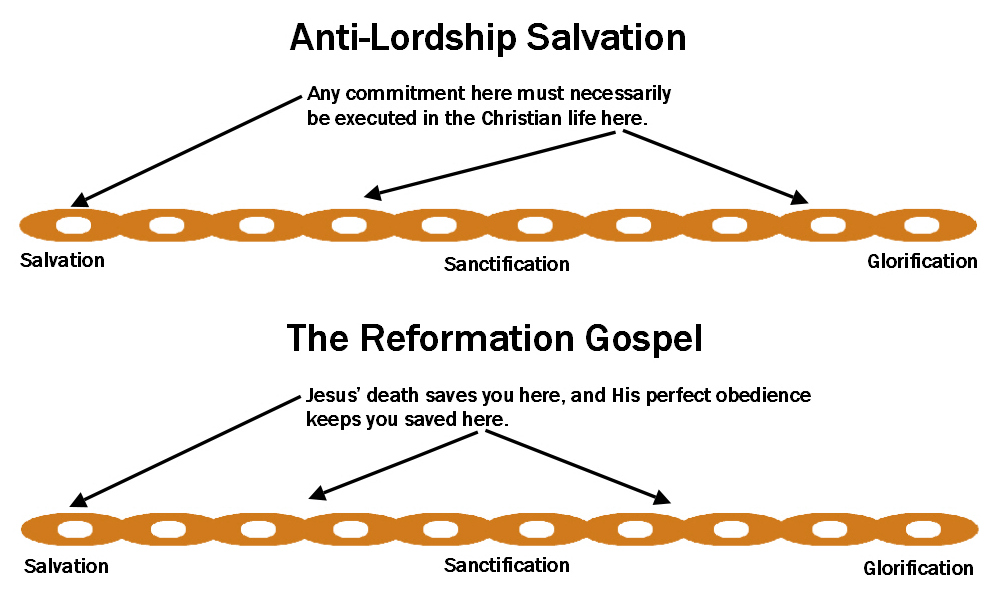
The issue made simple: Romans 8:30.
In Romans 8:30 we read the following:
And those whom he predestined he also called, and those whom he called he also justified, and those whom he justified he also glorified.
Notice that sanctification is missing from this verse even though the context spans the beginning of our salvation to our resurrection. This is the distinction between all golden chain gospels and the real gospel, the kingdom gospel. Jesus came preaching the “gospel of the kingdom.” Hereafter, KG. The golden chain gospel says that sanctification is missing from this verse because justification and sanctification are the same thing. The KG says that sanctification is missing from this verse because justification and sanctification are mutually exclusive. The context is assurance of salvation (see verses 31ff.).
Curiously, the golden chain gospel which includes both ALS and LS/Calvinism, teaches us to remind ourselves of God’s grace alone regardless of anything we do. If our behavior brings doubt, this is evidence of a fundamental misunderstanding of God’s grace and we should therefore remind ourselves of such. ALS says that concern over behavior suggests that you believe behavior finishes justification and not grace alone. With the KG, that consideration is not even on the radar screen because justification and sanctification are completely separate; finishing a finished work is impossible. You can’t have that mentality if you understand it to be an impossible reality. I might also add that simply returning to the same gospel that saved us to cure a troubled conscience instead of changing behavior sears the consequence over time. This is ill advised.
In other words, the KG says it is impossible to unwittingly attempt to please God to gain justification because that work is finished. One is free to aggressively obey God without any fear that they are unwittingly attempting to earn their justification. ALS and LS/Calvinism do not have this convenience because justification is both finished and not finished. The Reformed, already, but not yet construct that relates to predestination cannot be discussed here for lack of room and fear of confusion, but suffice to say for this study that the convenience is not there for either ALS or LS because justification is not finished. You must continue to remind yourself of free grace because you are in a continuum where unwitting works salvation can take place, and the only solution is to disavow good behavior as an evidence of conversion. Obedience must be completely optional. This used to be criticized as “Let go and let God” theology. According to the KG, such a continuum is impossible and not reality.
Consider some dialogue I have had recently with ALS proponents:
Paul, While you ponder my answer, I’d like to ask you, if you’d identify what you believe you must do, before, during and after, in order to be given eternal life. Thank you, In Him, Holly
“Before, during, and after”? to… “be given eternal life.”? The implied answer is: nothing in justification; nothing in sanctification; and nothing in glorification. But again “during” shouldn’t even be deemed possible.
LS in Cogous form already states that perpetual double imputation is needed, so bad behavior is actually a good thing because it “shows forth the gospel.” In contrast, advocates of the KG are concerned with evidence of the new birth, not the overcoming of a propensity to misunderstand the grace of God because all doing in the Christian life is attached to justification somehow. Advocates of the KG understand that nothing they do in the Christian life has anything at all to do with justification. Much assurance comes from that. However, lazy discipleship forfeits assurance because it violates the conscience, and judgment begins in the household of God regarding consequences for bad behavior in this life. The fear generated from that can get confused with fear of eternal judgment.
But don’t miss my main point here: the solution for a lack of assurance in both ALS and LS are the same: preach the gospel to yourself. Remind yourself that works done by us are completely irrelevant to our salvation which also includes sanctification (the Christian life). Both camps woefully devalue the new birth and its expectations. In effect, we have no righteousness and obedience is not really performed by us, but performed by the Holy Spirit if we are “abiding” in Christ. This is a passive sanctification of our works in sanctification in order to categorize them as living by faith alone. ANY work we do is accredited to the justification process, so it must be sanctified by the right process. In the final analysis, Christians must only EXPERIENCE an obedience imputed to us by Christ. Citations by the Reformed abound, and I can cite one from the aforementioned conversation with advocates of ALS:
We can have righteousness of our own, that is self-righteousness. I didn’t notice, did you answer any of the questions? Do you sin? How much? Or not? Are you sinless?
Park on the fact that both camps assert that the Christian has no righteousness. To have any righteousness is a “righteousness of our own.” It’s either ALL us or ALL Christ. Therefore, we can only EXPERIENCE righteousness imputed to us, but it really isn’t us performing it; hence, in relationship to the same conversation:
This passage has nothing to do with becoming saved or providing evidence through our works that we are saved. The passage is about living experientially in a manner that is consistent with our position on [sic] Christ.
Notice that the Christian lives “experientially” according to “our position [i]n Christ.” In other words, Christians only experience their position, they don’t actually perform obedience themselves. In addition, when talking to either camp, one is challenged with the question, “Did you sin today?” And in both cases, when you qualify the question with, “In justification or sanctification?”…without exception they are thrown for a loop. Why? Because they see sin in justification as no different than sin in sanctification—that’s why they ask the question in the first place. If you believe the Christian is personally righteous as well as positionally righteous, you are immediately challenged by both camps with, “Did you sin today?” Why? Because the same assumption is that righteousness and sin are mutually exclusive. For the world, this is true, but not for Christians.
Another fact of the Reformation gospel is “righteousness” is defined as a perfect keeping of the law. To remove the law’s perfect standard, and its demands for perfection from justification is the very definition of antinomianism according to the Reformers. A perfect law keeping must be maintained for each believer if they are to remain justification.
If you remember, this is a direct quote from part one. ALS and LS/Calvinism both define righteousness by perfect law keeping. Again, why the air of profundity in the terse rhetorical question designed to end the argument on the spot by coup de grace? The very essence of the question reveals a profound misunderstanding of law and grace.
Let’s get a little more full circle now with part one. Because the Christian, according to both camps, cannot be righteous if he/she sins even once (“Do you sin? How much? Or not? Are you sinless?”), the good old Reformed mainstay of double imputation is needed for both of these applications of the same golden chain gospel. From part one:
Thirdly, this requires what is known as double imputation. Christ not only died for our sins so that our sins could be imputed to Him, He lived a life of perfect obedience to the law so that His obedience could be imputed to our sanctification.
The windsock of double imputation is the idea that the righteousness of Christ is imputed to our sanctification. He died for our justification, and His perfect obedience to the law was imputed to our sanctification to keep justification rolling forward:
Model A asserts that since we cannot keep the law perfectly, we must invoke the double imputation of Christ by faith alone in order to be saved and stay saved (part 1).
Now let’s look again at the same recent conversation with ALS proponents:
Thanks Mark, I agree. We are qualified as saints, because of Christ’s righteousness imputed to us, but we still sin,..
Therefore, we only “qualify” as saints because we still sin, in order to keep our sainthood the righteousness of Christ must be imputed to us daily. Yes, that would be daily salvation. In the quote immediately prior, “Holly” was responding to this statement:
Hope you don’t mind me adding a thought, I think Paul is saying we were sinners but we are now saints (forgive me if I am wrong), it is true of course that we are saints but I believe it is also still true that we are sinners saved by grace because the Apostle Paul said, “Christ Jesus came into the world to save sinners; of whom I am chief”, present tense.
So, if Christians are still sinners, because we sin, and Christ came to save sinners, it would only make since that our need for salvation is still ongoing. Direct citations that agree with that point by John Calvin and Martin Luther is abundant low hanging fruit, but granted, such statements from the ALS camp are somewhat surprising. To further the point, I might add that “Holly” referred me to a message taught by a notable figure in the ALS movement who interpreted Romans 7:24 as a daily salvation. This is a very common rendering of that verse by the Reformed as well. The verse obviously refers to the redemption of the body and not a daily salvation.
Both are guilty of the same thing: a false double imputation construct must be applied to the Christian life by faith alone and the subjective experience thereof is optional. Like ALS—like Calvinism.
What is wrong with this gospel?
The golden chain gospel misrepresents the Trinity. The Father is removed from His role in salvation because it is His righteousness imputed to the believer before the foundation of the world. According to Romans 8:30, this guarantees glorification. The Holy Spirit is also misrepresented in regard to His role in salvation. His setting us apart before the foundation of the world is confused with His work in regeneration. Christ’s role is redefined beyond His death for our sins as a onetime act that ended sin. This is not a covering—it’s an ending. Even though the Reformed and ALS both concur that Christ died once, His death is perpetually reapplied to sins we commit as Christians when there is no such need. Neither is there a need to impute Christ’s righteousness to us perpetually. At the Bema event, it will not be God the Father looking at us and only seeing Jesus, it will be Jesus Himself judging His righteous followers. He will not be judging His own righteousness. The golden chain gospel is an egregious distortion of the Trinity.
True double imputation is our sins being imputed to Christ, and the Father’s righteousness imputed to us apart from the law. Christ came to end the law. It is because of this, and the new birth, that we are truly righteous in and of ourselves, but of course not apart from God’s power and plan of salvation. We have God’s seed in us, are no longer under any law that can judge us, and are able to please God with our lives. We are new creatures who are sinless according to justification because even if the old us that died with Christ was exhumed and brought into court, there would be no law to condemn us.
This gospel not only distorts the Trinity, rejects the new birth, and distorts double imputation, it misrepresents sonship. The sins we commit as a family member are considered to be sin against justification: “Did you sin today?” Again, if you ask them, “Sin in justification or sanctification?” all you will here is crickets, or the babblings of confused narcissists.
The golden chain gospel also strips the Christian of ability to love Christ and others by keeping Christians under the law of sin and death that Christ came to end. Said gospel makes that law the standard for righteousness. However, there is no law standard in justification, it is APART from any law—it is God’s righteousness imputed to us. Those under grace serve the law of the Spirit of life which is fulfilled by loving Christ and others:
“If you love me, keep my commandments.”
It is impossible to love Christ by keeping the law of sin and death. Besides, that law is ended when we believe. All of our sins committed before faith were against that law and in essence imputed to it. Before we were saved, we were enslaved to that law and it provoked us to sin. Consider two spouses: we were the spouse that was under the law of sin and death until we died with Christ, now we are free to serve another. Sins we now commit are against family relationship, not sins that fall short of the law of sin and death.
Said gospel prevents us from making a commitment to God’s kingdom because the commitment would have to be executed perfectly in kingdom living to maintain our citizenship. Said gospel demands that we only recognize Christ in a one-way relation while ignoring His kingdom, its law, and the king. Yea, we can only accept Him as savior in a one-way relationship. This assumes that a decision to flee the present kingdom of darkness for the kingdom of light cannot be a commitment totally separate from the kingdom citizenship. If we make a commitment, the commitment must be executed perfectly in order to remain a citizen. No, the commitment is totally separate from our citizenship in the same way justification is totally separate from sanctification.
I realize that only repentance was emphasized to the Jews, but they were already saturated with the concept of God’s kingdom. From the beginning, Abraham looked for a city built by God. As we see Gentiles coming into the church, they must be brought up to speed on their new Jewishness. We should read the Bible with this in mind and the way it affected the presentation of the gospel, and the very definition of the word “gospel” itself.
The golden chain gospel rejects the new birth by ignoring the difference in slavery between two different laws: the law of sin and death that will condemn the world, and the law of the kingdom; the law of the Spirit of life. It makes the law of the Spirit of life a fulfilment of the law of sin and death that is in fact ended. In essence we remain enslaved to a law of condemnation as “sinners.” This is a rejection of the new birth.
It also adds another seed to the covenant of promise. If the law of sin and death could impart life, it would be a second seed from which life would come to the world. It doesn’t matter who obeys it, it cannot impart life.
The golden chain gospel distorts the Trinity, distorts double imputation, misrepresents sonship, strips the Christian of ability to love Christ and others, rejects a biblical definition of the new birth, keeps Christians under the law of sin and death, distorts the atonement, perpetually reapplies the death of Christ to salvation, replaces the righteousness of God with a law standard, propagates a one-way relationship with God, makes sin as a kingdom citizen the same as condemning sin, enslaves us as a spouse still under the law of sin and death, calls for us to accept Christ as savior in a one-way relationship while ignoring His Lordship.
Do Christians have two natures? This will be examined in part 3.
paul
A Doctrinal Evaluation of the Anti-Lordship Salvation Movement: Part 3
Do Christians Have Two Natures?
My belief strata is probably similar to most Christians: A. Dogma, firm on that fact; B. Not dogmatic, sounds logical, going with that for now; C. That’s a bunch of boloney. The idea that Christians have two natures has always been categorized under B for me.
Where do I think a stake needs to be driven most in the arena of Christianity right now? Who we are. We are righteous. We are able. We are good. We are not just righteous positionally, we are in fact righteous in and of ourselves. Righteousness is a gift from God, we cannot earn it, but once we have accepted the gift, we possess it. I fear that most gospels in our day propagate a rejection of the righteousness gift, and I strongly suspect that this is the point of the Parable of the Talents. Clearly, the paramount gospels of our day promote a meditation on the gift in order to keep our salvation. To put the gift into practice is to make His story our own story exclusively.
What is the gift? Is the gift just a gift, or is it also a calling? The “church” is a “called out assembly.” Is answering the call works salvation? And what are we called to? We are called to holiness. In part 2 we have looked at the primary problem with anti-Lordship Salvation. They make answering the call works salvation. How do they rationalize this? As we have discussed, it is the age-old Protestant golden chain gospel. Because justification and sanctification are not separate, a calling to holiness is a declaration that progresses in sanctification; if we commit to holiness in order to be saved, we now have to participate in that progression by obedience to the law.
ALS solves that problem by eliminating the commitment all together and making obedience in sanctification optional—a nice gesture unto the Lord, and it will kinda make your life better. If we doubt our salvation because of behavior, it shows a fundamental misunderstanding of grace; so, the solution is to return to the same gospel that saved us and re-preach it to ourselves. Both ALS and the Calvinists they despise proffer this same construct.
Calvinists deal with the progression of justification in sanctification a different way: by all means we are saved by making a commitment to obedience, but the commitment we are making is a commitment to living by faith alone in sanctification which results in the commitment being fulfilled by Christ. In fact, both camps speak of experiential sanctification; viz, we only experience the works of the Spirit being done through us and we kinda really aren’t doing the work. In Reformed circles, even our “good” works are sin, and our demeanor in obedience gives a clue that the work may be executed by the Lord in that instance, but we don’t know for certain. They call this the “subjective nature of sanctification.” It is manifested in Arminian camps via, “I didn’t do it—it was the Holy Spirit doing it through me.” Really, in all Protestant camps, accomplishment and meekness are mutually exclusive; you can’t have both.
And with ALS as well as Calvinism, righteousness is defined by perfect law-keeping. When their fusion of justification and sanctification is challenged, both camps retort, “Did you sin today?” In BOTH cases, they make no distinction between sin against the law of sin and death, and sin against the law of the Spirit of life in sanctification—violations that grieve the Spirit. That’s because they see justification and sanctification as the same (though both camps are outraged in regard to the accusation).
Because ALS, like Calvinism, makes perfect law-keeping the essence of righteousness, they cannot not deem the Christian perfect in regard to justification. They posit the idea that the Christian is only positionally righteous and not practically righteous. Unfortunately, that same view of our righteousness is then juxtaposed into sanctification because they fuse the two together. To not continually drive home the idea that we are just “sinners saved by grace” is to suggest that we can keep the law perfectly. But the question is… “What law?” There is no law in justification, and where there is no law there is no sin (Rom. 4:15).
Christ primarily died on the cross to end the law of sin and death. Now there is no law to judge us, and that can be coupled with the fact that we are born again of the Spirit and have the seed of God within us (1Jn. 3:9). The new birth is a reversal of slavery resulting in a change of direction. We were once enslaved to sin and free to do good, resulting in a direction away from God (under law Rom. 6:14), but now are enslaved to righteousness and free to sin (Rom. 6:20). As we will see in Romans 7, we were once enslaved to the law of sin and death (Rom. 8:2), but now we are enslaved to the law of the Spirit of life. In both cases, there is a reverse freedom as well. Unfortunately, the Christian is still harassed by the law of sin and death, which is a law standard by the way, and free to sin against it. We will discuss exactly how this happens.
But, because ALS, like the Reformed only see one nomos (law), and Christians obviously sin, the Christian must be both saint and sinner in sanctification. This is Martin Luther’s Simul iustus et peccator—at the same time righteous and a sinner. But, this means saint by declaration and position only while the Christian remains in the same state. The only change is the recognition of his vileness—this defines faith according to Reformed ideology.
Likewise, since the Christian cannot keep the law of sin and death perfectly, and that is justification’s standard, the ALS has its own version of the Simul iustus et peccator: the two natures. Sure, it’s soft Simul iustus et peccator, or Simul iustus et peccator Light, but it’s the same concept. I am not going to take time here to articulate all of the versions, but suffice to say all denominations are spawned by the question of how we do justification in sanctification. There are only two religions in the world: Progressive Sanctification and Progressive Justification. One is a call to holiness and you get justification in the bargain. The other is a call to be declared righteous while remaining a sinner. The former is a call to be made righteous. Answering the call saves you, following the call sanctifies you, but the two are separate with the demarcation being the new birth—following the call does not justify you. Accepting the gift justifies you—but the gift is a calling to holiness. Seeing the gift and the execution of the gift as being the same is the monster of confusion known as Protestantism.
The idea of two natures is contradictory to the new birth.
There is only one us. The other guy is dead. His nature is not hanging around with us. He is not sort of dead, and we are not sort of under the law. We are not under the law at all. The guy’s death did not merely weaken him, it utterly slaughtered him. You are not kinda the old you, there is no old you, that person is not you at all, he is dead.
So what’s going on? I am going to pull the theses out of the barn from the get-go. Think, “sin.” This all starts with a very simple word that has very deep metaphysical ramifications that will not be investigated here, but it all begins with sin as a master. Sin was originally found in God’s most magnificent angel, Lucifer, “son of the morning.” How did sin get there? Far be it from us to discuss that here, but there are theories.
Secondly, a law that should promise life, but sin uses the law to create sinful DESIRES within the individual.
Thirdly, this is daring, but it is best to think of the “flesh,” also, “members” as neutral. Our members can be used for both good and evil. The “flesh” IS NOT the old nature.
Fourthly, fruits unto death and fruits unto life.
The Theses Articulated
Much more study needs to be done in this area; this study is designed to get the ball rolling, but you could spend a lifetime articulating it.
When man is born into the world, sin is within him and sin is a master. When people are born into the world, they are sold into slavery:
Romans 7:14 – For we know that the law is spiritual, but I am of the flesh, sold under sin.
Paul is not saying that flesh =’s evil, he is saying that sin resides in our mortal members. He is saying our birth sold us under sin. Sin is a master. According to the New Testament, this is synonymous with being born “under law” as in… “the law of sin and death.” Christ was the only man ever born under that law who could keep it perfectly. All others are condemned by it.
Let’s look at sin as master:
Genesis 4:6 – The Lord said to Cain, “Why are you angry, and why has your face fallen? 7 If you do well, will you not be accepted? And if you do not do well, sin is crouching at the door. Its desire is for you, but you must rule over it.”
Sin is a master who desires to rule over the individual. Sin is the problem. This does not mean mankind is totally depraved and his will is in complete bondage to sin, he/she is still free to do good and obey the conscience, but the overall direction is away from God and to sin.
Sin resides in the mortal body, but the mortal body, as we shall see, is somewhat neutral. I am not going to get into anthropological dichotomies and theories, but the Bible seems to say that the mind within the body is what’s redeemed when we are saved. Our thesis here contends that the battle within is between our redeemed righteous minds and SIN, not the old us that is dead. However, we are using the same body that the old man (the former us) used and the body can be habituated to some degree. We are to put off those habits and build new ones into our lives:
Ephesians 4:17 – Now this I say and testify in the Lord, that you must no longer walk as the Gentiles do, in the futility of their minds. 18 They are darkened in their understanding, alienated from the life of God because of the ignorance that is in them, due to their hardness of heart. 19 They have become callous and have given themselves up to sensuality, greedy to practice every kind of impurity. 20 But that is not the way you learned Christ!— 21 assuming that you have heard about him and were taught in him, as the truth is in Jesus, 22 to put off your old self, which belongs to your former manner of life and is corrupt through deceitful desires, 23 and to be renewed in the spirit of your minds, 24 and to put on the new self, created after the likeness of God in true righteousness and holiness.
The putting off of the old self is the likeness of the old self, not the literal old self. The body is habituated by the old ways, and we can bring those same habits into the Christian life with the same ill results. Note that the mind is being renewed, and we are putting off the old ways and putting on new ways. We are not “sinners” just because we fall short of perfect putting off and putting on, we are righteous persons in the process of renovation. The flesh is not inherently evil because it can be used for righteousness:
Romans 12:1 – I appeal to you therefore, brothers, by the mercies of God, to present your bodies as a living sacrifice, holy and acceptable to God, which is your spiritual worship.
Romans 6:19 – I am speaking in human terms, because of your natural limitations. For just as you once presented your members as slaves to impurity and to lawlessness leading to more lawlessness, so now present your members as slaves to righteousness leading to sanctification.
The flesh is weak, sin resides there, and our bodies will be redeemed; in that sense, “nothing good dwells in me,” but our members are to be used as instruments for righteousness nevertheless. Let me caution in regard to this study. This is not a study that should be approached with sloppy research. For instance, consider Romans 7:24:
Wretched man that I am! Who will deliver me from this body of death?
We now hear, “See! See! Paul stated that we are still wretched sinners!” Problem is, the Greek word translated “wretched” in this verse means to persevere in affliction. Paul is longing to be saved from his mortal body where the conflict rages. He is not saying that Christians remain as wretched sinners. Likewise, was Paul really saying elsewhere that at the time of his writing that he was the premier sinner in the entire world at that time? The “chief” of sinners? I doubt it. One may ponder the idea that…it’s obviously not true. Paul was making some other point that will not be addressed here.
So, what is the dynamic that we are really fighting against? We are set free from the law of sin and death because Christ purchased us on the cross:
1 Corinthians 6:19 – Or do you not know that your body is a temple of the Holy Spirit within you, whom you have from God? You are not your own, 20 for you were bought with a price. So glorify God in your body.
When we are saved, ownership is transferred to another master. We are no longer enslaved to Master Sin. Let’s look at what that slavery looked like:
Romans 7:4 – Likewise, my brothers, you also have died to the law through the body of Christ, so that you may belong to another, to him who has been raised from the dead, in order that we may bear fruit for God. 5 For while we were living in the flesh, our sinful passions, aroused by the law, were at work in our members to bear fruit for death. 6 But now we are released from the law, having died to that which held us captive, so that we serve in the new way of the Spirit and not in the old way of the written code.
As Christians, we are no longer enslaved to sin which used our passions aroused by the law to provoke us to sin. Apparently, the cancelation of the law’s ability to condemn us comes into play here. If we cannot be condemned by the law, sin’s motivation is gone. Being condemned by the law is how sin enslaved us. If Christ died for sin, and the penalty is paid, and there is no condemnation in regard to the Christian, sin is robbed of its power. In addition, I assume it goes much deeper than this, but that is another study. We may assume that the intrinsic power of sin over us was broken as well.
Sin was able to produce sinful desires within us that provoked us to break God’s law; we were enslaved to a lawless master. Hence, and this is VERY important, phrases like, “For while we were living in the flesh” should not be interpreted as flesh=evil; it means that the unbeliever was living in a mortal body that was controlled by the Master Sin dynamic that used the law to condemn us and control us, and destroy us. No doubt, sin uses sinful desires to get even unbelievers to violate their consciences against the works of the law written on their hearts (Rom. 2:12-16).
This is why many unbelievers will obey their passions in things that are in the process of destroying them. They are enslaved by passions that Sin uses to get them to violate their consciences. In this sense, we were living according to the flesh—our flesh was controlled by the triad dynamic of sin, sinful desire, and the law of sin and death. Now we are controlled by a different triad dynamic: the Holy Spirit, His law, and godly desires. To insinuate in any way that a believer remains the same as before or is in some way marginally different borderlines on blasphemy against the Holy Spirit and troddens underfoot the blood of Christ.
We will look at another text to build on our point:
Galatians 5:16 – But I say, walk by the Spirit, and you will not gratify the desires of the flesh. 17 For the desires of the flesh are against the Spirit, and the desires of the Spirit are against the flesh, for these are opposed to each other, to keep you from doing the things you want to do. 18 But if you are led by the Spirit, you are not under the law. 19 Now the works of the flesh are evident: sexual immorality, impurity, sensuality, 20 idolatry, sorcery, enmity, strife, jealousy, fits of anger, rivalries, dissensions, divisions, 21 envy,[d] drunkenness, orgies, and things like these. I warn you, as I warned you before, that those who do such things will not inherit the kingdom of God. 22 But the fruit of the Spirit is love, joy, peace, patience, kindness, goodness, faithfulness, 23 gentleness, self-control; against such things there is no law. 24 And those who belong to Christ Jesus have crucified the flesh with its passions and desires.
A problem arises when we interpret “flesh” without the full corpus of the subject. When we “walk” we are using the flesh. When we walk according to the Spirit, we are using our flesh (members/body) for holy purposes. The full dynamic of sin’s mastery is then interpreted by one word used in various and sundry ways to make any number of points. And, any idea that the Christian is still under the law of sin and death is particularly egregious. Worse yet, if one believes that the law still condemns them as most teach today, this empowers the Sin Master. The word of God can now be used to provoke even Christians with sinful desires.
Furthermore, since sin still remains in the body, it still attempts to use the law to provoke us with evil desires. I imagine that ignorance of the Scriptures supplies a field day for sin in the life of believers accordingly:
James 1:13 – Let no one say when he is tempted, “I am being tempted by God,” for God cannot be tempted with evil, and he himself tempts no one. 14 But each person is tempted when he is lured and enticed by his own desire. 15 Then desire when it has conceived gives birth to sin, and sin when it is fully grown brings forth death.
The desire James is talking about are sinful desires provoked by sin. When we are tempted by a sinful desire, we should know exactly where that is coming from; sin is still trying to master us by using the former scheme. A Christian can produce fruits of death in this life by succumbing to those desires. These are temporary death fruits, not eternal. The former you could generate fruits of death in both this life and the life to come, but the believer can only generate temporary fruits of death. Peter referred to it this way: suffering as an unbeliever.
With all of this in mind, let’s look at some verses from Romans 7:
Romans 7:14 – For we know that the law is spiritual, but I am of the flesh, sold under sin. 15 For I do not understand my own actions. For I do not do what I want, but I do the very thing I hate. 16 Now if I do what I do not want, I agree with the law, that it is good. 17 So now it is no longer I who do it, but sin that dwells within me.
Precisely. But note, when Paul writes, “I am of the flesh, sold under sin,” he is not saying that we are still enslaved to the same master or dynamic, he is saying the dynamic is still at work in us, but we are obviously no longer enslaved to it. Hence…
16 Now if I do what I do not want, I agree with the law, that it is good. 17 So now it is no longer I who do it, but sin that dwells within me.
So, “Did you sin today?” Well, what sayeth Paul? Unless you take all that we observed in these three parts, this statement by Paul would seem outrageous, but we know what he is saying, and no, we are NOT “sinners.” Note as well, the law is not sinful, our flesh is “weak,” but it is sin itself that causes us to sin. Before we were saved, we desired sin and were ruled by it, but now, we have the desires of the Spirit and love His law…
For I do not do what I want, but I do the very thing I hate.
And:
Romans 7:21 – So I find it to be a law that when I want to do right, evil lies close at hand. 22 For I delight in the law of God, in my inner being, 23 but I see in my members another law waging war against the law of my mind and making me captive to the law of sin that dwells in my members. 24 Wretched man that I am! Who will deliver me from this body of death? 25 Thanks be to God through Jesus Christ our Lord! So then, I myself serve the law of God with my mind, but with my flesh I serve the law of sin.
There remains a rest for God’s people, but it is not now. This is war, but we must know who the enemy is and how he works. Let me also add that simplicity is not the duty of the “learner,” aka disciple. Christians are to study in order to show themselves an approved “worker.” Lazy thinkers make for poor disciples and are the fodder for the wicked. The final analysis is this:
So then, I myself serve the law of God with my mind, but with my flesh I serve the law of sin.
We are enslaved to the law of the Spirit of life, and fight against the law of sin and death that sin uses to provoke us with evil desires.
Romans 8:1 – There is therefore now no condemnation for those who are in Christ Jesus. 2 For the law of the Spirit of life has set you free in Christ Jesus from the law of sin and death. 3 For God has done what the law, weakened by the flesh, could not do. By sending his own Son in the likeness of sinful flesh and for sin, he condemned sin in the flesh, 4 in order that the righteous requirement of the law might be fulfilled in us, who walk not according to the flesh but according to the Spirit. 5 For those who live according to the flesh set their minds on the things of the flesh, but those who live according to the Spirit set their minds on the things of the Spirit. 6 For to set the mind on the flesh is death, but to set the mind on the Spirit is life and peace. 7 For the mind that is set on the flesh is hostile to God, for it does not submit to God’s law; indeed, it cannot. 8 Those who are in the flesh cannot please God. 9 You, however, are not in the flesh but in the Spirit, if in fact the Spirit of God dwells in you. Anyone who does not have the Spirit of Christ does not belong to him. 10 But if Christ is in you, although the body is dead because of sin, the Spirit is life because of righteousness. 11 If the Spirit of him who raised Jesus from the dead dwells in you, he who raised Christ Jesus from the dead will also give life to your mortal bodies through his Spirit who dwells in you.
We are not fighting against the old us. We are fighting the sin within that is no longer our master. In addition, our battle is not against “flesh and blood” but rather principalities.
We only have ONE nature, the new one.

 Paul's Passing Thoughts
leave a comment