Achieving Total Conquest Over Depression, Part 1: Paul and Susan Christian Living Series on Blogtalk Radio Program 3
 Introduction for all parts:
Everyone wants to be happy. Happiness is the essence of a quality life. Closely akin to happiness is peace; a relaxed and tranquil state of mind. Clinical depression prevents both and thrusts one into the pits of darkness and despair. Trouble in life can put people into a day by day survival mode, clinical depression puts people into an hour by hour survival mode.
This type of depression is an oppression of the soul that often torments people with out of control thoughts coming from a racing mind. The person may experience psychopathic thoughts that are totally out of character for the individual. Interests and enjoyments vanquish—the depressed person loses all self confidence and believes they are losing their mind.
Depression’s greatest ploy is how it is experienced; it seems to be a foe that attacks from outside of us and oppresses whomever it chooses. In fact, the medical model of depression does nothing to lessen that fear. Can depression come upon us in the same way that we catch a cold? What are its causes, and what is the cure? Is there a cure? Is there hope for those stricken with major depression?
Susan and Paul will speak from their own experiences with clinical depression, and how it has stricken others. The topic of depression has been a focus of Paul’s studies for 35 years, and he has experienced it as an unbeliever and believer. But, ideas that come from experience alone are not adequate; facts must explain why life is experienced in the way that it is.
Don’t give depression another year; join Paul and Susan live and contribute to the discussion.
Achieving Total Conquest Over Depression: Part 1; Audio Podcast Link
Greetings truth lovers from the Potter’s House in Xenia, Ohio. This is Paul and Susan Dohse broadcasting live from blogtalkradio.com/falsereformation. Tonight, part 3 of our Christian Living series: “Achieving Total Conquest Over Depression.” [This is part 1 in regard to the subject of depression.]
If you want to join in the discussion, call 937-855-8317—you may remain anonymous—when you hear me say, “This is Paul and Susan, what is your comment or question” just start talking. You can also add to the program by emailing a comment or question to paul@ttanc.com that’s paul@ tyrant, tulip, Alice, Nancy, cat .com. We keep an eye on the email during the program. You can also find our published materials at tancpublishing.com.
So, of course, we are a pretty small-time ragtag operation here at blogtalk, so let me give you instructions on how to listen to the program over your phone if you don’t want to be patched in live to discuss this issue on the air. Call in, wait till you hear the show live; then hangup and call back. That’s our signal that you only want to listen to the show over your phone. If you want to be patched in to discuss the topic with Susan and me live, just call in and wait for us to patch you in. If your PC or MAC is near by, turn down the speakers to prevent feedback.
Let me begin tonight with this: even though depression has been a significant interest of mine for 35 years, it goes without saying that there is a lot about depression and related struggles that I do not know. Tonight is about what I do know, and how you can use it to help others who are in a state of depression.
First, here is what I know about depression’s most formidable weapon in its arsenal: the idea that depression is [always] a chronic medical problem is a lie. Depression is curable…always. I know this from personal study, personal experience, and my experience with helping others with depression. No, just because I am using the nomenclature, “clinical depression,” doesn’t mean I buy into the medical model. With that being said, I know from personal experience that depression can be caused by physiological conditions. Some medications can cause depression, and it is said that thyroid problems can cause depression as well. As far as the latter—don’t know, but in regard to the former—I do know from experience with other people.
Here is the first thing you do when you get depression: you go to the doctor. Doctors are an efficacious ally in the fight against depression, but many get some important things wrong; specifically, the idea that depression is a chronic medical problem—that’s just wrong.
Ok, so, let’s take my own case with depression for example. My doctor at the time was an awesome doctor, but he and I had some disagreement on this whole “chemical imbalance” thing. Undoubtedly part of God’s plan, I joined a church at the time pastored by a disciple of Dr. Jay Adams. And we have much to say tonight in regard to the infamous Dr.J., but suffice to say for now that I had bought into his idea that depression is not hopeless—there is something you can do about it.
Now, no doubt, people with severe depression probably have a chemical imbalance. And no doubt, medication makes the patient feel better. But here is the question: “Which comes first; the cause or the symptoms?” There is no doubt that causes of depression can lead to symptoms that all but totally disable the depressed person. Listen to me, lack of sleep alone will totally put you down. So here is what I decided early on: Adams’ counseling model was the ticket, but I needed the drugs to help me through the physiological symptoms caused by the depression.
At first, I took the doses prescribed by the doctor, and no doubt, the stuff works. But as I improved, I began cutting the doses back without telling the doctor. Of course, he believed that the medication was making me better, but I believed my change of thinking and lifestyle was making me better and the drugs were just taking care of the debilitating symptoms. He would often say, “Wow, this is great, we are finding just the right balance in the dosage” while in reality I was cutting in half whatever he told me to take. See the problem here? And, was that whole experience kinda fun? Yes it was.
But here is the problem: any sane person is going to naturally assume that because the medication is making them feel better, that the “cure” confirms the diagnosis and this is just not true. Listen, here is something else that we know…long term use of psychotropic drugs will mess your body up bad. Drugs are not the cure.
So, the most formidable weapon of depression is this whole idea that it has a medical cause. You get depression like you catch a cold or something. This leads to the medication whack-a-mole game and the real cause is never addressed. This leads to depression’s second greatest weapon: hopelessness. Um, I suppose people can live without hope, but it ain’t pretty. Who wants to hear a doctor say, “There is nothing we can do”? Second to that, “All we can do is help you cope.” However, whenever you can do something, well, obviously, that gives hope. Here is something about hope and please don’t miss this: the Bible makes hope synonymous with TRUTH. If a “truth” has no hope, it’s probably not true. This whole thing with DOING is big in regard to our discussion about Jay Adams which we will get to shortly.
Thirdly, another big weapon of depression follows: the gravity of it is only understood by those who have suffered from it. Those who have never experienced depression seem to assume that it is an overreaction to the blues or merely being bummed out. To the contrary, depression is a debilitating oppression. Imagine not having any interest in anything, or finding no enjoyment in anything that you formally enjoyed. In fact, things that you formally enjoyed like music may disturb and agitate you. The mind races with uncontrolled and disturbing thoughts. Though most of these thoughts are not accompanied by a desire or motive to carry them out, they are yet very disturbing and will involve hurting one’s self or others. Women will often put their children in the care of others because the presence of the children incite thoughts of hurting them. Of course, because one thinks they are losing their mind because of all of this, sleep deprivation follows which only further inflames the situation.
This is what I mean by the term, “clinical depression.”
A fourth weapon of depression is isolation. The depressed person believes that no one but them can understand what they are going through, and therefore, no one can help them. This will often lead the depressed person to suffer alone and not seek help.
The fifth weapon of depression is the downward spiral. Thoughts and actions create certain feelings, BUT feelings also produce thoughts. The depressed person’s worst enemy is thinking provided by feelings, and worse yet, when those thoughts are believed to be true. The depressed person will sometimes say, “I feel like I am losing my mind.” Note: their feelings are telling them something, leading to fear that such might happen. This think, feel, think, feel, think, feel, downward spiral is a very dangerous thing. [Thoughts (fears) produced by feelings accompanied by depression are lies].
Yet a sixth weapon of depression is the idea that depression comes from the outside and inflicts whomever it will. Depression is seen as an ominous force that comes from without and cannot be defeated or controlled. Many depressed people wonder if depression is demon oppression, and in fact I believe this to be the case in many instances. Worse yet however is the belief that Christians can be demon possessed, which definitely adds another recipe for disaster to the situation.
But the beginning of complete victory over depression starts with these facts: You are NOT losing your mind, your depression has a cause or causes, and when you find those causes, there are solutions that overcome the causes. In other words, HOPE. Without hopelessness, depression is dead in the water. Hopelessness is the food that feeds the depression beast. Depression has no greater ally than the medical model. This is not to say that depression doesn’t become a medical problem, this is saying the following idea is proven to be a lie: depression is caused by a chronic medical problem that requires medication throughout the remainder of the person’s life. This robs the depressed of hope as they are continually returning to doctors to get their medication adjusted.
Let’s pause here to make a point based on the obvious. Those who have lost a loved one or suffered some other sort of tragedy may become depressed. The cause is obviously grief. The cure is wisdom in regard to grief. The Bible has a lot to say about the proper way to grieve. We are not to grieve as those who have no hope [1Thess 4:13]. Also, we are created to be social beings; people can become depressed because they are lonely. Now look, I am not that much of a social being, so I don’t relate that much to people who are struggling with loneliness, but let me tell you something…I have seen loneliness utterly destroy people. It can be a very strong emotion. This is where I will point to one of many advantages of home fellowships versus the institutional church. Being around lots of people doesn’t cure loneliness, but can rather merely remind you of how lonely you are. Being around lots of people engaging in superficial conversation doesn’t cure loneliness, real friendships are the cure, not people gathered together to pay their salvation dues by participating in institutional sacraments.
Let’s look at another cause and effect depression issue. The Bible teaches that our heart will be where we invest. This is kind of in the area of preventative medicine regarding what we call a “balanced life.” You have an over-investment in a particular area of your life, and then you lose whatever that is. With women, it’s usually children; with men, it’s usually their careers. When the loss happens, it leaves a huuuuuge empty void in the person’s being. Empty nest syndrome can cause very severe depression in women.
These are easily defined types of depression. Tonight, we are dealing with oppressive types of depression which I described earlier—this type of depression seems to come out of nowhere.
What am I saying in all of this? Debilitating depression (not the depression all of us are bound to experience from time to time) is BOTH preventable and curable. And in both cases, practicality and wise living is the key.
So, we have three areas yet to visit tonight in regard to this issue of depression that is of the oppressive type: history, cause, and cure. As Christians, contemporary church history is very relevant to the subject of mental wellbeing among Christians and depression in particular.
When I became a Christian in 1983, one of the things I assumed was that Christians would be experts in good living. I thought, “I am saved, now it is time to get on with this living godly thing.” Boy, was I ever in for a surprise. Secondly, I assumed that no life problem was too big for God, and that the Bible had the answers for all of them. Again, I was in for a really big surprise. From the outset, I was perplexed about all of the discussion surrounding the same gospel that saved us.
Here is what I didn’t understand: Protestantism, hereafter, “church,” was/is predicated on the idea that salvation is a process that is maintained by faithfulness to church and its sacraments. Catholics are pretty upfront about this; Protestants and their “means of grace” are less so. You get saved by faith alone, but then faithfulness to the “means of grace” (grace refers to salvation) keeps the salvation process moving forward.
Both Catholics and Protestants (authentic Protestantism) believe that salvation is an ongoing process, aka progressive justification. Catholics believe in a literal new birth which qualifies one to do good works as one of the sacraments that progress salvation forward. Protestants cry foul on that and deem it works salvation. How then does Protestantism get around the works salvation charge? Well, since mere belief in the gospel that saved you is not a work, you keep yourself saved by returning to the same gospel that saved you over and over again. The likes of Dr. Micheal Horton call this, “revisiting the gospel afresh.”
So, how exactly do you return to the gospel? Well, how were you originally saved? Right, you repented and were forgiven of sin. Think about this: if you keep yourself saved by returning to the gospel, you must still need the gospel and salvation, right? Paul David Tripp calls this a “lifestyle of repentance.” Right, because of “present sin”, Christians still need ongoing forgiveness. Beginning salvation took care of all of our past sin while “preaching the gospel to ourselves every day” takes care of the “present sin.” IF we live our “Christian” lives by faith alone well enough, we will be able to stand in the final judgment covered by the righteousness of Christ and not a “righteousness of our own.” But take note: there is only ONE place where you can receive forgiveness for present sin and keep your salvation moving forward; that’s right, your good ol’ local institutional Protestant church. Look, this is documented Protestant orthodoxy. This is irrefutable.
But over the course of years from the Protestant Reformation, primarily from people reading the Bible grammatically within the Protestant camp, that gospel began to get integrated with other ideas like OSAS (once saved always saved) and ideas of obedience to the law, but not to the point where it had any real significance. As far as Protestants go, this led to living by biblical generalities. Yet, churchians functioned according to original Protestant tenets, but verbally professed things like OSAS and obedience to the law. As always, real life problems were farmed out to secular “experts” because the church’s business is keeping people saved, not solving life problems. I heard a pastor recently commend himself for not counseling in order to not be distracted from what really matters: the gospel.
In 1970, a Presbyterian pastor, Dr. Jay Adams, decided to pushback against the church’s inability to help people with the word of God. Dr. Adams was like most Protestants of that day; they really didn’t understand what the Reformation was really about. Adams is what we call a grammatical Calvinist; he interprets reality literally, and interprets the Bible grammatically. Much of Adams’ theology is predicated on the plain sense of Scripture, but that’s NOT Calvin and Luther, nor is it Augustine who Calvin and Luther followed. The big three of Protestant soteriology, Augustine, Luther, and Calvin, held to a redemptive view of reality (cross metaphysics) and a redemptive interpretation of Scripture.
These are also two different gospels. A grammatical Calvinist believes that salvation is a finished work and the Christian life, or sanctification, is completely separate from justification. The grammatical interpretation of Scripture and reality begins to formulate a hybrid theology with the redemptive fundamentals of Reformed doctrine. But this is not what the Reformers believed. Adams did not understand why the church was so passive in regard to helping people change, but nevertheless, he sought to apply his studies to changing that mode of operation.
In 1970, his book, Competent to Counsel, launched the biblical counseling movement. Let me also say this: Adams wanted this to be a laity movement. Adams was not the founder of CCEF or NANC. He was not in favor of certifying counselors. This is one of the many things he is to be commended for. His movement resulted in a real revival. I believe this movement, primarily in the 90s when it really picked up steam, was one of the few true revivals, if not the only true one post-Reformation. And don’t bring up the Great Awakening as an argument though that is a great example of many, many pseudo Reformed revivals claimed by that camp. The Great Awakening was a product of the American Revolution and its ideas concerning freedom. Then you have Edwards/Whitefield et al riding in on their mangy horses and taking credit for it. They shared the exact same Puritan soteriology that incited the American Revolution. At any rate, the biblical counseling movement was a true revival in that people’s lives were being changed dramatically. I was there and witnessed it with my own eyes, and was an avid supporter of the movement.
Also in 1970, a Seventh Day Adventist theologian named Robert Brinsmead launched a movement that revealed the real and original tenets of the Protestant Reformation. This movement led to several other movements resulting in a massive resurgence of Reformation soteriology known as the New Calvinism movement. Born out of the New Calvinism movement was an alternative to Adams’ counseling construct known as “second generation biblical counseling.” At first, both movements got along ok with Psychology being the primary whipping boy for both movements, but eventually their conflicting gospels would collide. While Jay Adams is the primary personification of first generation biblical counseling, Dr. David Powlison is such for second generation biblical counseling. While speaking at pastor John Piper’s church (the “elder statesmen of the New Calvinism”), Powlison admitted openly that the difference between the two counseling movements is a contrary gospel.
Now, let me make this as simple as I can. In change and problem solving, if you can do something, there is hope—if you can’t do something, there isn’t hope. If the doctor comes to you and says, “There is nothing we can DO,” that is NOT hopeful. If the doctor says, “There is something we can do,” there is hope. This would seem fairly evident. Listen to what Jay Adams told me himself face to face: when he was traveling about speaking at churches regarding his counseling movement, his talks were treated as if they were a “strange new gospel” because he was saying that we could DO something about our problems. A title of a book Adams wrote during that time is “More Than Redemption.” Say what?!! That title and the idea of it is completely antithetical to the Protestant Reformation which contended that justification is the whole enchilada from beginning to end. The point of all of this? In considering where to go for help in the evangelical church, what gospel is the counseling based on? Can one be helped by a false gospel? I think not.
In addressing the causes and biblical cures of oppressive types of depression we cannot discuss everything tonight, but we can discuss the most important things. In the case of my depression, I was never able to pinpoint a specific cause…until recently. I guess the cause is now so obvious that it escaped recognition as the obvious sometimes does—you are looking for something deeper rather than what is right in front of you.
Like most unbelievers, I believe I had an intuitive understanding of the new birth. I think most unbelievers know salvation means being saved from your present life. And that’s exactly the reason that unbelievers resist; even in the face of imminent disaster there is something about their life that they don’t want to give up. Perhaps they think they are free and the Lord’s commands are “burdensome.” At any rate, in my childlike state of mind as a new believer, I was shocked to realize that I was still sinning. You see, I assumed a radical transformation would take place. Sure, my life greatly improved, but I didn’t want to sin at all! I read book after book and agonized over the Scriptures in order to find out what was going on. And of course, no one in the institutional church could correctly explain it to me. The lame explanations that I received didn’t ring true to me [especially the “two natures” fighting against each other motif].
Bottom line: how could I be absolutely sure that anything I did for God in my life wasn’t an effort to justify myself? This threw cold water on any attempts to love God and kept me in constant doubt and turmoil.
Consequently, I doubted my salvation. Not only that, there were sins in my life that I just couldn’t overcome. Here is what I believe led to my depression: fear of condemnation, AND being under law. That’s where it began, and then some of the other factors we have discussed tonight all joined in resulting in a colossal downward spiral. If you doubt your salvation, your hope is greatly diminished. A basic fear of condemnation and judgment, I have come to believe, prefaces the massive list of phobias that exist in our society. The Bible states that fear and death go hand in hand, and the terror of death is defined by the fear of judgment that follows [Hebrews 2:15].
Moreover, a single perspective on law leading to a mentality verbalized to me just the other day, “sin is sin,” leads to slavery to sin because you are still under law and provoked by it leading to even more fear of condemnation [Romans 7:1-11]. I believe my former depression was the result of my defective understanding of law and gospel and justification specifically.
The Bible states that mature love casts out fear, but this does not speak of acts of love per se [acts of love however do bring peace and joy], but a state of being. Working out our love to the point of maturity is the antithesis of being under law and its condemnation—condemnation is impossible, and all that is left is the wages of life as opposed to the wages of death. We are under grace where love fulfills the whole law. If we still need the gospel, that means we still need salvation from the law’s condemnation. In fact, Calvin and Luther both stated that fear of condemnation is the catalyst for sanctification—they plainly said it! Hence, more depression should be expected in the church than anywhere else! [See the booklet, “It’s Not About Election” @ tancpublishing.com].
Fear is a really really big deal, and is more times than not a perquisite to depression. Please note the following from the Anxiety and Depression Association of America:
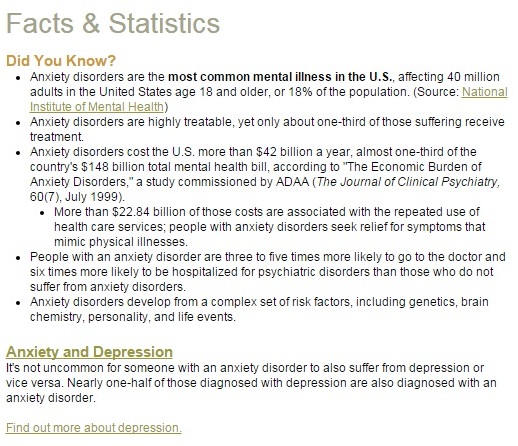


 [Note that fear/anxiety is associated with almost every mental illness that there is.]
I have come to believe that helping people with the deepest needs of life begins with a biblically accurate view of justification and its relationship to sanctification. This is where it begins, let’s go to the phones.
Achieving Total Conquest Over Depression: Paul and Susan Christian Living Series on Blogtalk Radio, Part 3
 Achieving Total Conquest Over Depression
Thursday night, January 7 @ 7pm.
Everyone wants to be happy. Happiness is the essence of a quality life. Closely akin to happiness is peace; a relaxed and tranquil state of mind. Clinical depression prevents both and thrusts one into the pits of darkness and despair. Trouble in life can put people into a day by day survival mode, clinical depression puts people into an hour by hour survival mode.
This type of depression is an oppression of the soul that often torments people with out of control thoughts coming from a racing mind. The person may experience psychopathic thoughts that are totally out of character for the individual. Interests and enjoyments vanquish—the depressed person loses all self confidence and believes they are losing their mind.
Depression’s greatest ploy is how it is experienced; it seems to be a foe that attacks from outside of us and oppresses whomever it chooses. In fact, the medical model of depression does nothing to lessen that fear. Can depression come upon us in the same way that we catch a cold? What are its causes, and what is the cure? Is there a cure? Is there hope for those stricken with major depression?
Susan and Paul will speak from their own experiences with clinical depression, and how it has stricken others. The topic of depression has been a focus of Paul’s studies for 35 years, and he has experienced it as an unbeliever and believer. But, ideas that come from experience alone are not adequate; facts must explain why life is experienced in the way that it is.
Don’t give depression another year; join Paul and Susan live and contribute to the discussion.
Live link on 1/7/2016: Achieving Total Conquest Over Depression
When Depression Wins
 I just received news about two hours ago that the famous actor Robin Williams has died in what looks to be a suicide. This has not been confirmed. Williams has been suffering from severe depression of late according to reports. I am not able to write about this tomorrow because of a project, but as a two-time survivor of severe depression, I would like to write a short essay on this before I turn in.
I would not wish severe depression on anyone, not even the most brutal of terrorists like the ones wreaking havoc in Iraq right now—that should put it in perspective for you. Serious depression is one of those experiences that you really have to experience to understand. The tragic news about Williams should turn our attention to those who may come our way. Can we help them? We most certainly can. Please, don’t just talk about this problem and move on. And, I don’t care how great you think the guy was—why does that matter now? While eulogies abound to show people how caring we are, conspicuously absent are questions about the problem itself.
And Williams forgot something: he wasn’t just fighting for himself—his loss does not give hope to others in his shoes.
There is a lot for Christians to learn about this problem, but unfortunately, the present-day church believes sanctification is pretty much the same thing as justification and depression is definitely a sanctification issue. No, preaching the gospel to yourself will not end the depression. No, prayer alone will not end depression; God cares, but you have to participate in the cure.
I wish I could refer people someplace, but I really can’t. In the 70’s, 80’s and 90’s, the biblical counseling movement was having great success in helping people with severe depression, but the fundamentals that drove that counseling have been discredited as “not vertical enough.” As far as finding a counselor, sorry to say, you are on your own, but I can share with you what I have learned about this very serious problem.
1. If you have lost interest in everything that gives you joy, feel like you are losing your mind, and are harassed and tormented by horrible thoughts, seek medical help as soon as possible. Depression can be caused by several different medical conditions and bad reactions to certain medications.
2. Be open to encouragement and help from non-Christians. Non-believers and Christians both played an important role in my recovery.
3. Though depression can be a medical problem, in most cases depression becomes a medical problem because of a person’s outlook on life. Specifically, wrongheaded thinking. I have no doubt at all, that depression is caused from chemical imbalance, but the question is, “Can one’s thinking and outlook on life cause those imbalances?” I think the answer is, “yes.”
4. If you struggle with anxiety problems, get the problem under control—anxiety can lead to severe depression.
5. Deal with guilt and relationship problems with others.
6. You are probably going to need medications to get you through the toughest part of your depression while you work on personal issues. Some doctors will say that you will need these medications for the rest of your life, but I know of many situations where this is not the case at all, including my own.
7. Put yourself under the care of a medical doctor and a good counselor. Do not isolate yourself, even if you feel like doing so. It will be necessary to do certain things whether you feel like it or not. Seek out friends that understand your problem.
8. Remember that thoughts invoke feelings and feelings invoke thoughts. Don’t think thoughts that make you feel bad for no good reason. When feelings invoke thoughts, talk back to them. Have a conversation with your thoughts. For me, when oppressed by horrible thoughts, I prayed a lot. Yes, find promises in the Bible and cling to them—by all means. Those horrible thoughts and bad feelings sure do make a strong case that you are helpless against them, but I do not think that is the case. Fight to think other thoughts by getting your mind on something else. Do not leave the thoughts unchallenged. One must ask when he considers what these loud, strong feelings are saying…
“are they telling the truth?”
9. Feelings are VERY important to life, but during a time of severe depression, feelings are your worst enemy. You must temporarily make feelings a lower priority during this time. Whether you feel like it or not, be other-person focused. Whether you feel like it or not, accomplish things. With the help of medications, you can stay productive, and this is important. Right feelings follow right doing, and especially right thinking.
10. This post may help: http://wp.me/pmd7S-Eu
We have much to learn about depression. Suicide is tragic for many reasons, but if people who feel like they are at the end of their rope would just wait one more day, in many cases a new day brings a totally different perspective. I am going to leave you with something very simple if you are a depressed person reading this. In the midst of my struggle, a man who had been through depression himself smiled at me and said, “You are going to be alright.” Oddly, if someone ambushed me with the question, “Right now, name the one thing that was most important in your recovery,” without even thinking about it, I would have to point to that one instance. I would add that life is worth fighting for. I would add that you need to fight because your family wants you to; fight to love them more than you hate your suffering. Win the fight for them. My friend, our great God assures us that trials are only for a time. Death will come soon enough…fight for the joy that will return. When depression wins, hope loses, and the world needs nothing more than hope. And…
“you are going to be alright.”
paul
Enough Already! Depression is NOT Always Caused by “Mental Illness”
 Look, even if I concede that the mind, i.e., our spiritual being can get a disease, which in this case I will, you can’t detract from the obvious fact that how we think can affect our mood. Chalking up all depression to mental illness strips people of hope and grievously misleads them.
Here is where pastors drop the ball: if a parishioner has been diagnosed with depression, all discussion of that person’s perspective on life and the way they think is off the table. To examine that would be judging some poor soul inflicted with a disease. Here is how I perceive pastors who buy into that: they are incompetent, borderline silly, lazy, cowardly, self-centered, and need to repent or get out the ministry.†
I believe the physical body can affect the mind’s ability to think and reason. I also believe choices made by the way we think in our mind (what the Bible often calls the “heart”) can affect us physically—it works both ways.* Depression obviously has to do with mood. How we feel is a major contributor to life. The apostle Paul commanded us to “rejoice always.”
Who denies that thinking affects mood? Who does that? Ever heard this? “I think I will go to a movie to get my mind off of what’s going on.” Right, that’s wise; if it is a situation out of your control, and dwelling on it is depressing you, don’t dwell on it!
Oh my, the Bible has so much to say about this issue; e.g., the difference between “dwelling” and other kinds of thinking etc. For example, the bible has a lot to say about worry. The Bible also divides worry and concern into different categories. Concern has to do with truth. Worry often concerns things that are not true. I always instruct people who worry to keep a Worry Journal. What they will find is that most worry never culminates into an actual event. This is why the Bible instructs us to “dwell” on what is true. Christ counseled people to focus on what they can do and control today.
From time to time, Susan and I are given opportunity to do marriage counseling. The opportunity usually arises from a spouse who is considering divorce. What I like to do is ask the spouse to name three good things about their spouse in thirty seconds. In most cases, it takes about fifteen minutes to come up with three, and that is with Susan and me coaching. Come now, is that true? Is most divorce caused by untrue thinking and perspective? Say, “yes.”
But note, worrying about things that may or may not come true can keep us awake at night, and sleep deprivation has a lot to do with mood. Thinking can evoke certain feelings, and feelings can evoke certain thoughts. It works both ways, and if you throw sleep deprivation into the mix, Katie bar the door.
Have you ever noticed that doing good makes you feel good? Have you ever noticed that doing bad makes you feel bad? Can depression be caused in people who continually violate their consciences? Say, “yes.”
Like I said, I concede that depression can be caused by biological considerations, but can thinking and perspective on life make it worse? Could it be that medication at times doesn’t work for that very reason? As one medical doctor told me, “antidepressants are mood-changers.” So is thinking and life perspective. Please don’t put a contract out on my life, I am merely saying one is as important as the other.
If I may, let me speak for myself. I have a practice in life that I have used for several years now. Whenever I feel depressed, I stop and take an inventory of what I have been thinking about. Usually, I can identify recent thinking that is making me feel that way. That is when I begin another custom of mine, preaching to myself, reasoning with myself, talking with myself, encouraging myself. We all do it.
But if it is effective, it is not fooling myself, it is a conversation based on the truth.
paul
*A point I can make about the dichotomy of mind and brain (as body) is an unfortunate example. When I was young and foolish, and in fact a fool, I partook in LSD with my friends. That drug, to say the least has a profound effect on body chemistry. Nevertheless, when I hallucinated, I knew it wasn’t real. I also knew I felt the way I felt because of the drug. One particular friend who often partook with me complained that I was looking at him with an evil stare that was scaring him during one of our LSD trips together. I then evaluated what I was thinking and assured him that I was not thinking anything that matched the evil stare.
Likewise, people often question the reality of what they are seeing, and wisely so when the body is under some kind of distress. My point is that we have the ability to do that somehow. Though I am far from being a big fan of John MacArthur Jr., he once shared an experience he had with a demon possessed girl. If I remember correctly, I read it in Confronting the Enemy, or some such book that he wrote. He states that he was able to talk to the girl directly, and separate from the demons, and that is what freed her. Though I do not think much of him, I do not think he would make up such a story.
† In my own case, I eventually had what was known as a “bad trip” which was not fearful hallucinations, but an indescribable oppression. When I found out about “flashbacks,” my thinking was launched into a life of fear and dread regarding the fact that said oppression could come upon me unexpectedly at any time. Throughout my young life, I suffered from emotional distress accordingly, and was periodically under the care of psychiatrists. The real source of my fears were never discussed, nor the possibility explored. Foolishly, I did not want to reveal what my fears were because I didn’t want to reveal that I had taken LSD.
My own private research indicated that flashbacks were unlikely after ten years, but unfortunately, after ten years, I had mentally trained my body to react to fear in a certain way. This is where I believe biofeedback treatments could be helpful, but I make that comment out of school because I have never researched it.
Ironically, I discovered the possibility of flashbacks from a goofy gospel tract that some young Christian girl gave me. It was a story of a girl who was a LSD user who gave her life to the Lord, and then later died from a flashback. That tract led to years of fear that eventually caused me to look up. Just think, that girl has no idea how handing me that tract without saying a word changed my life for all of eternity. Should be an interesting conversation with her in the future.
Another side note: though I was young and foolish, and a fool specifically, I had my limitations on foolishness. The nickname for LSD at that time was, “acid” or “windowpane.” I would have never taken the drug under the nomenclature of “LSD.” I think this is a good lesson in regard to the use of terms and the subject of “terminology” and its ability to affect decision making in general—and what we believe in particular.

 Paul's Passing Thoughts
leave a comment