The Horrible Protestant Doctrine of Mortification and Vivification
 Like any other super cult, Protestantism has hijacked and redefined every biblical definition of words and concepts from front cover to back cover. Any denomination that believes the clergy has authority is by definition a cult. The clergy has no horizontal authority, but only appeals to the free conscience of man in regard to the one vertical authority. The clergy has no authority by proxy. Any religious organization that believes the Bible defines an authority that they have by proxy is by definition a cult. Those who appeal to the free conscience of men in regard to the Bible are NOT a cult.
When the grammar is completely co-opted, the group being deceived is divided into two groups: those who know what you mean by the words, and those who think they know what you mean by the words with a slow indoctrination from the latter to the former. That’s how the deception has worked from the very beginning. If you are not a definer of words—you will be misled. In the garden, Eve thought she knew what the serpent meant by the word “death” and so it goes.
A good example is this article posted by the new cult hero among Neo-Calvinists, Rosaria Champagne Butterfield. On its face, few evangelicals are going to have any objection to anything written in the article because few evangelicals really know what’s behind the Reformed doctrine she underscores in the article: mortification and vivification. Remember, Reformed academics think they understand things the average parishioner can’t grasp, so Butterfield, like all Reformed philosopher queens, is going to let you assume definitions for the time being—it’s part of the indoctrination process.
So, what is the Reformed doctrine of mortification and vivification? Let’s reference two Reformed heavyweights in order to ascertain the formal definition.
“Progressive sanctification has two parts: mortification and vivification, ‘both of which happen to us by participation in Christ,’ as Calvin notes….Subjectively experiencing this definitive reality signified and sealed to us in our baptism requires a daily dying and rising. That is what the Reformers meant by sanctification as a living out of our baptism….and this conversion yields lifelong mortification and vivification ‘again and again.’ Yet it is critical to remind ourselves that in this daily human act of turning, we are always turning not only from sin but toward Christ rather than toward our own experience or piety” (Michael Horton: The Christian Faith; mortification and vivification, pp. 661-663 [Calvin Inst. 3.3.2-9]).
And…
“At conversion, a person begins to see God and himself as never before. This greater revelation of God’s holiness and righteousness leads to a greater revelation of self, which, in return, results in a repentance or brokenness over sin. [mortification] Nevertheless, the believer is not left in despair, for he is also afforded a greater revelation of the grace of God in the face of Christ, which leads to joy unspeakable.[vivification] This cycle simply repeats itself throughout the Christian life. As the years pass, the Christian sees more of God and more of self, resulting in a greater and deeper brokenness. Yet, all the while, the Christian’s joy grows in equal measure because he is privy to greater and greater revelations of the love, grace, and mercy of God in the person and work of Christ. Not only this, but a greater interchange occurs in that the Christian learns to rest less and less in his own performance and more and more in the perfect work of Christ. Thus, his joy is not only increased, but it also becomes more consistent and stable. He has left off putting confidence in the flesh, which is idolatry, and is resting in the virtue and merits of Christ, which is true Christian piety” (Paul Washer: The Gospel Call and True Conversion; Part 1, Chapter 1, heading – The Essential Characteristics Of Genuine Repentance, subheading – Continuing and Deepening Work of Repentance).
Where to begin? This is a horrible doctrine that turns true biblical soteriology completely on its head. Obviously, the least common denominator of this doctrine is a perpetual re-justification through “participation in Christ.” And how do we participate in Christ? By returning to the same gospel that saved us in a deeper and deeper way in order to keep ourselves saved.
In order for this doctrine to work, we must remain unchanged. Participation in Christ requires a deeper and deeper understanding of our present unchanged being coupled with a deeper and deeper understanding of present sin which supposedly causes deeper and deeper gratitude for the redemptive work of Christ resulting in joy. Our primary work is peeling away the layers of sin and seeing the sin under the sin (mortification) resulting in a deeper joy EXPERIENCE.
So basically, this redefines the new birth as a joy experience only and not a definitive recreation, makes the new birth a perpetual re-enactment rather than a one-time event, and makes the Christian life experience-oriented.
That’s all pretty major, but we are just getting started and an exhaustive articulation of this error would literally take several volumes of work, which we will not attempt in this post.
Mortification and vivification also correlates with the Reformed idea that present sin separates Christians from grace, or justification, and mortification, also known as “deep repentance,” rewashes the Christian and keeps them saved. The original water baptism that makes them official members of the church supplies an overall covering for sin, but if one practices mortification they will experience more of their salvation in a deeper way (vivification). But at any rate, mortification can ONLY be practiced and is only effective for re-salvation and vivification if one is a formal member of the Reformed church. This aspect of Reformed thought makes it the super cult that it is.
“Moreover, the message of free reconciliation with God is not promulgated for one or two days, but is declared to be perpetual in the Church (2 Cor. 5:18, 19). Hence believers have not even to the end of life any other righteousness than that which is there described. Christ ever remains a Mediator to reconcile the Father to us, and there is a perpetual efficacy in his death—viz. ablution, satisfaction, expiation; in short, perfect obedience, by which all our iniquities are covered” (The Calvin Institutes: 3.14.11).
“Where we land on these issues is perhaps the most significant factor in how we approach our own faith and practice and communicate it to the world. If not only the unregenerate but the regenerate are always dependent at every moment on the free grace of God disclosed in the gospel, then nothing can raise those who are spiritually dead or continually give life to Christ’s flock but the Spirit working through the gospel. When this happens (not just once, but every time we encounter the gospel afresh), the Spirit progressively transforms us into Christ’s image. Start with Christ (that is, the gospel) and you get sanctification in the bargain; begin with Christ and move on to something else, and you lose both” (Michael Horton: Christless Christianity; p. 62).
“Nor by remission of sins does the Lord only once for all elect and admit us into the Church, but by the same means he preserves and defends us in it. For what would it avail us to receive a pardon of which we were afterwards to have no use? That the mercy of the Lord would be vain and delusive if only granted once, all the godly can bear witness; for there is none who is not conscious, during his whole life, of many infirmities which stand in need of divine mercy. And truly it is not without cause that the Lord promises this gift specially to his own household, nor in vain that he orders the same message of reconciliation to be daily delivered to them” (The Calvin Institutes: 4.1.21).
“To impart this blessing to us, the keys have been given to the Church (Mt. 16:19; 18:18). For when Christ gave the command to the apostles, and conferred the power of forgiving sins, he not merely intended that they should loose the sins of those who should be converted from impiety to the faith of Christ; but, moreover, that they should perpetually perform this office among believers” (The Calvin Institutes: 4.1.22).
“Secondly, This benefit is so peculiar to the Church, that we cannot enjoy it unless we continue in the communion of the Church. Thirdly, It is dispensed to us by the ministers and pastors of the Church, either in the preaching of the Gospel or the administration of the Sacraments, and herein is especially manifested the power of the keys, which the Lord has bestowed on the company of the faithful. Accordingly, let each of us consider it to be his duty to seek forgiveness of sins only where the Lord has placed it. Of the public reconciliation which relates to discipline, we shall speak at the proper place” (Ibid).
“…by new sins we continually separate ourselves, as far as we can, from the grace of God… Thus it is, that all the saints have need of the daily forgiveness of sins; for this alone keeps us in the family of God” (John Calvin: Commentaries on the Catholic Epistles; The Calvin Translation Society 1855. Editor: John Owen, p. 165 ¶4).
The Reformed redefinition of law and gospel could also be discussed here if there was room, but let’s move on to the focus of this particular post.
It radically redefines what faith is. Instead of faith being a result of new creaturehood and working through love (Galatians 5:6), faith is narrowed to the work of repentance only to keep ourselves saved rather than endeavoring to take part in many-faceted forms of love.
Add to this the simple fact that it circumvents love in sanctification for the sake of keeping ourselves justified.
The doctrine excludes using our members for holy purposes. According to Washer, “He has left off putting confidence in the flesh, which is idolatry, and is resting in the virtue and merits of Christ, which is true Christian piety.” This circumvents the clear biblical mandate to use our members for holy purposes (Romans 6:13, 19, Romans 12:1).
It violates one of the primary virtues of love: not delighting in evil (1Corithians 13: 6). In mortification and vivification, focusing on sin leads to joy.
It violates the principle of one baptism (Ephesians 4:5) and replaces it with many baptism experiences.
It redefines the interpretation of reality through the gospel. “Subjectively experiencing this definitive reality.” Reality is only experienced through “this definitive reality”; i.e., the gospel.
It circumvents one of the primary causes of peace: what we dwell on (Philippians 4:8). Obviously, mortification and vivification is a call to dwell on sin, and if it’s not immediately evident, look for it via the “sin beneath the sin” (deep repentance).
In summary, this dastardly, vile doctrine claims that present sin removes us from grace, denies the new birth, empowers the institutional church to forgive sins on earth, reinterprets reality itself, makes the Christian life experience oriented, redefines biblical faith, circumvents Christian love towards God and others, violates the principle of one baptism, circumvents peace, and delights in evil.
paul
Are Calvinists Saved?
 Originally published October 6, 2012
The begging of the question has a sound Scriptural argument.
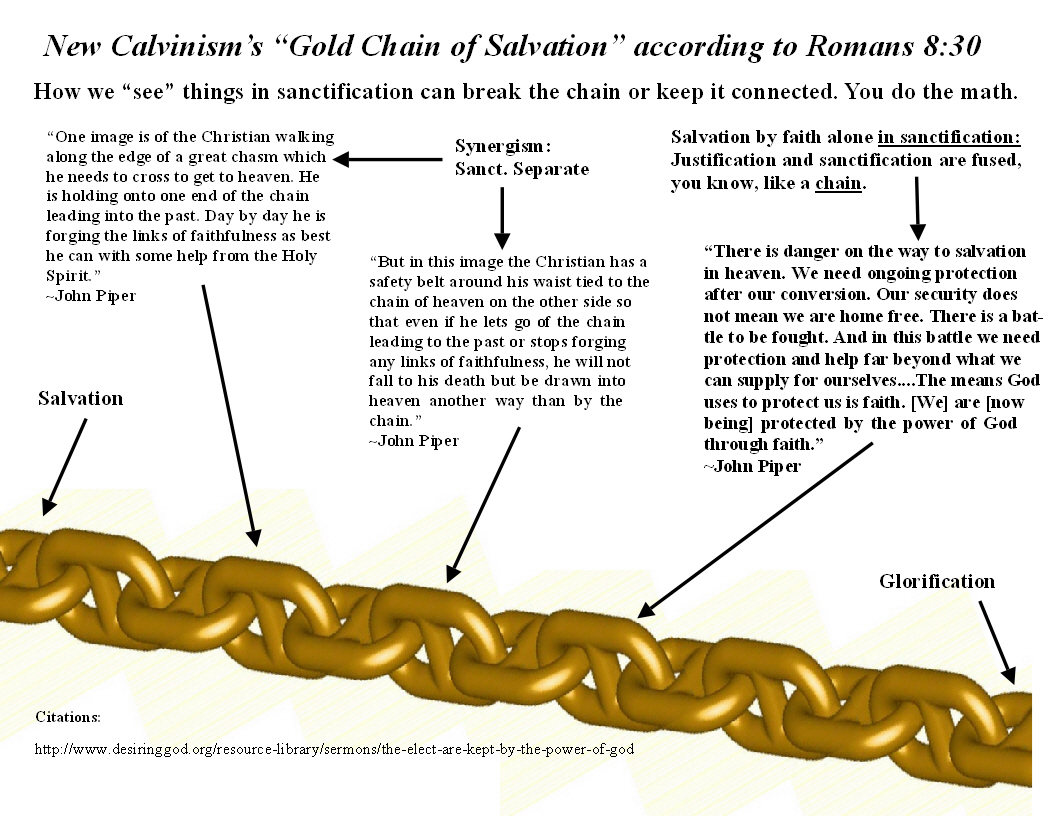
This ministry has made much of the critical importance of separating justification (salvation) and sanctification (growth in holiness, or kingdom living). The Reformed (Calvin/Luther Reformation doctrine/gospel) “never separate, but distinct” doublespeak doesn’t cut it in the arena of truth, and we will see why. “Never separate” =’s false gospel. If you get a little lost in the first part of my argument which gives the lay of the land, don’t worry, when I get into the specific Scriptural argument, it will clear things up and make it all come together for you. It must delight the ghosts of the Reformation that the argument has always been in the arena of freewill verses predestination. It’s the primary thrust of this ministry to change that argument. This isn’t a quibbling about semantics in the mainstream—this is about the truth of the gospel. As New Calvinist Russ Kennedy once thundered from the pulpit in his mousy voice: “Any separation of justification and sanctification is an abomination!” I have often argued from the standpoint of this issue. If sanctification is the middle of the Reformed “golden chain of salvation” then sanctification is part of finishing justification. This means that what happens in sanctification determines whether or not justification is properly finished. What’s a chain? John Piper even preached a message about the eternal importance of our contribution to the “links” in just the right way. In essence, sanctification becomes a spiritual minefield. This is exactly the same thing that the Reformed crowd has always accused Rome of: the fusing together of justification and sanctification. However, as we shall see, they are both guilty of the exact same heresy/false gospel. As we shall see, both teach that sanctification finishes justification. This is a linear gospel (one unified chain from salvation to resurrection (glorification) versus a parallel gospel with salvation on one plane as a finished work before the foundation of the world, and kingdom living that runs parallel with the finished work and reflects the reality of our salvation until glorification. Typical in the linear gospel is the idea that Christ died for all of our past sins, but we must now finish the work (with the Holy Spirit’s help [sanctified works salvation]) until glorification when we are completely transformed into complete holiness. This is the often-heard bemoaning of “Christ PLUS something.” 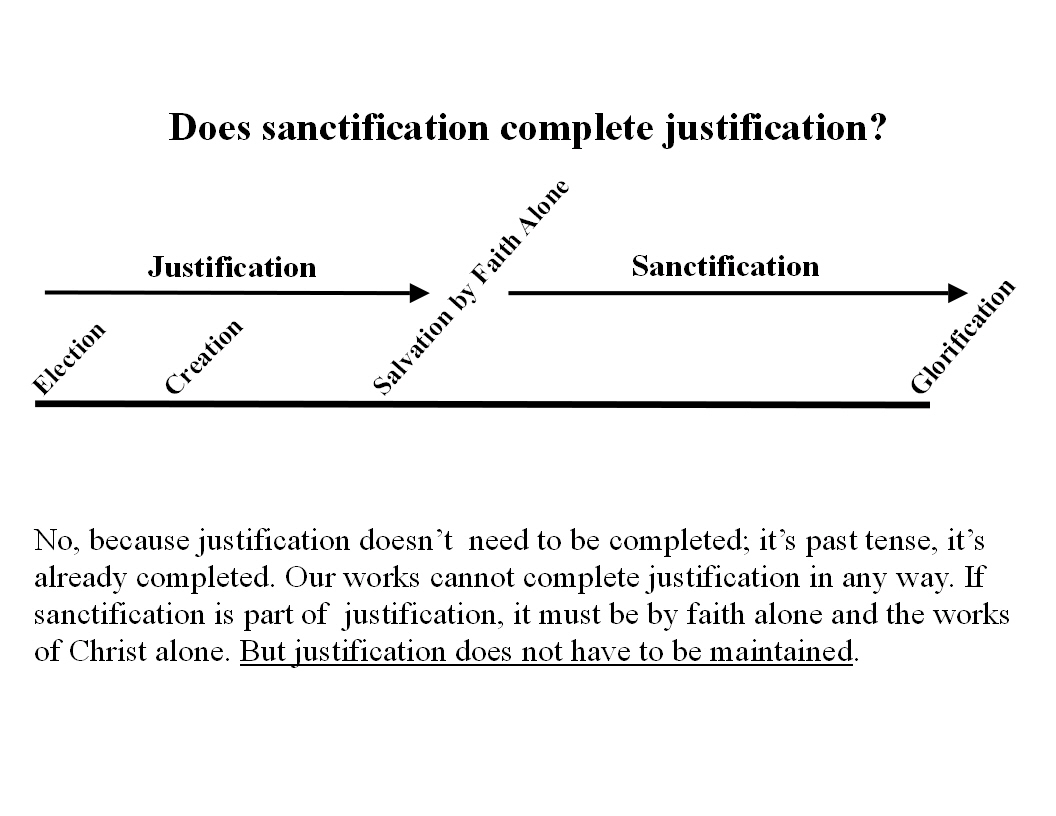 An excellent example is some strains of Freewill Baptists who teach that Christ died for all of our past sins, but with the help of the Holy Spirit, we must confess and repent of every sin we commit until the resurrection, e.g., Christ plus salvation by repentant prayer for sins committed after we are “saved.” My grandparents were saved out of this tradition. When my grandfather asked my grandmother if she thought that God could ever forgive him of all the sins he committed, she answered: “Yes, but you are going to have to pray awful hard!” Praise God that through the ministry of several individuals my grandparents eventually abandoned that gospel for the true one of salvation by faith alone as a finished work. Likewise, Rome teaches that you must let the Catholic Church finish your justification through ritual, e.g., Christ plus Catholic ritual. The Reformation gospel is also Christ plus something else, but the something else is ever-so-subtle. In both cases, sin must be dealt with in sanctification in order for the saint to remain justified until the final judgment. In other words, the righteous standard of justification must be maintained on our behalf. Like all other proponents of a linear gospel, the Reformed crowd contends that anything less than the perfection demanded of the law (“all sin is transgression of the law”) is “legal fiction.” So both Rome and the Reformers agree: justification must be maintained by sanctification, and in the case of the Reformers specifically, they believe that the perfect standard of the law must be maintained until glorification; otherwise, our justification is “legal fiction.” Here is where Reformed subtlety is uncanny: Christ keeps the law for us in sanctification. He maintains the perfect standard. All the fruit of sanctification (obedience/good works) flows from the life He lived on Earth and His death on the cross. Christ plus the works of Christ to finish salvation. “But Paul, what in the world is wrong with that?!” Here is what is wrong with it: works are still required to maintain justification. That is a huge problem, even if it is Christ doing the work. What did the Hebrew writer say about Christ’s work for justification not being complete? And even more subtle is the following Reformed idea: believing that the law is no longer a standard for maintaining justification is antinomianism. Antinomianism =’s legal fiction. Their definition of antinomianism is the removal of the law from justification as the standard for maintaining it. Traditionally, among Biblicists, antinomianism is the removal of the law from sanctification, and herein lays even further steroidal subtlety: the Reformed theologians would refute a removal of the law from sanctification as well, not only because they think justification and sanctification are the same thing, but because its perfect keeping is required to maintain a true declaration of the just that is not “legal fiction.”
  However, the Biblicist believes that the law is a standard for kingdom living and is no longer a standard for justification. Therefore, if we attempt to obey it with the Holy Spirit’s help, and to please/serve the Lord, it can have no bearing on our just state. While the Biblicists think they are therefore joint contenders with the Reformers against antinomianism, such is far from the truth. The Reformed mind believes the Biblicist is either a legalist or an antinomian, or both. The Biblicist is supposedly an antinomian because he/she has removed the law from justification as a just standard, or is a legalist because they think they should strive to keep the law in sanctification. Since sanctification finishes justification’s perfect standard of law keeping, our “own” attempts to keep the law in sanctification is an attempt to finish justification. Hence, what the Biblicist fails to understand is the Reformers belief that Christ must maintain the law for us in sanctification because justification and sanctification are not separate. Anything more or less is supposedly works salvation. On the other hand, because it is vital that Christ obeys the law for us in sanctification, the likes of John Piper and Tullian Tchividjian contend that those who are really preaching the Reformed gospel will indeed be accused of antinomianism. All in all, their position is easy to see if you pay attention. John Piper and many other Calvinists often state that, “Good works are the fruit of justification.” And, “Justification is the root, and sanctification is the fruit.” Well, the average Biblicist then thinks, “Yes, but of course, our salvation makes good works in sanctification possible.” But that’s not what they are saying. If you pay closer attention, they are saying that justification is a tree that produces its own fruit. Justification is the root, and whatever happens in true sanctification is the fruit of the root of the justification tree. Problem is, justification doesn’t grow. Justification is a finished work. What Calvinists refer to as “progressive sanctification” is really the fruit of the root: progressive justification. Another name for this that they throw around is “definitive sanctification.” The word “definitive” refers back to the definite completion of justification.
  Revision: this ministry now rejects the idea that orthodoxy is truth; orthodoxy is the traditions of men. Never in Scripture do we find premise for a body of teaching that explains the teaching. The above illustration is valuable for demonstrating that the fruit of justification is glorification, NOT sanctification. This brings us to the Scriptural argument which begins with a question I asked myself just this morning: “Paul, you are always harping about the crucial importance of the separation of justification and sanctification—a parallel gospel versus a linear one. But where does the Bible say specifically that this is critical?” First, the very definition of a lost person in the Bible is one who is “under the law”:
Romans 3:19 Now we know that whatever the law says it speaks to those who are under the law, so that every mouth may be stopped, and the whole world may be held accountable to God. Romans 6:14 For sin will have no dominion over you, since you are not under law but under grace. Romans 6:15 What then? Are we to sin because we are not under law but under grace? By no means! 1 Corinthians 9:20 To the Jews I became as a Jew, in order to win Jews. To those under the law I became as one under the law (though not being myself under the law) that I might win those under the law. Romans 7:1 Or do you not know, brothers —for I am speaking to those who know the law—that the law is binding on a person only as long as he lives? Romans 7:2 For a married woman is bound by law to her husband while he lives, but if her husband dies she is released from the law of marriage. Romans 7:3 Accordingly, she will be called an adulteress if she lives with another man while her husband is alive. But if her husband dies, she is free from that law, and if she marries another man she is not an adulteress.
The unsaved are “under the law” and will be judged by it in the end. This is the very definition of the unsaved. Calvinists define Christians the same way—we are supposedly still under the law and will be judged by it in the end. That’s why Christ must keep the law for us—because we are still under it. If not this position, why do many in the Reformed tradition hold to the idea that Christ’s perfect obedience is imputed to our sanctification? His death justifies us, and His perfect life sanctifies us. Hence, His death pays the penalty for past sins, and then His perfect life imputed to our sanctification keeps us justified. Why would an imputation to our sanctification be necessary if we are no longer under the law? This is known as the Reformed view of “double imputation” and has been called out as heresy by many respected theologians for this very reason: it implies that Christians are still under the law. In regard to sustaining the law in our stead, why? It has been totally abolished in regard to our just standing:
Romans 3:20 For by works of the law no human being will be justified in his sight, since through the law comes knowledge of sin. Romans 3:21 But now the righteousness of God has been manifested apart from the law, although the Law and the Prophets bear witness to it— Romans 4:15 For the law brings wrath, but where there is no law there is no transgression.
The keeping of the law by anybody DOES NOT do anything to justify mankind:
Romans 3:28 For we hold that one is justified by faith apart from works of the law.
Here is where the separation of justification and sanctification is vital on this first point: we ARE NOT under the law for justification, but rather UPHOLD THE LAW in sanctification. The two must be separate because of the differing relationships to the law:
Romans 3:31 Do we then overthrow the law by this faith? By no means! On the contrary, we uphold the law. Romans 6:15 What then? Are we to sin because we are not under law but under grace? By no means!
Furthermore, if we are still under the law (whether or not Christ obeys it for us to keep us in a just standing), this means we are still under the power of sin. Being under the law and also under its spell to provoke sin in the unregenerate is spoken of as being synonymous in the Bible. Those who are “under the law” are also under the power of sin and enslaved to it:
Romans 7:4 Likewise, my brothers, you also have died to the law through the body of Christ, so that you may belong to another, to him who has been raised from the dead, in order that we may bear fruit for God. Romans 7:5 For while we were living in the flesh, our sinful passions, aroused by the law, were at work in our members to bear fruit for death. Romans 7:6 But now we are released from the law, having died to that which held us captive, so that we serve in the new way of the Spirit and not in the old way of the written code. Romans 7:8 But sin, seizing an opportunity through the commandment, produced in me all kinds of covetousness. For apart from the law, sin lies dead.
If we are still under the law, and will be judged by it, whether or not Christ stands in the judgment for us with His own works, we are still enslaved to sin by virtue of being under the law…. for justification. And Calvinists know this to be true, that’s why they say we are still…. what? Right, even as Christians, “totally depraved.” And, “enemies of God.” Of course, throughout the Bible, Christians are spoken of as being friends of God and no longer His enemies. Our status as enemies of God is stated in the past tense. But the Reformed crew continually state that Christians are vile enemies of God and are enslaved to sin. They realize that this goes hand in hand with being under the law. To the contrary, dying to the law in the death of Christ….for justification—sets us free to be enslaved to the righteousness that is defined by the law. We are dead to the law for justification and alive to obey truth….for sanctification:
Romans 8:2 For the law of the Spirit of life has set you free in Christ Jesus from the law of sin and death. Romans 8:3,4 [emphasis by author] For God has done what the law, weakened by the flesh, could not do. By sending his own Son in the likeness of sinful flesh and for sin, he condemned sin in the flesh,….in order that the righteous requirement of the law might be fulfilled in us, who walk not according to the flesh but according to the Spirit. Romans 8:7 For the mind that is set on the flesh is hostile to God, for it does not submit to God’s law; indeed, it cannot. Romans 9:31 but that Israel who pursued a law that would lead to righteousness did not succeed in reaching that law. John 17:17 Sanctify them in the truth; your word is truth. James 1:25 But the one who looks into the perfect law, the law of liberty, and perseveres, being no hearer who forgets but a doer who acts, he will be blessed in his doing.
So, that is the separation that must be for the true Christian: Justification has no law for which we are judged, and we live by the law of blessings in sanctification. This brings us to another important separation in the two: the judgments. Those under the law and sin will stand in a final judgment which will be according to the law. Again, because Calvinists believe that we are still under the law, albeit that Christ obeyed/obeys it for us, Christians will supposedly stand in the same judgment as the damned who are under the law and enslaved to it. At that time, the children of God, according to Calvinists, will be “made manifest.” But because Christians are not under the law and cannot be judged by it, they will stand in a judgment for rewards and not a judgment that determines a perfect keeping of the law by Christ in our stead. Hence, there will be two different resurrections: one for those under the law and another for those under grace, and two different judgments for the same two groups. One for rewards, and one to determine if those under the law kept it perfectly. The latter judgment doesn’t go well for any standing in it.
Luke 14:12-14 He said also to the man who had invited him, “When you give a dinner or a banquet, do not invite your friends or your brothers or your relatives or rich neighbors, lest they also invite you in return and you be repaid. 13 But when you give a feast, invite the poor, the crippled, the lame, the blind, 14 and you will be blessed, because they cannot repay you. For you will be repaid at the resurrection of the just.” [Notice that this is a resurrection for the “just.” They are already determined to be just before they are resurrected]. 2Corinthians 5:9,10 So whether we are at home or away, we make it our aim to please him. 10 For we must all appear before the judgment seat of Christ, so that each one may receive what is due for what he has done in the body, whether good or evil. 1Corintians 3:11-15 For no one can lay a foundation other than that which is laid, which is Jesus Christ. 12 Now if anyone builds on the foundation with gold, silver, precious stones, wood, hay, straw— 13 each one’s work will become manifest, for the Day will disclose it, because it will be revealed by fire, and the fire will test what sort of work each one has done. 14 If the work that anyone has built on the foundation survives, he will receive a reward. 15 If anyone’s work is burned up, he will suffer loss, though he himself will be saved, but only as through fire. Hebrews 6:10 For God is not unjust so as to overlook your work and the love that you have shown for his name in serving the saints, as you still do. Revelation 20:6 Blessed and holy is the one who shares in the first resurrection! Over such the second death has no power, but they will be priests of God and of Christ, and they will reign with him for a thousand years. Revelation 20:11-15 Then I saw a great white throne and him who was seated on it. From his presence earth and sky fled away, and no place was found for them. 12 And I saw the dead, great and small, standing before the throne, and books were opened. Then another book was opened, which is the book of life. And the dead were judged by what was written in the books, according to what they had done. 13 And the sea gave up the dead who were in it, Death and Hades gave up the dead who were in them, and they were judged, each one of them, according to what they had done. 14 Then Death and Hades were thrown into the lake of fire. This is the second death, the lake of fire. 15 And if anyone’s name was not found written in the book of life, he was thrown into the lake of fire.
Don’t let anyone tell you that eschatology is a “secondary” or “nonessential” consideration. Your eschatology is your gospel. It will state your position regarding whether or not you fuse justification and sanctification together; ie, likening Christians to those under the law.
Yet another vital difference in sanctification and justification is repentance. Repentance for salvation (when you are justified) is different from our repentance in sanctification. Among many in the Reformed tradition where the “same gospel that saved you also sanctifies you,” the repentance is the same. Repentance unto salvation is not a onetime “washing,” but rather a means to continue “in the gospel” through what they call “deep repentance.” Biblicism holds to repentance in sanctification that restores his/her fellowship and communion with God as His children. They would see repentance unto salvation as differing, and only necessary for salvation—a onetime decision to take one’s life in a new direction by following Christ, and believing in his death, burial, and resurrection. Reformed repentance, according to the likes of Paul David Tripp and others is a “daily rescue.” Our original repentance was for rescue, and we need rescue today as much as we needed rescue when we were saved. Again, this indicates their belief that we are still under the curse of the law and need to be continually rescued from it while remaining under the bondage of sin. However, Christ made it clear to Peter (John 13:6-11) that those who have been washed (1Corinthians 6:11, Romans 8:30) do not need another washing. Those who drink of the living water do not thirst again (John 4:13,14). Lastly, though many other separations could be discussed, why saints can be considered just while they still sin at times is of paramount importance. There is no sin in our justification because there is no law, and where there is no law, there is no sin. Though unfortunate, there can be sin in our sanctification because it is totally separate from justification and can’t affect our just standing with God. Basically, all of the aforementioned makes it of necessity to deny the new birth. If we have God’s seed in us, and we do (1John 3:9), that dispels total depravity, and without total depravity, justification and sanctification cannot be fused together. The new birth is a huge problem for Reformed theology. If the old man that was under the law is dead (Romans 7:1ff), and the seed of God is in the saved person, and the sin due to our weakness in the flesh cannot be laid to our account for justification, then our justification is not “legal fiction” because we do not exhibit perfect obedience to the law. This is another grave consideration because Christ said, “You must be born again.” Obviously, despite their denials that they deny the new birth—you can’t be both totally depraved and born again. Reformation doctrine is clearly a false gospel. Its version of justification does not void the law, and denies the new birth while distorting everything in-between. Freewill verses predestination is hardly the issue, the very gospel itself is the issue.
paul
Bible Interpretation, the Rapture, and the Problem with Salvation
Children of the Reformation are crippled in their ability to understand the Bible because of the Reformation’s salvation/justification prism. In other words, we have a very strong tendency to interpret every verse through the prism of eternal salvation. This makes weak sanctification/kingdom living part and parcel with Reformation history. In fact, the Reformation gospel makes sanctification a mere extension of justification. There is justification, and that “experienced subjectively” (sanctification) and then “final justification.” Their words, not mine.
Hence, in the Bible, rewards in context of sanctification are seen as the reward of salvation. The attempt to make the reward salvation while claiming salvation by faith alone becomes a convoluted theological mess. Complicating the matter are many Bible passages that, in fact, seem to say that we obtain final salvation through perseverance. This is because our minds have been trained to interpret Scripture through a singular salvation prism.
“Singular salvation.” That is a point in and of itself. How many Christians think there is only ONE salvation? All save a few. How many think salvation and redemption are the same thing? All save a few. Salvation is the new birth; redemption is the salvation of the body when Christ comes to claim what is His. Seeing the two as the same thing creates a plethora of interpretive problems, and there are many other examples that could be cited.
And far from being the least of these interpretive problems is the idea that salvation is both gift and reward. The Reformed get around this by categorizing works into two categories: faith alone works that aren’t really works per se, and works that are really works. Yes, salvation is a gift, but it is also a reward for doing your part to obtain salvation via faith alone works. Key to understanding this concept is the imperative command is grounded in the indicative event. By doing gospel works, or faith alone works grounded in the “salvation event,” the works of Christ are imputed to your sanctification and “subjective justification” is kept properly on track until “final justification.”
Doing your part to keep your salvation isn’t works salvation because it is a prescribed faith alone work. If you do A, Christ will do B, and you get to keep your salvation. In Reformed circles that usually includes partaking in the “means of grace.” Since it is “the means of grace” it is not works. This usually includes formal church membership, “putting yourself under the authority of godly men,” sitting under Reformed preaching, partaking in the Lord’s Table, and “deep repentance” for sins that separate you from grace, etc.
The result is a missing, and massive kingdom living construct. Also missing is an understanding of any kind of gravity concerning kingdom living. How we participate in sanctification has no implications other than salvation. Until the recent resurgence of the Reformed gospel that makes final salvation the consequence of sanctification, kingdom living was relegated to mere fire insurance.
So, what is the point of this post? Christians must relearn and cultivate an understanding of incentives regarding kingdom living. One is present life more abundantly, peace, assurance, and blessings. The eternal ones are a little bit more difficult to understand, but sound pretty cool:
Daniel 12:3 – And those who are wise shall shine like the brightness of the sky above; and those who turn many to righteousness, like the stars forever and ever.
This is some kind of eternal reward for the soul winner. Other such eternal rewards can be found in the seven letters to the assemblies in Revelation. But like I said, the present rewards are easier to understand and have immediate benefits. At any rate, again, this is a body of wisdom that needs cultivation.
Let me SUGGEST another one. Not that it will do any good, but let me state that this is just an idea I am putting out there for consideration. Here, I will repeat it again, knowing that the attempt is futile, but nevertheless,
THIS IS JUST AN IDEA I AM PUTTING OUT THERE FOR CONSIDERATION.
con·sid·er·a·tion
kənˌsidərˈāSH(ə)n/
noun
Careful thought, typically over a period of time. “a long process involving a great deal of careful consideration” synonyms: thought, deliberation, reflection, contemplation, rumination, meditation;
NOT DOGMA.
Here is my thought. The rapture is a reward for suitable kingdom living. When the rapture happens, not everyone left behind is lost. Is that screaming I hear in the distance? Probably. What in the world would give me such an idea? Let me share:
Revelation 3:10 – Because you have kept my word about patient endurance, I will keep you from the hour of trial that is coming on the whole world, to try those who dwell on the earth. [Present reward?] 11 I am coming soon. Hold fast what you have, so that no one may seize your crown. [Present reward?] 12 The one who conquers, I will make him a pillar in the temple of my God. [Eternal reward?] Never shall he go out of it, and I will write on him the name of my God, and the name of the city of my God, the new Jerusalem, which comes down from my God out of heaven, and my own new name. 13 He who has an ear, let him hear what the Spirit says to the churches.’
Obviously, the hour of trial coming upon the world is the tribulation period. Here, being saved from that hour seems to be a reward (crown) for perseverance. You have two choices here: the reward is either the rapture or salvation. No? What am I missing? It wouldn’t be the first time that rapture was reward and didn’t include all of the saved (see “Enoch”). Also, Paul spoke of a reward for those “who have loved his appearing.” This is the “righteousness” crown (2Timothy 4:8).
What about all of the indifference among Christians concerning the rapture? What about all of the indifference regarding the New Testament call to be continually looking for the Lord’s unexpected and imminent return? Could this indifference stem from a fundamental ignorance in regard to sanctification?
There are many Christians in our day who reject the rapture, so should they expect to be a part of it? Is it some kind of secondary truth that is optional?
This is an attempt, perhaps a lame one, to get Christians to think more deeply about kingdom living and our present calling. Just food for thought. We need to challenge each other to think beyond orthodoxy. We need to set our kingdom living on fire.
paul
Calvinist Paul Washer: Christianity is Perpetual Death and Rebirth
In the following short clip, Paul Washer expounds on Reformed orthodox’s definition of the new birth: the Christian, which remains dead in trespasses and sin, experiences perpetual rebirth under the preaching of preordained prophets of God. This doctrine known as mortification and vivification, or “deep repentance/new obedience,” is well articulated in the Calvin Institutes and is formal Reformed orthodoxy. Hence, when will discernment bloggers say enough is enough and stop playing footsies with “old Calvinism.” No part of a false gospel will heal. Facts used in the commission of a false gospel will not heal. Why is this so hard to understand?
And just in case you need more convincing, consider this excerpt from Michael Horton’s “Christless Christianity,” p. 189ff:
God gathers his people together in a covenantal event to judge and to justify, to kill and to make alive. The emphasis is on God’s work for us – the Father’s gracious plan, the Son’s saving life, death, and resurrection, and the Spirit’s work of bringing life to the valley of dry bones through the proclamation of Christ. The preaching focuses on God’s work in the history of redemption from Genesis through Revelation, and sinners are swept into this unfolding drama. Trained and ordained to mine the riches of Scripture for the benefit of God’s people, ministers try to push their own agendas, opinions, and personalities to the background so that God’s Word will be clearly proclaimed. In this preaching the people once again are simply receivers – recipients of grace. Similarly, in baptism, they do not baptize themselves; they are baptized. In the Lord’s Supper, they do not prepare and cook the meal; they do not contribute to the fare; but they are guests who simply enjoy the bread of heaven.

 Paul's Passing Thoughts
9 comments