Horton’s Systematic Theology Adds To The Sonship/Gospel Sanctification Massive Subculture: Revised
[NOTE: This was written before I discovered that New Calvinism is in fact the same gospel that the Reformers taught. The resurgence movement began as COG in 1970, became Sonship circa 1986, Gospel Transformation in 2000, dubbed Gospel Sanctification by detractors in 2007, and finally New Calvinism in 2008. This was also written before I understood that orthodoxy is a part of spiritual caste in general].
“Gospel Sanctification, as Sonship is now called, will begin to totally rewrite orthodox Christianity” [Note also that I no longer equate “orthodoxy ” with truth per se].
[Further revision: much has been learned since this post, but the general idea is very accurate: the Neo-Calvinist movement is seeking to develop a subculture within American culture that will eventually, if all goes as planned, devour American culture as we know it. This is part and parcel with Calvinism’s dominion theology. This post submits a sketchy framework of useful categories under the general idea. For instance, one college that focuses strictly on the Neo-Calvinist vision is a far cry from the fact that this movement owns (in an intellectual capacity) most of the seminaries in America. Other categories could be added as well, e.g., Christian publishing ].
The Fix is now in. The false doctrine of the centrality of the objective gospel (COG) which found new life in Sonship Theology about thirty years ago—now has its own theology, hermeneutic, practical application, defined experience, ecumenical (inclusiveness) movement, history, college, counseling organization, missionary organization, Bible—and now, its own systematic theology. Gospel Sanctification (GS), as Sonship is now called, will begin to totally rewrite orthodox Christianity. It won’t be long; those who we minister to will have to be deprogrammed before we can help them, starting with convincing them that the Bible is to be taken as literal instruction from God as our authority for ministry and life. Not understanding GS beforehand will make any attempt to help people with the word of God—dead on arrival.
GS Theology
The movement started with a very powerful concept in the minds of its perpetrators. Supposedly, we grow spiritually by revisiting the gospel that saved us every day. Proponents were convinced (and still are) that this thesis stands alone as truth; therefore, all other propositions must bow to it.
The GS Hermeneutic
A literal interpretation of Scripture will continually contradict GS. So, the proponents have changed how we read/ interpret the Bible accordingly. The GS hermeneutic is an interpretive prism that will always yield results that make GS plausible. Unlike the rest of the elements (which are very contemporary), the hermeneutic (known as Biblical Theology or Redemptive-Historical hermeneutics) was borrowed from times past. It originated in Germany under the liberal teaching and writings of Johann Philipp Gabler (1753-1826), who emphasized the historical nature of the Bible over against a “dogmatic” interpretation thereof. Nearly a century later, Geerhardus Vos (1862-1949) was instrumental in taking the discipline of biblical theology in a, supposedly, more conservative direction. Graeme Goldsworthy tweaked the doctrine to facilitate COG, and today, Goldsworthy’s “Trilogy” is the pillar of interpretation within the movement.
Practical Application
The GS narrow approach to sanctification must be embellished and applicable to life in some way in order to be sold. This is Heart Theology, and was developed through David Powlison’s Dynamics of Biblical Change at Westminster Seminary. In 1996, two former students of Powlison articulated Heart Theology in a book entitled, “How People Change.”
Defined Experience
John Piper seeks to articulate how Sonship is experienced via Christian Hedonism. Because GS makes our works and the work of the Spirit an either/or issue, someone needed to develop a thesis that explained how the difference can be ascertained. John Piper answered the call with the development of Christian Hedonism.
Ecumenical Bent
GS now encompasses any group that agrees with its primary view of plenary monergism and the synthesis of justification and sanctification. All other disciplines are seen as secondary and irrelevant to fellowship and joint ventures. The Gospel Coalition (holding national conferences on odd years, 2011, etc.), and T4G (Together For The Gospel, holding national conferences on even years) work together to promote GS/S while promoting inclusiveness among denominations and religions.
History
GS proponents claim a historical precedent dating back to Creation, and also claim to be the second part of the first Reformation. Of course, this is laughable. Sonship, the Antioch school, TGC, T4G, NCT, CH, and HT have no historical precedent prior to 1970. Many of the notable proponents of GS are associated in some way with the father of Sonship Theology, Dr. John “Jack” Miller. Tim Keller and David Powlison were followers of Miller. Paul Tripp and Timothy Lane are followers of David Powlison. Jerry Bridges attributes his view of the gospel to Miller as well.
College
The Antioch School of leadership training has GS as its foundation and basis for training. It is located in Ames, Iowa.
Counseling Organization
The upstart Biblical Counseling Coalition, which seeks to network other counseling organizations as well, is intimately associated with T4G and The Gospel Coalition. The who’s who of Gospel Sanctification sit on its governing board including David Powlison and Paul David Tripp.
Missionary Organization
It’s primary missionary organization was founded by the father of Gospel Sanctification / Sonship—Dr. John “Jack” Miller. Banner of Truth states the following in The Movement Called Sonship: “Miller encouraged New Life Presbyterian Church into originating the ‘World Harvest Mission’, a non-denominational missionary organization. Sonship became its main teaching vehicle.”
Bible
The English Standard Version (ESV) was first published by Crossway in 2001. Its vice president of editorial is Justin Taylor who also authors The Gospel Coalition Blog, the multimedia propaganda machine for GS doctrine. One of the translators was Wayne Grudem, also well known as a major proponent of GS doctrine. The ESV’s GS connection has made it the most purchased English Bible in the past ten years. The latest promotion of the ESV by Crossway, “Trusted: Trusted Legacy [a whopping ten years]; trusted By Leaders; Trusted For Life,” features an endorsement by the who’s who of GS doctrine.
The Complete Fix
With Michael Horton’s recent publication of “The Christian Faith: A Systematic Theology for Pilgrims On the Way” (2011), the total fix is in place. The GS machine will now begin to move forward—rewriting and re-forming orthodox Christianity. I confidently predict that Horton’s book will be widely used in seminaries nationwide. Seminary students will be pumped into the local churches with a skewered view of truth—but using all of the same terminology that was formally orthodox.
What Can Be Done?
This doctrine thrives on the fact that Christians are theologically dumbed-down. If most Christians do not know the difference between justification and sanctification (and they don’t), they are helpless against this false doctrine. If most Christians don’t realize the importance of understanding hermeneutics (and they don’t), they are even more helpless. Local churches need to start in-doctrine–ating their people.
paul
A Plan for Saving Calvinism with “First Generation” Biblical Counseling
 “But since I am a nice guy, I hereby propose a plan to save Calvinism with first generation biblical counseling.”
I have been getting emails that suggest the present-day Neo-Calvinist movement has peaked, is imploding, and will soon be on the decline. This would be a repeat of history. The only problem is, what is left behind of the authentic Reformation still yields weak sanctification which leaves the door open for the authentic Reformation gospel to return.
This is because the Neo-Platonist political goal of the Reformation gospel sought to keep the masses under the one law of sin and death. The practical application of the Reformation gospel wasn’t a new method for interpreting the Bible, it was a new method for interpreting reality itself through the redemptive works of Christ. Man lives in the shadows of the true forms; Jesus Christ and His works. Reality is a gospel metaphysical narrative that glorifies God through the history of sinful man, and every event is completely pre-authored by God’s pen down to the smallest detail.
This isn’t a natural way to interpret reality or literature, and as history moved further away from Calvin’s Geneva, Christians began to gravitate more and more towards a grammatical interpretation of Scripture. This made Christians more than mere characters in a prewritten metaphysical narrative, and spawned the antinomian controversies throughout church history.
Even though the European idea of living a preordained life of slavery under preordained masters was eventually rejected in America, the significance of that idea in regard to the European gospel has never been fully dealt with. There has never been a complete reevaluation of the foundations laid by the Reformation regardless of its abhorrent historical fruit.
In 1970, the American church was languishing in anemic sanctification after the first gospel wave of the 50’s and 60’s produced massive converts with very little power in the Christian life to show for it. Christianity had few answers for life’s difficult questions. Billy Graham saved you, and Oprah Winfrey counseled you. Even in our day, a disciple of Winfrey’s, Dr. Phil McGraw, helps people with real-life problems more than the institutional church would ever dream of.
And what is the church’s Neo-Calvinist answer to that? “It’s not about your life, it’s about Jesus.” “It’s not about anything you do, it’s about what Jesus did.” “Is the gospel about Jesus, or your Spirit-filled life?” “We preach the gospel, we don’t try to be the gospel.” And yes, that was the answer for concerns raised in the 70’s about powerless Christianity. You see, supposedly, what little bit of sanctification and practical application that was being practiced at the time was the problem. The first gospel wave circa 1950-1970 was strong on getting people saved and emphasized sanctification little; the Neo-Calvinist gospel wave came along and said, for all practical purposes, that sanctification is not needed at all—what we need is more Jesus—“Jesus is our sanctification.” “Sanctification isn’t you—it’s Jesus.”
In the same year that the Reformed lager once again came to save Protestant Light, 1970, a Presbyterian by the name of Jay Adams ignited the biblical counseling movement with the groundbreaking and controversial book, “Competent to Counsel.” In my opinion, being a part of the movement during its peak in the 90’s, it was one of the true revivals in church history that was strictly a church affair minus European political intrigue, if not the only one.
The reason for this is simple: Adams focused on walking in the Spirit. This wasn’t a walking in the Spirit that prescribed working hard at gospel contemplationism, this was a walking in the Spirit that prescribed learning and hard work on the part of God’s people with the Holy Spirit as counselor and helper. Adams separated justification and sanctification, and claimed that the power for Christian living came from the new birth, not justification. The cross saves you, but it doesn’t sanctify you. The resurrection sanctifies you.
There is only one reason for being sanctified by justification: Christians remain under the law of sin and death. Hence, the cross must continue to save us from that law—more cross. Adams prescribed walking in the law of the Spirit of life, and rejected the idea that the law of the Spirit operated in the power of the cross; Adams insisted that obedience to the law of the Spirit of life was a colaboring between us and the Spirit who raised Christ from the grave.
And the Neo-Calvinist resurgence went to war against Adams and won. Adams’ primary nemesis was the propagators of Sonship theology who are alive and well in the present-day Neo-Calvinist movement and own 95% of all biblical counseling. Adams’ Institute for Nouthetic Studies is the last vestige of the revival standing, and is unfortunately staffed with some who want to be friends with both camps even though at issue is the very gospel of Jesus Christ—because the crux is, are we still under law, OR under grace and the law of the Spirit of life?
Though the “second generation” counseling movement has managed to stay clear of the ongoing implosion, they are in the Neo-Calvinist camp and if history repeats itself, and that is what seems to be happening, they will likewise die the same social death that monergistic substitutionary sanctification always dies. That is, unless it can get in bed with the government and compel its orthodoxy by force, but historically, that only buys it some additional time prior to its inevitable demise.
But since I am a nice guy, I hereby propose a plan to save Calvinism with first generation biblical counseling. It is said of Adams’ first generation biblical counseling that it is to be commended for paving the way and laying a foundation, but now the “second generation” of biblical counseling is the real solution. Oh really? They have been running the show completely for twenty years now in the American church, and are we better off? Hardly! They have created mediating organizations that keep churches out of court, or at least try to, as a solution for cleaning up the bad fruit that their false gospel has created. When in American history have we ever needed mediating organizations to keep Christians from suing the institutional church? 2009 brought a nuclear explosion of discernment blogs, not against the familiar isms of church history, but against the same old spiritual tyranny that this doctrine has produced for over 500 years leading to its own periodic social deaths.
The key to saving Calvinism in all of this is the general ignorance and doctrinal illiteracy that has always been part of Calvin’s tyranny. As the framers of our constitution stated, an informed people is a free people. Calvinists can now use this ignorance to save the movement, and take credit for the future fruits born by instructing people to walk in the Spirit of life through obedience to everything Christ has commanded.
Because we Christians are generally stupid, the same ploy used by David Powlison (one of the forefathers of second generation biblical counseling) against Jay Adams can now be employed to save Calvinism. On the one hand, Powlison et al call Adams a Pharisee, but on the other, they commend him for laying the foundation of biblical counseling, by far the most formidable catalyst for Neo-Calvinism in our day. In the same way, since God’s people have apparently bought into this oxymoron of helpful flawed foundations and false premises that bear good fruit, the same could be said of Calvin.
Yes, even though Calvin kept God’s people under the law of sin and death, it could be said of him, “Well, Calvinists don’t believe everything Calvin believed.” I know, it’s stupid, but hey, it works. In our day, it enables folks to call Jay Adams a Pharisee while at the same time commending him. And David Powlison is so nuanced in what he says, if he slithers back into first generation counseling, no one will know the difference.
Hence, a return to the real revival of the 90’s, while giving Calvin all the credit. Hey, people also buy into all of this Old Calvinist/New Calvinist stuff; Tullian Tchividjian could be labeled the father of New Calvinism and all of the blame for misunderstanding Calvin could be placed on him. There is already a head start on that play. I am telling you, this plan is coming together in my mind and is examplitory of my compassion for Calvinists. After all, we are all just sinners saved by grace.
Now, what would this new plan, “look like.” Well, it would look like Calvinists standing around a bonfire holding hands on a clear summer night, actually, a book burning, while singing… “trust and obey, for there is no other way to be happy in Jesus…trust and obey.”
paul
Why Contemporary Biblical Counseling is a Lie and Cannot Help Anyone, and What Should be Done About it.

Target Publication 2015
We are in the era of the biblical counselor. The National Association of Nouthetic Counselors (NANC), the Christian Counseling & Education Foundation (CCEF), and the Biblical Counseling Coalition (BBC) comprise the lion’s share of biblical counseling in our day and then some.
These organizations are all tightly associated with each other, and share involvement among directors and board members. The network between these organizations and local churches is massive, and thousands of people are referred to counselors through this network daily. These organizations also offer “training” and curriculum for major seminaries nationwide.
This is a massive network of “biblical” counselors who are wasting the time of troubled people, and doing more harm than good. Why? First, the whole system is based on the lie that they offer people a way to change. By “people,” I mean primarily Christians. One of the more notable figures in the network, Paul David Tripp, wrote a book titled, “How People Change.” A careful reading reveals that the book actually rejects the idea that people change, and instead posits the idea that Christians can only experience the joy of grace in a deeper and deeper way. A deeper and deeper realization of how totally depraved we are leads to a greater and greater appreciation of God’s grace resulting in happiness. Hence, what they are really offering is something that sounds spiritual: “Happiness regardless of your circumstances.”
People come to counseling because they want to change something about their lives; this is assumed, and the biblical counseling machine allows them to believe they share the same agenda, and even state it accordingly. And here is the problem: God will not honor a lie; God will not bless a lie.
Nor will God honor their elitist attitude towards the common parishioner. The contemporary biblical counseling network allows this noble lie because most people are not “ready” for the “truth” that people really don’t change in what they do, but only in how they experience life. Ironically, if they were honest, they would be surprised to find that the “truth” of not changing, but rather feeling good about your depravity would be a much easier sell. But to the contrary, the network couches terminology in nuance to make it sound like change in behavior is the agenda—it’s deliberate deception on a massive scale, and has much to do with funding and the money in general.
Central to this issue is the fact that the network is grounded in the authentic Reformed tradition. The new executive director of NANC, a lackey by the name of Heath Lambert, recently wrote an article about Martin Luther and “all the ways that Luther impacted the church, for all the ways that Luther advanced the Kingdom of Christ, and for all the ways we will commemorate the good work he began.” And:
In particular I am thankful for his influence when it comes to the kind of biblical counseling we stand for at the Association of Certified Biblical Counselors [the new name for NANC]. The very first item listed on the document nailed to the Wittenberg Gate said, “When our Lord and Master, Jesus Christ, said “Repent,” he called for the entire life of believers to be one of repentance.” This has everything to do with biblical counseling.
Right, “he called for the entire life of believers to be one of repentance.” They call this, “deep repentance.” The “entire” life of the believer is about repentance. In the Reformed tradition, the “T” in TULIP also applies to the saints. By living a “lifestyle of repentance” that delves deeper and deeper into our depravity, we continually experience the “joy of our original salvation” in a deeper and deeper way. This is exactly what Luther taught:
Now you ask: What then shall we do? Shall we go our way with indifference because we can do nothing but sin? I would reply: By no means. But, having heard this, fall down and pray for grace and place your hope in Christ in whom is our salvation, life, and resurrection. For this reason we are so instructed-for this reason the law makes us aware of sin so that, having recognized our sin, we may seek and receive grace (THD thesis 16,17).
In Reformed circles, this process is called mortification and vivification. It is a perpetual cycle of repentance and joy. It is expressed in the contemporary mantra, “We must preach the gospel to ourselves every day.” Dr. Michael Horton calls it, “reliving our baptism.” One of the most well-known figures of the biblical counseling network, Dr. David Powlison, sets this counseling against those “who see the cross for salvation and the Holy Spirit for sanctification.” This is counseling that focuses on, “living by the cross.”
As one who has spent almost seven years researching this issue, it is easy to see that the Neo-Reformed movement that is behind the network meticulously follows the Calvin Institutes. The Calvin Institutes articulate Luther’s theology of the cross. This is yet another huge problem. The Calvin Institutes, as well as the Westminster Confession, were designed to fit the church states of that era. This is a representative republic; hence, the kind of control that pastors were able to exercise over people in that day is not possible in our day. Yet, the theology of that day was part and parcel with elements of control.
As a result, many, many churches in the network are cultish. Control was part of the counseling construct in Luther and Calvin’s day, and that is difficult to separate from the theology. It stands to reason that if you are still totally depraved, you need to be controlled. Therefore, when people are referred to network churches for counseling, they are often required to attend church there, or even become members for the purpose of “adding the love of community” to the counseling. This is a strong allure because the counseling is often “free,” or by a love offering determined by the counselee. However, once a counselee signs a church membership covenant, they have relinquished significant personal autonomy to local church elders. The average American parishioner is woefully inept in understanding the Reformed tradition enough to join them in a covenant, and on this wise as well, the network is deliberately deceptive.
For example, few would sign up if they knew Reformed pastors believe they have the authority to proclaim someone unsaved. This is Calvin’s power of the keys—whatever a pastor binds on earth, heaven will bind it as well according to their word. In other words, the pastor has the authority to have your name removed from the book of life. Furthermore, counseling is seen as part of the church discipline process, so the second a counselee signs on the dotted line, they are officially under church discipline as well. Counseling is seen as “unresolved sin issues” and therefore under the auspices of church discipline. You said you needed counseling, no? You are under the “first step” of church discipline when you enter counseling. The steps can progress toward excommunication if the counseling doesn’t go well. This reality has caused enough conflict to incite the founding of mediation organizations like Peacemaker Ministries. These are damage control organizations heavily vested in the biblical counseling network.
These are just a few issues at hand, but all in all, what should be done about this problem? Answer: in regard to the Reformed tradition and the contemporary biblical counseling movement; true education, true education, true education, true education, and true education. I believe that a genuine understanding of biblical counseling history (and not the usual propaganda spewed out by the network) will lead parishioners to solid answers.
Meanwhile, I would seize on God’s promise to give you wisdom in the midst of a trial. I would also go into all counseling with eyes wide open. Find out who they are, who they are affiliated with, and be careful what you sign. This is the information age—research the ideology behind the counseling construct you are considering. In cases of severe depression, general practitioners often take a good commonsense approach to the problem. I would also read materials written by Dr. Jay Adams that pertain to your particular problem.
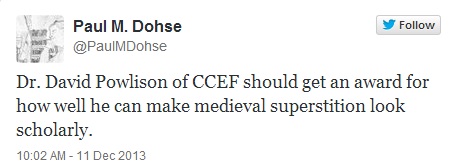
The last thing you need right now is medieval superstition. Trust me, there is a reason for the undertaker-like demeanor of Dr. David Powlison.
paul
Albert Mohler, Nelson Mandela, and the Crusade for a New Calvinist Host
 I have to think long and hard these days for something that annoys me more than Albert Mohler. His presidency at Southern Seminary is a boondoggle rivaled only by the election of Barak Obama, who is, by the way, advocated by Mohler. As the world was blessed with another week, Mohler failed not to mark his territory with an article about the passing of Nelson Mandela lest the world not know his opinion about it. Hence, the Louisville Kool-Aid drinkers who wait with bated breath for his unctions from on high are now apprised.
The article compared Nelson Mandela to George Washington. Ok, the buffoonery of that theses aside, why does Mohler meddle in this stuff? What makes the president of Southern Seminary a political player? For crying out loud, why does Mohler, Piper et al weigh in on every political tryst that comes down the pike? Why did a lot of these guys vote for Barak Obama? Answer: Calvinist history predicated by Calvinist need.
As you know, New Calvinism is the latest resurgence of authentic Reformed doctrine. Historically, authentic Calvinism dies a social death and experiences periodic resurgences in 100-year cycles. New Calvinism is the fifth resurgence since Calvin’s Geneva. Volume 2 of TTANC will document the history of these cycles and the reasons for them.
Protestantism is predicated on passive sanctification/Christian living. Therefore, in an attempt to stop the death spiral Protestantism finds itself in from time to time because it is a light form of its original lager recipe, it attempts to go back to the original recipe for a solution. The only solution in history since the Reformation that offered aggressive sanctification as a solution was the biblical counseling movement founded by Dr. Jay Adams. However, his movement was spawned in the same year that New Calvinism was born (1970), and a war ensued accordingly.
The true biblical counseling movement and its aggressive sanctification lost the war. I witnessed the movement and was involved in it firsthand when it really started
Target Publication 2015
making a radical difference in Christianity circa 1990. New Calvinism (then known as Sonship Theology), infiltrated the true biblical counseling movement through Westminster Seminary and effectively destroyed it by 2006. The high priest of this inquisition was Dr. David Powlison who was a mentoree of the father of Sonship Theology, Dr. John “Jack” Miller. I therefore assume that Powlison will one day receive his just reward for snuffing out one of the most significant revivals in church history.
There are six reasons authentic Calvinism dies:
1. Protestantism was founded on the ancient ideology of spiritual caste. As a result, the Reformation gospel integrated Neo-Platonism with the Bible and offered not just a different gospel, but an entirely different way to interpret reality. Luther, taking his cue from St. Augustine, made the cross the sum of epistemology in and of itself. Many didn’t understand this and still don’t.
In other words, the Reformers interpreted reality through a redemptive prism, while the natural tendency is to interpret reality grammatically. The former believes that creation is a narrative that points to nothing but redemption; the latter doesn’t reject the idea that redemption is referred to in some way, but also believes other things are going on, and the plain sense of words are the key to understanding reality. The redemptive view of reality relies heavily on allegory because it demands a redemptive outcome.
The Reformers actually believed, as many do today, that a grammatical interpretation of reality is synonymous with works salvation and the glory of man. This was Luther’s epistemology. New Calvinists such as Paul David Tripp and Rick Holland have said that a literal, exegetical approach to Scripture separates us from the saving works of Christ (Tripp), and makes bad theology (Holland). Salvation is therefore married to redemptive eisegesis.
Hence, as time progressed, redemptive Protestants grew fewer, and grammatical Protestants increased in number. Remember, at issue is the very interpretation of reality itself. This has resulted in the present-day reality of redemptive Calvinists and grammatical Calvinists; ie., “Old Calvinists” and “New Calvinists.” Both claim Calvin, the former unwittingly. Therefore, in the midst of these resurgences, you have Calvinists fighting Calvinists. Examples of this are ample in church history and will be detailed in TTANC2. Along with every resurgence is an antinomian controversy between Calvinists.
The first point here is that authentic Calvinism dies a social death because its contra intuitive interpretation of reality is a natural anomaly. As it dies, it is replaced with the weaker form that came from it, and a need for solutions once again arise, and the original once again presents itself as the solution: “See, we have gotten away from our roots. That’s the problem.”
2. The original calls for a perpetual revisiting of the same gospel that saved us. This simply becomes boring and people lose interest. Susan and I have recently visited New Calvinist churches that were on fire in the early 80s. They are now deader than dead. Imagine our teenage son pointing this out without any cue from Susan and me at all.
3. The doctrine does not produce spiritual growth which results in a plethora of negative issues that arise from spiritual immaturity. See Hebrews 5:11-6:8. Infants in adult bodies will eventually devour each other.
4. The spiritual tyranny that is ALWAYS part and parcel with this doctrine. Remember, it is basically a spiritual cast system that puts a high premium on control.
5. God’s people eventually figure out that it is a false doctrine.
6. Ultimately, it needs to survive by getting in bed with the government as a way to enforce its orthodoxy. If this doesn’t happen, reasons 1-5 result in its death. Everyone agrees that the Enlightenment era destroyed authentic Reformed orthodoxy because it severed church and state—first in America, and then Europe followed. When this happened, it resulted in the proliferation of cults because government force had to be replaced with various forms of manipulation and mind control.
And this is why New Calvinists such as Albert Mohler are so politically minded. Authentic Calvinism has always been a parasite that will ultimately die unless it finds a government host. Be sure of it: this is what happened to the colonial Puritans, they were kept out of the American political process when they attempted to use the American Constitution to enforce their orthodoxy. This resulted in the death of American Puritanism. Before the American Revolution, the Colonies were Puritan theocracies.
Mohler et al knows their movement will eventually die unless they can use the government to enforce it, and this is behind their liberal political leanings. It takes a collectivist government to enforce a collectivist religion. They know this; hence, “No Government is perfect.” This is why Mohler thinks that “one man’s terrorist is another man’s freedom fighter.” This is why Mohler thinks the differences between Washington and Mandela are “ironic” despite the fact that Mandela was a communist.
Frankly, I believe that this is why John Piper retired from the pastorate and made a video in Geneva that announced his future vision. New Calvinists will continue to become more and more involved in the political realm. There is an agenda to get in bed with the state in order to enforce their faith. If they don’t, history will repeat itself—they know this. They will go the way of the colonial Puritans.
This is just simply history. Calvinists will do what Calvinists have always done. Sure, grammatical Calvinists may deny this historic agenda because they don’t get it, but the authentic Calvinists do get it…
It’s about the collectivist parasite feeding from the host of individualism.
paul

 Paul's Passing Thoughts
1 comment