Religious Tyranny: A Case Study; Introduction and Chapter One
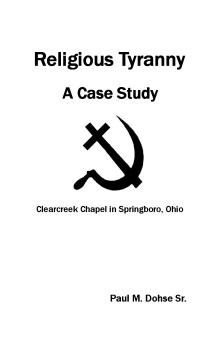
Cover: Religious Tyranny; A Case Study
Preamble
I need another project right now like I need a hole in the head; nevertheless, recent events have impressed upon me the immediate need for this work. As I accomplish each part I will be posting it here on PPT and making all readers part of an editing committee. So, comment here, email me here mail@ttanc.com, and pass judgment on content, grammar, style or whatever else editors do. The compilation will be available in a free ebook or hardcopy book form that can be purchased.
Thank you for your input.
paul
Introduction
“…I have sworn upon the altar of god eternal hostility against every form of tyranny over the mind of man.” – Thomas Jefferson to Dr. Benjamin Rush, September 23, 1801
This book flows not from the winepress of sour grapes, but rather from thankfulness. Whether secular or religious tyranny, these endeavors always yield freedom. Tyranny was a usurper into God’s creation and challenges man’s innate need to be free. Therefore, sin finds itself in a quandary; it is utterly driven by a lust to enslave, but this will eventually drive men to a fight or flight. Tyranny is affliction, but it will always awaken man to his freedom duty. For this, we can be thankful.
This book is an in-depth look into religious tyranny using Clearcreek Chapel in Springboro, Ohio as a case study. However, this case study is a story that reads like most church experiences in our day, and the personal testimonies read the same as well. The information written within will come from the author’s firsthand experience and the testimonies of others, but there is no need to focus on a few people when this is the like testimony of many. Hence, the study will focus on common experiences and not particular individuals.
Most people are saved according to the experience described by the apostle Paul in 1Thessalonians 1:5,
For our gospel came not to you in word only, but also in power, and in the Holy Ghost, and in much assurance; as you know what manner of men we were among you for your sake (KJV).
Yet, most professing Christians doubt their salvation, and furthermore, most professing Christians know there is something fundamentally missing in church; something isn’t right, but they can’t put their finger on it. The present mass exodus from the institutional church is well documented while most people leaving the church don’t know specifically why they are leaving. They are leaving because something is missing, but they are not sure what that something is. The salvation that came with much power and assurance has faded into doubt and indifference.
On the other hand, the church, whether Catholic or Protestant, seems to be supported by many others who are unwavering despite tyranny, illogical contradictions, hypocrisy, and evils not even spoken of in the secular world. How can this be? How can a church like Clearcreek Chapel now embrace beliefs that would have been rejected out of hand with extreme prejudice by the same Chapel parishioners twenty years prior? How can the present leadership behave in a way that would not have been tolerated for a moment twenty years prior by the same people who now embrace it wholeheartedly?
This study proposes to answer all of these questions in no uncertain way, but one final question needs to be answered to complete the study; once the indictment is clarified, what should our response be? What is the solution?
So then, how can we have full assurance of salvation? What is wrong with church? Why is tyranny acceptable? And what should we do about it?
Because only truth sanctifies (John 17:17),
Paul M. Dohse Sr.
Chapter One: The Chapel’s Unique Place in Church History
Clearcreek Chapel in Springboro, Ohio played an important and telling role in contemporary church history. Founded by a young Dr. John D. Street in the latter 1980’s, it sought to be relevant in contemporary culture. Dr. Street often described the church at that time as “ministering to the present culture while wearing bellbottom pants.” Street also patterned the Chapel ministry after his mentor, Pastor John MacArthur Jr.
Dr. Street also made an emerging movement at that time a hallmark of the Chapel ministry; the biblical counseling movement founded by Dr. Jay Adams. The advent of said movement began with Adams’ controversial book, “Competent to Counsel” (1970). The Chapel became a training center for the biblical counseling movement founded by Adams, and in large part a face of the biblical counseling movement.
Adams, a Presbyterian minister, was provoked by his own confession that he was unable to help people with serious problems, and indicted the church as a whole in the same way. What made this indictment painfully obvious was the integration of secular Psychology into religious thought during the 1980s. This integration was a movement that peaked in the 80’s. Help could not be found in the church so people looked for help outside of the church. The biblical counseling movement peaked in the 1990’s and this is when it experienced a true biblical revival, and Clearcreek Chapel was one of the epicenters of that spiritual awakening.
It is now very important to explain what that revival looked like because the implications are profound. This is the first point in beginning to answer the questions presented in the introduction: what’s wrong with church? Why do so many Christians doubt their salvation? Why do so many embrace churches that practice open tyranny? And lastly, what should we do about it?
If most Christians are honest, they see very little progressive change in the people they attend church with. If most Christians are honest, they admit people who are saved from the outside secular world into an enduring life testimony are very few and far in-between. Yet, this was not what was going on at the Chapel during the 90s. In one year (1995) as a result of the biblical counseling focus, twelve people were saved in 1Thessalonians 1:5 fashion and stayed the course. During this time other churches influenced by the Chapel shared the same testimony.
But let’s back up for a moment; Jay Adams’ testimony is startling. As one who came from the elitist hallowed halls of Protestant brain trust, he openly admitted himself that he was clueless in regard to helping people with real life problems. Furthermore, this was his indictment against the church at large as well. We must pause and ponder this fact soberly; after more than 500 years and oceans of Protestant scholarly ink, it was commonly accepted that most ministers were unable to take the word of God and help people with serious problems. There is a very simple answer in regard to why that was the reality and still is, and we will arrive there in due process. But before we move on, it is interesting to note that while the Protestant brain trust openly confessed its inability to help people with deep personal problems, it wailed and screamed in sackcloth and ashes that the void was filled with secular Psychology.
The brainchild of Adams’ biblical counseling construct is even more startling. In beginning his quest for helping people with real problems, he sought out none other than O. Hobart Mowrer, a notable secular Psychiatrist who fathered a kind of responsibility therapy movement championed by the likes of Dr. Phil McGraw and Dr. Laura Schlessinger. Adams wrote in the introduction of Competent To Counsel,
Reading Mowrer’s book The Crisis in Psychiatry and Religion, as I said, was an earth-shaking experience. In this book Mowrer, a noted research psychologist who had been honored with the Presidency of the American Psychological Association for his breakthrough in learning theory, challenged the entire field of psychiatry, declaring it a failure, and sought to refute its fundamental Freudian presuppositions. Boldly he threw down the gauntlet to conservative Christians as well. He asked: “Has Evangelical religion sold its birthright for a mess of psychological pottage?”
In Crisis, Mowrer particularly opposed the Medical Model from which the concept of mental illness was derived. He showed how this model removed responsibility from the counselee. Since one is not considered blameworthy for catching Asian Flu, his family treats him with sympathetic understanding, and others make allowances for him. This is because they know he can’t help his sickness. He was invaded from without. Moreover, he must helplessly rely on experts to help him get well. Mowrer rightly maintained that the Medical Model took away the sense of personal responsibility. As a result, psychotherapy became a search into the past to find others (parents, the church, society, grandmother) on whom to place the blame. Therapy consists of siding against the too-strict Super-ego (conscience) which these culprits have socialized into the poor sick victim.
In contrast, Mowrer antithetically proposed a Moral Model of responsibility. He said that the “patient’s” problems are moral, not medical. He suffers from real guilt, not guilt feelings (false guilt). The basic irregularity is not emotional, but behavioral. He is not a victim of his conscience, but a violator of it. He must stop blaming others and accept responsibility for his own poor behavior. Problems may be solved, not by ventilation of feelings, but rather by confession of sin.
From my protracted involvement with the inmates of the mental institutions at Kankakee and Galesburg, I was convinced that most of them were there, as I said, not because they were sick, but because they were sinful. In counseling sessions, we discovered with astonishing consistency that the main problems people were having were of their own making. Others (grandmother, et al.) were not their problem; they themselves were their own worst enemies. Some had written bad checks, some had become entangled in the consequences of immorality, others had cheated on income tax, and so on. Many had fled to the institution to escape the consequences of their wrongdoing. A number had sought to avoid the responsibility of difficult decisions. We also saw evidence of dramatic recovery when people straightened out these matters. Humanistic as his methods were, Mowrer clearly demonstrated that even his approach could achieve in a few weeks what in many cases psychotherapy had been unable to do in years.
I came home deeply indebted to Mowrer for indirectly driving me to a conclusion that I as a Christian minister should have known all along, namely, that many of the “mentally ill” are people who can be helped by the ministry of God’s Word. I have been trying to do so ever since.
This experience was the breakthrough that launched the biblical counseling movement and its subsequent success. Without Mowrer’s observations, the biblical counseling movement never happens. Nevertheless, Adams then states the following in the same introduction:
Let me append one final word about Mowrer. I want to say clearly, once and for all, that I am not a disciple of Mowrer or William Glasser (a writer in the Mowrer tradition who has become popular recently through the publication of Reality Therapy,a book that has confirmed Mowrer’s contentions in a different context). I stand far off from them. Their systems begin and end with man. Mowrer and Glasser fail to take into consideration man’s basic relationship to God through Christ, neglect God’s law, and know nothing of the power of the Holy Spirit in regeneration and sanctification. Their presuppositional stance must be rejected totally. Christians may thank God that in his providence he has used Mowrer and others to awaken us to the fact that the “mentally ill” can be helped. But Christians must turn to the Scriptures to discover how God (not Mowrer) says to do it.
All concepts, terms and methods used in counseling need to be re-examined biblically. Not one thing can be accepted from the past (or the present) without biblical warrant. Biblical counseling cannot be an imposition of Mowrer’s or Glasser’s views (or mine) upon Scripture. Mowrer and Glasser have shown us that many of the old views were wrong. They have exposed Freud’s opposition to responsibility and have challenged us (if we read their message with Christian eyes) to return to the Bible for our answers. But neither Mowrer nor Glasser has solved the problem of responsibility. The responsibility they advocate is a relative, changing human responsibility; it is a non-Christian responsibility which must be rejected as fully as the irresponsibility of Freud and Rogers. At best, Mowrer’s idea of responsibility is doing what is best for the most. But social mores change; and when pressed as to who is to say what is best, Mowrer falls into a subjectivism which in the end amounts to saying that each individual is his own standard. In other words, there is no standard apart from God’s divinely imposed objective Standard, the Bible. Tweedie is correct, therefore, when he rejects Mowrer’s “projected solution” to the problem of sin as an “acute” disappointment.
During the years that followed, I have been engrossed in the project of developing biblical counseling and have uncovered what I consider to be a number of important scriptural principles. It is amazing to discover how much the Bible has to say about counseling, and how fresh the biblical approach is. The complete trustworthiness of Scripture in dealing with people has been demonstrated. There have been dramatic results, results far more dramatic than those I saw in Illinois.
In light of the entire context stated here, Adams’ paradoxical twist on Mowrer is both stunning and perplexing, but don’t miss the much larger point; Adams’ perspective as documented here is profoundly indicative of what is fundamentally wrong with church. Yes, it is the something that is wrong that few are able to put their finger on. However, we are still in the history stage of our study. In regard to why Clearcreek Chapel is a paramount case study for religious tyranny, we are still laying the historical groundwork.
Chapter Two: The Insurgency
PPT Will Pen an In-Depth Exposé on Clearcreek Chapel
 In the near future, PPT will publish an in-depth exposé on Clearcreek Chapel in Springboro, Ohio. This will include its history and an in-depth profile of past and present elders. Also, its litany of unresolved conflict with many Christian families will be documented in painstaking detail.
This is in response to the constant flow of longstanding emotional suffering flowing out of this “ministry” that refuses to cease or even slow down. Particular attention will be paid to the rabid lust for controlling others practiced by the Clearcreek elders.
And lastly, evangelical organizations, churches, individuals, and pastors who enable their behavior will also be profiled.
This project will surpass any level of in-depth research performed by TANC Ministries since 2009, and will be accompanied by aggressive widespread publication.
The goal is to temper the suffering foisted upon unsuspecting people by Clearcreek Chapel that is constantly brought to our attention by those seeking counsel.
How should such organizations be responded to? That question will be explored as well.
Paul Dohse
TANC Ministries
Why The Slandering of My Character Gives Me So Much Joy
 Really, I have much to do this morning but another correspondence came in, one of many this week (and the week is yet young), that goes something like this: “I was talking to someone who is warning me about you. What really happened at Clearcreek Chapel? Why did they bring you up on church discipline? Did you commit adultery or something like that? It’s alright if you did, just tell me so I will be ready when people discuss you.”
This is the game played by the Protestant Resurgent Church. Many of the congregants are not fully boiled yet so they can’t be told the elders have God’s very authority and can excommunicate someone for anything deemed sin by them—the cardinal one being; questioning their authority. So, they just excommunicate someone publically for say, not loving his wife like Christ loves the church, whisper: the standard is the perfection of the law, not love.
Therefore, EVERYONE under the condemnation of the law (see, “Protestant”) is guilty of everything under the law all of the time. This is why Mark Dever et al say that you are technically in the discipline batter’s box the day you join the church. You are fodder for discipline at all times, so keep your mouth shut and put your temple tax in the plate. Verily, ahhhhmen.
Hence, this actually makes the elders look gracious as the parishioners are left to their assumptions that the husband did something not even named among the Gentiles. Pretty slick: they look above the fray of gossip while avoiding the truth about the authority they claim and leaving the congregation to their own imaginations resulting in the ultimate character assassination. That’s a lot of heavy work accomplished in one sitting. Perhaps we should complement their efficiency.
But this is all good news for me, and I write this post full of joy. Please, if you have heard something bad about me, do share. I know that it goes on a lot behind closed doors, but how is one to be encouraged if you only talk of him secretly? Look, I know that your bundle of encouragement probably pales to what is out there, viz, I tried to murder the Clearcreek elders, I committed adultery, I moved to Indiana to hide from the IRS (this accusation was presented by an elder that owed the IRS over $100,000 and had his assets frozen), I am a drunkard, I abandoned my family, presumably with my mistress and left no forwarding address or money to live on, etc., etc., etc., but do tell anyway. Just ask the guy who shared last week by telephone how hard I was laughing.
The Bible states plainly that laughter is good for the bones. Why deprive me of such joy? When I began this ministry, it was founded on my first morsel of truth obtained as a recovering Protestant: the Spirit only uses truth, and eventually, the hammer of truth will start making a dent. Seek truth, truth, truth, and leave the results to the Spirit. This is what kept me going when only 20 people were coming to my blog per day. The standard was one, so 20 was pretty good to me. Since then, views range from 150 to 800, and we have hit 2000 on at least one day. We still haven’t figured out what the trends are, but the higher numbers used to be event-driven, but that is no longer the case. BUT…NOTHING spells e-f-f-e-c-t-i-v-e-n-e-s-s like slander. I will take the slander over numbers any day.
Nevertheless, let me make the vetting of these various and sundry accusations very simple. Several formidable evangelicals who know the Clearcreek Chapel elders personally not only fellowshipped with me after the fact, but invited me to participate in their ministries. Why? They know the discipline was totally bogus. One of these men, a former associate pastor at Clearcreek Chapel, even tried to get Peacemaker Ministries involved in the situation. In addition, and again, after the fact, some of these ministries shared very sensitive inside information with me concerning ACBC (Association of Certified Biblical Counselors) that would be gut-wrenching if made public. That clearly speaks to trust.
So obviously, it doesn’t add up. But, I can go public with this stuff at any given time. However, again, this wouldn’t be nearly as satisfying as the slander.
Slander is confirmation that truth is a big problem for them. Nothing is more satisfying than to see the wild animals of falsehood cornered with the truth and lashing out in desperation.
paul
Clearcreek Chapel Gone Wild: Jesus Keeps the Clearcreek Covenant for You
 Originally posted November 18, 2013
My, my, how different Clearcreek Chapel of Springboro, Ohio is since a pack of New Calvinist wolves took it over shortly after the departure of the founding pastor. The victorious pack, led by Chad Bresson (who for some reason recently left the KoolAid paradise that he built at his former chapel with a creepy adoration for his supposed theological prowess) began infiltrating the flock a couple of weeks before Dr. John Street’s departure.
The undomesticated canine delegation he brought with him from a Baptist church in Dayton, Ohio seemed to be frustrated with their inability to devour at that location. Really old sheep produce a mutton that is tough to chew, and invariably leaves a bad aftertaste.
As far as the “friends” I knew back in that day and their susceptibility to believe Bresson’s outrageous mythology, I never saw it coming.
Apparently, just about any place a thinking person pokes the Chapel these days produces something utterly bizarre. I say this because of what I accidently stumbled onto today. In a recent sermon by Chapel elder Devon Berry, who is a mental healthcare professional (yikes!), he stated that Jesus keeps the Chapel covenant for the “beloved” members. Let me share an excerpt:
Is the Chapel covenant a call to a certain kind of living in the Church? Yes, it is. But beloved, it is a call to much, much, much more than that and it can never be only that. It is a call to the living Christ, our righteousness, our sin-bearer, our life. When you read the Chapel Covenant, reflect on Christ first for it is meant to point us to him – not to ourselves and our own efforts. Then rejoice. He has obeyed for us. He has suffered and died for us. And, he has also enabled us by grace – something we’ve talked around this morning but not mentioned directly.
Let me close by contradicting myself. Earlier I said that you could not keep the Chapel Covenant. I will end by saying that you can keep the Chapel Covenant. Grace, the enabling power given by God because we are at peace with him through the work of the cross, provides all that we need to obey and overcome sin. Hence, the Chapel Covenant is a call to live in the reality of who we are as believers. There is no better place you could live, no more joyful place you could abide, no more beautiful place you could dwell than in the life-transforming reality of the gospel. Believer, be who you are for Christ has given you all that you need.
Clearly, Berry is putting the Chapel covenant on par with the Scriptures. He states that it is more than a standard, it is a “call to the living Christ.” And, the ability to keep the covenant requires the enabling grace of Christ? This is beyond creepy. Moreover, if 2+2=4, Berry makes living by the Chapel covenant via the grace of Christ synonymous with dwelling in the “life-transforming reality of the gospel.” And according to Berry, there is not a place in the world where they could have more joy.
Sorry I am missing all the fun.
paul
Clearcreek Chapel Gone Wild: Jesus Keeps the Clearcreek Covenant for You
 My, my, how different Clearcreek Chapel of Springboro, Ohio is since a pack of New Calvinist wolves took it over shortly after the departure of the founding pastor. The victorious pack, led by Chad Bresson (who for some reason recently left the KoolAid paradise that he built at his former chapel with a creepy adoration for his supposed theological prowess), began infiltrating the flock a couple of weeks before Dr. John Street’s departure.
The undomesticated canine delegation he brought with him from a Baptist church in Dayton, Ohio seemed to be frustrated with their inability to devour at that location. Really old sheep produce a mutton that is tough to chew, and invariably leaves a bad aftertaste.
As far as the “friends” I knew back in that day, and their susceptibility to believe Bresson’s outrageous mythology, I never saw it coming.
Apparently, just about any place a thinking person pokes the Chapel these days produces something utterly bizarre. I say this because of what I accidently stumbled onto today. In a recent sermon by Chapel elder Devon Berry, who is a mental healthcare professional (yikes!), he stated that Jesus keeps the Chapel covenant for the “beloved” members. Let me share an excerpt:
Is the Chapel covenant a call to a certain kind of living in the Church? Yes, it is. But beloved, it is a call to much, much, much more than that and it can never be only that. It is a call to the living Christ, our righteousness, our sin-bearer, our life. When you read the Chapel Covenant, reflect on Christ first for it is meant to point us to him – not to ourselves and our own efforts. Then rejoice. He has obeyed for us. He has suffered and died for us. And, he has also enabled us by grace – something we’ve talked around this morning but not mentioned directly.
Let me close by contradicting myself. Earlier I said that you could not keep the Chapel Covenant. I will end by saying that you can keep the Chapel Covenant. Grace, the enabling power given by God because we are at peace with him through the work of the cross, provides all that we need to obey and overcome sin. Hence, the Chapel Covenant is a call to live in the reality of who we are as believers. There is no better place you could live, no more joyful place you could abide, no more beautiful place you could dwell than in the life-transforming reality of the gospel. Believer, be who you are for Christ has given you all that you need.
Clearly, Berry is putting the Chapel covenant on par with the Scriptures. He states that it is more than a standard; it is a “call to the living Christ.” And, the ability to keep the covenant requires the enabling grace of Christ? This is beyond creepy. Moreover, if 2+2=4, Berry makes living by the Chapel covenant via the grace of Christ synonymous with dwelling in the “life-transforming reality of the gospel.” And according to Berry, there is not a place in the world where they could have more joy.
Sorry I am missing all the fun.
paul

 Paul's Passing Thoughts
leave a comment