My Answer to Justin Taylor and Pyro Blog Regarding the “Gospel-Centered” Take on “Gossip.”
 “None of these videos will make sense for anyone who doesn’t follow this brand of blogging or this brand of gospel centrism. I admit that.”
~Frank Turk
“By the way, the term, ‘gospel-centered’ saturates the Pyro blog, and it means much more than you think it does. Understanding the meaning of this term is key to understanding why they think the crying out on behalf of raped children is gossip…. This is much more than just a common understanding of how we are saved—this is a radical worldview.”
“Susan also came from such circumstances and slept one night in contemplation with a gun under her pillow. ‘Survivor’ is a word that is only worthy of irony in the minds of New Calvinists like Frank Turk who have a twisted worldview. And one only needs to read the SGM legal brief to know exactly who Frank Turk is mocking.
As the New Calvinist cartel circles the wagons around CJ Mahaney, an abnormal number of blog posts concerning “gossip” have appeared on the Evangelical blogosphere. I checked my calendar to see if perhaps February 12 is Gossip Awareness Day. Hmmmm, not finding it on the calendar.
Dan Phillips is one of the authors of the Team Pyro blog along with Frank Turk. Phil Johnson, most prominent in the John MacArthur venquilitrist show, is a former author on the blog. Phillips posted the exact same article that Justin Taylor posted (and the same day) on the Gospel Coalition blog. The post insinuates that the survival of a local church is paramount to all else. “Gossip” is a “church-killer.” Bill Gates would be asking me for money if I had a nickel for every time we hear this from the who’s who of New Calvinism:
Yes, yes, what they did to you is horribly wrong! But exposing this under any circumstances could destroy that church, and whoever destroys the temple of God will be destroyed by God!
Per the normal, an exegetical argument from the Bible was not executed, but rather run of the mill Reformed orthodoxy. That brings us to the gospel-centered motif that drives almost everything in the American church in our day. By the way, the term, “gospel-centered” saturates the Pyro blog, and it means much more than you think it does. Understanding the meaning of this term is key to comprehending why they think the crying out on behalf of raped children is gossip. And it starts with orthodoxy. In the Reformed construct, elders receive the word from God, and then repackage it in a way that can be understood by the totally depraved unenlightened masses. Hence:
It is wholly an issue of whether or not authority comes from God through the Scripture to the elders and pastors of your church and is therefore the basis for their credibility and their exercise of spiritual responsibility.
This was a comment made by Frank Turk in the comment thread of a Post by Johnson entitled “Should Type-R Charismatics Get A Free Pass?” Type-R refers to Reformed Charismatics. And yes, according to Team Pyro, they should get a pass because….
I have warm affection and heartfelt respect for most of the best-known Reformed charismatic leaders, including C. J. Mahaney, Wayne Grudem, and Sam Storms. [Let’s call them “Type-R Charismatics.”] I’ve greatly benefited from major aspects of their ministries, and I regularly recommend resources from them that I have found helpful. I’ve corresponded with the world-famous Brit-blogger Adrian Warnock for at least 15 years now and had breakfast with him on two occasions, and I like him very much. I’m sure we agree on far more things than we disagree about. And I’m also certain the matters we agree on—starting with the meaning of the cross—are a lot more important than the issues we disagree on, which are all secondary matters.
Got that? ALL other issues apart from their “meaning of the cross,” i.e., gospel-centered are “secondary.” This is the tie that binds. “Cross-centered” and “gospel-centered” are often used interchangeably. This is much more than just a common understanding of how we are saved—this is a radical worldview. The uniqueness of it can be further demonstrated by this:

We are glad that you admit it Frank. Refreshing. But before we continue, let me interject an example of the kind of hypocrisy that comes part and parcel with this worldview. Here are the five points outlined in the post by Pyro and TGC blogs:
1. Ask, “Why are you telling me this?”
2. Ask, “What’s the difference between what you’re telling me and gossip?”
3. Ask, “How is your telling me that thought, that complaint, that information going to help you and me love God and our brothers better, and knit us closer together as a church in Christ’s love?”
4. Ask, “Now that you’ve told me about that, what are you going to do about it?”
5. Say, “Now that you’ve told me about that, you’ve morally obligated me to make sure you talk to ____ about it. How long do you think you need, so I can know when this becomes a sin that I will need to confront in you?”
But yet, consider this by Phil Johnson:
Shortly after that (in early 1992), John MacArthur, Lance Quinn, and I met with Paul Cain and Jack Deere in John MacArthur’s office at Jack Deere’s request. Deere wanted to try to convince John MacArthur that the charismatic movement—especially the Vineyard branch—was on a trajectory to make doctrinal soundness and biblical integrity the hallmarks of Third-Wave charismatic practice. He brought Cain along, ostensibly so that we could see for ourselves that Cain was a legitimate prophet with a profound gifting.
But Cain was virtually incoherent that day. Lance Quinn remarked to me immediately afterward that it seemed as if Cain had been drinking heavily. (In retrospect it seems a fair assumption that this may indeed have been the case.) Even Deere apologized for Cain’s strange behavior that day, but Deere seemed to want us to assume it was because the Spirit was upon Cain in some unusual way. They both admitted to us that Cain’s “prophecies” were wrong at least as often as they were right. When we cited that as sufficient reason not to accept any of their prophecies at face value, they cited Wayne Grudem’s views on New Testament prophecy as justification for ignoring the errors of prophecies already proven false while giving credence to still more questionable pronouncements (Ibid.)
If Johnson and Quinn confronted Cain about their concerns before they gossiped to Deere about it, they may have known exactly why Cain was acting the way he was. Furthermore, why was his demeanor relevant to what he specifically stated? Moreover, unbeknownst to Deere or anyone else for that matter, Cain could have been on medication for a medical problem. That is why Matthew 18 states that if you have a concern or issue with someone; first, go to them “ALONE.” This is only a grain of sand on the beach in reference to the kind of hypocrisy that is constantly vomited out of the Pyro blog and is indicative of their grossly distorted worldview.
What is that view? I have written on this extensively, but here I go again. Volumes could be written about this, but I am stating what coincides with the subject of justice. Luther’s Heidelberg Disputation was written about six months after the 95 Theses disputation. It is really the magnum opus of the Reformation. Calvin then took Luther’s HD worldview which he got from Pope Gregory/Augustine and developed it into a full orbed philosophical statement adorned with Bible verses. That would be the Calvin Institutes.
Reformed theology sees all reality from Luther’s Theology of the Cross. Basically, there is only two prisms from which to interpret the world: the glory story (existentialism), or the cross story (all reality is seen through objective redemption history outside of us). The cross story objectively categorizes all of life into two categories: God’s holiness and our sinfulness. Reality is the difference between the two and defines each more fully leading to greater and greater understanding. The first known counseling manual written by a clergyman was based on this concept; i.e., Gregory’s “Pastoral Care,” which is the model for most Reformed pastoral counseling in our day. Everything else is the glory story which is considered to be a gargantuan cesspool of subjectivism; specifically, anything at all about us.
….I think that the idea that Christians have been given The Truth, and The Truth is utterly embodied in Christ, and that we shouldn’t pretend like other explanations of reality have any worth because they have no eternal worth is, at its core, the only true monotheism. Its unquestionable that this is the reason we evangelize and not merely discuss our faith as if it was one of several viable choices (Frank Turk: Unleash the Response; Pyro blog).
It’s really a great gig if you want to believe in it. You can totally separate yourself from the realities of the world by focusing your whole mindset on our worthlessness, powerlessness, and hopelessness. All of our hope is in Christ and everything He has done—not anything we do. At all. To the degree that we are able to empty ourselves, we can detach ourselves emotionally from the world. This mindset enabled Puritan Christopher Love’s pregnant wife to write him a seemingly celebratory letter prior to his impending execution for meddling in English political affairs. Love could have escaped execution and not left his wife with a quiver-full to care for on her own by merely promising to mind his own business. He refused. Luther’s worldview, articulated by Calvin, spawned the most radical religious sect ever known to man—the Puritans, who are the envy of New Calvinists—particularity Phil Johnson.
Therefore, all of the misfortunes and tragedy of life serve to humble us. They eradicate the glory story, and lift up the cross story. Luther specifically states this idea in his HD. Life is about deathly humbling that brings about resurrections. These resurrections are experienced by joy in our deprivation for the clay vessel is being shattered and thereby allowing the glory of the cross to shine forth into the world. We have this treasure in earthen vessels; the glory of Christ, which can only be manifested when we suffer the way He did. All suffering is a cross event. Are we not to take up our cross and follow Him daily? Got cancer? Awesome! Another cross event! Been raped? What an awesome opportunity to show forth the forgiveness you have received! There aren’t any victims, just preordained cross opportunities.
This is why the Reformers were indifferent to suffering and didn’t take the concept of justice seriously. Calvin called justice, “mere iniquity” (CI 3.12.4). This is why New Calvinists disdain the idea of victims, justice, and “survivors.” They often preface these words in what we grammatically call scare quotes. Scare quotes preface the word with the idea of “supposedly,” or “so-called.” So, let me give you an example from Pyro blog:
OK: enough is enough. I’m opening this post and the comments below for one reason only: SGM “Survivors”.
Note the scare quotes utilized by Frank Turk. Interesting. You see, Susan and I counsel people who have left abusive church organizations, and when we asked one counselee to tell us about other families that left—this is what we heard:
Some turned their back on the faith. Some do church at home, and some committed suicide. Not many marriages survived.
Susan also came from such circumstances and slept one night in contemplation with a gun under her pillow. “Survivor” is a word that is only worthy of irony in the minds of New Calvinists like Frank Turk who have a twisted worldview. And one only needs to read the SGM legal brief to know exactly who Frank Turk is mocking.
This would also explain why Pyro continually defends the president of SGM, a defendant in the class action sexual abuse lawsuit filed against SGM. The following screen shots from Pyro illustrate this below, including Frank Turks indictment of SGM whistleblower Brent Detwiler:

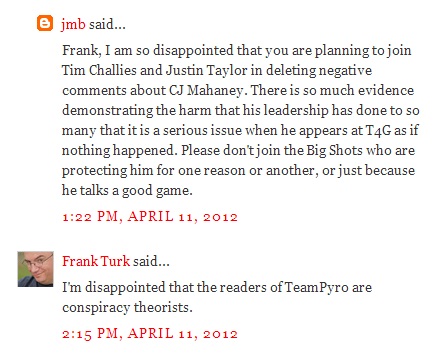
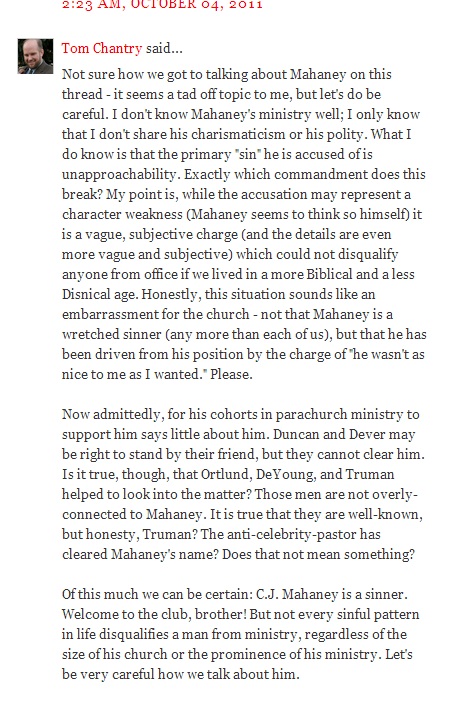


This Reformed worldview is the reason for the present-day tsunami of spiritual/sexual abuse in the church. While the Reformed accuse dispensationalists of escapism their doctrine is a gnostic-like escape from the here and now. It has always appealed to intellectual elitists and run along the upper socio-economic paths. It avoids the messy, painful experience of fighting for the most vulnerable among us. Embracing pain and suffering as the gateway to joyful resurrections is the pastoral easy-button. This gives them time to blog about the “deep things” of God and supply cover for abusers.
The logic is the same, the mentality is the same, and the behavior is therefore the same: coldblooded, vindictive, and controlling.
paul
Frank Turk Helps Case Against New Calvinism Before Excommunicating Me From Pyro
 “So, is understanding Piper like going to college? Are there prerequisite books to understanding his other books? Notice that Turk does not address my reply, but brings up another book. Why? Was Piper for it before he was against it?”
“Here is Turk’s gracious reply; which by the way, he later pulled down: ‘Going forward, ‘Paul’ will be dealt with by the Blogger spam filter.’ ”
As Susan and many of my close friends know, the ill effects of New Calvinist theology on real life hits close to home for me. For me, this isn’t intriguing theological debate—I see the debris that is continually being cleaned up after this hideous doctrine. One writer called John Piper “the elder statesman of New Calvinism.” Yes, him: the one, who among other things, proclaims with certainty how someone who is genuinely saved will feel during the conversion process—apparently, they will always have joy. But the problem is how many of us, especially in western culture, and especially a new Christian, might interpret “joy.” Isn’t dogma concerning how we”feel” during conversion a subject that is best left alone lest it sets up a stumbling block to salvation? (As I have personally witnessed). Not for John Piper—he fearlessly pontificates with all confidence concerning such matters, like other New Calvinist such as Tim Keller who recently proclaimed that those who are genuinely saved must also repent of all “good works” that they did while they were unbelievers.
The insanity that is New Calvinism matters not to those I used to deeply respect among Evangelical leaders. John MacArthur and his closest associate, Phil Johnson, are absolutely hell-bent on lending creditability to the likes of John Piper via association and accolades. Phil Johnson authors a blog named Pyromaniacs. I have visited Pyro on two occasions (with multiple visits within a short time frame for each occasion)—at the behest of a friend: yesterday, and a year ago because of dialogue that was occurring there that my friend wanted me to be privy to.
Before I continue, the purpose of this post is to reveal the fact that Pyro will defend Piper for any reason and at all cost. Why? Have they, including MacArthur, become New Calvinist? I’m beginning to think so. The exchange also enabled me to better articulate what Piper teaches, which is very opportune because of his mastery in deceptive doublespeak. The latter is my primary purpose. If you want to skip all the drama and focus on that, see the two GREEN sections.
The latest topic was another open letter to John Piper authored by a member of the Pyro Team of authors, Frank Turk. The letter was like the last one I was referred to which was a “gee whiz, pweeze stop saying stuff wike that because we wuv you soooo much and it’s getting harder and harder and harder to defend you.” After being accused by Turk on an initial comment of being off-topic, I noted the first comment by another Pyro Team member (Dan Phillips) to make sure I was perceived as being on-topic regarding further comments:
Another stellar letter. Thanks, Frank.
I may say more later, but for now let me join you in affirming my own appreciation for and personal indebtedness to John Piper. Those factors don’t dull the concern I feel for Piper’s attempt here to help Warren; they heighten that concern. I think the interview neither helps Warren personally, nor does it help his perception in the eyes of those who are concerned about his (to be charitable) many missteps.
My comment that caused a disturbance was the following:
In light of Elizabeth’s comment and, [Frank Turks answer to it] “I read Ms. Taylor as saying that the radical anti-Warren crowd is disowning Piper without grasping Piper. I agree with her,” I assume the following is on-subject: I am completely indifferent to who Piper associates with because I have formed judgments about what Piper believes based on what he says and what he writes.
He believes that the Law only expresses the works of Christ and not any obligation on our part. He believes Christians are still “enslaved” to sinful passions. He believes sanctification and justification are the same thing. He believes (still undefined by him) joy ALWAYS proceeds saving faith. He believes that obedience without joy during the act “strips obedience of its moral value” (see Matthew 26 and Hebrews 11 on that ridiculous notion). My concern is for those he associates with more than anything.
A comment came later by a Pyro reader that challenged my accusation:
Paul, your comments should be retracted if you cannot back them up with evidence. Anyone who has spent time in Piper’s works already knows that you have either grossly misinterpreted his positions (at best) or are simply slandering him (at worst). Either way, you should retract the statements.
The challenge was pulled down by Turk later. Here is my response:
1. He believes that the Law only expresses the works of Christ and not any obligation on our part: “What Then Shall Those Who Are Justified Do with the Law of Moses?
Read it and meditate on it as those who are dead to it as the ground of your justification and the power of your sanctification. Read it and meditate on it as those for whom Christ is your righteousness and Christ is your sanctification. Which means read and mediate on it to know Christ better and to treasure him more” (John Piper Sermon: How to Use the Law of God Lawfully to Bear Fruit For God).
He’s saying that we are dead to the Law in regard to it having power in our sanctification. Is that true (Mathew 4:4 John 17:17 James 1:25)? Are we to just meditate on the law or obey it also? Do you really think he left out “obedience” by accident? He is also saying that we should read it as if Christ effects our sanctification in the same way he effected our justification. In other words, sanctification by justification. Also, the “Law of Moses” bit is a deliberate smoke screen. Is he saying we should only meditate on the Law of Moses and do something different with the rest of Scripture? As usual, he creates confusion in the way he uses words, like, all the time.
2. He believes Christians are still “enslaved” to sinful passions: “Yes, it becomes increasingly evident that the experience of joy in God is beyond what the sinful heart can do. It goes against our nature. We are enslaved to pleasure in other things (Romans 6:17).” [Treating Delight as Duty is Controversial written by John Piper and available on his “Desiring God” website].
“We [Christians] are enslaved to pleasure…” That’s not true about a Christian in ANY regard. Notice he cites Romans 6:17 which is in the past tense, but his statement is in the present tense speaking of the same condition of the past tense verse. How can he do that? Easy—he thinks justification and sanctification are the same regarding our role.
3. He believes sanctification and justification are the same thing: From Another Gospel P.M. Dohse, p.111 concerning Piper’s sermon, God Strengthens Us by the Gospel:
“’I know that there are people reading this [edited for written form] who are not trusting Jesus Christ, and therefore can only expect condemnation. So I’m just going to plead with you here at the end, lay down that rebellion. Lay it down. And simply embrace the gospel that Jesus Christ, the Son of God, the Righteous One, died for your sins. He was raised on the third day, triumphant over all his enemies. He reigns until he puts all of his enemies under his feet. Forgiveness of sins and a right standing with God comes freely through him alone, by faith alone. I plead with you, don’t try to be strong in your own strength; it will not be there when you need it. Only one strength will be there—the strength that God gives according to the gospel. Don’t put it off.’
Piper begins this section with the following: ‘I know that there are people reading this who are not trusting Jesus Christ, and therefore can only expect condemnation.’ In context, what does he mean that they are not ‘trusting Jesus Christ’? Well, he continues: ‘Forgiveness of sins and a right standing with God comes freely through him alone, by faith alone.’ So, who is he talking to? I’m glad you asked, he continues in the very next sentence: ‘I plead with you, don’t try to be strong in your own strength; it will not be there when you need it. Only one strength will be there—the strength that God gives according to the gospel.’ He is talking about being strong, or strengthened, in regard to ‘us’ (remember the title of the sermon that the video was excerpted from? ‘God Strengthens Us by the Gospel’). In other words, exerting our own effort in the sanctification process, and especially apart from the gospel, will result in ‘condemnation.’ This is a plea for any person who believes in synergistic sanctification to be saved.”
CONTINUE
4. He believes (still undefined by him) joy ALWAYS proceeds saving faith:
“The pursuit of joy in God is not optional. It is not an ‘extra’ that a person might grow into after he comes to faith. Until your heart has hit upon this pursuit, your ‘faith’ cannot please God. It is not saving faith” (Desiring God page 69).
“We are converted when Christ becomes for us a Treasure Chest of holy joy” (Desiring God page 66).
“Before the decision comes delight. Before trust comes the discovery of treasure” (Desiring God, page 68).
“Something has happened in our hearts before the act of faith. It implies that beneath and behind the act of faith which pleases God, a new taste has been created. A taste for the glory of God and the beauty of Christ. Behold, a joy has been born!” (Desiring God page 67).
“Not everybody is saved from God’s wrath just because Christ died for sinners. There is a condition we must meet in order to be saved. I want to try to show that the condition…is nothing less than the creation of a Christian Hedonist” (Desiring God page 61).
“Could it be that today the most straightforward biblical command for conversion is not, ‘Believe in the Lord,’ but, ‘Delight yourself in the Lord’?” (Desiring God page 55).
“Unless a man be born again into a Christian Hedonist he cannot see the kingdom of God” (Desiring God page 55).
5. He believes that obedience without joy during the act “strips obedience of its moral value”: “Unless a spontaneous affection for my person motivates you, your overtures are stripped of all moral value” (Treating Delight as Duty is Controversial written by John Piper and available on his Desiring God website).
Turk responded with a classic New Calvinist defense—if you haven’t read all of Piper’s books (what? 600 or so by now?), you can’t evaluate any of his particular statements:
Paul:
You have never read the book, “What Jesus Demands of the World”, by John Piper, have you?
So, is understanding Piper like going to college? There are prerequisite books to understanding his other books? Notice that Turk does not address my reply, but brings up another book. Why? Was Piper for it before he was against it? However, after this, he did reply:
I have read Paul’s mini-thesis on Dr. Piper and have found it, um, shall we say “less than serious with the subject matter, [Frank, please just address the quotes that plainly demonstrate my accusations] but very serious in terms of offensiveness.” It’s out, and if it turns up again, it will get deleted again [thanks for the warning Frank—like I would try to repost it—you take yourself waaaay too seriously].
Paul: for your own edification, [thanks Frank, got anything on discernment?] here’s my single-subject justification for deleting your posts [because you can’t answer the others].
You said:
[QUOTE]
He believes that the Law only expresses the works of Christ and not any obligation on our part: “What Then Shall Those Who Are Justified Do with the Law of Moses?
Read it and meditate on it as those who are dead to it as the ground of your justification and the power of your sanctification. Read it and meditate on it as those for whom Christ is your righteousness and Christ is your sanctification. Which means read and mediate on it to know Christ better and to treasure him more” (John Piper Sermon: “How to Use the Law of God Lawfully to Bear Fruit For God”).
He’s saying that we are dead to the Law in regard to it having power in our sanctification. Is that true (Mathew 4:4 John 17:17 James 1:25)? Are we to just meditate on the law or obey it also? Do you really think he left out “obedience” by accident? He is also saying that we should read it as if Christ effects our sanctification in the same way he effected our justification. In other words, sanctification by justification. Also, the “Law of Moses” bit is a deliberate smoke screen. Is he saying we should only meditate on the Law of Moses and do something different with the rest of Scripture? As usual, he creates confusion in the way he uses words, like, all the time.
[/QUOTE]
Here is the complete text of that sermon
The context for this sermon is a supplement to his 3-year preaching through the book of Romans — Rom 7-8, for example. You’ve read it, I am sure: [no Frank, I didn’t take that Piper prerequisite course] “we were living in the flesh, our sinful passions, aroused by the law, were at work in our members to bear fruit for death. 6But now we are released from the law, having died to that which held us captive,” “I was once alive apart from the law, but when the commandment came, sin came alive and I died. The very commandment that promised life proved to be death to me,” “I see in my members another law waging war against the law of my mind and making me captive to the law of sin that dwells in my members. Wretched man that I am! Who will deliver me from this body of death?” But also “For the law of the Spirit of life has set you free in Christ Jesus from the law of sin and death. For God has done what the law, weakened by the flesh, could not do.”
So Piper’s starting point is not whether there is a command to general obedience, or whether we ought to seek to do it: it is Paul’s own words which tell us that seeking justification of ourselves through the Law is only going to bring condemnation — thus we are wretched men. [But Frank, one of my points is that he then projects that point onto sanctification].
And his text for the sermon is 1 Tim 1:5-11. “we know that the Law is good, if one uses it lawfully, realizing the fact that law is not made for a righteous person” and so on [your not going to answer the question, are you?].
You are concerned that he says this much: ” if the law has done its condemning and convicting work to bring you to Christ for justification and transformation, then it is not made for you any more …”
But you have snatched it away from the very next clause: “– in that sense. There may be other uses you can make of it, but that’s not what this text is about.”
In doing that, you are the one making a confusion of the sermon and of the message [no, he later projects the justification point onto the subject of sanctification—making the two equal]. And you are using that confusion to slander Dr. Piper [no, you are slandering me, I assume, unwittingly, because you can’t decipher Piper’s deceptive doublespeak].
Don’t do that. This is your only warning.
Turk then pulled down my posts that I copied above, which I commented on:
Frank,
The fact that you pulled my posts while only addressing the more nuanced statement by Piper is telling. The fact that neither you, nor anyone else will address Piper’s outrageous statements in Desiring God is also telling. And, I find the linguistic demeanor that suggests that posting here is some kind of privilege….well, arrogant and laughable.
That initiated this lame response from Dan Phillips:
Yeah, it’s “telling” that we have a policy of trying to keep comments on the topic of the post, which your personal hobby-horse/vendetta isn’t.
And for general edification: the position that Christians are not under the law of Moses per se, but rather are under the spoken/enscripturated/heart-inscribed law of Christ per se, is neither fringe nor heresy.
Obviously, my comments were on topic. Turk is the one who opened the floor to the whole “condemning Piper without grasping Piper” thing. Hobby-horse? Vendetta? I checked. Of the 218 articles posted on my blog right now, a search turned-up zero on “John Piper” that are presently posted, but I remember one that I can’t find. In fact, someone who was apparently involved in the conversation over at Pyro emailed me and complained that they couldn’t find any of my articles on Piper. What is Phillips talking about? A New Calvinist hobby-horse? Well, he would be correct about that, but you know, somebody has to tell the truth. Accolades are not the truth just because they are accolades.
Furthermore, what’s up with, “Christians are not under the law of Moses per se, but rather are under the spoken/enscripturated/heart-inscribed law of Christ per se,” Huh? What’s the difference in light of Paul telling Timothy that “all Scrpture” is profitable for making the man of God fully equipped? What Scripture equips us and which doesn’t? Nothing in the Law of Moses equips us? And as far as living by every word that comes from the mouth of God (Matthew 4:4), is it not that per se, but this per se? Does Phillips even know what he’s saying? I doubt it.
Meanwhile, Piper Koolaid Drinker extraordinaire, Mike Ricardo, said this to the reader who launched the original challenge:
You’re welcome to venture into this with Paul, but just know that he’s already ground this axe some time ago — in fact, almost a year ago to the day [this should reveal how enamored I am with the Pyro team]. This is his pet issue, and despite the lengths to which responses have gone, there seems to be no arrival in his understanding.
Add to that the fact that this post has nothing to do with Piper’s theology of Law and Gospel, but with his recent interview with Rick Warren [then why did Phillips make the opening comment that he made?].
The individual who first challenged me then typed this Extreme Anti-Berean Team statement:
Mike Riccardi,
thanks for the heads up. I should have known better. [CLICK, that was easy! Is it now any wonder why Pyro has the following that they have?]
I made this final appeal:
Frank,
I’m not too sure you guy’s KNOW my motives; forgive me if I don’t take that to the bank just yet. So, you guys have no problem with the 6 quotes from Desiring God. Ok, fair enough, but just do me one last favor; I will not even respond—I will let your answer stand as it is for your readers and will be instructed by it—as my promise not to respond should indicate. Fair enough? And besides, you did respond to it—I’m just requesting a final clarification.
First, you said:
“But you have snatched it away from the very next clause: ‘– in that sense. There may be other uses you can make of it, but that’s not what this text is about.’
In doing that, you are the one making a confusion of the sermon and of the message. And you are using that confusion to slander Dr. Piper.”
But Frank, he goes on to say: “But for the righteous – for people who have come to Christ for justification and come to Christ for the inner spiritual power to love, this role of the law is past. From now on, the place where we seek the power to love is not the law of commandments but the gospel of Christ.” How does that jive with John 17:17 and John 14:15,16? Is he not saying that as believers, we have to go through the “gospel” first before the law—and if we don’t, we are acting as if the power is in the letter of the law instead of the Spirit? And what does it mean to love through the gospel as opposed to loving through the law? What does that even mean? Our love is defined by “gospel” and not “law”? Frank, is this not a fair question? AND, the law and the gospel are for justification, but moving forward—only the gospel is applicable for sanctification? Forgive me if it is eerily similar to, “The same gospel that saves you also sanctifies you.”
Second, and lastly, and I will bother you no more:
On point 3, I cite his entire conclusion (and summation) to God Strengthens Us by the Gospel. Ok, who is “us”? Christians, right? I mean, unbelievers don’t need “strengthening”—they need salvation. So, in the conclusion, apparently, if I’m sitting there listening, I’m thinking: “Oh, ok, this is a gospel presentation just in case there are unsaved people here”;
“I know that there are people reading this [edited for written form] who are not trusting Jesus Christ, and therefore can only expect condemnation. So I’m just going to plead with you here at the end, lay down that rebellion. Lay it down. And simply embrace the gospel that Jesus Christ, the Son of God, the Righteous One, died for your sins. He was raised on the third day, triumphant over all his enemies. He reigns until he puts all of his enemies under his feet. Forgiveness of sins and a right standing with God comes freely through him alone, by faith alone”
BUT then he concludes, STARTING IN THE VERY NEXT SENTENCE with:
“I plead with you, don’t try to be strong in your own strength; it will not be there when you need it. Only one strength will be there—the strength that God gives according to the gospel. Don’t put it off.”
Frank, he is clearly synthesizing those who need strengthening with those who need the gospel, and being “strengthened in you own strength” is the object. AND, this is an *either/or* hermeneutic that implies that it is either all God (gospel—ever read ”God is the Gospel”?) OR all “us.” But in John 14:16, which is connected to verse 15 by the conjunction “and,” (as translated by the Bible of choice according to Piper, the ESV), the Holy Spirit is called a “helper.” What is he helping us with? It’s in verse 15—loving Christ by keeping his commandments! So, how do we know when our “own efforts “ are our “own strength” instead of God’s? What’s the difference between striving to obey with the Spirit’s “help” and being strengthened by the strength God gives “according to the gospel” which also necessitates the law to condemn for justification, but now only the “gospel” apart from the law is needed?
Are these not fair questions?
Here is Turk’s gracious reply; which by the way, he later pulled down:
Going forward, “Paul” will be dealt with by the Blogger spam filter.
Frank, I’m not sure, but I have a hunch that I will get over it.
paul

 Paul's Passing Thoughts
6 comments