You Believe a False Gospel If…
If you believe Christ died for our present and future sin—you believe a false gospel.
If you believe Christ came to obey the law for us—you believe a false gospel.
If you believe saints have NO righteousness of our own—you believe a false gospel.
If you believe sanctification is the growing part of salvation—you believe a false gospel.
If you believe you are a “sinner,” you are a sinner and you need salvation—you believe a false gospel.
If you believe that justification is merely a legal declaration—you believe a false gospel.
If you believe weakness is sin—you believe a false gospel.
If you believe the same gospel that saved you also sanctifies you—you believe a false gospel.
If you believe your sins are merely covered, and not ENDED—you believe a false gospel.
If you preach the gospel to yourself everyday, you still need salvation—this would seem evident.
If you see no need to interpret Bible verses in context of justification, or sanctification, or redemption…
you believe a false gospel.
Protestant/Baptist Theological Stupidity: A Mother Can Give Birth and Leave the Baby Unborn
 Meme Post #3
Thank goodness your mother didn’t give birth to you and leave you unborn! Such is the logic of this meme because those who hold to progressive justification do not understand the new birth. The new birth ends sin—there is no sin to be left in or to deal with in regard to justification. Christ does not finish justification through sanctification. The new birth justifies completely apart from the law whereas sanctification needs the law (Jn 17:17, Matt 4:4). The weakness of the flesh yields no condemning sin that Christ could theoretically “leave us in.” There is NO “your sin” as that sin died with the old you. Your so-called “present sin” is not the same sin that once condemned you. The new birth ends condemning sin and you cannot be unborn.
The Power of Christian Living is Found in Family Relationship NOT a “Personal” Relationship
 One of the prevailing pithy truisms of churchianity is that “Christianity” is a “personal relationship” with none other than Jesus Christ. Of course, per the usual, because it sounds spiritual, no one thinks beyond the surface of the truism and questions what that means exactly. Be sure of this: the statement promotes a specific soteriology, worldview, and philosophy of life. If a string of memes replace the meat of Scripture, the latter is effectively replaced, and that is exactly what has happened in our day with the personal relationship with Jesus meme leading the way.
What’s really behind it and why has it sucked the life out of Christianity? First, it denies a biblical definition of the new birth. It replaces a literal family of God reality with ONE pseudo-relationship that is at best ambiguous. Proponents of the truism, when they care to add some sort of substantive mini-treatise to the meme, separate the reasoning of propositional truth expressed in words, even words from Jesus Himself, from this highfalutin “Christianity is a relationship [singular], not a religion.” The supposed antithesis in this case, “religion,” according to the logical conclusion, is propositional truth of some sort expressed in a common understanding of Bible sentences. This is the way it is sometimes expressed: “Jesus is a person, not a precept.” Supposedly, if one attempts to follow Jesus according to a reasonable interpretation of what He said as recorded in Scripture, we miss the point by appealing to reason. Instead, we need to seek a relationship with Jesus that is “more like falling in love” as expressed in two bestselling contemporary works by Jason Gray (a #1 song) and Francis Chan (the book, “Crazy Love.”).
Hence, if salvation is strictly experiential, like being “madly in love” with someone, it’s not works on our part and enables us to live out our “Christian” lives by faith alone, and apart from reason to boot. After all…“we [Christians] live [our Christian lives] by faith [alone] NOT by sight [ie., reason]” as the twisting of 2Corintians 5:7 is often applied. This mystical lovey-dovey Jesus is my boyfriend theology effectively separates professing Christians from a literal true-to-life family of God application via the new birth. It replaces a salvific family relationship with a singular relationship. The differences are ever-so subtle, but catastrophic. Rather than our identity being that of a literal child of God in a family setting, we are “Christ’s bride” whom He has married regardless of our shortcomings. Yes, we are supposedly lowly lovers married to a “friend of sinners” who “bring nothing to the marriage.”1 Yes indeed, the lowly lovers identity versus family children enables the redefinition of the new birth as some sort of ongoing exhilarating experience with our “lover.”2
But what is the new birth from a true biblical perspective? It is “the free gift”3 and “the promise.”4 Salvation is the receiving of the promised Spirit that was even a promise made to Christ Himself.5 Christ made the coming promise of the Spirit possible by dying for our sins and ending the law of sin and death. Prior to the coming of the promised Spirit, Jews and Gentiles were not baptized into one body, but at any rate, this baptism of the Holy Spirit makes a person a literal family member of God. This is a onetime personal event that is irreversible—you cannot unborn someone.
The aversion to biblical new birth finds its roots in Gnosticism which rejects the uniting together of holiness and the material. Even though Christians remain in mortal bodies, they are yet God’s righteous children. 1John ch.3 makes it clear that we are God’s literal offspring and His seed is within us. In contrast, the idea that our relationship is with one person who substitutes everything for us as opposed to a family relationship is the major consideration. Rather than Christ making the onetime baptism of the Spirit possible through His onetime death, He is made to be a salvific avatar that substitutes everything efficacious to salvation through faith in Him alone. This is a denial of the new birth and our true identity as God’s righteous children. Salvation is not a onetime spiritual birth, it is a process through the worship of one person who substitutes a life that we don’t actually possess. Worship is not family life, it is something that we do to keep our salvation by faith alone. Hence, the idea of faith alone actually becomes a work on our part as it evokes the substitutional work of Christ for Christian living. Obviously, therefore, the “Christian’s” true ability to love is circumvented.
When one desires to receive the promise—the free gift, the Holy Spirit falls on them and baptizes them into Christ’s death and resurrection.6 This is the literal new birth. This makes us righteous children of God in the literal sense per Romans ch.6. Why we are literally righteous is explained in Romans ch.7, and our fulfillment of the law to our Father’s pleasure is explained in Romans ch.8.
In other words, the substitution of Christ happened once to make the new birth possible, but the so-called “personal relationship” calls for a continued substitution that negates a literal family relationship which is given mere lip service. Along with the avatar approach, not to mention sub-avatars, is the institutional angle. Institutions go hand in hand with the idea of religious authority and hierarchy. This is where the Christianity brand is found impotent in both reproduction and functionality.
The early church met exclusively in private homes, why? Because they understood that they were a literal family. They also had “all things in common”7 What family builds a separate building and pays to maintain it for the purpose of Thanksgiving dinner and other family get-togethers? How much sense does that make? And how many families organize systems of commerce within the household? If a sibling in a household learns something new about living, does he write a book and sell it to his brothers and sisters? No, he shares it at the dinner table or other like family experiences.
A hierarchical corporate mentality and structure naturally subjugates a literal family system. The two function differently in almost every respect. This is the key to revival—a return to the apostolic assembly of Christ and its literal family construct and function. It is a multifaceted relationship with many, not ONE.
paul
1Paul David Tripp: How People Change, Punch Press 2006
2Francis Chan: Crazy Love
3Romans 5:15,16, 17 “the free gift” stated 5 times.
4Acts 2:39, Ephesians 2:12, Galatians 3; “promises” “the promise,” “by promise” 8 times.
5Galatians 3:16
6Acts 11:15
7Acts 2:44
Albert Mohler: “Christians” Retain Their Salvation by Sitting Under Pastoral Preaching
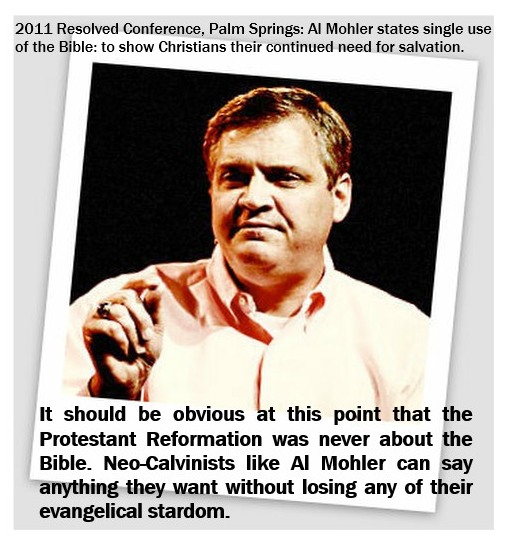 This ministry has documented extensively through the words of Protestant evangelical pundits what the true soteriology of authentic Protestantism is: it is the false gospel of progressive justification. One is saved through the institutional church and its hierarchical priesthood, and then must remain faithful to the institution and its “means of grace” in order to retain salvation. Though evangelicals vehemently deny salvation by church membership, the facts are irrefutable.
Let’s review the major tenets of this false gospel propagated by Protestants and their many offshoots such as Baptists etc. Though they claim salvation by new birth, the biblical definition is denied. In contrast to the biblical definition, justification is a mere “forensic declaration.” Instead of the saint being literally made righteous, they are only declared righteous. This attempts to reconcile their error concerning law and gospel.
In the soteriology of Protestantism, the law only has one purpose instead of two: it only serves to show one’s sin.1 Therefore, the law is justification’s standard. Hence, the simple biblical concept of justification being apart from the law is totally missed.2 Now more error must be added to cover for the fundamental error: their definition of justification as a legal declaration. Now, the law is unwittingly added as something that can give life.3 And since it is seated on a throne beside God and the Son, “its righteous demands must be continually fulfilled.” This necessarily requires even more error: the idea that Christ not only died for our sins, but that He also lived a perfect life in obedience to the law so that His obedience can be continually imputed to the law in the believer’s stead. This is known as “double imputation.”
Enter even more error. Since justification is only a legal declaration and didn’t put the old us to death through Spirit baptism, and we are therefore still under the law’s condemnation instead of Christ’s death ending that aspect of the law, our sins are only COVERED and not ENDED which means continued imputation of Christ’s death and righteousness is needed. However, we don’t need Christ’s obedience to the law imputed to us in order to keep us saved because we were made righteousness in being resurrected with Him4—also in Spirit baptism. This frees us from all condemnation under the law and frees us to serve according to the positive aspects of the law…love.5
And consequently due to this error, “saints” only remain covered by double imputation through faithfulness to the institutional church and its “means of grace” or what really boils down to means of continued salvation.6 These “means of grace” can only be found in the institutional church, and there are many, but one is the hearing of pastoral preaching. Faith comes by hearing the word of God, we know that, but in context of Protestantism, that’s an ongoing need that is only found in the institutional church. If we don’t continually hear the word from those “under the authority of the church” we lose our faith and subsequently our salvation.
In the following video link, Albert Mohler expresses these ideas starting at mark 1:14:00. Yes, he throws in some red herrings in regard to individual study of the word, but take note towards the end regarding his statement that salvation is for the lost as well as the saved. In other words, the “saved” need continued means of salvation that can only be found in the church. This ministry has documented many statements by evangelical leaders plainly stating that Christians continue to need salvation. Where the confusion often comes in is with the citation of verses referring to the saving of the mortal body, viz, redemption which is NOT salvation in the justification sense. Both only happen once.
paul
1Romans 8:2
2Romans 3:21
3Galatians 3
4Romans 5 and 6
5Romans 7 and Galatians 5:6
The Protestant Twisting of 1John, Part 4 – A Clarification: Gospel and Obedience
 Originally published April 20, 2015
Listen to audio or download audio file.
Welcome to Blogtalk Radio False Reformation this is your host Paul M. Dohse Sr. Tonight, part 4 of “The Protestant Twisting of 1John: A Clarification.” If you would like to add to our lesson or ask a question, call (347) 855-8317. Remember to turn your PC volume down to prevent feedback. Per the usual, we will check in with Susan towards the end of the show and listen to her perspective.
If you would like to comment on our subject tonight, you can also email me at paul@ttanc.com. That’s Tom, Tony, Alice, Nancy, cat, paul@ttanc.com. I have my email monitor right here and can add your thoughts to the lesson without need for you to call in.
Initially, I wanted to just address 1John 1:9 in a thorough way to debunk this whole Protestant idea that we keep ourselves saved by returning to the same gospel that saved us. And, the way we reutilize the same gospel that saved us is a continued repentance for “present sin.” It’s this whole idea that Jesus died for our past sins, but we must ask forgiveness for known present sin in order to keep ourselves saved. When we do that, it’s a reapplication of Jesus’ death for present sin. Hence, 1John 1:9.
But it doesn’t stop there in Protestant soteriology. They then concern themselves with the question of true righteousness. If our sins are forgiven, that keeps us out of hell, but it doesn’t make us truly righteous. What to do? So here is what they came up with: Jesus came to die for our forgiveness, past and present IF we return to the same gospel that saved us by faith alone, but He also came to keep the law perfectly so that His perfect obedience could be imputed to “Christian” life. The Reformed call this “double imputation.”
And it turns the true biblical gospel completely upside down. First, it makes the law the standard for justification. There is no law in justification, we are justified APART from the law. Why would Christ obey the law for us when justification is apart from the law? Then what is the standard for righteousness? NOT the law, but rather God’s righteousness. What’s that? For one, and primarily, it’s the new birth. For us, the standard of righteousness is being a child of God. Being the offspring of God is what makes us righteous. Kinship, not law.
Secondly, we are not justified by the law, no matter who keeps it—who keeps it is not the point, the law itself is the point, because there is no law that can give life. Only the new birth gives life (Galatians 3:21).
Thirdly, double imputation is obviously a covering for sin with the righteousness of Christ and not an ENDING of sin. Our sins are not “taken away” they are only covered. “Christianity” is about living a life of faith only to maintain a covering for sin. Therefore, we are not the ones really obeying, and therefore, we are not the ones performing love either.
And boy does this notion land us right where we are at in 1John. I have invested so much in the untwisting of 1John 1:9 in this series, that I thought, “I might as well finish the book out and make it our 1John commentary.” And so it is.
This is our theses: the new birth creates us anew into people who love the truth, and therefore practice oblove. That’s a new word that I made up. What is the definition of oblove? It’s the combination of the words “love” and “obedience.” Biblically, you cannot separate these two words, they are synonymous. The law is the Bible, and it is a book of condemnation to the unsaved and a beloved love manual for those born again. This is also why our sins are not covered, they are taken away (1John 3:5). Christ came to take away sin, not cover it.
You know, many go to church and sing the hymns, and many listen to Christian radio and raise their hands in praise while stopped at red lights, but a lot of that good Protestant music is just really bad theology that imperils the soul and stops far short of inciting the curiosity of the unsaved. One example is a beautiful song by Steve Camp titled, “He Covers Me.” But again, the premise of the song is that our sins are covered and not ended.
You know, there is a quiet revolution going on in Christianity. Christian husbands are beginning to stand up and assume their rightful role as spiritual leaders. This necessarily means leaving the institutional church which deliberately seeks to emasculate the men among us. One thing that I hear back is that fathers are beginning to stand silent and not sing traditional songs that are deviations from the truth. Good for them. I even hear back that their children ask, “Daddy, why aren’t you singing?” And they tell them why. Undoubtedly, children and wives will get way more out of these types of examples rather than 365 different versions of the same gospel that saved us.
“Why is it that all we ever hear about in the church is the gospel?” Because we have to keep returning to the same gospel that saved us to keep ourselves saved, and by the way, the only place that this continued atonement is valid is in the institutional church. Sure, Protestants will deny salvation by church membership; they will rather become indignant and state that salvation is only found in the gospel. However, the fact remains that they also believe that authority to preach the gospel is vested in the institutional church.
If our sins are only covered, the focus of the Christian life is to keep ourselves covered, not obedience because now obedience is defined by law-keeping. We have been trained mentally to think of obedience as something demanded by the law. This makes the law a co-life-giver with God. At least in one regard, the idea of one God connects with this idea. There is only one life-giver (Galatians 3:10-21).
I strongly suspect that when the Bible talks about God being one, it in no way includes the context of the Trinity. It’s interesting to note that in context of Galatians 3:10-21, the point is that the law is not a coequal with God—there is only one God.
1John 3:1 – See what kind of love the Father has given to us, that we should be called children of God; and so we are. The reason why the world does not know us is that it did not know him. 2 Beloved, we are God’s children now, and what we will be has not yet appeared; but we know that when he appears we shall be like him, because we shall see him as he is. 3 And everyone who thus hopes in him purifies himself as he is pure.
4 Everyone who makes a practice of sinning also practices lawlessness; sin is lawlessness. 5 You know that he appeared in order to take away sins, and in him there is no sin. 6 No one who abides in him keeps on sinning; no one who keeps on sinning has either seen him or known him. 7 Little children, let no one deceive you. Whoever practices righteousness is righteous, as he is righteous. 8 Whoever makes a practice of sinning is of the devil, for the devil has been sinning from the beginning. The reason the Son of God appeared was to destroy the works of the devil. 9 No one born of God makes a practice of sinning, for God’s seed abides in him, and he cannot keep on sinning because he has been born of God. 10 By this it is evident who are the children of God, and who are the children of the devil: whoever does not practice righteousness is not of God, nor is the one who does not love his brother.
11 For this is the message that you have heard from the beginning, that we should love one another. 12 We should not be like Cain, who was of the evil one and murdered his brother. And why did he murder him? Because his own deeds were evil and his brother’s righteous. 13 Do not be surprised, brothers, that the world hates you. 14 We know that we have passed out of death into life, because we love the brothers. Whoever does not love abides in death. 15 Everyone who hates his brother is a murderer, and you know that no murderer has eternal life abiding in him.
16 By this we know love, that he laid down his life for us, and we ought to lay down our lives for the brothers. 17 But if anyone has the world’s goods and sees his brother in need, yet closes his heart against him, how does God’s love abide in him? 18 Little children, let us not love in word or talk but in deed and in truth.
19 By this we shall know that we are of the truth and reassure our heart before him; 20 for whenever our heart condemns us, God is greater than our heart, and he knows everything. 21 Beloved, if our heart does not condemn us, we have confidence before God; 22 and whatever we ask we receive from him, because we keep his commandments and do what pleases him. 23 And this is his commandment, that we believe in the name of his Son Jesus Christ and love one another, just as he has commanded us. 24 Whoever keeps his commandments abides in God, and God in him. And by this we know that he abides in us, by the Spirit whom he has given us.
The law is not the standard for justification; it is the standard for our love, obedience, and submission. If there is a standard for justification at all, it would simply be defined by the new birth. We are justified by virtue of being in God’s family. The first man was a created being. God did not decide to save man by restoring a covenant of works, or restoring man’s image created in the likeness of God, or to restore paradise lost. He decided to save man by making him His literal family. The gospel isn’t about restoring things; it’s about making all things new. This defines you as pure, albeit in mortality. Nevertheless, being born of God in mortality results in the inevitable morphing into more and more purity:
See what kind of love the Father has given to us, that we should be called children of God; and so we are. The reason why the world does not know us is that it did not know him. 2 Beloved, we are God’s children now, and what we will be has not yet appeared; but we know that when he appears we shall be like him, because we shall see him as he is. 3 And everyone who thus hopes in him purifies himself as he is pure.
Let’s ask an interpretive question here. What did Jesus mean when He told John the Baptist that His baptism by John would fulfill all righteousness? I think it fulfilled all righteousness by representing the literal new birth, or Spirit baptism. Though we still reside in mortal bodies, the decision to be saved is a decision to follow Christ in baptism, or a decision to be born again. That’s the gospel. That’s what the gospel is.
Romans 6:1 – What shall we say then? Are we to continue in sin that grace may abound? 2 By no means! How can we who died to sin still live in it? 3 Do you not know that all of us who have been baptized into Christ Jesus were baptized into his death? 4 We were buried therefore with him by baptism into death, in order that, just as Christ was raised from the dead by the glory of the Father, we too might walk in newness of life.
5 For if we have been united with him in a death like his, we shall certainly be united with him in a resurrection like his. 6 We know that our old self was crucified with him in order that the body of sin might be brought to nothing, so that we would no longer be enslaved to sin. 7 For one who has died has been set free from sin. 8 Now if we have died with Christ, we believe that we will also live with him. 9 We know that Christ, being raised from the dead, will never die again; death no longer has dominion over him. 10 For the death he died he died to sin, once for all, but the life he lives he lives to God. 11 So you also must consider yourselves dead to sin and alive to God in Christ Jesus.
12 Let not sin therefore reign in your mortal body, to make you obey its passions. 13 Do not present your members to sin as instruments for unrighteousness, but present yourselves to God as those who have been brought from death to life, and your members to God as instruments for righteousness. 14 For sin will have no dominion over you, since you are not under law but under grace.
The more you study the apostle John, the more you will see the apostle Paul. Romans 6 is key here. The perfection of the law is not the standard for righteousness, passing from life to death is the standard. Though we still sin, we are dead to sin. Being deemed righteous in our present state is defined by a reversal of slavery leading to a new direction in life. Romans 6 explains, as we shall see, 1John 3. The literal new birth, in essence reverses slavery (Romans 6:20). This also debunks the whole Reformed total depravity song and dance. Before the baptism of the Spirit that comes by believing on Christ, the unregenerate are free to do good, but enslaved to the law of sin and death (Romans 8:2).
Being under the curse of the law is both a forensic statement and a state of being. It is true, while under law, a perfect keeping of the law is demanded. But this is key: when it gets right down to it, unbelievers are indifferent to the Bible or the law of God. And remember, the law and the Bible are the same thing. Man is capable of doing good, and in fact does do good, but because he/she has no love for God’s truth, and in fact are indifferent to it, life decisions lead to many-faceted forms of death, and ultimately, eternal death. Unbelievers that live according to conscience will suffer a lesser punishment in this life and the life to come.
Believers can in fact make life and death decisions, but are inclined towards obeying the law because of the new birth. Clearly, the Bible states that there is a reversal of slavery. The believer is enslaved to righteousness, but unfortunately free to sin. But according to Paul, a believer can stupidly enslave themselves to certain sins by obeying the desire that the sin produces. The believer is no longer enslaved to sin, but can be ignorant of this fact. And keep in mind, Protestantism is predicated on the idea that we are still enslaved to sin as believers which goes part and parcel with still being under the law and law continuing to be the standard for justification.
Listen, here is why the home fellowship movement is going to eventually take off: the alternative is Protestantism which defines the believer according to how the Bible defines an unbeliever. Eventually, people are going to figure out that they have been proudly proclaiming themselves as unregenerate in the name of Christ.
Lastly, this is defined by the fact that believers have the freedom to present their bodies as living sacrifices, or in other words, present their members for holy purposes that please God. The body is not inherently evil because it is part of the material world. Whether saved or unsaved, the body can be used for good purposes. However, in the case of an unbeliever, good behavior doesn’t lead to life more abundantly, it just leads to lesser punishment and a more bearable eternal state. For the unbeliever, good behavior merely leads to less death. For the believer, obedient love leads to more life.
Now with all of this in mind, let’s read further in 1John Chapter 3:
4 Everyone who makes a practice of sinning also practices lawlessness; sin is lawlessness. 5 You know that he appeared in order to take away sins, and in him there is no sin. 6 No one who abides in him keeps on sinning; no one who keeps on sinning has either seen him or known him. 7 Little children, let no one deceive you. Whoever practices righteousness is righteous, as he is righteous. 8 Whoever makes a practice of sinning is of the devil, for the devil has been sinning from the beginning. The reason the Son of God appeared was to destroy the works of the devil. 9 No one born of God makes a practice of sinning, for God’s seed abides in him, and he cannot keep on sinning because he has been born of God. 10 By this it is evident who are the children of God, and who are the children of the devil: whoever does not practice righteousness is not of God, nor is the one who does not love his brother.
John wrote what he wrote in 1John 3 because of what Paul wrote in Romans 6—it’s saying the same thing. Obeying the law isn’t the issue, a “commitment” to obey the law isn’t the issue, the reality of the new birth is the issue.
1Corinthians 15:1- Now I would remind you, brothers, of the gospel I preached to you, which you received, in which you stand, 2 and by which you are being saved, if you hold fast to the word I preached to you—unless you believed in vain.
3For I delivered to you as of first importance what I also received: that Christ died for our sins in accordance with the Scriptures, 4 that he was buried, that he was raised on the third day in accordance with the Scriptures, 5 and that he appeared to Cephas, then to the twelve. 6 Then he appeared to more than five hundred brothers at one time, most of whom are still alive, though some have fallen asleep.
This is, as Paul called it, the gospel of “first importance” or literally “the gospel of first order of importance.” There is way more behind this than a mental ascent to the facts of the gospel. You have to believe that this first happened to Christ in order to believe that it really happened to you spiritually. Repentance is a change of mind in regard to many things concerning your life and the life of Christ.
By the way, there was an evangelical movement for a while that emphasized the new birth. It peaked in the 70’s and was considered to be the most egregious of all false gospels. The Australian Forum, the think tank that gave birth to the present-day return to authentic Reformed soteriology, actually published an article titled, “The False Gospel of the New Birth.”
John continues in chapter 3 to explain one of the characteristics of being born again, love. But let me insert this, and this is VERY important: the characteristics of the new birth are framed in what the Bible refers to as “abiding.” If God’s seed “abides in” us (1John 3:9), other things also abide in us: the fact that we abide in Him also; the truth abides in us; we know the truth; we love the truth; we love fellow Christians; we do not practice sin, but rather practice righteousness as a life direction and pattern; we love God’s law; we submit to need; we obey; we seek to please God; we have a hunger for learning more of God’s word, and many more can be listed.
Let’s read more of John 3 with this in mind:
11 For this is the message that you have heard from the beginning, that we should love one another. 12 We should not be like Cain, who was of the evil one and murdered his brother. And why did he murder him? Because his own deeds were evil and his brother’s righteous. 13 Do not be surprised, brothers, that the world hates you. 14 We know that we have passed out of death into life, because we love the brothers. Whoever does not love abides in death. 15 Everyone who hates his brother is a murderer, and you know that no murderer has eternal life abiding in him.
16 By this we know love, that he laid down his life for us, and we ought to lay down our lives for the brothers. 17 But if anyone has the world’s goods and sees his brother in need, yet closes his heart against him, how does God’s love abide in him? 18 Little children, let us not love in word or talk but in deed and in truth.
See, the order in which John discusses these things is in no wise disconnected. We need to start thinking about “obedience” in reference to love and the new birth. Really, the Christian life is about love. But listen, any love that flows from you starts with a love for truth. Also, please take note of a more biblical definition of love: love is a submission to need—that’s love. When the Scriptures tell women to submit to their husbands, that’s just another way of telling wives to love their husbands. When the Bible tells men to love their wives, it’s simply telling men to submit to their needs. Look at 1John 3:17 again. How does benevolence get parachuted into that body of text out of nowhere? John goes from discussing murder to meeting financial need; it seems like he is all over the map, but not really.
Lastly, working out the new birth with love leads to assurance.
19 By this we shall know that we are of the truth and reassure our heart before him; 20 for whenever our heart condemns us, God is greater than our heart, and he knows everything. 21 Beloved, if our heart does not condemn us, we have confidence before God; 22 and whatever we ask we receive from him, because we keep his commandments and do what pleases him. 23 And this is his commandment, that we believe in the name of his Son Jesus Christ and love one another, just as he has commanded us. 24 Whoever keeps his commandments abides in God, and God in him. And by this we know that he abides in us, by the Spirit whom he has given us.
Assurance of salvation comes through working out our new birth in fear and trembling. Assurance of salvation is grounded in the ending of the law because the old us died with Christ resulting in no condemnation, while our new relationship to the law leads us in love and life. Now listen, even a casual student of the Bible can begin to hang Bible verses all over this framework.
Next week, we will build on this as we go into chapter 4—let’s go to the phones.

 Paul's Passing Thoughts
35 comments