The Institutional Church and Wedding versus Marriage
 I am presently reading Houses That Change the World by Wolfgang Simson. First, let me say that those whom I disagree with on theological issues while still recommending them in regard to important contributions of thought is a very short list as far as I am concerned. It’s maybe one hand, in regard to fingers. At this point, I am not ready to add Wolfgang Simson to the list, but I still feel that this book is must reading for every Christian living today.
A revised version, by what means unclear, titled The House Church Book, completely rewrites chapter two (according to my Kindle version) and edits out Simpson’s historical account of persecution suffered by house churches via the Reformers. I have ordered a hardcopy to confirm this interesting edit. According to Simpson on pages 67 and 68, the Reformers were responsible for civil laws banning home fellowships (especially in regard to the Anabaptists) and were directly and indirectly responsible for at least 30,000 Anabaptist deaths.
We must remember that the Western institutional church is a product of the Reformation, and the level of denial regarding its bad fruit never ceases to amaze. How can those who put people to death for disagreeing with them on theological issues be our heroes? The Fox Book of Martyrs, considered a classic among Evangelicals, shamelessly excludes the historical Protestant inquisition.
So far, and from everything I have seen from a cursory perusal through the rest of the book, it is a profound form of thinking out of the box in regard to Western tradition. I pause here as I work through the book to add thoughts to his idea of a wedding ceremony versus married life (p. 19).
A wedding is a formal ceremony that marks a commitment to sharing a life together. It is a formal public confession. It takes much planning and proper execution. Married couples do not repeat the ceremony on a weekly basis. Married life is much different from the ceremony—it moves on from symbolism to substance. It moves on to The Way (the initial term for Christianity) from the what.
Is church a weekly ceremony? A weekly celebration? Is life imparted by the living out of life, or something symbolic of that life? Do marriages grow by the initial ceremony? Do we have a marriage ceremony every week in order to grow in our marriage? Listen to Protestant pastors (especially those of the Neo-Reformed bent) carefully; in essence, life does come by celebrating our initial conversion. “Grace” is imparted by coming to the “worship service.” They openly admit that church is all about “the gospel.” One pastor told me that they cancelled children’s church so that the children would be in adult church and therefore, “under the gospel.”
Rather than a less formal, less structured fellowship that equips and encourages, life is imparted by a ceremony. Consider the following statement by Neo-Calvinist Michael Horton:
God gathers his people together in a covenantal event to judge and to justify, to kill and to make alive. The emphasis is on God’s work for us – the Father’s gracious plan, the Son’s saving life, death, and resurrection, and the Spirit’s work of bringing life to the valley of dry bones through the proclamation of Christ. The preaching focuses on God’s work in the history of redemption from Genesis through Revelation, and sinners are swept into this unfolding drama. Trained and ordained to mine the riches of Scripture for the benefit of God’s people, ministers try to push their own agendas, opinions, and personalities to the background so that God’s Word will be clearly proclaimed. In this preaching the people once again are simply receivers – recipients of grace. Similarly, in baptism, they do not baptize themselves; they are baptized. In the Lord’s Supper, they do not prepare and cook the meal; they do not contribute to the fare; but they are guests who simply enjoy the bread of heaven. As this gospel creates, deepens, and inflames faith, a profound sense of praise and thanksgiving fills hearts, leading to good works among the saints and in the world throughout the week. Having been served by God in the public assembly, the people are then servants of each other and their neighbors in the world.
It’s like trying to obtain a deeper marriage by revisiting the original ceremony, instead of sharing the experience of obeying God’s word in real life:
The image of much contemporary Christianity could be summarized as holy people coming regularly to a holy place on a holy day at a holy hour to participate in a holy ritual led by a holy man dressed in holy cloths for a holy fee (Preface p.11).
paul
Who Knew? Discipleship After the Institution
 I am presently in the midst of writing the second volume of The Truth About New Calvinism and have a good start accordingly. Those who have agreed to do editing have requested a full manuscript when it is done rather than installments (that’s why some of you have not received scripts lately). And, John Immel has agreed to write the forward!
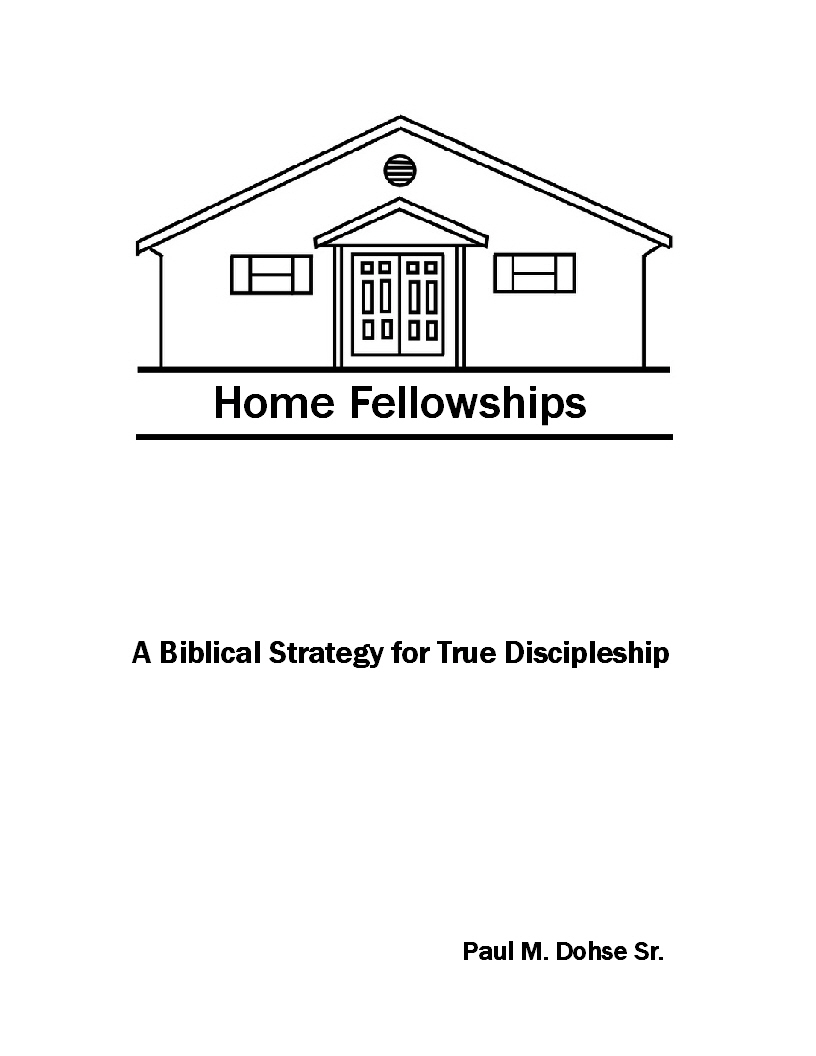
However, I have taken a short break to write a booklet on the New Testament assembly model. I am compelled to do this because the institutional church versus something else motif seems to be gaining serious traction. It’s the something else I am concerned with; we can’t just stop doing things, we need to replace what we have put off with the right replacement. Christians fellowshipping together is extremely important. Folks, we can’t just stop assembling together while going to “Echurch.”
Consider a comment I read yesterday on another blog:
Members of institutional churches are slaves. The Pharoes want their pyramids (institutional religious themed businesses) built, and they need slaves (members) to do the labor. The slaves go on visitation hoping to recruit new slaves (members). The slaves go into the community not with the gospel, but with cards telling what time Sunday School starts, etc.
The slaves have to gather their own straw (pay into the pot in order to use their spiritual gift), as many Pharoes will not let you serve in their “church” unless you pay into the pot, all the while they will not use their gifts without being paid out of the pot. Tell me that the children of God today are not taken bondage by a spiritual Egypt (institutional churches) and serve a Pharoe (clergy employed pastor), and needs a Moses to lead them out of this slave system. Look at the lies told to church members at this link here: [link has some great ideas, but don’t care to indorse it].
The parable is a little raw, but as we blush, we have to admit that it is technically all true. The link that was cited supplies resources/ammunition for those who are anti-institutional church, but again, no alternatives. That is why I am compelled to write this booklet. I want to at least get the ball rolling with some foundational challenges and a place to start. For those not assembling with other believers, it’s time to decide on a course of action IMO. I hope this booklet will encourage you to do so.
And in regard to the book, I am finding myself in the midst of some very interesting research. I have been able to conclude that the New Testament has left us an objective, definitive, Assembly model. And here is something cool: even though this will entail massive research of which I am able to do almost full time, the booklet is being kept to 50 pages; I am only hitting the high points.
I also want to put some history in there. When and how did the New Testament Assembly become an institution? Clearly, the apostles did not leave an institutional model. And, in the New Testament model, all, I repeat, ALL authority is in Christ. Unity is predicated on agreement regarding what Christ said. Fellowships are predicated on various degrees of agreement and cooperation—not horizontal authority. Vertical authority, horizontal agreement and a co-op of gifts occupied by each member. Leadership is a gift, not a position of authority.
This is what my research is beginning to reveal: a contention over what constitutes unity took place very early in the apostolic church era; authority versus fellowship. The idea that persuasive leadership leads to agreement and unity versus blank check submission to ecclesiastic authority. While some of the apostles were still living, bishops located in Rome start showing up and trying to tell the church what to do. At this point, I am not sure what their connection with the Roman government was, if any. The first Romish bishop was installed (by what means presently not known) circa during the same time that Jerusalem was sacked by Titus.
During this time (64-100 AD), controversies arise between Roman bishops and the Christian assemblies at large. The Roman bishops must have had some influence as the regional bishops (which were an aberration of earlier elders), at least argued with them. One controversy is striking. It resulted in the first Roman counsel and reveals that the early church observed Passover until at least 200 AD. Rome insisted that the “church” should observe Passover on Sunday rather than other days that fall on the 14th day of Nisan. Rome eventually won that battle, and hence today we observe Easter on “Easter Sunday.” Who knew? This is by no means tradition, but documented history:
Bishop Victor apparently felt that he had the authority to impose his will on the churches of Asia Minor. But they refused. It is also important to recall that Irenaeus told Victor that he should not have tried to impose Roman traditions on the Asia Minor churches.
The Orthodox Church reports this brief explanation of events in one of its timelines:
193 A.D. – Council of Rome, presided over by Bishop Victor, condemns the celebration of Pascha on Nisan 14, and addresses a letter to Polycrates of Ephesus and the Churches in Asia.
193 A.D. – Council of Ephesus, presided over by Bishop Polycrates, and attended by several bishops throughout Asia, reject the authority of Victor of Rome, and keep the Asian paschal tradition (Markou, Stavros L. K. An Orthodox Christian Historical Timeline. Copyright © 2003 OrthodoxFaith.com).
The Catholic writer Eusebius recorded that Polycrates of Ephesus, around 195 A.D. wrote the following to the Roman Bishop Victor who, as the previous writing showed, wanted all who professed Christ to change Passover from the 14th of Nisan to Sunday:
We observe the exact day; neither adding, nor taking away. For in Asia also great lights have fallen asleep, which shall rise again on the day of the Lord’s coming, when he shall come with glory from heaven, and shall seek out all the saints. Among these are Philip, one of the twelve apostles, who fell asleep in Hierapolis; and his two aged virgin daughters, and another daughter, who lived in the Holy Spirit and now rests at Ephesus; and, moreover, John, who was both a witness and a teacher, who reclined upon the bosom of the Lord, and, being a priest, wore the sacerdotal plate.
He fell asleep at Ephesus. And Polycarp in Smyrna, who was a bishop and martyr; and Thraseas, bishop and martyr from Eumenia, who fell asleep in Smyrna. Why need I mention the bishop and martyr Sagaris who fell asleep in Laodicea, or the blessed Papirius, or Melito, the Eunuch who lived altogether in the Holy Spirit, and who lies in Sardis, awaiting the episcopate from heaven, when he shall rise from the dead? All these observed the fourteenth day of the passover according to the Gospel, deviating in no respect, but following the rule of faith.
And I also, Polycrates, the least of you all, do according to the tradition of my relatives, some of whom I have closely followed. For seven of my relatives were bishops; and I am the eighth. And my relatives always observed the day when the people put away the leaven. I, therefore, brethren, who have lived sixty-five years in the Lord, and have met with the brethren throughout the world, and have gone through every Holy Scripture, am not affrighted by terrifying words. For those greater than I have said ‘ We ought to obey God rather than man’ (Eusebius. Church History, Book V, Chapter 24. Translated by Arthur Cushman McGiffert. Excerpted from Nicene and Post-Nicene Fathers, Series Two, Volume 1. Edited by Philip Schaff and Henry Wace. American Edition, 1890. Online Edition Copyright © 2004 by K. Knight).
Notice that Polycrates said that he and the other early church leaders (like the Apostles Philip and John, and their successors like Polycarp, Thraseas, Sagaris, Papirius, Melito) would not deviate from the Bible, and that they knew the Bible taught them to keep the Passover on the correct date, and not on a Sunday. Polycrates also reminded the Roman bishop that true followers of Christ “obey God rather than men”.
Hence it is clear that throughout the second century, the churches in Asia Minor continued to observe the Passover on the 14th of Nisan (and for doing so, they were labeled as Quartodecimans by the Romans), unlike the Romans, and they refused to accept the authority of any Roman bishop over scripture (Bob Thiel, Ph.D.: Victor of Rome; online source | cogwriter.com/victor.htm).
Another interesting controversy arose very early in church history between Clement, the third bishop of Rome, and the church at Corinth. These early bishops constitute the beginning of the Catholic Church. The church at Corinth disfellowshipped several bishops. This happened circa 90 AD, and was the subject of a lengthy letter to Corinth by Clement (1Clement). The letter is a lengthy linguistic drone that addresses no specific issues whatsoever. The long and short of Clement’s appeal is bishop authority. Were these bishops sent by Rome to replace the unity of fellowship with authority? And what was the relationship between the bishops of Rome and the Roman government? Did their pressure result in the one city, one church, one bishop model? Prior to that, there were several home fellowships in each city or region led by several elders. It will take more research to answer these questions.
paul
TANC Strategic Plan: From Identification to Solution; a Thesis on the New Testament Church Model
TANC (Truth About New Calvinism) is a research organization that seeks to thoroughly understand Reformed theology and its effect on the church and culture. We believe that enough information has been accumulated to draw conclusions, and there are enough conclusions to begin the formulation of solutions.
It is our conclusion that Reformed theology is an ill-advised doctrinal construct for the church and has had a detrimental effect on culture in general. Currently, American church culture is in upheaval (note innumerable discernment/abuse blogs); yet, the new resurgence of Reformed theology began in 1970 and has dominated the American church for the past twenty years. Where are the results that supposedly always spring forth from the Reformation’s Post Tenebras Lux (After darkness….light)?
Though research will continue on the WHAT, there is enough information on the WHY to begin setting the solution in motion. The solution is the New Testament church model. The assumption has always been that the New Testament model was transitional, informal, and deliberately ambiguous to allow morphing for changing times. We now think that this is not the case at all. We think the Bible sets forth a specific model in detail. We think this model is the answer for the present condition of the American church.
1. The general form.
The New Testament church was made up of home fellowships and each church was designated by a geographical area, usually a city. Perhaps the clearest example of this is Acts 20:
17 Now from Miletus he sent to Ephesus and called the elders of the church to come to him. 18 And when they came to him, he said to them:
“You yourselves know how I lived among you the whole time from the first day that I set foot in Asia, 19 serving the Lord with all humility and with tears and with trials that happened to me through the plots of the Jews; 20 how I did not shrink from declaring to you anything that was profitable, and teaching you in public and from house to house, 21 testifying both to Jews and to Greeks of repentance toward God and of faith in our Lord Jesus Christ. 22 And now, behold, I am going to Jerusalem, constrained by the Spirit, not knowing what will happen to me there, 23 except that the Holy Spirit testifies to me in every city that imprisonment and afflictions await me. 24 But I do not account my life of any value nor as precious to myself, if only I may finish my course and the ministry that I received from the Lord Jesus, to testify to the gospel of the grace of God. 25 And now, behold, I know that none of you among whom I have gone about proclaiming the kingdom will see my face again. 26 Therefore I testify to you this day that I am innocent of the blood of all, 27 for I did not shrink from declaring to you the whole counsel of God. 28 Pay careful attention to yourselves and to all the flock, in which the Holy Spirit has made you overseers, to care for the church of God, which he obtained with his own blood. 29 I know that after my departure fierce wolves will come in among you, not sparing the flock; 30 and from among your own selves will arise men speaking twisted things, to draw away the disciples after them. 31 Therefore be alert, remembering that for three years I did not cease night or day to admonish every one with tears. 32 And now I commend you to God and to the word of his grace, which is able to build you up and to give you the inheritance among all those who are sanctified. 33 I coveted no one’s silver or gold or apparel. 34 You yourselves know that these hands ministered to my necessities and to those who were with me. 35 In all things I have shown you that by working hard in this way we must help the weak and remember the words of the Lord Jesus, how he himself said, ‘It is more blessed to give than to receive.’”
It was ONE “church” in Ephesus made up of several households. Paul taught the Ephesian church (singular) from “house to house.” “Public” doesn’t necessarily mean a building where they met corporately. In fact, in all cases where epistles are addressed, it would have to assume that each geography or city only had one church building—this is unlikely.
There were a group of elders who led the home churches in a particular city. This is who Paul calls together to give his last charge before his departure. One of the qualifications of an elder is “given to hospitality,” probably because many of the house fellowships were the homes of elders.
While many point to the seven letters in Revelation for proof regarding one pastor/ one church, again, this assumes there was only one place of gathering in each city. The “messenger” of each city was probably just that: a messenger responsible for delivering letters and other correspondence to each home fellowship in a given geography or city. In the case of Revelation, this could have been an actual angel assigned to each city church as well given the apocalyptic nature of the book.
Remember also that Titus was given the responsibility of appointing elders in “every town.”
2. Leadership structure and purpose.
The New Testament model combines strong structure with free fellowship. It rejects institutional authority while implementing strong planning and order. It focuses on the gifts of believers in order to execute the Lord’s strategic plan for the ages. We see this in Ephesians 4:
11 And he gave the apostles, the prophets, the evangelists, the shepherds and teachers, 12 to equip the saints for the work of ministry, for building up the body of Christ, 13 until we all attain to the unity of the faith and of the knowledge of the Son of God, to mature manhood, to the measure of the stature of the fullness of Christ, 14 so that we may no longer be children, tossed to and fro by the waves and carried about by every wind of doctrine, by human cunning, by craftiness in deceitful schemes. 15 Rather, speaking the truth in love, we are to grow up in every way into him who is the head, into Christ, 16 from whom the whole body, joined and held together by every joint with which it is equipped, when each part is working properly, makes the body grow so that it builds itself up in love.
I am not sure what could be clearer. There is equipping gifts and ministry gifts given to every believer for the building up of Christ’s body. Institutions, by virtue of their very nature begin to devalue individual gifts. Posit the idea if you will, that an institution can function like a body, but it has never been done. That is because caste systems and a body of believers are mutually exclusive concepts. The fellowship of the saints is focused on a purpose that requires all parts to be well equipped and functioning properly while building each other up in love.
Teachers equip an army of ministers with innumerable categories of ministry, love and good works. The floodgates of possibllity are opened. Administration and organization would be the focus of deacons and deaconesses. One must get past the present cultural conditioning that dichotomizes structure and fellowship. It is the same mentality that sets different standards for the church and homes. We act different in each setting; e.g., many would not attend a church that functions like their own home. But in contrast, “an elder must order his household well, for if he cannot manage his own household, how will he manage the household of God?” Homes are as informal as you get, but they need order. Instead of keeping homes separate from church, the New Testament model brings church to the home. In the book of Ephesians, Paul starts with the fellowship in 4:1, addresses the home, and then behavior in the secular realm.
This is not some weird communal concept; it merely puts strong emphasis on planning and order for the informal fellowship of the church. The unique concept is the fusion of informal fellowship with strong planning while eliminating the caste system inherent in institutions.
3. Expected problems.
Where humans are involved in any model, even born again creatures in mortal bodies, problems will arise. That is exactly what the letters to Corinth are about. When you have numerous fellowships led by teachers, the whole FAVORITE TEACHER thing arises followed by competition between the households. In a Reformed church where I was one of the pastors, we had midweek home fellowships as a replacement for Wednesday night services. I saw these Corinth-like problems develop firsthand. The congregants would gravitate to the households where the charismatic teachers taught, leaving the rest of the fellowships to their humble little huddles.
Of course, being ignorant Protestants, we fixed the problem through authority. Rather than not being jaded by tradition and correcting the problem by example and a study of Paul’s letters to Corinth, we implemented a rule that each congregant had to attend the home group in their vicinity. That is not how Paul dealt with the same exact problem at Corinth. By the way, note that the baptisms Paul mentions were unique to the home fellowships where their favorite teachers taught. These epistles shouldn’t be read as if the church at Corinth met together corporately. The problems were inherent throughout many of the home fellowships save a few. Apparently, a fellowship in the home of a woman named Chloe (literally, “them of Chloe”) sent word to Paul about what was going on in the other fellowships at Corinth. The following has also been suggested:
There are three interesting names to consider that come up in the closing of Paul’s letter: Stephanas, Fortunatus, and Achaicus were from Corinth and visiting Paul (who was in Ephesus at the time) when he wrote this letter containing Chloe’s name. It seems very plausible that Stephanas, Fortunatus, and Achaicus were “Chloe’s people.” It is also possible that these three returned to Corinth to deliver Paul’s letter to the Christians there (Theresa Doyle Nelson: Chloe and the Corinthians).
At any rate, the letters to the church at Corinth supply a painstaking detailed account concerning Christian living within the church and the procedure of it as well.
4. Authority and Fellowship
The only authority is Christ and His word recorded in the Bible. This guides the fellowship of believers whose unity is determined by the “one mind in Christ” found in the Bible. Churches have been given authority as Christ’s ambassadors on earth. We represent the kingdom that is presently in heaven and we have been given authority to make disciples on behalf of that kingdom. However, there is no authority among the ambassadors, only fellowship. The assemblies function in a fellowship construct. Elders are to lead by example and equip. The purpose of this treatise is to lay a basic thesis, so I am not going to take room here to build this case, but will touch on the most popular argument for authority in the church:
Hebrews 13:17 – Obey your leaders and submit to them, for they are keeping watch over your souls, as those who will have to give an account. Let them do this with joy and not with groaning, for that would be of no advantage to you.
The word for “obey” in this verse is πείθω (peithō) which means to persuade by argument. The word “submit” is ὑπείκω hypeikō which means “to surrender.” Here is the best rendering according to a heavy paraphrase:
Be persuaded by your leaders’ arguments from Scripture and don’t be stubborn in regard to the truth for this is no advantage to your own spiritual wellbeing. Besides, they have to give an account for how they led you, and let that account be a joyful recital to the Lord rather than a sorrowful report.
There is no authority, but rather fellowship modification in specified instances; for example,
A. We can’t hang out with you if you won’t let us help you with this problem.
B. You’re my brother in Christ, but I can’t have you over for dinner if you won’t work.
There would be no formal membership role. You either fellowship with the group or you don’t. You either recognize your gift and apply it within the body or you don’t. You identify with the group by fellowship, service, and obedience to the word of God, not church leaders.
I might add that almost all of the New Testament epistles are addressed to the church as a whole and not just the elders. Apostolic authority was a charge mandated to the whole assembly—that’s where the authority is, not with the elders.
5. Gatherings
The examples are consistent throughout the New Testament. The saints met in homes for a meal, general fellowship, a time of teaching, a time of encouraging others unto good works, the singing of hymn’s, and an informal breaking of bread and drinking of the cup to remember the Lord’s return. In the house churches of Corinth, the aristocracy that didn’t work were eating all of the food before the slaves got there. So, the salves were showing up hungry and tired after work and there was no food left. This is one of the issues Paul addressed.
6. Practical Considerations
The Protestant Reformation was predicated on a false gospel with a Gnostic application and has no authority. No Protestant linage of authority can be traced back to the apostolic church. Moreover, the father of the Reformation, St. Augustine, never repented of being a Catholic and never vacated the Catholic Church’s spiritual idolatry or murderous ways. The tyranny of Catholicism and Protestantism is only tempered by the rule of law spawned by the Enlightenment Era. The remnants of its tyranny in our day only has use for threatening to withhold absolution. Its authority model mires the so-called church in all sorts of legal red tape required of institutions in a secular society. In church state societies, its construct does little more than spawn civil wars and inquisitions.
The fellowship model focuses on strong sanctification and wise living. Practically, this New Testament model could begin with one fellowship in a city. This is what we have done here at the Potter’s House. The church is “The Fellowship in Xenia,” and we consider the Potter’s House the first household of faith thereof. Others who would like to join this movement could simply begin by joining us here, or start their own fellowship. The two groups would then work together to refine the movement’s mode of operation moving forward. The applications are without end.
There is no room here to list all of the controversies in the formal church that would become non-issues in the fellowship model. Controversy among fellowships would be resolved within each city. The successful model would then be duplicated in other cities, but issues within those fellowships would be resolved within that geographical fellowship. Of course, the evangelism angle here has deep ramifications.
7. Conclusion
This model is based on the authority of God’s word and fellowship. The authority is vertical, not horizontal. Its focus is aggressive sanctification leading to a natural outflow of evangelism, and a strong emphasis on individual gifts.
Are House Churches the Biblically Prescribed Model?
It is irrefutable that the early church met in homes. It is also irrefutable that apostolic epistles were written to groups of home churches designated by an area, primarily cities. The letters were written for specific purposes unique to those churches, which clearly demonstrates a fellowship and unity among them.
In Acts 20, Paul called for a meeting with the Ephesian elders. Those elders represented the home churches in Ephesus—this is evident. Churches were separated by geographies made up of home assemblies and led by a particular group of elders. Once you see this construct, massive amounts of biblical data begins to fall into place. And once again, we find that we have been fed a load of boloney on another issue by the institutionalized church: “New Testament church models are ambiguous.” Not so.
Question is, was this a transitional model or intended to be the norm? I think it was intended to be the norm for a couple of reasons. First, several of the home churches were hosted by believers with significant financial means. Even though the New Testament spans several years and the church was endowed with wealthy people to some degree, we see no other model in regard to a central meeting place. Secondly, according to my wife Susan who has studied Reformation history extensively, it was Augustine who normalized the central meeting place concept. That means the initial model was in practice for at least 300 years.
The New Testament describes the leadership, the worship, and general activities of the early church in detail. There is no ambiguity here, a prescribed model is apparent. But home church does not mean the organization thereof is loosey-goosey. Far from it. Structure and organization is described in detail. Key to a successful home church network like that of the early church is paid, fulltime leaders. It is a structure within a free atmosphere. Administration and procedure are critical. Things are to be done, “decently and in order.”
As you can see, I am only putting forth a general thesis here for the time being. But in the near future I will be writing a detailed explanation of the New Testament model. Basically, I think it is a model that combines the casual and free atmosphere of the home with sound administration.
Also, there is leadership, but no polity (government), and fellowship versus authority. Sound administration can be mutually exclusive from government and authority. Unity is the goal, not control. It’s a “household of faith” not an institution. Unity comes from following the one mind in Christ; i.e., TRUTH.
1. Leadership, not government.
2. Fellowship, not authority.
3. Unity, not control.
4. A household of faith, not an institution.
Time to think out of the box on this. Time to rethink all of our presuppositions.
paul

 Paul's Passing Thoughts
8 comments