The Key to Revival: Stop Saying “Sins of the Flesh”. The Flesh is NOT Sinful
 Protestantism wasn’t born of Gnosticism; it was born of Neo-Platonism which became Gnosticism. Most Protestants would deny that they are Gnostics, but because the fruit doesn’t fall far from the tree, they often embrace ideology that is Gnostic. In other words, they are functioning Gnostics.
The prime example is the whole “sins of the flesh” Christian mantra. That’s not a biblical idea, and is essentially Gnostic.
A primary tenet of Gnosticism is Either/Or epistemology. If you pay attention to the words used in this Sunday’s sermon, more than likely, you will notice that everything is either/or with no middle ground. I realize that the Bible does contain sentences that refer to the “desires of the flesh” and “sins of the flesh,” but that refers to when the flesh, the bodily members, are used for sinful purposes. Please note that the Bible also states that we can use our members for holy purposes as well.
Furthermore, the Bible even states that as believers, our bodies are the temples of God. Moreover, a more careful examination reveals that the reference to “temple” in regard to our bodies actually refers to the Holy of Holies. If you think you can presently hear Calvin and Luther rolling and screaming in their graves in response to that assertion—the problem is not in your cranium set.
If you are actually free to present your body as a living sacrifice to God in the Holy of Holies, what do you need the vast Protestant industrial complex for? You don’t.
The flesh is NOT sinful, according to the Bible; it is “weak.” The idea that weakness is part and parcel with the evil material world is a Gnostic presupposition. For example, the holy angels are weaker than God, no?
Pastors, do you want revival? Stop telling your parishioners that they are “sinners saved by grace.” They are not sinners; they are literally a nation of holy priests.
“But we still sin.”
If you just said that, you are not fit for the ministry—you don’t even understand Biblical Law/Gospel 101.
Get with the program. You will never have revival with a bunch of sinners—that would seem evident. Grow up in Christ, and stop listening to men. You are like my adorable grandson, Blaine, who is 4 years old. He is a great listener and repeats everything he hears.
That’s just adorable, but when grown men who dare to call themselves pastors do the same thing—not so much.
paul
If You Don’t Have “A Righteousness of Your Own,” You Are Condemned
 “And frankly, that’s exactly what Protestantism teaches: that righteousness is on loan from Jesus.”
In vogue among evangelicals is the idea that we have no righteousness of our own. If we lay claim to a good work that pleases God, we must sanctify it with, “It wasn’t I who did it—it was Jesus working through the Spirit.”
To take credit for a good work is to steal the glory from God, and lay claim to a “righteousness of our own.” This idea is rooted in Martin Luther’s alien righteousness. It is the belief that all righteousness remains outside of the believer.
The result is a confused endeavor to do Christianity without doing anything; after all, “The just shall live by faith.” Therefore, Protestantism still struggles in the clarification of how we do Christianity without doing anything; after all, “It’s not about our doing, it’s about what He has done.” Protestantism is fraught with these doing it without doing it truisms.
Actually, Luther and Calvin articulated how the Christian life is done without doing, but Protestantism wouldn’t be any more popular than the Branch Davidians if Protestants knew the true tenets of Protestantism.
But here is the primary problem: Protestantism is a slick works salvation gospel. Basically, it turns doing nothing into a work; you do nothing to keep yourself saved. People assume that doing nothing with intentionality to obtain an objective is not doing anything. In reality, doing nothing is still doing something; it’s a “choice,” and deciding to do something or not do something is doing something in both cases.
The linchpin is Protestantism’s redefinition of the new birth which is redefined as an ability to better see what we can’t do, rather than a new creature who does things because of who we are.
Hence, if we have no righteousness of our own, we are condemned. If you are the least bit familiar with the New Testament, you know of the interpretive duo of “gift” and “reward.” Once you receive a gift, you own it, right? Salvation and the righteousness that comes with it is a GIFT. Rewards come in this life and the life to come as a result of how we put the gift that we now own into use. Primarily, the Bible calls that “love.”
But now think with me for a moment. If something is not a gift, what is it? Right, it’s a loan, and what do we know about loans? Right, you have to pay them back. And frankly, that’s exactly what Protestantism teaches: that righteousness is on loan from Jesus. We have no righteousness of our own; we only have the righteousness of Jesus. The gift of righteousness is really righteousness on loan from Jesus, and we receive the benefits by antinomian faith alone payments (doing nothing).
Let’s clarify the Protestant payments a little more. Because of this construct, Protestants have to categorize works into two categories: works of self-righteousness, and faith alone works. Faith alone works usually consist of praying, faithfulness to church attendance, tithing, and behaving well at church. Works of self-righteousness are pretty much everything else, but particularly thinking that you know something well enough to debate the pastor.
Because Protestantism denies that we own the gift of righteousness, they must now define REWARD as final salvation, and they most certainly do in no uncertain terms. Think about that: the final equation of Luther’s alien righteousness is salvation as reward for living by faith alone. That’s a huge problem.
One of the keys to understanding all of this is Hebrews 6:10,
“For God is not unjust so as to overlook your work and the love that you have shown for his name in serving the saints, as you still do.”
Why would it be “unjust” for God to “overlook” YOUR “work”? Because you have earned it. This isn’t complicated: salvation/righteousness is a gift that you can’t earn, but nevertheless this righteousness is part and parcel with your new being, and you are rewarded for how you put it to use for love’s sake.
The conclusion of the matter is simple: Protestantism is a false gospel that circumvents love because we supposedly have no righteousness of our own. It makes ownership synonymous with being the originators of righteousness which also defies the reality of a “gift” as well.
paul

What is the Gospel?
Is the gospel a declaration about the death, burial, and resurrection of Christ? Are people saved because they believe those facts?
Granted, they have to believe those facts to be saved, but they must not only believe that Christ died for our sins and was resurrected three days later, they must also believe something else about those facts:
Salvation is a choice to follow Christ in that same death, burial, and resurrection. He accomplished such so that we can follow Him in it.
Salvation is an intellectual ascent AND a choice. The choice is also referred to as “repentance.” You are not only turning from an indifference to God’s truth, you are turning from who you are to whatever God wants to make you.
This is called the new birth, or the baptism of the Holy Spirit. You can do absolutely nothing to effect this new birth, you can only ask for it. It is the desire to turn from who you are to whatever God makes you. If you understand that, and want that, God has promised it to you if you ask for it.
Being saved encompasses the belief that you have passed from death to life. The Bible then commands us to proceed with life based on certain assumptions. First, we must know that we cannot be condemned for any sin. Secondly, we make it our goal to please God by putting off the former ways and learning the new ways of the Spirit. Spiritual growth is a true colaboring between ourselves and the Spirit. Our focus is putting off the old ways and putting on the new ways of the Spirit. This is the laser focus of discipleship.
A contrary focus on our supposed continued need for the same gospel that saved us, and a focus on how “sinful” we are is a denial that we have passed from death to life. Instead of our goal being love, our goal becomes a deeper and deeper appreciation of why Christ had to die for us. This is functioning on a completely different assumption:
It denies that we have passed from death to life, and makes our greatest sin that of not understanding how sinful we are resulting in a supposed lack of gratitude for Christ’s sacrifice. It assumes that the old us is still alive, and able to supply ample fodder for showing us why Christ had to die for us. Instead of the Bible showing us the new way of the Spirit, it supposedly shows us the old way of sin leading to a greater appreciation of the cross.
This is the theme we hear constantly in the institutional church, on Christian radio, and in contemporary praise music. And unfortunately, it tells us what we really believe about the gospel.
The new birth is redefined as a mere ability to see how sinful we are, and not an ability to be a transformed person—a true kingdom citizen—a true child of God. Transformation is redefined as an increased ability to see how sinful we are and plunge the depths of our total depravity. The idea that we can actually change and better learn Christ is declared to be arrogant, prideful, and… “having a righteousness of your own.”
This is a slick, deliberate play on words that subtly denies the new birth. It takes the reality that righteousness did not originate with us, and makes it tantamount to having NO righteousness that is a part of our true being. We remain unchanged except for an ability to SEE only, and the righteousness of God that comes part and parcel with being born of Him remains apart from us. We are merely vessels that “reflect” God’s righteousness, but it remains separate from our new identity.
In other words, we really don’t perform any love that pleases God, our only goal is to plunge the depths of our own sinfulness that results in God “reflecting” His love on us and others. This coincides with rhetoric we hear in the church constantly such as, “It wasn’t I who did it—it was the Spirit working through me.”
Passages like Galatians 2:20 are then twisted to make the case.
Consequently, instead of a proper dichotomy being drawn between GIFT and REWARD, salvation ends up as our reward for living a life of faith alone in… “what Jesus HAS done, not anything I do.”
Again, this not only denies the new birth, but makes “Christians” unwitting participants in a damning endeavor to keep ourselves saved by faith alone which is defined as a mere ability to see our need for a savior more and more. “Jumping directly from the commandment to obedience” is supposedly works salvation.
Jesus said, “You must be born again,” and this is exactly why He said it. Water baptism has nothing to do with a church membership found nowhere in the Bible, and it is not only about what Jesus did, it is a testimony that you have followed Christ in a literal death and resurrection.
Salvation is the abandonment of who you are, and trusting what God will do by recreating you into His own child. It is a matter of trust, because…
That which is born of the flesh is flesh, and that which is born of the Spirit is spirit. Do not marvel that I said to you, ‘You must be born again.’ The wind blows where it wishes, and you hear its sound, but you do not know where it comes from or where it goes. So it is with everyone who is born of the Spirit.
paul
The Biblical Emphasis on Pastors and Their Authority: Where is It? Romans 15:14
 Listen to the show audio or download the video file here.
Welcome to Blogtalk Radio False Reformation this is your host Paul M. Dohse Sr. Tonight, “The Biblical Emphasis on Pastors and Their Authority: Where is It?” If you would like to add to our lesson or ask a question, call (347) 855-8317. Remember to turn your PC volume down to prevent feedback. Per the usual, we will check in with Susan towards the end of the show and listen to her perspective.
If you would like to comment on our subject tonight, you can also email me at paul@ttanc.com. That’s Tom, Tony, Alice, Nancy, cat, paul@ttanc.com. I have my email monitor right here and can add your thoughts to the lesson without need for you to call in.
We are going to begin tonight by surveying the present landscape. The church invests billions in the education and accreditation of pastors. Of course, this is all made possible by the working class laity. Pastorate authority is expressed in church polity, and they are seen as the gatekeepers of orthodoxy. Never before in history have so many willingly paid so much for the privilege of being subservient.
Let me just pull the rabbit out of the hat right now. Let me go ahead and reveal where I am going with all of this tonight, and then I will make my case. We know that America was the first idea in human history that rejected the marriage of faith and force, and the results speak for themselves. We also know why some people deny what America has done for the world because of their ancient presuppositions concerning mankind; i.e., if mankind is allowed to self-govern, chaos will ensue.
There is that crowd, then there is the crowd that thinks mankind is just outright evil, and the American idea emphasizes life and liberty, so America is the antitheses of this whole idea that mankind is evil. And remember, this is not just a religious idea. No, no, no. This is also very prevalent among secular ideas. Some environmentalists would be included among them.
In the minds of the framers of the American Constitution, the marriage of faith and force always leads to tyranny, and history would agree. It all starts with those who are specially gifted to know truth that the masses are not able to understand, and for their own good, the masses that is, or the “great unwashed” if you will, the great seers call on the state to enforce their wisdom for the good of mankind and its overall survival. It is a striving for social justice leading to utopia.
We know that this basic presupposition about man’s ability to self-govern always leads to tyranny, and it now begs the question: culturally, in the church, if truth is married with pastoral authority, is the same tyranny inevitable? We think the answer is “yes.” The marriage of faith and authority in the church will yield the same results as the marriage of faith and force among governments. The problem is the injunction of truth on the majority by the few.
Without getting into another body of study altogether, let me answer some anticipated objections. A couple of weeks ago while Charlie Rose was interviewing the president of Syria, here is a paraphrase of what he said: “Society in general doesn’t accept the use of chemical weapons.” Interesting. What was he in essence saying albeit probably unwittingly? Answer: Romans chapters one and two. The law of God is written on the hearts of every man and his God-given conscience passes judgement on his actions. Why do we need government? For people who are deficient in regard to their faculties of conscience—that’s why.
Let’s note something important moving forward. The behavior evidenced in the church in our present day is consistent across all religions and denominations. Why? Because they all have one thing in common: they marry faith and authority. This is just another institutional church elephant in the room; the question of pastoral authority. And how churches get around this is soooo smooth:
“As pastors, our only authority is in the word of God.”
Well, that’s just wonderful because the Bible covers every nuance of life. While that answer usually assumes the Bible is boss and pastors only point people to its authority, what is really being said is the Bible determines the parameters of their authority which is without bounds if determined by the Bible.
What does this across-the-board authority look like regardless of the particular breed of church? What does it mean when we say that pastors “have authority”? It all starts with a same presupposition concerning mankind. Basically, mankind in general is not able to properly understand reality in a way that brings about social justice resulting in utopia. Man needs to be ruled over for his own good, and those who believe man can self-govern must be neutralized for the good of the many.
This is why the line between churches and liberal leftwing politics is often blurred. Why did some church, I think in New York, recently sue Walmart to ban their gun sales? Because in their mind, you just can’t have people in general running around with guns. In their minds, that’s a disaster waiting to happen.
So, it starts with that philosophy. Now, how does it seek to implement this philosophy? What system dictates the application for the greater good? Again, in ALL religions and denominations it’s the same: mediation, authority, orthodoxy, progressive justification, polity, political collectivism, resulting in the EXACT same results and behavior. This is the technical definition of “the church.” Take note of how often you hear “the church” in the everyday white noise of churchianity.
Mediation. The Bible makes it clear that there is one mediator between God and man: Christ, period. All institutional churches have a concept of what Protestants call the “power of the keys.” This is the idea that the institution represents the body of Christ on earth. Hence, institutional membership is synonymous with salvation. The institution represents Christ’s mediation on earth by proxy. Whatever the church binds on earth will be bound in heaven, and whatever the church looses on earth will be loosed in heaven.
Authority. Vested in the elders/pastors of the church regardless of the fact that Christ clearly stated that ALL authority in heaven and earth has been given to Him. Pastors are men who have been preordained and specially gifted to know things that the common Christian does not know. Therefore, God has supposedly given them authority on earth for the collective good of mankind. Every institutional church has its own breed of popery.
“But Paul, I am a Southern Baptist and our churches are” …and this is so adorable… “independently autonomous.”
OK, now try to be a pastor of a Southern Baptist church without a degree from a Southern Baptist seminary. Good luck with that. If you are not credentialed, if you do not speak according to authority given you by the church, if your words do not carry authority by the aping of those credentialed, you are nothing but a little yapping mutt that will be ignored. If you tithe enough, people will put up with you and that’s about it.
For the time being, file this away: this is the exact same system Christ was up against when he came. How did He deal with it? Confirming miracles. Remember the paraplegic He healed so that people would know that the Son of Man has authority to forgive sins on earth?
Orthodoxy. This is the extra-biblical authoritative body of teaching that is developed by those in authority. Since the great unwashed cannot understand truth, orthodoxy takes the higher knowledge of truth and puts it in story form for the spiritually adolescent masses. It’s exactly like story books written for children that explain reality via narratives that they can understand. In church culture, orthodoxy is synonymous with truth itself. This is why in seminary you are told straight up that the knowledge you are learning there is not anything you will be teaching at local churches—they can’t understand it. However, you will learn a lot about being a good spiritual cowboy who keeps the herd from being spooked resulting in a stampede. You will also be taught how to deal with those who think they can know truth, also known as Mad Cow disease.
Progressive justification. All religions and denominations have some form of progressive justification. This soteriology is the necessary gospel that must go hand in hand with mediation, authority, and orthodoxy. It is the teaching that salvation progresses from point A to point B, and the institutional church is the overseer of that progression. This is a hard-fast rule. The church cannot function or survive by propagating the true gospel—it’s impossible and we will look at why this is the case tonight. Why are there so many different religions and denominations? It’s all disagreement on how you get from point A to point B.
Polity. Or “church polity.” This is a soft term for “church government.” All churches have church government. It’s different levels of authority and an epistemological pecking order. In contrast, biblical contra church assemblies are based on fellowship with the Father and His Son—not authority. Historically, churches enforce polity by getting into bed with the government, but post America, the emphasis is control over your salvation.
In pre-American history, if you didn’t believe the church had the authority to take away your salvation, they would simply hang you, drown you, cut you in half, or burn you, not necessarily in that order. So, in our day, the heavy emphasis is authority and control over your eternal destiny. Why do people obey the outrageous notions that flow from the traditions of men? Because their eternal salvation depends on it, and “faith believes all things,” right? One of the favorite truisms vomited out by the clergy is this whole Lutheresque idea that “knowledge puffeth up” and makes people proud.
The real problem is that informed people are very difficult to control. Let me pull another rabbit out of the hat right now. I will make the case tonight that cultism goes hand in hand with elder authority. It is absolutely impossible to separate horizontal authority among God’s people and cultism. Religion plus horizontal authority ALWAYS equals cult. This is an unavoidable and hard-fast rule.
Political collectivism. Here is the dirty little secret: ultimate control is really in the hands of the populous. Why? It’s simple; they outnumber government. In China, if the people decide to rise up, the Chinese government is totally screwed. There are particular things common to people that the framers of the American constitution recognized such as those things that are “self-evident.” All in all, the church has merely stuck its nose in the debate over who owns truth: mankind in general or the state?
This necessarily demands a conversation about the church’s dominion theology. Is God’s kingdom presently on earth, or is it presently in heaven? If it is presently down here, then obviously the church has a dog in the fight. Therefore, since populous rule is the real power in the world, power is determined by how many people you have effectively brainwashed. The church cannot avoid being a political animal seeking to gain control by numbers and infrastructure because it believes it is a nation builder on earth.
This includes all of the trappings of doing good works to endear numbers, and formal education for the purposes of indoctrinating people. Most church hierarchies openly admit that their agenda is to take over every aspect of culture; i.e., education, the arts, etc, etc. The specific quotations abound and are not the least bit ambiguous.
Also, watch out for the “Oh my, missionaries are being persecuted for the gospel in this country, that country, or the other country.” No, many countries are more privy to the dominion aspirations of the church than their own missionaries. In many cases, it is feared that missionaries will incite an insurrection. A cursory observation of history confirms this as a valid concern. Traditionally, church missionaries not only want to get people saved, they want to quote, “transform the culture.” They say it all the time!
Let me stick this idea in here. Do you know how home fellowships could do world evangelism? We could find people gifted to be elders in other countries and bring them stateside to live for a while in the home fellowship network. They would live with a sponsoring family and learn/experience the New Testament model. As they learn and experience, they could be feeding the information back to their country of origin. This would be dirt cheap and very effective.
Do you know how expensive and ineffective world missions are in the institutional church? It’s horrific, and mostly predicated on Western arrogance. I have heard missionaries say it: “Without our academic wherewithal, effective ministry is impossible.” Behold the arrogance: after hundreds of years of trial and error and oceans of ink used in the pontification of orthodoxy, 1600 people a day leave the church and become Nones or Dones. 1500 pastors per month leave the ministry for good. But yet, the church continues to export this failed model overseas on the financial backs of the laity. It’s beyond insane.
Behavior. The results are all the same. Spiritual abuse in the church is just a symptom of the specific problem, church. Stuff happening in the church is not the problem—church is the problem. Thanks to the internet, we now know that the church produces the exact same behavior over and over and over again. We now know that the institutional church is nothing more or less than a super-cult.
Let’s begin to look at the evidence.
Yes, once again, Calvary Temple of Sterling, Va. is back in the news. Let’s listen to the recent news report by MRC TV titled “Sexual Abuse, Broken Families, and Race Cars: The Story Of An Alleged D.C.-Area Cult” dated 4/2/2015/. As you listen to this clip, make a list of the elements such as “authority,” “broken family relationships,” “control,” “divorce,” etc.
Listen, whether the HBO documentary I mentioned last week on Scientology, or my wife’s testimony in regard to her experience in the Baptist church, or what my son shared with me the other night about a Jehovah Witness that he works with and what that guy is going through with his church, or my own testimony, or myriads of testimonies that you can read via the internet discernment blogs, it is all the same basic elements in regard to behavioral outcomes.
Sure, John MacArthur Jr. isn’t going to marry a twenty-year-old and buy a dragster and a race car, he just oversees an in-house police station at Grace Community Church that will escort you out to your car if you ask too many questions in Sunday school. I know from firsthand testimony that MacArthur rules that church with an iron fist. I rubbed shoulders with some of his elders for years. In addition, accusations from relatively sound people that Grace Community Church is a cult abound. One such site is The Watchman Wakes .com / John MacArthur’s cult. Google that and the exact link should come up. Look, all one needs to know for purposes of confirming these allegations is MacArthur’s own words from last week’s sound bites; the inevitable result of the belief that elders have authority on earth is cultism.
Let’s also look at the obvious manifestation of well-behaved tyranny. Even though some church pastors would not engage in some of the more outrageous behavior, by and large, the well-behaved tyrants of the church turn a blind eye to the behavior and even cover for it. MacArthur is absolutely notorious for turning a blind eye to the atrocities committed by the institutional church. Why? The obvious answer is the church’s authority to forgive sins on earth. Without the institutional church, there is no means of salvation for anyone so the church must be saved at all cost. I am not sure what is more obvious.
Look, for example, Jack Hyles could have been shut down years ago. All it would have taken is twenty-five IFB pastors walking down the isle of First Baptist Church of Hammond, Ind. and rebuking the guy publically on a Sunday morning. Game over. Why doesn’t that ever happen even though it is the exact biblical prescription? Because the institution has to be preserved as God’s authority on earth by proxy—that’s why.
I am not going to rehearse the outrageous details of the ABWE scandal, but in reaction to ABWE refusing to deal with the situation, not one GARB church withdrew from the association in protest, and as far as I know, not one church withdrew support from ABWE. One GARB pastor that I know who was mortified by the scandal nevertheless allowed Michael Loftis, at that time the president of ABWE to speak at their church.
Why?!!!! because there is only one name under heaven by which man is saved—the institutional church and its authority on earth by proxy. This isn’t complicated. Support the church if you will, but also know that you are supporting the divine right of kings to rape, pillage and steel at will.
“But my pastor isn’t like that!” Yes he is—he turns a blind eye to it!
It’s all the same, and they all operate by the same principles; for example, let’s just take one, orthodoxy. For Baptists, what is it? The First and Second London Baptist Confessions. For Presbyterians, what is it? The Westminster Confession. For Jehovah Witnesses, what is it? The Watchtower. For Mormons, what is it? The Book of Mormon. For Islam, what is it? The Quran. It’s all the same stuff resulting in the same behavior. Read history for yourself—none of these religions acted any differently until America came along.
At any rate, the church invests billions in the education and accreditation of pastors. Their authority is expressed in church polity, and they are seen as the gatekeepers of orthodoxy. When one surveys the emphasis on pastors in the church, certainly we should expect to easily find abundant information about them in the Scriptures. A cursory observation of Scripture should reveal their purpose, scope of authority, and a description of their duties.
But in reality, the lack of biblical emphasis on pastors and elders is stunning when compared to the emphasis experienced in the institutional church. If a pastor has authority, where does that authority begin and end? While the idea of elder authority is common, any discussion of the parameters is extremely uncommon and such ambiguity can lead anywhere, and it does. Furthermore, their assumed authority is nowhere to be found in holy writ.
In regard to their importance in general, the specific gift of elder/pastor is mentioned a meager four times in Scripture.
In the most vital portions of Scripture where elders would be prevalent according to their assumed authority, they are not mentioned. In the corrective letters to Corinth where Christianity was completely off the reservation, elders are not mentioned once. In the book of Romans, the magnum opus of soteriology, again, elders are not written about.
In Paul and Peter’s mini-treatises regarding submission starting in the home, to the workplace, and society in general, again, no mention of elders (Eph 5:22-33, 1Pet 2:13-3:7).
In the protocol for solving conflict among believers in Matthew 18, the same. If a person finally refuses to repent of what he has done to a fellow brother, the passage doesn’t say to go tell the elders, it says to go tell the assembly. The process in Matthew 18 is commonly thought to be a process under the control and auspices of the elders, but if that’s the case, where are they?
Sure, when the Greek widows were treated unfairly as documented in Acts 6:1ff, the people appealed to the apostles, but who was given the responsibility to choose what I think were the first Deacons? Right, the saints in general. Not only that, notice that the solution offered by the apostles met the approval of the people. They did not go to the apostles for an edict—they sought their counsel and leadership in the situation, but it obviously needed the approval of the people.
In Philippians 4:2,3, Paul entreats the whole congregation to reconcile the two women who were in some kind of rift, and this is the same pattern found in Matthew 18 as well. Listen, we could go on and on and on and add Acts 17:11 as well, but is this sinking in? Where are the big bad elders? Where are they and their supposed authority? I do believe the apostles had authority, but clearly what they emphasized is the model that would follow after their departure; appeal to the one mind of Christ and not the dictation of authority.
Moreover, not only are elders conspicuously missing, the saints in general are told throughout the New Testament that they are qualified to do ministry that is normally attributed to elders exclusively. A good example is Romans 15:14.
I myself am satisfied about you, my brothers, that you yourselves are full of goodness, filled with all knowledge and able to instruct one another.
Another one is 1John 2:27.
But the anointing that you received from him abides in you, and you have no need that anyone should teach you. But as his anointing teaches you about everything, and is true, and is no lie—just as it has taught you, abide in him.
Clearly, when it gets right down to it, God’s people can do without elders. Eldership is a gift that is no more or less important to the body of Christ than any other gift. Yes, if God’s people are serious about furthering the testimony and deepening fellowship, they should seek out good elders. But eldership is not a horizontal authority granted by God. Eldership does not represent God’s authority on earth.
Indeed, the apostles did have some of God’s authority, and that’s why they will sit on twelve thrones judging Israel in the final days, but that authority was NOT passed on to the elders. This is why the apostles predominately appealed to the one mind of Christ and not authority.
So, what is in fact the biblical model? Let’s compare the biblical model point by point with the institutional model. Here we go.
Presuppositions concerning mankind. Simple, Romans chapters one and two. Man can know reality and is personally and individually accountable to God. Throughout history for the most part, society in general determines law and what is acceptable. But please do not underestimate the real debate underlying the more visible debates manifested in this question: does man understand the reality that he lives in. He most certainly does. Mankind does not need seers to rule over them who have special insight into a reality that the masses do not understand.
History is a vicious cycle of the masses buying into that philosophy resulting in revolts when the tyranny of it becomes more than they can bear. Life gets to the point where it is not worth living and there is an uprising. The framers of the American Constitution observed this vicious historical cycle of serfism, tyranny, war, freedom, serfism, tyranny, war, freedom, serfism, tyranny, war, freedom, and the lightbulb turned on. America is the greatest country ever because it is the first ever government by the people and for the people.
The Bible is clear, people stand before God at the judgement individually. Be sure of this: the church’s emphasis on pastors comes from the world’s debate on man’s ability to self-govern. According to the Bible, and more specifically 1John, God’s people are able to self-govern because all of them have the same anointing of the Holy Spirit. When it gets right down to it, we have no need for anyone to teach us.
Mediation. There is only one mediator between God and man—Christ. Clearly, the church posits elders as sub mediators. This does not pass biblical muster.
Orthodoxy. There isn’t any. God’s people do not need a dumbed down version of truth written by sub-mediators creating…watch it… here it is, “subordinate truth.” Really? This is absolutely nothing new and the very reason that the Bible is constantly drilling down on oneness: one truth, one mind, one mediator, one Spirit, one baptism, one anointing, one Lord, etc., etc., ect. There isn’t two minds, there is only one and one truth accordingly. And really? There is such a thing as a lesser truth? No, it is either true or it isn’t true.
Progressive justification. No institution or religious hierarchy is needed to get us from salvation point A to salvation point B. This is why we constantly hear, “We don’t believe the gospel and then move on to something else, we never leave the gospel.” “The gospel isn’t the ABCs of salvation, it’s the A-Z,” etc., etc., etc. If your salvation is finished, and you do move on to something else, guess who you no longer need?
The elements of the institutional church follow a logical progression: presuppositions concerning mankind; sub-mediation; orthodoxy or sub-truth; the gospel of progressive justification; church government (polity) because authority trumps fellowship; political activism because God’s kingdom is supposedly on earth (if it wasn’t authority would be absent), and the subsequent bad behavior ordinarily exhibited by the divine right of kings, mind control cults, and institutional ownership of truth.
Church polity (government). Christ’s assembly does not have a government structure. There is no church polity. There is a body made up of gifts that seeks to mature by “mutual edification” through fellowship under one head. There is no government, but rather organization. Here is the organization: gifted elders equip the saints for ministry, and deacons/deaconesses oversee need. There aren’t any bosses; it’s a cooperative striving for a common goal. It’s an organized body where every part is equally valued. It’s just this simple, and this is the exact same analogy seen throughout the New Testament: to the degree that your body is sound, you can accomplish work. Ephesians 4:1-16 spells it out point by point, and so does 1Corinthians chapter 12. That’s not a government—it’s an organized body.
Political collectivism. It is not the concern of Christ’s assembly to take over every aspect of culture. Our concern is to build up the body in love and let the world watch. And watch they will. Our kingdom is NOT on earth—it’s still up in heaven. That’s why we are called “ambassadors” in the Bible. What’s an “ambassador”? An ambassador doesn’t live in a country to…here it is, we hear this constantly…”take over the culture for Christ.” No, we are here to represent another kingdom that is not presently here.
Behavior. The goal is to think like our big brother Jesus Christ and do what He would do. And trust me, the world will take note.
Here are some references that you should read on your own: Matt 23:8, Psalm 133:1, Acts 4:32, Rom 12:16, Rom 14:19… Rom 15:5, 1Cor 1:10, 2Cor 13:11, Eph 4:3, Phil 1:27, Phil 2:2, Phil 3:16, 1Peter 3:8.
Elder authority, where is it? Where is the emphasis on body striving for unity in one mind? EVERYWHERE! Let’s now go to the phones.
“Grace” is NOT Salvation, and Why Justification is the Antithesis of Sanctification
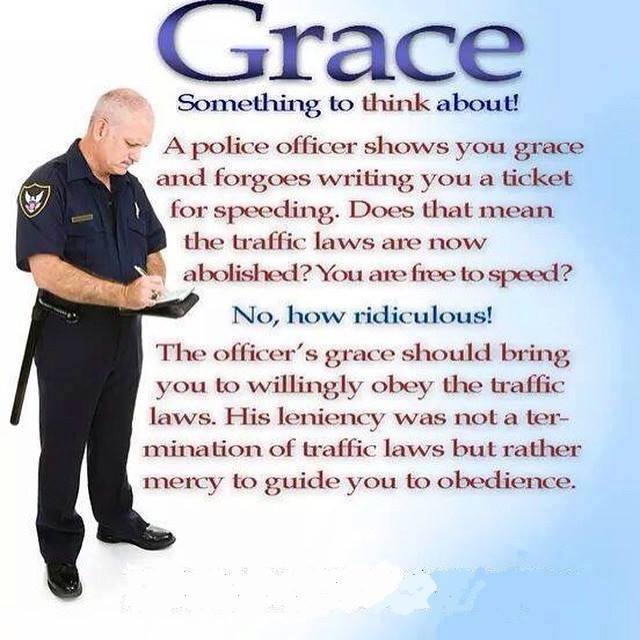 If every verse in the Bible is not about justification, but Protestants believe that, and they do, this will redefine the Bible from cover to cover, and it does. The result is a completely upside down gospel.
For example, the internet placard that inspired this post. How does it define “grace”? Obviously, it defines grace as Christians not getting the punishment they deserve from the “righteous demands of the law.” This “mercy” “guides” you to obedience. But what “obedience”? Well, let me quote the pastor of the person who posted the placard: “You don’t keep the law by keeping the law.”
“You don’t keep the law by keeping the law.” What does that mean in conjunction with “mercy” leading us to this “obedience.” And, do Christians still need “mercy”? According to Protestantism, “yes.” I understand that some Protestants understand this to mean that we are motivated by God’s mercy when we don’t get the punishment that we deserve, but that is a watered down version of the authentic Protestant gospel. And anyway, true Christians no longer need mercy because we are no longer under condemnation; there is “no condemnation” for Christians. But more on the significance of that later.
The crux of the placard and the idea that Christians still need grace is well defined by some comments that were posted in regard to the placard. It starts with the idea that “grace” is synonymous with biblical justification or salvation. And since we still need “mercy” from the law as Christians, we must know how to obtain this mercy leading to keeping the law by not keeping the law. The endeavor is twofold, and exemplified in the following aforementioned comments:
MERCY is when judgement is constrained, and hence is what is being illustrated in this story by the officer letting you off the hook. But GRACE is not that judgement was constrained, but that it was conferred! It’s the picture of the officer, though acknowledging that you were guilty of trespassing the speed limit, determines that he’ll let you go on the premise that he PAID the ticket for you!
And…
What if the police officer decided to jump in the car with you. So every time you drove he’s sitting next to you and just keeps saying don’t worry about speeding I have fulfilled that law. [Viz, I kept the law for you] I’ll whisper to your heart and let you know if you are heading towards the speed limit. I just want to sit and chat with you and get to know you so well that you never ever want to speed again. Because you are forgiven and I love you.
If you think these are armchair theologians, think again. What they are saying is a mirror image of how two heavyweight Protestant theologians stated it in the following video:
What’s the idea here? Since Christians still need mercy from the righteous demands of the law, they must continually receive it by returning to the same gospel that saved them. “Grace” is defined as justification/salvation, so obviously, we must continually return to the same gospel that saved us. To most professing Christians in our day, the idea that Christians still need grace and mercy is a no-brainer and is pontificated with the often-heard, “We must preach the gospel to ourselves every day.”
What is that gospel? It is twofold as exhibited by the two comments. Christ died for our sins which takes care of the penalty of sin (first comment), and then He kept the law perfectly so that His righteousness (perfect obedience) can be imputed to our Christian life. Therefore, as Christians, we continually go back to the salvation well for forgiveness and a righteousness that is not our own. That’s how we keep the law by not keeping the law: Jesus keeps it/kept it for us. The same gospel that saved you also sanctifies you.
Why is this an egregious false gospel? First, we are not under the law for justification. There is no law for Jesus to keep for us. Jesus didn’t come to keep the law for us, He came to end the law… for Justification (Romans 10:4). The fulfilling of the law by Christ does not refer to Him keeping the law perfectly so that His obedience can be imputed to our sanctification.
And “grace” is NOT justification or salvation. “Grace” defines why God saved man; it’s an act of love that expects nothing in return, and of course, we need this same kind of love in our Christian lives, but that doesn’t make our sanctification a progression or specific expression of justification. The love of God is not applied to justification in the exact same way it is applied to our Christian lives (sanctification). Grace, as the reason God justified us (His unmerited love) expects nothing in return because man is utterly unable to justify himself.
However, God also displays His love (“grace” also means “help”) in regard to the purpose for which he saved us: good works…that we actually do in order to please Him. God doesn’t love Himself through us—we are not mere conduits from which God loves Himself; we in fact love God or we do not belong to Him. God’s love towards man in justification has a different application in sanctification. In the former man is completely helpless, in the latter man needs help. Both expressions of love are “grace.”
This is demonstrated by Ephesians 2:8-10…
8 For by grace you have been saved through faith. And this is not your own doing; it is the gift of God, 9 not a result of works, so that no one may boast. 10 For we are his workmanship, created in Christ Jesus for good works, which God prepared beforehand, that we should walk in them.
Grace, or charis, is a Greek word that means “a joyful benevolence.” Actually, the word has a wide variance of applications including, “favor,” “love,” “help,” “dignity,” etc. To define “grace” as synonymous with salvation is inaccurate; grace is the reason God saves, but it is also the reason God does many other things as well. Grace is also the reason that God is our advocate, comforter, co-laborer, and helper in our Christian life. In regard to our Christian life (sanctification), these words are used interchangeably (Heb 13:6, Jn 14:16 Rom 8:26).
Note verse 8: grace is the reason God saved us (John 3:16), but salvation is “the gift.” It is not the result of “works” (v.9), but the result of grace. This is where we have a radical dichotomy between justification (gift) and sanctification (reward). The two are mutually exclusive, and “grace” does not bridge the two. Gift and reward are mutually exclusive. In fact, Hebrews 6:10 says that God would be “unjust” to forget our works in sanctification. Why? Because our works in sanctification is an earned reward that deserves to be recognized. There is no other conclusion that can be drawn from that passage.
The word for “works” in verse 9 is ergon which according to Greek scholar Spiros Zodhiates “stands in direct antithesis” to charis (grace) and the two words are “mutually exclusive” (The Complete Word Study Dictionary, AMG Int. 1992, p.1469). Yet, verse 10 indicates that good “ergon” or works is the purpose of salvation. Salvation is caused by grace, but works is the purpose of salvation. This is why justification and sanctification are mutually exclusive and not bridged by grace. One result of grace is the gift of salvation while the result of the other is reward. Gift and reward cannot be intermingled.
The type and kind of works were predetermined, but we are responsible to “walk” in them with God’s help. In justification, God is a savior; in sanctification, God is a “helper.”
Notice how the professing Christians of our day are obsessed with SIN. Because we are still supposedly under law and need the same “grace” that saved us, our Christianity is obsessed with failure and our dire need for more and more mercy. Life is lived under the cloud of the law, and the focus is how often the holy policemen in the sky does not write a ticket of condemnation.
A pity, because we are not under law and are rather under grace which means we seek to obey God’s law in love. The focus isn’t failure so that we can supposedly glorify God by returning to the foot of the cross, the focus is love which “covers a multitude of sin” (1Pet 4:8). We would sin a lot less if our focus was love, not the expectation of failure under the heavy burden of the law. We are not under the law of sin and death, we are under the law of the Spirit of life (Rom 8:2). We strive to obey that law in love as the primary focus of our life; we dwell on love, not sin.
Moreover, if we glory in more and more mercy that saves us from the law that we are supposedly still under, that will result in a relaxing (lyō) of the law in sanctification that Christ warned us about (Matt 5:19) because after all, we can’t keep it perfectly anyway.
As Christians, our sin is family sin against our Father and can bring chastisement, but it is not sin under the condemnation of the law that requires a return to the same “grace” that saved us. That’s a false gospel. That’s under law, NOT under grace.
So, you do in fact keep the law by keeping the law, because that’s love.
paul

 Paul's Passing Thoughts
6 comments