Sally Lloyd-Jones: The Wicked Witch of New Calvinism
 Originally published July 11, 2013
“Basically, Jones is actively indoctrinating our children to see reality in a contra-normative construct, and teaching them salvation through perseverance in antinomianism. Christ is clear on this: for those who lead children astray, it would be better for them if they were never born. And that also goes for anyone who propagates her materials.”
It isn’t enough for the New Calvinists to lead adults into hell with a false gospel and let them have the blood of their own children on their hands. No, they have to take their false gospel directly to the children for fear that the parents cannot do the job themselves.
But targeting children with a false gospel is where I draw the line. Now that the New Calvinists have emasculated “Christian” fathers who now stand aside and give these tyrants unfettered access to their families, New Calvinist organizations are cashing in on repackaging the false gospel of progressive justification for children.
A reader sent me a post by Sally Lloyd-Jones in which she endorses her new children’s book that propagates the false gospel of progressive justification via Redemptive Historical hermeneutics; ie., the Bible as gospel metanarrative. Here, “meta” doesn’t mean “grand narrative,” but rather the interpretation of reality through narrative, or story. By seeing our wickedness as set against God’s holiness in the narrative, we experience the works of Christ that He imputed to our sanctification by His perfect fulfillment of the law while on earth. Hence, the Bible is not for instruction or rules. Its purpose is to show the works of Christ that we are unable to perform (though Christ plainly stated that we would do more than He did [JN 14:12]). It’s a formula for living by faith alone in sanctification. This is nothing new, it is primarily what James refuted in his epistle. That’s why Luther rejected the canonicity of said epistle—it contradicts the Reformed gospel that interprets ALL reality through Christocentricity. This also defies the metaphysical reality that all rules are not morally based. “Rules” make living life itself possible in many regards. The rules for baking a cake are morally neutral, but necessary if you want an edible cake.
According to this doctrine, the experience of our obedience, or better said, the experience of “obedient faith,” is subjective because we really don’t know what we are doing in our “own efforts” versus what the Spirit is manifesting in our realm. Anything done in our “own efforts” should be repented of as “self-righteous works.” I have heard elders offer up such prayers for the congregation firsthand. If we actually believe that we can learn God’s will and perform the work ourselves as born again believers, that is “mortal sin” of a false gospel that will condemn us to hell. If all of our good works are attended with fear that they could be perceived as our own works, that’s “venial sin” that doesn’t condemn us and can be forgiven by “repenting of good works” as propagated by the likes of Dr. Tim Keller. In fact, Keller, an in-your-face and in-broad-daylight Christian mystic is Jones’ pastor.
Jones, in the promo post for her children’s book entitled, “Teaching Children the Bible,” begins with this question:
Do you read the Bible like a rulebook? Do you look at the biblical characters as heroes to emulate? Or do you read Scripture as a Story with one great Hero?
This statement is indicative of the Redemptive Historical worldview; there isn’t more than one way to look at the Bible. But most importantly, the Bible is used as a tool for a worldview that is contra-normative to interpreting reality. In this construct, there are only two ways to look at reality: the cross story or the glory story. If it is about us (the glory story), rules and heroes are applicable. But if it’s about the cross story, only Christ and His works are to be seen, “not anything we do.” “It’s not about anything we do, but what Jesus has done.”
So, supposedly, there are two ways to look at reality, and in the correct way, the cross story, realty is only perceived in the difference between the following duality: our sinfulness as set against God’s holiness. Moreover, Jesus as hero is often presented by New Calvinists as Christ saving us from a wrathful God who still holds the law over our heads. That’s why rules are bad: we are still under the jurisdiction of the law and therefore unless we can keep the law perfectly, all bets are off—Jesus to the perpetual rescue. We are still under the law, so if we don’t keep it perfectly, we are guilty of violating all of it. To think we can keep the law in a way that pleases God is a mortal sin because when we break the law at any point, our basis for justification collapses. The basis of justification is a continued maintaining of the law. So obviously, a perpetual maintaining of the law is required to keep us saved; ie., the progressive imputation of Christ’s perfect works to our sanctification which is supposedly the road to “final justification.”
And this is clearly the problem with the Reformed gospel; the law is the standard for our justification and not the death of Christ alone. The one act of obedience is not the ground of our justification, but the perpetual and progressive imputation of Christ’s fulfillment of the law to our life by faith alone without works. This is a gospel that keeps Christians under law and redefines under grace as Christ keeping the law in our stead. But this is still, “under law.” Those under grace are justified “apart from the law.” Therefore, in the same way that we violated the law at every point when we were under it, we fulfill all of it when we love our neighbors because we are under grace and not under law.
The reader who sent me the link protested to a Facebook friend who endorsed the book on her page. Her response was that he was clueless because they were not advocating the unimportance of rules. Exactly, rules are extremely important to them because it is still the basis of our justification. The key is that Jesus keeps the law for us. But of course, this is a metaphysical sleight of hand that comes from Calvin himself and is an under law gospel. Basically, Jones is actively indoctrinating our children to see reality in a contra-normative construct, and teaching them salvation through perseverance in antinomianism. Christ is clear on this: for those who lead children astray, it would be better for them if they were never born. And that also goes for anyone who propagates her materials.
Unbelievably, Jones is given full access to our children by brain-dead shepherds. In the promotion, she brags about how she undermines what the parents in local churches teach their children:
When I go to churches and speak to children, I often start by asking them two questions:
First, How many people here sometimes think you have to be good for God to love you? They tentatively raise their hands. I raise my hand along with them.
And second, how many people here sometimes think that if you aren’t good, God will stop loving you? Almost without fail they raise their hands. These children think they have to keep the rules or God won’t love them. They think if they mess up God will stop loving them.
These children are in Sunday schools. They know all their Bible stories. And they have missed what the Bible is all about.
They are children like I once was.
On display here is the arrogant metaphysical sleight of hand that is indicative of mystic despots that believe they understand the high mysteries of God that the masses are unable to understand. If she is confronted about undermining the parents of the church, she will insist that she was referring to the children only when she said “people” and not the parents of the church. If she is confronted about law and love being mutually exclusive, she will assert that she was only talking about justification. Here we have the diabolical communication of the New Calvinist on full display. Law and love are mutually exclusive in justification, but NOT sanctification. However, that distinction is never made as these wicked false teachers talk about sanctification in a justification way because we are still under the law according to their gospel. They incessantly teach the fusion of justification and sanctification (which equals being yet under law), and only make the distinction when they are called on it. But even then, their “progressive sanctification” is really progressive justification as they play on the assumptions of those being deceived. This is deceptive communication that comes directly from the pit of hell.
Jones continues:
Even though I came to faith as a small child, I somehow grew up thinking the Bible was filled with rules you had to keep (or God wouldn’t love you) and with heroes setting examples you had to follow (or God wouldn’t love you).
I tried to be good. I really did. I was quite good at being good and keeping the rules. But however hard I tried, I couldn’t keep the rules all the time, so I knew God must not be pleased with me.
And as far as being a hero: I certainly couldn’t ever be as brave as Daniel. I remember being tormented by that Sunday school chorus “Dare to Be a Daniel.”
Notice how our love is completely excluded from the metaphysical construct of the argument. That’s because we cannot have any love, that’s the glory story. And if we have love, that enables a dichotomy between justification and sanctification. Hence, justification is the setting of God’s love on us without merit, and our love for God in sanctification is our fatherly love as His children that is not under law but under grace. Like all Calvinists, she makes the two the same. Any ability to love God points directly back to the standard of justification and is not separated from sanctification. And law is not the standard for justification to begin with; it’s the one act of Christ’s obedience to the cross.
In the second paragraph, the idea that perfection is a requirement to MAINTAIN our justification is clearly evident. I was really, really good at keeping the law, but God requires perfection in order to be pleased with us. Therefore, Christ must keep the law for us in sanctification in order to maintain our justification. This is clearly works salvation by persevering in antinomianism. Other Christians can’t inspire us to love God in sanctification by keeping His commands—that’s the glory story.
This doctrine also denies the new birth and the fundamental difference between being under law and under grace. When we are under law, we are enslaved to sin and free to do good (ROM 6:20). That means the overall direction of our life will be law-breaking and then we will be judged by that very law in the end. Under grace is enslavement to righteousness and the freedom to sin (ROM 6:18). In salvation and the new birth, slavery and freedom are switched resulting in an overall direction of life. But our justification will not be judged by our freedom to sin because we are no longer under it. The overall direction of our sanctified life will be righteousness because we are born of God and have His seed within us. Loving God by keeping His commandments is therefore the direction of our life and not the perfection. Per the Reformed false gospel of progressive justification, perfection is still the standard because we are still under law and not born again by the biblical definition:
At the end of the story there were no other teachers around, and I panicked and went into autopilot and heard myself—to my horror—asking, “And so what can we learn from Daniel about how God wants us to live?”
And as I said those words it was as if I had literally laid a huge load on that little girl. Like I broke some spell. She crumpled right in front of me, physically slumping and bowing her head. I will never forget it.
It is a picture of what happens to a child when we turn a story into a moral lesson.
When we drill a Bible story down into a moral lesson, we make it about us. But the Bible isn’t mainly about us, and what we are supposed to be doing—it’s about God, and what he has done.
Children don’t need to be told to try harder, believe more, or do it better. That just leaves them in despair. The moral code always leaves us in despair. We can never live up to it.
I knew it as a child—I could never be good enough or brave enough.
None of that is the point unless we are still under law. The point of sanctification is not moral law, but loving God and glorifying His name and wisdom through obedience. The Reformed gospel denies our ability to please God through obedience (ROM 8:7,8). The crux is perpetual re-salvation by faith alone apart from works in sanctification. Nothing could be clearer. The new birth is redefined by, “mortification and vivification” which is a perpetual reliving of our baptism to maintain our justification. Note Jones’ statement in the same promotion:
We don’t need a moral code. We need a rescuer. And that’s why I wrote The Jesus Storybook Bible and Thoughts to Make Your Heart Sing, So children could know what I didn’t: That the Bible isn’t mainly about me and what I should be doing. It’s about God and what he has done.
That the Bible is most of all a story—the story of how God loves his children and comes to rescue them.
Obviously, in context, one can only conclude logically that this is a perpetual “rescue” and not a onetime event. The New Calvinist Paul David Tripp calls this an “everyday rescue.” In a sermon at Southeastern Theological Seminary (Spring 2007), referring to Romans 7:24, he made it clear that Christians need to be rescued [saved] every day. That’s the crux.
It grieves my heart that these wicked satanic minions are given free access to our children. This is where Christians should be motivated to standup against these false teachers.
If we are not motivated by the eternal wellbeing of our children, we are a disgrace to the cause of Christ.
paul
Like John Street, Like Stuart Scott: A Celebration of Mystic Despotism

Will Speak at Clearcreek Chapel’s 2015 “Family Enrichment” weekend.
 “Hence, and don’t miss this, justice is not the point. The concept of justice and fairness digresses from Reformed Calvinistic dualism.”
“….six months after Luther’s 95 Theses launched the Reformation, the true magnum opus of the Reformation was written, his Heidelberg Disputation to the Augustinian Order. The document reflects Luther’s utter Platonist disdain for humanity.”
“Now, let’s take this information and evaluate why Scott et al are completely indifferent to suffering and injustice.”
Once again, Stuart Scott will break bread with the elders at Clearcreek Chapel (Springboro, Ohio) as he is the featured speaker at this year’s “Family Enrichment” Conference. Clearcreek Chapel having a family enrichment conference is like the Nazis sponsoring an endowment for Judaism. It’s a mockery; the Chapel has ravaged innumerable families and Christian lives since its orchestrated takeover by Russ Kennedy and aided by former Clearcreek elder Greg Cook. Cook brought in a group from another Baptist church which included present Clearcreek elders Chad Bresson and Dr. Dale Evans.
Their attempted takeover of the church they left failed, but their endeavor at the Chapel succeeded—the spiritual carnage notwithstanding. Cook, as director of Clearcreek’s counseling program, was giving wives the green light to divorce husbands who had “ruined the family finances” while he himself was just under $200,000.00 in due and owing debt. It is unclear as to whether this revelation led to his stepping down as an elder, or not. Probably not since hypocrisy is a requirement for eldership in our day.
Other present Clearcreek elders have been forced to step down in the past, but have been reinstated; specifically, Mark Schindler who was re-baptized after his prior eldership. Apparently, not being sanctified by justification was the prior cause of his disgrace. Whatever it was specifically, his wife gave testimony that she never considered divorce and was determined to make the marriage work. It’s a pity that such wifely resolve that saved Schindler’s marriage is not encouraged among wives in the counseling rooms of the Chapel in this day. But one must remember that such resolve is only honorable in regard to saving the marriages of New Calvinist philosopher kings.
It all seems insane until you realize that people act from their logic. Why would Scott give credence to such a camp? Why would he ignore the pleadings of the oppressed? Why is he, like all New Calvinists, utterly indifferent to justice? We get a clue from his book The Exemplary Husband on page 72. He states the following:
God uses everything in our lives for His perfecting (growing) purposes (Romans 8:28-29; James 1:2-4). As we learned earlier, our growth as Christians toward Christ-likeness is a life-long process, often referred to as sanctification. Because God is so intent on sanctifying us, we know that He will certainly use our most important human relationships to do this.
Right. As I have worn out multiple keyboards emphasizing here on PPT, New Calvinism is a dualist philosophy. Let’s go over this again. Below is THEIR illustration, NOT mine:

Note first that regardless of their verbiage, they don’t believe we really grow, it’s the cross (what it represents) that grows. That’s obviously job one. The endeavor thereof requires a primary focus on two goals and two goals only: a deeper and deeper UNDERSTANDING of our sinfulness, and absolutely nothing else, as set against God’s holiness. Part and parcel with this is also the idea of worthlessness on our part.
The cross represents bigger and bigger salvation which must be manifested more and more until the day when our “final justification” is “revealed.” This occurs as we are sanctified the same way we are saved, by partaking in the realizing of our sinful worthlessness before God and His holiness. The more we understand the difference between the two, the more our salvation is manifested. We don’t change, only the greatness of our salvation changes in order to glorify God. Of course, this obviously redefines the new birth and denies it.
As propagated in the satanic treatise “How People Change” by Paul David Tripp, ALL tragic and sinful events in life serve the bottom of the cross chart, and ALL good that occurs in our lives serves the top of the chart. As we contemplate the gospel narrative, the goodness of God is manifested which contributes to more understanding at the top of the chart. Goodness is not our fruit, its God’s fruit only for the purpose of aiding us in understanding His goodness—not ours. Hence, and don’t miss this, justice is not the point. The concept of justice and fairness digresses from Reformed Calvinistic dualism.
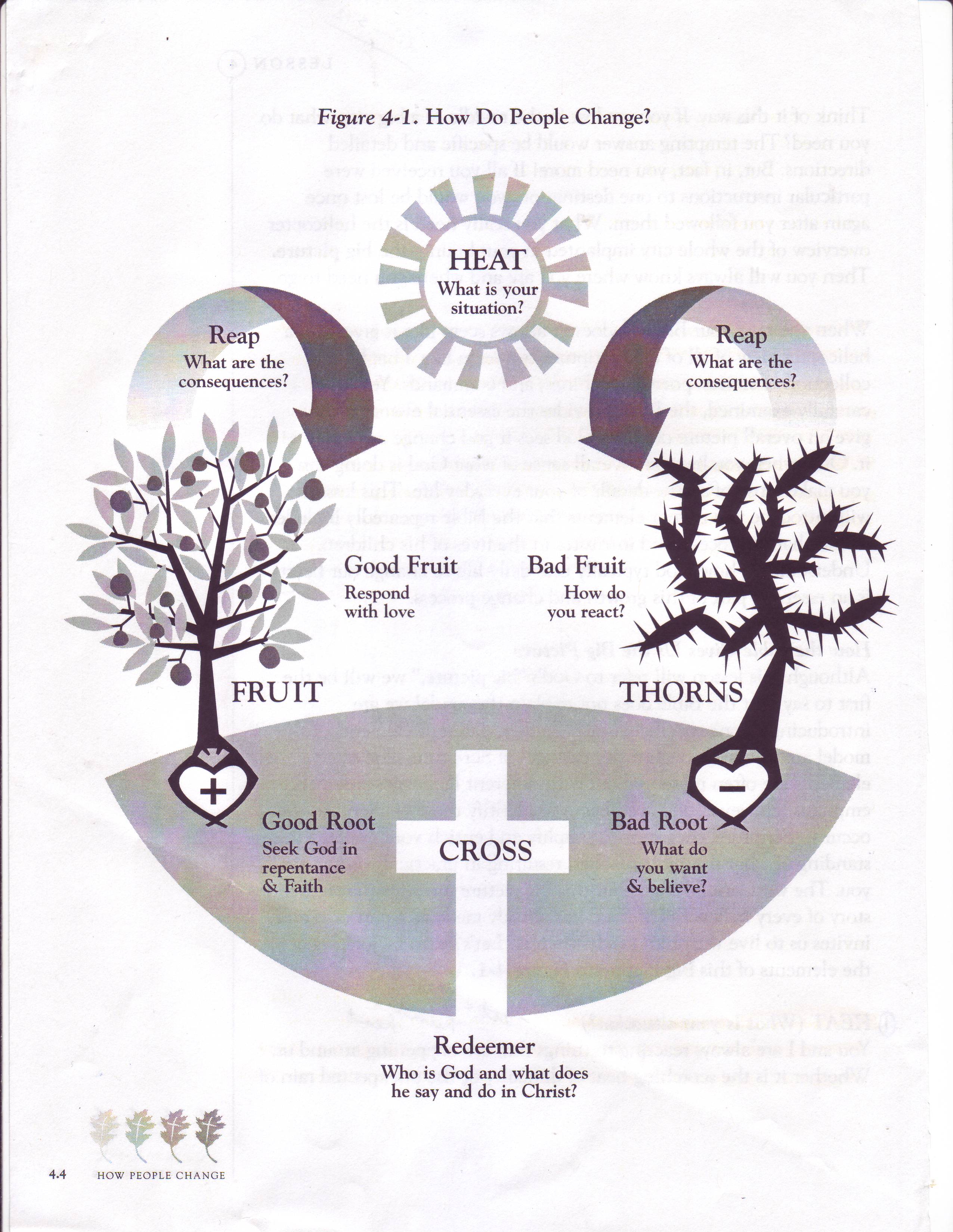
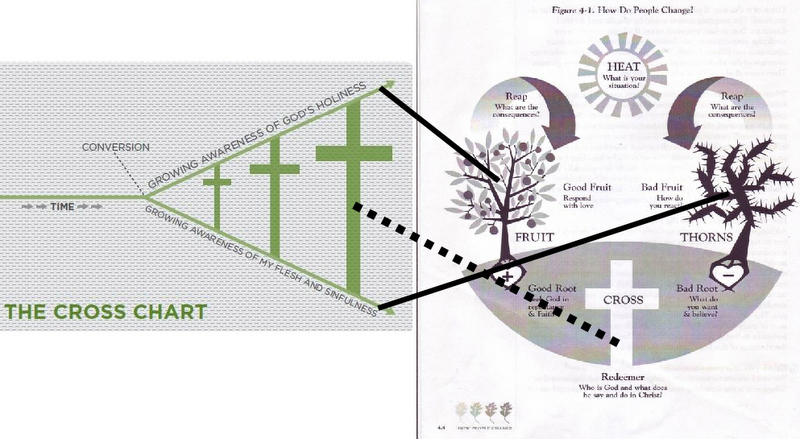
The next point is that in the neo-Calvinist gospel schema, the Scriptures serve as a Cross narrative to help us see this dualism in a clearer way. In the mind of the neo-Calvinist, the Scriptures do not define what is right and fair; the Scriptures define Luther’s “cross story.” Here is what the vast majority of Christians do not understand: six months after Luther’s 95 Theses launched the Reformation, the true magnum opus of the Reformation was written, his Heidelberg Disputation to the Augustinian Order. The document reflects Luther’s utter Platonist disdain for humanity.
In Luther’s Disputation, all reality must be seen through the cross story; i.e., the cross illustration at hand here, and ALL else is the “glory story” or anything at all to do with us—our glory, not the cross story that makes God bigger and mankind smaller. To any degree that we are in the equation, the cross story is diminished.
Now, let’s take this information and evaluate why Scott et al are completely indifferent to suffering and injustice. What did the Clearcreek elders do that is wrong? Nothing because the purpose of the Bible is not to judge the authority of Reformed elders, it is to show forth the cross story, not our story, and injustice is an Us Story kind of thing. Have former parishioners at Clearcreek suffered unjustly at the hands of the elders? Well, that’s a good thing! That suffering shows us the bottom of the chart. And besides, “justice”? If we got what we all deserved, there wouldn’t be any grace! Is this like Paul’s protest in Romans against propagating more evil that grace may abound? Yes, I think so. To the contrary in the minds of neo-Calvinists, we should bow down and thank God for bringing such abuse into our lives.
This is the gospel construct that rules the majority of biblical counseling in our day and is taking over the church in this country. It is a Platonist world view that set Europe on fire for hundreds of years with unspeakable horrors. And it is a story that is playing at a local church near you.
And this weekend, Stuart Scott brings his version of the show to Springboro, Ohio. A celebration of suffering in the name of Christ. But I have news for Scott: the sins of the Clearcreek elders does not cause grace to abound. And his appearance there has nothing to do with grace or love.
If there are any parishioners at Clearcreek (who may be reading this) who are presently there against their will for fear of public humiliation or things revealed in counseling —in your desperation, don’t slip Scott a note—he’s one of them.
paul
Weakness is NOT Sin: Christians Need Better Definitions, NOT More Mysticism
 Christians speak and write much about seeing the Bible with “new eyes,” etc. The mystical and spiritual seems to legitimize all that we say and teach.
I didn’t realize the extent to which I functioned as a Christian mystic until I was exposed to Dr. Jay E. Adams. I found his common sense practicality applied to Scripture liberating. His principle of definitive knowledge as a starting point is a principle I have never swayed from. He had simple quips that would fill the hopeless with hope in a matter of seconds:
“I’m having a nervous breakdown—I’m losing my mind! ‘No, you are not having a nervous breakdown. Obviously, your nerves are working quit well, we just need to see what God’s word says about bringing your nerves into proper use.’”
“We can’t go there, that will open up a can of worms! ‘Perhaps, but if we deal with one worm at a time, the can will eventually be empty, and the more empty the can is, the better off you are.’”
…or something like that, close enough.
Christians don’t need more spiritual bumper stickers to live by, they need better definitions of words. We are in a day when biblically specific word use has never been more important. When we read our Bibles, we need to make sure that we really know what the words mean specifically, and we need to be biblically specific in our communication when referring to it.
Until very recently, I always read the word “flesh” in the Bible as synonymous with evil/sin. With that presupposition intact, it led to the conclusion that “weakness” is also synonymous with evil as well.
This is not the case. Let’s think about this. The “’holy’ angels” are weaker than God, no? This obviously does not make them sinful. Being weaker than God is not sin.
This is also the definition of “flesh,” “members,” “body,” etc., in the Bible; it’s “weak” (specifically defined as such many places in the Bible), but not inherently evil. How do we know this? Because our bodies can be used for holy purposes:
Romans 12:1 – I appeal to you therefore, brothers, by the mercies of God, to present your bodies as a living sacrifice, holy and acceptable to God, which is your spiritual worship.
Romans 6:13 – Do not present your members to sin as instruments for unrighteousness, but present yourselves to God as those who have been brought from death to life, and your members to God as instruments for righteousness.
Throughout the Bible, the problem of sin is defined as sin that resides in the body, but the body is not sin. Notice that Paul tells us to not “present” our bodies TO sin. We are to offer our bodies to God as a living sacrifice, not to sin. The body cannot be both. God is a master, and sin is also biblically defined as a master, the body can be used to serve either.
To the degree that we have improper understanding of biblical words, we are blinded to the truth of Scripture. To the degree that we are biblically ignorant, we are enslaved.
paul
Sally Lloyd-Jones: The Wicked Witch of New Calvinism
“Basically, Jones is actively indoctrinating our children to see reality in a contra-normative construct, and teaching them salvation through perseverance in antinomianism. Christ is clear on this: for those who lead children astray, it would be better for them if they were never born. And that also goes for anyone who propagates her materials.”
It isn’t enough for the New Calvinists to lead adults into hell with a false gospel and let them have the blood of their own children on their hands. No, they have to take their false gospel directly to the children for fear that the parents cannot do the job themselves.
But targeting children with a false gospel is where I draw the line. Now that the New Calvinists have emasculated “Christian” fathers who now stand aside and give these tyrants unfettered access to their families, New Calvinist organizations are cashing in on repackaging the false gospel of progressive justification for children.
A reader sent me a post by Sally Lloyd-Jones in which she endorses her new children’s book that propagates the false gospel of progressive justification via Redemptive Historical hermeneutics; ie., the Bible as gospel metanarrative. Here, “meta” doesn’t mean “grand narrative,” but rather the interpretation of reality through narrative, or story. By seeing our wickedness as set against God’s holiness in the narrative, we experience the works of Christ that He imputed to our sanctification by His perfect fulfillment of the law while on earth. Hence, the Bible is not for instruction or rules. Its purpose is to show the works of Christ that we are unable to perform (though Christ plainly stated that we would do more than He did [JN 14:12]). It’s a formula for living by faith alone in sanctification. This is nothing new, it is primarily what James refuted in his epistle. That’s why Luther rejected the canonicity of said epistle—it contradicts the Reformed gospel that interprets ALL reality through Christocentricity. This also defies the metaphysical reality that all rules are not morally based. “Rules” make living life itself possible in many regards. The rules for baking a cake are morally neutral, but necessary if you want an edible cake.
According to this doctrine, the experience of our obedience, or better said, the experience of “obedient faith,” is subjective because we really don’t know what we are doing in our “own efforts” versus what the Spirit is manifesting in our realm. Anything done in our “own efforts” should be repented of as “self-righteous works.” I have heard elders offer up such prayers for the congregation firsthand. If we actually believe that we can learn God’s will and perform the work ourselves as born again believers, that is “mortal sin” of a false gospel that will condemn us to hell. If all of our good works are attended with fear that they could be perceived as our own works, that’s “venial sin” that doesn’t condemn us and can be forgiven by “repenting of good works” as propagated by the likes of Dr. Tim Keller. In fact, Keller, an in-your-face and in-broad-daylight Christian mystic is Jones’ pastor.
Jones, in the promo post for her children’s book entitled, “Teaching Children the Bible,” begins with this question:
Do you read the Bible like a rulebook? Do you look at the biblical characters as heroes to emulate? Or do you read Scripture as a Story with one great Hero?
This statement is indicative of the Redemptive Historical worldview; there isn’t more than one way to look at the Bible. But most importantly, the Bible is used as a tool for a worldview that is contra-normative to interpreting reality. In this construct, there are only two ways to look at reality: the cross story or the glory story. If it is about us (the glory story), rules and heroes are applicable. But if it’s about the cross story, only Christ and His works are to be seen, “not anything we do.” “It’s not about anything we do, but what Jesus has done.”
So, supposedly, there are two ways to look at reality, and in the correct way, the cross story, realty is only perceived in the difference between the following duality: our sinfulness as set against God’s holiness. Moreover, Jesus as hero is often presented by New Calvinists as Christ saving us from a wrathful God who still holds the law over our heads. That’s why rules are bad: we are still under the jurisdiction of the law and therefore unless we can keep the law perfectly, all bets are off—Jesus to the perpetual rescue. We are still under the law, so if we don’t keep it perfectly, we are guilty of violating all of it. To think we can keep the law in a way that pleases God is a mortal sin because when we break the law at any point, our basis for justification collapses. The basis of justification is a continued maintaining of the law. So obviously, a perpetual maintaining of the law is required to keep us saved; ie., the progressive imputation of Christ’s perfect works to our sanctification which is supposedly the road to “final justification.”
And this is clearly the problem with the Reformed gospel; the law is the standard for our justification and not the death of Christ alone. The one act of obedience is not the ground of our justification, but the perpetual and progressive imputation of Christ’s fulfillment of the law to our life by faith alone without works. This is a gospel that keeps Christians under law and redefines under grace as Christ keeping the law in our stead. But this is still, “under law.” Those under grace are justified “apart from the law.” Therefore, in the same way that we violated the law at every point when we were under it, we fulfill all of it when we love our neighbors because we are under grace and not under law.
The reader who sent me the link protested to a Facebook friend who endorsed the book on her page. Her response was that he was clueless because they were not advocating the unimportance of rules. Exactly, rules are extremely important to them because it is still the basis of our justification. The key is that Jesus keeps the law for us. But of course, this is a metaphysical sleight of hand that comes from Calvin himself and is an under law gospel. Basically, Jones is actively indoctrinating our children to see reality in a contra-normative construct, and teaching them salvation through perseverance in antinomianism. Christ is clear on this: for those who lead children astray, it would be better for them if they were never born. And that also goes for anyone who propagates her materials.
Unbelievably, Jones is given full access to our children by brain-dead shepherds. In the promotion, she brags about how she undermines what the parents in local churches teach their children:
When I go to churches and speak to children, I often start by asking them two questions:
First, How many people here sometimes think you have to be good for God to love you? They tentatively raise their hands. I raise my hand along with them.
And second, how many people here sometimes think that if you aren’t good, God will stop loving you? Almost without fail they raise their hands. These children think they have to keep the rules or God won’t love them. They think if they mess up God will stop loving them.
These children are in Sunday schools. They know all their Bible stories. And they have missed what the Bible is all about.
They are children like I once was.
On display here is the arrogant metaphysical sleight of hand that is indicative of mystic despots that believe they understand the high mysteries of God that the masses are unable to understand. If she is confronted about undermining the parents of the church, she will insist that she was referring to the children only when she said “people” and not the parents of the church. If she is confronted about law and love being mutually exclusive, she will assert that she was only talking about justification. Here we have the diabolical communication of the New Calvinist on full display. Law and love are mutually exclusive in justification, but NOT sanctification. However, that distinction is never made as these wicked false teachers talk about sanctification in a justification way because we are still under the law according to their gospel. They incessantly teach the fusion of justification and sanctification (which equals being yet under law), and only make the distinction when they are called on it. But even then, their “progressive sanctification” is really progressive justification as they play on the assumptions of those being deceived. This is deceptive communication that comes directly from the pit of hell.
Jones continues:
Even though I came to faith as a small child, I somehow grew up thinking the Bible was filled with rules you had to keep (or God wouldn’t love you) and with heroes setting examples you had to follow (or God wouldn’t love you).
I tried to be good. I really did. I was quite good at being good and keeping the rules. But however hard I tried, I couldn’t keep the rules all the time, so I knew God must not be pleased with me.
And as far as being a hero: I certainly couldn’t ever be as brave as Daniel. I remember being tormented by that Sunday school chorus “Dare to Be a Daniel.”
Notice how our love is completely excluded from the metaphysical construct of the argument. That’s because we cannot have any love, that’s the glory story. And if we have love, that enables a dichotomy between justification and sanctification. Hence, justification is the setting of God’s love on us without merit, and our love for God in sanctification is our fatherly love as His children that is not under law but under grace. Like all Calvinists, she makes the two the same. Any ability to love God points directly back to the standard of justification and is not separated from sanctification. And law is not the standard for justification to begin with; it’s the one act of Christ’s obedience to the cross.
In the second paragraph, the idea that perfection is a requirement to MAINTAIN our justification is clearly evident. I was really, really good at keeping the law, but God requires perfection in order to be pleased with us. Therefore, Christ must keep the law for us in sanctification in order to maintain our justification. This is clearly works salvation by persevering in antinomianism. Other Christians can’t inspire us to love God in sanctification by keeping His commands—that’s the glory story.
This doctrine also denies the new birth and the fundamental difference between being under law and under grace. When we are under law, we are enslaved to sin and free to do good (ROM 6:20). That means the overall direction of our life will be law-breaking and then we will be judged by that very law in the end. Under grace is enslavement to righteousness and the freedom to sin (ROM 6:18). In salvation and the new birth, slavery and freedom are switched resulting in an overall direction of life. But our justification will not be judged by our freedom to sin because we are no longer under it. The overall direction of our sanctified life will be righteousness because we are born of God and have His seed within us. Loving God by keeping His commandments is therefore the direction of our life and not the perfection. Per the Reformed false gospel of progressive justification, perfection is still the standard because we are still under law and not born again by the biblical definition:
At the end of the story there were no other teachers around, and I panicked and went into autopilot and heard myself—to my horror—asking, “And so what can we learn from Daniel about how God wants us to live?”
And as I said those words it was as if I had literally laid a huge load on that little girl. Like I broke some spell. She crumpled right in front of me, physically slumping and bowing her head. I will never forget it.
It is a picture of what happens to a child when we turn a story into a moral lesson.
When we drill a Bible story down into a moral lesson, we make it about us. But the Bible isn’t mainly about us, and what we are supposed to be doing—it’s about God, and what he has done.
Children don’t need to be told to try harder, believe more, or do it better. That just leaves them in despair. The moral code always leaves us in despair. We can never live up to it.
I knew it as a child—I could never be good enough or brave enough.
None of that is the point unless we are still under law. The point of sanctification is not moral law, but loving God and glorifying His name and wisdom through obedience. The Reformed gospel denies our ability to please God through obedience (ROM 8:7,8). The crux is perpetual re-salvation by faith alone apart from works in sanctification. Nothing could be clearer. The new birth is redefined by, “mortification and vivification” which is a perpetual reliving of our baptism to maintain our justification. Note Jones’ statement in the same promotion:
We don’t need a moral code. We need a rescuer. And that’s why I wrote The Jesus Storybook Bible and Thoughts to Make Your Heart Sing, So children could know what I didn’t: That the Bible isn’t mainly about me and what I should be doing. It’s about God and what he has done.
That the Bible is most of all a story—the story of how God loves his children and comes to rescue them.
Obviously, in context, one can only conclude logically that this is a perpetual “rescue” and not a onetime event. The New Calvinist Paul David Tripp calls this an “everyday rescue.” In a sermon at Southeastern Theological Seminary (Spring 2007), referring to Romans 7:24, he made it clear that Christians need to be rescued [saved] every day. That’s the crux.
It grieves my heart that these wicked satanic minions are given free access to our children. This is where Christians should be motivated to standup against these false teachers.
If we are not motivated by the eternal wellbeing of our children, we are a disgrace to the cause of Christ.
paul

 Paul's Passing Thoughts
leave a comment