The Hostile Takeover of the SBC by “Aggressive Calvinism” Began in 1982
Addendum to Second Edition: The Truth About New Calvinism
Very well, if folks want to refer to the New Calvinists taking over the SBC as “aggressive Calvinism,” that will work; New Calvinists are very aggressive. The events going on in the SBC right now are a mirror image of Coral Ridge, Clearcreek Chapel, NANC, and many, many other examples. Some months prior, a Presbyterian pastor/acquaintance of mine warned a church that called him for references regarding a new pastor for their church; in essence, he told them, “there is a dangerous movement afoot and the proponents are very stealth in regard to what they really believe—be careful.” They didn’t listen. The tragic results are all too common. The present debate over the SBC name change is part of it, and Southern Baptists better win that symbolic battle in order to hold ground. There is hope; the Daviess-McLean Baptist Association recently took a stand against “aggressive Calvinism.” If the SBC survives, it will only be because others follow their example.
More hope: there are lots of folks in the SBC who do not like hyper-Calvinists who also concern real Calvinists. New Calvinism is hyper-Calvinism in both justification (salvation) and sanctification (plenary hyper-Calvinism). So if many Southern Baptists do not like hyper-Calvinism, they should dislike the double hyper-Calvinists even more who are in the process of taking over the convention, and seeking to wipe out the memory of the SBC they secretly despise. Yes, there is hope, but SBC protestants need to better identify the enemy. We need to get rid of the “aggressive [New] Calvinists” first, and then have discussion about the hypers and the standards later. Aggressive Calvinists threaten the very existence of the SBC. We have our problems, and we may even be on life support, but Dr. Kevorkian presiding over our condition is not the answer—neither do I think he should be able to plunder SBC resources before he pulls the plug.
The Difference Between the Old and the New
This is not difficult. One only needs to examine their mantras to know the difference between Old and New Calvinism. “The same gospel that saved you also sanctifies you.” “We must preach the gospel to ourselves every day.” “The gospel isn’t the entry point of Christianity, it is the A-Z of Christianity” [even though Christ referred to the gospel as an entry point to the kingdom, and the apostle Paul referred to the gospel as a “foundation”: 1Corinthians 3:10-15, Romans 15:20]. If we are sanctified by salvation, what does that say about what Aggressive [New] Calvinists believe about sanctification? All Christians, whether Calvinistic or otherwise, believe that salvation is by faith alone and not works. Theologians call this “monergistic.” However, we also believe that sanctification is “synergistic,” meaning that the new birth enables us to co-labor with God in the sanctification process as friends devoted to Him in the truest sense. In other words, our marvelous God has made a way to be reconciled to Him while also enabling us to participate in His work in a truly legitimate way despite our weakness. The Bible specifically refers to us as God’s co-laborers in 1Corinthians 3:9, 1Thessalonians 3:2, and 2 Corinthians 6:1.
But obviously, if we are sanctified by monergism, sanctification must also be monergistic (a work by God alone). And as indicated elsewhere in this book, this is critical because the law (Scripture) is a primary conduit used to participate in God’s work. If we cannot participate in sanctification, neither can we uphold God’s law in sanctification any more than we could in justification. This is the crux of the matter. The real issue is the church’s primary nemesis used by the kingdom of darkness throughout the ages: against every word that proceeds from the mouth of God. This is what theologians call “antinomianism,” and as discussed in chapter one, the Bible predicts that it will be the spirit of the last days. Christ and the apostles framed the last days in context of “anomia” (primarily, 2Thessalonians, chapter 2; Matthew 7:23, 13:41, 24:11,12; 2Corinthians 6:14; Titus 2:14). It’s the same type word, used in all of these cited verses regarding the spirit, fellowship, love, antichrist, and redemption of the last days, as our English word “atypical,” or “against/anti what is normal.” Old Calvinists do not believe in monergistic sanctification which necessarily makes us antinomians. And orthodox evangelicalism has never believed in sanctification by faith alone. The modern-day epitome of Old Calvinism, Dr. Peter Masters, stated the following:
The new Calvinism is not a resurgence but an entirely novel formula which strips the doctrine of its historic practice, and unites it with the world (The Merger of Calvinism with Worldliness from Sword & Trowel 2009, No. 1 by Dr Peter Masters).
And this by Calvinistic Baptist Donn Arms, M.Div.:
Justification is monergistic, sanctification is synergistic. Walking is what I do, not something Christ does for me (Institute for Nouthetic Studies blog: Archives; Gospel Sanctification, May 13, 2011 Gospel Sanctification comments section).
Despite their adamant denials concerning the above, the simplicity of the Aggressive Calvinist mantras will always betray them in regard to their lies. And as discussed elsewhere in this book, all of their massive doctrinal pontification is discussion on how to make an overly passive sanctification work with the blessed truth of our Lord and Savior. Our brother Jude called Him our “absolute ruler” (despotace) and “supreme commander” (kooreeos).
Thirdly, Old Calvinists, unlike the Aggressive Calvinists, do not believe in the fusion of justification and sanctification. Listen to what Old Calvinist Jay Adams (no pun intended) said about “Gospel Sanctification” (the name given to New Calvinism [Aggressive Calvinism] before it was realized they are the same thing):
The crux of the issue has to do with the unbiblical fusion of sanctification with justification. The latter is set forth not as “keeping” God’s commandments, but as bringing about change by concentrating on the cross. As one immerses himself in the cross of Christ, sanctifying growth occurs. The biblical truth is that we are to pursue fruit, which becomes a reality and the Spirit helps us grow in grace (Institute for Nouthetic Studies blog: Archives; Gospel Sanctification, May 9, 2011 by Jay Adams).
The fact that Aggressive Calvinism fuses justification and sanctification together can be seen clearly in their mantra-like anthems such as, “The same gospel that saves you also sanctifies you.” This completely distorts the orthodox view of justification which is a onetime declaration by God that His righteousness has been credited to our account in full. According to their own pithy truisms, justification continues and completes itself. That’s a huge problem. If justification is progressive (what they deceptively call “progressive sanctification”), we cannot be involved, except in whatever our involvement was concerning justification. Hence, “….because the believer’s role is reduced to a point that is not according to Scripture, he/she is deprived of the abundant life in a way God wants us to experience it for His glory and the arousing of curiosity from those who don’t have the hope of the gospel.” And, “….while reductionist theologies seek to reduce the believer’s role to the least common denominator, supposedly to make much of God and little of man, the elements that attempt to make it seem plausible are often complex and mutating. Therefore, instead of majoring on the application of what is learned from Scripture, believers are constantly clamoring about for some new angle that will give them a ‘deeper understanding’ of the gospel that saved them.”(p. 77, The Truth About New Calvinism).
Unless this doctrine is exposed and halted, it will leave the SBC in ruins.
New Covenant Theology Cannot be Separated from New Calvinism
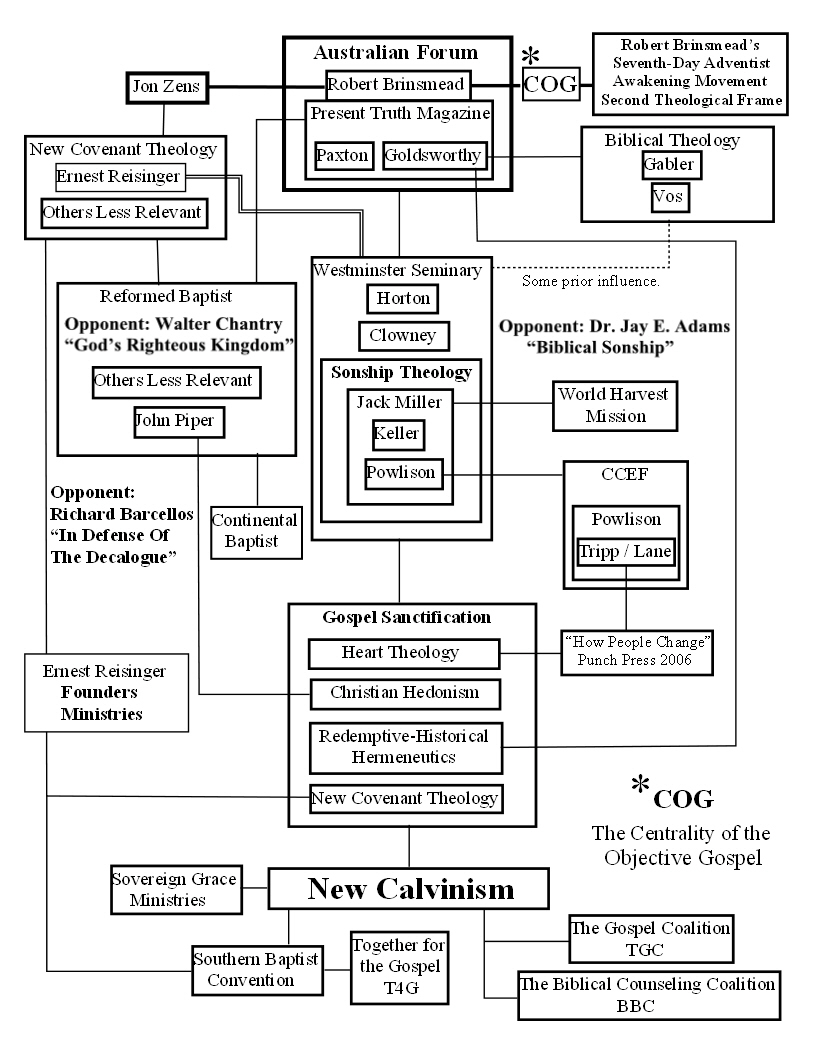
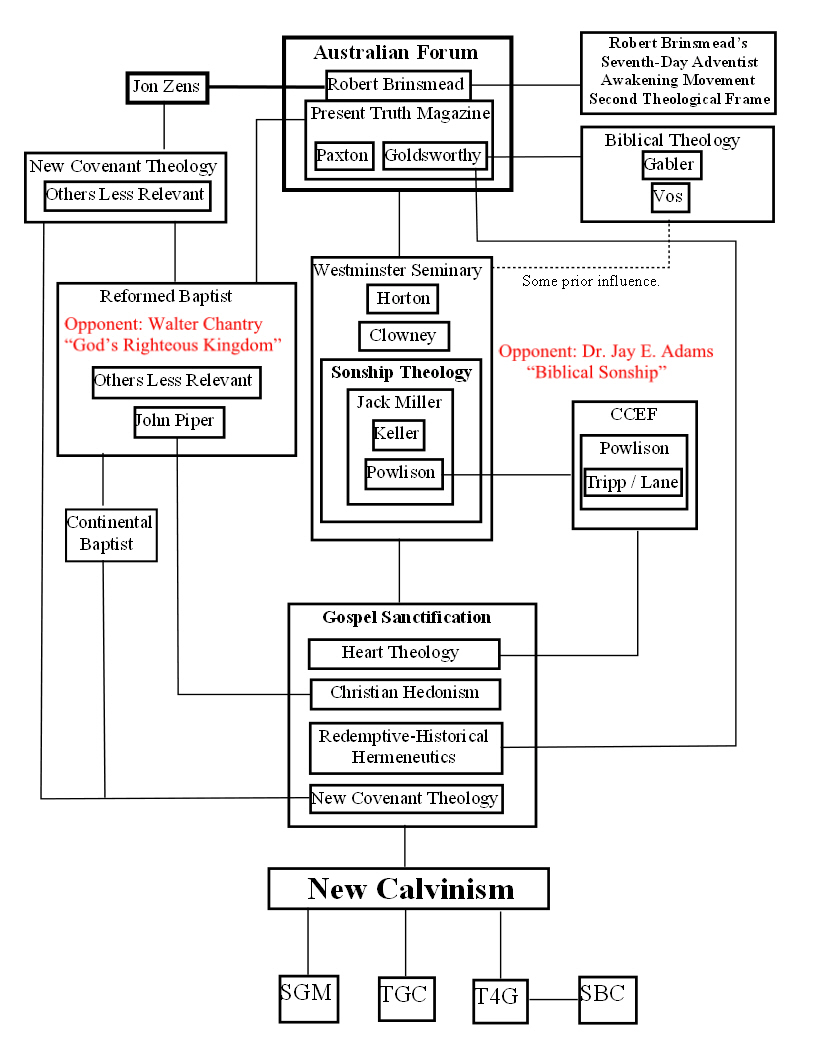
It is important to note that New Calvinism entered into the SBC through Reformed Baptist circles. New Calvinism was conceived by the Australian Forum’s Centrality of the Objective Gospel (COG). The detailed history can be observed in the “History” section of The Truth About New Calvinism. Jon Zens, the father of New Covenant Theology (NCT), worked with the Forum to develop a systematic theology that would make COG plausible. Present Truth magazine was the Forum’s theological journal. Citing from volume 16, article 13, it is obvious that the Forum’s doctrine is exactly the same as present-day New Calvinism:
Unless sanctification is rooted in justification and constantly returns to justification, it cannot escape the poisonous miasma of subjectivism, moralism or Pharisaism…. Since the life of holiness is fueled and fired by justification by faith, sanctification must constantly return to justification. Otherwise, the Christian cannot possibly escape arriving at a new self-righteousness. We cannot reach a point in sanctification where our fellowship with God does not rest completely on forgiveness of sins…. Christian existence is gospel existence. Sanctification is justification in action (emphasis mine).
As noted in The Truth About New Calvinism, Robert Brinsmead, the principle figure of the Forum, was intimately involved with Zens and the development of New Covenant Theology before Zens coined the phrase in 1981 (chapter 5). Zens himself said that Robert Brinsmead wrote articles in the Baptist Reformed Review (BRR) that accomplished the following: “The dynamic N.T. approach to law and gospel was stated forcefully by RDB [Robert D. Brinsmead]….” (Id. pages 56,57). The BRR was the primary lightening rod in the law/gospel debate raging in Reformed Baptist circles at that time, and Robert Brinsmead was a contributing author at the behest of Jon Zens. Zens took the doctrine into Reformed Baptist circles, while the Forum was primarily responsible for spreading the doctrine in Presbyterian territory, especially Westminster Seminary. Also, according to Zens, Present Truth magazine was “….the largest English-speaking theological journal in the world at that time” (Id. p. 53).
Though COG/NCT took on different nuances, COG and NCT share the same basic tenets that make the primary doctrine unique. They share the same unique hermeneutic, the same emphasis on progressive justification, the centrality of the gospel, a historic Christocentricity to the understanding and meaning of all reality, the personification of the law, the indicative/imperative prism, so-called “experiential Calvinism,” a majority view of Supersessionism, and especially unorthodox dichotomies of law and gospel (to name a few). The differences come in regard to how law and gospel relate to each other in order to make the doctrine fit together with “truth” in the best possible way. But they all believe that the same gospel that saves us also sanctifies us. Both infuse justification and sanctification.
The recognition that NCT is integral to New Calvinism is grudging and aloof among proponents. For example, DA Carson vigorously supports NCT by his actions, but when cornered verbally, espouses things that sound like, “I was for it before I was against it.” And, “It depends on what the meaning of the word ‘is’ is.” A good example of this is an article by Jim Gunn entitled, A Critique of New Covenant Theology (online source: http://goo.gl/Pm9E9). The article is an apt specimen of how Carson and Tom Nettles vigorously support NCT, but refuse to acknowledge its validity in plain language. Other New Calvinist leaders openly acknowledge that the two are inseparable. One example is the elders of Clearcreek Chapel in Springboro, OH. They are a highly respected New Calvinist church regularly hosting notable teachers such as Paul David Tripp, Stuart Scott, Dr. Robert D. Jones, and Dr. Lou Priolo. While embracing gospel centrality, they consider it all to be under the auspices of NCT. This can be seen best in a series preached there by Dr. Dale Evans entitled, A Gospel-Centered Hermeneutic: Foundations for a New Covenant Theology. In his introduction, Evans stated:
Over the last several weeks, the pulpit ministry at Clearcreek Chapel has focused on presenting texts and issues related to the concept know[n] as New Covenant Theology. This morning we will look at a text and suggest that this idea under this label is exactly how the apostle Paul read and interpreted Scripture.
As a ministry that vigorously supports all the major tenets of New Calvinism such as Heart Theology, Redemptive Historical Hermeneutics, and Christian Hedonism, one of their pastors on staff, former radio personality Chad Bresson, is sometimes referred to as “the golden boy of central Ohio NCT.” He is also a member of the Earth Stove Society formed to promote NCT. On the other hand, he has a blog dedicated to the “Biblical Theology” of Geerhardus Vos, the father of Chrsitocentric Hermeneutics. He often posts articles by two former key figures of the Australian Forum on that same blog: Robert Brinsmead and Graeme Goldsworthy.
The Plot to Take over the SBC With COG
The plot to take over the SBC with the Forum doctrine was hatched in a hotel room in Euless, Texas on November 13, 1982:
Then, on November 13, 1982, [Ernest] Reisinger, Nettles and Malone met at a Holiday Inn in Euless, Texas, for prayer to seek God’s direction with respect to a Southern Baptist conference ministry. Nettles brought to the meeting several young men who had embraced the doctrines of grace. Among them were Bill and Tom Ascol, Ben Mitchell and evangelist R.F. Gates. Reisinger later called this one of the most meaningful prayer meetings in which he had ever participated. The attendees spent the first half of the day in prayer, reading Psalms and hymns. During the second half of the day, they discussed ideas. They finally settled on the idea of a conference with the doctrines of grace as its foundation. Thus began the Southern Baptist Founders Conference (Founders Ministries blog: The Beginnings of Reformation in The Southern Baptist Convention: The Rise of the Founders Movement).
Reisinger was a former Presbyterian turned Reformed Baptist, then Southern Baptist. He also knew Cornelius Van Til personally. Van Til, a Reformed Presbyterian with an inclination towards mysticism like his close friend Geerhardus Vos, attended Reisinger’s ordination in 1971. As far as the movement begun by Reisinger and others to restore the “doctrines of grace” to the SBC, another Presbyterian by the name of John H. Armstrong was apparently present at its conception and describes the movement as the beginnings of the “neo-Calvinism” movement in a review of Time magazine’s 2009 assessment of the New Calvinism movement:
I have watched this movement for neo-Calvinism from its infancy. I personally attended the first meeting (and several more the years following) of the group that started this effort back in the 1980s. I personally knew the founder who dreamed up the idea of recovering Calvinism in the SBC [Ernie Reisinger] and then spread the “doctrines of grace” very widely. He is now with the Lord [ie., five years prior in 2004]….I was also involved in the various “gospel” recovery groups which were begun, now creating large gatherings of folk who believe they are the people who are preaching and recovering the “biblical gospel” (John H. Armstrong blog: The New Calvinism, Archives; March 31, 2009).
The early eighties is when the combination of the Forum, their theological journal, and the push among Reformed Baptist by Jon Zens (with the help of Robert Brinsmead) began to rapidly expand. And the torch carried forth was the idea that the Forum had recovered the lost doctrines of grace. Armstrong makes that clear:
The sixteenth-century rediscovery of Paul’s objective message of justification by faith [and sanctification also because justification is supposedly progressive] came upon the religious scene of that time with a force and passion that totally altered the course of human history. It ignited the greatest reformation and revival known since Pentecost.
Now, if the Fathers of the early church, so nearly removed in time from Paul, lost touch with the Pauline message, how much more is this true in succeeding generations? The powerful truth of righteousness by faith needs to be restated plainly, and understood clearly, by every new generation.
In our time we are awash in a “Sea of Subjectivism,” as one magazine put it over twenty years ago. Let me explain. In 1972 a publication known as Present Truth published the results of a survey with a five-point questionnaire which dealt with the most basic issues between the medieval church and the Reformation. Polling showed 95 per cent of the “Jesus People” were decidedly medieval and anti-Reformation in their doctrinal thinking about the gospel. Among church-going Protestants they found ratings nearly as high.
Reading Scott Hahn’s testimony in his book, Rome Sweet Home (Ignatius Press, 1993), I discovered the same misunderstanding. Here can be found a complete and total failure to perceive the truths of grace, faith and the righteousness of God. No wonder Hahn left his Presbyterian Church of America ordination behind to become a Roman Catholic. He did not understand the gospel in the first place, as his own words demonstrate.
I do not believe that the importance of the doctrine of justification by faith can be overstated. We are once again in desperate need of recovery. Darkness has descended upon the evangelical world in North America and beyond, much as it had upon the established sixteenth-century church (The Highway blog: Article of the Month, Sola Fide: Does It Really Matter?; Dr. John H. Armstrong).
According to Armstrong: “We are once again in desperate need of recovery. Darkness has descended upon the evangelical world in North America and beyond, much as it had upon the established sixteenth-century church.” Apparently, light came “twenty years” prior to his writing of that post via the Forum’s Present Truth magazine. That was the mindset of the “Reformation” movement in the early eighties that is now New Calvinism. The details of this are expanded in chapter four of The Truth About New Calvinism.
A Proven Method
Reisinger was no stranger to how the formation of conferences could affect the taking over of Christian groups. He witnessed firsthand how this was done by Jon Zens in 1979:
At the fall Banner of Truth Conference in 1979, Ron McKinney spoke with lain Murray, Ernie Reisinger and others about the possibility of having a conference where some aspects of Reformed theology could be discussed and evaluated by men of differing viewpoints (Jon Zens: Law And Ministry In The Church: An Informal Essay On Some Historical Developments (1972-1984).
That conference ended up being the first “1980 Council on Baptist Theology” held in Plano, TX. It was the coming out party for New Covenant Theology, and eventually resulted in the formation of a denomination that split a large group of Reformed Baptists. Two years later, Reisinger would be leading the way for the same kind of “revival.” From the beginning, NCT/COG came forth from the womb with visions of grandeur, splitting churches, deceiving, and wreaking havoc on God’s people. It will continue to do so until it is stopped.
But wasn’t Ernest Reisinger an opponent of NCT and a good friend of Walter Chantry who also opposed NCT? Apparently, Chantry was opposed to certain aspects of Zens’ teachings before it was NCT, especially the antinomian parts. As far as the who’s who of the evangelical world mugging together while differing on theology—what’s new? NCT theology cannot be separated from New Calvinism over one of many disagreements among them concerning how law and gospel relate to each other. Still, they all believe in the fusion of justification and sanctification. Ernest Reisinger stated the following in “Lordship and Regeneration”:
The Lordship teaching puts the order of salvation as follows: 1) Regeneration, 2) Faith (which includes repentance), 3) Justification, 4) Sanctification (distinct from but always joined to justification), and 5) Glorification.
The “always joined” justification and sanctification is the fusion thereof, and the “distinct[ion]” he is talking about is the supposed idea that sanctification is the progressive form of justification. Orthodox evangelicals believe no such thing. Also, his view of the distinctions between law and gospel are endorsed by proponents of Sonship Theology, which will certainly save one research on that wise concerning Reisinger (Gospel Discipling—The Crying Need of the Hour: Stephen E. Smallman; Executive Director, World Harvest Mission, November 1997).
Does Chantry believe in the synthesis of justification and sanctification? It’s not relevant—the primary point concerning Chantry is that he recognized antinomian elements of NCT early in the movement, and also, his role refutes the story among New Calvinists that this doctrine has always been widely accepted among other Reformed leaders. It might be noted that he didn’t launch an attempted takeover of the SBC which makes him less relevant than Reisinger, who also promoted the Founders movement among Southern Baptists by claiming that James Boyce believed in their form of “Calvinism.” Did James Boice believe in the fusion of justification and sanctification? That’s doubtful.
Did the COG Come After the Reisinger, or Before the Ascol?
One of the participants in the “prayer meeting”/takeover plot at the Holiday Inn at Euless was Tom Ascol, heir apparent to Reisinger’s pastorate and Founders Ministries. Ascol is a consummate New Calvinist. On Grace Baptist Church’s website, under “core distinctives,” the following statement appears:
The gospel is not an add-on to our services or merely an entry point to Christianity. The gospel is the message we preach and the means by which we persevere in the faith. We focus on applying the gospel to every area of living, including marriage, family, work, personal sanctification, evangelism, and Christian community.
In 2010, Ascol authored a resolution to the SBC’s annual convention entitled, “SBC Resolution on the Centrality of the Gospel.” In part, it reads:
….and be it further
RESOLVED, That we encourage churches in preaching, teaching, and discipleship to proclaim the gospel to unbelievers, showing them how to find peace with God, and to proclaim the gospel to believers, that through the renewing of our minds we might continually be transformed by the gospel.
Did Ascol embrace New Calvinism after the passing of an orthodox Ernest Reisinger? That’s very doubtful. Ascol said the following on Reisinger’s homepage:
Ernie Reisinger has been a mentor, friend and great encourager to me in the ministry. I thank the Lord for his influence in my life. Tom Ascol Pastor of Grace Baptist Church, Cape Coral, Florida, Executive Director of Founders’ Ministries and Editor of Founders Journal. (The Reformed Reader blog homepage).
Ascol represents what Reisinger believed from the beginning. Ascol learned it from Reisinger. Armstrong places Reisinger at the beginning of the movement, and as an eyewitness, describes it to a “T.” And like all New Calvinists, Reisinger possessed an arrogance that crowned him the supposed savior of the SBC.
The SBC’s Dark Future
Unless the hostile takeover of the SBC is halted, Southern Baptists will be removed from history, its service assets compiled by sacred labor plundered, assemblies divided, and replaced with cult-like congregations. The very essence of this movement and its tenets breed cultish assemblies. The following can be read on page 134 of The Truth About New Calvinism:
All this leads to many New Calvinist churches taking on cult-like tendencies. Exclusiveness (new Reformation), an attitude that some higher knowledge is a part of the movement that many are not “ready” for (the scandalous gospel), and a subjective view of Scripture (a gospel narrative, not instruction) is a mixture that will have bad results, and is the perfect formula for a cult-like church.
The footnote accompanying this quote also reads as follows:
Many New Calvinist churches fit all eight descriptive points published by cultwatch.com: 1. Deception 2. Exclusiveness 3. Intimidation 4. Love Bombing 5. Relationship Control 6. Information Control 7. Reporting Structure 8. Time Control.
One example of this is New Calvinism’s dirty little secret about what they really believe concerning church discipline. They don’t believe in a Matthew 18 process to correct a particular situation—they believe in “redemptive church discipline.” What’s that? It holds to the view that all sin is a result of one’s view of justification. Therefore, what they did is not the issue, their view of justification is the issue. So the discipline is “redemptive.” In other words, it is designed to bring the individual into New Calvinism and out of “evangelicalism” which New Calvinists continually liken to the Roman Catholicism that the “first reformers” contended against. This attitude can be seen in the prior citation by Armstrong. Is this creepy and cultish? Absolutely. Hints of this can be seen in a 2008 resolution to the SBC that (according to my understanding) Ascol contributed to:
RESOLVED, That we urge the churches of the Southern Baptist Convention to repent of the failure among us to live up to our professed commitment to regenerate church membership and any failure to obey Jesus Christ in the practice of lovingly correcting wayward church members (Matthew 18:15-18).
Notice the implication that church discipline regenerates.
Much could be discussed here just on the “deception” point alone, but I will close with one example that exemplifies the character of this movement. In heated back and forth correspondence with New Calvinists regarding the proposed connection between Founders and NCT, one of the contenders emailed Tom Ascol and asked him to verify that both Founders and Reisinger are/were anti-NCT. Ascol replied in the affirmative for them, and I was copied on the email. As evidence, Ascol claimed that Founders Press published the book, “In Defense Of The Decalogue” by Richard Barcellos (which is a devastating treatise against NCT). I found this very perplexing, and checked my copy. Sure enough, it was published by Barcellos himself through Winepress Publishing. Both the contenders and I have emailed Founders for an explanation, and are still waiting.
paul

Rick Holland’s “Uneclipsing The Son” Part 4: Mr. Holland Was For Obedience Before He was Against It, And The Sonship / AF Connection
 On pages 46 through 56 (most of chapter 4), Holland makes a case that the book of Job is all about Christ. Of course, New Calvinist believe every verse in the Bible is about Christ so that’s no surprise. Though I believe his exegesis is a stretch to come to that conclusion, these pages are by far the less ghastly so far and have some merit. In addition to making this point, he seems to slightly redefine the word transcendence as primarily the difference between two things, rather than something that is superior or not confined by immanence. I know, this seems like nitpicking, but Holland seems to use his primary definition to make some sort of strict dichotomy between the Son and the Father that effects how we perceive the Trinity, and such dichotomies tend to make me suspicious. Not only that, it’s eerily similar to the “objective” part of COG (the centrality of the objective gospel) which teaches that gospel reality is completely outside of us. This can subtly set up a prism that requires all realities about the Father to be seen through the Son, rendering the Father as true, but insignificant when compared to Christ; and in fact, our biggest problem—with Christ coming to the rescue. Of course, there is some truth to that, but that approach also makes me uncomfortable with what seems like an unbalanced view of the Trinity that can lead to bad places.
Nevertheless, what follows is much easier to expound on. On page 59, Holland reiterates what makes GS what it is: contemplative spirituality. Holland states on page 59: “In other words, we see Christ now, and the more we know Him and the more we study Him, the more we become like the clear image we see of Him. Looking for [emphasis mine. This is supposedly what job one is for Christians when reading their Bible] and seeing and gazing [my emphasis] at the excellencies, the glories of Jesus leads to greater vision, sharper focus, deeper awareness of Jesus and His permanent abiding presence. It elevates the soul to a higher vantage point of worship. We must learn to stare at the Son of God such that we are blinded to all the allurements of the world! All encumbrances aside, all slack hardeness aside, everything aside but…Him.”
Along with this statement being a superb specimen of how GS instructs followers to read the Bible, looking for Jesus only; and specifically, his “excellencies” and “glories,” the statement shows the kinship between GS and Sonship Theology. In a book Jay Adams’ wrote to warn the church about Sonship, he wrote the following:
“The problem with Sonship is that it misidentifies the source of sanctification (or the fruitful life of the children of God) as justification. Justification, though a wonderful fact, a ground of assurance, and something never to forget, cannot produce a holy life through strong motive for it.”
And,
“Certainly, all of us may frequently look back to the time when we became sons and rejoice in the fact, but there is no directive to do so for growth, or even an example of this practice, in the New Testament….The true reminder of the good news about Jesus’ death for our sins is the one that he left for us to observe-the Lord’s supper (‘Do this in remembrance of Me’).”
Holland follows this up on page 60 and 61 with the usual GS slight of hand. On page 60, using John 14:21 as a point of reference, he makes several orthodox statements concerning obedience. He seems to be clearly saying that obedience is the gateway to a deeper love for Christ. He seems to be saying the same thing Christ is clearly saying in that text: obedience to Christ is synonymous with loving Him. In other words, obedience is a loving act (John 3:16).
I used to become perplexed by these sudden bursts of orthodoxy after reading page after page of “truth” seasoned with nuance because God’s people are not yet ready to accept that we have been supposedly living under a false gospel for the past 100 years. I calmly read pages 60-61 while enjoying a nice lunch Susan fixed for me. Two all beef patties smothered in pepper-jack cheese and jalapeños. No buns because I’m on a low-carb diet that is working fabulously (email me at pmd@inbox.com if you want the details). She also brought me a glass of tea sweetened with something other than sugar, but it was really good. Before I finished the last bite, Holland began to explain exactly what he means by “obedience” on page 61. He was for it on page 60, but on page 61, well, you see, what Jesus meant in John 14:21 is love and obedience are the same thing.
But you say: “Paul, that agrees with what you just said was orthodox!” Not exactly. I said that obedience is an act among many that is a demonstration of love. On page 61, Holland makes the point that they are the same thing, but obedience must be defined by love, and now we must ask ourselves what “love” is. Hmmmmm—get you hand on your wallet:
“So what does it mean to love Jesus? Yes, we’ve already seen obedience. That’s a given [I’m sure]. But [just like the “But”Light commercial: “Here we go!”] true Christians are distinguished from unbelievers not only by their obedience, but by their love for Christ. Let this question echo in your soul: Do you love Christ? Is He precious to you, as He was to Peter? Is He the hub of your faith and your life, [and here is the crux:] or have you made Christianity something of a way to live instead of a person to love?”
NOTE, after saying obedience and love are intrinsically connected, he makes a dichotomy that is impossible to distinguish in real life. How can one possibly distinguish Godly obedience from making “Christianity something of a way to live instead of a person to love?” It’s a false dichotomy that forces the reader to decide whether true love is a way of life or a “person to love.” And again, and again, regardless of a calling to live in a new way throughout Holy Writ, Holland does not qualify the statement.
HOWEVER, Holland then defines what this true love is on pages 61-67 after the pesky subject of obedience is relegated to its proper place in the back of the bus. He then breaks down a “biblical” definition of love into three categories: Love And Faith (p.61), Love And Understanding (p.64), and Love And Affections (p.66).
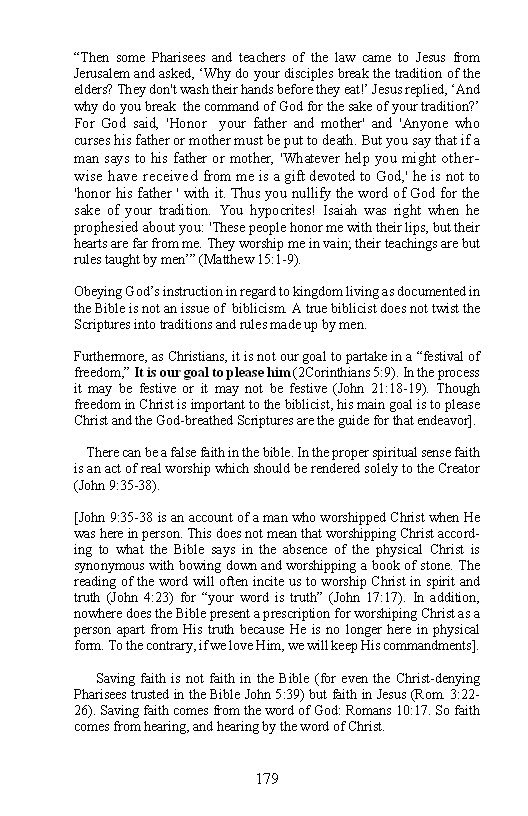
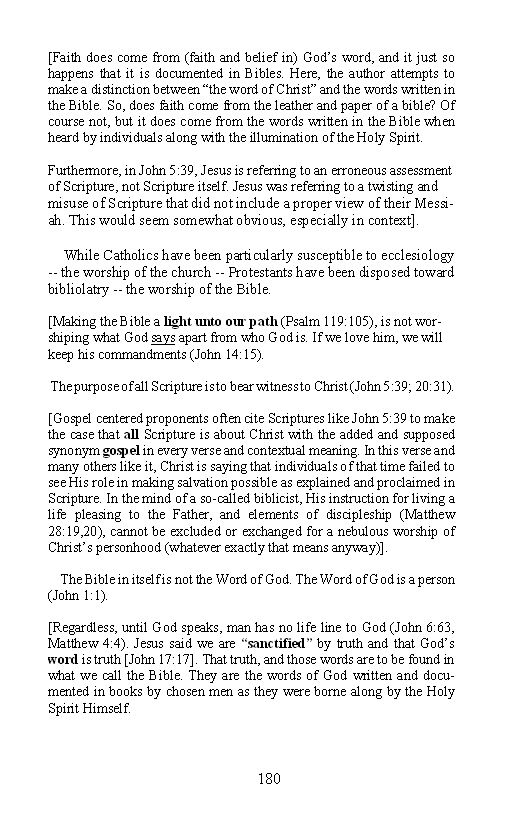
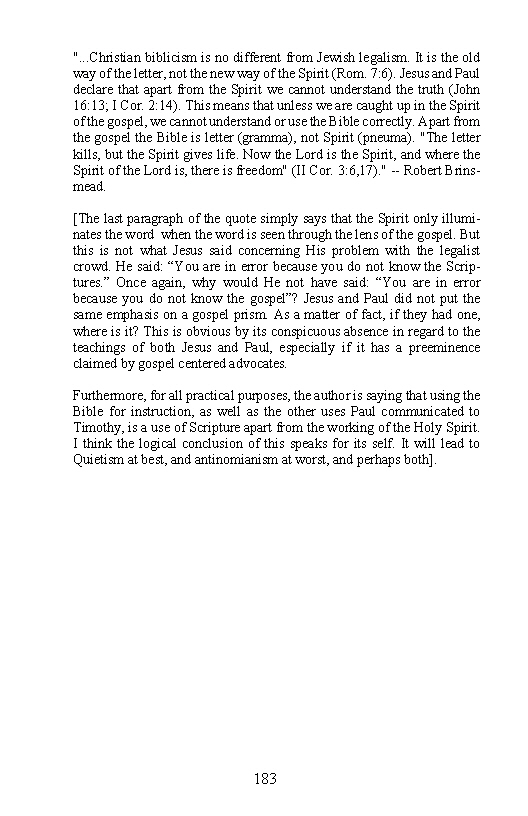
In the first segment, “Love And Faith,” Holland clearly shows this book’s kinship with the Australian Forum. I devote a whole chapter in my book, “Another Gospel” to Robert Brinsmead’s interpretive prism as taught by him and Paxton / Goldsworthy. Following this post, a full copy of that chapter can be viewed. On page 62, Holland describes faith as the “eye of the soul.” He then writes that Scripture is the lens used by faith and the Holy Spirit illuminates Scripture for one purpose and one purpose only: “Suddenly the Bible comes alive and we see Christ’s excellence, His splendor!” Hence, this is the EXACT position of the AF: the Bible’s only purpose is to obtain a deeper knowledge of the gospel, and the Holy Spirit will not illuminate anything else but that. Holland writes on page 63: “There must be a faith that engages with God’s Word on Jesus and estimates it to be the most important information in the world” [which then becomes the interpretive mode of operation].
Therefore, the Bible is for the purpose of plunging the depths of seeing the glory of Christ and nothing else. Any other information in the Bible that seems to be contrary to that thesis is descriptions of what Christ has done and should teach us more about Him instead of being an instruction book for a different “way to live.” All of the commands in the Bible are meant to show us what Christ has done for us already, and to humble us because we can’t keep all of them perfectly anyway. As I heard one pastor say from a pulpit about three months ago: “You can’t keep all of God’s law anyway, so don’t even try.” Pondering the volume of commands should also drive us to the foot of the cross and more dependence on Christ. Supposedly.
Therefore, the only logical conclusion is that obedience is a natural result of “Staring At The Son” (the actual title of chapter 5). But how do we know when we are committing the horrible sin of “obeying Jesus in our own efforts?” Well, because it will FEEL like it—that’s how you supposedly know, and Holland emphasizes that point throughout the rest of chapter 5. Throughout the book, Holland reiterates the same worn-out GS points made by Francis Chan (“When it’s love, it feels like love”), John Piper (“Beholding as a way of becoming” and joy is synonymous with faith), Paul David Trip (Christians are still spiritually dead), and Michael Horton (we only grow spiritually when we “revisit the gospel afresh”). The following is the chapter of my future book where the AF view of interpretation is dealt with—which is the same approach propagated by Holland:




Gospel Sanctification and Sonship’s Gospel-Driven Genealogy, Part 6A: Horton’s Kinship With the Australian Forum Can be Seen in Frame’s Review
Let me continue to voice my appreciation for the information sent by readers; that’s what this network ministry is all about— cooperation in sharing information about New Calvinism / Gospel Sanctification / Sonship Theology which are all the same thing, and hereafter: NCGSS. Information sent yesterday is the subject of this post.
This particular series is exploring the possibility that New Calvinism was born from the Australian Forum. A working hypothesis chart can be viewed in part 2 of this series
( http://wp.me/pmd7S-Gm ); Horton’s place in the theoretical history can be seen on the chart. One thing thus far is certain: the doctrines are identical. Furthermore, both movements show the same motives, and both claim to have returned to Reformed / Puritan doctrine—this is the same dominate theme / staple of both movements. Also, there is reason to believe that New Covenant Theology was conceived from Jon Zens’ association with the Forum, and he also shared their desire to find middle ground between difficult doctrines.
As I noted previously, the Australian Forum Three were Robert Brinsmead, G. Paxton, and G. Goldsworthy. Brinsmead was excommunicated from the Seventh-Day Adventist Church (SDA) which was founded by Ellen G. White. Though Brinsmead and the Forum were trying to reform SDA, the Australian Forum (hereafter AF) endorsed much of Ellen White’s teachings. In fact, Paxton was infatuated with Adventist theology and lost a teaching position because of his association with the AF. Paxton and Brinsmead also shared a rabid distaste for Charismatic theology (they would not be pleased with New Calvinism’s inclusion of Charismatics). Goldsworthy’s motives for being involved with the AF are yet unclear, but the fact that he is oftentimes quoted by New Calvinist (hereafter NC) is no accident.
The subject of this post is John Frame’s review of Michael Horton’s “Christless Christianity” sent to me by a reader. The review is full of painstaking discernment. This kind of discipline in sorting through the mystical theological world of Michael Horton is very commendable. Frame also mentions what I call Horton’s Kerryisms: “I was for it before I was against it.” Or, “I know I said ‘A,’ but let me clarify so you poor spiritual peasants don’t misunderstand my theological brilliance: I only said ‘A’ in a manner of speaking, unless you agree with ‘A.’ If you agree, I really said it, but if you disagree, I was only saying ‘A’ in a manner of speaking.”
As I was reading Frames’ review—I saw AF footprints everywhere. I will be pointing to that relationship, using Frames review while mentioning other residual issues related to NC.
Frame opens his review this way:
The title of this book is alarming, certainly by design. But the subtitle is even more so. Does it mean that the whole American church (all traditions, denominations, locations) is committed to an “alternative Gospel?” Or is it that, though part of the American church upholds the true, biblical gospel, there is within that church a movement (evidently a significant movement) to the contrary?
John, Horton is what we call a New Calvinist. They hold to the doctrine of Gospel Sanctification. As implied by the title, we are supposedly sanctified by the same gospel that saved us. In other words, we are sanctified by justification, and the contemplation thereof. As John Piper says, “beholding as a way of becoming.” John: yes! Yes! Yes! They believe anything short of monergistic substitutionary sanctification is a false gospel. That’s why Horton’s ministry is named “Modern Reformation.” Listen very carefully to Piper’s “6 Minute Gospel” video on the internet as he calls for Evangelicals everywhere who believe in our efforts in sanctification to be saved from works salvation. It’s why Tullian Tchividjian said the following:
“As I’ve said before, I once assumed (along with the vast majority of professing Christians) that the gospel was simply what non-Christians must believe in order to be saved, while afterward we advance to deeper theological waters. But I’ve come to realize that the gospel isn’t the first step in a stairway of truths, but more like the hub in a wheel of truth. As Tim Keller explains it, the gospel isn’t simply the ABCs of Christianity, but the A-through-Z. The gospel doesn’t just ignite the Christian life; it’s the fuel that keeps Christians going every day.”
These guys believe that God is using them to reform another Dark Age of distinctions between justification and sanctification. They are also very resentful—they believe that Evangelicalism has sold the church a bill of goods about salvation. This attitude can be seen in the many hostile ministry takeovers playing out across this country (of which are finally being spoken of by Ovadal, Hamilton, and others). A good example is Coral Ridge. This mentality is also identical to that of the AF Three. A good thumbnail of this doctrine / mentality can be read in Horton’s Christless Christianity:
“Where we land on these issues is perhaps the most significant factor in how we approach our own faith and practice and communicate it to the world. If not only the unregenerate but the regenerate are always dependent at every moment on the free grace of God disclosed in the gospel, then nothing can raise those who are spiritually dead or continually give life to Christ’s flock but the Spirit working through the gospel. When this happens (not just once, but every time we encounter the gospel afresh), the Spirit progressively transforms us into Christ’s image. Start with Christ (that is, the gospel) and you get sanctification in the bargain; begin with Christ and move on to something else, and you lose both.”
NO ONE has yet demanded that Horton explain this statement. And this is fact: any statement made by NC proponents that seems to contradict this statement is just that—seemingly at odds. Furthermore, in many NC Reformed Baptist churches, they practice what is called “Redemptive Church Disciple.” When a parishioner is caught in a sin, the discipline doesn’t address the sin, it focuses on the supposed fundamental problem of how the “vast majority” of evangelicals understand the gospel. Therefore, the discipline focuses on “redemption.” The sin is supposedly a mere symptom of a false gospel. Hence, the discipline focuses on converting the individual from orthodox Evangelicalism to Gospel Sanctification. The discipline goes from step to step as the victim refuses to “repent” from synergistic sanctification to a monergistic substitutionary form. Moreover, as unsuspecting evangelical married couples join Reformed churches; one spouse in a marriage may come to believe the doctrine while the other spouse doesn’t. The marriage is then deemed a mixed marriage (believer / unbeliever) by the NC leadership. I have firsthand knowledge of this, and it is one of many in regard to the dirty little secrets of NC.
What are these subtle distortions? Evidently, what Horton is concerned with is an emphasis. The metaphors of “looking away from” Christ and putting something else on “center stage” have to do with the emphasis we put on Christ.
Right. Horton got this from the AF. Though Horton or the AF affirm many tenets of orthodoxy, they also say that the tenets are irrelevant for all practical purposes. Why? Because they eclipse Christ. To talk about it is to NOT talk about Christ; therefore, “it” is error. So, truthful orthodoxy is true as long as you don’t talk about it—unless you talk about “it” in it’s Christocentric context or it’s gospel context, Or it’s context in regard to justification, or it’s context in regard to what Jesus did—not anything we do. Likewise, that is how the movement denies that we are the subjects of biblical imperatives—because “the imperative command is grounded in the indicative event.”
This is also how the AF and Horton both deny the “new birth,” or the belief that Christians are born again despite what is plainly stated in Scripture. Unless the new birth can be framed in a Christocentric context that completely eliminates us from consideration—it’s error. As long as you don’t talk about it—it’s truth, so if anyone calls them on it—they simply say that “emphasis” is the issue, not a denial of the new birth. Let me further elaborate. I wrote the following in part 4:
“This post is about NCGSS’s total depravity of the saints—and AF’s denial of the new birth. Obviously, spiritually dead saints (as Paul Tripp teaches), and born again Christianity is a contradiction. In Present Truth Magazine (the official journal of AF doctrine), archives volume 37, article 4, Paxton (one of the AF Three) penned the article entitled “The False Gospel of the New Birth.” Present Truth had a large readership among Reformed Baptist in the seventies, and many voiced their displeasure at the article…. Take note: Goldsworthy, one of the AF Three and the golden boy of NCGSS hermeneutics, affirmed his agreement with Paxton by footnoting the article in “Obituary for the Old Testament.”:
‘Bultmann’s existential gospel led him inevitably to a negative view of the Old Testament. And the new-birth oriented ‘Jesus-in-my-heart’ gospel of evangelicals has destroyed the Old Testament just as effectively as has nineteenth-century liberalism.1’”
The footnote in the same article is the following:
1 See Geoffrey J. Paxton, ‘The False Gospel of the New Birth,’ Present Truth Magazine 7, no.3 (June 1978): 17-22.
Let me save a bunch of ink here. The premise of Paxton’s article is that since the new birth isn’t as important as focusing on Christ’s works in the gospel—the new birth is therefore not relevant. Again, it’s either / or, which characterizes and saturates NCGSS teachings. While Paxton writes, ‘We [“we” being the AF Three] are not saying that the typical evangelical approach to the new birth is an outright denial of the truth….’ he then continues to write, ‘Rather, it is the corruption of the ultimate truth. It confuses a good effect with the best cause. It puts a good fruit in place of the best root. Many who do this are good people whose Christian status and integrity we do not question. But that is the alarming thing about the newbirth craze.’”
So, the new birth is false because, “it is the corruption of the ultimate truth. It confuses a good effect with the best cause. It puts a good fruit in place of the best root.” Therefore, unless the new birth is taught without considering saintly ramifications, it eclipses Christ and becomes a false doctrine. Horton reflected this exact same maniacal approach to the new birth in: “In the Face of God.” I will now compare Paxton’s summary quote from the aforementioned article and a quote from Horton in the book I just mentioned:
Paxton: “It robs Christ of His glory by putting the Spirit’s work in the believer above
and therefore against what Christ has done for the believer in His doing and dying.”
Horton: “Is the ‘Good News’ no longer Christ’s doing and dying, but our own’ Spirit-filled’ life?”
The above discussion casts some light on another theme of this book, one which Horton develops in many of his writings. Horton often emphasizes his view that the gospel focuses (again, note the relative term) on the “outer” rather than the “inner,” what happens outside of us, rather than what happens within us, the objective rather than the subjective. He quotes Goldsworthy,
“The pivotal point of turning in evangelical thinking which demands close attention is the change that has taken place from the Protestant emphasis on the objective facts of the gospel in history, to the medieval emphasis on the inner life. The evangelical who sees the inward transforming work of the Spirit as the key element of Christianity will soon lose contact with the historic faith and the historic gospel “(152).
Again, Horton gets this from the AF. And therefore, the quote by Goldsworthy, one of the AF Three, should come as no surprise. The AF wrote no less than 103 articles on this subject. Here is one excerpt:
“The tendency of human nature is to make the subjective aspect of Christianity the focal point of concern. This is what happened in the early church. It lost sight of the great Pauline message of justification by God’s work outside of man. Even in the teachings of the fathers of the post-apostolic church, the objective truth of justification by faith held no prominent place. More and more the church began to focus on the experience of sanctification. Indeed, justification came to be looked upon only as an initiating step at the beginning of the Christian’s life; the mighty Pauline truth about justification was subordinated to what was thought to be the higher blessing of sanctification. The focus of attention was away from the gospel to the fruit of the gospel, away from Christ’s experience to Christian experience, away from the objective to the subjective.”
This second excerpt shows why this subject was core to the AF doctrine:
“The medieval thought was man-centered, experience-centered, and subjective. The Reformation thought was Christ-centered, cross-centered, and objective.”
In these two statements from the AF—we see one of the core elements that NCGSS proponents believe connects them to the Reformation. Arrogantly, they believe that Pauline doctrine on justification was lost twice: once following the Apostolic Age; and again after the Reformation ignited by Martin Luther. Let there be no doubt—New Calvinist believe that they are the cutting edge of the second Reformation in Redemptive History, and they are taking no prisoners.
paul
Gospel Sanctification and Sonship’s Gospel-Driven Genealogy, Part 5: Ellen White Was A New Calvinist Momma
“White, like many New Calvinist of our day, believed that faith alone, and what she called ‘deep repentance,’ was the twofold operating dynamic of sanctification. In fact, Ellen White may have actually coined the phrase, ‘deep repentance.’”
As I study the Australian Forum (AF) archives to first establish that their theology is exactly the same as contemporary New Calvinism / Gospel Sanctification / Sonship Theology (NCGSS), the task is becoming a real yawner. Monday, I will be writing a post on the AF version of “the imperative command is grounded in the indicative event.” The whole indicative/imperative thing is a NCGSS staple. Further articles will be a mopping up of comparisons—almost a boring formality. I will also note a comparison of the AF’s version of Michael Horton’s Doctrine to Doxology.
As I noted previously, the AF three are Robert Brinsmead, G. Paxton, and G. Goldsworthy. Brinsmead was excommunicated from the Seventh-Day Adventist Church (SDA) which was founded by Ellen G. White. Though Brinsmead was trying to reform SDA, the AF endorsed much of Ellen White’s teachings.
And why not? According to reviews written by the AF, White (hereafter “NCM”) had much in common with contemporary New Calvinism. First, NCM believed that sanctification was through justification alone. Or, ‘The same gospel that saved you also sanctifies you.” Paxton had this to say while reiterating NCM’s belifs:
“Justification is not a filling station that is passed but once, or a one-time event which is followed by sanctification—with perhaps an occasional looking back to justification. This theology [White’s] will not allow that. Justification and sanctification must be kept together. One blessing is the obverse side of the other. Justification feeds sanctification, and sanctification must continually return to justification” ( “The Theology of Ellen G. White: Sanctification” Present Truth Magazine [prim. ref.]).
Here is how Tullian Tchividjian, a New Calvinist, stated it:
“As I’ve said before, I once assumed (along with the vast majority of professing Christians) that the gospel was simply what non-Christians must believe in order to be saved, while afterward we advance to deeper theological waters. But I’ve come to realize that the gospel isn’t the first step in a stairway of truths, but more like the hub in a wheel of truth. As Tim Keller explains it, the gospel isn’t simply the ABCs of Christianity, but the A-through-Z. The gospel doesn’t just ignite the Christian life; it’s the fuel that keeps Christians going every day.”
It was the AF’s contention (it was mostly Paxton who wrote on behalf of the Forum) that because of people’s lack of understanding in regard to what NCM believed—there are many misconceptions accordingly. In their article on NCM’s view on sanctification, they make the case that what she wrote must be seen through her basic prism on the subject of sanctification (which is very similar to NCGSS):
”Contradictions? Paradoxes? That is for the reader to judge, but he who does not recognize (or refuses to recognize) these factors in Mrs. White is like the man who comes to the United States, takes a look around Los Angeles, and is satisfied that America boils down to smog and freeways” (prim. ref.).
NCM, like NCGSS advocates, was also a proponent of sanctification being limited to the same elements of justification—faith and repentance only: “There is no such thing as going beyond repentance, beyond the need of forgiveness and justification. To reach up in faith for acceptance with God is not one act in a lifetime. That no point in our experience can we dispense with the assistance of that which enables us to make the first start” (prim. ref.).
White, like many New Calvinist of our day, believed that faith alone, and what she called “deep repentance,” was the twofold operating dynamic of sanctification. In fact, Ellen White may have actually coined the phrase, “deep repentance.” She believed that growth in sanctification depended on a contemplation of Christ and His works in comparison to our own inability to keep the law. As we (supposedly) gaze on Christ in the Scriptures, we become more, and more aware of our own sinfulness, and this (supposedly) fosters a deeper, and deeper dependence on Christ while nurturing humbleness. She believed that this continual partaking in deep repentance changes us from “glory to glory.” Sound familiar? In relationship to the law—her view was very positive. The law did two things: on the one hand, it is a glorious testimony as to what Christ obeyed for us—making us thankful. On the other hand, it shows us what we are unable to do—driving us back to the cross with pleas for mercy. I call this law positive and law negative. NCGSS advocates refer to it as “using the law lawfully.” The following are quotes from the same article that reference what I have proposed above:
“Here is the paradox of joy and sorrow. ‘The deepest joy of heart comes from the deepest humiliation.’(79) Sanctification therefore means progress in two directions. ‘The closer you come to Jesus, the more faulty you will appear in your own eyes; for your vision will be clearer, and your imperfections will be seen in broad and distinct contrast to His perfect nature.’(80) ‘At every advance step in our Christian experience our repentance will deepen.’(81) ‘The more our sense of need drives us to Him [Christ] and to the word of God, the more exalted views we shall have of His character, and the more fully we shall reflect His image.’82 “ (footnotes supplied by Forum: 79; 3T 459, 80; SC 64, 81; AA 561, 82; SC 65 [ key to abbreviations: http://goo.gl/y8Kfj ]).
“Brethren and sisters, it is by beholding that we become changed. By dwelling upon the love of God and our Saviour, by contemplating the perfection of the divine character and claiming the righteousness of Christ as ours by faith, we are to be transformed into the same image” (“Signs of the Times” pages 743-745).
“The justified believer, being no longer under the law’s condemnation, nor under it as a covenant of works, has a new attitude toward the law. He delights in it after the inward man, he wants to be perfect, but he mourns because he falls so far short of it.The law thus reminds him of how he must continue to hide his lack of perfection in Christ.Thus the believer always sees himself a sinner and counts himself vile….” (SL 81, DA 519, AA 561).
“The sanctification of the soul is accomplished through steadfastly beholding Him [Christ] by faith. . . .”(21) “Our faith increases by beholding Jesus. . . .”(22) “Our greatest need is faith. . . .”(23) It would not be difficult to make a good case for the life of faith being the dynamic of sanctification, in real Luther style” (21; 6BC 1117, 22; HP 127, 23; 7T 211).
“So will it be with all who behold Christ. The nearer we come to Jesus, and the more clearly we discern the purity of His character, the more clearly shall we see the exceeding sinfulness of sin, and the less shall we feel like exalting ourselves. There will be a continual, earnest, heartbreaking confession of sin and humbling of the heart before Him. At every advance step in our Christian experience our repentance will deepen” (“Acts of the Apostles” 560, 561).
“Law and gospel, deep repentance and joyous faith, sinful and righteous, must always be kept together in Christian existence” (Paxton’s reiteration).
One may compare these quotes with the likes of John Piper:
“What Then Shall Those Who Are Justified Do with the Law of Moses? Read it and meditate on it as those who are dead to it as the ground of your justification and the power of your sanctification. Read it and meditate on it as those for whom Christ is your righteousness and Christ is your sanctification. Which means read and mediate on it to know Christ better and to treasure him more. Christ and the Father are one (John 10:30; 14:9). So to know the God of the Old Testament is to know Christ. The more you see his glory and treasure his worth, the more you will be changed into his likeness (2 Corinthians 3:17-18)” (“How to Use the Law of God Lawfully” Desiring God Ministries).
“Beholding is a way of becoming” (“The Pleasures Of God” p. 17).
“Along with deep repentance, Scripture calls us to a faith that rests and feeds upon the living Christ. He fills us with himself through the person of the Holy Spirit and we are transformed by faith” (Paul David Tripp, “How People Change” p. 28).
Like new Calvinist, White’s sanctification by justification also enabled her to speak in orthodox terms without contradicting her theology. For instance:
“Then again, one can make a good case out of union with Christ or the reception of the Holy Spirit as being the theme of Mrs. White’s concept of the Christian life. Here she is a quietist, telling us that the Christian life is a life of trust and restfulness. There she is a full-blooded activist, urging the reader to action, telling him that the Christian life is a fight, a battle, a march, that he must steel every nerve and fiber in what promises to be ‘slow, toilsome steps’ toward perfection.”
Right. Because when she speaks of “toilsome steps,” she is either speaking of toiling in the narrow endeavor of faith/deep repentance ONLY, or the results of that which leads to Christ’s toiling—NOT ours, or both. Paul Tripp does the same thing in “How People Change” on page 6:
“Rather, He calls us to a life of constant work, constant growth, and constant confession and repentance.”
Tripp, like NCM, is not talking about work by us in a sanctification that is many faceted, but work in “confession and repentance” only, and it is not certain whether the “work” is that of Christ that supposedly results from deep repentance, or the prior. Hence, NCGSS doctrine makes this kind of deceptive doublespeak possible, while appearing orthodox.
paul

 Paul's Passing Thoughts

11 comments