The Hostile Takeover of the SBC by “Aggressive Calvinism” Began in 1982
Addendum to Second Edition: The Truth About New Calvinism
Very well, if folks want to refer to the New Calvinists taking over the SBC as “aggressive Calvinism,” that will work; New Calvinists are very aggressive. The events going on in the SBC right now are a mirror image of Coral Ridge, Clearcreek Chapel, NANC, and many, many other examples. Some months prior, a Presbyterian pastor/acquaintance of mine warned a church that called him for references regarding a new pastor for their church; in essence, he told them, “there is a dangerous movement afoot and the proponents are very stealth in regard to what they really believe—be careful.” They didn’t listen. The tragic results are all too common. The present debate over the SBC name change is part of it, and Southern Baptists better win that symbolic battle in order to hold ground. There is hope; the Daviess-McLean Baptist Association recently took a stand against “aggressive Calvinism.” If the SBC survives, it will only be because others follow their example.
More hope: there are lots of folks in the SBC who do not like hyper-Calvinists who also concern real Calvinists. New Calvinism is hyper-Calvinism in both justification (salvation) and sanctification (plenary hyper-Calvinism). So if many Southern Baptists do not like hyper-Calvinism, they should dislike the double hyper-Calvinists even more who are in the process of taking over the convention, and seeking to wipe out the memory of the SBC they secretly despise. Yes, there is hope, but SBC protestants need to better identify the enemy. We need to get rid of the “aggressive [New] Calvinists” first, and then have discussion about the hypers and the standards later. Aggressive Calvinists threaten the very existence of the SBC. We have our problems, and we may even be on life support, but Dr. Kevorkian presiding over our condition is not the answer—neither do I think he should be able to plunder SBC resources before he pulls the plug.
The Difference Between the Old and the New
This is not difficult. One only needs to examine their mantras to know the difference between Old and New Calvinism. “The same gospel that saved you also sanctifies you.” “We must preach the gospel to ourselves every day.” “The gospel isn’t the entry point of Christianity, it is the A-Z of Christianity” [even though Christ referred to the gospel as an entry point to the kingdom, and the apostle Paul referred to the gospel as a “foundation”: 1Corinthians 3:10-15, Romans 15:20]. If we are sanctified by salvation, what does that say about what Aggressive [New] Calvinists believe about sanctification? All Christians, whether Calvinistic or otherwise, believe that salvation is by faith alone and not works. Theologians call this “monergistic.” However, we also believe that sanctification is “synergistic,” meaning that the new birth enables us to co-labor with God in the sanctification process as friends devoted to Him in the truest sense. In other words, our marvelous God has made a way to be reconciled to Him while also enabling us to participate in His work in a truly legitimate way despite our weakness. The Bible specifically refers to us as God’s co-laborers in 1Corinthians 3:9, 1Thessalonians 3:2, and 2 Corinthians 6:1.
But obviously, if we are sanctified by monergism, sanctification must also be monergistic (a work by God alone). And as indicated elsewhere in this book, this is critical because the law (Scripture) is a primary conduit used to participate in God’s work. If we cannot participate in sanctification, neither can we uphold God’s law in sanctification any more than we could in justification. This is the crux of the matter. The real issue is the church’s primary nemesis used by the kingdom of darkness throughout the ages: against every word that proceeds from the mouth of God. This is what theologians call “antinomianism,” and as discussed in chapter one, the Bible predicts that it will be the spirit of the last days. Christ and the apostles framed the last days in context of “anomia” (primarily, 2Thessalonians, chapter 2; Matthew 7:23, 13:41, 24:11,12; 2Corinthians 6:14; Titus 2:14). It’s the same type word, used in all of these cited verses regarding the spirit, fellowship, love, antichrist, and redemption of the last days, as our English word “atypical,” or “against/anti what is normal.” Old Calvinists do not believe in monergistic sanctification which necessarily makes us antinomians. And orthodox evangelicalism has never believed in sanctification by faith alone. The modern-day epitome of Old Calvinism, Dr. Peter Masters, stated the following:
The new Calvinism is not a resurgence but an entirely novel formula which strips the doctrine of its historic practice, and unites it with the world (The Merger of Calvinism with Worldliness from Sword & Trowel 2009, No. 1 by Dr Peter Masters).
And this by Calvinistic Baptist Donn Arms, M.Div.:
Justification is monergistic, sanctification is synergistic. Walking is what I do, not something Christ does for me (Institute for Nouthetic Studies blog: Archives; Gospel Sanctification, May 13, 2011 Gospel Sanctification comments section).
Despite their adamant denials concerning the above, the simplicity of the Aggressive Calvinist mantras will always betray them in regard to their lies. And as discussed elsewhere in this book, all of their massive doctrinal pontification is discussion on how to make an overly passive sanctification work with the blessed truth of our Lord and Savior. Our brother Jude called Him our “absolute ruler” (despotace) and “supreme commander” (kooreeos).
Thirdly, Old Calvinists, unlike the Aggressive Calvinists, do not believe in the fusion of justification and sanctification. Listen to what Old Calvinist Jay Adams (no pun intended) said about “Gospel Sanctification” (the name given to New Calvinism [Aggressive Calvinism] before it was realized they are the same thing):
The crux of the issue has to do with the unbiblical fusion of sanctification with justification. The latter is set forth not as “keeping” God’s commandments, but as bringing about change by concentrating on the cross. As one immerses himself in the cross of Christ, sanctifying growth occurs. The biblical truth is that we are to pursue fruit, which becomes a reality and the Spirit helps us grow in grace (Institute for Nouthetic Studies blog: Archives; Gospel Sanctification, May 9, 2011 by Jay Adams).
The fact that Aggressive Calvinism fuses justification and sanctification together can be seen clearly in their mantra-like anthems such as, “The same gospel that saves you also sanctifies you.” This completely distorts the orthodox view of justification which is a onetime declaration by God that His righteousness has been credited to our account in full. According to their own pithy truisms, justification continues and completes itself. That’s a huge problem. If justification is progressive (what they deceptively call “progressive sanctification”), we cannot be involved, except in whatever our involvement was concerning justification. Hence, “….because the believer’s role is reduced to a point that is not according to Scripture, he/she is deprived of the abundant life in a way God wants us to experience it for His glory and the arousing of curiosity from those who don’t have the hope of the gospel.” And, “….while reductionist theologies seek to reduce the believer’s role to the least common denominator, supposedly to make much of God and little of man, the elements that attempt to make it seem plausible are often complex and mutating. Therefore, instead of majoring on the application of what is learned from Scripture, believers are constantly clamoring about for some new angle that will give them a ‘deeper understanding’ of the gospel that saved them.”(p. 77, The Truth About New Calvinism).
Unless this doctrine is exposed and halted, it will leave the SBC in ruins.
New Covenant Theology Cannot be Separated from New Calvinism
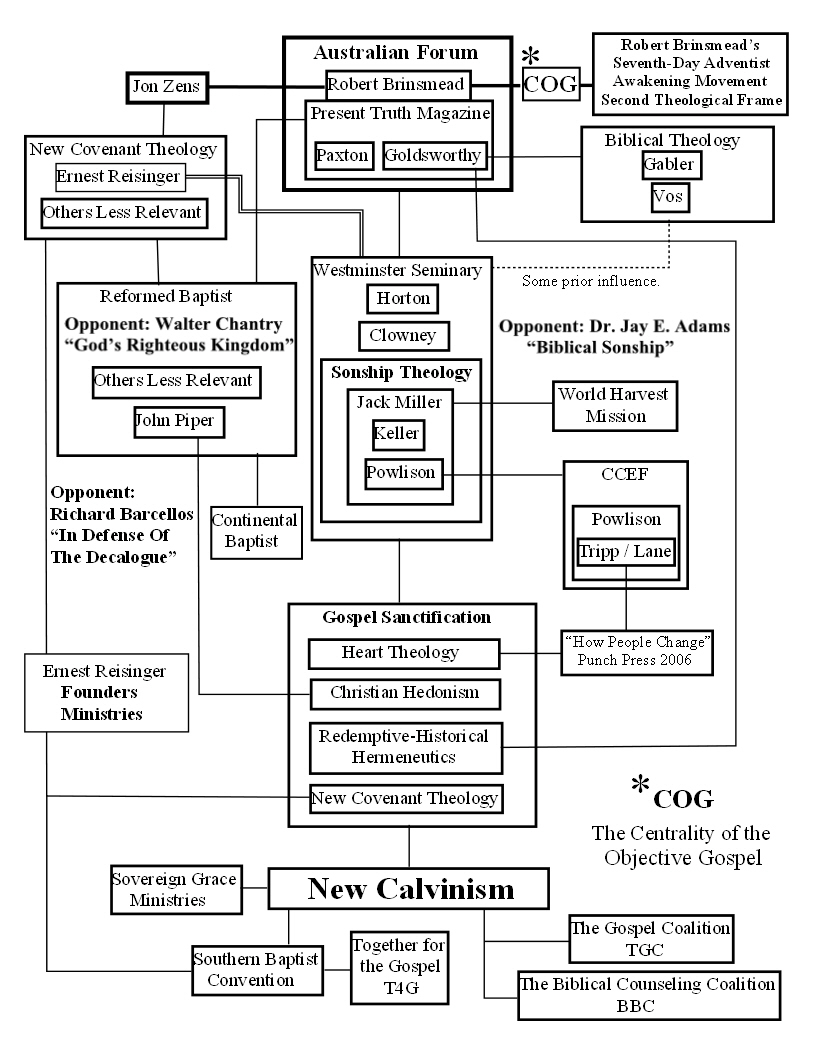
It is important to note that New Calvinism entered into the SBC through Reformed Baptist circles. New Calvinism was conceived by the Australian Forum’s Centrality of the Objective Gospel (COG). The detailed history can be observed in the “History” section of The Truth About New Calvinism. Jon Zens, the father of New Covenant Theology (NCT), worked with the Forum to develop a systematic theology that would make COG plausible. Present Truth magazine was the Forum’s theological journal. Citing from volume 16, article 13, it is obvious that the Forum’s doctrine is exactly the same as present-day New Calvinism:
Unless sanctification is rooted in justification and constantly returns to justification, it cannot escape the poisonous miasma of subjectivism, moralism or Pharisaism…. Since the life of holiness is fueled and fired by justification by faith, sanctification must constantly return to justification. Otherwise, the Christian cannot possibly escape arriving at a new self-righteousness. We cannot reach a point in sanctification where our fellowship with God does not rest completely on forgiveness of sins…. Christian existence is gospel existence. Sanctification is justification in action (emphasis mine).
As noted in The Truth About New Calvinism, Robert Brinsmead, the principle figure of the Forum, was intimately involved with Zens and the development of New Covenant Theology before Zens coined the phrase in 1981 (chapter 5). Zens himself said that Robert Brinsmead wrote articles in the Baptist Reformed Review (BRR) that accomplished the following: “The dynamic N.T. approach to law and gospel was stated forcefully by RDB [Robert D. Brinsmead]….” (Id. pages 56,57). The BRR was the primary lightening rod in the law/gospel debate raging in Reformed Baptist circles at that time, and Robert Brinsmead was a contributing author at the behest of Jon Zens. Zens took the doctrine into Reformed Baptist circles, while the Forum was primarily responsible for spreading the doctrine in Presbyterian territory, especially Westminster Seminary. Also, according to Zens, Present Truth magazine was “….the largest English-speaking theological journal in the world at that time” (Id. p. 53).
Though COG/NCT took on different nuances, COG and NCT share the same basic tenets that make the primary doctrine unique. They share the same unique hermeneutic, the same emphasis on progressive justification, the centrality of the gospel, a historic Christocentricity to the understanding and meaning of all reality, the personification of the law, the indicative/imperative prism, so-called “experiential Calvinism,” a majority view of Supersessionism, and especially unorthodox dichotomies of law and gospel (to name a few). The differences come in regard to how law and gospel relate to each other in order to make the doctrine fit together with “truth” in the best possible way. But they all believe that the same gospel that saves us also sanctifies us. Both infuse justification and sanctification.
The recognition that NCT is integral to New Calvinism is grudging and aloof among proponents. For example, DA Carson vigorously supports NCT by his actions, but when cornered verbally, espouses things that sound like, “I was for it before I was against it.” And, “It depends on what the meaning of the word ‘is’ is.” A good example of this is an article by Jim Gunn entitled, A Critique of New Covenant Theology (online source: http://goo.gl/Pm9E9). The article is an apt specimen of how Carson and Tom Nettles vigorously support NCT, but refuse to acknowledge its validity in plain language. Other New Calvinist leaders openly acknowledge that the two are inseparable. One example is the elders of Clearcreek Chapel in Springboro, OH. They are a highly respected New Calvinist church regularly hosting notable teachers such as Paul David Tripp, Stuart Scott, Dr. Robert D. Jones, and Dr. Lou Priolo. While embracing gospel centrality, they consider it all to be under the auspices of NCT. This can be seen best in a series preached there by Dr. Dale Evans entitled, A Gospel-Centered Hermeneutic: Foundations for a New Covenant Theology. In his introduction, Evans stated:
Over the last several weeks, the pulpit ministry at Clearcreek Chapel has focused on presenting texts and issues related to the concept know[n] as New Covenant Theology. This morning we will look at a text and suggest that this idea under this label is exactly how the apostle Paul read and interpreted Scripture.
As a ministry that vigorously supports all the major tenets of New Calvinism such as Heart Theology, Redemptive Historical Hermeneutics, and Christian Hedonism, one of their pastors on staff, former radio personality Chad Bresson, is sometimes referred to as “the golden boy of central Ohio NCT.” He is also a member of the Earth Stove Society formed to promote NCT. On the other hand, he has a blog dedicated to the “Biblical Theology” of Geerhardus Vos, the father of Chrsitocentric Hermeneutics. He often posts articles by two former key figures of the Australian Forum on that same blog: Robert Brinsmead and Graeme Goldsworthy.
The Plot to Take over the SBC With COG
The plot to take over the SBC with the Forum doctrine was hatched in a hotel room in Euless, Texas on November 13, 1982:
Then, on November 13, 1982, [Ernest] Reisinger, Nettles and Malone met at a Holiday Inn in Euless, Texas, for prayer to seek God’s direction with respect to a Southern Baptist conference ministry. Nettles brought to the meeting several young men who had embraced the doctrines of grace. Among them were Bill and Tom Ascol, Ben Mitchell and evangelist R.F. Gates. Reisinger later called this one of the most meaningful prayer meetings in which he had ever participated. The attendees spent the first half of the day in prayer, reading Psalms and hymns. During the second half of the day, they discussed ideas. They finally settled on the idea of a conference with the doctrines of grace as its foundation. Thus began the Southern Baptist Founders Conference (Founders Ministries blog: The Beginnings of Reformation in The Southern Baptist Convention: The Rise of the Founders Movement).
Reisinger was a former Presbyterian turned Reformed Baptist, then Southern Baptist. He also knew Cornelius Van Til personally. Van Til, a Reformed Presbyterian with an inclination towards mysticism like his close friend Geerhardus Vos, attended Reisinger’s ordination in 1971. As far as the movement begun by Reisinger and others to restore the “doctrines of grace” to the SBC, another Presbyterian by the name of John H. Armstrong was apparently present at its conception and describes the movement as the beginnings of the “neo-Calvinism” movement in a review of Time magazine’s 2009 assessment of the New Calvinism movement:
I have watched this movement for neo-Calvinism from its infancy. I personally attended the first meeting (and several more the years following) of the group that started this effort back in the 1980s. I personally knew the founder who dreamed up the idea of recovering Calvinism in the SBC [Ernie Reisinger] and then spread the “doctrines of grace” very widely. He is now with the Lord [ie., five years prior in 2004]….I was also involved in the various “gospel” recovery groups which were begun, now creating large gatherings of folk who believe they are the people who are preaching and recovering the “biblical gospel” (John H. Armstrong blog: The New Calvinism, Archives; March 31, 2009).
The early eighties is when the combination of the Forum, their theological journal, and the push among Reformed Baptist by Jon Zens (with the help of Robert Brinsmead) began to rapidly expand. And the torch carried forth was the idea that the Forum had recovered the lost doctrines of grace. Armstrong makes that clear:
The sixteenth-century rediscovery of Paul’s objective message of justification by faith [and sanctification also because justification is supposedly progressive] came upon the religious scene of that time with a force and passion that totally altered the course of human history. It ignited the greatest reformation and revival known since Pentecost.
Now, if the Fathers of the early church, so nearly removed in time from Paul, lost touch with the Pauline message, how much more is this true in succeeding generations? The powerful truth of righteousness by faith needs to be restated plainly, and understood clearly, by every new generation.
In our time we are awash in a “Sea of Subjectivism,” as one magazine put it over twenty years ago. Let me explain. In 1972 a publication known as Present Truth published the results of a survey with a five-point questionnaire which dealt with the most basic issues between the medieval church and the Reformation. Polling showed 95 per cent of the “Jesus People” were decidedly medieval and anti-Reformation in their doctrinal thinking about the gospel. Among church-going Protestants they found ratings nearly as high.
Reading Scott Hahn’s testimony in his book, Rome Sweet Home (Ignatius Press, 1993), I discovered the same misunderstanding. Here can be found a complete and total failure to perceive the truths of grace, faith and the righteousness of God. No wonder Hahn left his Presbyterian Church of America ordination behind to become a Roman Catholic. He did not understand the gospel in the first place, as his own words demonstrate.
I do not believe that the importance of the doctrine of justification by faith can be overstated. We are once again in desperate need of recovery. Darkness has descended upon the evangelical world in North America and beyond, much as it had upon the established sixteenth-century church (The Highway blog: Article of the Month, Sola Fide: Does It Really Matter?; Dr. John H. Armstrong).
According to Armstrong: “We are once again in desperate need of recovery. Darkness has descended upon the evangelical world in North America and beyond, much as it had upon the established sixteenth-century church.” Apparently, light came “twenty years” prior to his writing of that post via the Forum’s Present Truth magazine. That was the mindset of the “Reformation” movement in the early eighties that is now New Calvinism. The details of this are expanded in chapter four of The Truth About New Calvinism.
A Proven Method
Reisinger was no stranger to how the formation of conferences could affect the taking over of Christian groups. He witnessed firsthand how this was done by Jon Zens in 1979:
At the fall Banner of Truth Conference in 1979, Ron McKinney spoke with lain Murray, Ernie Reisinger and others about the possibility of having a conference where some aspects of Reformed theology could be discussed and evaluated by men of differing viewpoints (Jon Zens: Law And Ministry In The Church: An Informal Essay On Some Historical Developments (1972-1984).
That conference ended up being the first “1980 Council on Baptist Theology” held in Plano, TX. It was the coming out party for New Covenant Theology, and eventually resulted in the formation of a denomination that split a large group of Reformed Baptists. Two years later, Reisinger would be leading the way for the same kind of “revival.” From the beginning, NCT/COG came forth from the womb with visions of grandeur, splitting churches, deceiving, and wreaking havoc on God’s people. It will continue to do so until it is stopped.
But wasn’t Ernest Reisinger an opponent of NCT and a good friend of Walter Chantry who also opposed NCT? Apparently, Chantry was opposed to certain aspects of Zens’ teachings before it was NCT, especially the antinomian parts. As far as the who’s who of the evangelical world mugging together while differing on theology—what’s new? NCT theology cannot be separated from New Calvinism over one of many disagreements among them concerning how law and gospel relate to each other. Still, they all believe in the fusion of justification and sanctification. Ernest Reisinger stated the following in “Lordship and Regeneration”:
The Lordship teaching puts the order of salvation as follows: 1) Regeneration, 2) Faith (which includes repentance), 3) Justification, 4) Sanctification (distinct from but always joined to justification), and 5) Glorification.
The “always joined” justification and sanctification is the fusion thereof, and the “distinct[ion]” he is talking about is the supposed idea that sanctification is the progressive form of justification. Orthodox evangelicals believe no such thing. Also, his view of the distinctions between law and gospel are endorsed by proponents of Sonship Theology, which will certainly save one research on that wise concerning Reisinger (Gospel Discipling—The Crying Need of the Hour: Stephen E. Smallman; Executive Director, World Harvest Mission, November 1997).
Does Chantry believe in the synthesis of justification and sanctification? It’s not relevant—the primary point concerning Chantry is that he recognized antinomian elements of NCT early in the movement, and also, his role refutes the story among New Calvinists that this doctrine has always been widely accepted among other Reformed leaders. It might be noted that he didn’t launch an attempted takeover of the SBC which makes him less relevant than Reisinger, who also promoted the Founders movement among Southern Baptists by claiming that James Boyce believed in their form of “Calvinism.” Did James Boice believe in the fusion of justification and sanctification? That’s doubtful.
Did the COG Come After the Reisinger, or Before the Ascol?
One of the participants in the “prayer meeting”/takeover plot at the Holiday Inn at Euless was Tom Ascol, heir apparent to Reisinger’s pastorate and Founders Ministries. Ascol is a consummate New Calvinist. On Grace Baptist Church’s website, under “core distinctives,” the following statement appears:
The gospel is not an add-on to our services or merely an entry point to Christianity. The gospel is the message we preach and the means by which we persevere in the faith. We focus on applying the gospel to every area of living, including marriage, family, work, personal sanctification, evangelism, and Christian community.
In 2010, Ascol authored a resolution to the SBC’s annual convention entitled, “SBC Resolution on the Centrality of the Gospel.” In part, it reads:
….and be it further
RESOLVED, That we encourage churches in preaching, teaching, and discipleship to proclaim the gospel to unbelievers, showing them how to find peace with God, and to proclaim the gospel to believers, that through the renewing of our minds we might continually be transformed by the gospel.
Did Ascol embrace New Calvinism after the passing of an orthodox Ernest Reisinger? That’s very doubtful. Ascol said the following on Reisinger’s homepage:
Ernie Reisinger has been a mentor, friend and great encourager to me in the ministry. I thank the Lord for his influence in my life. Tom Ascol Pastor of Grace Baptist Church, Cape Coral, Florida, Executive Director of Founders’ Ministries and Editor of Founders Journal. (The Reformed Reader blog homepage).
Ascol represents what Reisinger believed from the beginning. Ascol learned it from Reisinger. Armstrong places Reisinger at the beginning of the movement, and as an eyewitness, describes it to a “T.” And like all New Calvinists, Reisinger possessed an arrogance that crowned him the supposed savior of the SBC.
The SBC’s Dark Future
Unless the hostile takeover of the SBC is halted, Southern Baptists will be removed from history, its service assets compiled by sacred labor plundered, assemblies divided, and replaced with cult-like congregations. The very essence of this movement and its tenets breed cultish assemblies. The following can be read on page 134 of The Truth About New Calvinism:
All this leads to many New Calvinist churches taking on cult-like tendencies. Exclusiveness (new Reformation), an attitude that some higher knowledge is a part of the movement that many are not “ready” for (the scandalous gospel), and a subjective view of Scripture (a gospel narrative, not instruction) is a mixture that will have bad results, and is the perfect formula for a cult-like church.
The footnote accompanying this quote also reads as follows:
Many New Calvinist churches fit all eight descriptive points published by cultwatch.com: 1. Deception 2. Exclusiveness 3. Intimidation 4. Love Bombing 5. Relationship Control 6. Information Control 7. Reporting Structure 8. Time Control.
One example of this is New Calvinism’s dirty little secret about what they really believe concerning church discipline. They don’t believe in a Matthew 18 process to correct a particular situation—they believe in “redemptive church discipline.” What’s that? It holds to the view that all sin is a result of one’s view of justification. Therefore, what they did is not the issue, their view of justification is the issue. So the discipline is “redemptive.” In other words, it is designed to bring the individual into New Calvinism and out of “evangelicalism” which New Calvinists continually liken to the Roman Catholicism that the “first reformers” contended against. This attitude can be seen in the prior citation by Armstrong. Is this creepy and cultish? Absolutely. Hints of this can be seen in a 2008 resolution to the SBC that (according to my understanding) Ascol contributed to:
RESOLVED, That we urge the churches of the Southern Baptist Convention to repent of the failure among us to live up to our professed commitment to regenerate church membership and any failure to obey Jesus Christ in the practice of lovingly correcting wayward church members (Matthew 18:15-18).
Notice the implication that church discipline regenerates.
Much could be discussed here just on the “deception” point alone, but I will close with one example that exemplifies the character of this movement. In heated back and forth correspondence with New Calvinists regarding the proposed connection between Founders and NCT, one of the contenders emailed Tom Ascol and asked him to verify that both Founders and Reisinger are/were anti-NCT. Ascol replied in the affirmative for them, and I was copied on the email. As evidence, Ascol claimed that Founders Press published the book, “In Defense Of The Decalogue” by Richard Barcellos (which is a devastating treatise against NCT). I found this very perplexing, and checked my copy. Sure enough, it was published by Barcellos himself through Winepress Publishing. Both the contenders and I have emailed Founders for an explanation, and are still waiting.
paul
An Open Letter to Dr. Lou Priolo
To Elder Lou Priolo, Eastwood Presbyterian Church
Mr. Priolo,
I am writing you this letter to ask that you stand for the truth and families. As you know, standing for families and truth means more than writing books about it. At issue is your planned teaching engagement at Clearcreek Chapel’s “Family Enrichment Conference” in January of 2012. At issue is the fact that such appearances by teachers of your stature lends unwarranted and dangerous credibility to men who have wreaked havoc in the lives of many people through their unbiblical counsel and cult-like behavior.
This is an open letter because the likes of Robert Jones and Stuart Scott have ignored my pleadings in the past. Scott’s response was typical of those in our day who claim to love the truth—it went something like this: “Not my problem.” Robert Jones, whose claim to fame is a “peacekeepers” ministry, also ignored the pleadings of this ministry and stood with Clearcreek Chapel though that church has a very lengthy list of unresolved conflict with many, many Christians. If I didn’t know better, I would say that there is a mode of operation among the visible leaders of our day that automatically dismisses the evangelical peasantry they are selling books to, but maybe my doubts on that are naive.
Among those, at least two families chose to move to other states to get as far away from the Chapel as possible. Not my choice. The Chapel’s outrageous and unbiblical behavior towards my family can be observed here: How PPT Came About. They have been confronted on numerous occasions and refuse to repent. Therefore, they need to be treated like any other “believers” who refuse to repent according to Matthew 18.
If you choose to question them about this matter, let me send you court documents from the divorce proceedings and the Guardian ad Litem—people tend not to tell the same stories under oath that they do in church. You may also want a copy of a letter they sent me explaining away a false accusation they were caught in: they supposedly thought they had brought my bogus church discipline to a second level because of a mistake made on the minutes of an elder’s meeting. A church of less than 300 people, eight elders, and they thought I was in the second step of discipline because of a mistake in the minutes of a meeting? Right. Actually, the lie was told to try to cover for other documented behavior after I sent a letter to the fellowship of churches they belong to.
Dr. Priolo, I recently had a discussion with a pastor who has noticed a trend in Christians being reluctant to join churches or enter into formal biblical counseling with pastors. That shouldn’t surprise us. When the chips are down, parishioners will be on their own and they know it. It’s time for the professional courtesies to stop. You men are not doctors and lawyers, you’re pastors—your allegiance is to Christ for the sheep—not each other.
Be different. Send the right message. That’s my plea to you.
Paul M. Dohse
How Paul’s Passing Thoughts Came About
 There is no doubt that much of my Christian life will be defined by my stand against New Calvinism. Not long after I became a Christian, my life was providentially moving toward the establishment of this ministry.
Saved in late 1983 in Dallas, Texas, and baptized in the Southern Baptist church in 1984, I began to see serious contradictions between God’s word and what was going on in church. My perception did not come from a limited view; in my early years as a Christian, I went to a major seminary and taught in various types of ministries.
In 1989, I moved back to my hometown in Dayton, Ohio with my family, and living the Christian life according to biblical generalities had taken its toll. In 1990, and by God’s providence, I was led to Clearcreek Chapel in Springboro, Ohio (a suburb of Dayton). Pastor John Street had implemented NANC (National Association of Nouthetic Counselors) counseling at the Chapel, and that counseling turned my life around. The Chapel also became a NANC counseling center for pastors. In 1994, I was asked to serve as an elder and accepted. I served as an elder for five years. At that time, elders were reconfirmed by a congregational vote every three years. I was confirmed by the congregation twice.
In 1997/98(?), “pastor” Russ Kennedy returned to the Chapel after leaving in controversy for a pastorate in Illinois. That was in the early 90’s, and he returned to the Chapel after (unknown to most at the Chapel) being dismissed from his post in Illinois. According to a family member and close friend of Kennedy, he was dismissed for plagiarizing a John Piper sermon. During the time of his return, DA Carson and Jerry Bridges were invited to speak at our church. I realize now that he was probably behind that. I was out of town when Carson spoke, but remember thinking that the following statement from Bridges was rather odd: “We must preach the gospel to ourselves every day.” Though I thought the statement was odd, I brushed it aside and thought no more of it. Little did I know how much that little phrase would one day change my life!
Russ Kennedy was considered for eldership in 1999. In preparation for a forum to consider his appointment, he produced a sixteen-page booklet that outlined his doctrinal beliefs and philosophy of ministry. It is now evident, twelve years later, that he had totally bought into Gospel Sanctification, Sonship Theology, and New Covenant Theology at that time. Reading the booklet presently, I can only shake my head in disbelief as I read what he stated on page six concerning sanctification: “I believe that every believer is sanctified (set apart) unto God by justification….” There it is: sanctification by justification—if it was a snake it would have bit me. He also stated that this sanctification is known as “progressive sanctification” which is the usual deceptive term used by New Calvinists to describe the unorthodox concept of progressive justification.
Kennedy was affirmed, and right away things started getting weird. In the first elder’s meeting he attended, I was immediately taken aback by his heavy-handed style of leadership. I had to insist that a softer approach be taken concerning a miscommunication between Chapel elders and some students we were supporting at Master’s Seminary; specifically, a phone call for clarification verses a formal letter of rebuke from the elders. Shortly thereafter, I stepped aside as an elder for personal reasons (1/10/1999), but continued to teach at the Chapel. During this same time, a group of men from Emmanuel Baptist church in Dayton, Ohio started showing up. Dale Evans, Chad Bresson, Greg Cook, and Tom Watkins. This also coincided with the announcement by John Street that he was leaving the Chapel for a ministry in California.
I am unaware of how Kennedy knew this group of men who came over from Emmanuel, but they were all of New Covenant Theology persuasion and followers of Chad Bresson. All of this group except for Watkins ended up being elders at the Chapel after John Street departed (2000). We should pause here and examine their mindset that set the table for events following. This is an excerpt from this ministry’s book, “The Truth About New Calvinism” page 131:
This whole Reformation motif was started by the Forum which taught that all doctrines either fall into the objective gospel or subjective experience. Subjective spirituality was supposedly spawned by Rome and resulted in a reversal of justification and sanctification. Therefore, the Reformers rediscovered the objective gospel which ignited the Reformation, and also taught that the job wasn’t done (semper reformanda), and you can imagine who contemporary New Calvinists think that duty has fallen to. This is all covered in chapter four along with documentation concerning the fact that John Piper, one of the “elder statesmen” of the New Calvinist movement agrees with that scenario. This us against them mentality was passed down from the Forum and blossoms in the movement to this very day. They are the children of the Reformers—we are Rome.
And this arrogance translates into a predominant characteristic of New Calvinism: heavy-handed leadership style. As far as New Calvinists are concerned, evangelicals have been leading people into hell for the past 100 years (their estimation of when semper reformanda was lost) and any interference with the “unadjusted gospel” will be dealt with—no holds barred.
And such was the case at Clearcreek Chapel. After John Street left, changes were swift and radical. Russ Kennedy was appointed to replace Street, but we were clueless as to what he really believed. The front doors of the Chapel had barely hit Street in the backside before a marked difference in the preaching was noticed. A friend of mine referred to it as “flyby preaching.” Many left the Chapel shortly thereafter because “things are getting weird,” but really didn’t know why. Eventually, even though the elder over adult education was part of the old guard and called on me to teach from time to time, I declined because of the open hostility towards my teachings from the Emmanuel crowd.
All in the same year: my mentor left; I stepped aside as an elder; stepped aside as a teacher; and found it difficult to wrap my mind around what was going on with the new leadership. I started investing more time at work and began traveling a lot, but still stayed connected to the Chapel body. In 2003, I began discussing a business partnership with two core members at the Chapel, Matt and Sheelah Beaver. About the same time, something strange happened. The aforementioned Greg Cook, who I never really related to well, and always felt uncomfortable around, offered to start meeting with me every Monday morning for breakfast to discuss business, and offer advice on being the sales manager for the company that was being formed by the Beavers and me. Not long after that, I started attending a Friday morning men’s fellowship, and upon my attendance, an elder by the name of Dan Turner also started attending. I began to notice a pattern—I was being monitored.
It is important to share this testimony about Clearcreek Chapel because it is typical of many New Calvinist churches and where they end up because of their mindset concerning semper reformanda. Frankly, they become cultish. In fact, as we shall see, Clearcreek Chapel possesses all eight points that constitute a cult by Cultwatch.com. The first point is Deception. Cultwatch says the following about the first point:
A cult needs to recruit and operate using deception. Why? Because if people knew their true practices and beliefs beforehand, then they would not join. A cult needs to hide the truth from you until they think you are ready to accept it.
New Calvinist leaders are not hasty to reveal to people that they believe the Reformation was about the “false gospel of the new birth” and that you are either with them or the Roman Catholics. Neither are they hasty to introduce their ministries as part of the original Reformation. It is clear that the Clearcreek elders spoon-fed the congregation over a number of years. When one member started raising questions about New Covenant Theology, a gag order was placed on him and he was told by elder Chad Bresson that NCT would be taught when the members “were ready.”
The second point is Exclusiveness. This speaks for itself. To say that New Calvinists believe they have an exclusive doctrine would be a gargantuan understatement. This mindset is fertile ground for cultism.
A third point described by Cultwatch is a Reporting Structure. The Chapel clearly had a reporting/monitoring structure—primarily through the elders, and I assume they still do. The Chapel has three times the number of elders that is prescribed by church consulting groups for a church their size. When I was a member there—it was clear that elders were used to monitor the congregation.
In 2004, I parted ways with the Beavers; they took the retail part of the company, and I took the service part and started my own company. That was the agreement. The separation was overseen by Greg Cook and all parties agreed to it. In 2006, I began redoubling my efforts to become closer to the Clearcreek Chapel “family.” I had a large tolerance for the ongoing weirdness; it’s the only church my children knew, my daughter and son-in-law were married by Russ Kennedy, and after twenty years of membership, all of the “friends” that I had were there.
That’s when the problems started. Questions I was asking in Sunday School couldn’t be answered. The first problem was that the Chapel elders were asking long time core members to teach their doctrine when the members had no idea what they were teaching. They were given the material and told to merely read through it. One or two elders would then be assigned to that class to monitor the outcome. This was obviously done to give the doctrine credibility with the Chapel members. At least one parishioner resented being used in that way and told me so (Terri Engle). The problems started for me in a class where Greg Simmons was “co-teaching” a class with elder Mark Schindler. It became obvious that Simmons had no idea what he was teaching, and frankly, I didn’t either.
Another individual in the class was also asking difficult questions. He was telephoned by elder Chad Bresson and put under a gag order. I was called into a meeting with two elders (Devon Berry and Mark Schindler) and told that members were concerned about the questions I was asking. I pointed out that Matthew 18 was being ignored and that if those individuals had a problem with me, they needed to come to me “alone.” The response was: “They don’t have a problem with you, they are just ‘concerned.’” To this day, I contend that there was no “they” because several members were thanking me for the questions I was asking because, “I don’t know enough about theology to even know how to ask the questions I want to ask.”
The elders were beginning to lose credibility, so core members were removed and replaced with elders; and that didn’t go any better—now several other people were asking difficult questions. Then all of the Sunday Schools were combined into the auditorium to be taught by the big gun—Russ Kennedy. That didn’t go well either. The whole situation was becoming a comedy of confusion. Then one night, while relaxing in my living room, there was a knock on the door. When I answered, I was surprised to see three elders standing at my door, Mark Schindler, Greg Cook, and Devon Berry. They had inappropriately prearranged the meeting with my wife for obvious shock and awe effect (element of surprise by coming unannounced—plus three of them which is very unusual). Surprisingly, the meeting was not about doctrinal issues, but a “concern” for the difficulties I was having with my company. However, Mark Schindler had the audacity to suggest that I not be concerned about doctrinal issues “for at least two years.” I remember thinking, “That should give you enough time to assimilate the doctrine (whatever it is) into the minds of our people.” What was going on was completely obvious. This brings me to another Cultwatch element, Intimidation. This meeting was designed to intimidate, and several members who thanked me for asking questions would do so stealthily—wanting to encourage me to do so while being too fearful of the Chapel elders to do so themselves. The climate of fear at the Chapel was evident.
There were several of these kinds of meetings in the months following. During that time, the Chapel elders offered to pay for my CE in fire inspection—I declined for obvious reasons. By December 2007, I still had very little idea what these guys were teaching. My best guess was that they were enamored by New Covenant Theology, Christian Hedonism, Heart Theology, and Redemptive-Historical hermeneutics, and were trying to devise their own system that unified these theologies into a consistent system. However, unknown to me at the time, that was already a done deal—they were propagating a prepackaged system that had already accomplished that. Whether you want to call it the centrality of the objective gospel, Sonship Theology, or New Covenant Theology, that was their package. I submitted my letter to the elders in December of 2007 and departed with my family. We began to attend Grace Covenant Church in Beavercreek, Ohio. The church is pastored by a former associate pastor of the Chapel, Rick Wilson.
After my departure, and apparently due to being called on it previously, Mark Schindler and Devon Berry called and asked for a prearranged meeting with me. However, Schindler lied about the purpose of the meeting. When they arrived, and much to my surprise, they announced that they were putting me under the “first step of church discipline.” Already upset about leaving my church family of twenty years, this turn of events stunned and confused me. I collected my thoughts enough to ask for specifics. Four reasons were given: 1. Sewing discord among the brethren. 2. Worldly sorrow 3. Slothfulness 4. Walking in darkness. I thought number three to be interesting because I knew I had a reputation at the Chapel for being too focused on work. When I asked for clarification on number three, Schindler corrected Berry and said that wasn’t one of the reasons, so these two elders were not even on the same page regarding the purpose of the discipline. I asked for time to consider whether or not I would submit to the discipline, and such was granted, but I also knew what would happen if I refused to submit regardless of the fact that I had already submitted a letter of departure.
The next day I contacted Rick Wilson. He didn’t know what to make of the situation. However, a former elder from the Chapel suggested that the situation was driven by Russ Kennedy reliving visions of Illinois. Rick Wilson’s counsel was probably apt for the moment; the best I can remember: “Look Paul, you have been there twenty years. Go back and take their concerns seriously, and then take your family and leave in peace.” That’s what I did, but if I didn’t do anything else correctly, I was smart about one thing: I insisted that they put the reasons for the church discipline in writing. This took about two weeks of my insistence because it was evident that they did not want to do this. When I finally got the letter, two reasons were stated. 1. Love your wife according to Ephesians chapter five. 2. Find a different job. They refused to put any of the initial four reasons in writing. When I finally got the letter, I met with Rick Wilson at a Cracker Barrel restaurant, his treat, and he was completely perplexed by the letter and didn’t know how to respond.
I returned to address the issues, but in every meeting with the elders, NEW ISSUES were introduced. The whole situation became very confusing. Two months later, I announced to the elders that I was leaving the discipline. I was sternly warned that I would be excommunicated and declared an unbeliever before the congregation. I later found out that controlling a person in any way via threat of personal loss, including reputation, was a felony listed as Coercion under Ohio kidnapping laws. Another month later, it became evident that I was going to have to embrace their doctrine before I was released from the church discipline. That’s why New Calvinists call it “redemptive church discipline.” The goal is not to correct behavior, but to bring the individual into a “redemptive understanding of sanctification.” Hence, all of my meetings with the elders were break sessions attempting to use what I call “law negative” in The Truth About New Calvinism to show me that it is impossible for a Christian to keep the law in our “own efforts.” In fact, to attempt to do so in sanctification is an attempt to duplicate the fruits of justification; so for all practical purposes, justification by works. That’s why the elders continued to bring up more and more issues in our meetings while I was under their church discipline. As I saw my failures and a second step of church discipline looming on the horizon, I was supposed to break down and cry out, “I cannot keep it—someone must keep the law for me!” I cite New Calvinist Bill Baldwin in the book to illustrate this twisted reality concerning New Calvinism. This also explains why Mark Schindler was baptized again shortly after John Street left. Apparently, he repented, leaving Rome and joining semper reformanda.
Meanwhile, my missionary son-in-law and daughter came back on furlough from Puerto Rico and become intimately involved in the situation. Upon his counsel and the counsel of other pastors, I walked away from the discipline and took my family to Rick Wilson’s church. Shortly thereafter, Berry and Schindler came to my house on a Saturday evening and warned me not to leave. I in turn warned them that God would judge all things in the end. The next morning I was excommunicated before the congregation and declared an unbeliever. No reasons were given; the congregation was left to their own imaginations. Many who I had ministered to in the past simply assumed that I had committed adultery against Shirley and was unrepentant. In fact, a member of the Chapel recently told an acquaintance of mine that they were told such accordingly. In a meeting with myself, Mark Schindler, and Rick Wilson, Schindler pathetically denied that deliberate form of slander by saying that the elders mentioned in their statement to the congregation that I disagreed with the discipline. No kidding? I bet they were surprised to hear that! Adulterers rarely agree with church discipline. No?
Upon arrival at Grace Covenant with my family, Shirley and I entered marriage counseling with pastor Wilson. In our first counseling session, Wilson asked Shirley what it would look like for me to repent of the reasons I was brought up on church discipline. She didn’t know. In fact, she said she wasn’t sure why I was brought up on discipline. During this time, and unknown to me or Wilson, the Clearcreek elders privately submitted a six-page resolution to my wife commanding her to return to the Chapel without me. The statement painstakingly documented all of my sins against Shirley, which excluded verbal accusations they were making to Chapel parishioners at home Bible studies. The document also gave her the green light to divorce me based on three biblical abandonment principles of not supplying need: love; sex; financial needs. A copious note written by Shirley on the document is telling: “Is it still abandonment if 3, or 2 of the 3 are provided?” Also, I submitted full financial disclosure to Wilson which he also forwarded to the Chapel elders. I found the document in Shirley’s Bible. It also included a promise of a job, financing of a divorce attorney, and housing. Had Wilson been copied on the document, it could have been used to address specific issues in our counseling, but the document was given to Shirley in secret. They also stated to Shirley in the document that I had no authority over her because I had been declared an unbeliever by the Clearcreek elders. According them, they were the ones who had the authority in her life, and they were instructing her to return to the Chapel. At that same time, they instructed parishioners to barrage Shirley with cards and letters. Cultwatch calls this technique, Love Bombing.
During that time, I began receiving emails from a Clearcreek parishioner. Here are some excerpts:
So what ended up happening, is all these clues started to add up. The major one was how they responded to your being “given the boot” so to speak… I was there when they first announced it in service, and later on, in flock when Dan brought it up “in order to allay [or prevent…] our questions and concerns”. You probably already know basically what we were told- not to visit your website, not to engage debate with you- to trust our elders who knew so much more than we did from having spent so much time “in” the situation. And shortly after that, was when they implemented the security measures, in a not-so-concealed and vague way, they certainly implied you or someone on your behalf may pose a serious threat. I of course went to search out the website immediately, I’m sorry but even the apostle Paul encouraged the church to search the Scriptures for themselves- to my knowledge he never demands our unconditional trust of himself, or anyone but the Lord.
The website that the parishioner is speaking of is a website constructed by my son-in-law to confront the Clearcreek congregation for breaking up our family. The website, eldersresolution.org contains substantial documentation for purposes of ascertaining the truth in the situation. But the parishioner’s testimony is also indicative of two more points by Cultwatch: Relationship Control and Information Control. Regarding the first, Cultwatch says, “Beware of a group that tells you who you can and cannot see.” Regarding information control, Cultwatch states, “If you are instructed by a group not to read information critical of the group, then that is a sign of a cult.”
Regarding the motives of the Chapel elders, this email was interesting:
Even after this, I continued to attend Clearcreek. But more questions arose, especially concerning church discipline. More and more it seemed they selected the ppl for discipline, while others were left alone. I am a prime example. I realize they don’t have the resources to follow everyone around, but I was even living with my [boyfriend/girlfriend (info withheld to protect identity of parishioner)] at one point and [name of elder withheld to protect identity of parishioner] just eventually quit talking to me- though my membership remains and I was never brought up on any “charges”. I’d been in counseling for much of the entire time I attended. There are more strange happenings, but I won’t get into all of it.
The above was going on while I was literally being held hostage at the Chapel under a bogus church discipline. The Chapel elders severely overestimated the congregations ability to think for themselves or to take a stand. They should have just let it all go. But they continued to try to cover bad decisions with more bad decisions. And as time goes on, they are telling more lies to try to cover for prior lies.
Though these events are tragic, I can now see where they have equipped me to contend against this false doctrine. My story is by no means isolated or unique. I think Clearcreek Chapel is typical of the kind of ministries that are being spawned by New Calvinism. In fact, I know it is. This has given me the drive necessary to research this doctrine in order to learn more and more about it and warn others. And to earnestly contend for the faith once delivered to the saints. Because only truth sanctifies (John 17:17).
paul
DeYoung’s Plan Won’t Work
Special K is at it again. Kevin DeYoung keeps writing orthodox-like articles about sanctification in hopes that he can get someone from the New Calvinist crowd to kinda agree with him without receiving the dreaded tweet from the first pope of New Calvinism, John Piper the First. Bye-bye you fill in the blank. Have you heard? Rob Bell is resigning from the church he founded—done in by the dreaded tweet.
I can tell from reading his stuff that he knows New Calvinism is propagating antinomian doctrine. However, they are so subtle about it that they could slip back into orthodoxy and the dumbed-down congregants of our day would never know the difference. This is what Special K is hoping for so he keeps writing stuff about sanctification to get someone to join what might be the beginning of the Great Slither back to orthodoxy.
So far—no takers. For one thing, you have Tullian Tchividjian pushing back against DeYoung and as many of his victims know—he’s one bad dude. Everyone saw how he cleaned house at Coral Ridge and few want any part of that. Chad Bresson, the author of Vossed World blog and a New Calvinist elder weighed in as well, saying that Young’s discussion of the difference between monergistc sanctification and synergistic sanctification is “interesting.” Both articles were the usual nuanced New Calvinist double-speak because they just can’t come right out and say that they believe Christ obeys for us. I doubt Special K still believes that, but you know, a man has to eat. If he can get the Great Slither going—he can have it both ways.
Bresson’s post, about a thousand words later, concluded with the following profound unction: “In the end DeYoung is helpful in showing us the drawbacks of using certain terminology to describe what the Bible teaches us about the role of the Spirit and our participation in our transformation into Christ’s image. We are participants in salvation history. Language is not always precise in delineating the inner machinations of how that participation comes to be. It’s easy to see the downward slopes off the deep end in both directions. And DeYoung, like others who may disagree on certain points, wants to avoid the deep ends.”
Likewise, DeYoung’s conclusion was nearly as profound: “So what do we see in this short survey of Reformed theologians. For starters, we do not see the exact language of monergism or synergism applied to sanctification….Second, we see that, given the right qualifications, either term could be used with merit….Third, we see in this Reformed survey the need to be careful with our words. For example, “passive” can describe our role in sanctification, but only if we also say there is a sense in which we are active.”
Huh? Well, there was some definitive verbiage by pastor Terry Rayburn who isn’t very popular among that bunch because he stinks at nuance. Here were his comments at VW:
So the best question is not ” monergistic or synergistic?” The better question is, “Sanctification: by Law or by Grace?” The clear biblical answer is “by Grace”.
The Law (OC or NC) can neither save nor sanctify. We are no longer under the power of sin, why? Because we have the Law? No, because we are no longer UNDER Law, but Grace (Rom. 6:14). The Law is the very POWER of sin (1 Cor. 15:56), so certainly can’t sanctify. Of course, a quick Bible word search will show that the concept of “sanctification” is MOSTLY zeroed in on our once-for-all already-done sanctification. What we loosely call “progressive sanctification” is always by grace through faith, just like initial salvation.
Go Terry!!! Yaaaaaaaa Terry!!!! I love those New Calvinist guys that just come right and say sanctification is by the same grace that saved us, which is monergistic, soooo—you fill in the blank. Will the next Piper Tweet be, “Yaaaaaa Terry!!!!!”? Bresson didn’t follow-up on Rayburn’s comment, go figure.
Here, let me help also by quoting their Reformed daddy, RC Sproul. I agree with Sproul, this is a simple thing:
Sanctification is cooperative. There are two partners involved in the work. I must work and God will work. If ever the extra-biblical maxim, “God helps those who help themselves,” had any truth, it is at this point. We are not called to sit back and let God do all the work. We are called to work, and to work hard. To work something out with fear and trembling is to work with devout and conscientious rigor. It is to work with care, with a profound concern with the end result” (“Pleasing God” p. 227).
As far as Rayburn’s candid comment about how the NC crowd views the law, especially John Piper, here is what Sproul said in the same book:
From the law comes knowledge of sin. Also from the law comes knowledge of Righteousness.
In working with God to be “set apart,” the law is an absolute must, and Bresson’s belief as he alludes to above that the Bible is a gospel narrative and not for instruction in sanctification is antinomianism of the baser sort. And obviously, if we believe use of the law propagates sin—that’s a whole other issue as well.
This is a simple thing: “I can DO all things through Chrsit who strengthens me.” We DO and Chrsit strengthens, and it’s a seamless experience—not a New Calvinist either all the Spirit or all me hermeneutic. But Sproul has it right; if we don’t work—neither does the Spirit: “I must work and God will work.” That’s why we will be judged in the end at the Bema Seat judgment that New Calvinists have to deny. Not a judgment for justification, but a judgment in regard to how well we appropriated the gifts God granted us. And by the way, when you receive a “gift”—you now own it!
The only thing confusing is the double-speak New Calvinist have to use to teach that Jesus obeys for us without actually saying it. And Special K might as well give up because antinomians rarely repent.
paul


 Paul's Passing Thoughts
11 comments